Have some strudel or schnitzel, enjoy this performance:
and this view of Symphony 39’s context:
https://www.laphil.com/philpedia/music/symphony-no-39-e-flat-k-543-wolfgang-amadeus-mozart
Advanced knowledge
Have some strudel or schnitzel, enjoy this performance:
and this view of Symphony 39’s context:
https://www.laphil.com/philpedia/music/symphony-no-39-e-flat-k-543-wolfgang-amadeus-mozart
Was the recent Swiss avalanche’s cause the last, triggering snowflake, or the billions of snowflakes before it?
There’s been a slight increase in the number of PNAS studies that included the “catastrophic” search word from October 2016 to mid-January 2018 compared to the January 2014 to mid-April 2015 period referenced in How well can catastrophes be predicted?.
What are the drivers?
Or is the main driver something else?
This 2017 Georgia human review covered:
“Recent studies, primarily focused on the findings from human studies, to indicate the role of DNA methylation in the associations between childhood adversity and cardiometabolic disease in adulthood. In particular, we focused on DNA methylation modifications in genes regulating the hypothalamus-pituitary-adrenal axis as well as the immune system.”
Recommendations in the review’s Epigenetics inheritance and preadaptation theory section included:
“Twin studies offer another promising design to explore the mediation effect of DNA methylation between child adversity and cardiometabolic outcomes..which could rule out heterogeneity due to genetic and familia[l]r environmental confounding.”
As it so happened, the below 2018 study provided some evidence.
http://www.sciencedirect.com/science/article/pii/S0167527317352762 “The role of DNA methylation in the association between childhood adversity and cardiometabolic disease” (not freely available) Thanks to lead author Dr. Guang Hao for providing the full study.
This 2018 UK human study:
“Tested the hypothesis that victimization is associated with DNA methylation in the Environmental Risk (E-Risk) Longitudinal Study, a nationally representative 1994-1995 birth cohort of 2,232 twins born in England and Wales and assessed at ages 5, 7, 10, 12, and 18 years. Multiple forms of victimization were ascertained in childhood and adolescence (including physical, sexual, and emotional abuse; neglect; exposure to intimate-partner violence; bullying; cyber-victimization; and crime).
Hypothesis-driven analyses of six candidate genes in the stress response (
- NR3C1 [glucocorticoid receptor],
- FKBP5 [a regulator of the stress hormone system],
- BDNF [brain-derived neurotrophic factor],
- AVP [arginine vasopressin],
- CRHR1 [corticotropin-releasing hormone receptor 1],
- SLC6A4 [serotonin transporter]
) did not reveal predicted associations with DNA methylation.
Epigenetic epidemiology is not yet well matched to experimental, nonhuman models in uncovering the biological embedding of stress.”
One of the sad findings was that as the types of trauma inflicted by other people on the subjects increased, so did the percentage of subjects who hurt themselves by smoking. Two-thirds of teens who reported three or more of the seven adolescent trauma types also smoked by age 18:

Self-harming behaviors other than smoking weren’t considered.
Another somber finding was:
“Childhood sexual victimization is associated with stable DNA methylation differences in whole blood in young adulthood. These associations were not observed in relation to sexual victimization in adolescence.”
The researchers guided future studies regarding the proxy measurements of peripheral blood DNA methylation:
“The vast majority of subsequent human studies, including the present one, have relied on peripheral blood. This choice is expedient, but also scientifically reasonable given the aim of detecting effects on stress-related physical health systems that include peripheral circulating processes (immune, neuroendocrine).
But whole blood is heterogeneous, and although cell-type composition can be evaluated and controlled, as in the present study, it does raise the question of whether peripheral blood is a problematic surrogate tissue for research on the epigenetics of stress.
Comparisons of methylomic variation across blood and brain suggest that blood-based EWAS may yield limited information relating to underlying pathological processes for disorders where brain is the primary tissue of interest.”
1. The comment on “epigenetic epidemiology” overstated the study’s findings because the epigenetic analysis, although thorough, was limited to peripheral blood DNA methylation. Other consequential epigenetic effects weren’t investigated, such as histone modifications and microRNA expression.
2. An unstated limitation was that the DNA methylation analyses were constrained by budgets. Studies like The primary causes of individual differences in DNA methylation are environmental factors point out restrictions in the methodology:
“A main limitation with studies using the Illumina 450 K array is that the platform only covers ~1.5 % of overall genomic CpGs, which are biased towards promoters and strongly underrepresented in distal regulatory elements, i.e., enhancers.
WGBS [whole-genome bisulfite sequencing] offers single-site resolution CpG methylation interrogation at full genomic coverage.
Another advantage of WGBS is its ability to access patterns of non-CpG methylation.”
I’d expect that in the future, researchers with larger budgets would reanalyze the study samples using other techniques.
3. The researchers started and ended the study presenting their view of human “embedding of stress” as a fact rather than a paradigm. Epigenetic effects of early life stress exposure compared and contrasted this with another substantiated view.
4. The study focused on the children’s intergenerational epigenetic effects. An outstanding opportunity to advance science was missed regarding transgenerational epigenetic inheritance:
https://ajp.psychiatryonline.org/doi/full/10.1176/appi.ajp.2017.17060693 “Analysis of DNA Methylation in Young People: Limited Evidence for an Association Between Victimization Stress and Epigenetic Variation in Blood” (not freely available) Thanks to coauthor Dr. Helen Fisher for providing the full study.
The subject of this 2017 Spanish review was human placental epigenetic changes:
“39 papers assessing human placental epigenetic signatures in association with either
- (i) psychosocial stress,
- (ii) maternal psychopathology,
- (iii) maternal smoking during pregnancy, and
- (iv) exposure to environmental pollutants,
were identified.
Their findings revealed placental tissue as a unique source of epigenetic variability that does not correlate with epigenetic patterns observed in maternal or newborn blood.“
Each study’s confounders were summarized by a column in Table 1. Some of the reviewers’ comments included:
“33 out of 39 papers reviewed (85%) reported significant associations between either placental DNA methylation or placental miRNA expression and exposure to any of the risk factors assessed. However, the methodological heterogeneity present throughout the studies reviewed does not allow meta-analytic exploration of reported findings.
Heterogeneity regarding the origin of biological tissues analyzed confounds the replicability and validity of reported findings and their potential synthesis.”
Sponsors and researchers really have to take their work seriously if the developmental origins of health and disease hypothesis can advance to a well-evidenced theory. Study designers should:
Every human alive today has observable lasting epigenetic effects caused by environmental factors during the earliest parts of our lives, and potentially even before we’re conceived. Isn’t this sufficient rationale to expect serious efforts by research sponsors and designers?
https://www.sciencedirect.com/science/article/pii/S0892036217301769 “The impact of prenatal insults on the human placental epigenome: A systematic review” (click the Download PDF link to read the paper)
Patrick Latter has for years produced one amazing series of photos after another. The appeal of Hiking Photography isn’t only as a travelog of his trips, usually in western Canada. His artistry also inspires wonder of our world.
Look at his latest presentation and subscribe!
Let’s start out 2018 paying more attention to advancements in science that provide sound empirical data and methodology. Let’s ignore and de-emphasize studies and reviews that aren’t much more than beliefs couched in models and memes, whatever their presumed authority.
Let sponsors direct researchers to focus on ultimate causes of diseases. Let’s put research of treatments affecting causes ahead of those that only address symptoms.
Here are two areas of epigenetic research that improved in 2017.
Improved methodologies enabled DNA methylation studies of adenine, one of the four bases of DNA, to advance, such as this 2017 Wisconsin/Minnesota study N6-methyladenine is an epigenetic marker of mammalian early life stress:
“6 mA is present in the mammalian brain, is altered within the Htr2a gene promoter by early life stress and biological sex, and increased 6 mA is associated with gene repression. These data suggest that methylation of adenosine within mammalian DNA may be used as an additional epigenetic biomarker for investigating the development of stress-induced neuropathology.”
Most DNA methylation research is performed on the cytosine and guanine bases.
Other examples of improved methodologies were discussed in this 2017 Japanese study Genome-wide identification of inter-individually variable DNA methylation sites improves the efficacy of epigenetic association studies:
“A strategy focusing on CpG sites with high DNA methylation level variability may attain an improved efficacy..estimated to be 3.7-fold higher than that of the most frequently used strategy.
With ~90% coverage of human CpGs, whole-genome bisulfite sequencing (WGBS) provides the highest coverage among the currently available DNAm [DNA methylation] profiling technologies. However, because of its high cost, it is presently infeasible to apply WGBS to large-scale EWASs [epigenome-wide association studies], which require DNAm profiling of hundreds or thousands of subjects. Therefore, microarrays and targeted bisulfite sequencing are currently practicable for large-scale EWASs and thus, effective strategies to select target regions are essentially needed to improve the efficacy of epigenetic association studies.
DNAm levels measured with microarrays are invariable for most CpG sites in the study populations. As invariable DNAm signatures cannot be associated with exposures, intermediate phenotypes, or diseases, current designs of probe sets are inefficient for blood-based EWASs.”
This 2017 New Zealand human research studied the effect of one supplement on recovery from exercise-induced muscle damage:
“Eccentric exercise is known to bring about microstructural damage to muscle, initiating an inflammatory cascade involving various reactive oxygen species. This, in turn, can significantly impair physical performance over subsequent days. Taurine, a powerful endogenous antioxidant, has previously been shown to have a beneficial effect on muscle damage markers and recovery when taken for a few days to several weeks prior to eccentric exercise.
The amount of powder was set at 0.1 g∙kg−1 body weight∙day−1, based on several studies that found no adverse effects at levels of up to 10 g∙day. No participant was at a body weight that resulted in consuming more than 10 g∙day.
Supplementation with taurine twice daily for 72 h following eccentric exercise-induced muscle damage may improve eccentric performance recovery of the biceps brachii in healthy males.”
My main takeaway from the study came from this finding:
“Our results show that neither treatment group fully recovered force output by 72 h.”
I was surprised to see that even three days wasn’t enough time for a muscle to fully recover. And the study’s subjects were young males:
“Age = 26.5 ± 6.5 years, height = 180 ± 9.2 cm, mass = 80 ± 11.5 kg. All participants were recreationally fit, engaging in exercise 2–3 times per week.”
This gave me pause to reflect on how inattention to cumulative strain may have produced repetitive stress injuries. I’ve adjusted my workout routines accordingly.
The study listed a number of limitations. An unstated one was that nobody should take supplements in quantities that are many times greater than normal dosages without being informed by quality human experimental evidence.
http://www.mdpi.com/2076-3921/6/4/79/htm “The Effect of Taurine on the Recovery from Eccentric Exercise-Induced Muscle Damage in Males”
Let’s start by observing that people structure their lives around beliefs. As time goes on, what actions would a person have taken to ward off non-confirming evidence?
One response may be that they would engage in ever-increasing efforts to develop new beliefs that justified how they spent their one precious life’s time so far.
Such was my take on beliefs embedded in https://www.ncbi.nlm.nih.gov/pmc/articles/PMC5684598/pdf/PSYCHIATRY2017-5491812.pdf “Epigenetic and Neural Circuitry Landscape of Psychotherapeutic Interventions”:
“Animal models have shown the benefits of continued environmental enrichment (EE) on psychopathological phenotypes, which carries exciting translational value.
This paper posits that psychotherapy serves as a positive environmental input (something akin to EE).”
The author conveyed his belief that wonderful interventions were going to happen in the future. However, when scrutinized, most human studies have demonstrated NULL effects of psychotherapeutic interventions on causes. Without sound evidence that treatments affect causes, his belief seemed driven by something else.
The author cited findings of research like A problematic study of oxytocin receptor gene methylation, childhood abuse, and psychiatric symptoms as supporting external interventions to tamp down symptoms of patients’ presenting problems. Did any of the 300+ cited references concern treatments where patients instead therapeutically addressed their problems’ root causes?
For an analogous religious example, a person’s belief caused him to spend years of his life trying to convince men to act so that they could get their own planet after death, and trying to convince women to latch onto men who had this belief. A new and apparently newsworthy belief developed from his underlying causes:
“The founder and CEO of neuroscience company Kernel wants “to expand the bounds of human intelligence.” He is planning to do this with neuroprosthetics; brain augmentations that can improve mental function and treat disorders. Put simply, Kernel hopes to place a chip in your brain.
He was raised as a Mormon in Utah and it was while carrying out two years of missionary work in Ecuador that he was struck by what he describes as an “overwhelming desire to improve the lives of others.”
He suffered from chronic depression from the ages of 24 to 34, and has seen his father and stepfather face huge mental health struggles.”
https://www.theguardian.com/small-business-network/2017/dec/14/humans-20-meet-the-entrepreneur-who-wants-to-put-a-chip-in-your-brain “Humans 2.0: meet the entrepreneur who wants to put a chip in your brain”
The article stated that he had given up Mormonism. There was nothing to suggest, though, that he had therapeutically addressed any underlying causes for his misdirected thoughts, feelings, and behavior.
So he developed other beliefs instead.
What can people do to keep their lives from being wasted on beliefs? As mentioned in What was not, is not, and will never be:
“The problem is that spending our time and efforts on these ideas, beliefs, and behaviors won’t ameliorate their motivating causes. Our efforts only push us further away from our truths, with real consequences: a wasted life.”
The goal of the therapeutic approach advocated by Dr. Arthur Janov’s Primal Therapy is to remove the force of presenting problems’ motivating causes. Success in reaching this goal is realized when patients become better able to live their own lives.
This 2017 Australian review’s subject was epigenetic impacts involving microRNA in adverse intrauterine environments, and how these affected fetal heart tissue development:
“We describe how an adverse intrauterine environment can influence the expression of miRNAs (a sub-set of non-coding RNAs) and how these changes may impact heart development. Potential consequences of altered miRNA expression in the fetal heart include; Hypoxia inducible factor (HIF) activation, dysregulation of angiogenesis, mitochondrial abnormalities and altered glucose and fatty acid transport/metabolism.
This feedback network between miRNAs and other epigenetic pathways forms an epigenetics–miRNA regulatory circuit that organizes the whole gene expression profile. The human heart encodes over 700 miRNAs.”
A 2016 review Lack of oxygen’s epigenetic effects also provided a details about hypoxia. Those reviewers importantly pointed out the natural lack of a feedback mechanism to the HIF-1α signaling source, and how this evolutionary lack contributed to diseases.
http://www.mdpi.com/1422-0067/18/12/2628/htm “Adverse Intrauterine Environment and Cardiac miRNA Expression”
Imagine that you were a parent who puzzled over the mystery of your pre-teen daughter’s hyperactive behavior. Without detailed family medical histories, would anyone recognize this as a preprogammed phenotype?
Could anyone trace the daughter’s behavior back to her maternal great-grandmother being treated with glucocorticoids near the end of the second trimester of carrying her grandfather?
Such was a finding of a 2017 Canadian guinea pig study that was undertaken to better inform physicians of the transgenerationally inherited epigenetic effects of glucocorticoid treatments commonly prescribed during human pregnancies:
“This study presents the first evidence that prenatal treatment with sGC [synthetic glucocorticoid] results in transgenerational paternal transmission of hyperactivity and altered hypothalamic gene expression through three generations of young offspring. Female offspring appear to be more sensitive than male offspring to the programming effects of sGC, which suggests an interaction between sGC and sex hormones or sex-linked genes. Paternal transmission to F3 strongly implicates epigenetic mechanisms in the process of transmission, and small noncoding RNAs likely play a major role.”
Some details of the study included:
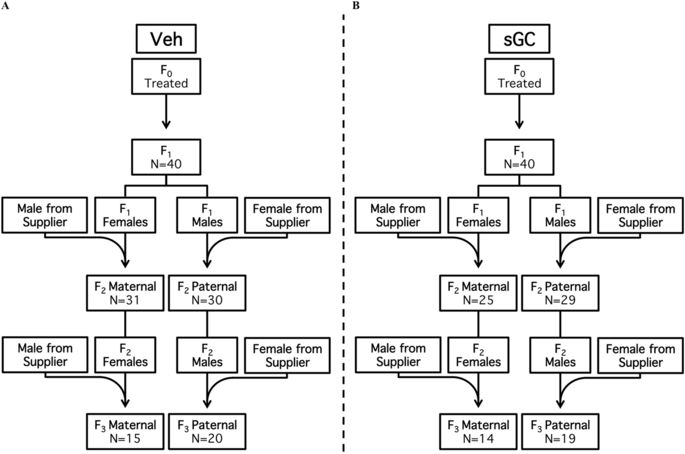
Veh[icle] was the control group initially treated with saline.
The study was informative and conclusive for the aspects studied. From the Methods section:
“Data from same-sex littermates were meaned to prevent litter bias. Sample sizes (N) correspond to independent litters, and not to the total number of offspring across all litters.
Power analyses based on previous studies determined N ≥ 8 sufficient to account for inter-litter variability and detect effects in the tests performed.”
https://www.nature.com/articles/s41598-017-11635-w “Prenatal Glucocorticoid Exposure Modifies Endocrine Function and Behaviour for 3 Generations Following Maternal and Paternal Transmission”
This 2017 California rodent study found:
“Neural representations within the mouse hypothalamus, that underlie innate social behaviours, are shaped by social experience.
In sexually and socially experienced adult males, divergent and characteristic neural ensembles represented male versus female conspecifics [members of the same species]. However, in inexperienced adult males, male and female intruders activated overlapping neuronal populations.
Sex-specific neuronal ensembles gradually separated as the mice acquired social and sexual experience. In mice permitted to investigate but not to mount or attack conspecifics, ensemble divergence did not occur. However, 30 minutes of sexual experience with a female was sufficient to promote the separation of male and female ensembles.
These observations uncover an unexpected social experience-dependent component to the formation of hypothalamic neural assemblies controlling innate social behaviours. More generally, they reveal plasticity and dynamic coding in an evolutionarily ancient deep subcortical structure that is traditionally viewed as a ‘hard-wired’ system.”

Hat tip to Neuroskeptic for both alerting me to the study and simplifying its overly-dense graphics.
http://www.nature.com/nature/journal/v550/n7676/full/nature23885.html “Social behaviour shapes hypothalamic neural ensemble representations of conspecific sex” (not freely available)
I saw Blade Runner 2049 yesterday with my 22-year old son. We chose seats with no one in front of us, and got the full impact of sight and sound.
The primary story was one person’s search for his truths: of his origins; of his memories; of his feelings. Who was the infant in the woman’s arms? Are my earliest memories real? Are my feelings true?
The lead character might as well have been lifeless. His activities were dictated by his designated role in society, by what was expected of him. It was no surprise that he preferred ethereal company over people.
He constantly repressed the memories and feelings that were most important to him, that could have given his life meaning. Despite being repressed, his memories and feelings impelled him to discover and confront his truths.
It was a defining moment when his earliest memory was recognized as real:
The miracle of life was celebrated, especially at the end. Like the first Blade Runner, society’s members who were deemed unworthy of life were the ones who cherished this fleeting moment most dearly.
See it up close and personal, in a theater with a good screen and sound system.
This post has somehow become a target for spammers, and I’ve disabled comments. Readers can comment on other posts and indicate that they want their comment to apply here, and I’ll re-enable comments.
Transgenerational epigenetic inheritance is a subject whose time has come. This week I sequentially curated two 2017 reviews and two 2016 studies of the subject, and ended with a meta-analysis of human preventive treatments:
It’s the opposite of advancing science for those in the funding chain to give lip service to the subject, and then create an atmosphere where proposals to extend experiments to subsequent generations to study possible transgenerational epigenetic effects are neither encouraged nor funded.
Here’s an Amazon book review I wrote six years ago when I regularly read 2-3 books a week while on the train to and from work. The book served as an example of how behavioral researchers couldn’t reach their stated goals by using standard scientific methods.
Everybody would benefit from reading this collection of experiments with human behavior.
It would be fair to compare the book’s accomplishments with its declared goals. The author stated the book’s primary goal early on when he wrote:
“We need to first figure out what forces really cause people to cheat and then apply this improved understanding to curb dishonesty. That’s exactly what this book is about.
Once we more clearly understand the forces that really drive us, we discover that we are not helpless in the face of our human follies (dishonesty included), that we can restructure our environment, and that by doing so we can achieve better behaviors and outcomes.”
I appreciated the author’s research that described and delineated what his experiments chose to observe. For example, in one series of experiments, people lied in order to get tokens that a few seconds later were exchanged into money. These subjects cheated to an extent that was almost twice the amount of people who lied in order to directly get money.
Another series of experiments showed that when people were tired or stressed, they were more likely to cheat. The amount that mentally exhausted subjects cheated was almost three times the amount of non-stressed subjects.
There was also a series of experiments that tested the “what the hell” effect. The researchers found that the amount of cheating was not linear. A point was frequently reached where the subjects apparently decided to abandon a little bit of cheating, and started to cheat at every opportunity.
The author proposed that a “fake it until you make it” approach doesn’t ultimately lead to honest behavior. He suggested that it would probably start a chain of events that proceeded through the “what the hell” context, where a little bit of cheating became a lot, and ended up with suffering when the truth was eventually revealed.
What these experiments examined wasn’t the origins of dishonest behavior, but rather the middle and ending parts of dishonest behaviors. As such, I didn’t see how the book’s primary goal could be achieved.
Without exploring the precedents to dishonest behavior, we’re also left with a patchwork approach to achieving the secondary goal of changing outcomes by influencing the salient aspects of behavior.
Understanding that I’m not an expert or a researcher, let me offer an approach that could be more conducive to achieving the primary and secondary goals of the book. The necessary but unexplored research area would be along the lines of “What do I feel just before I act dishonestly?”
The subjects’ probable answers to this unasked question would indicate that the person’s unfulfilled needs were in play. These needs are for the most part unconscious, and are the sources of automatic behavior that seeks to fulfill these needs. The outward manifestations of this automatic behavior will lead the subjects to symbolic fulfillment of their old needs.
The subjects in the experiments may not be able to make the connection between their behaviors of say, cheating on a pledge to quit smoking, and their driving forces. This is probably because the subjects weren’t consciously aware of the feelings they had just before they acted.
The researchers may be able to bridge this gap with information obtained from measurements done by fMRIs and other instruments. They can integrate these measurements with the subjects’ reports of their feelings.
To meet the goals of the book, it’s important that the researchers uncover the subjects’ underlying feelings. This is necessary because feelings are usually closer to the causes of a person’s behavior.
The subjects’ behaviors were symptoms of their problems, not the problems themselves. The researchers would be better served to study the entire situation as best they can.
All of us anticipate while we read a book that there will be prescriptions and answers to the circumstances and troubles presented. But because The (Honest) Truth About Dishonesty didn’t identify “what forces really cause people to cheat,” the primary goal, to “clearly understand the forces that really drive us” wasn’t attained.
Realization of the secondary goal is undecided. The author presented several examples of how environments affect people’s dishonesty, such as conflicts of interests. He showed how people’s rationalizations allow them to permit a level of dishonesty that doesn’t harm their ideas about their own morality.
But how can effective and enduring solutions arise “so we can achieve better behaviors and outcomes” when the roots of the behaviors aren’t examined?
A coauthor of the studies referenced in:
offered an opinion piece in A Paper a Day Keeps the Scientist Okay entitled “Do We Need To Study The Brain To Understand The Mind?”
“The emerging consensus appears to be that implementation is important. Interestingly, the inverse question is also being asked by neurobiologists—do we need consider the mind to understand the brain?—and answered largely and increasingly in the affirmative.
Is pain different from negative emotions such as sadness and anger, or are they variants on a common theme? Pain appears to be distinct from negative emotion, but commonalities suggest ways in which they may share underlying processes such as heightened attention.
One of the biggest pitfalls is the temptation to observe brain activity and make inferences about the psychological state—for example, to infer:
- Episodic memory retrieval from hippocampal activity,
- Fear from amygdala activity, or
- Visual processing from activity in the ‘visual cortex.’
These inferences ignore the scope of processes which may activate each of these areas and involve a fallacy in reasoning: “if memory then hippocampus” is not the same thing as “if hippocampus then memory.”
The fact that few brain areas, including the ‘visual cortex,’ are dedicated to one process means that self-report is still the gold standard for assessing emotional experience and the contents of thought. This is a serious challenge for those who would like, for example, to assess your brand preferences or your political affiliation from a brain scan. (And isn’t it easier just to ask?)”

