People will forgive you for being wrong, but they will never forgive you for being right – especially if events prove you right while proving them wrong. Thomas Sowell
This 2017 New Zealand review compared and contrasted epigenetic evidence from placental and cancer research:
“Placental and cancer cells are globally hypomethylated and share an epigenetic phenomenon that is not well understood – they fail to silence repetitive DNA sequences (retrotransposons) that are silenced (methylated) in healthy somatic cells.
In the placenta, hypomethylation of retrotransposons has facilitated the evolution of new genes essential for placental function. In cancer, hypomethylation is thought to contribute to activation of oncogenes, genomic instability, and retrotransposon unsilencing; the latter, we postulate, is possibly the most important consequence.
Activation of placental retrotransposon-derived genes in cancer underpins our hypothesis that hypomethylation of these genes drives cancer cell invasion.”
“THC [delta9-tetrahydrocannabinol, the psychoactive compound of cannabis] exposure affects histone modifications in the brain of female rats in a region- and age-specific manner. Specifically, THC acts on different targets depending on the considered brain area and, remarkably, the adolescent brain is generally more sensitive to THC than the adult brain.
Adolescent exposure to THC, or to synthetic cannabinoids, induced sex-dependent brain and behavioral alterations at adulthood. In female rats, the phenotype was more complex, as both depressive-like and psychotic-like signs were present.
Development of the depressive/psychotic-like phenotype is restricted to adolescent THC exposure. Not only the behavioral phenotype developed after adolescent, and not adult, exposure, but also changes in both histone modifications and gene expression were more widespread and intense after adolescent treatment, further confirming a specific adolescent susceptibility.
The primary effect in the adolescent brain was represented by changes leading to transcriptional repression, whereas the one observed after adult treatment led to transcriptional activation. Moreover, only in the adolescent brain, the primary effect was followed by a homeostatic response to counterbalance the THC-induced repressive effect, except in the amygdala.”
The authors’ interpretation of the brain area results was:
“The amygdala is more responsive in adult than adolescent animals. Since it has been established that the amygdala is activated during exposure to aversive stimuli, functioning as a “behavioral brake”, different response between adult and adolescent animals could represent the biological bases of the adolescent propensity for risk-taking and novelty-seeking behaviors. Also in adolescent humans, neuroimaging studies have shown a weaker involvement of the amygdala, and a greater contribution of the NAc[nucleus accumbens], in response to negative and positive stimuli compared to adults.”
“It doesn’t matter about the facts we know if we cannot maintain a relationship with someone else.”
I kept that thought in the forefront.
Both of us are prisoners of our childhoods. I’ve tried to see and feel the walls and bars for what they are.
Like all of us, J hadn’t tried to process the reality of her childhood and life. For example, on her birthday I asked her how she celebrated her birthdays when she was growing up. She provided a few details, then mentioned that her parents had skipped some of her birthdays. Although I had no immediate reaction, she quickly said that she had a happy childhood.
I was at fault, too, of course. I again asked a woman to marry me who hadn’t ever told me she loved me, except in jest.
I asked J to marry me around the six-month point of our relationship. I felt wonderful, in love with her that August morning after she slept with me at my house. I made an impromptu plan: in the middle of a four-mile walk, I asked her to marry me while kneeling before her as she sat on a bench outside a jewelry store. But she wouldn’t go in to choose a ring. She said she’d think about it.
A month later, after several dates, sleepovers at her house, and a four-day trip to Montreal, I again brought up marriage while we rested on her large couch in her nice sun room. The thing I felt would be wonderful brought about the end.
I tried to understand why she couldn’t accept me for the person who I intentionally showed her I am. She abstracted everything that she said.
I tried to get her to identify why, after all the times we cared for each other, after all our shared experiences, she didn’t want me around anymore.
Didn’t happen. She didn’t tell me things that made sense as answers to my questions.
One thing she said without abstraction was that I was weak for showing my feelings. She told me I was clingy.
Another thing she communicated at the end shocked me. She somehow thought that I was going to dump her. I said that the thought never even crossed my mind.
I didn’t recognize it as projection at the time. Prompted by her underlying feelings, she attributed to me the actions and thoughts that only she herself had.
I’ve tried to put myself in J’s place.
How horrible must it have been for her to be steadily intimate with a man and not feel that his touches, kisses, words, affection, expressed love?
That he couldn’t really love me, and so I couldn’t love him?
That he was actually after something else, because it was impossible that he loved me?
One thing I’ve felt after the end was that the need underlying my only stated relationship goal – to live with a woman I love who also loves me – is again ruining my life. My latest efforts towards that goal were rife with unconscious symbolic act outs of an unsatisfied need from my early life.
That unrelenting need is for a woman’s love. The women I’ve chosen, though, have always given me what I got from my mother: they wouldn’t accept me as I am, and didn’t love me.
And there can never be a substitute. Most of my Primal Therapy sessions included the PAIN OF FEELING exactly that.
My prison cell is what Dr. Janov calls the imprint where I – as a child, teenager, young man, middle-aged man, old man – futilely ATTEMPT TO CHANGE THE PAST.
“Standing next to me in this lonely crowd Is a man who swears he’s not to blame All day long I hear him shout so loud Crying out that he was framed
I see my light come shining From the west down to the east Any day now, any day now I shall be released”
P.S. – We got back together seven months later, and are still going strong.
This 2017 German review discussed the results of many of the studies performed over the past thirty years investigating the health-promoting effects of cruciferous vegetable compounds:
“SFN [sulforaphane] [is] the ITC [isothiocyanate] that is the most extensively studied for its chemopreventive and anti-inflammatory properties in vitro, as well as in vivo.
Due to the reversible nature of epigenetic aberrations, a modulation of epigenetically caused changes in gene expression by phytochemicals may be a promising approach in cancer prevention at the initiation step of carcinogenesis. Both SFN and DIM [diindolemethane] reversed many of the cancer-associated promotor methylations, including abnormally-methylated genes that are dysregulated during cancer progression..modulate the abnormal expression of miRNAs in different types of cancer.”
This post has somehow become a target for spammers, and I’ve disabled comments. Readers can comment on other posts and indicate that they want their comment to apply here, and I’ll re-enable comments.
This 2017 Italian review selected 9 human studies on the epigenetic effects of:
“One of the major adverse events in human development. Preterm infants are hospitalized in the Neonatal Intensive Care Unit where they are exposed to life-saving yet pain-inducing procedures and to protective care.”
Highlights of the referenced studies included:
“Early exposure to adverse events during the third trimester of pregnancy is capable to alter the epigenetic status of imprinted and placenta-related genes which have relevant implications for fetal development and preterm infants’ HPA[hypothalamic–pituitary–adrenal] stress reactivity during infancy.”
“There was an association between DNAm [DNA methylation] and white matter tract tissue integrity and shape inferred from dMRI [diffusion MRI], suggesting that epigenetic variation may contribute to the cerebral phenotype of preterm birth.”
Limitations of the referenced studies included:
“A multiple sampling design that includes parental samples, placental tissue, cord blood and extends across the life-course would be required to investigate the relative contributions of in utero and postnatal exposures to changes in DNAm, and the extent to which preterm birth leaves a legacy on the methylome.”
Saliva, blood, and other tissues’ DNA methylation may not produce valid links to brain tissue DNA methylation of the same gene, which may hamper conclusive inferences about behavior, etc.
This 2017 blog post from Antiwar.com’s Justin Raimondo outlines the latest instance of exploiting beliefs:
“Neither the sources of this story nor those who are reporting it can be trusted. Journalism is not a means of discovering knowledge, but a weapon to be deployed in a political-ideological conflict.”
Similar to the development of other beliefs, the reporting of the referenced story discouraged inquiries into “Information about the real world..giving us a highly distorted version of events.” It followed the blueprint of Using citations to develop beliefs instead of evidence in that once the faulty information became widely cited, refuting evidence would be ignored, and the false belief was used for other purposes.
This post has somehow become a target for spammers, and I’ve disabled comments. Readers can comment on other posts and indicate that they want their comment to apply here, and I’ll re-enable comments.
I used a browser yesterday that didn’t have ad blocker software installed. The below pictures came from one of the ads that displayed:
A young girl in a dance position and outfit juxtaposed with an appeal: “No situation is HELPLESS because there is HOPE.” How interesting!
I didn’t click through the ad yesterday to see what was being sold by engaging customers’ beliefs, within which lay hope. When I clicked the ad today, it asked for donations to “Sponsor a Child,” develop “the perfect recipe for sustainable success,” and, at the bottom of the page, “We love because Jesus loves.”
What do we know about this ad’s appeal from reading Dr. Arthur Janov’s May 2016 book Beyond Belief? Can hope change a helpless situation per the ad?
On one level – yes, in a believer’s brain, by blocking helpless feelings. Otherwise – no. Hope ultimately isn’t a remedy for the causes of what created helpless feelings.
I donated to a similar organization for a few years, but not anymore.
Continuing to read Dr. Arthur Janov’s May 2016 book Beyond Belief:
“p.13 Beliefs are medicine for the hopeless. They attenuate despair, vitiate loneliness, and dissipate helplessness.
p. 14 We need hope more than we need truth. Beliefs divert us from past traumas and current pains because inside the belief lies hope.
p.15 Hope is ‘the meaning of life.’ It shimmers and sparkles and blinds us from seeing the bars of our prisons of belief.
We are all, in one way or another, victims of early unfulfilled need. Never think that intelligence prohibits this kind of behavior.
We search for hope here and there based on early hopelessness of which we are unaware. Nothing in one’s current life points to the problem, and nothing even in one’s childhood clarifies it.
One’s expectations may exceed reality when feelings are thrust into the arena of ideas. One no longer sees reality, but rather a projection of need.”
“We need hope more than we need truth.” Is this part of why we accept headlines as facts, and don’t pay attention to the stories’ subsequent corrections? Why do we accept as facts news articles that don’t link to the cited sources?
I had dinner earlier this week with an intelligent woman. She mentioned that she constantly listened to National Public Radio. I asked her what value she got from it, and she replied that it kept her current with events.
I asked what other news sources she sought out. She said that she didn’t usually have the time, and that NPR was a reliable source.
I didn’t further challenge her beliefs. It’s up to each individual to realize that their beliefs are symptoms of what’s ruining their one precious life.
Last weekend I engaged in essentially the same conversation over lunch with another intelligent woman who relied on conservative news sources. She also became defensive, and ended that part of our conversation as a matter of “agreeing to disagree.”
Why does intelligence seem to have little to do with accepting being propagandized?
I’ve started to read Dr. Arthur Janov’s May 2016 book Beyond Belief. Here are a few thoughts I’ve expressed to friends that were prompted by the first dozen pages of the paperback version.
“p. 5 We need a painless liberation from our insidious emotional wounds..a leader who will take the place of an emotionally distant parent for whom we will sacrifice anything just for the promise of love, protection, and caring.”
The elections of the past two presidents were symptoms of the hopelessness that most Americans feel. Both elections promised hope.
“p. 6 Beliefs sell and sell well. People will pay dearly for even the promise of fulfillment, even if it is in the next life.”
Religion can have a much worse and lasting effect on people than any politician or political system can. Politicians can drag out and delay living up to their promises.
Religious leaders don’t have to deliver much at all during their followers’ lives. In fact, it works in the leaders’ favor to minimally address their followers’ current sufferings, as that strengthens the appeal of the imaginary next life!
The past three weeks I’ve gone to 7-11 to get a morning coffee. More often than not, I see people buying lottery tickets during the 2-3 minutes when I’m there.
What accounts for this behavior? Not everyone who buys a lottery ticket is innumerate.
I’d guess that it’s a symptom of hopelessness. Feelings of hopelessness cause us to generate a faith that an exceedingly-improbable event will benefit our life. Lottery-ticket behavior follows.
State governments are responsible for these lotteries. It’s one of the ways governments prey upon their citizens’ feelings of hopelessness.
I once worked as a contractor in a government office where everyone except me pooled money every week to buy lottery tickets. I was also the only nonreligious person there.
The genetics percentage from a 2017 summary of Alzheimer’s disease research caught my eye:
“Although numerous single nucleotide polymorphisms (SNPs) have now been robustly associated with AD via genome-wide association studies and subsequent meta-analyses, collectively these common SNPs are believed to only account for 33% of attributable risk and the mechanism behind their action remains largely unknown.”
Dr. Moshe Szyf of McGill University explains current rodent epigenetic research into addiction in this October 2016 interview.
“What happens during the time when there’s no drug [cocaine] exposure, there’s just the memory of the original drug exposure? And we found huge epigenetics changes during this time, the time of abstinence.
It actually suggests that abstinence cannot cure addiction. It might even aggravate it.
We found out that timing is very important. Pairing the drug [a DNA methylation inhibitor] administration with the cue was critical with reversing the epigenetic effects and the behavioral effects.
Epigenetic treatment should theoretically reprogram the animal to forget or erase the epigenetic consequences of the initial exposure. And therefore the animal should be protected from addiction for a long time if indeed we found what we thought we did with epigenetic reprogramming.”
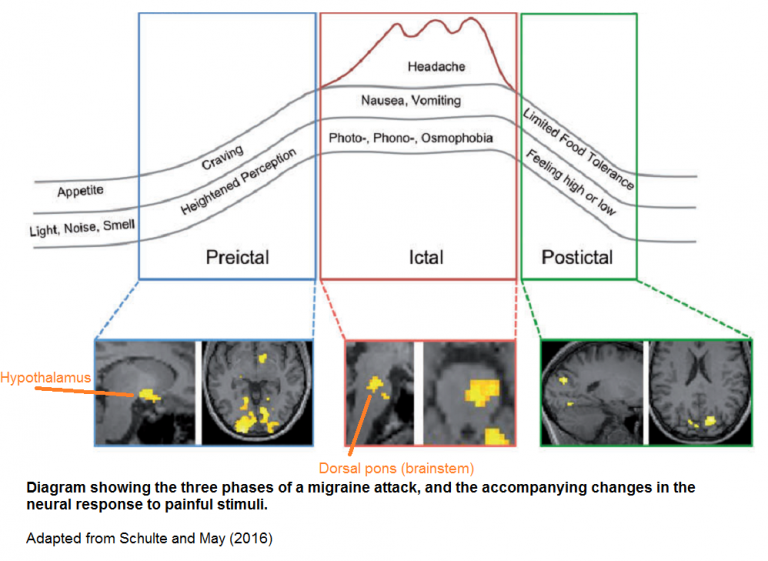
This 2016 German human study with one subject found:
“The hypothalamus to be the primary generator of migraine attacks which, due to specific interactions with specific areas in the higher and lower brainstem, could alter the activity levels of the key regions of migraine pathophysiology.”
The subject underwent daily fMRI scans, and procedures to evoke brain activity. She didn’t take any medications, and suffered three migraine attacks during the 31-day experimental period.
Neuroskeptic commented:
“The dorsal pons has previously been found to be hyperactive during migraine. It’s been dubbed the brain’s ‘migraine generator.’ Schulte and May’s data suggest that this is not entirely true – rather, it looks like the hypothalamus may be the true generator of migraine, while the brainstem could be a downstream mediator of the disorder.
A hypothalamic origin of migraines would help to explain some of the symptoms of the disorder, such as changes in appetite, that often accompany the headaches.”
The above graphic looks to me like the result of feedback mechanisms that either didn’t exist or inadequately handled the triggering event. Other examples of the hypothalamus lacking feedback or being involved in a deviated feedback loop include:
There are many unanswered questions with a one-person study, of course. Addressing the cause of this painful condition would find out when, where, and how a person’s hypothalamus became modified to express migraine tendencies.
I’d guess that migraine tendencies may appear as early as the first trimester of pregnancy, given that a highly functional hypothalamus is needed for survival and development in our earliest lives. Gaining as much familial and historical information as possible from the person would be necessary steps in therapies that address migraine causes.
As mentioned in How to cure the ultimate causes of migraines? comments are turned off for this post due to it somehow becoming a magnet for spammers. Readers can comment on that post instead.
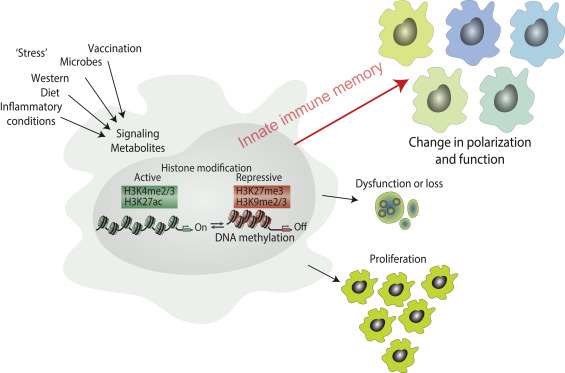
This 2016 German review subject was memory characteristics of immune cells:
“Innate immune memory has likely evolved as an ancient mechanism to protect against pathogens. However, dysregulated processes of immunological imprinting mediated by trained innate immunity may also be detrimental under certain conditions.
Evidence is rapidly accumulating that innate immune cells can adopt a persistent pro-inflammatory phenotype after brief exposure to a variety of stimuli, a phenomenon that has been termed ‘trained innate immunity.’ The epigenome of myeloid (progenitor) cells is presumably modified for prolonged periods of time, which, in turn, could evoke a condition of continuous immune cell over-activation.”
These reviewers focused on an example of atherosclerosis, although other examples were discussed of epigenetic remodeling to acquire immune memory:
“In the last ten years, several novel non-traditional risk factors for atherosclerosis have been identified that are all associated with activation of the immune system. These include chronic inflammatory diseases such as:
Diets were discussed, mainly regarding their various negative effects. I was interested to see a study that referenced a common dietary supplement:
“Pathway analysis of promoters that were potentiated by β-glucan identified several innate immune and signaling pathways upregulated in trained cells that are responsible for induction of trained immunity.”
Other curated research into epigenetic remodeling of immune system memory includes:
In memoriam to my father who died twenty years ago last week. World War II ruined his life with undiagnosed PTSD, some of the effects of which affected his children.
His brother – my uncle – was a Navy hospital corpsman during the slaughter at Iwo Jima, and was even more afflicted.