A GWAS meta-analysis of two epigenetic clocks

This 2019 UK human study conducted a meta-analysis of genome-wide association studies of two epigenetic clocks using 13,493 European-ancestry individuals aged between ten and 98 years:

“Horvath-EAA, described in previous publications as ‘intrinsic’ epigenetic age acceleration (IEAA), can be interpreted as a measure of cell-intrinsic ageing that exhibits preservation across multiple tissues, appears unrelated to lifestyle factors, and probably indicates a fundamental cell ageing process that is largely conserved across cell types.

In contrast, Hannum-EAA, referred to in previous studies as ‘extrinsic’ epigenetic age acceleration (EEAA), can be considered a biomarker of immune system ageing, explicitly incorporating aspects of immune system decline such as age-related changes in blood cell counts, correlating with lifestyle and health-span related characteristics, and thus yielding a stronger predictor of all-cause mortality.

The meta-analysis of Horvath-EAA identified ten independent associated SNPs [single nucleotide polymorphisms], doubling the number reported to date, and highlighted 21 genes involved in Horvath-based epigenetic ageing. Four of the ten Horvath-EAA-associated SNPs are mQTL [methylation quantitative trait loci] for CpGs used in the Horvath/Hannum epigenetic clocks. A possible interpretation of this is that the functional mechanism by which these SNPs influence the rate of biological ageing is via altering methylation levels.

Father’s age at death, a rough proxy for lifespan, was nominally significantly correlated with both EAA measures, and parents’ age at death was additionally correlated with Hannum-EAA. Aside from these, genetic correlations with age-related traits were surprisingly few: it is possible that this could reflect an overly conservative correction for the multiple tests carried out, or low statistical power, rather than a genuine lack of correlations.

Genetic correlation analysis should be restricted to GWAS with a heritability Z-score of 4 or more, on the grounds of interpretability and power, so the Horvath-based results particularly should be interpreted with caution.”


A non-apologetic way to explain the above graphic is that NONE of these 218 “health and behavioral traits” were any more associated with the studied genetic measurements than would be expected by chance!

Fervent believers in the GWAS methodology’s capability to exactly predict individual phenotypes eventually become victims of the scientific method. These GWAS researchers griped about “overly conservative correction, or low statistical power” and other predictable shortfalls, and ended a long limitations statement with:

“While we have identified a number of SNPs and genes significantly associated with EAA, including genes already known to be related to ageing, the analyses presented here fall short of providing a mechanistic explanation for how these variants and genes act to influence biological age.”

Outside of beliefs, it’s hard to understand why research money keeps pouring into the GWAS dead end. If these researchers and their employing institution and sponsors want to make a difference in human lives, they need to get busy in other areas.

These researchers were employed by the same institution that couldn’t be bothered to scrape together six more weeks of funds to study the transgenerational damaging effects of acetaminophen – an analgesic available to billions of people – in Epigenetics research that was designed to fall one step short of wonderful.

https://journals.plos.org/plosgenetics/article?id=10.1371/journal.pgen.1008104 “A meta-analysis of genome-wide association studies of epigenetic age acceleration”

Organismal aging and cellular senescence

I’ll curate this 2019 German review through its figures:

“With the discovery of beneficial aspects of cellular senescence and evidence of senescence being not limited to replicative cellular states, a redefinition of our comprehension of aging and senescence appears scientifically overdue.

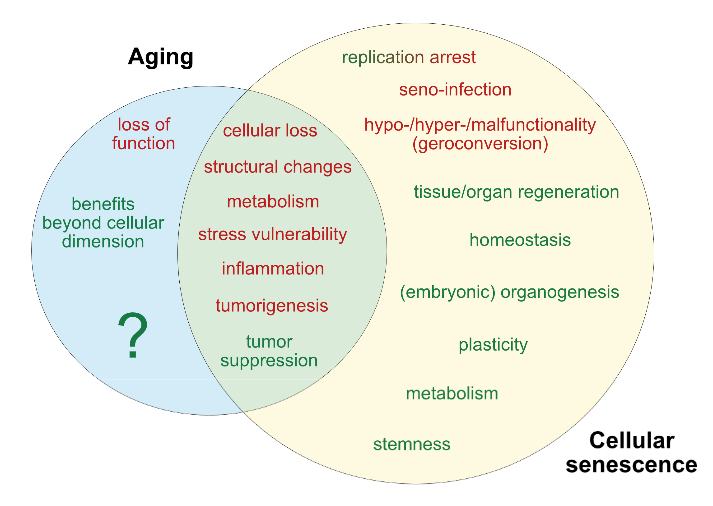
Figure 1. Current determinants and relevant open questions, marking the processes of aging and senescence as discussed in the text. Aspects represented in green are considered as broadly accepted or scientifically consolidated. Novel aspects that are yet unproven, or are under debate, are highlighted in red.

SASP = senescence-associated secretory phenotype. AASP = putative aging-associated secretory phenotype as suggested in the text.

Figure 2. Theories on the causality and purpose of aging. Graphically summarized are four contrasting concepts crystallized from current evidence addressing the inductive driving force of aging. Apart from a stochastic deleteriome, there are arguments for a pseudo-programmed, programmed or at least partially programmed nature of aging.

Figure 3. Comparative representation of the aging and senescence processes highlighting different levels of interaction and putative sites of interventions.

(1) As discussed in the text, causative mechanisms of aging are still not well understood, however, multiple factors including genetic, epigenetic and stress-related effects seem to have an orchestrated role in the progression of aging. Senescence on the other hand, is seen as a programmed response to different kinds of stressors, which proceed in defined stages. Whether, in analogy, aging also follows a defined program or sequential stages is not known.

(2) Senescence involves autocrine and paracrine factors, which are responsible for a ‘seno-infection’ or bystander effect in neighboring cells. There is currently no direct evidence for a similar factor composition propagating the aging process via a kind of ‘gero-infection’.

(3) Accumulation of senescent cells has been described as a hallmark of aging; however, whether they are a causative factor or a consequence of tissue and organismal aging is still unknown. As discussed in the text, it appears possible that aging and senescence mutually influence each other through positive feedback at this level, leading to accelerated tissue damage and aging.

(4,5) Clearance of senescent or aging cells might constitute putative targets for interventional approaches aimed to reduce or reverse the impact of aging and improve cell and tissue homeostasis by inducing a ‘rejuvenation’ process.

Figure 4. Pathological and beneficial functions of aging and senescence, according to current knowledge. In red are represented pathological consequences and in green beneficial functions of aging and senescence.

The impact of aging has mainly been described at the organismal level, since a complete cellular functional profile has not yet been established. Accordingly, whether beneficial consequences of the aging process exist at the cellular level is unclear.”


The assertion of Figure 3 (2) that:

“There is currently no direct evidence for a similar factor composition propagating the aging process via a kind of ‘gero-infection.”

was shown to be false in Reevaluate findings in another paradigm:

“It was demonstrated that increased aging occurred as a result of lack of gonadotropin-releasing hormone and that increased lifespan resulted from its provision during aging.

In this manner:

  1. Aging of hypothalamic microglia leads to
  2. Aging of the hypothalamus, which leads to
  3. Aging elsewhere in the body.

So here we have a multi-level interaction:

  1. Activation of NF-κB leads to
  2. Cellular aging, leading to
  3. A diminished production of GnRH, which then
  4. Acts (through cells with a receptor for it, or indirectly as a result of changes to GnRH-receptor-possessing cells) to decrease lifespan.

So the age state of hypothalamic cells, at least with respect to NF-κB activation, is communicated to other cells via reduced output of GnRH.”


The reviewers’ position on Figure 2 was:

“In our view, recent evidence that

  • Senescence is based on an unterminated developmental growth program and the finding that
  • The concept of post-mitotic senescence requires the activation of expansion, or ‘growth’ factors as a second hit,

favor the assumption that aging underlies a grating of genetic determination similarly to what is summarized above under the pseudo-programmed causative approach.”

Their position on Figure 4’s beneficial effects of aging began with the sentence:

“If we assume that aging already starts before birth, it can be considered simply a developmental stage, required to complete the evolutionary program associated with species-intrinsic biological functions such as reproduction, survival, and selection.”

Cited studies included:

https://www.mdpi.com/2073-4409/8/11/1446 “Dissecting Aging and Senescence-Current Concepts and Open Lessons”

A strawman argument against epigenetic clocks

This 2019 review of epigenetic clocks by Washington cancer researchers ignored the elephant in the room: Their epigenetic drift paradigm is generally inapplicable to humans because the vast majority of our cells don’t divide/proliferate. They repeatedly returned to an argument for randomness as a cause for aging and disease:

“A time-dependent stochastic event process, like epigenetic drift, could lead to cancer formation through the accumulation of random epigenetic alterations that, through chance, eventually alter epigenetic driver gene expression leading to a clone of cells destined to become cancer.

It is plausible that the stochastic process inherent in epigenetic drift can induce aberrant methylation events that accumulate in normal cells and eventually induce cancer formation.

Epigenetic drift relates to a biological process that changes the DNA methylome with age via stochastic gains or losses of DNA methylation. Epigenetic drift can be understood in terms of errors in DNA methylation maintenance during DNA-replication.

The phenomenon of (epi)genetic drift is generally associated with phenotypic neutrality.

For patients who develop cancer around age 80, the most likely initiation time for the founder adenoma cell is predicted to be very early in life, roughly between the ages 15 to 20 years. This unexpected and provocative finding suggests that the optimal age-range for prevention of colorectal cancer may be in adolescence and early adulthood (and ideally through lifelong) dietary and lifestyle interventions.”


The reviewers’ strawman arguments intentionally mischaracterized aspects of the epigenetic clock:

1. The epigenetic clock founder’s actual view on aging was in The epigenetic clock theory of aging:

“The proposed epigenetic clock theory of ageing views biological ageing as an unintended consequence of both developmental programmes and maintenance programmes, the molecular footprints of which give rise to DNAm age estimators.”

The reviewers omitted this intrinsic view of aging, which didn’t fit into the above graphic.

2. Another misrepresentation was:

“In contrast to epigenetic clocks, epigenetic drift refers to a stochastic process that involves both gains and losses of the methylation state of CpG dinucleotides over time.”

A reader of the original 2013 epigenetic clock study would understand that epigenetic clocks measure “both gains and losses of methylation” as in:

“The 193 positively and 160 negatively correlated CpGs get hypermethylated and hypomethylated with age, respectively.”

3. These reviewers omitted recent epigenetic clock significant developments. For example, there was no mention of the GrimAge study, although it was published before this review was submitted.

4. Epigenetic drift as the cause of aging and disease has abundant contrary evidence. These reviewers tossed in a little toward the end of their directed narrative:

“We found only a small number of drift-related CpG island-gene pairs for which drift correlated positively and significantly with gene expression.

The functional consequences of epigenetic drift need to be further elucidated.”

However, they never acknowledged the elephant in the room!

https://cancerres.aacrjournals.org/content/early/2019/11/06/0008-5472.CAN-19-0924 “Epigenetic aging: more than just a clock when it comes to cancer” (not freely available)

Epigenetic transgenerational inheritance extends to the great-great-grand offspring

This 2019 rodent study by the Washington State University labs of Dr. Michael Skinner continued to F4 generation great-great-grand offspring, and demonstrated that epigenetic inheritance mechanisms are similar to imprinted genes:

“Epigenetic transgenerational inheritance potentially impacts disease etiology, phenotypic variation, and evolution. An increasing number of environmental factors from nutrition to toxicants have been shown to promote the epigenetic transgenerational inheritance of disease.

Imprinted genes are a special class of genes since their DNA methylation patterns are unchanged over the generation and are not affected by the methylation erasure occurring early in development. The transgenerational epigenetic alterations in the germline appear to be permanently reprogrammed like imprinted genes, and appear protected from this DNA methylation erasure and reprogramming at fertilization in the subsequent generations. Similar to imprinted genes, the epigenetic transgenerational germline epimutations appear to have a methylation erasure in the primordial germ cells involving an epigenetic molecular memory.

Comparison of the transgenerational F3 generation, with the outcross to the F4 generation through the paternal or maternal lineages, allows an assessment of parent-of-origin transmission of disease or pathology. Observations provided examples of the following:

  1. Pathology that required combined contribution of both paternal and maternal alleles to promote disease [testis and ovarian disease];
  2. Pathology that is derived from the opposite sex allele such as father to daughter [kidney disease] or mother to son [prostate disease];
  3. Pathology that is derived from either parent-of-origin alleles independently [obesity];
  4. Pathology that is transmitted within the same sex, such as maternal to daughter [mammary tumor development]; and
  5. Pathology that is observed only following a specific parent-of-origin outcross [both F4 male obesity and F4 female kidney disease in the vinclozolin lineage].”

https://www.sciencedirect.com/science/article/pii/S0012160619303471 “Epigenetic transgenerational inheritance of parent-of-origin allelic transmission of outcross pathology and sperm epimutations”


This study showed that epigenetically inherited legacies extend to the fifth generation. Do any of us know our ancestors’ medical histories back to our great-great-grandparents?

Will toxicologists take their jobs seriously, catch up to current science, and investigate possible effects in at least the F3 generation that had no direct toxicant exposure?

Restrict information in the name of science?

A Stanford researcher was annoyed that we live in the 21st century, and advocated we return to previous centuries’ information-flow check valves of wise old men. No doubt the publishers of and subscribers to the Journal of the American Medical Association applauded the same old tired prescription.

Ten instances of the word “should” in the final two paragraphs provided ample evidence of the paper’s intent. Mirroring the current political climate – projecting – accusations made of others were items the accusers were guilty of themselves, such as:

“When these scientists act as investigators in the hundreds of observational studies that they publish, or as editors and peer reviewers in evaluating submissions from others, would they tolerate publishing analyses and funding proposals that might contradict their belief system?”

https://jamanetwork.com/journals/jama/fullarticle/2753533 “Neglecting Major Health Problems and Broadcasting Minor, Uncertain Issues in Lifestyle Science”


One of the paper’s references included an informative graphic:

“A histogram of the total number of rumor cascades in our data across the seven most frequent topical categories.”

https://science.sciencemag.org/content/359/6380/1146 “The spread of true and false news online”


I’ll borrow from the curation of another Stanford paper Online dating cuts out the middlemen in conclusion:

“Are there examples where it wouldn’t potentially improve a person’s life to choose their information sources? Friends, family, and other social groups – and religious, educational, and other institutions – have had their middlemen/guarantor time, and have been found lacking.

Make your own choices for your one precious life.”

Maternal obesity causes heart disease in every offspring generation

This 2019 St. Louis rodent study found:

“We hypothesized that maternal obesity induces cardiac mitochondrial dysfunction in the offspring via transgenerational inheritance of abnormal oocyte mitochondria. All F1 to F3 descendants bred via the female in each generation were nonobese and demonstrated cardiac mitochondrial abnormalities.

Contrary to our hypothesis, male F1 also transmitted these effects to their offspring, ruling out maternal mitochondria as the primary mode of transmission. We conclude that transmission of obesity-induced effects in the oocyte nucleus rather than abnormal mitochondria underlie transgenerational inheritance of cardiac mitochondrial defects in descendants of obese females.”


For some reason, the researchers didn’t cite any of Dr. Michael Skinner’s research on epigenetic transgenerational inheritance. Their time, efforts, and resources would have been more productive had they used Dr. Skinner’s studies – such as the 2018 Epigenetic transgenerational inheritance of ovarian disease – as guides.

A podcast with the researchers is available here.

https://www.physiology.org/doi/abs/10.1152/ajpheart.00013.2019 “Maternal High-Fat, High-Sucrose Diet Induces Transgenerational Cardiac Mitochondrial Dysfunction Independent of Maternal Mitochondrial Inheritance” (not freely available)

Do genes or maternal environments shape fetal brains?

This 2019 Singapore human study used Diffusion Tensor Imaging on 5-to-17-day old infants to find:

“Our findings showed evidence for region-specific effects of genotype and GxE on individual differences in human fetal development of the hippocampus and amygdala. Gene x Environment models outcompeted models containing genotype or environment only, to best explain the majority of measures but some, especially of the amygdaloid microstructure, were best explained by genotype only.

Models including DNA methylation measured in the neonate umbilical cords outcompeted the Gene and Gene x Environment models for the majority of amygdaloid measures and minority of hippocampal measures. The fact that methylation models outcompeted gene x environment models in many instances is compatible with the idea that DNA methylation is a product of GxE.

A genome-wide association study of SNP [single nucleotide polymorphism] interactions with the prenatal environments (GxE) yielded genome wide significance for 13 gene x environment models. The majority (10) explained hippocampal measures in interaction with prenatal maternal mental health and SES [socioeconomic status]. The three genome-wide significant models predicting amygdaloid measures, explained right amygdala volume in interaction with maternal depression.

The transcription factor CUX1 was implicated in the genotypic variation interaction with prenatal maternal health to shape the amygdala. It was also a central node in the subnetworks formed by genes mapping to the CpGs in neonatal umbilical cord DNA methylation data associating with both amygdala and hippocampus structure and substructure.

Our results implicated the glucocorticoid receptor (NR3C1) in population variance of neonatal amygdala structure and microstructure.

Estrogen in the hippocampus affects learning, memory, neurogenesis, synapse density and plasticity. In the brain testosterone is commonly aromatized to estradiol and thus the estrogen receptor mediates not only the effects of estrogen, but also that of testosterone.”

https://onlinelibrary.wiley.com/doi/full/10.1111/gbb.12576 “Neonatal amygdalae and hippocampi are influenced by genotype and prenatal environment, and reflected in the neonatal DNA methylome” (not freely available)

Because..Harvard?

This 2019 Harvard review entitled “Transgenerational epigenetic inheritance: from phenomena to molecular mechanisms” DETRACTED from science. Readers would become less-informed on the subject due to poorly-researched statements such as:

“Non-Mendelian inheritance, termed transgenerational epigenetic inheritance,”

which wasn’t an adequate definition of the transgenerational epigenetic inheritance term.


Contributing to the paper’s misdirection was the omission of Dr. Michael Skinner from any of the 349 cited references. Hard to believe that ignoring his research wasn’t intentional, since a PubMed “transgenerational” search sorted by Best Match displayed Dr. Skinner as author or coauthor in 3 of the first 20 results:

The abstract asserted:

“How this epigenetic information escapes the typical epigenetic erasure that occurs upon fertilization and how it regulates behavior is still unclear.”

However, Another important transgenerational epigenetic inheritance study – published well before the current paper – was one of Dr. Skinner’s Washington State University lab studies that CLEARLY demonstrated contrary evidence.

Who benefits from hijacking a scientific term and ignoring groundbreaking research?

Why did the two editors approve for publication a paper with obvious omissions and egregious errors? Because..Harvard?

https://www.sciencedirect.com/science/article/abs/pii/S0959438818302204 “Transgenerational epigenetic inheritance: from phenomena to molecular mechanisms” (not freely available)

Emotional responses and BDNF methylation

This 2019 German human study found:

“A critical role of BDNF [brain-derived neurotrophic factor] methylation in human amygdala response to negative emotional stimuli, whereby:

  • High BDNF methylation rates were for the first time shown to be associated with a high reactivity in the amygdala; and
  • High BDNF methylation and high amygdala reactivity were associated with low novelty seeking.

There was no interaction or main effect of the Val66Met polymorphism on amygdala reactivity.

Our data adds evidence to the hypothesis that epigenetic modifications of BDNF can result in an endophenotype associated with anxiety and mood disorders. However, since correlations do not prove causality:

  • A direct link between human BDNF mRNA/protein levels, methylation, amygdala reactivity and psychiatric disorders is still missing, demanding further research.
  • Determining the underlying directions of the relations between BDNF methylation, amygdala reactivity, and NS [novelty seeking] cannot be accomplished based on our data and must await further research.

The fact that our results mainly involve the right amygdala is in line with previous studies. Recent reviews suggest a general right hemisphere dominance for all kinds of emotions, and, more specifically, a critical role of the right amygdala in the early assessment of emotional stimuli.

The experimental fMRI paradigm utilized a face‐processing task (faces with anger or fear expressions), alternating with a sensorimotor control task. Harm avoidance, novelty seeking, and reward dependence were measured using the Tridimensional Personality Questionnaire.”

https://onlinelibrary.wiley.com/doi/full/10.1002/hbm.24825 “The role of BDNF methylation and Val 66 Met in amygdala reactivity during emotion processing”

Reversing epigenetic T cell exhaustion

This 2019 worldwide discussion among 18 experts concerned T cell exhaustion:

“‘T cell exhaustion’ is a broad term that has been used to describe the response of T cells to chronic antigen stimulation, first in the setting of chronic viral infection but more recently in response to tumours.

Key questions remain about the potential to reverse the epigenetic programme of exhaustion and how this might affect the persistence of T cell populations.”


There were nearly a dozen viewpoints on “What do we mean by T cell exhaustion and/or dysfunction and how would you define this state?” 🙂

Answers to the question “What are the key controversies and outstanding research questions?” included:

  • “What are the cellular signalling and transcriptional pathways that drive the conversion to an exhausted T cell phenotype, and how can the chromatin and transcriptional changes of exhaustion be reversed in individual exhausted cells?
  • Whether and how we can manipulate signalling pathways to both activate and maintain T cell responses remain open questions, as does the question of whether pharmacological manipulations can reverse the epigenetic changes associated with exhaustion versus expand less-exhausted populations.
  • We need to define better the effects of the microenvironment on the induction of T cell exhaustion, the developmental trajectories of exhaustion and the point at which and extent to which exhaustion can be reversed. Understanding the consequences of unleashing T cells from exhaustion will also be crucial to designing the most effective therapeutic interventions.
  • When and how exhausted T cell populations are formed. The original view that they are terminally differentiated descendants of formerly ‘normal’ effector T cells has been challenged.
  • Whether the predysfunctional T cells themselves, or their more differentiated (and phenotypically dysfunctional) progeny, form the ultimate effector pool for control of human tumours.
  • How do the functions and states (subpopulations) of exhausted T cells change over time? Can the epigenetic state of exhaustion be reversed to form true effector or memory T cells, and is this required for improved cancer immunotherapy?
  • There is no definitive marker for exhausted T cells, although TOX may prove to be useful. Transcriptional profiles are informative, but epigenetic changes are more specific and robust. A major clinical question is whether exhausted T cells can be, or indeed need to be, reprogrammed to achieve therapeutic benefit.”

https://www.nature.com/articles/s41577-019-0221-9 “Defining ‘T cell exhaustion'” (not freely available)

Get outside today

This 2019 Finnish review focused on vitamin D’s immune system effects:

“The epigenome of human monocytes is at multiple levels sensitive to vitamin D. These data served as the basis for the chromatin model of vitamin D signaling, which mechanistically explains the activation of a few hundred primary vitamin D target genes.

Vitamin D and its receptor are able to antagonize the pro-inflammatory actions of the transcription factors nuclear factor activated T cells (NF-AT) and nuclear factor κ-light-chain-enhancer of activated B cells (NF-κB) in T cells. In this way, vitamin D reduces autoimmunity, such as the onset and progression of multiple sclerosis, as well as chronic inflammation.

Population-wide recommendations do not take inter-individual variations into account, such as a different molecular response to vitamin D, which are expressed by the vitamin D response index. Instead of population-based recommendations for vitamin D3 supplementation there should be personalized recommendations in order to reach a vitamin D status that is optimized for an individual’s health protection.

Trained immunity implies that immune cells memorize challenges, to which they are exposed in their rather short lifespan, in form of changes of their epigenome leading to subtype specification. The stabilization of the epigenomes of the subtypes of monocytes, macrophages and dendritic cells by vitamin D can prevent or delay the onset of common age-related diseases.”

https://www.ncbi.nlm.nih.gov/pmc/articles/PMC6753645/ “Vitamin D Signaling in the Context of Innate Immunity: Focus on Human Monocytes”


One of the five elements of the clinical trial Reversal of aging and immunosenescent trends was daily 3,000 IU vitamin D3 supplementation for nine months. That study’s monocyte findings included:

“Analysis of CyTOF‐defined immune cell populations revealed the most robust changes to be decreases in total and CD38‐positive monocytes and resulting increases in the lymphocyte‐to‐monocyte ratio (LMR). The changes in mean monocyte populations persisted 6 months after discontinuation of treatment, and the increase in LMR remained highly significant at 18 months as well.”

May you be the hero who solves your own problems

This 2019 Germany/US review subject was the failure of psychotherapy and pharmacotherapy:

“Each mental disorder raises its own host of issues. However, recent evidence across multiple meta-analyses on key mental disorders provides an overarching picture of limited benefits for both psychotherapy and pharmacotherapy.

Some differences for specific disorders are not strong enough to weaken the overall impression that a dead end has been reached in the treatment of mental disorders. For this reason, a paradigm shift seems to be required.”


Investigate the above linked Primal Therapy category to figure out what you could do for yourself. Follow the below review link for reasons to avoid treatments that waste your one precious life.

https://www.cambridge.org/core/journals/psychological-medicine/article/toward-a-paradigm-shift-in-treatment-and-research-of-mental-disorders/FDE68FF26E946276A334FA90ACE28D9F/core-reader “Toward a paradigm shift in treatment and research of mental disorders”

Transgenerational epigenetic inheritance of thyroid hormone sensitivity

My 500th curation is a 2019 Portuguese human study of Azorean islanders:

“This study demonstrates a transgenerational epigenetic inheritance in humans produced by exposure to high TH [thyroid hormone] in fetal life, in the absence of maternal influences secondary to thyrotoxicosis. The inheritance is along the male line.

The present work took advantage of the relatively frequent occurrence of fetal exposure to high TH levels in the Azorean island of São Miguel. This is the consequence of a missense mutation in the THRB gene causing the amino-acid replacement R243Q, resulting in reduced affinity of the TH receptor beta (TRβ) for TH and thus RTHβ.

Its origin has been traced to a couple who lived at the end of the 19th century. F0 represented the third generation and F3 the sixth and seventh generation descendant.”


These researchers provided the first adequately evidenced human transgenerational epigenetic inheritance study! However, the lead sentence in its Abstract wasn’t correct:

“Evidence for transgenerational epigenetic inheritance in humans is still controversial, given the requirement to demonstrate persistence of the phenotype across three generations.”

Although found in this study, there is no “requirement to demonstrate persistence of the phenotype.” Observing the same phenotype in each generation is NOT required for human transgenerational epigenetic inheritance to exist!

Animal transgenerational studies have shown that epigenetic inheritance mechanisms may both express different phenotypes for each generation:

and entirely skip a phenotype in one or more generations!

  • Transgenerational pathological traits induced by prenatal immune activation found a F2 and F3 generation phenotype of impaired sociability, abnormal fear expression and behavioral despair – effects that weren’t present in the F1 offspring;
  • The transgenerational impact of Roundup exposure “Found negligible impacts of glyphosate on the directly exposed F0 generation, or F1 generation offspring pathology. In contrast, dramatic increases in pathologies in the F2 generation grand-offspring, and F3 transgenerational great-grand-offspring were observed.” (a disease phenotype similarly skipped the first offspring generation);
  • Epigenetic transgenerational inheritance mechanisms that lead to prostate disease “There was also no increase in prostate histopathology in the directly exposed F1 or F2 generation.” (a prostate disease phenotype skipped the first two male offspring generations before it was observed in the F3 male offspring); and
  • Epigenetic transgenerational inheritance of ovarian disease “There was no increase in ovarian disease in direct fetal exposed F1 or germline exposed F2 generation. The F3 generation can have disease while the F1 and F2 generations do not, due to this difference in the molecular mechanisms involved.” (an ovarian disease phenotype similarly skipped the first two female offspring generations before it was observed in the F3 female offspring).

Details of epigenetic inheritance mechanisms were provided in Another important transgenerational epigenetic inheritance study. Mechanisms from fetal exposure to the fungicide vinclozolin were compared with mechanisms from fetal DDT exposure, and summarized as:

The fetal exposure initiates a developmental cascade of aberrant epigenetic programming, and does NOT simply induce a specific number of DMRs [DNA methylation regions] that are maintained throughout development.

I emailed references to the studies in the first five above curations to the current study’s corresponding coauthor. They replied “What is the mechanism for the transgenerational inheritance you describe?” and my reply included a link to the sixth curation’s study.

Are there still other transgenerational epigenetically inherited effects due to fetal exposure to high thyroid hormone levels?

https://www.liebertpub.com/doi/full/10.1089/thy.2019.0080 “Reduced Sensitivity to Thyroid Hormone as a Transgenerational Epigenetic Marker Transmitted Along the Human Male Line”

Preliminary findings from a senolytics clinical trial

This 2019 US human clinical trial reported preliminary results. See Reanalysis of findings from a senolytics clinical trial for strikeout changes.

Senescent cells, which can release factors that cause inflammation and dysfunction, the senescence-associated secretory phenotype (SASP), accumulate with ageing and at etiological sites in multiple chronic diseases. Senolytics, including the combination of Dasatinib and Quercetin (D + Q), selectively eliminate senescent cells by transiently disabling pro-survival networks that defend them against their own apoptotic environment.

Since the target of senolytics is senescent cells, these drugs do not need to be continuously present in the circulation in the same way as drugs whose mechanism of action is to occupy a receptor, modulate an enzyme, or act on a particular biochemical pathway, at least in mice. Intermittently administering D + Q effectively circumvents any potential off-target effects due to continuous receptor occupancy or modulation of an enzyme or biochemical pathway.

To test whether intermittent D + Q is effective in targeting senescent cells in humans, we administered a single 3 day course of oral D + Q and assayed senescent cell abundance 11 days after the last dose in subjects with DKD [diabetic kidney disease], the most common cause of end-stage kidney failure and which is characterized by increased senescent cell burden.

In this interim report of findings, we found the single brief course of D + Q:

  • Attenuated adipose tissue and skin senescent cell burden,
  • Decreased resulting adipose tissue macrophage accumulation,
  • Enhanced adipocyte progenitor replicative potential, and
  • Reduced key circulating SASP factors.”

gr2_lrg.jpg

“In adipose tissue D + Q significantly reduced raw numbers of:

  • p16INK4A+ cells by 35%;
  • p21CIP1+ cells by 17%;
  • SAβgal+ cells by 62%;
  • CD68+ macrophages by 28%; and
  • Crown-like structures by 86%.”

https://www.ebiomedicine.com/article/S2352-3964(19)30591-2/fulltext “Senolytics decrease senescent cells in humans: Preliminary report from a clinical trial of Dasatinib plus Quercetin in individuals with diabetic kidney disease”


In a referenced 2019 rodent study by many of the same researchers:

“We also found that even Q alone can prevent high fat diet-induced increases in markers of senescence, renal fibrosis, decreases in renal oxygenation, and increased creatinine in mice, although Q alone did not prevent insulin resistance.”

The rodent study’s 50 mg/kg quercetin dose scaled human-equivalent dose would be (0.081 x 50 mg) = 13.3 mg/kg. This was 375% higher than a 1,000 mg/75 kg quercetin dose (clinical trial participants’ weights weren’t disclosed.)

https://onlinelibrary.wiley.com/doi/full/10.1111/acel.12950 “Targeting senescent cells alleviates obesity‐induced metabolic dysfunction”

Reversal of aging and immunosenescent trends

The title of this post is essentially the same as the 2019 human clinical trial:

“Epigenetic aging can be reversed in humans. Using a protocol intended to regenerate the thymus, we observed protective immunological changes, improved risk indices for many age‐related diseases, and a mean epigenetic age approximately 1.5 years less than baseline after 1 year of treatment.

This is to our knowledge the first report of an increase, based on an epigenetic age estimator, in predicted human lifespan by means of a currently accessible aging intervention.

Analysis of CyTOF‐defined immune cell populations revealed the most robust changes to be decreases in total and CD38‐positive monocytes and resulting increases in the lymphocyte‐to‐monocyte ratio (LMR). The changes in mean monocyte populations persisted 6 months after discontinuation of treatment, and the increase in LMR remained highly significant at 18 months as well.

Example of treatment‐induced change in thymic MRI appearance. Darkening corresponds to replacement of fat with nonadipose tissue. White lines denote the thymic boundary. Volunteer 2 at 0 (a) and 9 (b) months”

https://onlinelibrary.wiley.com/doi/full/10.1111/acel.13028 “Reversal of epigenetic aging and immunosenescent trends in humans”


Here’s a 2017 interview with the clinical trial lead author:

“You might also say that what also happened was to just postpone death from infectious diseases to after 60-65 years of age, which means that the same basic problem still remains.”


The popular press botched the facts as they usually do. I won’t link the UK Independent article because they couldn’t be bothered to even define epigenetic clock correctly.

A science journal article did a better job of explaining the study to readers. However, they often used hyperbole instead of trying to promote understanding.

Josh Mitteldorf’s blog post 1st Age Reversal Results—Is it HGH or Something Else? provided the most informative explanations:

“In 2015, Fahy finally had funding and regulatory approval to replicate his one-man trial in a still-tiny sample of ten men, aged 51-65. That it took so long is an indictment of everything about the way aging research is funded in this country; and not just aging – all medical research is prioritized according to projected profits rather than projected health benefits.”


Further thoughts in Reversal of aging and immunosenescent trends with sulforaphane and Part 2 of Reversal of aging and immunosenescent trends with sulforaphane.