A one-sided review of stress

The subject of this 2016 Italian/New York review was the stress response:

“The stress response, involving the activation of the hypothalamic-pituitary-adrenocortical [HPA] axis and the consequent release of corticosteroid hormones, is indeed aimed at promoting metabolic, functional, and behavioral adaptations. However, behavioral stress is also associated with fast and long-lasting neurochemical, structural, and behavioral changes, leading to long-term remodeling of glutamate transmission, and increased susceptibility to neuropsychiatric disorders.

Of note, early-life events, both in utero and during the early postnatal life, trigger reprogramming of the stress response, which is often associated with loss of stress resilience and ensuing neurobehavioral (mal)adaptations.”


The reviewers’ intentional dismissal of the role of GABA in favor of the role of glutamate was a key point:

“The changes in neuronal excitability and synaptic plasticity induced by stress are the result of an imbalance of excitatory (glutamatergic) and inhibitory (GABAergic) transmission, leading to long-lasting (mal)adaptive functional modifications. Although both glutamate and GABA transmission are critically associated with stress-induced alteration of neuronal excitability, the present review will focus on the modulation of glutamate release and transmission induced by stress and glucocorticoids.”

No particular reason was given for this bias. I inferred from the review’s final sentence that the review’s sponsors and funding prompted this decision:

“In-depth studies of changes in glutamate transmission and dendrite remodeling induced by stress in early and late life will help to elucidate the biological underpinnings of the (mal)adaptive strategies the brain adopts to cope with environmental challenges in one’s life.”

The bias led to ignoring evidence for areas the reviewers posed as needing further research. An example of relevant research the reviewers failed to consider was the 2015 Northwestern University study I curated in A study that provided evidence for basic principles of Primal Therapy that found:

“In response to traumatic stress, some individuals, instead of activating the glutamate system to store memories, activate the extra-synaptic GABA system and form inaccessible traumatic memories.”

http://www.ncbi.nlm.nih.gov/pmc/articles/PMC4812483/ “Stress Response and Perinatal Reprogramming: Unraveling (Mal)adaptive Strategies”

A followup study of DNA methylation and age

This 2016 Finnish human study was a followup to A study of DNA methylation and age:

“At the 2.55-year follow-up, we identified 19 mortality-associated CpG sites that mapped to genes functionally clustering around the nuclear factor kappa B (NF-κB) complex. None of the mortality-associated CpG sites overlapped with the established aging-associated DNAm sites.

Our results are in line with previous findings on the role of NF-κB in controlling animal life spans and demonstrate the role of this complex in human longevity.”


I was again impressed with the researchers’ frankness in the Discussion section:

“Our data do not provide a mechanistic link between the hypomethylation of these CpG sites and the risk of mortality.

Our data do not allow us to determine whether disrupted regulation of chromatin permissiveness underlies the increased mortality risk.

None of our top 250 mortality-associated methylomic sites were among the 525 common age-associated CpG sites that have been observed in more than one study.”

Regarding the lack of confirmation at the 4-year followup:

“The number of mortality-associated CpG sites was markedly reduced from the 2.55-years follow-up to the 4-years follow-up.

A substantial part of the genomic CpG sites might be constantly remodeled, and during 4 years, their methylation levels are likely to change to an extent that their predictive ability in our population is reduced. The longer follow-up time also allows more time for stochastic mortality determinants, such as trauma, to operate, which may thus weaken the role of the genomic predictors.”

The epigenetic clock method was investigated:

“The DNAm age has also been recently demonstrated to predict all-cause mortality in four different cohorts of elderly individuals and in Danish twins. However, the DNAm age was not predictive of mortality in our study.

One reason for the negative finding might be that individuals in our cohort were all very old at baseline (90 years), and death at this age likely has different underpinnings than at younger old ages and when assessed in cohorts with wider age spectra.”

http://www.impactjournals.com/oncotarget/index.php?journal=oncotarget&page=article&op=view&path[]=8278&path[]=24504 “Methylomic predictors demonstrate the role of NF-κB in old-age mortality and are unrelated to the aging-associated epigenetic drift”

The current paradigm of child abuse limits pre-childhood causal research

As an adult, what would be your primary concern if you suspected that your early life had something to do with current problems? Would you be interested in effective treatments for causes of your symptoms?

Such information wasn’t available in this 2016 Miami review of the effects of child abuse. The review laid out the current paradigm mentioned in Grokking an Adverse Childhood Experiences (ACE) score, one that limits research into pre-childhood causes for later-life symptoms.

The review’s goal was to describe:

“How numerous clinical and basic studies have contributed to establish the now widely accepted idea that adverse early life experiences can elicit profound effects on the development and function of the nervous system.”

The hidden assumptions of almost all of the cited references were that these distant causes could no longer be addressed. Aren’t such assumptions testable today?

As an example, the Discussion section posed the top nine “most pressing unanswered questions related to the neurobiological effects of early life trauma.” In line with the current paradigm, the reviewer assigned “Are the biological consequences of ELS [early life stress] reversible?” into the sixth position.

If the current paradigm encouraged research into treatment of causes, there would probably already be plenty of evidence to demonstrate that directly reducing the source of damage would also reverse damaging effects. There would have been enough studies done so that the generalized question of reversibility wouldn’t be asked.

Aren’t people interested in treatments of originating causes so that their various symptoms don’t keep bubbling up? Why wouldn’t research paradigms be aligned accordingly?


The review also demonstrated how the current paradigm of child abuse misrepresented items like telomere length and oxytocin. Researchers on the bandwagon tend to forget about the principle Einstein expressed as:

“No amount of experimentation can ever prove me right; a single experiment can prove me wrong.”

That single experiment for telomere length arrived in 2016 with Using an epigenetic clock to distinguish cellular aging from senescence. The review’s seven citations for telomere length that all had findings “associated with” or “linked to” child abuse should now be viewed in a different light.

The same light shone on oxytocin with Testing the null hypothesis of oxytocin’s effects in humans and Oxytocin research null findings come out of the file drawer. See their references, and decide for yourself whether or not:

“Claimed research findings may often be simply accurate measures of the prevailing bias.”

http://www.cell.com/neuron/fulltext/S0896-6273%2816%2900020-9 “Paradise Lost: The Neurobiological and Clinical Consequences of Child Abuse and Neglect”


This post has somehow become a target for spammers, and I’ve disabled comments. Readers can comment on other posts and indicate that they want their comment to apply here, and I’ll re-enable comments.

Beneficial epigenetic effects of mild stress with social support during puberty

This 2016 Pennsylvania rodent study found:

“Stress in the context of social support experienced over the pubertal window can promote epigenetic reprogramming in the brain to increase resilience to age-related cognitive decline in females.

These findings are actually consistent with previous studies showing that some amount of adversity, or adversity under more favorable circumstances such as social support or a protective gene polymorphism, provides a measure of ‘grit’ in coping with later life challenges.

Our findings provide a unique perspective on this relationship, as they highlight the important link between experience during the pubertal window and cognitive health during aging.”

These researchers made efforts to further investigate causes of unexpected results, such as:

“Peripubertal stress alone did not significantly alter Barnes maze performance in aging compared to aged Controls. Mice that had experienced stress with concurrent social support (CVS + SI) actually performed better than Control aged mice, specifically in learning the reversal task faster.

Peripubertal stress had no effect on corticosterone levels in response to an acute restraint stress or in sensorimotor gating and baseline startle reactivity.”

Their investigations led to epigenetic findings:

“Consistent with our behavioral findings, stress in the context of social interaction resulted in long-term reprogramming of gene expression in the PFC [prefrontal cortex]. While there were no differentially expressed genes between Control and CVS females, there were 88 genes that were significantly different between Control and CVS + SI groups. Of genes that were downregulated, a large portion (23 genes; 35%) were microRNAs.

We found that the PFC transcriptome of CVS + SI aged females was significantly enriched for predicted targets of the 23 microRNAs that were downregulated in the PFC in these mice. This suggests that microRNAs represent a mode of regulation capable of enacting far-reaching programmatic effects, and are a critical epigenetic gene expression regulatory mechanism.”

Applicability to humans was suggested by associations such as:

“A single microRNA can target more than a hundred different mRNA targets, and more than 45,000 conserved microRNA binding sites have been annotated in the 3′ UTR of 60% of human genes.”


A few limitations were noted:

“Given that mice at this age (1 year) are commonly compared to ‘late middle aged’ humans, later aging time points may yield differences in this group. Alternatively, it is possible that there was an effect of peripubertal stress that was not long-lasting due to the mild nature of our chronic stress model.

To include early neglect as a part of the stressor experience, CVS females were weaned one week earlier (PN21) than Control and CVS + SI mice. Addition of stress of this earlier weaning likely poses a significant contribution to programming of the PFC.”

One of the study coauthors was also a coauthor of:

https://www.ncbi.nlm.nih.gov/pmc/articles/PMC4870871/ “Peripubertal stress with social support promotes resilience in the face of aging”

What’s the underlying question for every brain study to answer?

Is the underlying question for every brain study to answer:

  • How do our brains internally represent the external world?

Is it:

  • How did we learn what we know?
  • How do we forget or disregard what we’ve learned?
  • What keeps us from acquiring and learning newer or better information?

How about:

  • What affects how we pay attention to our environments?
  • How do our various biochemical states affect our perceptions, learning, experiences, and behavior?
  • How do these factors in turn affect our biology?

Or maybe:

  • Why do we do what we do?
  • How is our behavior affected by our experiences?
  • How did we become attracted and motivated toward what we like?
  • How do we develop expectations?
  • Why do we avoid certain situations?

Not to lose sight of:

  • How do the contexts affect all of the above?
  • What happens over time to affect all of the above?

This 2015 UCLA paper reviewed the above questions from the perspective of Pavlovian conditioning:

“The common definition of Pavlovian conditioning, that via repeated pairings of a neutral stimulus with a stimulus that elicits a reflex the neutral stimulus acquires the ability to elicit that the reflex, is neither accurate nor reflective of the richness of Pavlovian conditioning. Rather, Pavlovian conditioning is the way we learn about dependent relationships between stimuli.

Pavlovian conditioning is one of the few areas in biology in which there is direct experimental evidence of biological fitness.”


The most important question unanswered by the review was:

  • How can its information be used to help humans?

How can Pavlovian conditioning answer: What can a human do about the thoughts, feelings, behavior, epigenetic effects – the person – the phenotype – that they’ve been shaped into?

One example of the unanswered question: the review pointed out in a section about fear extinction that this process doesn’t involve unlearning. Fear extinction instead inhibits the symptoms of fear response. The fear memory is still intact, awaiting some other context to be reactivated and expressed.

How can this information be used to help humans?

  • Is inhibiting the symptoms and leaving the fear memory in place costless with humans?
  • Or does this practice have both potential and realized adverse effects?
  • Where’s the human research on methods that may directly address a painful emotional memory?

One relevant hypothesis of Dr. Arthur Janov’s Primal Therapy is that a person continues to be their conditioned self until they address the sources of their pain. A corollary is that efforts to relieve symptoms seldom address causes.

How could it be otherwise? A problem isn’t cured by ameliorating its effects.

http://cshperspectives.cshlp.org/content/8/1/a021717.full “The Origins and Organization of Vertebrate Pavlovian Conditioning”

Use it or lose it: the interplay of new brain cells, age, and activity

This 2015 German review was of aging and activity in the context of adult neurogenesis:

“Adult neurogenesis might be of profound functional significance because it occurs at a strategic bottleneck location in the hippocampus.


Age-dependent changes essentially reflect a unidirectional development in that everything builds on what has occurred before. In this sense, aging can also be seen as continued or lifelong development. This idea has limitations but is instructive with regard to adult neurogenesis, because adult neurogenesis is neuronal development under the conditions of the adult brain.

The age-related alterations of adult neurogenesis themselves have quantitative and qualitative components. So far, most research has focused on the quantitative aspects. But there can be little doubt that qualitative changes do not simply follow quantitative changes (e.g., in cell or synapse numbers), but emerge on a systems level and above when an organism ages. With respect to adult neurogenesis, only one multilevel experiment including morphology and behavior has been conducted, and, even in that study, only three time points were investigated.

In old age, adult neurogenesis occurs at only a small fraction of the level in early adulthood. The decline does not seem to be ‘regulated’ but rather the by-product of many age-related changes of other sorts.


From a behavioral level down to a synaptic level, activity increases adult neurogenesis. This regulation does not seem to occur in an all-or-nothing fashion but rather influences different stages of neuronal development differently. Both cell proliferation and survival are influenced by or even depend on activity.

The effects of exercise and environmental enrichment are additive, which indicates that increasing the potential for neurogenesis is sufficient to increase the actual use of the recruitable cells in the case of cognitive stimulation. Physical activity would not by itself provide specific hippocampus-relevant stimuli that induce net neurogenesis but be associated with a greater chance to encounter specific relevant stimuli.


Adult hippocampal neurogenesis might contribute to a structural or neural reserve that if appropriately trained early in life might provide a compensatory buffer of brain plasticity in the face of increasing neurodegeneration or nonpathological age-related functional losses. There is still only limited information on the activity-dependent parameters that help to prevent the age-dependent decrease in adult neurogenesis and maintain cellular plasticity.

The big question is what the functional contribution of so few new neurons over so long periods can be. Any comprehensive concept has to bring together the acute functional contributions of newly generated, highly plastic neurons and the more-or-less lasting changes they introduce to the network.”

I’ve quoted quite a lot, but there are more details that await your reading. A few items from the study referenced in the first paragraph above:

“The hippocampus represents a bottleneck in processing..adult hippocampal neurogenesis occurs at exactly the narrowest spot.

We have derived the theory that the function of adult hippocampal neurogenesis is to enable the brain to accommodate continued bouts of novelty..a mechanism for preparing the hippocampus for processing greater levels of complexity.”


The role of the hippocampus in emotion was ignored as it so often is. The way to address many of the gaps mentioned by the author may be to Advance science by including emotion in research.

For example, from the author’s The mystery of humans’ evolved capability for adults to grow new brain cells:

“Adult neurogenesis is already effective early in life, actually very well before true adulthood, and is at very high levels when sexual maturity has been reached. Behavioral advantages associated with adult neurogenesis must be relevant during the reproductive period.”

When human studies are designed to research how “behavioral advantages associated with adult neurogenesis must be relevant” what purpose does it serve to exclude emotional content?

http://cshperspectives.cshlp.org/content/7/11/a018929.full “Activity Dependency and Aging in the Regulation of Adult Neurogenesis”

Early-life epigenetic regulation of the oxytocin receptor gene

This 2015 US/Canadian rodent study investigated the effects of natural variation in maternal care:

“The effects of early life rearing experience via natural variation in maternal licking and grooming during the first week of life on behavior, physiology, gene expression, and epigenetic regulation of Oxtr [oxytocin receptor gene] across blood and brain tissues (mononucleocytes, hippocampus, striatum, and hypothalamus).

Rats reared by high licking-grooming (HL) and low licking-grooming (LL) rat dams exhibited differences across study outcomes:

  • LL offspring were more active in behavioral arenas,
  • Exhibited lower body mass in adulthood, and
  • Showed reduced corticosterone responsivity to a stressor.

Oxtr DNA methylation was significantly lower at multiple CpGs in the blood of LL versus HL males, but no differences were found in the brain. Across groups, Oxtr transcript levels in the hypothalamus were associated with reduced corticosterone secretion in response to stress, congruent with the role of oxytocin signaling in this region.

Methylation of specific CpGs at a high or low level was consistent across tissues, especially within the brain. However, individual variation in DNA methylation relative to these global patterns was not consistent across tissues.

These results suggest that:

  • Blood Oxtr DNA methylation may reflect early experience of maternal care, and
  • Oxtr methylation across tissues is highly concordant for specific CpGs, but
  • Inferences across tissues are not supported for individual variation in Oxtr methylation.

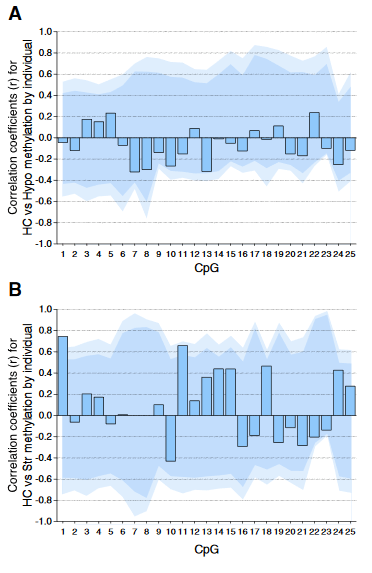
nonsignificance

Individual DNA methylation values were not correlated across brain tissues, despite tissue concordance at the group level.

For each CpG, we computed the Pearson correlation coefficient r between methylation values for matched samples in pairs of brain regions (bars). Dark and light shaded regions represent 95% and 99% thresholds, respectively, of distributions of possible correlation coefficients determined from 10,000 permutations of the measured values among the individuals. These distributions represent the null hypothesis that an individual DNA methylation value in one brain region does not help to predict the value in another region in the same animal.

(A) Correlations based on pyrosequencing data for matched samples passing validation in both hippocampus (HC) and hypothalamus (Hypo). Correlations for individuals at each CpG were either weak (.2 < r < .3) or absent (r < .2), and none were significant, even prior to correction for multiple comparisons.

(B) Correlations for matched samples passing validation in both hippocampus and striatum (Str). Two correlations (CpG 1 and 11) were individually significant prior to but not following correction, and this result could be expected by chance.

Correlations between hippocampus and blood (described in the text) yielded similar results, and no particular CpG yielded consistently high correlation across multiple tissues.”


The study focused on whether or not an individual’s experience-dependent oxytocin receptor gene DNA methylation in one of the four studied tissues could be used to infer a significant effect in the three other tissues. The main finding was NO, it couldn’t!

The researchers’ other findings may have been strengthened had they also examined causes for the observed effects. The “natural variation in maternal licking and grooming” developed from somewhere, didn’t it?

The subjects’ mothers were presumably available for the same tests as the subjects, but nothing was done with them. Investigating at least one earlier generation may have enabled etiologic associations of “the effects of early life rearing experience” and “individual variation in DNA methylation.”

https://www.sciencedirect.com/science/article/abs/pii/S0018506X1500118X “Natural variation in maternal care and cross-tissue patterns of oxytocin receptor gene methylation in rats” (not freely available)

The effects of imposing helplessness

This 2016 New York rodent study found:

“By using unbiased and whole-brain imaging techniques, we uncover a number of cortical and subcortical brain structures that have lower activity in the animals showing helplessness than in those showing resilience following the LH [learned helplessness] procedure. We also identified the LC [locus coeruleus] as the sole subcortical area that had enhanced activity in helpless animals compared with resilient ones.

Some of the brain areas identified in this study – such as areas in the mPFC [medial prefrontal cortex], hippocampus, and amygdala – have been previously implicated in clinical depression or depression-like behavior in animal models. We also identified novel brain regions previously not associated with helplessness. For example, the OT [olfactory tubercle], an area involved in odor processing as well as high cognitive functions including reward processing, and the Edinger–Westphal nucleus containing centrally projecting neurons implicated in stress adaptation.

The brains of helpless animals are locked in a highly stereotypic pathological state.”

Concerning the study’s young adult male subjects:

“To achieve a subsequent detection of neuronal activity related to distinct behavioral responses, we used the c-fosGFP transgenic mice expressing c-FosGFP under the control of a c-fos promoter. The expression of the c-fosGFP transgene has been previously validated to faithfully represent endogenous c-fos expression.

Similar to wild-type mice, approximately 22% (32 of 144) of the c-fosGFP mice showed helplessness.”

The final sentence of the Introduction section:

“Our study..supports the view that defining neuronal circuits underlying stress-induced depression-like behavior in animal models can help identify new targets for the treatment of depression.”


Helplessness is both a learned behavior and a cumulative set of experiences during every human’s early life. Therapeutic approaches to detrimental effects of helplessness can be different with humans than with rodents in that we can address causes.

The researchers categorized activity in brain circuits as causal in the Discussion section:

“Future studies aimed at manipulating these identified neural changes are required for determining whether they are causally related to the expression of helplessness or resilience.”

Studying whether or not activity in brain circuits induces helplessness in rodents may not inform us about causes of helplessness in humans. Our experiences are often the ultimate causes of helplessness effects. Many of our experiential “neural changes” are only effects, as demonstrated by this and other studies’ induced phenotypes such as “Learned Helplessness” and “Prenatally Restraint Stressed.”

Weren’t the researchers satisfied that the study confirmed what was known and made new findings? Why attempt to extend animal models that only treat effects to humans, as implied in the Introduction above and in the final sentence of the Discussion section:

“Future studies aimed at elucidating the specific roles of these regions in the pathophysiology of depression as well as serve as neural circuit-based targets for the development of novel therapeutics.”

http://journal.frontiersin.org/article/10.3389/fncir.2016.00003/full “Whole-Brain Mapping of Neuronal Activity in the Learned Helplessness Model of Depression” (Thanks to A Paper a Day Keeps the Scientist Okay)

Advance science by including emotion in research

This 2015 analysis of emotion studies found:

“Emotion categories [fear, anger, disgust, sadness, and happiness] are not contained within any one region or system, but are represented as configurations across multiple brain networks.

For example, among other systems, information diagnostic of emotion category was found in both large, multi-functional cortical networks and in the thalamus, a small region composed of functionally dedicated sub-nuclei.

The dataset consists of activation foci from 397 fMRI and PET [positron emission tomography] studies of emotion published between 1990 and 2011.”

From the fascinating Limitations section:

“Our analyses reflect the composition of the studies available in the literature, and are subject to testing and reporting biases on the part of authors. This is particularly true for the amygdala (e.g., the activation intensity for negative emotions may be over-represented in the amygdala given the theoretical focus on fear and related negative states). Other interesting distinctions were encoded in the thalamus and cerebellum, which have not received the theoretical attention that the amygdala has and are likely to be bias-free.

Some regions—particularly the brainstem—are likely to be much more important for understanding and diagnosing emotion than is apparent in our findings, because neuroimaging methods are only now beginning to focus on the brainstem with sufficient spatial resolution and artifact-suppression techniques.

We should not be too quick to dismiss findings in ‘sensory processing’ areas, etc., as methodological artifacts. Emotional responses may be inherently linked to changes in sensory and motor cortical processes that contribute to the emotional response.

The results we present here provide a co-activation based view of emotion representation. Much of the information processing in the brain that creates co-activation may not relate to direct neural connectivity at all, but rather to diffuse modulatory actions (e.g., dopamine and neuropeptide release, much of which is extrasynaptic and results in volume transmission). Thus, the present results do not imply direct neural connectivity, and may be related to diffuse neuromodulatory actions as well as direct neural communication.”


Why did the researchers use only 397 fMRI and PET studies? Why weren’t there tens or hundreds of times more candidate studies from which to select?

The relative paucity of candidate emotion studies demonstrated the prevalence of other researchers’ biases for cortical brain areas. The lead researcher of the current study was a coauthor of the 2016 Empathy, value, pain, control: Psychological functions of the human striatum, whose researchers mentioned that even their analyses of 5,809 human imaging studies was hampered by other imaging-studies researchers’ cortical biases.

Functional MRI signals depend on the changes in blood flow that follow changes in brain activity. Study designers intentionally limit their findings when they scan brain areas and circuits that are possibly activated by human emotions, yet exclude emotional content that may activate these areas and circuits.

Here are a few examples of limited designs that led to limited findings when there was the potential for so much more:

It’s well past time to change these practices now in the current year.


This study provided many methodological tests that should be helpful for research that includes emotion. It showed that there aren’t impenetrable barriers – other than popular memes, beliefs, and ingrained dogmas – to including emotional content in studies.

Including emotional content may often be appropriate and informative, with the resultant findings advancing science. Here are a few recent studies that did so:

http://journals.plos.org/ploscompbiol/article?id=10.1371%2Fjournal.pcbi.1004066 “A Bayesian Model of Category-Specific Emotional Brain Responses”

Treating prenatal stress-related disorders with an oxytocin receptor agonist

This 2015 French/Italian rodent study found:

“Chronic systemic treatment with carbetocin [unavailable in the US] in PRS [prenatally restraint stressed] rats corrected:

  • the defect in glutamate release,
  • anxiety– and depressive-like behavior,

and abnormalities:

  • in social behavior,
  • in the HPA response to stress, and
  • in the expression of stress-related genes in the hippocampus and amygdala.

These findings disclose a novel function of oxytocin receptors in the hippocampus, and encourage the use of oxytocin receptor agonists in the treatment of stress-related psychiatric disorders in adult life.”

carbetocin

The adult male subjects were:

“PRS rats..the offspring of dams exposed to repeated episodes of restraint stress during pregnancy.

These rats display anxiety- and depressive-like behaviors and show an excessive glucocorticoid response to acute stress, which is indicative of a dysregulation of the hypothalamus-pituitary-adrenal (HPA) axis caused by an impaired hippocampal glucocorticoid negative feedback.

PRS rats show a selective reduction in glutamate release in the ventral hippocampus.”

The researchers cited several other studies they have performed with the PRS phenotype. In the current study:

“Carbetocin treatment had no effect on these behavioral and neuroendocrine parameters in prenatally unstressed (control) rats, with the exception of a reduced expression of the oxytocin receptor gene in the amygdala.

Carbetocin displayed a robust therapeutic activity in PRS rats, but had no effect in unstressed rats, therefore discriminating between physiological and pathological conditions.”


The PRS phenotype showed the ease with which a child can be epigenetically changed – even before they’re born – to be less capable over their entire life. Just stress the pregnant mother-to-be.

https://www.sciencedirect.com/science/article/abs/pii/S0306453015002395 “Activation of presynaptic oxytocin receptors enhances glutamate release in the ventral hippocampus of prenatally restraint stressed rats” (not freely available) Thanks to coauthor Dr. Eleonora Gatta for providing the full study.

Stress consequences on gut bacteria, behavior, immune system, and neurologic function

This 2015 Canadian rodent study found:

“Chronic social defeat induced behavioral changes that were associated with reduced richness and diversity of the gut microbial community.

The degree of deficits in social, but not exploratory behavior, was correlated with group differences between the microbial community profile.

Defeated mice also exhibited reduced abundance of pathways involved in biosynthesis and metabolism of tyrosine and tryptophan: molecules that serve as precursors for synthesis of dopamine, norepinephrine, serotonin, and melatonin, respectively.

This study indicates that stress-induced disruptions in neurologic function are associated with altered immunoregulatory responses.”

These researchers had an extensive Discussion section where they placed study findings in contexts with other rodent and human studies. For example:

“Our analyses also predicted reduced frequency of fatty acid biosynthesis and metabolism pathways, including that of propanoate and butanoate – byproducts of dietary carbohydrate fermentation by intestinal microorganisms.

Butyrate is a potent histone deacetylase (HDAC) inhibitor that exerts antidepressant-like effects by increasing histone acetylation in the frontal cortex and hippocampus, and consequentially, raising BDNF transcript levels.

Although it was previously unclear whether systemic levels of these metabolites achieved in vivo were sufficient to produce behavioral changes, progress has been made by discovering their presence in cerebrospinal fluid and the brain, and demonstrating that colon-derived SCFAs [short chain fatty acids] cross the blood–brain barrier and preferentially accumulate in the hypothalamus, where they can affect CNS activity.”

http://www.psyneuen-journal.com/article/S0306-4530%2815%2900934-8/fulltext “Structural & functional consequences of chronic psychosocial stress on the microbiome & host”

Epigenetic effects of cow’s milk

This 2015 German paper with 342 references described:

“Increasing evidence that milk is not “just food” but represents a sophisticated signaling system of mammals.

This paper highlights the potential role of milk as an epigenetic modifier of the human genome paying special attention to cow milk-mediated overactivation of FTO [a gene associated with fat mass and obesity] and its impact on the transcriptome of the human milk consumer.”

The author declared “no competing interests” and “There are no sources of funding.” He presumably wasn’t pressured into writing this paper.

The paper wasn’t agenda-free, however. The main thesis was:

“Persistent milk-mediated epigenetic FTO signaling may explain the epidemic of age-related diseases of civilization.”

There were separate sections on how milk may promote:

  • Breast cancer
  • Prostate cancer
  • Obesity
  • Metabolic syndrome
  • Coronary heart disease
  • Early menarche
  • Type 2 diabetes
  • Neurodegenerative diseases

I don’t eat or drink dairy products because I’m lactose-intolerant. I coincidentally don’t have any of the diseases mentioned in the paper.

My life experiences haven’t led me to share the author’s sense of alarm, or to attribute other people’s problems to their consumption of milk products. However, more than a few problems I’ve had are things I’ve done to myself through actions or inaction that may have turned out differently if I had better information.

So I curated this article in case we’re insufficiently informed about the harmful epigenetic effects of milk. What do you think?

http://www.ncbi.nlm.nih.gov/pmc/articles/PMC4687119/ “Milk: an epigenetic amplifier of FTO-mediated transcription? Implications for Western diseases”

Epigenetic consequences of early-life trauma: What are we waiting for?

This 2015 UK human review discussed:

“The progress that has been made by studies that have investigated the relationship between depression, early trauma, the HPA axis and the NR3C1 [glucocorticoid receptor] (GR) gene.

Gene linkage studies for depression, as well as for other common complex disorders, have been perceived by some to be of only limited success; hence the focus on GWAS [genome-wide association studies]. However, even for simple traits, genetic variants identified by GWAS are rarely shown to account for more than 20% of the heritability.

Epigenetic changes are potentially reversible and therefore amenable to intervention, as has been seen in cancer, cardiovascular disease and neurological disorders.”


Five of the review’s references included FKBP5 (a gene that produces a protein that dampens glucocorticoid receptor sensitivity) in their titles, but it wasn’t mentioned in the review itself. A search on FKBP5 also showed human studies such as the 2014 Placental FKBP5 Genetic and Epigenetic Variation Is Associated with Infant Neurobehavioral Outcomes in the RICHS Cohort that found:

“Adverse maternal environments can lead to increased fetal exposure to maternal cortisol, which can cause infant neurobehavioral deficits. The placenta regulates fetal cortisol exposure and response, and placental DNA methylation can influence this function.

Placental FKBP5 methylation reduces expression in a genotype specific fashion, and genetic variation supersedes this effect. These genetic and epigenetic differences in expression may alter the placenta’s ability to modulate cortisol response and exposure, leading to altered neurobehavioral outcomes.”


The authors listed seven human studies conducted 2008-2015 “investigating interactions between methylation of NR3C1, depression and early adversity”:

“Newborn offspring exposed to maternal depression in utero had increased methylation at [a GR CpG site] as well as adverse neurobehavioural outcomes.

Unlike the majority of animal studies examining NR3C1 methylation, many types of potential stressors, sometimes at different developmental stages, have been used to represent early human adversity.

Substantial differences can be expected in the nature of stresses prenatally compared with postnatally, as well as their developmental consequences.”

Seven human studies over the past eight years was a very small number considering both the topic’s importance and the number of relevant animal studies during the period.

Is the topic too offensive for human studies? What makes people pretend that adverse prenatal and perinatal environments have no lasting consequences to the child?

“Many more studies will be needed before effects directly attributable to early life trauma can be separated from those relating to tissue type.

Although investigators have amassed a considerable amount of evidence for an association between differential methylation and HPA axis function in humans, a causal relationship still needs to be fully established.”

Factors that disrupt neurodevelopment may be the largest originators of epigenetic changes that are sustained throughout an individual’s entire lifespan.

Are the multitude of agendas that have resources thrown at them more important than ensuring the well-being of a human before and after they are born?

https://www.researchgate.net/publication/282048312_Early_life_trauma_depression_and_the_glucocorticoid_receptor_gene_-_an_epigenetic_perspective “Early life trauma, depression and the glucocorticoid receptor gene–an epigenetic perspective”

It is known: Are a study’s agendas more important than its evidence?

This 2015 Swiss human study’s Abstract began:

“It is known that increased circulating glucocorticoids in the wake of excessive, chronic, repetitive stress increases anxiety and impairs Brain-Derived Neurotrophic Factor (BDNF) signaling.”


The study had several statements that were unconvincingly supported by the study’s findings. One such statement in the Conclusions section was:

“This study supports the view that early-life adversity may induce long-lasting epigenetic changes in stress-related genes, thus offering clues as to how intergenerational transmission of anxiety and trauma could occur.”

However, the study’s evidence for “intergenerational transmission of anxiety and trauma” as summarized in the Limitations section was:

“This study did not directly associate child behavior or biology to maternal behavior and biology.”

In another example, the Discussion section began with:

“The severity of maternal anxiety was significantly correlated with mean overall methylation of 4 CpG sites located in exon IV of the BDNF promoter region as measured from DNA extracted from mothers’ saliva.

In addition, methylation at CpG3 was also significantly associated with maternal exposure to domestic violence during childhood, suggesting that BDNF gene methylation levels are modulated by early adverse experiences.”

The researchers assessed five DNA methylation values (four individual sites and the overall average). The CpG3 site was “significantly associated with maternal exposure to domestic violence during childhood” and the three other CpG sites’ methylation values were not.

IAW, the researchers found only one of four sites’ methylation values significantly associated to only one of many studied early adverse experiences. This finding didn’t provide sufficient evidence to support the overarching statement:

“BDNF gene methylation levels are modulated by early adverse experiences.”

To make such a generally applicable statement – more than one BDNF gene’s methylation levels could be directly altered by more than one early adverse experience – the researchers would, AT A MINIMUM, need to provide evidence that:

  1. The one category of significantly associated early adverse experience directly altered the one significantly associated CpG site’s DNA methylation level
  2. Other categories of early adverse experiences were fairly represented by the one significantly associated experience category
  3. Other categories of early adverse experiences could directly alter other BDNF genes’ DNA methylation levels
  4. The significantly associated DNA methylation level of only one out of four CpG sites was fairly represented by the overall average of the four sites
  5. Other BDNF gene’s methylation levels were fairly represented by the overall average of the four sites

If researchers and sponsors must have agendas, a worthwhile, evidence-supported one would be to investigate prenatal and perinatal epigenetic causes for later-life adverse effects.

As Grokking an Adverse Childhood Experiences (ACE) score pointed out, environmental factors that disrupt neurodevelopment may be the largest originators of epigenetic changes that are sustained throughout an individual’s entire lifespan.

What’s the downside of conducting studies that may “directly associate child behavior or biology to maternal behavior and biology” during time periods when a child’s environment has the greatest impact on their development?

When prenatal and perinatal periods aren’t addressed, researchers and sponsors neglect the times during which many harmful epigenetic consequences may be prevented. It is known.

http://journals.plos.org/plosone/article?id=10.1371/journal.pone.0143427 “BDNF Methylation and Maternal Brain Activity in a Violence-Related Sample”

A study of stress factors and neuroplasticity during infancy/early childhood

This 2015 French rodent study found:

“The coordinated actions of BDNF and glucocorticoids promote neuronal plasticity and that disruption in either pathway could set the stage for the development of stress-induced psychiatric diseases.

Genetic strategies that disrupted GR [glucocorticoid receptor] phosphorylation or TrkB [the BDNF receptor] signaling in vivo impaired the neuroplasticity to chronic stress and the effects of the antidepressant fluoxetine.

We demonstrate that fluoxetine prevented the neuroplasticity of chronic stress by priming GR phosphorylation at BDNF-sensitive sites.”


It wasn’t too difficult to see how many of the stressors had human equivalents during infancy/early childhood:

“To determine the plasticity of GR phosphorylation upon changes in the endogenous levels of BDNF and glucocorticoids, mice were exposed to a chronic unpredictable stress that included one daily random stressor for 10 consecutive days from P21 [immediately after weaning] to 1 mo of age.

Chronic unpredictable stress includes one of the following daily random stressors (wet bedding, no bedding, food deprivation, crowded cage, 2 h or 6 h restraining, forced swim, tail suspension).”

But who would give fluoxetine – Prozac – to a human infant or young child to prevent “the neuroplasticity of chronic stress” from having adverse effects?

http://www.pnas.org/content/112/51/15737.full “Neurotrophic-priming of glucocorticoid receptor signaling is essential for neuronal plasticity to stress and antidepressant treatment”