The epigenetic clock theory of aging

My 400th curation is a 2018 US/UK paper by coauthors of Using an epigenetic clock to distinguish cellular aging from senescence. They reviewed the current state of epigenetic clock research, and proposed a new theory of aging:

“The proposed epigenetic clock theory of ageing views biological ageing as an unintended consequence of both developmental programmes and maintenance programmes, the molecular footprints of which give rise to DNAm [DNA methylation] age estimators.

It is best to interpret epigenetic age estimates as a higher-order property of a large number of CpGs much in the same way that the temperature of a gas is a higher-order property that reflects the average kinetic energy of the underlying molecules. This interpretation does not imply that DNAm age simply measures entropy across the entire genome.

To date, the most effective in vitro intervention against epigenetic ageing is achieved through expression of Yamanaka factors, which convert somatic cells into pluripotent stem cells, thereby completely resetting the epigenetic clock. In vivo, haematopoietic stem cell therapy resets the epigenetic age of blood of the recipient to that of the donor.

Future epidemiological studies should consider other sources of DNA (for example, buccal cells), because more powerful estimates of organismal age can be obtained by evaluating multiple tissues. Other types of epigenetic modifications such as adenine methylation or histone modifications may lend themselves for developing epigenetic age estimators.”


https://www.nature.com/articles/s41576-018-0004-3 “DNA methylation-based biomarkers and the epigenetic clock theory of ageing” (not freely available)


I curated four other papers cited in this review:

Do you want your quality of life to be under or over this curve?

What are you doing to reverse epigenetic processes and realize what you want?

  • Do you have ideas and/or behaviors that interfere with taking constructive actions to change your phenotype?
  • If you aren’t doing anything, are you honest with yourself about feelings of helplessness?
  • Do your beliefs in fate, or in technology, or in divine interventions justify inactions?

The lifelong impact of maternal postpartum behavior

This 2018 French/Italian/Swiss rodent study was an extension of the work done by the group of researchers who performed Prenatal stress produces offspring who as adults have cognitive, emotional, and memory deficiencies and Treating prenatal stress-related disorders with an oxytocin receptor agonist:

“Reduction of maternal behavior [nursing behavior, grooming, licking, carrying pups] was predictive of behavioral disturbances in PRS [prenatally restraint stressed] rats as well as of the impairment of the oxytocin and its receptor gene expression.

Postpartum carbetocin [an oxytocin receptor agonist unavailable in the US] corrected the reduction of maternal behavior induced by gestational stress as well as the impaired oxytocinergic system in the PRS progeny, which was associated with reduced risk-taking behavior.

Moreover, postpartum carbetocin had an anti-stress effect on HPA [hypothalamic-pituitary-adrenal] axis activity in the adult PRS progeny and increased hippocampal mGlu5 [type 5 metabotropic glutamate] receptor expression in aging.

Early postpartum carbetocin administration to the dam enhances maternal behavior and prevents all the pathological outcomes of PRS throughout the entire lifespan of the progeny..proves that the defect in maternal care induced by gestational stress programs the development of the offspring.


This chart from Figure 4 summarized the behavioral performance of aged adult male progeny in relation to the experimental variables of:

  1. Stress administered to the mothers three times daily every day during the second half of pregnancy up until delivery; and
  2. The effects on the mothers’ behavior of daily carbetocin administration during postpartum days 1 through 7.

The symbols denote which of these relationships had statistically significant effects:

  • “* p [Pearson’s correlation coefficient] < 0.05 PRS-Saline vs. CONT-Saline;
  • # p < 0.05 PRS-Carbetocin vs. the PRS-Saline group.”

There are many interesting aspects to this study. Ask the corresponding coauthor Dr. Sara Morley-Fletcher at sara.morley-fletcher@univ-lille1.fr for a copy.

One place the paper referenced the researchers’ previous studies was in this context:

“Postpartum carbetocin administration reversed the same molecular and behavioral parameters in the hippocampus, as does adult chronic carbetocin treatment, i.e. it led to a correction of the HPA axis negative feedback mechanisms, stress and anti-stress gene expression, and synaptic glutamate release. The fact that postpartum carbetocin administration [to the stressed mothers in this study] had the same effect [on the PRS infants in this study] as adult carbetocin treatment [to the PRS offspring in the previous study] indicates a short-term effect of carbetocin when administered in adulthood and a reprogramming (long-term) effect lasting until an advanced age when administered in early development.”

This group’s research seems to be constrained to treatments of F0 and F1 generations. What intergenerational and transgenerational effects would they possibly find by extending research efforts to F2 and F3 generations?


As the study may apply to humans:

The study demonstrated that stresses during the second half of pregnancy had lifelong impacts on both the mothers’ and offsprings’ biology and behavior. Studies and reviews that attribute similar human biological and behavioral conditions to unknown causes, or shuffle them into the black box of individual differences, should be recognized as either disingenuous or insufficient etiological investigations.

The study showed that prevention of gestational stress was a viable strategy. The control group progeny’s biology and behavior wasn’t affected by carbetocin administration to their mothers because neither they nor their mothers had experience-dependent epigenetic deficiencies.

The study demonstrated a biological and behavioral cure for the PRS offspring by changing their stressed mothers’ behaviors during a critical period of their development. The above excerpt characterized improving the mothers’ behaviors as a long-term cure for the PRS descendants, as opposed to the short-term cure of administering carbetocin to the PRS children when they were adults.

What long-term therapies may be effective for humans who had their developmental trajectories altered by their mothers’ stresses during their gestation, or who didn’t get the parental care they needed when they needed it?

https://www.sciencedirect.com/science/article/pii/S0161813X18301062 “Reduced maternal behavior caused by gestational stress is predictive of life span changes in risk-taking behavior and gene expression due to altering of the stress/anti-stress balance” (not freely available)

The role of DNMT3a in fear memories

This 2018 Chinese rodent study found:

“Elevated Dnmt3a [a DNA methyltransferase] level in the dorsal dentate gyrus (dDG) of hippocampus was associated with the absence of fear renewal in an altered context after extinction training. Overexpression and knockdown of Dnmt3a in the dDG regulated the occurrence of fear renewal in a bi-directional manner.

We found that renewal of remote fear memory can be prevented, and the absence of renewal was concurrent with an elevated Dnmt3a level.

Our results indicate that Dnmt3a in the dDG is a key regulator of fear renewal after extinction, and Dnmt3a may play a critical role in controlling fear memory return and thus has therapeutic values.”


The study was a collection of five experiments investigating causes and effects of biology and behavior. The researchers used different techniques to achieve their goals. I’ve quoted extensively below to show some background and results.

“Alterations in histone acetylation and DNA methylation are involved in the formation and extinction of long-term memory. DNMTs catalyze the cytosine methylation and are required to establish and maintain genomic methylation.

Dnmt3a and Dnmt3b are de novo DNA methyltransferases. Dnmt1 is the maintenance DNA methyltransferase.

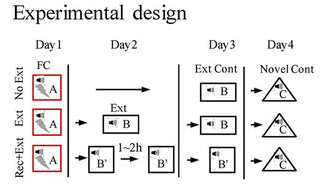
  1. Dnmt3a expression was elevated in the dDG after extinction training followed by a brief memory retrieval (Rec+Ext), which was associated with the absence of fear renewal when tested in an altered context.
  2. Increasing Dnmt3a expression in the dDG using AAV [recombinant adeno-associated virus] expression led to the prevention of fear renewal following a standard extinction training protocol. 
  3. Knockdown of Dnmt3a in the dDG using CRISPR/Cas9 resulted in fear renewal following Rec+Ext protocol.
  4. Renewal of remote fear memory can be prevented using the Rec+Ext protocol.
  5. The absence of renewal was concurrent with an elevated Dnmt3a level.

Current exposure therapy, although effective in many patients, suffers from the inability to generalize its efficacy over time, or is limited by the potential return of adverse memory in the new/novel contexts. These limitations are caused by the context-dependent nature of extinction which is widely viewed as the biological basis of exposure therapy.

Achieving a context-independent extinction may significantly reduce fear renewal to improve the efficacy of exposure therapy. Our current study suggests that the effectiveness of these approaches, and ultimately the occurrence of fear renewal, is determined by the level of Dnmt3a after extinction training, especially in the dDG.

There are two potential mechanisms underlying extinction, one is erasure or updating of the formed memory, and the other is the formation of a new extinction memory which suppresses or competes with the existing memory in a context-dependent manner. While most studies favor the suppression mechanism in the adult, limited studies do suggest that erasure occurs in the immature animals.

We propose that if Dnmt3a level is elevated with extinction training (such as with Rec+Ext protocol), modification to the existing memory occurs and as a consequence extinction does not act as a separate mechanism or form a new memory; but if Dnmt3a level is unaltered with extinction training, a separate extinction memory is formed which acts to suppress or compete with the existing memory.”


The relevant difference between humans and lab rats is that we can ourselves individually change our responses to experiential causes of ongoing adverse effects. Standard methodologies can only apply external treatments such as exposure therapy and manipulating Dnmt3a levels.

https://www.nature.com/articles/s41598-018-23533-w “Dnmt3a in the dorsal dentate gyrus is a key regulator of fear renewal”

The purpose of epigenetic mechanisms

The concluding remarks of this 2018 Chinese review were:

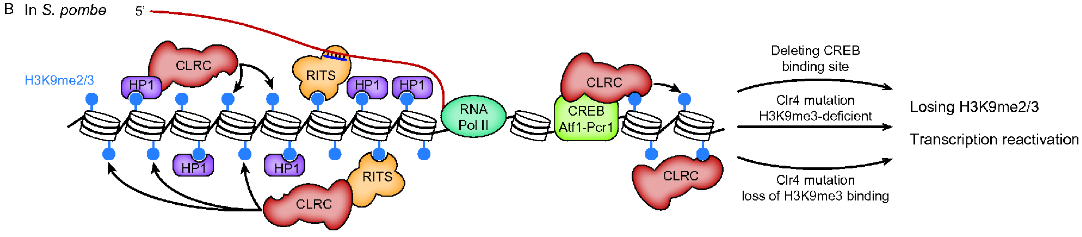
“Using heterochromatin as a model, we have reviewed here the mechanisms behind the establishment and maintenance of silent chromatin domains. We conclude that almost every component of the chromatin environment, including DNA elements, RNAs, histones and other chromatin proteins, plays a role in the process of shaping and maintaining epigenetic states.

Epigenetic mechanisms have evolved..to solve the problem of orchestrating the differentiation of cells with the same genome. Just as any stable system must preserve some degree of flexibility, crosstalk and feedback among all elements in the system are mechanistically required.

We emphasize that:

  1. Epigenetic information is inherited [from parent cell to child cell] in a relatively stable but imprecise fashion;
  2. Multiple cis and trans factors are involved in the maintenance of epigenetic information during mitosis; and
  3. The maintenance of a repressive epigenetic state requires both recruitment and self-reinforcement mechanisms.”


Studies I’ve curated in 2018 whose methodologies may have benefited from investigating multiple epigenetic mechanisms included:

Only DNA methylation:

Only microRNAs:

A review of studies that investigated DNA methylation and microRNAs but not histone modifications:

https://link.springer.com/article/10.1007/s11427-018-9276-7 “Recruitment and reinforcement: maintaining epigenetic silencing” (not freely available)

Genomic imprinting and growth

This 2018 UK paper reviewed genomic imprinting:

“Since their discovery nearly 30 years ago, imprinted genes have been a paradigm for exploring the epigenetic control of gene expression. Moreover, their roles in early life growth and placentation are undisputed.

However, it is becoming increasingly clear that imprinted gene function has a wider role in maternal physiology during reproduction – both by modulating fetal and placental endocrine products that signal to alter maternal energy homeostasis, and by altering maternal energetic set points, thus producing downstream actions on nutrient provisioning.”

“Imprinted genes in the conceptus produce products that alter maternal resource allocation by:

  1. altering the transport capacity of the placenta;
  2. increasing fetal demand for resources by their action on the intrinsic growth rate; and
  3. signalling to the mother by the production of fetal/placental hormones that modify maternal metabolism.”

Other studies/reviews I’ve curated that covered genomic imprinting are:

http://jeb.biologists.org/content/jexbio/221/Suppl_1/jeb164517.full.pdf “Genomic imprinting, growth and maternal-fetal interactions”


This post has somehow become a target for spammers, and I’ve disabled comments. Readers can comment on other posts and indicate that they want their comment to apply here, and I’ll re-enable comments.

How well do single-mother rodent studies inform us about human fathers?

Two items before getting to the review:

This 2018 Australian review subject was paternal intergenerational and transgenerational transmission of biological and behavioral phenotypes per this partial outline:

“Evidence for non-genetic inheritance of behavioral traits in human populations

  • Intergenerational inheritance modulating offspring phenotypes following paternal exposure to trauma
  • Epigenetic inheritance via the germline following paternal environmental exposures
  • Limitations of research on epigenetic inheritance in human populations

The transgenerational impact of stressful paternal environments

  • Impact of paternal stress on affective behaviors and HPA-axis regulation of progeny
  • Influence of paternal stress exposure on offspring cognition
  • Role of sperm-borne microRNAs in the epigenetic inheritance of stress

Sexually dimorphic aspects of paternal transgenerational epigenetic inheritance”

The review was comprehensive, and filled in the above outline with many details towards the goal of:

“This exciting new field of transgenerational epigenomics will facilitate the development of novel strategies to predict, prevent and treat negative epigenetic consequences on offspring health, and psychiatric disorders in particular.”

The reviewers also demonstrated that current intergenerational and transgenerational research paradigms exclude a father’s child care behavior.


The fact that studies use rat and mouse species where fathers don’t naturally provide care for their offspring has warped the translation of findings to humans. The underlying question every animal study must answer is: how can its information be used to help humans? I asked in A limited study of parental transmission of anxiety/stress-reactive traits:

“How did parental behavioral transmission of behavioral traits and epigenetic changes become a subject not worth investigating? These traits and effects can be seen everyday in real-life human interactions, and in every human’s physiology.

Who among us doesn’t still have biological and behavioral consequences from our experiences of our father’s child care actions and inactions? Why can’t researchers and sponsors investigate these back to their sources that may include grandparents and great-grandparents?

Such efforts weren’t apparent in the review’s 116 cited references that included:

The reviewer in the latter has been instrumental in excluding behavioral inheritance mechanisms from these research paradigms, leading to my questions:

  1. “If the experimental subjects had no more control over their behavioral stress-response effects than they had over their DNA methylation, histone modification, or microRNA stress-response effects, then why was such behavior not included in the “epigenetic mechanisms” term?
  2. How do behavioral inheritance mechanisms fall outside the “true epigenetic inheritance” term when behavioral stress-response effects are shown to be reliably transmitted generation after generation?
  3. Wouldn’t the cessation of behavioral inheritance mechanisms confirm their status by falsifiability as was similarly done with studies such as the 1995 Adoption reverses the long-term impairment in glucocorticoid feedback induced by prenatal stress?”

Translating rodent studies into human mothers’ behavioral transmission of biological and behavioral phenotypes isn’t hampered by the studied species’ traits as it is for human fathers. But sponsors have to have the guts to support human research that may not produce politically-correct findings.


http://www.translatingtime.org provides an inter-species comparative timeline. For example, an input of:

  • Species 1: Human
  • Process: Lifespan
  • Location: Whole Organism
  • Days (post-conception): 270
  • Species 2: Mouse

produces a list of event predictions. Note how many significant events occur before humans are born at day 270, assuming everything goes right with our developmental processes! Also, the model predictions for humans end at post-conception day 979, three weeks short of when we celebrate our second birthday.

https://www.nature.com/articles/s41380-018-0039-z “Transgenerational epigenetic influences of paternal environmental exposures on brain function and predisposition to psychiatric disorders” (not freely available) Thanks to Dr. Shlomo Yeshurun for providing a full copy.

Dealing with big data in epigenetic studies

There’s been a long-standing need for tools and mathematical techniques which effectively deal with the large amount of data present in epigenetic studies. Complete experimental conditions and results aren’t accurately described when researchers fail to transform large sets of data into information.

This 2018 Baltimore review/promotional paper described an approach that promised to resolve the following data issues.

1. Epigenetic changes occur in many ways and areas, and they often aren’t isolated from each other:

“Fully characterizing the polymorphic and stochastic nature of DNA methylation requires specification of joint probability distributions of methylation patterns formed by sets of spatially coupled CpG sites.”

2. The absence of DNA methylation or gene expression provides signals that should be processed into information. A study of DNA methylation and age reported this situation as:

“Due to the methods applied in the present study, not all the effects of DNA methylation on gene expression could be detected; this limitation is also true for previously reported results.

The textbook case of DNA methylation regulating gene expression (the methylation of a promoter and silencing of a gene) remains undetected in many cases because in an array analysis, an unexpressed gene shows no signal that can be distinguished from background and is therefore typically omitted from the analysis.”

The current review described the problem as:

“These techniques assign zero probabilities to unobserved methylation patterns despite their biological plausibility, which results in underestimating the true biological heterogeneity of methylation patterns.”

3. A subset of the above is that unknown or random past causes and effects of epigenetic changes aren’t adequately modeled:

“We demonstrated..that the empirical approach to joint methylation analysis..does not perform well when dealing with highly stochastic methylation data.”


The paper’s approach is tailored for whole genome bisulfite sequencing (WGBS), the “gold-standard experimental technique for studying DNA methylation.” It’s named informME and is publicly available at https://github.com/GarrettJenkinson/informME.

https://bmcbioinformatics.biomedcentral.com/track/pdf/10.1186/s12859-018-2086-5 “An information-theoretic approach to the modeling and analysis of whole-genome bisulfite sequencing data”

A study of gene-environment interactions

This 2018 Hungary/UK study used Bayesian analysis to better understand gene-environment interactions that produce depression:

“Most genetic studies do not consider the effect of stressors which may be one reason for the lack of replicable results in candidate gene studies, GWAS [genome-wide association studies] and between human studies and animal models. Animal models of depression usually imply environmental factors, such as chronic unpredictable stress or learned helplessness.

Relevance of functional polymorphisms in seven candidate genes previously implicated in animal and human studies on a depression-related phenotype given various recent stress exposure levels was assessed with Bayesian relevance analysis in 1682 subjects.

Our data support the strong causative role of the environment modified by genetic factors, similar to animal models.”

From the Methods and Materials section:

“In order to identify recent negative life events (RLE) we used the List of Threatening Experiences questionnaire which queried problems related to illnesses/injuries, financial difficulties, problems related to intimate relationships, and social network occurring in the last year. Based on corresponding items the number of RLEs was counted for each subject, and categorized (low = 0–1, moderate = 2, high = 3/more).”

One item from the findings, and two from the cited references were:

“5-HTTLPR [serotonin transporter], the most extensively investigated polymorphism with respect to interaction with life events, showed only very low relevance.

Compared to heritability which accounts for 37–42% in the variance in general population samples, influence of environmental effects is estimated at 63% in depression.

Etiologically relevant distal and proximal stressors are relatively common, and while frequency of severe life events is estimated to be one in every 3–4 years, depression is triggered in only about one fifth of those with acute stress exposure.”


The methods of this study bypassed problems with GWAS and provided evidence for the lasting effects of “Etiologically relevant distal..stressors.” This was another way of saying that traumatic experiences beginning from the earliest parts of our lives can affect our lifelong biology and behavior.

As mentioned in Changing an individual’s future behavior even before they’re born, GWAS:

“Focuses on the average effect of alternative alleles averaged in a population.”

What this methodology often missed was:

“When phenotypic variation results from alleles that modify phenotypic variance rather than the mean, this link between genotype and phenotype will not be detected.”

The problems found in GWAS may also be found in epigenome-wide association studies. Researchers conducting DNA methylation analyses in particular may benefit from changing their approach if what they’re doing follows the GWAS paradigm.

Using twins to estimate the extent of epigenetic effects summarized three studies’ methods that showed:

“The epigenetic effects of each of our unique experiences of our non-shared environment predominately determine our individual physiology.”

This study’s approach should be considered, given the almost 2:1 relative impacts of environmental over genetic factors in influencing our biology and behavior. It’s especially indicated when human studies don’t replicate animal studies’ findings from strictly controlled experimental environments.


It wasn’t the study’s purpose to evaluate effective treatments for depression. Yet the abstract ended with:

“Galanin-2 receptor, BDNF and X-type purin-7 receptor could be drug targets for new antidepressants.”

The researchers were very careful to document the benefits of using a different approach to a problem. I hope that in the future, they will maintain their carefulness and independence in their approach to solutions, and not be influenced by:

“Consultancy, speaking engagements and research for Bristol-Myers Squibb, AstraZeneca, Eli Lilly, Schering Plough, Janssen-Cilag and Servier..share options in P1vital..consultancy fees from Alkermes, Lundbeck-Otsuka Ltd., Janssen-Cilag Ltd and fees for speaking from Lundbeck.”

https://www.nature.com/articles/s41598-018-22221-z “Significance of risk polymorphisms for depression depends on stress exposure”

Sleep and adult brain neurogenesis

This 2018 Japan/Detroit review subject was the impact of sleep and epigenetic modifications on adult dentate gyrus neurogenesis:

“We discuss the functions of adult‐born DG neurons, describe the epigenetic regulation of adult DG neurogenesis, identify overlaps in how sleep and epigenetic modifications impact adult DG neurogenesis and memory consolidation..

Whereas the rate of DG neurogenesis declines exponentially with age in most mammals, humans appear to exhibit a more modest age‐related reduction in DG neurogenesis. Evidence of adult neurogenesis has also been observed in other regions of the mammalian brain such as the subventricular zone, neocortex, hypothalamus, amygdala, and striatum.

Adult‐born DG neurons functionally integrate into hippocampal circuitry and play a special role in cognition during a period of heightened excitability and synaptic plasticity occurring 4–6 weeks after mitosis. Adult DG neurogenesis is regulated by a myriad of intrinsic and extrinsic factors, including:

  • drugs,
  • diet,
  • inflammation,
  • physical activity,
  • environmental enrichment,
  • stress, and
  • trauma.”


Some of what the review stated was contradicted by other evidence. For example, arguments for sleep were based on the memory consolidation paradigm, but evidence against memory consolidation wasn’t cited for balanced consideration.

It reminded me of A review that inadvertently showed how memory paradigms prevented relevant research. That review’s citations included a study led by one of those reviewers where:

“The researchers elected to pursue a workaround of the memory reconsolidation paradigm when the need for a new paradigm of enduring memories directly confronted them!”

Some of what this review stated was speculation. I didn’t quote any sections after:

 “We go one step further and propose..”

The review also had a narrative directed toward:

“Employing sleep interventions and epigenetic drugs..”

It’s storytelling rather than pursuing the scientific method when reviewers approach a topic as these reviewers did.

Instead of reading a directed narrative, read this informative blog post from a Canadian researcher. The post provided scientific contexts to summarize what was and wasn’t known in 2018 about human neurogenesis.

http://onlinelibrary.wiley.com/doi/10.1002/stem.2815/epdf “Regulatory Influence of Sleep and Epigenetics on Adult Hippocampal Neurogenesis and Cognitive and Emotional Function”

An example of researchers changing their field’s paradigms

This 2018 German review subject was retroviruses:

“Initial indications that retroviruses are connected to neoplastic transformation were seen more than a century ago. 43% of the human genome is made up of such elements and 8% of the genome is comprised of retroviruses that infected human ancestors, entering cells of the germ line or proliferating thereafter by retrotransposition.

Endogenized retroviruses (ERVs) are abundantly expressed in many transformed cells. In healthy cells, ERV expression is commonly prevented by DNA methylation and other epigenetic control mechanisms.

A recent string of papers has described favorable outcomes of increasing human ERV (HERV) RNA and DNA abundance by treatment of cancer cells with methyltransferase inhibitors. Analogous to an infecting agent, the ERV-derived nucleic acids are sensed in the cytoplasm and activate innate immune responses that drive the tumor cell into apoptosis.”


Some researchers weren’t satisfied with the status quo of this century-old field:

“Chiappinelli et al. (2015) and Roulois et al. (2015) demonstrated a link between DNMTi-induced activation of HERV expression and innate sensing of transcribed viral RNAs and activation of innate immunity signaling pathways leading to an inhibition of tumor cell growth. These results represent a paradigm shift in our comprehension of the antitumor activity of demethylating agents.”

There are opportunities for any researcher whose field can be related to epigenetics to update the way studies are done. Why should researchers settle for mediocrity when they can make a difference?

https://www.ncbi.nlm.nih.gov/pmc/articles/PMC5816757/pdf/fmicb-09-00178.pdf “HERVs New Role in Cancer: From Accused Perpetrators to Cheerful Protectors”

What will it take for childhood trauma research to change paradigms?

This 2018 German human study found:

“DNA methylation in a biologically relevant region of NR3C1-1F [glucocorticoid receptor gene] moderates the specific direction of HPA-axis dysregulation (hypo- vs. hyperreactivity) in adults exposed to moderate-severe CT [childhood trauma].

In contrast, unexposed and mildly-moderately exposed individuals displayed moderately sized cortisol stress responses irrespective of NR3C1-1F DNA methylation. Contrary to some prior work, however, our data provides no evidence for a direct association of CT and NR3C1-1F DNA methylation status.”


The study was an example of why researchers investigating the lasting impacts of human traumatic experiences won’t find causes, effects, and productive therapies until their paradigms change.

1. Limited subject histories

A. Why weren’t the subjects asked for historical information about their parents, grandparents, and great-grandparents?

The researchers had no problem using animal studies to guide the study design, EXCEPT for animal studies of the etiologic bases of intergenerational and transgenerational transmission of biological and behavioral phenotypes. Just the approximate places and dates of three generations of the German subjects’ ancestors’ births, childhoods, adolescences, and early adulthoods may have provided relevant trauma indicators.

B. Why are studies still using the extremely constrained Childhood Trauma Questionnaire? Only one CTQ aspect was acknowledged as a study design limitation:

“Our findings rely on retrospective self-report measures of CT, which could be subject to bias.”

But bias was among the lesser limiting factors of the CTQ.

The study correlated epigenetic changes with what the subjects selectively remembered, beginning when their brains developed sufficient cognitive functionalities to put together the types of memories that could provide CTQ answers – around age four. The basic problem that kept the CTQ from discovering likely most of the subjects’ traumatic experiences causing epigenetic changes was that these experiences predated the CTQ’s developmental starting point:

  1. A human’s conception through prenatal period is when both the largest and the largest number of epigenetic changes occur, and is when our susceptibility and sensitivity to our environment is greatest;
  2. Birth through infancy is the second-largest; and
  3. Early childhood through the age of three is the third largest.

CTQ self-reports were – at best – evidence of experiences after age three, distinct from the  experience-dependent epigenetic changes since conception. If links existed between the subjects’ early-life DNA methylation and later-life conditions, they weren’t necessarily evidenced by CTQ answers about later life that can’t self-report relevant early-life experiences that may have caused DNA methylation.

2. Limited subject selection

The researchers narrowed down the initial 622 potential subjects to the eventual 200 subjects aged 18 to 30. An exclusion criteria that was justified as eliminating confounders led to this limitation statement:

“Our results might be based on a generally more resilient sample as we had explicitly excluded individuals with current or past psychopathology.”

Was it okay for the researchers to assert:

“Exposure to environmental adversity such as childhood trauma (CT) affects over 10% of the Western population and ranges among the best predictors for psychopathology later in life.”

but not develop evidence for the statement by letting people who may have been already affected by age 30 and received treatment participate in the study?

Was the study design so fragile that it couldn’t adjust to the very people who may be helped by the research findings?

3. Limited consequential measurements

The current study design conformed to previous studies’ protocols. The researchers chose cortisol and specific DNA methylation measurements.

A. Here’s what Sex-specific impacts of childhood trauma had to say about cortisol:

“Findings are dependent upon variance in extenuating factors, including but not limited to, different measurements of:

  • early adversity,
  • age of onset,
  • basal cortisol levels, as well as
  • trauma forms and subtypes, and
  • presence and severity of psychopathology symptomology.”

The researchers knew or should have known all of the above since this quotation came from a review.

B. What other consequential evidence for prenatal, infancy, and early childhood experience-dependent epigenetic changes can be measured? One overlooked area was including human emotions as evidence.

There are many animal studies from which to draw inferences about human emotions. There are many animal models of creating measurable behavioral and biological phenotypes of human emotion correlates, with many methods, including manipulating environmental variables during prenatal, infancy, and early childhood periods.

Studies that take detailed histories may arrive at current emotional evidence for human subjects’ earliest experience-dependent changes. Researchers who correlate specific historical environments and events, stress measurements, and lasting human emotions expressed as “I’m all alone” and “No one can help me” will better understand causes and effects.

CTQ answers weren’t sufficiently detailed histories.

4. Limited effective treatments and therapies

The current study only addressed this area in the final sentence:

“Given their potential reversibility, uncovering epigenetic contributions to differential trajectories following childhood adversity may serve the long-term goal of delivering personalized prevention strategies.”


Researchers – if your paradigms demonstrate these characteristics:

  • Why are you spending your working life in efforts that can’t make a difference?
  • Aren’t your working efforts more valuable than that?
  • What else could you investigate that could make a difference in your field?

I hope that researchers will value their professions enough to make a difference with their expertise. And that sponsors won’t thwart researchers’ desires for difference-making science by putting them into endless funding queues.

http://www.psyneuen-journal.com/article/S0306-4530(17)31355-0/pdf “Glucocorticoid receptor gene methylation moderates the association of childhood trauma and cortisol stress reactivity” (not freely available)

Cell senescence and DNA methylation

This 2018 Baltimore cell study found:

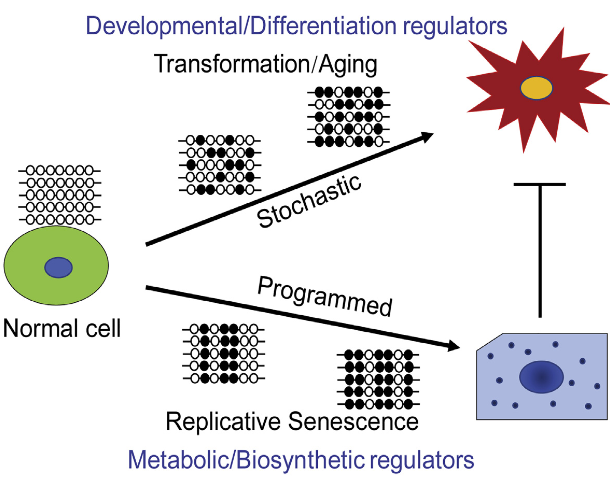
“Based on similarities in overall methylation patterns in replicative senescence and cancers, it is hypothesized that tumor-promoting DNA methylation in cancers derives from cells escaping senescence.

We show that the tumor-associated methylation changes evolve independently of senescence and are pro-survival events with functional implications contrasting that in senescence.

In our analyses, although overall global gains and losses in DNA methylation are similar, at individual genomic regions the methylation patterns are very different for senescence versus transformation.”

https://www.sciencedirect.com/science/article/pii/S1535610818300084 “DNA Methylation Patterns Separate Senescence from Transformation Potential and Indicate Cancer Risk” (not freely available)


I hesitated to use the study’s main graphic:
because the “Stochastic” labeling of the upper branch didn’t represent the vector’s meaning. The In Brief and the Summary sections contributed to the misrepresentation by stating:

“transformation-associated methylation changes arise stochastically.”

which wasn’t the study’s main finding:

“Our data outlined in the above sections strongly suggest against this senescence bypass hypothesis.”

Although the experimental design and methods evoked randomness:

“Immortalization on the path to malignant transformation involves stochastic epigenetic patterns from which cells contributing to transformation may evolve.”

the graphic’s upper branch vector represented the cells’ evolutionary responses. The Significance section best characterized what the study found:

“Tumor-associated methylation changes evolve independently of senescence and are pro-survival events.”

Would anyone at John Hopkins argue, as the graphic’s upper branch labeling suggested, that cellular aging is a predominantly random process? NO!


1. Epigenetics research and evolution promoted understanding the graphic’s upper branch vector:

“Evolution is an ongoing set of iterative interactions between organisms and the environment. Directionality is introduced by the agency of organisms themselves.”

2. The current study provided another data point about the uselessness of convenient but non-etiologic, inconsequential measurements of global methylation:

“Although overall global gains and losses in DNA methylation are similar, at individual genomic regions the methylation patterns are very different.”

3. The current study was congruent with the below finding of Using an epigenetic clock to distinguish cellular aging from senescence regarding the differentiation of cellular aging from senescence:

“Cellular ageing is distinct from cellular senescence and independent of DNA damage response and telomere length.”

The influence of donor age on induced pluripotent stem cell functionality

This 2018 German review subject was the influence of donor age on induced pluripotent stem cell functionality:

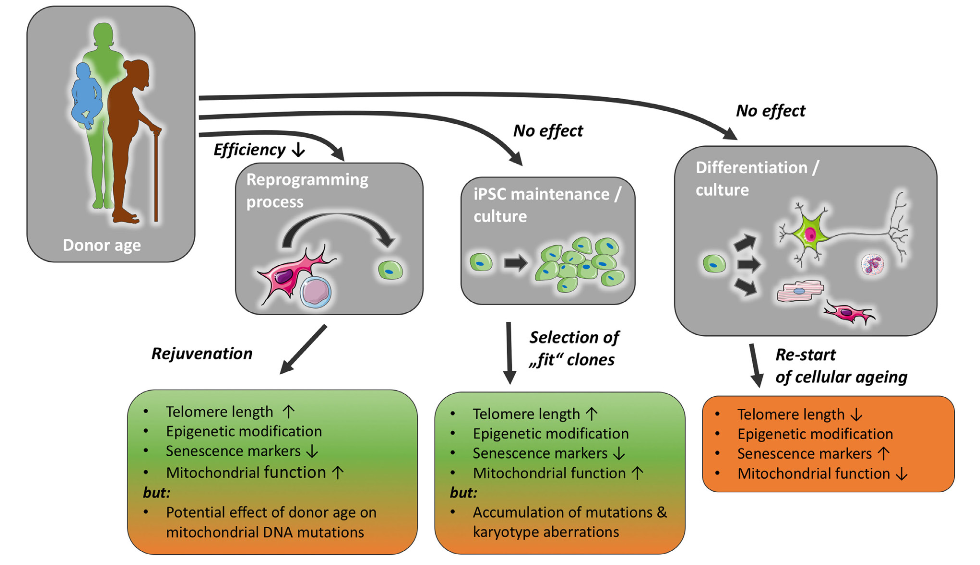
“Induced pluripotent stem cells (iPSCs) avoid many of the restrictions that hamper the application of human embryonic stem cells. Also, the donor’s clinical phenotype is often known when working with iPSCs.

Typical signs of cellular ageing are reverted in the process of iPSC reprogramming, and iPSCs from older donors do not show diminished differentiation potential nor do iPSC-derived cells from older donors suffer early senescence or show functional impairments when compared with those from younger donors.”

The reviewers discussed limitations in the current research:

  • “Mutations in nuclear and mitochondrial DNA acquired over the donor’s lifespan and during the reprogramming process might persist.
  • It is not yet known how strongly the variable genetic background of individual donors affects the reprogramming process and the quality of resulting iPSCs.
  • A low number of donors and cell lines is a general problem in almost all research articles on the topic of iPSCs. This combined with the lack of a standardised protocol for optimal iPSC derivation, culture and quality control makes any comparison between different publications very difficult if not impossible. Especially, since it has been shown that many factors influence the quality of iPSCs and iPSC-derived cells, such as time and cell type used for reprogramming, time in culture, or reprogramming modality.
  • A problem lies in the retention of tissue-specific epigenetic alterations which in part could be caused by incomplete reprogramming and might be improved by vigorous quality testing and careful selection of iPSC colonies during reprogramming and passaging.
  • The question regarding tumourigenicity will most likely only be answered satisfactorily once 1) the differentiation methods are further improved, 2) iPSC-derived cell-based therapies have made their way further into clinical practice, and 3) patients receiving treatments have been observed for multiple years.”

https://www.ncbi.nlm.nih.gov/pmc/articles/PMC5790033/pdf/fcvm-05-00004.pdf “Age Is Relative-Impact of Donor Age on Induced Pluripotent Stem Cell-Derived Cell Functionality”

Sex-specific impacts of childhood trauma

This 2018 Canadian paper reviewed evidence for potential sex-specific differences in the lasting impacts of childhood trauma:

“This paper will provide a contextualized summary of neuroendocrine, neuroimaging, and behavioral epigenetic studies on biological sex differences contributing to internalizing psychopathology, specifically posttraumatic stress disorder and depression, among adults with a history of childhood abuse.

Given the breadth of this review, we limit our definition [of] trauma to intentional and interpersonal experiences (i.e., childhood abuse and neglect) in childhood. Psychopathological outcomes within this review will be limited to commonly explored internalizing disorders, specifically PTSD and depression.

Despite the inconsistent and limited findings in this review, a critical future consideration will be whether the biological effects of early life stress can be reversed in the face of evidence-based behavioral interventions, and furthermore, whether these changes may relate to potentially concurrent reductions in susceptibility to negative mental health outcomes.”


It was refreshing to read a paper where the reviewers often interrupted the reader’s train of thought to interject contradictory evidence, and display the scientific method. For example, immediately after citing a trio of well-respected studies that found:

“Psychobiological research on relationships linking impaired HPA axis functioning and adult internalizing disorders are suggestive of lower basal and afternoon levels of plasma cortisol in PTSD phenotype.”

the reviewers stated:

“However, a recent meta-analysis suggests no association between basal cortisol with PTSD.”

and effectively ended the cortisol discussion with:

“Findings are dependent upon variance in extenuating factors, including but not limited to, different measurements of:

  • early adversity,
  • age of onset,
  • basal cortisol levels, as well as
  • trauma forms and subtypes, and
  • presence and severity of psychopathology symptomology.”

The reviewers also provided good summaries of aspects of the reviewed subject. For example, the “Serotonergic system genetic research, childhood trauma and risk of psychopathology” subsection ended with:

“Going forward, studies must explore the longitudinal effects of early trauma on methylation as well as comparisons of multiple loci methylation patterns and interactions to determine the greatest factors contributing to health outcomes. Only then, can we start to consider the role of sex in moderating risk.”


I didn’t agree with the cause-ignoring approach of the behavior therapy mentioned in the review. Does it make sense to approach one category of symptoms:

“the biological effects of early life stress”

by treating another category of symptoms?

“can be reversed in the face of evidence-based behavioral interventions.”

But addressing symptoms instead of the sometimes-common causes that generate both biological and behavioral effects continues to be the direction.

After receiving short-term symptom relief, wouldn’t people prefer treatments of originating causes so that their various symptoms don’t keep bubbling up? Why wouldn’t research paradigms be aligned accordingly?

I was encouraged by the intergenerational and transgenerational focus of one of the reviewer’s research:

“Dr. Gonzalez’s current research focus is to understand the mechanisms by which early experiences are transmitted across generations and how preventive interventions may affect this transmission.”

This line of hypotheses requires detailed histories, and should uncover causes for many effects that researchers may otherwise shrug off as unexplainable individual differences. Its aims include the preconception through prenatal periods when both the largest and the largest number of epigenetic changes occur, and is when our susceptibility and sensitivity to our environment is greatest. There are fewer opportunities for effective “preventive interventions” in later life compared with these early periods.

Unlike lab rats, women and men can reach some degree of honesty about our early lives’ experiential causes of ongoing adverse effects. Experiential therapies that allow humans to potentially change their responses to these causes deserve more investigation than do therapies that apply external “interventions.”

https://www.sciencedirect.com/science/article/pii/S0272735817302647 “Biological alterations affecting risk of adult psychopathology following childhood trauma: A review of sex differences” (not freely available) Thanks to lead author Dr. Ashwini Tiwari for providing a copy.

Viruses target epigenetic processes

This 2018 Colorado review subject was general and specific ways viruses target epigenetic processes:

“We describe viral mechanisms and virus-host interactions by which DNA tumor viruses regulate host DNA methylation to evade antiviral immunity.

It is well known that most endogenous retroviruses and retrotransposons in the human genome are inactivated by DNA hypermethylation. In addition to endogenous retroviruses, the genomes of DNA viruses, such as human papillomavirus (HPV), herpes simplex virus 1 (HSV-1), adenovirus, and hepatitis B virus (HBV), are also frequently methylated and silenced in infected cells.

A recently described mechanism for viruses to epigenetically subvert host immunity is repression of immune-related gene expression by induction of DNA hypermethylation. Some host genes are not silenced simply through promoter hypermethylation or histone deacetylation alone, and therefore, viruses may have evolved mechanisms to ensure host gene downregulation through multiple epigenetic modifications.”

http://www.mdpi.com/1999-4915/10/2/82/htm “DNA Tumor Virus Regulation of Host DNA Methylation and Its Implications for Immune Evasion and Oncogenesis”


A second 2018 New York study focused on the Zika virus and DNA methylation:

“We studied the impact of ZIKV infection on the DNA methylation pattern across the entire genome in selected neural cell types. The virus unexpectedly alters the DNA methylome of neural progenitors, astrocytes, and differentiated neurons at genes that have been implicated in the pathogenesis of a number of brain disorders.

It remains open, however, whether the methylation changes come first or whether the viral infection dysregulates epigenetic regulatory genes prior to any epigenetic shift.”

http://msystems.asm.org/content/3/1/e00219-17 “Zika Virus Alters DNA Methylation of Neural Genes in an Organoid Model of the Developing Human Brain”