Transgenerational transmission of stress

This 2023 rodent study found that effects of stress during mid-late gestation were epigenetically transmitted to the first, second, and third female generations:

“We investigated effects of gestational chronic variable stress (CVS) in rats using restraint and social isolation stress in the parental F0 generation. Only the F0 pregnant dams were subjected to stress.

When a pregnant female experiences adversity, impacts of that stress affect exposed somatic tissues (F0 generation), the fetuses (F1 generation), and the fetuses’ germline (F2 generation). A true transgenerational inheritance arises when germline epimutations are transmitted to unexposed F3 offspring.

A subset of F1 rats was housed in an enriched environment (EE) to mitigate adverse effects of CVS. F2 offspring reared in EE had increased birth weights, but their uterine gene expression patterns remained comparable to those of stressed animals.

ijms-24-03734-g001

We provide evidence that psychological and psychosocial CVS alters inflammatory status and endocrine markers in uteri of adult dams through transgenerational programming of the female germline. EE therapy in prenatally stressed F1 offspring had no beneficial effects on uterine expression of inflammatory and endocrine markers for them or their future offspring.”

https://www.mdpi.com/1422-0067/24/4/3734 “Environmental Enrichment Promotes Transgenerational Programming of Uterine Inflammatory and Stress Markers Comparable to Gestational Chronic Variable Stress”


PXL_20230611_100728709

Taurine’s effects on healthspan and lifespan

A 2023 human / primate / rodent / worm study with 56 coauthors exhaustively investigated taurine effects:

“We measured the blood concentration of taurine during aging and investigated the effect of taurine supplementation on healthspan and lifespan in several species.

  • In C57Bl/6J wild-type (WT) mice, serum taurine concentrations declined from 132.3 ± 14.2 ng/ml at 4 weeks to 40.2 ± 7.1 ng/ml at 56 weeks.
  • In 15-year-old monkeys, serum taurine concentrations were 85% lower than in 5-year-old monkeys.
  • Taurine concentrations in elderly humans were decreased by more than 80% compared with concentration in serum of younger individuals.

Regardless of their sex, taurine-fed mice survived longer than control mice. The median lifespan increase was 10 to 12%, and life expectancy at 28 months increased by 18 to 25%.

Improved survival of taurine-fed mice was not a consequence of low survival of control animals or differences in diet. Taurine deficiency is a driver of aging in mice because its reversal increases lifespan.

lifespan extension starting taurine in middle age

We investigated the health of taurine-fed middle-aged mice and found an improved functioning of bone, muscle, pancreas, brain, fat, gut, and immune system, indicating an overall increase in healthspan. Taurine reduced cellular senescence, protected against telomerase deficiency, suppressed mitochondrial dysfunction, decreased DNA damage, and attenuated inflammation.

An association analysis of metabolite clinical risk factors in humans showed that lower taurine, hypotaurine, and N-acetyltaurine concentrations were associated with adverse health, such as increased abdominal obesity, hypertension, inflammation, and prevalence of type 2 diabetes. We found that a bout of exercise increased concentrations of taurine metabolites in blood, which might partially underlie antiaging effects of exercise.

Taurine abundance decreases during aging. A reversal of this decline through taurine supplementation increases healthspan and lifespan in mice and worms, and healthspan in monkeys.”

https://www.science.org/doi/10.1126/science.abn9257 “Taurine deficiency as a driver of aging”


One area curiously not investigated in this study was that taurine supplementation freed up cysteine to do things other than synthesize taurine, like synthesize glutathione, an idea in Treating psychopathological symptoms will somehow resolve causes? An introductory article brought up this point:

“One of the most studied mechanisms of action for taurine is an increase in antioxidant capacity. Although oxidative damage is not clearly linked to mammalian lifespan, it plays a role in many age-associated pathologies.

Taurine is a poor scavenger of reactive oxygen species, with the exception of hypochlorite, which it detoxifies to N-chlorotaurine. N-Chlorotaurine is anti-inflammatory and induces expression of antioxidant enzymes in mice and humans.

Taurine supplementation might also cause an increase in levels of its precursors, including the antioxidants hypotaurine and cysteine. An interesting corollary is that up-regulating endogenous taurine synthesis would have the opposite result—consuming hypotaurine and cysteine.”

https://www.science.org/doi/10.1126/science.adi3025 “Taurine linked with healthy aging”


A human equivalent taurine dose is (1 g x .081) x 70 kg = 5.67 grams. Dose tests from supplementary data were:

“Dose and frequency of taurine administration was selected based on a pilot study, which showed that when given once daily to middle-aged WT mice, this regimen increased peak blood taurine concentrations to baseline concentrations in young (4-week-old) mice.”

taurine dose

I’ve taken 2 grams every day for the past three years, and will now bump that up to 5 grams. My diet doesn’t regularly include any foods high in taurine.

I recommend reading the study rather than commentaries. Its publisher did a very good job of linking figures so that images can be viewed, then the reader returned to the right context.

Gatekeepers are out in full force on this study, and their viewpoints are probably what you’ll see first, to include unevidenced statements like “the study’s main authors cautioned the public not to self-dose with the supplement” and the above introductory article’s unreferenced “equivalent doses used in the study by Singh et al. would be very high in humans.” Pretty pathetic that such ‘authorities’ are even publicized after recent years of deliberately misleading the world about science and medicine.

This study and all commentaries called for clinical trials that are NOT going to happen:

  • Drug companies can’t make money from a research area that’s cheap, not patentable, and readily accessible.
  • Government sponsors are likewise not incentivized to act in the public’s interest per their recent behavior.

Take responsibility for your own one precious life. See Part 2 for a sample of citing papers.

PXL_20230601_181526429

Amphibian epigenetic clocks

This 2023 study of two frog species expanded one of the cited studies in Epigenetic clocks so far in 2022 to include post-embryonic epigenetic clock measurements:

“We generated DNA methylation data from African clawed frogs (Xenopus laevis) and Western clawed frogs (Xenopus tropicalis) and built multiple epigenetic clocks. Dual species clocks were developed that apply to both humans and frogs (human-clawed frog clocks), supporting that epigenetic aging processes are evolutionary conserved outside mammals.

The two species underlying our Xenopus clocks have markedly different maximum lifespans (30.3 for X. laevis and 16 for X. tropicalis), and average ages of sexual maturity (1 year for laevis and 0.375 for tropicalis). When building our Xenopus clocks, we addressed this fact in two ways:

  • In our pan-clock, we used a log-linear transformation of age that effectively normalizes ages with respect to age at sexual maturity.
  • In our relative pan-clock, we instead estimate relative age (chronological age divided by maximum lifespan), which normalizes ages with respect to maximum lifespan.

We also created dual-species clocks, referred to as human-clawed frog clocks, for estimates of chronological age and relative age. Relative age is the ratio of chronological age to maximum lifespan, and takes on values between 0 and 1. Maximum lifespan observed for humans was 122.5 years.

The relative age clock allows for alignment and biologically meaningful comparison between species with different lifespans.

relative age

Previous studies in humans showed that a hallmark of age-related CpGs is their association with target sites of Polycomb repressive complex 2 (PRC2), which gain methylation with age. This feature is fully recapitulated in Xenopus, and physiological significance of this association is an important open question.

PRC2 plays a prominent role during embryonic development and consequently, many aging-clock-associated genes relate to developmental processes. Given its evolutionary conservation from frogs to humans, methylation status of PRC2 targets supports some critical causal relationship to systemic aging.

Since the association with PRC2 with aging stems from analyses of adult postmitotic cells, and of different tissue origin rather than from embryonic cells, it is tempting to speculate that adult methylation status will get important input during embryonic development, the very phase when PRC2 target gene expression is prominent.

Genes associated with both positive and negative age-related CpGs relate to neural processes, although in somewhat opposite direction. While DNAm increase is linked to neural developmental genes, DNAm decrease links to synaptic transmission, roughly corresponding to processes of immature vs. mature neuronal cells, respectively. This leads to the counter-intuitive suggestion that studying Xenopus neural development may yield new insights into biological aging.”

https://link.springer.com/article/10.1007/s11357-023-00840-3 “DNA methylation clocks for clawed frogs reveal evolutionary conservation of epigenetic aging”


I’ve seen dual-species epigenetic clocks – introduced in A rejuvenation therapy and sulforaphane – referenced elsewhere, most recently in Selective Breeding for High Intrinsic Exercise Capacity Slows Pan-Tissue Epigenetic Aging in Rats. These clocks still aren’t in wide use by researchers, though. Don’t know what it will take to persuade researchers to use dual-species relative age clocks in their model organism studies so that they can justifiably invoke human applicability.

PXL_20230601_182718629

Measuring gut microbiota, Part 1

A 2023 paper combined results of two clinical trials focused on large intestine microbiota:

“Our current understanding of the gut microbiome places it at the center of multiple physiological processes, and establishes its relevance to many facets of health and disease. Microbiome databases are based upon stool samples or invasively-acquired colon samples obtained during procedures such as colonoscopy.

We present data from two prospective clinical studies describing significant differences between the stool microbiome and inner-colonic microbiome collected during FDA-cleared defecation-inducing, gravity-fed, and high-volume colonic lavage. We examined several microbiome characteristics, including microbial diversity, community differential abundance, and composition of biosynthetic gene clusters (BGCs).

BGCs are locally clustered groups of two or more genes that encode a biosynthetic pathway that produces a secondary metabolite:

  • 6% of identified BGCs were common to stool and pooled inner-colonic effluent samples, 25% were expressed only in stool, and 69% were unique to effluent samples.
  • When effluent-specific BGCs were divided according to colon areas, 25% were found in Effluent-1 (left descending colon), 21% in Effluent-2 (transverse colon), and 11% in Effluent-3 (right ascending colon).

gr4

Taxonomic and phylogenetic differences between inner-colonic effluent and stool samples increased gradually when approaching the proximal colon and small intestine:

  • Comparing the left colon to stool showed that 22 species were significantly enriched while only five species were significantly more abundant in stool.
  • A comparison between the transverse colon and stool revealed 76 species that were significantly more differentially abundant, while stool had 10 differentially abundant species.
  • The most significant differentially abundant species were found by comparing the right colon (closest to the small intestine) to stool, with 96 species differently enriched while stool had 20 species significantly enriched.

Individuals are far more distinct in their inner-colonic microbial community than in their stool samples. Microbiota are relatively similar across patients when examining stool samples, while expression of rare microbial strains is more specific to each individual.

Analyzing both stool and inner-colonic effluents can provide more information on the gut microbiome.”

https://www.cell.com/heliyon/fulltext/S2405-8440(23)00809-5 “The gut microbiome–Does stool represent right?”

Continued in Part 2.


PXL_20230529_162603190.MP

Nrf2 Week #8: Epithelium

A 2023 review of Nrf2 regulating repair of epithelial cells in the skin, eye, lung, liver, and kidney:

“Major functions of epithelial cells include secretion/excretion of material, absorption of nutrients, as well as filtration. Some epithelial cells also act as a barrier to, and sensor of, the external environment, and are actively involved in inflammatory processes.

The epithelium is equipped with efficient protective capabilities to handle diverse environmental challenges while maintaining its function, or in the case of injury, mounting an effective repair response. It coordinates a combination of proliferation, migration, cell spreading, and differentiation to restore the lost tissue and its functionality. Defects in any of these cellular processes can result in chronic tissue damage as seen, for example, in chronic skin ulcers.

m_bst-2022-0228c.02

We summarize evidence for a direct involvement of NRF2 in repair processes after injury has occurred and relevant NRF2 target genes whose function extend beyond cytoprotection. We report on tissues and organs for which such data are available, including skin, eye, lung, liver, and kidney. Roles of NRF2 in repair of additional epithelial tissues are likely, but remain to be determined.

A beneficial effect of NRF2 activation on epithelial repair was confirmed in multiple studies. However, prolonged activation negatively impacted repair of the lung, liver, and kidney under certain conditions.

Compounds or treatment regimens that allow a precise timing of the extent and duration of NRF2 activation are required for promoting tissue repair. Identification of further NRF2 target genes and their function could help predict for what tissues or injury situations NRF2 activation may offer the greatest benefit.”

https://portlandpress.com/biochemsoctrans/article/51/1/101/232562/Targeting-NRF2-to-promote-epithelial-repair “Targeting NRF2 to promote epithelial repair”

Nrf2 Week #7: Immunity

Two reviews of Nrf2 relationships with our two immune systems, starting with adaptive immunity:

“We highlight recent findings about the influence of Keap1 and Nrf2 in development and effector functions of adaptive immune cells, T lymphocytes and B lymphocytes. We summarize Nrf2 research potential and targetability for treating immune pathologies.

Immune cells have mechanisms in place to strike a perfect redox balance, and to modulate levels of ROS differentially during their naive, activated, and effector stages for tailored immune responses. Cells of the lymphoid lineage (T, B, and NK cells) and myeloid lineage (macrophages, granulocytes, dendritic cells, and myeloid-derived suppressor cells) are generated from self-renewing progenitors, hematopoietic stem cell (HSCs) in the bone marrow.

Nrf2 activation in HSCs skews hematopoietic differentiation toward the myeloid lineage at the cost of the lymphoid lineage cells. Nrf2 does not participate in late T cell development leading to generation of single-positive CD4 and CD8 T cells.

ih2200061f2

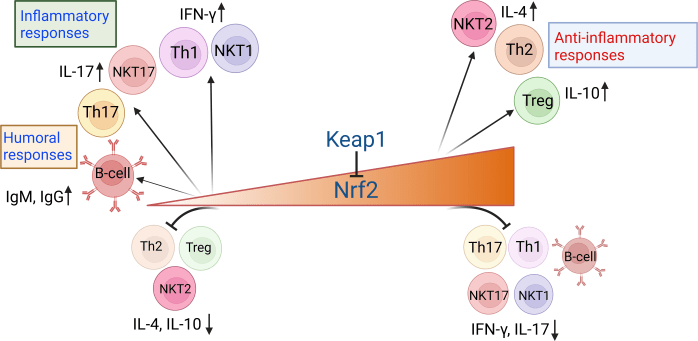
  • Nrf2 activation supports differentiation of the Th2 subset, regulatory T cells (Tregs), and the NKT2 subset while inhibiting differentiation of Th1, Th17, NKT1, and NKT17 subsets.
  • The absence of or low Nrf2 results in enhanced proinflammatory responses, characterized by differentiation of Th1, Th17, NKT1, and NKT17 subsets, and subdued generation of Th2, Treg, and NKT2 subsets.

Nrf2 activation levels also influence generation of humoral responses.

  • Low Nrf2 levels favor T cell–dependent production of IgG and IgM Abs by activated B cells.
  • High Nrf2 suppresses B cell responses such as differentiation of germinal center B cells and plasma cells.

Nrf2 negatively regulates T–cell mediated inflammatory responses and T-dependent B cell responses.

https://journals.aai.org/immunohorizons/article/7/4/288/263657/Beyond-Antioxidation-Keap1-Nrf2-in-the-Development “Beyond Antioxidation: Keap1–Nrf2 in the Development and Effector Functions of Adaptive Immune Cells”


And our innate immune system:

“Nrf2 regulates the immune response by interacting directly or indirectly with one or more of the major innate immune signaling components that maintain cellular homeostasis. Toll-like receptors (TLR) signaling can induce Nrf2 activation, and this is primarily found to be through autophagy-mediated degradation of Keap1.

TLR agonists may be considered as stimuli that induce Nrf2 to reduce stress and inflammation, linking the immune and antioxidant pathways. Conversely, Nrf2 activation may restrain TLR-mediated inflammatory response through induction of antioxidant proteins and inhibition of pro-inflammatory cytokines.

Following LPS stimulation, the NF-κB pathway is engaged to initiate a host of pro-inflammatory responses such as IL-6 and interleukin 1 beta (IL-1β) gene expression. Nrf2 induction inhibits LPS-mediated activation of pro-inflammatory cytokines in macrophages.

Inflammasome activation is an essential component of the innate immune response, and is critical for clearance of pathogens or damaged cells through pro-inflammatory cytokine secretion and/or cell-death induction. While Nrf2 activation is in general associated with an anti-inflammatory state, Nrf2 has also been reported to be required for optimal NLRP3 inflammasome activity.

The type-I interferon (IFN) system constitutes an essential part of innate immunity. Type-I IFNs are produced upon recognition of foreign or self-DNA or RNA, and are best-known for inducing an antiviral state through the induction of interferon-stimulated genes. While Nrf2 interferes with IRF3 activation, STING expression, and type-I IFN signaling, none of these crucial players in innate immunity have been demonstrated to be direct targets of Nrf2.

The antiviral effect of Nrf2 activation by 4-OI may use various pathways to limit viral replication that have not been identified yet. It is important to consider that Nrf2-activating metabolites may also act as immunomodulators in a Nrf2-independent manner.

Anti-inflammatory properties of Nrf2 are independent of redox control. Further mechanistic studies are needed to decipher the exact indirect and/or direct interactions between Nrf2 and innate immune players.”

https://www.sciencedirect.com/science/article/pii/S0952791522000942 “Regulation of innate immunity by Nrf2”

Nrf2 Week #6: Phytochemicals

This 2023 review explored Nrf2 relationships with plant chemicals:

“This review focuses on possible mechanisms of Nrf2 activation by natural phytochemicals in preventing or treating chronic diseases, and regulating oxidative stress. Excess oxidative stress is closely related to many kinds of chronic diseases, such as cardiovascular diseases, cancer, neurodegenerative diseases, diabetes, obesity, and other inflammatory diseases.

Mitochondrial dysfunction and hyperglycemia lead to the massive production of ROS, which triggers molecular damage, inflammation, ferroptosis, insulin resistance, and β-cell dysfunction.

antioxidants-12-00236-g001

Crosstalk between Keap1-Nrf2-ARE pathway and other signaling pathways endows it with high complexity and significance in the multi-function of phytochemicals. Limited human data makes an urgent need to open the new field of phytochemical-original supplement application in human chronic disease prevention.”

https://www.mdpi.com/2076-3921/12/2/236 “The Regulatory Effect of Phytochemicals on Chronic Diseases by Targeting Nrf2-ARE Signaling Pathway”


Top ten mentions, not including references:

  • 21 Sulforaphane
  • 16 Broccoli
  • 9 Curcumin
  • 5 Resveratrol
  • 5 Green tea catechins
  • 4 Luteolin
  • 3 Garlic
  • 3 Soy isoflavones
  • 3 Lycopene
  • 3 Quercetin

PXL_20230518_191008431

Nrf2 Week #4: Aging

Two 2023 reviews of Nrf2 and aging, starting with Nrf2-mitochondria interactions:

“We discuss molecular mechanisms of interactions between Nrf2 and mitochondria that influence the rate of aging and lifespan. Nrf2 activity positively affects both mitochondrial dynamics and mitochondrial quality control.

Nrf2 influences mitochondrial function through regulation of nuclear genome-encoded mitochondrial proteins and changes in the balance of ROS or other metabolites. In turn, multiple regulatory proteins functionally associated with mitochondria affect Nrf2 activity and even form mutual regulatory loops with Nrf2. These loops enable fine-tuning of cellular redox balance and, possibly, of the cellular metabolism as a whole.

mtDNA-encoded signal peptides interact with nuclear regulatory systems, first of all, Nrf2, and are possibly involved in regulation of the aging rate. Interactions between regulatory cascades that link programs ensuring maintenance of cellular homeostasis and cellular responses to oxidative stress are a significant part of both aging and anti-aging programs.

Understanding these interactions will be of great help in searching for molecular targets to counteract aging-associated diseases and aging itself. Future research on Nrf2 signaling and ability of various substances that activate the Nrf2 pathway to prevent age-associated chronic diseases will provide further insight into the role of Nrf2 activation as a possible longevity-promoting intervention.”

https://link.springer.com/article/10.1134/S0006297922120057 “Transcription Factor Nrf2 and Mitochondria – Friends or Foes in the Regulation of Aging Rate” (not freely available) Thanks to Dr. Gregory A. Shilovsky for providing a copy.


The second review evaluated whether Nrf2 is a master regulator of aging:

“This paper briefly presents main mechanisms of mammalian aging and roles of inflammation and oxidative stress in this process. Mechanisms of Nrf2 activity regulation, its involvement in aging and development of the senescence-associated secretory phenotype are also discussed.

The age-related decrease in Nrf2 activity is of universal interspecies character:

  • Rodents with high Nrf2 activity have a longer lifespan than rodents with low activity.
  • Genetic knockout of Nrf2 usually leads to the increased senescent phenotype in a variety of animal organs and tissues, and also reduces lifespan of female mice.
  • There are also opposite examples, where Nrf2 knockout in aging mice reduced iron ions deposition in the brain, lowered the level of oxidative damage in the striatum, and also alleviated age-related motor dysfunction.

10541_2022_2401_Fig2

It would be incorrect to consider the effect of Nrf2 transcription factor at the organism level as exclusively antioxidant, anti-inflammatory, and, ultimately, anti-aging. Nrf2 controls many genes, products of which have complex, pleiotropic effects on the body:

  • No experiments that use Nrf2 chemical inducers as anti-aging drugs have been performed so far.
  • Nrf2 is not involved in life extension caused by caloric restriction.
  • Epigenetic clocks do not reveal transcription factors activity of which changes with aging.

Aging is accompanied by changes in gene expression profiles, which are tissue- and species-specific. These changes only to a small extent include genes controlled by Nrf2. At the moment, it cannot be concluded that Nrf2 is the master regulator of the aging process.”

https://link.springer.com/article/10.1134/S0006297922120045 “Does Nrf2 Play a Role of a Master Regulator of Mammalian Aging?”


PXL_20230520_182643299

Nrf2 Week #3: Epigenetics

To follow the Nrf2 Week #2 finding that chromatin accessibility parallels Nrf2 expression, this 2023 cell study explored how Nrf2 influences other epigenetic processes:

“We identified antioxidant response element sequences in promoter regions of genes encoding several epigenetic regulatory factors, such as histone deacetylases (HDACs), DNA methyltransferases (DNMTs), and proteins involved in microRNA biogenesis.

  • We treated cells with dimethyl fumarate (DMF), an activator of the NRF2 pathway through both the KEAP1 and GSK-3 pathways. NRF2 is able to modulate expression of HDAC1, HDAC2, HDAC3, and SIRT1 in different cell types.
  • DMF treatment induced DNMT1 and DNMT3b at both mRNA and protein levels. For DNMT3a, there was a slight induction of mRNA levels but not at the protein level.

antioxidants-12-00641-g007

  • Our data indicate that of all miRNAs analyzed, only miR-27a-3p, miR-27b-3p, miR-128-3p, and miR-155-5p associate with Nfe2l2 mRNA. NRF2 causes degradation of miR-155-5p, which is implicated in neuroinflammation and other pathologies, and is the main miRNA induced by LPS treatment in microglia. miR-155 alters expression of genes that regulate axon growth, supporting the bioinformatic prediction that miR-155 can regulate expression of genes involved in central nervous system development and neurogenesis.

Todate we only understand how epigenetic modifications affect expression and function of the NRF2 pathway. The fact that NRF2 can promote expression of type I HDACs, DNMTs, and proteins involved in miRNA biogenesis opens new perspectives on the spectrum of actions of NRF2 and its epigenetic influences.”

https://www.mdpi.com/2076-3921/12/3/641 “The Transcription Factor NRF2 Has Epigenetic Regulatory Functions Modulating HDACs, DNMTs, and miRNA Biogenesis”


PXL_20230515_185958612

Nrf2 Week #2: Neurons

To follow the Nrf2 Week #1 suggestion that Nrf2 target neurological disorders, this 2023 cell study investigated Nrf2 expression in neurons:

“Oxidative metabolism is inextricably linked to production of reactive oxygen species (ROS), which have the potential to damage all classes of macromolecules. Yet ROS are not invariably detrimental. Several properties make ROS useful signaling molecules, including their potential for rapid modification of proteins and close ties to cellular metabolism.

We used multiple single cell genomic datasets to explore Nrf2 expression and regulation in hundreds of neuronal and non-neuronal cell types in mouse and human. With few exceptions, Nrf2 is expressed at far lower levels in neurons than in non-neuronal support cells in both species.

This pattern is maintained in multiple disease states, and the chromatin accessibility landscape at the Nrf2 locus parallels these expression differences. These results imply that Nrf2 activity is limited in almost all neurons of the mouse and human central nervous system (CNS).

nrf2 expression

We separated cell types into neuron or non-neuronal ‘support’ cell categories. The general ‘support’ term is not meant to minimize the functional relevance of non-neuronal cells in the CNS, but is an umbrella term meant to cover everything from glial cell types (astrocytes, microglia, oligodendrocytes) to endothelial cells.

It is not clear why an important, near ubiquitous cytoprotective transcription factor like Nrf2 remains off in mature neurons, especially considering oxidative stress is a driver of many diseases. The simplest explanation is that Nrf2 activity also disrupts normal function of mature neurons.

ROS play a key role in controlling synaptic plasticity in mature neurons. These activity-dependent changes in synaptic transmission, which are important for learning and memory, are disrupted by antioxidants.

A subset of important Nrf2-targeted antioxidant genes (e.g., Slc3a2, Slc7a11, Nqo1, Prdx1) are also low in neurons. So it is likely that these and/or other Nrf2 targets must remain low or non-ROS-responsive in mature neurons. Future work exploring why this expression pattern persists in mature neurons will inform our models on roles of antioxidant genes in normal neuronal physiology and in neurological disorders.

https://www.biorxiv.org/content/10.1101/2023.05.09.540014v1.full “Limited Expression of Nrf2 in Neurons Across the Central Nervous System”


PXL_20230520_182827767

Nrf2 Week #1: Targeting

It’s been a while since I curated Nrf2 research. Read almost a dozen relevant 2023 papers last week. Let’s begin with an opinion paper by a highly qualified researcher:

“The inducible transcription factor nuclear factor erythroid 2-related factor 2 (NRF2) regulates expression of several hundred genes encoding proteins with antioxidant, anti-inflammatory, drug metabolising, and other homeostatic functions. Through its transcriptional targets, NRF2 activation orchestrates a comprehensive and long-lasting protection that allows adaptation and survival under diverse forms of cellular and organismal stress.

We highlight three NRF2 activators that have progressed furthest in clinical development. Overall outcomes of clinical trials with sulforaphane-rich preparations have strengthened preclinical evidence that sulforaphane has the potential to prevent toxic and neoplastic effects of environmental carcinogens, as well as to ameliorate conditions characterised by chronic oxidative, metabolic, and inflammatory stress.

Anti-inflammatory effects of most electrophilic NRF2 activators are partly NRF2-independent, and include inhibition of other inflammatory mediators. The majority of non-electrophilic PPI inhibitors are less potent in activating NRF2 in cellular systems than the electrophilic sulforaphane.

It remains to be shown that measurement of NRF2 activation in blood samples can reflect modulation of the pathway in target tissues. The field has yet to reach a consensus on the best approach for monitoring NRF2 activation in humans, including selection of the optimal panel of gene/protein targets.

Even after a single dose of an NRF2 activator, increased levels of the actual protectors (i.e., the downstream transcriptional targets of NRF2) persist over long periods of time (days), exceeding the half-life (hours) of the drug.

target disease

In certain contexts, the role of NRF2 is complex and cell-type-specific, for example, in mouse models of atherosclerosis. Considering that NRF2 activation functions to:

  • Restore cellular redox and protein homeostasis;
  • Preserve mitochondrial function; and
  • Inhibit inflammation.

Perhaps the most logical disease areas are neurological conditions where all of these processes contribute to survival of neurons and astrocytes, as well as metabolic disease and cancer prevention.”

https://www.cell.com/trends/pharmacological-sciences/fulltext/S0165-6147(22)00277-2 “Advances and challenges in therapeutic targeting of NRF2”


PXL_20230520_182543000.MP

Don’t eat yourself into disease, Part 2

This blog’s 1000th curation is a 2023 rodent study associating gut microbiota, behavior, memory, and food reward:

“Energy intake and energy expenditure is regulated by the hypothalamus, and is referred to as homeostatic regulation of food intake. The reward system is the non-homeostatic regulation of food intake – pleasure-related consumption of foods enriched in fat and sugar. The pleasure is encoded by dopamine release from dopaminergic neurons projecting from the ventral tegmental area to the striatum, the nucleus accumbens, and the prefrontal cortex.

Food reward can be divided into three components – liking, wanting, and learning:

  • Liking refers to food hedonic value;
  • Wanting to the motivational process to seek out and consume certain foods; and
  • Learning to reinforcing conditioning behavior associated with food intake stimulus.

We confirmed that obese mice have a dysregulation of the learning and the wanting components of  food reward. Our previous data showed that the liking component was transferable through fecal material transplantation.

We demonstrated that gut microbes play a role in the regulation of food reward, and could be responsible for compulsive behavior and excessive motivation to obtain sucrose pellets. Moreover, obese gut microbes affected dopaminergic and opioid markers involved in reward system.

We identified 33HPP (produced exclusively by gut bacteria) as particularly increased in mice recipients of gut microbes from obese mice. We were able to demonstrate its effects as key mediator of the gut-brain axis controlling the reward response to palatable food.”

https://microbiomejournal.biomedcentral.com/articles/10.1186/s40168-023-01526-w “Obese-associated gut microbes and derived phenolic metabolite as mediators of excessive motivation for food reward”


PXL_20230415_195202937

Don’t eat yourself into disease, Part 1

Starting a sample of 2023 papers with a porcine review:

“Epigenetic programing predisposes pigs to insulin insensitivity, but pigs seem to sense this insensitivity and consequently eat less, preventing obesity. Pigs naturally prefer to eat small breakfasts and large dinners.

Deviating from this eating pattern or providing diets with a high glycemic burden can trigger obesity; however, pigs will restrict food intake to prevent serious obesity. In practice, problems with obesity are rarely seen, even when pigs are fed poorly timed diets similar to junk food, likely because swine diets are balanced for every nutrient.

Feeding pigs diets deficient in micronutrients does trigger obesity. For humans, several micronutrient requirements have not been set officially, and diets optimized for all micronutrients are rarely provided.

metabolites-13-00420-g015

Although we could debate whether this is a cause or effect, the above data on hyper-processed diets fed to pigs would indicate that it is causative. Pigs were fed a diet which included ‘human-targeted junk food’ but was adequate in phosphate, and they experienced no issues.

Controlled human studies are generally conducted with very small populations of subjects for very short durations, as emotions come into play. Humans are hard to persuade to follow a boring diet, especially over a longer period of time, and humans are easily tempted to deviate from a protocol if peer pressure or desires are high.

Even worse, in survey type experiments, people are asked what they ate for the past one or several days, and these data may well be subsequently extrapolated to patterns of behavior and then correlated with developments in health. Recalling what and especially how much a person ate yesterday is already a challenge for many, confounded even further by the desire not to include items that may be considered less acceptable.

On the swine side, knowledge on nutrient yield of foods and nutrient requirement appears further advanced, and controlled feeding trials are much easier to perform. Borrowing pig data is arguably much closer to the truth for humans than having no data at all.”

https://onlinelibrary.wiley.com/doi/10.1002/advs.202205346 “Eat like a Pig to Combat Obesity”


One fish in the gullet, another soon on its way

PXL_20230509_094500357

No exit

This 2023 rodent study investigated aging processes and gut microbiota in crowded conditions:

“Our study provides clear evidence that high-density crowding accelerates the aging process of Brandt’s voles. We also found that ‘high-density microbiota’ promote the aging-related phenotype in voles.

Because we minimized effects of direct fighting on mortality of voles, observed changes in lifespan in this study should mostly represent the natural aging processes of voles.

high-density survival

High density increased the level of stress hormone corticosterone, which disrupted gut microbiota composition by:

  • Decreasing abundance of anti-aging or anti-inflammatory bacterial species; and
  • Increasing the proportion of pathogenic bacteria.

This caused an increase in DNA oxidation and inflammation through upregulation of NF-kB and COX-2 pathways.

Although high-density relief and butyric acid administration interventions could reverse aging-related processes of adult voles, it remains unclear whether they could reverse the aging process in terms of lifespan.

Our results suggest that gut microbiota play a significant role in mediating aging-related processes of voles under high-density conditions, and can be used as a potential therapeutic target for treating stress-related diseases in humans.”

https://onlinelibrary.wiley.com/doi/10.1002/advs.202205346 “Gut Microbiota is Associated with Aging-Related Processes of a Small Mammal Species under High-Density Crowding Stress”


I came across this study by it citing Reversing hair greying for effects of stress interventions.

PXL_20230505_185253518.MP

Broccoli seeds and yeast?

This 2023 study created sulforaphane from broccoli seeds at room temperature using a yeast strain that expressed myrosinase enzyme:

“Myrosinase harboring high glucoraphanin-hydrolyzing activity is the key to prepare sulforaphane efficiently. Almost all the reported exogenous myrosinases are extracted obtained from plants by complex steps. In our previous study, it was proved that a Yarrowia lipolytica 20–8 carrying an Arabidopsis thaliana-derived myrosinase gene can be applied to hydrolyze glucoraphenin for efficient preparation of sulforaphene.

Before being evenly crushed, broccoli seeds were incubated at 100 ℃ for 1.5 h to eliminate endogenous myrosinases and epithiospecifier protein. One unit (U) of glucoraphanin-hydrolyzing activity was defined as the amount of enzyme that hydrolyzes glucoraphanin into 1 μmol glucose per minute.

gr3

Yeast whole-cell catalyst of Y. lipolytica 20–8 could yield 10.32 mg (58.22 μmol) sulforaphane from 1 g dried broccoli seeds within 15 min under mild reaction conditions with a conversion rate of 99.86%. This yeast whole-cell catalyst could be employed for efficient and reusable preparation of sulforaphane.”

https://www.sciencedirect.com/science/article/pii/S2590157523001104 “High-level and reusable preparation of sulforaphane by yeast cells expressing myrosinase”


These researchers referenced their 2021 study where they did the same thing with sulforaphene and radish seeds. That caused English-translation confusion in the Abstract and Conclusion sections.

This study’s yeast strain price and/or availability may preclude use for home sprouting. Arabidopsis thaliana is a road-side weed in Eurasia, though, so who knows what a functioning market could deliver?

3-day-old broccoli sprouts have the optimal yields heated broccoli seed powder at 55° C for only 5 minutes – which sufficiently inactivated epithiospecifier protein – vs. this study’s 1.5 hours at 100° C. Would you do that for five minutes, mix in yeast, then wait 15 minutes for a better sulforaphane yield?

PXL_20230413_102138959