People will forgive you for being wrong, but they will never forgive you for being right – especially if events prove you right while proving them wrong. Thomas Sowell
Continuing from Part 1, 7/15/2021 test results received 7/27 showed I was putatively below average in four gut bacteria. The most relatively deficient (percentage-wise) were populations in genus Bifidobacterium:
Looking through Thryve’s recommended foods, eating all but one (green lentils) of twenty legumes increased genus Bifidobacterium. Here’s a sample:
I already had dried garbanzo and Adzuki beans in my pantry. One serving (35 grams, 1/4 cup) of each are soaking overnight.
Adzuki beans would be expected to improve genus Bifidobacterium populations through resistant starch 2. Garbanzo beans would be expected to improve genus Bifidobacterium populations primarily through resistant starch 3, while also improving relatively-deficient Akkermansia and Lactobacillus bacteria.
At first, I started mustard and red cabbage seeds with the same 10.7 gram weight (one tablespoon) of seeds. They grew well such that after three days, mustard sprouts weighed an average 61.2 g, and red cabbage sprouts weighed 60.3 g average. Both of these were slightly less than broccoli sprouts’ 65.5 g average.
3-day-old mustard sprouts substantially mellowed out from mustard seeds’ effects. After microwaving mustard sprouts to ≤ 60°C (140°F) and letting them sit for five minutes, I still felt constant nose burn while eating them. 3-day-old red cabbage sprouts were milder than broccoli sprouts, so no difficulties.
The main problem with doing one tablespoon seed weights of all three Brassicaceae species consistently was that 61.2 + 60.3 + 65.5 = 187 g (6.6 ounces) twice a day was too much for me. I eat a lot of low-calorie fibrous food everyday to make my gut microbiota happy. An extra 4+ oz increase at the same time as twice-daily broccoli sprouts put my stomach over the top.
I changed to make equal contents (one teaspoon) of these three Brassicaceae species be the 10.7 g (one tablespoon) that I started sprouting twice a day.
2. I haven’t seen relevant mustard and red cabbage 3-day-old sprout studies, only 7+ day microgreen and mature plant studies. Evidence is limited in determining effects of cutting my estimated 52 mg of daily sulforaphane intake from broccoli sprouts by two-thirds starting this week.
A. I’ve eaten a clinically-relevant amount of sulforaphane every day for 4+ times longer than any clinical trial. I’ve experienced many positive effects described in studies, and look forward to further improvements.
Reducing sulforaphane intake from broccoli sprouts to 17 mg is still within boundaries of measurable effects. As an example, Upgrade your brain’s switchboard with broccoli sprouts found effects from a daily sulforaphane 17.3 mg (100 µmol) intake. Plus red cabbage’s main glucosinolate, like broccoli sprouts, is glucoraphanin, which may hydrolyze to sulforaphane.
B. Mustard’s main glucosinolate, sinigrin, hydrolyzes to allyl isothiocyanate, and is in the same aliphatic group as broccoli’s glucoraphanin, which hydrolyzes to sulforaphane. An example of their similar effects was in a citation of Eat broccoli sprouts for DIM:
“Isothiocyanates are both inducers and substrates for Phase II enzymes as glutathione-S-transferases, and polymorphisms of these enzymes have a significant impact.”
Mustard’s myrosinase enzyme activities over and above broccoli myrosinase were highlighted in cited studies of Does sulforaphane reach the colon? Don’t know whether mustard sprouts’ myrosinase ≤ 60°C boosts broccoli and red cabbage sprouts’ hydrolyzation of glucoraphanin into sulforaphane.
The seeds I received were an “Agnostic” variety. In clarification correspondence with my supplier, I received a response“It means in this use ‘Generic’ or Variety not stated. Meaning it is just whatever variety of Red cabbage we bought and we don’t know the exact specifics.” 🙄
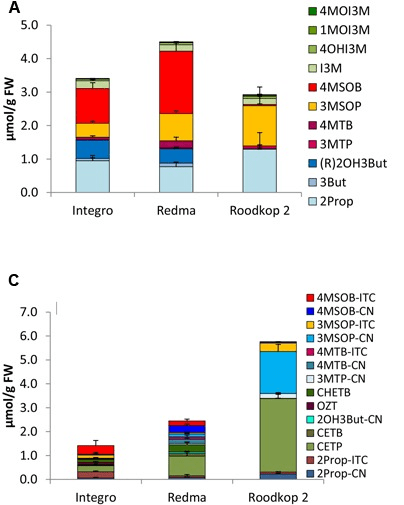
Figure 5 of Lab analyses of broccoli sprout compounds had analysis of three red cabbage cultivars’ 9-day-old sprouts. Glucosinolates are on top, hydrolysis products on the bottom. Glucoraphanin is red 4MSOB in A, and sulforaphane is red 4MSOB-ITC in C:
D. In summary, I don’t think I’ve significantly reduced broccoli sprouts’ effects by substituting two-thirds weight with two other Brassicaceae species. I haven’t noticed that growth characteristics / compounds interfered with each other.
Still looking for mustard and red cabbage 3-day-old sprout studies. My current Brassicaceae species composite is tasty, and doesn’t cause mustard nose burn.
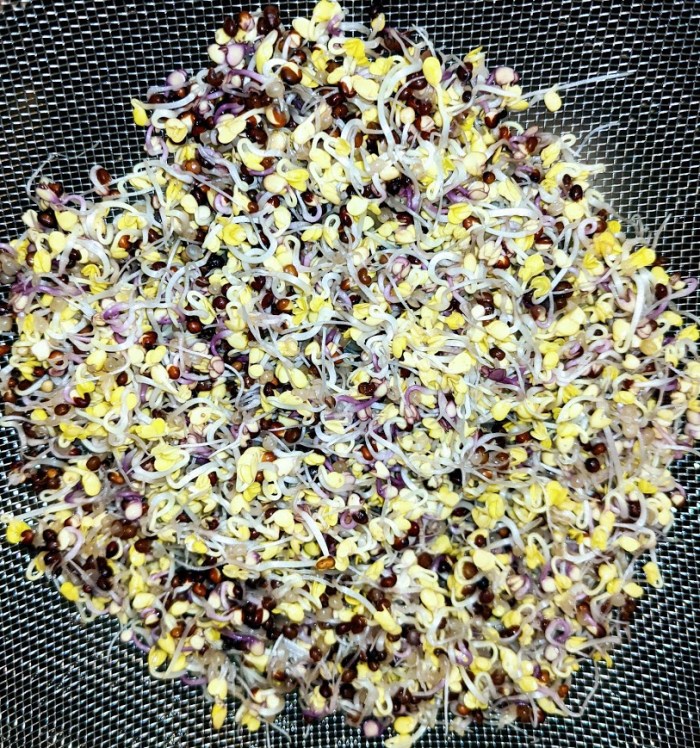
3. This Brassicaceae species composite isn’t photogenic:
Red cabbage sprouts by themselves are pretty.
4. I still eat 3-day-old oat sprouts twice a day per Sprouting hulled oats. I don’t eat them with Brassicaceae species, but with Avena nuda oats in the morning, and AGE-less chicken vegetable soup in the evening.
A. I thought in Week 28 that extrapolating A rejuvenation therapy and sulforaphane results to humans would produce personal results by this week. An 8-day rat treatment period ≈ 258 human days, and 258 / 7 ≈ 37 weeks.
There are just too many unknowns to say why that didn’t happen. So I’ll patiently continue eating a clinically relevant 65.5 gram dose of microwaved broccoli sprouts twice every day.
“Depends, it might take 37 weeks or more for some aspects of ‘youthening’ to become obvious. It might even take years for others.
Who really cares if you are growing younger every day?
For change at the epigenomic/cellular level to travel up the biological hierarchy from cells to organ systems seems to take time. But the process can be repeated indefinitely (so far as we know) so by the second rejuvenation you’re already starting at ‘young’. (That would be every eight to ten years I believe.)”
B. I thought that adding 2% mustard seed powder to microwaved broccoli sprouts per Does sulforaphane reach the colon? would work. Maybe it would, maybe it wouldn’t, but my stomach and gut said that wasn’t for me.
2. Oat sprouts analysis paired studies were very informative, don’t you think? One study produced evidence over 18 germination-parameter combinations (hulled / dehulled seeds of two varieties, for 1-to-9 days, at 12-to-20°C).
Those researchers evaluated what mix of germination parameters would simultaneously maximize four parameters (β-glucan, free phenolic compounds, protease activity, and antioxidant capacity) while minimizing two (enzymes α-amylase and lipase). Then they followed with a study that characterized oat seeds sprouted under these optimal conditions.
I doubted PubMed’s “oat sprout” 20 search results for research 1977 to the present. Don’t know why they didn’t pick up both of these 2020 studies, but I’m sure that .gov obvious hindrances to obtaining relevant information like this won’t be fixed. What other search terms won’t return adequate PubMed results?
3. The blog post readers viewed this week that I made even better was Do delusions have therapeutic value? from May 2019. Sometimes I’ve done good posts describing why papers are poorly researched.
4. I’ve often changed my Week 4 recipe for an AGE-less Chicken Vegetable Soup dinner (half) then the next day for lunch. The biggest change brought about by 33 weeks of behavioralcontagion is that I now care more about whether vegetables are available than whether or not they’re organic. Coincidentally, I’ve developed a Costco addiction that may require intervention.
1/2 lemon
4 Roma tomatoes
4 large carrots
6 stalks organic celery
6 mushrooms
6 cloves garlic
6 oz. organic chicken breast fillet
1 yellow squash, alternated with 1 zucchini
1 cup sauvignon blanc
32 oz. “unsalted” chicken broth, which still contains 24% of the sodium RDA
Pour wine into a 6-quart Instant Pot; cut and strain squeezed lemon; cut chicken into 1/4″ cubes and add; start mixture on Sauté. Wash and cut celery and stir in. Wash and cut carrots and stir in.
When pot boils around 8 minutes, add chicken broth and stir. Wash mushrooms, slicing into spoon sizes.
Wash and slice yellow squash / zucchini. Crush and peel garlic, tear but don’t slice. Turn off pot when it boils again around 15 minutes.
Wait 2-3 minutes for boiling to subside, then add yellow squash / zucchini, mushrooms, garlic, whole tomatoes. Let set for 20 minutes; stir bottom-to-top 5 and 15 minutes after turning off, and again before serving.
AGE-less Chicken Vegetable Soup is tasty enough to not need seasoning.
This 2019 US study investigated the context of creative ideas:
“Creative inspiration routinely occurs during moments of mind wandering. Approximately 20% of ideas occurred in this manner.
Although ideas that occurred while participants were both on task and mind wandering did not differ in overall quality, there were several dimensions on which they did consistently differ. Ideas that occurred while mind wandering were reported to be experienced with a greater sense of ‘aha’ and were more likely to involve overcoming an impasse.
The present findings are consistent with the view that spontaneous task-independent mind wandering represents a source of the inventive ideas that individuals have each day. This potential function of mind wandering may help to explain why a mental state that can be associated with significant negative outcomes is nevertheless so ubiquitous.”
“Would you say the idea felt like an ‘aha!’ moment?” and “How creative do you feel the idea was?” were the closest items to emotional measures. “How important do you think this idea is?” and several months later “How important has the idea proven to be overall?” were used to measure importance.
The study’s design missed opportunities to discover sources of creative ideas and feelings of importance. It focused on effects and intentionally disregarded causes, despite asserting that “mind wandering represents a source of inventive ideas.”
Experiments were subjectively biased for a framework that considered ideas as originating solely from a person’s thinking brain. A framework like Primal Therapy that demonstrated how ideas may arise as defenses against feelings wasn’t considered, although relevant.
Let’s use the finding “Ideas that occurred while mind wandering were more likely to involve overcoming an impasse” as an example for a Primal Therapy framework’s view:
A person who has a seemingly unsolvable work problem probably encounters feelings of helplessness.
Staying busy with tasks can distract them from these feelings.
During times of less cognitive activity, though, these feelings can have more impetus.
The resultant discomfort will trigger ideas to help ward off helpless feelings.
A pair of 2019 Virginia studies involved human mother/infant subjects:
“We show that OXTRm [oxytocin receptor gene DNA methylation] in infancy and its change is predicted by maternal engagement and reflective of behavioral temperament.”
“Infants with higher OXTRm show enhanced responses to anger and fear and attenuated responses to happiness in right inferior frontal cortex, a region implicated in emotion processing through action-perception coupling.
Infant fNIRS [functional near-infrared spectroscopy] is limited to measuring responses from cerebral cortex. It is unknown whether OXTR is expressed in the cerebral cortex during prenatal and early postnatal human brain development.”
Blood Oxtr DNA methylation may reflect early experience of maternal care, and
Oxtr methylation across tissues is highly concordant for specific CpGs, but
Inferences across tissues are not supported for individual variation in Oxtr methylation.
That rat study found that blood OXTR methylation of 25 CpG sites couldn’t accurately predict the same 25 CpG sites’ OXTR methylation in each subject’s hippocampus, hypothalamus, and striatum (which includes the nucleus accumbens) brain areas. Without significant effects in these limbic system structures, there couldn’t be any associated behavioral effects.
But CpG site associations and correlations were deemed good in the two current studies because they cited:
“Recent work in prairie voles has found that both brain- and blood-derived OXTRm levels at these sites are negatively associated with gene expression in the brain and highly correlated with each other.”
The 2018 prairie vole study – which included several of the same researchers as the two current studies – found four nucleus accumbens CpG sites that had high correlations to humans. Discarding one of these CpG sites allowed their statistics package to make a four-decimal place finding:
“The methylation state of the blood was also associated with the level of transcription in the brain at three of the four CpG sites..whole blood was capable of explaining 94.92% of the variance in Oxtr DNA methylation and 18.20% of the variance in Oxtr expression.”
Few limitations on the prairie vole study findings were disclosed. Like the two current studies, there wasn’t a limitation section that placed research findings into suitable contexts. So readers didn’t know researcher viewpoints on items such as:
What additional information showed that 3 of the 30+ million human CpGs accurately predicted specific brain OXTR methylation and expression from saliva OXTR methylation?
What additional information demonstrated how “measuring responses from cerebral cortex” although “it is unknown whether OXTR is expressed in the cerebral cortex” provided detailed and dependable estimates of limbic system CpG site OXTR methylation and expression?
Was the above 25-CpG study evidence considered?
Further contrast these three studies with a typical, four-point, 285-word limitation section of a study like Prenatal stress heightened adult chronic pain. The word “limit” appeared 6 times in that pain study, 3 times in the current fNIRS study, and 0 times in the current maternal engagement and cited prairie vole studies.
Frank interpretations of one’s own study findings to acknowledge limitations is one way researchers can address items upfront that will be questioned anyway. Such analyses also indicate a goal to advance science.
This information is from a 2019 prepublication Stanford study:
“We present new data from a nationally representative 2017 survey showing that meeting online has continued to grow for heterosexual couples, and meeting through friends has continued its sharp decline. As a result of the continued rise of meeting online and the decline of meeting through friends, online has become the most popular way heterosexual couples in the U.S.
Meeting through friends and family provided guarantees that any potential partner had been personally vetted and vouched for by trusted alters. We would expect any rise in Internet dating to reinforce rather than to displace the traditional roles of friends and family as introducers and intermediaries. [Hypothesis 2]
Results reflect support of Hypothesis 1, as the percentage of heterosexual couples meeting online has surged in the post‐2009 smart phone era. Because the results show that meeting online has displaced meeting through friends and meeting through family, we find evidence to reject Hypothesis 2, which led us to expect that online dating would reinforce existing face‐to‐face social networks.
Figure 1’s apparent post‐2010 rise in meeting through bars and restaurants for heterosexual couples is due entirely to couples who met online and subsequently had a first in‐person meeting at a bar or restaurant or other establishment where people gather and socialize. If we exclude the couples who first met online from the bar/restaurant category, the bar/restaurant category was significantly declining after 1995 as a venue for heterosexual couples to meet.”
Are there examples where it wouldn’t potentially improve a person’s life to choose their information sources? Friends, family, and other social groups – and religious, educational, and other institutions – have had their middlemen / guarantor time, and have been found lacking.
Make your own choices for your one precious life. Similar themes are explored in:
This 2019 UK review discussed delusions, aka false beliefs about reality:
“Delusions are characterized by their behavioral manifestations and defined as irrational beliefs that compromise good functioning. In this overview paper, we ask whether delusions can be adaptive notwithstanding their negative features.
We consider different types of delusions and different ways in which they can be considered as adaptive: psychologically (e.g., by increasing wellbeing, purpose in life, intrapsychic coherence, or good functioning) and biologically (e.g., by enhancing genetic fitness).”
A. Although section 4’s heading was Biological Adaptiveness of Delusions, the reviewers never got around to discussing evolved roles of brain areas and beliefs (delusions). One mention of evolutionary biology was:
“Delusions are biologically adaptive if, as a response to a crisis of some sort (anomalous perception or overwhelming distress), they enhance a person’s chances of reproductive success and survival by conferring systematic biological benefits.”
B. Although section 5’s heading was Psychological Adaptiveness of Delusions, the reviewers didn’t connect feelings and survival sensations as origins of beliefs (delusions) and behaviors. They had a few examples of feelings:
“Delusions of reference and delusions of grandeur can make the person feel important and worthy of admiration.”
and occasionally sniffed a clue:
“Some delusions (especially so‐called motivated delusions) play a defensive function, representing the world as the person would like it to be.”
where “motivated delusions” were later deemed in the Conclusion section to be a:
“Response to negative emotions that could otherwise become overwhelming.”
C. Feelings weren’t extensively discussed until section 6 Delusions in OCD and MDD, which gave readers an impression that feelings were best associated with those diseases.
D. In the Introduction, sections 4, 5, and 7 How Do We Establish and Measure Adaptiveness, the reviewers discussed feeling meaning in life, but without understanding:
“Without feeling, life becomes empty and sterile. It, above all, loses its meaning.“
Beliefs (delusions) defend against feelings.
Consequentially, the stronger and / or more numerous beliefs (delusions) a person has, the less they feel meaning in life.
E. Where, when, why, and how do beliefs (delusions) arise? Where, when, why, and how does a person sense and feel, and what are the connections with beliefs (delusions)?
F. The word “sense” was used 29 times in contexts such as “make sense” and “sense of [anxiety, coherence, control, meaning, purpose, rational agency, reality, self, uncertainty]” but no framework connected biological sensing to delusions. Papers from other fields have detailed cause-and-effect explanations and predecessor-successor diagrams for every step of a process. Not this one.
Regarding any therapeutic value of someone else’s opinion of a patient’s delusions:
I’ll reuse this quotation from the Scientific evidence page of Dr. Janov’s 2011 book “Life Before Birth: The Hidden Script that Rules Our Lives” p.166:
“Primal Therapy differs from other forms of treatment in that the patient is himself a therapist of sorts. Equipped with the insights of his history, he learns how to access himself and how to feel.
The therapist does not heal him; the therapist is only the catalyst allowing the healing forces to take place. The patient has the power to heal himself.“
Wouldn’t it be nice if we were older Then we wouldn’t have to wait so long? And wouldn’t it be nice to live together In the kind of world where we belong?
You know it’s gonna make it that much better When we can say goodnight and stay together
Wouldn’t it be nice if we could wake up In the morning when the day is new? And after having spent the day together Hold each other close the whole night through?
Happy times together we’ve been spending I wish that every kiss was neverending Oh wouldn’t it be nice?
Maybe if we think and wish and hope and pray it might come true Baby then there wouldn’t be a single thing we couldn’t do We could be married (we could be married) And then we’d be happy (and then we’d be happy) Oh wouldn’t it be nice?
You know it seems the more we talk about it It only makes it worse to live without it But lets talk about it Oh wouldn’t it be nice?
Ponder this drone photo of “a flying human tethered to a monkey” ground drawing made over 1,000 years ago as reported by National Geographic and excerpted by the Daily Star:
1. Aren’t the geoglyph and its description pretty good expressions of our evolved condition? Especially since it’s the interpretation of people who lived more a millennium ago?
With so many information sources freely available now, though, one couldn’t successfully argue that the ancients understood the world better than we do. Our understanding comes from our “flying human” time and efforts, without which we’re as ignorant as our “monkey.”
“I remain skeptical of a tendency to ascribe most modern woes to incongruence between our evolved nature and western cultural practices. We did not evolve to be happy or healthy but to leave genetic descendants, and an undue emphasis on mismatch risks conflating health and fitness [genetic rather than physical fitness].”
Our “flying human” can make happiness and health choices that our “monkey” can’t:
“Our genetic adaptations often try to fool us into doing things that enhance fitness at costs to our happiness.
Our genes do not care about us and we should have no compunction about fooling them to deliver benefits without serving their ends.
Contraception, to take one obvious example, allows those who choose childlessness to enjoy the pleasures of sexual activity without the fitness-enhancing risk of conception.”
“Aging is not and cannot be programmed. Instead, aging is a continuation of developmental growth, driven by genetic pathways.
Genetic programs determine developmental growth and the onset of reproduction. When these programs are completed, they are not switched off.
Aging has no purpose (neither for individuals nor for group), no intention. Nature does not select for quasi-programs. It selects for robust developmental growth.”
“The proposed epigenetic clock theory of ageing views biologicalageing as an unintended consequence of both developmental programmes and maintenance programmes.”
Aging decisions are examples of our “flying human” making choices that aren’t available to our “monkey” concerning the structure, direction, and duration of our one precious life.
“What are you doing to reverse epigenetic processes and realize what you want? Do you have ideas and/or behaviors that interfere with taking constructive actions to change your phenotype?”
“It doesn’t matter about the facts we know if we cannot maintain a relationship with someone else.”
I kept that thought in the forefront.
Both of us are prisoners of our childhoods. I’ve tried to see and feel the walls and bars for what they are.
Like all of us, J hadn’t tried to process the reality of her childhood and life. For example, on her birthday I asked her how she celebrated her birthdays when she was growing up. She provided a few details, then mentioned that her parents had skipped some of her birthdays. Although I had no immediate reaction, she quickly said that she had a happy childhood.
I was at fault, too, of course. I again asked a woman to marry me who hadn’t ever told me she loved me, except in jest.
I asked J to marry me around the six-month point of our relationship. I felt wonderful, in love with her that August morning after she slept with me at my house. I made an impromptu plan: in the middle of a four-mile walk, I asked her to marry me while kneeling before her as she sat on a bench outside a jewelry store. But she wouldn’t go in to choose a ring. She said she’d think about it.
A month later, after several dates, sleepovers at her house, and a four-day trip to Montreal, I again brought up marriage while we rested on her large couch in her nice sun room. The thing I felt would be wonderful brought about the end.
I tried to understand why she couldn’t accept me for the person who I intentionally showed her I am. She abstracted everything that she said.
I tried to get her to identify why, after all the times we cared for each other, after all our shared experiences, she didn’t want me around anymore.
Didn’t happen. She didn’t tell me things that made sense as answers to my questions.
One thing she said without abstraction was that I was weak for showing my feelings. She told me I was clingy.
Another thing she communicated at the end shocked me. She somehow thought that I was going to dump her. I said that the thought never even crossed my mind.
I didn’t recognize it as projection at the time. Prompted by her underlying feelings, she attributed to me the actions and thoughts that only she herself had.
I’ve tried to put myself in J’s place.
How horrible must it have been for her to be steadily intimate with a man and not feel that his touches, kisses, words, affection, expressed love?
That he couldn’t really love me, and so I couldn’t love him?
That he was actually after something else, because it was impossible that he loved me?
One thing I’ve felt after the end was that the need underlying my only stated relationship goal – to live with a woman I love who also loves me – is again ruining my life. My latest efforts towards that goal were rife with unconscious symbolic act outs of an unsatisfied need from my early life.
That unrelenting need is for a woman’s love. The women I’ve chosen, though, have always given me what I got from my mother: they wouldn’t accept me as I am, and didn’t love me.
And there can never be a substitute. Most of my Primal Therapy sessions included the PAIN OF FEELING exactly that.
My prison cell is what Dr. Janov calls the imprint where I – as a child, teenager, young man, middle-aged man, old man – futilely ATTEMPT TO CHANGE THE PAST.
“Standing next to me in this lonely crowd Is a man who swears he’s not to blame All day long I hear him shout so loud Crying out that he was framed
I see my light come shining From the west down to the east Any day now, any day now I shall be released”
P.S. – We got back together seven months later, and are still going strong.







 Surface Your Real Self