A study of stress factors and neuroplasticity during infancy/early childhood

This 2015 French rodent study found:

“The coordinated actions of BDNF and glucocorticoids promote neuronal plasticity and that disruption in either pathway could set the stage for the development of stress-induced psychiatric diseases.

Genetic strategies that disrupted GR [glucocorticoid receptor] phosphorylation or TrkB [the BDNF receptor] signaling in vivo impaired the neuroplasticity to chronic stress and the effects of the antidepressant fluoxetine.

We demonstrate that fluoxetine prevented the neuroplasticity of chronic stress by priming GR phosphorylation at BDNF-sensitive sites.”


It wasn’t too difficult to see how many of the stressors had human equivalents during infancy/early childhood:

“To determine the plasticity of GR phosphorylation upon changes in the endogenous levels of BDNF and glucocorticoids, mice were exposed to a chronic unpredictable stress that included one daily random stressor for 10 consecutive days from P21 [immediately after weaning] to 1 mo of age.

Chronic unpredictable stress includes one of the following daily random stressors (wet bedding, no bedding, food deprivation, crowded cage, 2 h or 6 h restraining, forced swim, tail suspension).”

But who would give fluoxetine – Prozac – to a human infant or young child to prevent “the neuroplasticity of chronic stress” from having adverse effects?

http://www.pnas.org/content/112/51/15737.full “Neurotrophic-priming of glucocorticoid receptor signaling is essential for neuronal plasticity to stress and antidepressant treatment”

Mitochondria interface genetic/epigenetic responses to psychological stress

This 2015 Pennsylvania rodent study found:

Mitochondria can regulate complex whole-body physiological responses, impacting stress perception at the cellular and organismal levels.

Mitochondrial dysfunctions altered the

  1. hypothalamic–pituitary–adrenal [HPA] axis, sympathetic adrenal–medullary activation and catecholamine levels,
  2. the inflammatory cytokine IL-6,
  3. circulating metabolites, and
  4. hippocampal gene expression

responses to stress.

Stress-induced

  1. neuroendocrine,
  2. inflammatory,
  3. metabolic, and
  4. transcriptional responses

coalesced into unique signatures that distinguish groups based on their mitochondrial genotype.”

The study’s design was comprehensive for the subject of mitochondrial function and stress response categories. It interrelated elements that had a common cause of stress, such as:

  • Hyperglycemia
  • Increased lipids
  • Corticosterone sensitivity
  • Epigenetic changes within the brain

The study’s Figure 6E was a hierarchical “heat map” of the correlations among the 77 stress-induced changes that were measured. Figure 6G presented these variables per the five mitochondrial genotypes (a control wild-type and four genetic dysfunctions). Many of the lines forming the hierarchy needed careful reading of the study’s interpretations.


I downgraded the study’s rating because the authors inappropriately forced the “allostatic load” buzzword into the Significance statement and otherwise informative Discussion section. The term refers to a hypothetical long-term situation, but the study’s experiments lasted 2 hours at most before the subjects were killed.

www.pnas.org/content/112/48/E6614.full “Mitochondrial functions modulate neuroendocrine, metabolic, inflammatory, and transcriptional responses to acute psychological stress”

Neural pathways for forgetting bad smells

This 2015 New York fruit fly study found:

“Forgetting is regulated by multiple neural pathways that impinge upon a memory center.

Forgetting over time and the acute forgetting of conflicting memory during reversal learning rely on separable neural circuits.

Inactivating these neurons inhibits memory decay without altering learning, whereas activating them promotes forgetting. These neurons [include] a cluster of dopaminergic neurons and a pair of glutamatergic neurons.

Although activity of these neurons is required for memory decay over time, they are not required for acute forgetting during reversal learning. Our results thus not only establish the presence of multiple neural pathways for forgetting in Drosophila but also suggest the existence of diverse circuit mechanisms of forgetting in different contexts.”

Here’s a 3D view of the glutamatergic neurons:

http://movie-usa.glencoesoftware.com/video/10.1073/pnas.1512792112/video-2

http://www.pnas.org/content/112/48/E6663.full “Dissecting neural pathways for forgetting in Drosophila olfactory aversive memory”

Familiar stress opens up an epigenetic window of neural plasticity

This 2015 Italian rodent study found:

“There is a window of plasticity that allows familiar and novel experiences to alter anxiety– and depressive-like behaviors, reflected also in electrophysiological changes in the dentate gyrus (DG).

A consistent biomarker of mood-related behaviors in DG is reduced type 2 metabotropic glutamate (mGlu2), which regulates the release of glutamate. Within this window, familiar stress rapidly and epigenetically up-regulates mGlu2..and improves mood behaviors.

These hippocampal responses reveal a window of epigenetic plasticity that may be useful for treatment of disorders in which glutamatergic transmission is dysregulated.”

The current study included two of the authors of A common dietary supplement that has rapid and lasting antidepressant effects.

The supplementary material showed the:

“Light–dark test as a screening method allowed identification of clusters of animals with a different baseline anxiety profile”

for the BDNF Val66Met subjects. This research methodology better handled the individual differences that often confound studies.

The study’s press release provided further details such as:

“Here again, in experiments relevant to humans, we saw the same window of plasticity, with the same up-then-down fluctuations in mGlu2 and P300 in the hippocampus, Nasca says. This result suggests we can take advantage of these windows of plasticity through treatments, including the next generation of drugs, such as acetyl-L-carnitine, that target mGlu2—not to ‘roll back the clock’ but rather to change the trajectory of such brain plasticity toward more positive directions.”


I disagree with the authoring researchers’ extrapolation of these rodent findings to humans, which seemed to favor chemical intervention. Causes of human stress should be removed or otherwise addressed.

I hope that the study’s “familiar stress” findings won’t be use to attempt to justify potentially harmful practices such as Critical Incident Stress Debriefing, which mandatorily guides people to process recent trauma. Instead, An interview with Dr. Rachel Yehuda on biological and conscious responses to stress made a point about “windows of plasticity” that’s relevant to who we are as feeling human beings:

“What I hear from trauma survivors — what I’m always struck with is how upsetting it is when other people don’t help, or don’t acknowledge, or respond very poorly to needs or distress.”

http://www.pnas.org/content/112/48/14960.full “Stress dynamically regulates behavior and glutamatergic gene expression in hippocampus by opening a window of epigenetic plasticity”

A review of genetic and epigenetic approaches to autism

This 2015 Chicago review noted:

“Recent developments in the research of ASD [autistic spectrum disorder] with a focus on epigenetic pathways as a complement to current genetic screening.

Not all children with a predisposing genotype develop ASD. This suggests that additional environmental factors likely interact with the genome in producing ASD.

Increased risk of ASD is associated with mutations in genes that overlap with chromatin remodeling proteins, transcriptional regulators and synapse-associated proteins. Interestingly, these genes are also targets of environmentally induced changes in gene expression.”

Evidence was discussed for both broad and specific epigenetic ASD causes originating in the prenatal environment:

  • Maternal stress:

    “Prenatal stress exerts a profound epigenetic influence on GABAergic interneurons by altering the levels of proteins such as DNMT1 and Tet1 and decreasing the expression of various targets such as BDNF.

    Ultimately, this results in reducing the numbers of fully functional GABAergic neurons postnatally and a concomitant increased susceptibility toward hyperexcitability. The delayed migration of GABAergic interneuron progenitors results in reduced gene expression postnatally which is likely the consequence of increased amounts of DNA methylation.

    The net effect of stress during early development is to disrupt the balance of excitatory/inhibitory neuronal firing due to the loss of function associated with disrupted neuronal migration and maturation.”

  • Prenatal nutrition:

    “Exposure to a wide range of environmental toxins that impact neurodevelopment also result in global DNA hypomethylation. This model was extended to connect pathways between dietary nutrition and environmental exposures in the context of DNA hypomethylation. More recently, this hypothesis was expanded to show how dietary nutrients, environmental toxins, genome instability and neuroinflammation interact to produce changes to the DNA methylome.”

  • Maternal infections:

    “Inflammation, autoimmunity and maternal immune activation have long been suspected in the context of aberrant neurodevelopment and ASD risk.”

  • Exposure to pollutants, medications, alcohol

This was a current review with many 2015 and 2014 references. However, one word in the reviewers’ vernacular that’s leftover from previous centuries was “idiopathic,” as in:

“Idiopathic (nonsyndromic) ASD, for which an underlying cause has not been identified, represent the majority of cases.”

It wasn’t sufficiently explanatory to use categorization terminology from thousands of years ago.

Science has progressed enough with measured evidence from the referenced studies that the reviewers could have discarded the “idiopathic” category and expressed probabilistic understanding of causes. They could have generalized conditional origins of a disease, and not reverted to “an underlying cause has not been identified.”


Another word the reviewers used was “pharmacotherapeutic,” as in:

“The goal for the foreseeable future is to provide a better understanding of how specific genes function to disrupt specific biological pathways and whether these pathways are amenable to pharmacotherapeutic interventions.”

Taking “idiopathic” and “pharmacotherapeutic” together – causes for the disease weren’t specifically identified, but the goal of research should be to find specific drug treatments?

Of course reviewers from the Department of Psychiatry, The Psychiatric Institute, University of Illinois at Chicago are biased to believe that “the design of better pharmacotherapeutic treatments” will fulfill peoples’ needs.

Are their beliefs supported by evidence? Without using drugs, are humans largely incapable of therapeutic actions such as:

  • Preventing epigenetic diseases from beginning in the prenatal environment?
  • Treating epigenetic causes for and alleviating symptoms of their own disease?

http://www.futuremedicine.com/doi/full/10.2217/epi.15.92 “Merging data from genetic and epigenetic approaches to better understand autistic spectrum disorder”

An interview with Dr. Rachel Yehuda on biological and conscious responses to stress

How Trauma and Resilience Cross Generations

“The purpose of epigenetic changes, I think, is simply to increase the repertoire of possible responses.

So let’s say, for some reason, your parents transmitted to you biologic changes that are very appropriate to starvation, but you don’t live in a culture where food is not plentiful.

You’re just not optimized, but I think that if we develop an awareness of what the biologic changes from stress and trauma are meant to do, then I think we can develop a better way of explaining to ourselves what our true capabilities and potentials are.


What I hear from trauma survivors — what I’m always struck with is how upsetting it is when other people don’t help, or don’t acknowledge, or respond very poorly to needs or distress.


Feel it instead of running to someone to give you a sleeping pill.”

Transcript: http://www.onbeing.org/program/rachel-yehuda-how-trauma-and-resilience-cross-generations/transcript/7791

Telomere dynamics, stress, and aging across generations

This 2015 Pennsylvania/North Dakota animal and human review noted:

“The mechanisms linking stress exposure to disease progression and ageing either within individuals or across generations are still unclear, but recent work suggests that telomere dynamics (length and loss rate) may play an important role.

Parental stress may directly influence the parental germline telomeres pre-fertilization, affecting the telomere length inherited by offspring. Alternatively, parental stress may affect telomere dynamics indirectly either pre- or post-natally. The physiological mechanisms by which stress elicits changes in telomere length are also diverse.

We need more information about how these effects vary between developmental stages, among individuals, and within tissues of individuals..to mitigate the effects of early life adversity on human health.”

I was disappointed that the reviewers chose Problematic research with telomere length as a reference. Then again, maybe their statement:

“how these traits are related to one another clearly deserves more study”

is a polite way of saying that study’s methodology was flawed?

Regarding evolutionary biology:

“While most evidence suggests that the effect of parental stress exposure on offspring telomeres is negative, it is important to remember that this is just one trait that can contribute to parental and offspring fitness.

Investment in traits that increase fitness is expected to be favoured, even if they come at a cost to traits associated with longevity, such as telomere length.”

A similar point was made in a reference of A study of DNA methylation and age that:

“Aging has no purpose (neither for individuals nor for group), no intention. Nature does not select for quasi-programs. It selects for robust developmental growth.”


http://rsbl.royalsocietypublishing.org/content/11/11/20150396 “Telomere dynamics may link stress exposure and ageing across generations”

Psychological therapy and DNA methylation

This 2015 worldwide human study was:

“The largest study to date investigating the role of HPA [hypothalamic–pituitary–adrenal] axis related genes in response to a psychological therapy. Furthermore, this is the first study to demonstrate that DNA methylation changes may be associated with response to psychological therapies in a genotype-dependent manner.

In this study, we tested the association between polymorphisms of FKBP5 [a gene that produces a protein that dampens glucocorticoid receptor sensitivity primarily in areas of the limbic system such as the hippocampus and amygdala] and GR [glucocorticoid receptor gene] and response to CBT [cognitive behavior therapy] in children with anxiety disorders (N = 1,152), and examined change in DNA methylation at specific regions of these genes during the course of CBT in a subset of the sample (n = 98).

No significant association was found between GR methylation and response. Allele-specific change in FKBP5 methylation was associated with treatment response.”

Regarding “treatment response:”

“Subjects aged 5–18 (mean: 9.8 years) met DSM-IV criteria for primary diagnosis of an anxiety disorder.

Clinical severity ratings (CSRs) were usually based on composite parent and child reports, and were assigned on a scale of 0–8. [36] [linked below]

Treatment response was defined as the change in primary anxiety disorder severity from pretreatment to follow-up. A diagnosis was made when the child met diagnostic criteria and received a CSR of 4 or more. Remission was regarded as the absence of the primary anxiety according to diagnostic criteria, as determined by the clinicians at the follow-up interview.”


Scenarios where nine-year-olds and their parents may have benefited from skewing their “composite parent and child reports” either way:

  1. Parents benefited from an anxious-child report (financial support provided, social services provided, avoided undesirable activities like going to work, continued psychological dependence, provided victim celebrity, enabled their own problems)
  2. Parents benefited from a well-child report (freed up time to pursue desirable activities, financial relief, relief from court-ordered or social-services-required activities, covered up their own contributions to the child’s problems)
  3. Nine-year-olds benefited from an anxious report (relief from undesirable activities like school attendance, continued psychological dependence, provided victim celebrity, activities structured around their condition, enabled the parents’ problems)
  4. Nine-year-olds benefited from a well report (symptom reduction, met parental expectations, freed up time to pursue desirable activities, covered up the parents’ contributions to the child’s problems).

I wonder what “treatment response” criteria were available other than self-serving reports and “diagnostic criteria, as determined by the clinicians.” Every day medical personnel hear patients self-report conditions where biological measurements may confirm or indicate something different. Did the “diagnostic criteria, as determined by the clinicians” include comparisons to relevant biological measurements?


The related study linked below points out:

“Although CBT has been established as an efficacious treatment, roughly 40% of children retain their disorder after treatment.”

Its focus was also on predictors (other than genetic) of CBT outcomes.

Neither study provided evidence of attempts to find originating causes for the children’s conditions. Were the international CBT approaches only interested in treating symptoms?


http://onlinelibrary.wiley.com/doi/10.1002/da.22430/full “HPA AXIS RELATED GENES AND RESPONSE TO PSYCHOLOGICAL THERAPIES: GENETICS AND EPIGENETICS”

Related 2015 study: http://www.jaacap.com/article/S0890-8567%2815%2900191-4/pdf “Clinical Predictors of Response to Cognitive-Behavioral Therapy in Pediatric Anxiety Disorders: The Genes for Treatment (GxT) Study”

A review of epigenetic transgenerational inheritance of reproductive disease

This 2015 Washington review of epigenetic transgenerational inheritance of reproductive disease defined transgenerational effects as follows:

“In considering transgenerational phenomena it is important to distinguish between direct exposure effects versus germline (sperm or egg) mediated transgenerational events.

When a gestating F0 generation female is exposed the F0 generation female, the F1 generation fetus and the germ cell (sperm or egg) that is inside the fetus and that will produce the F2 generation are all directly exposed. Any effects in the F0, F1 and F2 generations may be due to direct exposure toxicity or to environmentally induced epigenetic changes in the directly exposed cells. Examination of the F3 generation (great grand-offspring) is needed to determine if a transgenerational phenomenon has occurred, since the F3 generation has had no direct exposure effects.

In contrast, in the event an adult male or non-pregnant female is exposed, the F0 generation adult and the germ cells that will generate the F1 generation are directly exposed, such that examination of the F2 generation (grand-offspring) is required to demonstrate a transgenerational phenomenon.”


This review was an example of a government agency commissioning science that narrowly supported their view. NIEHS funded this review, and the authors interpreted “environment” in “Environmentally Induced Epigenetic Transgenerational Inheritance of Reproductive Disease” to fit this conduit of public funds.

The problem was that this interpretation of “environment” limited the subject to the categories pictured in this Venn diagram. The authors’ tailoring of “environmentally induced” to the government agency’s interests should have similarly restricted the title.

F3 sperm epimutations


Other interpretations of “environment” were in studies such as:

and their references. Such studies demonstrated both that:

  1. Environmental factors like stress and nutrition – especially in early life – cause diseases in later life; and
  2. These diseases may be inherited by the subjects’ descendants.

The authors elsewhere referred generally and specifically (nutrition) to studies of other environmental factors.

Have you ever heard that our children and then their children could possibly inherit our diseases caused by stressful environments? Wouldn’t that research be of equal to or greater importance in our lives than pesticides’ harmful effects?

http://www.bioone.org/doi/10.1095/biolreprod.115.134817 “Environmentally Induced Epigenetic Transgenerational Inheritance of Reproductive Disease”

Fetal exposure to sex hormones and female anxiety

This 2015 Swedish rodent study found:

“Women with polycystic ovary syndrome (PCOS) display high circulating androgen levels that may affect the fetus and increase the risk of mood disorders in offspring.

Although clinical data are inconsistent, there are indications that androgens play a crucial role in behavior and mood regulation in females.

Studies on the link between testosterone and anxiety behavior in males have generated inconsistent results.

Higher circulating testosterone has previously been reported in female rat PNA [prenatal androgen] offspring. This discrepancy may be a result of the higher doses of maternal testosterone (5 mg) used in the previous study compared with the present study (0.5 mg).

Although the anxiety-like behavior observed in the female PNA offspring in the present study cannot be directly explained by high circulating androgens, the reduced AR [androgen receptor] expression in the amygdala suggests a compensatory response to the high prenatal testosterone exposure, a result implicating the amygdala as the CNS site underlying the changes in anxiety in the PNA offspring. This idea is further strengthened by our experiment showing that subchronic testosterone exposure into amygdala is sufficient to produce anxiety-like behavior in adult females.

Maternal testosterone exposure causes anxiety-like behavior in female, and to a lesser extent male offspring, an effect that seems to occur during fetal life and to be mediated via AR in the amygdala, together with changes in ER [estrogen receptor] and in the serotonergic and GABAergic pathways in the amygdala and hippocampus of female PNA rats.”

The news coverage – too much testosterone caused anxiety-like symptoms in females whether they are adults or fetuses – was NOT what the study found. The headlines disregarded its caveat:

“The anxiety-like behavior observed in the female PNA offspring in the present study cannot be directly explained by high circulating androgens.”

I look forward to research on floor levels of testosterone, below which there are also adverse effects on females. There is such evidence, but would it play well with popular memes?

See Sex hormone exposure to the developing female fetus causes infertility in adulthood for another study that used the PCOS phenotype.

http://www.pnas.org/content/112/46/14348.full “Maternal testosterone exposure increases anxiety-like behavior and impacts the limbic system in the offspring”

A molecular study of the epigenetic regulation of memory

This 2015 Norwegian rodent study provided:

“New insights into the molecular underpinnings of synaptic plasticity.

We report the first global transcriptome [all RNA found in specific cells] analysis of in vivo synaptic plasticity, using the well-established model of LTP [long-term potentiation, an increase in synaptic strength that underlies memory] in the rat dentate gyrus [a region of the hippocampus where neurogenesis occurs].

We have identified a number of novel lncRNAs [long (more than 200 nucleotides) noncoding (non-protein coding) RNA] that are dynamically regulated in response to LTP. In addition, we also observed an altered expression of multiple classes of repeat elements [mobile DNA sequences often involved in mutations] including retrotransposons [a repeat element type formed by copy-and-paste mechanisms].

The results presented here reveal a vast extension of mRNAs [messenger RNA, a large RNA that carries codes for protein production] previously not associated with neuronal plasticity; the discovery of extensive, dynamic regulation of lncRNAs, repeat elements, and tRNA [transfer RNA that links mRNA and amino acids during protein production] following LTP induction in the adult rat brain.

These findings provide a broader foundation for elucidating the transcriptional and epigenetic regulation of synaptic plasticity.”

Regarding lncRNA:

“We annotate a total of 10,256 novel lncRNAs in the rat transcriptome.

To infer possible functions of lncRNAs, we correlated [71] differentially expressed lncRNAs with regulated protein coding genes.

There are no established rules for predicting the function of lncRNAs.”

Regarding repeat elements:

“It is intriguing to consider that expression of repeat elements during LTP is the first step toward retrotransposition and reshaping of the neuronal genome. A hypothetical mechanism for how these repeat elements could be linked to memory, would be that a certain stimuli, whether it is stress or a learning task (here LTP), deregulate the repression of repeat elements which are then rapidly and transiently transcribed. These elements reinsert themselves back into the genome of stimulated neurons where they influence the expression of neighboring genes.

The present work supports the intriguing hypothesis that dynamic retrotransposition may act as a molecular means to reprogram the neuronal genome as part of long-term synaptic plasticity and memory formation.”

See RNA as a proxy signal for context-specific biological activity for more about lncRNA.

http://journal.frontiersin.org/article/10.3389/fnins.2015.00351/full “Dynamic expression of long noncoding RNAs and repeat elements in synaptic plasticity”

Is the purpose of research to define opportunities for interventions?

In this 2014 review, a social scientist first presented an interpretive history of what he found to be important in the emergence of epigenetics. He proceeded into his ideas of “a possible agenda of the social studies of the life-sciences” in the “postgenomic age” with headings such as “Postgenomic biopolitics: “upgrade yourself” or born damaged for ever?”

This perspective included:

“The upgradable epigenome may become the basis for a new motivation to intervene, control and improve it through pharmacological agents or social interventions.

An important trend is the use of epigenetic and developmental findings in the so-called early-intervention programmes.

It is possible that epigenetic findings will become increasingly relevant in social policy strategies.”


In this blog I often highlight research that may help us understand details of how each of us is a unique individual. It’s my view that insofar as research helps each of us understand our unique, real self, we may be able to empathetically understand others’ unique qualities.

Click individual differences for a sample of how researchers explain away uniqueness in order to converge on a study’s desired objectives. There’s seldom an attempt to further understand what caused each subject to develop their unique qualities.

Why would this reviewer advocate that

  • Researchers,
  • People working in the social sciences,
  • People employed or involved in social services, and
  • Their sponsors and employers

intentionally disregard another individual’s unique qualities?

I’ll answer this question from a perspective that explains how this common, reflexive action derives from a person being unable to face the facts of their own life. Pertinent fundamentals of Dr Arthur Janov’s Primal Therapy are:

  1. Pain motivates a person’s unconscious act-outs of their underlying problems.
  2. The behavior that caused a problem is sometimes also the act-out behavior.
  3. Act-outs enable a person to re-experience the feelings of their historical struggles, in a vain attempt to resolve them.
  4. Due to pain barriers, people seldom become consciously aware of and – more importantly – address the causes for their own problematic behavior.
  5. “The patient has the power to heal himself.”

A consequent hypothesis is that a person will often glorify their unconscious act-outs and surround themself with justifications for these actions. For example, a person who can’t sit still may refer to their incessant activity with socially acceptable phrases such as “I’m always busy” or “I love to travel.” They’ll structure their life to enable their unconscious behavior, never questioning how they were attracted to an always-on-the-go occupation such as flight attendant, only vaguely feeling that they were made for it.

The behavior relevant to the current review may be exhibited by a person with a history of having no control over their own life. Following the above first two fundamentals, the pain of historically not having control over their life may motivate them to control other people’s lives.

Unfortunately for everyone who’s affected, such unconscious act-outs don’t resolve anything:

  1. The initiator may achieve some symbolic satisfaction by controlling others’ lives.
  2. This temporary satisfaction doesn’t make the initiator’s underlying problems less painful.
  3. The motivation impelling these unconscious act-outs isn’t thereby reduced.
  4. So the initiator soon repeats their controlling behavior, stuck in a loop of unresolved feelings.
  5. Since the self-chosen interests of someone who’s being controlled are lesser concerns to the initiator than exercising control, the controlled person may or may not be helped by the controller’s act-outs.

Research provides abundant evidence that we are unique individuals.

This is a strong indicator of who is best qualified to direct each of our unique lives.

A person who is driven to control others’ lives won’t accept epigenetic research as instructive for understanding, honoring, and respecting others as unique individuals. They’ll use research as a way to enable their own unconscious act-outs, and view it as offering opportunities for interventions into the lives of others.

This is the way that “pharmacological agents or social interventions” are often the intended “use of epigenetic and developmental findings.” Interventions receive justifications with “a possible agenda of the social studies of the life-sciences.”

Becoming aware of one’s own act-outs – and then individually addressing one’s own underlying problems – often take backseats to employment and other concerns to keep enabling one’s own behavior. That makes it likely that interventions justified by “epigenetic findings..in social policy” will continue, whether or not the subjects agree that they’re being helped.

For examples, take a look at a few of the YouTube presentations by people employed in the social sciences and social services on a topic of epigenetics. Compare them with the current state of epigenetic research in Grokking an Adverse Childhood Experiences (ACE) score.

What did you notice? How many presentations emphasized disrupted prenatal development – a period when problems can be prevented? Did you instead see that many more of the presentations emphasized controlling behavior?

http://journal.frontiersin.org/article/10.3389/fnhum.2014.00309/full “The social brain meets the reactive genome: neuroscience, epigenetics and the new social biology

Transgenerational epigenetic programming with stress and microRNA

This 2015 Pennsylvania rodent study found:

“Sperm miRs [microRNAs, a small non-coding RNA that has a role in gene expression] function to reduce maternal mRNA [messenger RNA, a large RNA that carries codes for protein production] stores in early zygotes, ultimately reprogramming gene expression in the offspring hypothalamus and recapitulating the offspring stress dysregulation phenotype.”

These researchers caused stress-induced changes at an early stage of embryonic development with microRNA injections. Resultant adverse effects weren’t observed until subjects were adults!

Most news coverage focused on it being a male’s stress, not a female’s, that affected a developing embryo. Either or both sexes can epigenetically disadvantage a fetus – okay.

Demonstrating how a damaging influence can begin immediately after conception, but symptoms didn’t present until adulthood made this study newsworthy.


Although the term “transgenerational” was used in the study’s title, abstract, and elsewhere, studied epigenetic effects were intergenerational rather than transgenerational. Per A review of epigenetic transgenerational inheritance of reproductive disease, for the term to apply, researchers need to provide evidence in at least the next 2 male or non-gestating female generations and/or 3 gestating female generations of:

“Altered epigenetic information between generations in the absence of continued environmental exposure.”


From a press release, a study coauthor who also coauthored How to make a child less capable even before they are born: stress the pregnant mother-to-be stated:

“Bale suspects that when a male experiences stress it may trigger the release of miRs contained in exosomes from epithelial cells that line the epididymis, the storage and maturation site for sperm between the testes and the vas deferens. These miRs may be incorporated into maturing sperm and influence development at fertilization.”

Not all stress-related gene expression in pituitary and adrenal glands differed.

http://www.pnas.org/content/112/44/13699.full “Transgenerational epigenetic programming via sperm microRNA recapitulates effects of paternal stress”

A review of the epigenetic basis for mental illness

This 2015 New York combined animal and human review of epigenetic studies noted:

“While genetic factors are important in the etiology of most mental disorders, the relatively high rates of discordance among identical twins, particularly for depression and other stress-related syndromes, clearly indicate the importance of additional mechanisms.

Environmental factors such as stress are known to play a role in the onset of these illnesses.

Exposure to such environmental insults induces stable changes in gene expression, neural circuit function, and ultimately behavior, and these maladaptations appear distinct between developmental versus adult exposures.

Increasing evidence indicates that these sustained abnormalities are maintained by epigenetic modifications in specific brain regions.”

Placing the “maladaptations” and “sustained abnormalities” phrases into their contexts:

  • A fetus biologically adapted to their environment – however toxic it was – in order to best survive.
  • These adaptations for survival were subsequently viewed as Disrupted Neurodevelopment and “maladaptations” from the perspectives of normal development and environments.
  • The “sustained abnormalities” caused within the earlier environments “are maintained by epigenetic modifications.” An improved environment wasn’t impetus enough to change developmental “maladaptations.”

Per the below link, it’s been a month since this review was published. Why has there been ZERO news coverage of it?

One reason may be that the Friedman Brain Institute, Icahn School of Medicine at Mount Sinai, didn’t issue a press release or otherwise publicize it. Another reason may be the groups that are opposed to its findings:

  • Parents who provided harmful environments for their children, beginning at conception;
  • People who feel threatened when scientific causal evidence resonates with what happened in their own lives, and in response, limit their empathetic understanding of others’ problems;
  • Social workers, psychologists, and others in industries whose paychecks depend on efforts that aren’t directed towards ameliorating the causes for these later-life effects;
  • Psychiatrists and medical personnel whose livelihoods depend on pharmaceutical and other treatments that only alleviate symptoms;
  • Researchers whose funding depends on producing non-etiologic findings.

Despite resistance to this review’s findings, a large number of people would benefit from publicizing evidence for:

“These sustained abnormalities are maintained by epigenetic modifications in specific brain regions.”

http://nro.sagepub.com/content/early/2015/09/24/1073858415608147 “Epigenetic Basis of Mental Illness”

Grokking an Adverse Childhood Experiences (ACE) score

What does it take to empathetically understand, to make a part of oneself, to grok an ACE score?

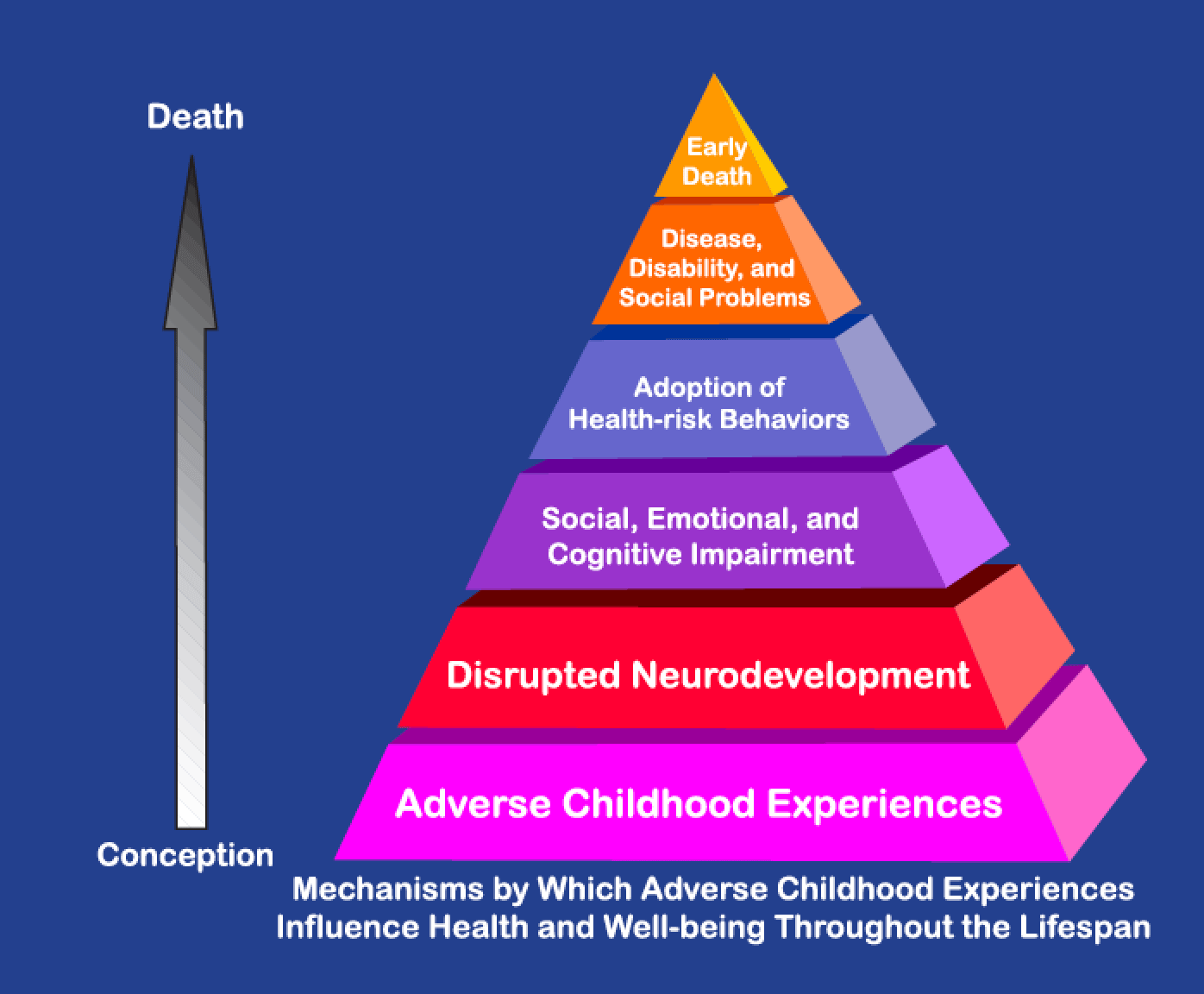
The ACE effort was initiated in 1985 in an era before epigenetics was well-studied. Its artifacts included the ACE pyramid:

The_ACE_PyramidThe historical ACE lifespan continuum on the left began at conception. The pyramid on the right promoted a limited view of ACE that assigned childhood as the pyramid’s base.

Current official depictions of the ACE pyramid assign an expanded view of ACE as the pyramid’s base. The viewer’s attention is directed to “Scientific Gaps” between pyramid layers, but the largest gap remains: the continuum starts at conception but the pyramid still starts at childhood. The narrative claims:

“To provide scientific information that would be useful for developing new and more effective prevention programs.”

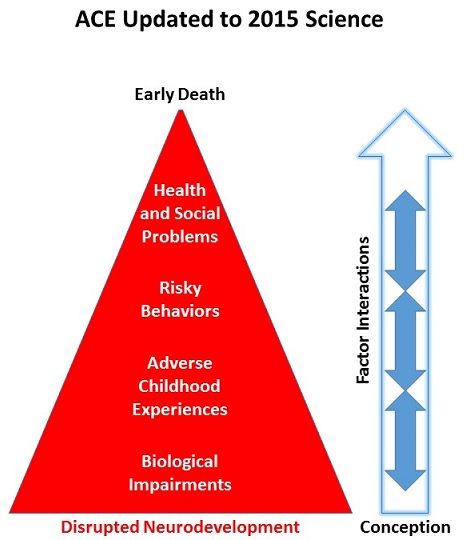
The official ACE pyramid doesn’t accurately reflect current science documented in, for example, Epigenetic effects of early life stress exposure. By downplaying Disrupted Neurodevelopment that may begin at conception, governing agencies implicitly endorse approaches that fail to address prenatal causes for later-life adverse effects.


If the ACE diagram was drawn thirty years later in 2015 to incorporate evidence for epigenetics, Disrupted Neurodevelopment wouldn’t be a consequent layer to an ACE base. The potential start of Disrupted Neurodevelopment would coincide with conception:Updated for 2015 to show Disrupted Neurodevelopment

What’s an example of current ACE-related scientific evidence that wasn’t present three decades ago and also isn’t represented in the official ACE pyramid? Prenatal Disrupted Neurodevelopment may be considered today as a possible consequence of a “Yes” answer to half of the original ACE questions:

  • Were your parents were too drunk or high to take care of you or take you to the doctor?
  • Were your parents ever separated or divorced?
  • Was your mother often or very often pushed, grabbed, slapped, or had something thrown at her?
  • Did you live with anyone who was a problem drinker or alcoholic or who used street drugs?
  • Was a household member depressed or mentally ill?

These threats and other stresses cause a fetus to biologically adapt. When such adaptations occur during prenatal development, they may:

  • Have much larger impacts and
  • Cause Biological Impairments that
  • Don’t unassistedly disappear over time.

Emphasizing Disrupted Neurodevelopment that may begin at conception would encourage:

  • Research that’s directed toward producing causal evidence for adaptations that largely occur during the early periods of an individual’s lifespan; and
  • Research on how these adaptations consistently influence our later-life ideas, biology, and behavior.

The above recommendations for research are neither the current focus of ACE research nor the direction of related efforts to assist affected individuals. Relevant studies that I’ve curated on this blog often only produced symptomatic evidence:

  • If a study couched its findings in non-etiologic phrases such as “is associated with” or “is linked to” or “may relate to,” it didn’t address ACE originating causes.
  • “New and more effective prevention programs” seldom address Disrupted Neurodevelopment and Biological Impairments with efforts to reduce the source of the damage.
  • If a program’s presentation showed multivariate analyses with ACE score probabilities and percentages, it didn’t address originating causes.

Here’s a YouTube search of ACE + adverse. Evaluate the current focus of ACE efforts by people employed in the social sciences and services. What did you notice?

How many presentations emphasized prenatal Disrupted Neurodevelopment, a period during which problems may be prevented by addressing causes? Did you instead see that these were outnumbered by many more presentations that emphasized Health and Social Problems symptom interventions?


So, what does it take to empathetically understand, to make a part of oneself, to grok a person’s ACE score?

Regarding empathy – it’s best to avoid the advice of studies such as:

People who are helped may not recognize it at first, but over time, they’ll sense whether the helper’s empathy is genuine.

Regarding understanding – I feel that people first need to ameliorate the origins of their own problems. Then they may be able to help others therapeutically address causes for ACE symptoms.

Need proof? Think of someone you’ve met whose thoughts and feelings and behavior were caught up in and motivated by their own problems:

  • Did you feel they could empathetically understand others?
  • Wasn’t the welfare of the people who may have been helped truly incidental and secondary to someone who was acting out their own problems?