Maintaining your myelin, Part 1

Three papers on myelin and oligodendrocytes, starting with a 2023 review:

“Myelin is the spiral ensheathment of axons by a lipid and cholesterol-rich glial cell membrane that reduces capacitance and increases resistance of the axonal membrane. Axonal myelination speeds up nerve conduction velocity as a function of axon diameter.

While myelination proceeds rapidly after birth in the peripheral nervous system, central myelination is a spatially and temporally more regulated process. Ongoing myelination of the human brain has been documented at up to 40 years of age. This late myelination in the adult cortex is followed by exhaustion of oligodendrocyte precursor cells (OPC) with senescence and a gradual loss of myelin integrity in the aging brain.

The brain is well known for its high energy demands, specifically in gray matter areas. In white matter tracts, energy consumption is lower. Myelination poses a unique challenge for axonal energy generation where myelin sheaths cover more than 95% of the axonal surface areas.

Oligodendrocytes help support axonal integrity. Oligodendrocytes survive well in the absence of mitochondrial oxidative phosphorylation, and without signs of myelin loss, cell death, neurodegeneration or secondary inflammation.

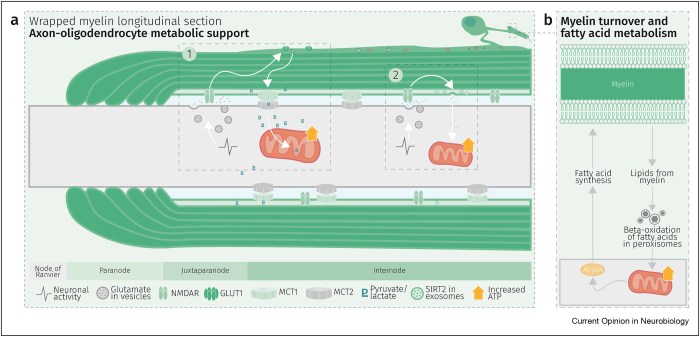
Glycolysis products of oligodendroglial origin are readily metabolized in axonal mitochondria. Oligodendroglial metabolic support is critical for larger and faster-spiking myelinated axons that also have a higher density of mitochondria. An essential requirement for the direct transfer of energy-rich metabolites from oligodendrocytes to the myelinated axonal compartment is ‘myelinic channels’ within the myelin sheath.

Interactions of oligodendrocytes and myelin with the underlying axon are complex and exceed the transfer of energy-rich metabolites. Continuous turnover of myelin membranes by lipid degradation and fatty acid beta-oxidation in mitochondria and peroxisomes leads to recycling of acetate residues by fatty acid synthesis and membrane biogenesis.
1-s2.0-S0959438823001071-gr2_lrg

In human multiple sclerosis (MS) and its animal model myelin oligodendrocyte glycoprotein-experimental autoimmune encephalomyelitis (MOG-EAE), acute inflammatory demyelination is followed by axonal degeneration in lesion sites that is mechanistically not fully understood. It is widely thought that demyelination and the lack of an axon-protective myelin sheath in the presence of numerous inflammatory mediators are the main causes of axon loss.

But unprotected axons improve rather than worsen the overall clinical phenotype of EAE mice which exhibited the same degree of autoimmunity. Thus, ‘bad myelin is worse than no myelin’ because MS-relevant myelin injuries perturb the integrity of myelinic channels and metabolic support.

Dysfunctional or injured oligodendrocytes that do not allow for compensation by any other cell types turn the affected myelin ensheathment into a burden of the underlying axonal energy metabolism, which causes irreversible axon loss. Any loss of myelin integrity, as seen acutely in demyelinating disorders or more gradually in the aging brain, becomes a risk factor for irreversible neurodegeneration.”

https://www.sciencedirect.com/science/article/pii/S0959438823001071 “Expanding the function of oligodendrocytes to brain energy metabolism”


A 2024 review focused on myelin and oligodendrocyte plasticity:

“This review summarizes our current understanding of how myelin is generated, how its function is dynamically regulated, and how oligodendrocytes support the long-term integrity of myelinated axons.

Apart from its unique ultrastructure, there are several other exceptional features of myelin. One is certainly its molecular composition. Another is its extraordinary stability. This was compellingly illustrated when 5000-year-old myelin with almost intact ultrastructure was dissected from a Tyrolean Ice Man.

Myelin is a stable system in contrast to most membranes. However, myelin is compartmentalized into structurally and biochemically distinct domains. Noncompacted regions are much more dynamic and metabolically active than tightly compacted regions that lack direct access to the membrane trafficking machinery of oligodendrocytes.

The underlying molecular basis for stability of myelin is likely its lipid composition with high levels of saturated, long chain fatty acids, together with an enrichment of glycosphingolipids (∼20% molar percentage of total lipids) and cholesterol (∼40% of molar percentage of total lipids). In addition, myelin comprises a high proportion of plasmalogens (ether lipids) with saturated long-chain fatty acids. In fact, ∼20% of the fatty acids in myelin have hydrocarbon chains longer than 18 carbon atoms (∼1% in the gray matter) and only ∼6% of the fatty acids are polyunsaturated (∼20% in gray matter).

With maturation of oligodendrocytes, the plasma membrane undergoes major transformations of its structure. Whereas OPCs are covered by a dense layer of large and negatively charged self-repulsive oligosaccharides, compacted myelin of fully matured oligodendrocytes lacks most of these glycoprotein and complex glycolipids.

Schematic depiction of an oligodendrocyte that takes up blood-derived glucose and delivers glycolysis products (pyruvate/lactate) via monocarboxylate transporters (MCT1 and MCT2) to myelinated axons. Oligodendrocytes and myelin membranes are also coupled by gap junctions to astrocytes, and thus indirectly to the blood–brain barrier.

oligodendrocyte

Adaptive myelination refers to dynamic events in oligodendroglia driven by extrinsic factors such as experience or neuronal activity, which subsequently induces changes in circuit structure and function. Understanding how these adaptive changes in neuron-oligodendroglia interactions impact brain function remains a pressing question for the field.

Transient social isolation during adulthood results in chromatin and myelin changes, but does not induce consequent behavioral alterations. When mice undergo a social isolation paradigm during early life development, they similarly exhibit deficits in prefrontal cortex function and myelination, but these deficiencies do not recover with social reintroduction. This implicates a critical period for social deprivation effects on myelin dynamics. Experience-dependent changes in myelin dynamics may depend on not only the age, brain region, and cell type studied, but also the specific myelin structural change assessed.

Local synaptic neurotransmitter release along an axon not only affects the number of OPCs and oligodendrocytes associated with that axon and local synthesis of myelin proteins, but also drives preferential selection of active axons for myelination over the ensheathment of electrically silenced neighboring axons. Neuronal activity–induced plasticity may preferentially impact brain regions that remain incompletely myelinated compared to more fully myelinated tracts.

Whereas the myelin sheath has been regarded for a long time as an inert insulating structure, it has now become clear that myelin is metabolically active with cytoplasmic-rich pathways, myelinic channels, for movement of macromolecules into the periaxonal space. The myelin sheath and its subjacent axon need to be regarded as one functional unit, which are not only morphological but also metabolically coupled.”

https://cshperspectives.cshlp.org/content/early/2024/04/15/cshperspect.a041359 “Oligodendrocytes: Myelination, Plasticity, and Axonal Support” (not freely available) Thanks to Dr. Klaus-Armin Nave for providing a copy.


A 2024 rodent study investigated oligodendrocyte precursor cell transcriptional and epigenetic changes:

“We used single-cell RNA sequencing (scRNA-seq), single-cell ATAC sequencing (scATAC-seq), and single-cell spatial transcriptomics to characterize murine cortical OPCs throughout postnatal life. One group (active, or actOPCs) is metabolically active and enriched in white matter. The second (homeostatic, or hOPCs) is less active, enriched in gray matter, and predicted to derive from actOPCs. Relative to developing OPCs, both actOPCs and hOPCs are less active metabolically and have less open chromatin.

In adulthood, these two groups are transcriptionally but not epigenetically distinct, indicating that they may represent different states of the same OPC population. If that is the case, then one model is that the parenchymal environment maintains adult OPCs within an hOPC state, whereas those OPCs recruited into white matter or exposed to demyelinated axons may transition toward an actOPC state in preparation for making new oligodendrocytes. We do not yet know the functional ramifications of these differences, but this finding has clear implications for the development of therapeutic strategies for adult remyelination.

opcs

Another finding is that developing but not adult actOPC chromatin is preferentially open for binding motifs associated with neural stem cells, transit-amplifying precursors, and neurogenesis. Although this may simply reflect their origin as the immediate progeny of neonatal neural precursor cells, it may also explain why developing but not adult OPCs have the capacity to make neurons in culture.

If we could, at least in part, reverse the global chromatin shutdown that occurs between development and adulthood, then perhaps adult OPCs may reacquire the ability to make neurons or become better able to generate new oligodendrocytes for remyelination.”

https://www.cell.com/stem-cell-reports/fulltext/S2213-6711(24)00077-8 “Single-cell approaches define two groups of mammalian oligodendrocyte precursor cells and their evolution over developmental time”

Continued in Part 2.


PXL_20240414_103442372

Changing a cancerous phenotype

A 2024 Dr. Goodenowe presentation to a professional audience. He ended the presentation by using his 86-year-old father as a case study of treatment to create an inhospitable environment for cancer.

1. Get the body ready

slide 189

2. Starve the cancer and boost the immune system

slide 190

3. Characteristics

slide 191

4. 2019 sample biochemistry

slide 192

5. 2023 biochemistry (compare HDL (33 vs. 80), see off-the-chart hsCRP, Hcy 16)

slide 193

6. Treatment details #1

slide 197

7. Treatment details #2

slide 198

https://drgoodenowe.com/tfim-2024-recording-now-available/ “Breaking Cancer: The Biochemistry of Cancer Risk Assessment, Prevention, and Treatment—Real Knowledge That You Can Use In Your Practice”


PXL_20240408_185424838

Sulforaphane’s effects on autism and liver disease

Here are two more papers that cited Precondition your defenses with broccoli sprouts, starting with a 2024 human / rodent study investigating gut microbiota / sulforaphane’s effects on autism:

“Sulforaphane (SFN) has been found to alleviate complications linked with several diseases by regulating gut microbiota (GM), while the effect of GM on SFN for autism spectrum disorders (ASD) has not been studied. We evaluated therapeutic effects of SFN on maternal immune activation (MIA)-induced ASD-like rat model and pediatric autism patients aged 4–7 years.

OSU-SO for social interactive OSU behavioral subscores, OSU-CO for non-verbal communicative OSU behavioral [significant] subscores, and OSU-ST for repetitive or ritualistic OSU behavioral subscores:

fnut-10-1294057-g0005

Although gut microbiota composition was significantly altered in SFN-treated ASD-like rats, alteration of GM was not evident in ASD patients after 12 weeks of SFN treatment. Limitations in this study:

  1. Studies were conducted in male rats and boys only;
  2. The sample size of our clinical study is relatively small [6 SFN-treated boys] and needs to be further expanded in the future; and
  3. This study only uncovered a potential link between gut flora and the therapeutic effects of SFN on ASD.

SFN treatment alleviates social deficits in MIA-induced ASD-like rats and ASD patients, and improvements might be associated with gut microbiota.”

https://www.frontiersin.org/articles/10.3389/fnut.2023.1294057/full “Therapeutic efficacy of sulforaphane in autism spectrum disorders and its association with gut microbiota: animal model and human longitudinal studies”

The 2022 Efficacy of Sulforaphane in Treatment of Children with Autism Spectrum Disorder: A Randomized Double-Blind Placebo-Controlled Multi-center Trial (not freely available) was referenced for sulforaphane (actually, glucoraphanin with myrosinase enzyme) doses:

“Dosing was weight-based:

  • Two tablets/day for 10–29 lb;
  • Three tablets/day for 30–49 lb;
  • Four tablets/day for 50–69 lb.

An estimated delivery of approximately 24, 36, and 48 μmol of sulforaphane daily was expected in the respective SF dosage groups.”

Weights of the above μmol estimated dose amounts per https://pubchem.ncbi.nlm.nih.gov/compound/sulforaphane are 4.3, 6.4, and 8.5 mg, respectively. An average weight of a 4-year-old boy is 36 lbs / 16.3 kg, and a 7-year-old boy is 51.1 lbs / 23.2 kg.

This study’s maternal immune activation was done by injecting lipopolysaccharide into pregnant rats. Would injecting pregnant women with immune-activating substances have similar harmful effects on the fetus? We don’t have evidence because unbiased and unconflicted studies looking for such effects weren’t sponsored and/or published before immune-activating substances’ deployments.


A 2024 rodent study investigated sulforaphane’s effects on diabetic liver damage:

“We investigated whether sulforaphane, an Nrf2 activator and antioxidant, prevents diabetes-induced hepatic ferroptosis, and the mechanisms involved. Results showed that diabetes-induced inactivation of Nrf2 and decreased expression of its downstream antiferroptotic molecules critical for:

  • Antioxidative defense (catalase, superoxide dismutases, thioredoxin reductase);
  • Iron metabolism (ferritin heavy chain (FTH1), ferroportin 1);
  • Glutathione (GSH) synthesis (cystine-glutamate antiporter system, cystathionase, glutamate-cysteine ligase catalitic subunit, glutamate-cysteine ligase modifier subunit, glutathione synthetase); and
  • GSH recycling – glutathione reductase (GR)

were reversed/increased by sulforaphane treatment.

Diabetes-induced increases in serum glucose and triglyceride levels were also significantly reduced by sulforaphane. Taken together, our results demonstrate a potent effect of SFN in inhibiting ferroptotic death of hepatocytes under diabetic conditions in vivo, thereby alleviating liver injury.

This is the first study to demonstrate the protective role of SFN against ferroptosis in the liver of diabetic mice. This nominates sulforaphane as a promising phytopharmaceutical for the prevention/alleviation of ferroptosis in diabetes-related pathologies.”

https://iubmb.onlinelibrary.wiley.com/doi/10.1002/biof.2042 “Sulforaphane prevents diabetes-induced hepatic ferroptosis by activating Nrf2 signaling axis”

Take acetyl-L-carnitine if you are healthy

Eight 2023 acetyl-L-carnitine / L-carnitine papers, starting with three healthy human studies:

“Thirty healthy volunteers aged between 19 and 52 years were divided randomly into two equal groups, one of which received 1000 mg of L-carnitine (LC) per day over a 12-week period. Total cholesterol and HDL-C increased significantly after supplementation. LC could be useful in impeding development of heart diseases in subjects with low HDL-C.”

https://journaljammr.com/index.php/JAMMR/article/view/5166 “L-Carnitine Increases High Density Lipoprotein-Cholesterol in Healthy Individuals: A Randomized Trial”

Rationale for dose selection wasn’t provided, and the possibility of limited results due to poor study design wasn’t mentioned.


“This study examined effects of 12 weeks of LC supplementation on bone mineral density (BMD) and selected blood markers involved in bone metabolism of postmenopausal women participating in a resistance training (RT) program. Participants’ diets were supplemented with either 1 g of LC-L-tartrate and 3 g of leucine per day (LC group) or 4 g of leucine per day as a placebo (PLA group), in a double-blind fashion.

Because the study protocol consisted of both exercise and supplementation, some favorable changes in the BMD could be expected. However, it was not possible to detect them in the short study period. No significant modification in BMDs of the spine, hip, and total skeleton and no differences between groups in one-repetition maximum could be due to the relatively short duration of the RT intervention.”

https://nutritionandmetabolism.biomedcentral.com/articles/10.1186/s12986-023-00752-1 “Effect of a 3-month L-carnitine supplementation and resistance training program on circulating markers and bone mineral density in postmenopausal women: a randomized controlled trial”

Same comments as the first study regarding no rationale for dose selection, and no mention that limited results were possibly due to an inadequate dose.


In a letter to the editor, a researcher took issue with a study’s methodology:

“Based on finding that intravenous provision with carnitine alone does not increase muscle carnitine accretion, and on the above-reevaluated data, it appears that the basis for carnitine with caffeine being able to increase muscle carnitine levels, and thereby manipulation of muscle metabolism and exercise performance, is uncertain.

Carnitine bioavailability in any group would have been 9.5%. This assessment would be in line with previously recorded values of 5%–18% carnitine bioavailability. It is firmly believed that low carnitine bioavailability is attributable to the inability of kidneys to reabsorb carnitine when the threshold concentration for tubular reabsorption (about 40–60 μmol/L) has passed this value.

The authors’ proposed long-term use of carnitine supplementation as an aid to improve fat oxidation in type II diabetes also seems to lack provision.”

https://physoc.onlinelibrary.wiley.com/doi/10.14814/phy2.15736 “LTE: Does caffeine truly raise muscle carnitine in humans?”


Two genetic studies:

“Our findings suggest that humans have lost a gene involved in carnitine biosynthesis. Hydroxytrimethyllysine aldolase (the second enzyme of carnitine biosynthesis) activity of serine hydroxymethyl transferase partially compensates for its function.”

https://www.researchsquare.com/article/rs-3295520/v1 “One substrate-many enzymes virtual screening uncovers missing genes of carnitine biosynthesis in human and mouse”


“Reported prevalence of primary carnitine deficiency (PCD) in the Faroe Islands of 1:300 is the highest in the world. The Faroese PCD patient cohort has been closely monitored and we now report results from a 10-year follow-up study of 139 PCD patients.

PCD is an autosomal recessive disorder that affects the function of organic cation transporter 2 (OCTN2) high-affinity carnitine transporters, that localizes to the cell membrane and transport carnitine actively inside the cell. Without proper functioning OCTN2 carnitine transporters, renal reabsorption of carnitine is impaired, and as a consequence, patients suffering from PCD have low plasma levels of carnitine. This can disturb cellular energy production and cause fatigue, but also in extreme cases lead to cellular dysfunction and severe symptoms of coma and sudden death.

PCD patients seem to adhere well to L-carnitine treatment, even though they have to ingest L-carnitine tablets at least three times a day. Overall mean L-carnitine dosage was 66.3 mg/kg/day.”

https://onlinelibrary.wiley.com/doi/10.1002/jmd2.12383 “Patients with primary carnitine deficiency treated with L-carnitine are alive and doing well—A 10-year follow-up in the Faroe Islands”

The average daily dose is (66.3 mg x 70 kg) = 4,641 mg. A third of this dose would be about 1.5 g.

The first study of Acetyl-L-carnitine dosing also suggested dosing L-carnitine three times a day because of 10-20% bioavailability.


A study with unhealthy humans:

“This retrospective study analyzed medical records of adult patients between March 2007 and April 2019, with presenting complaints of fatigue and lethargy. Acetyl-L-carnitine has physiological functions similar to L-carnitine but has higher bioavailability and antioxidant properties. This study confirmed that a triple combination therapy with γ-linolenic acid, V. vinifera extract, and acetyl-L-carnitine can improve arterial stiffness in patients.

Our study had some limitations:

  1. The study population may not be representative of the entire Korean adult population.
  2. The study did not have a medication-free control group. Instead, the comparison group comprised patients with medication compliance <80%.
  3. Drop-out rate of the triple-combination therapy (46.2%, 147/318) was relatively high, indicating the possibility of bias due to loss to follow-up.
  4. The study did not consider lifestyle factors such as smoking, diet, and physical activity level, which may affect arterial stiffness.
  5. The study did not examine interactions among drugs comprising the combination therapy, although all drugs are known to positively impact blood vessels.”

https://onlinelibrary.wiley.com/doi/10.1111/jch.14708 “Efficacy of γ-linolenic acid, Vitis vinifera extract, and acetyl-L-carnitine combination therapy for improving arterial stiffness in Korean adults: Real-world evidence”

This study’s acetyl-L-carnitine dose was 500 mg three times a day.


Wrapping up with two rodent studies:

“Acetyl L-carnitine (ALCAR) has proved useful in treatment of different types of chronic pain with excellent tolerability. The present work aimed at evaluating the anti-hyperalgesic efficacy of ALCAR in a model of persistent visceral pain associated with colitis.

The acetyl group in the ALCAR molecule can enhance cholinergic signalling by promoting synthesis of neurotransmitter acetylcholine, which plays an important role in both the enteric and central nervous systems. Acetylcholine signalling has significant antinociceptive effects in development of visceral pain, so it has been proposed as a therapeutic target.

ijms-24-14841-g001

ALCAR significantly reduced establishment of visceral hyperalgesia in DNBS-treated animals, though the interventive protocol showed a greater efficacy than the preventive one.

  • The interventive protocol partially reduced colon damage in rats, counteracting enteric glia and spinal astrocyte activation resulting from colitis.
  • The preventive protocol effectively protected enteric neurons from inflammatory insult.

These findings suggest the putative usefulness of ALCAR as a food supplement for patients suffering from inflammatory bowel diseases.”

https://www.mdpi.com/1422-0067/24/19/14841 “Anti-Hyperalgesic Efficacy of Acetyl L-Carnitine (ALCAR) Against Visceral Pain Induced by Colitis: Involvement of Glia in the Enteric and Central Nervous System

This study cited multiple animal studies that found acetyl-L-carnitine was effective for different types of pain. I’ve taken it every day for nineteen years, and haven’t noticed that effect.


“Repetitive mild traumatic brain injuries (rmTBI) may contribute to development of neurodegenerative diseases through secondary injury pathways. Acetyl-L-carnitine (ALC) shows neuroprotection through anti-inflammatory effects, and via regulation of neuronal synaptic plasticity by counteracting post-trauma excitotoxicity. This study aimed to investigate mechanisms implicated in etiology of neurodegeneration in rmTBI mice treated with ALC.

ALC is an endogenously produced carnitine metabolite present in tissue and plasma, and readily crosses the blood brain barrier, unlike its unacetylated form. ALC is also a commonly available nutritional supplement, with a known safety profile, and had been well-studied for its role in aiding β-oxidation of long chain fatty acids in the mitochondria.

While some studies have shown promise for improving clinical and psychometric outcomes in individuals with probable Alzheimer’s disease (AD) and mild cognitive impairment, other studies that included participants with moderate AD progression were less conclusive. It may be that this lack of improvement is related to a therapeutic window of opportunity. Once neurodegenerative mechanisms have commenced, a reversal of these processes is not attainable.

There is currently a lack of evidence for safe therapeutics that can be administered long-term to reduce the risk of individuals developing cognitive and neuropsychological deficits after rmTBIs. Prophylactic ALC treatment in a paradigm of neurotrauma may be a way to maximize its therapeutic potential.

While brain structures display differential vulnerability to insult as evidenced by location specific postimpact disruption of key genes, this study shows correlative mRNA neurodegeneration and functional impairment that was ameliorated by ALC treatment in several key genes. ALC may mitigate damage inflicted in various secondary neurodegenerative cascades – confirmed by improvements in behavioral and cognitive function – and contribute to functional protection following rmTBI.”

https://www.frontiersin.org/articles/10.3389/fphar.2023.1254382/full “Repetitive mild traumatic brain injury-induced neurodegeneration and inflammation is attenuated by acetyl-L-carnitine in a preclinical model”

I read many traumatic brain injury papers earlier this year, but only curated two in Brain endothelial cells. I came away thinking that there’s no permanent recovery from TBIs, as just symptoms are effectively treated.

Most TBIs happen to old people who have diminished brain reserves. I didn’t see studies that factored in evidence of what happened earlier in injured people’s lives that created TBI susceptibility but wasn’t remembered.

Unlike other years, I haven’t watched any football this season. It’s unsettling that transient entertainment value continues to take precedence over permanent effects on players’ lives.


PXL_20231223_175628957

What you expect may not be what you find

I’m halfway through a 90-day trial of plasmalogens coincident with improving peroxisomal function via resistance exercise and time-restricted eating. I haven’t curated related 2023 papers I’ve read concerning plasmalogens, peroxisomes, sphingolipids, ceramides, and mitochondrial interactions with these, mainly because I haven’t seen human-pertinent aspects similar to Dr. Goodenowe’s efforts.

The 2023 papers I’ve read have more to do with researcher incentives rather than actual human benefits. I’d guess that researchers care about these related subjects to the extent that they want to be the first to publish arcane details about them, like peroxisomes in the parotid salivary gland.

One area I expected to see a difference at the regimen’s beginning was in my peripheral nervous system Schwann cells. Instead, I had taste and smell improvements in my primary olfactory nervous system olfactory ensheathing cells, which are highly similar to Schwann cells. I was also happy to experience an immediate halt to my ulnar nerve elbow pain after what I interpret as ProdromeNeuro effects and perhaps coincident ProdromeGlia effects on items upstream of Schwann cells.

Here are three papers on Schwann cells that I haven’t yet seen as applicable to my current regimen, starting with a 2022 review:

“We summarise contributions of neurotransmitter receptors in regulation of morphogenetic events of glial cells, with particular attention paid to the role of acetylcholine receptors in Schwann cell physiology. This redundant and complex integrated regulation system could be explained as a mechanism of preserving glial cell physiology. In case of a single receptor signalling dysfunction, other neurotransmitters can overcome the deficit, preserving functions of glia and health of the nervous system.

Increased knowledge in medicinal chemistry and in bioinformatics accompanied by drug delivery studies might open a fascinating therapeutic perspective for cholinergic mimetics for treatment of several nervous system pathologies, and in reducing neuroinflammation both in the central and peripheral nervous systems.”

https://www.mdpi.com/2227-9059/11/1/41 “Emerging Roles of Cholinergic Receptors in Schwann Cell Development and Plasticity”


A 2023 study investigated the vagus nerve’s Schwann cells’ impact with gut function:

“The vagus nerve is the longest extrinsic cranial nerve in the body. It regulates gut physiology through the intrinsic nervous system (myenteric and submucosal plexus) and enteric glial cells interactions, which participate in controlling intestinal absorption, secretion, immune homeostasis, and motility.

Normal intestinal motility is critical for nutrition assimilation and several biological functions. The loss of normal gut function aggravates inflammation, oxidative stress, and other cellular stressors.”

https://bmcbiotechnol.biomedcentral.com/articles/10.1186/s12896-023-00781-x “A critical role for erythropoietin on vagus nerve Schwann cells in intestinal motility”


I haven’t curated a Buck Institute for Research on Aging sponsored study for a while, since their 2015 A study of how “age” itself wasn’t a causal factor for wound-healing differences detracted from science and their 2020 Linear thinking about biological age clocks wasted resources.

This 2023 rodent study couldn’t investigate anything outside of Buck’s limited paradigm’s echo chamber. This sponsor would rather break their arms patting themselves on their backs pretending they’re advancing science than fund relevant human research successes that do advance science:

“Following peripheral nerve injury, successful axonal growth and functional recovery require Schwann cell (SC) reprogramming into a reparative phenotype. This work provides the first characterization of senescent SCs and their influence on axonal regeneration in aging and chronic denervation.”

https://www.embopress.org/doi/full/10.15252/emmm.202317907 “Senescent Schwann cells induced by aging and chronic denervation impair axonal regeneration following peripheral nerve injury”


PXL_20231207_185309349

A good activity for bad weather days

A free educational series recorded in 2021-2022 available at https://drgoodenowe.com/dr-goodenowes-educational-seminars/ takes the viewer through underlying research and principles of Dr. Goodenowe’s approach to health. It’s advertised as lasting four hours, but took me two days to view.

The series’ discussions and references are background material to better understand later presentations and interviews. Points of interest included:

  • Seminar B100 shows that the metabolomic profile of people who regularly eat broccoli is different than others.
  • B109 clarifies how peroxisomal function is improved through resistance exercise and intermittent fasting.
  • C103 and C104 show how plasmalogens act against neurodegeneration (Parkinson’s disease and multiple sclerosis).

Texts below videos are additional information, not transcripts. C101 text is historically informative.


The B200 ProdromeScan tutorial will take more study. But unlike Labcorp tests, ordering a ProdromeScan requires using a practitioner in Dr. Goodenowe’s network.

I sent the following to Prodrome customer service earlier this month:

Please add me to your approved list for ProdromeScan.

Customer service replied:

“We only add health professionals to an approved list, not individuals.”

I responded:

Good morning. I looked at the websites of doctors who are associated with Dr. Goodenowe who are near me. All of them are too compromised for me to establish a doctor / patient relationship. But I’m glad they left up their blog posts from earlier this decade so I could see who they really were before I reached out to them.

I request an exception to the policy.

Customer service replied:

“There is no exception that can be made to this policy. You need to be a patient of a certified practitioner.”

I’ll escalate my request before my 90-day trial of Prodrome Glia and Neuro products ends so I can get an appropriate metabolomic status. Right now, I won’t involve someone I can’t trust just to know my ProdromeScan information that’s additional to next week’s Labcorp tests.

My treatment-result metabolomic data is probably not mature today on Day 29 of ProdromeGlia and ProdromeNeuro supplementation, resistance exercise, and intermittent fasting. I otherwise wouldn’t have experienced these two events:


I have a quibble with the series’ recommendations for taking N-acetyl cysteine. Relevant views and research:

Switch on your Nrf2 signaling pathway pointed out:

“We use NAC in the lab all the time because it stops an Nrf2 activation. So that weak pro-oxidant signal that activates Nrf2, you switch it off by giving a dose of NAC. It’s a potent antioxidant in that right, but it’s blocking signalling. And that’s what I don’t like about its broad use.”

If someone bombs themself everyday with antioxidants, they’re doing nothing to improve training of their endogenous systems’ defensive functions. What happens when they stop bombing? One example was a 2022 human study that found GlyNAC-induced improvements dissolved back to baseline after supplements stopped.

Also, Precondition your defenses with broccoli sprouts highlighted NAC’s deleterious effects on autophagy and lysosome functions:

“TFEB activity is required for sulforaphane (SFN)-induced protection against both acute oxidant bursts and chronic oxidative stress. SFN-induced TFEB nuclear accumulation was completely blocked by pretreatment of cells by N-acetyl-cysteine (NAC), or by other commonly used antioxidants. NAC also blocked SFN-induced mRNA expression of TFEB target genes, as well as SFN-induced autophagosome formation.”

If a secondary goal of taking NAC per is also necessary for the formation of glutathione, taurine can do that without an antioxidant bomb. Taurine supplementation will free up cysteine to do things other than synthesize taurine, like synthesize glutathione.


PXL_20231123_194849211.MP

Brain restoration with plasmalogens

In this 2023 presentation for a professional audience, Dr. Dayan Goodenowe showed an example of what could be done (in the form of what he personally did at ages 53-54) to restore and augment brain structure and function over a 17-month period by taking plasmalogens and supporting supplements:

https://drgoodenowe.com/recording-of-dr-goodenowes-presentation-from-the-peptide-world-congress-2023-is-now-available/

Follow the video along with its interactive transcript. Restorative / augmentative supplements included:

1. Nutritional Supplementation Strategy

Forms of MRI used to document brain structure and function changes were:

2. Advanced MRI Technologies

Brain volume decreases are the rule for humans beginning at age 40. Dr. Goodenowe documented brain volume increases, which aren’t supposed to happen, but did per the below slide of overall results:

3. Reversing Brain Shrinkage

“From a global cortical volume and thickness perspective, 17 months of high-dose plasmalogens reversed ~15 years of predicted brain deterioration.”


Specific increased adaptations in brain measurements over 17 months included:

  1. Cortical thickness .07/2.51 = +3%.
  2. White matter microstructure fractional anisotropy +8%.
  3. Nucleus accumbens volume +30%.
  4. Dopaminergic striatal terminal fields’ volume +18%.
  5. Cholinergic cortical terminal fields’ volume +10%.
  6. Occipital cortex volume +10%.
  7. Optic chiasm volume +225%.
  8. Nucleus basalis connectivity.
  9. Neurovascular coupling signal controlled by noradrenaline integrity.
  10. Amygdala volume +4% and its connectivity to the insula, indicating ongoing anxiety and emotional stress response.
  11. Parahippocampus volume +7%.
  12. Hippocampus fractional anisotropy +5%.

No changes:

  1. Amygdala connectivity to the ventral lateral prefrontal cortex, the same part of the brain that relates to placebo effect.
  2. Hippocampus connectivity.

Decreased adaptations in brain measurements included:

  1. White matter microstructure radial diffusivity -10%.
  2. Amygdala connectivity to the anterior cingulate cortex to suppress / ignore / deny anxiety response.
  3. Amygdala connectivity to the dorsal lateral prefrontal cortex.
  4. Entorhinal cortex volume -14%.
  5. Hippocampus volume -6%.
  6. Hippocampus mean diffusivity (white matter improved, with more and tighter myelin) -4%.

The other half of this video was a lively and wide-ranging Q&A session.


The referenced 2023 study of 653 adults followed over ten years showed what brain deterioration could be expected with no interventions. Consider these annual volume decrease rates to be a sample of a control group:

etable 3

https://jamanetwork.com/journals/jamanetworkopen/fullarticle/2806488 “Characterization of Brain Volume Changes in Aging Individuals With Normal Cognition Using Serial Magnetic Resonance Imaging”

Also see a different population’s brain shrinkage data in Prevent your brain from shrinking.


The daily plasmalogen precursor doses Dr. Goodenowe took were equivalent to 100 mg softgel/kg, double the maximum dose of 50 mg softgel/kg provided during the 2022 clinical trial of cognitively impaired old people referenced in Plasmalogens Parts 1, 2, and 3.

He mentions taking 5 ml in the morning and 5 ml at night because he used the Prodrome oil products. 1 ml of a Prodrome oil plasmalogen precursor product equals 900 mg of their softgel product.


“My brain is trying to minimize long-term effects of pain/stress by suppressing my memory of it. But this can only go on for so long before it becomes an entrenched state.

I have solved the sustenance side of the equation. I need to work harder to solve the environmental side.”

While I agree that we each have a responsibility to ourselves to create an environment that’s conducive to our health, the above phenomenon isn’t necessarily resolvable by changing an individual’s current environment. My understanding is that long-term effects of pain, stress, and related human experiences are usually symptoms of causes that started much earlier in our lives.

Adjusting one’s present environment may have immediate results, but probably won’t have much therapeutic impact on long-term issues. Early life memories and experiences are where we have to gradually go in order to stop being driven by what happened back then.

See Dr. Arthur Janov’s Primal Therapy for its principles and explanations. I started Primal Therapy at a similar age, 53, and continued for three years.


Continued with Part 2.
Eat broccoli sprouts to inhibit brain cancer

This 2023 rodent study by Our model clinical trial group investigated effects of broccoli seeds, 8-day-old sprouts, 95-day-old florets, and pure sulforaphane on glioma:

“This study employs a C6 rat glioma model to assess chemoprotective potential of aqueous extracts from broccoli seeds, sprouts, and inflorescences, all rich in sulforaphane (SFN), and pure SFN as positive control.

In plant material, seeds and sprouts exhibited a heightened concentration of aliphatic-type glucosinolates (GSLs), while broccoli heads showcased a more substantial amount of indole group GSLs. Similar to the GSL trend, the highest concentration of phenolic compounds was evident in sprouts, succeeded by seeds, with broccoli heads exhibiting a subsequent lower content.

seed-sprout-inflorescence

Within freeze-dried aqueous extracts obtained from plant material samples, seeds exhibited the most substantial SFN content, trailed by sprouts and inflorescences. This hierarchy aligns with precursor GSL content, specifically glucoraphanin (GRA). These outcomes imply that approximately 5% of GRA content converted into SFN.

Sinapic acid derivatives emerged as the primary category of phenolic compounds. Higher concentrations of these phenolic compounds were observed in inflorescences, succeeded by seeds, and lastly, broccoli sprouts.

sfn phenolics

Aqueous extracts from seeds, sprouts, and inflorescences were administered to rats over 30 days before the introduction of C6-glioma cells. This specific time frame corresponds to a critical risk factor and initiation of the tumor niche in humans. The objective was to assess whether this consumption could protect against tumor development.

Tumor volume within the control SS group significantly increased compared to the sprout group. Volume fluctuations observed in the seed and inflorescence groups did not demonstrate any statistically significant differences when compared to the control group.

1-s2.0-S0753332223015184-gr2_lrg

Subjects administered with 0.1 mg/kg of SFN displayed a notable decrease in tumor growth. A stark contrast is evident when compared to the corresponding control group (control OO) and the 0.7 mg/kg SFN-treated group.

These findings substantiate the notion that elevated doses of the pure compound might potentially assume a pro-oxidant role, while lower doses hold promise in fostering an environment rich in antioxidants and conducive to chemoprotection.

1-s2.0-S0753332223015184-gr4_lrg

All experimental groups developed gliomas. However, the group administered with aqueous extract of broccoli sprouts and the group treated with pure SFN at 0.1 mg/kg exhibited formation of diffuse low-grade gliomas. Conversely, the remaining groups exhibited malignant characteristics, and manifested development of thrombosed vessels.

Incorporating broccoli sprouts into one’s regular diet emerges as a highly promising strategy for averting onset of specific types of cancer. It is the most cost-effective option for society when contrasted with consumption of nutraceuticals. While achieving a standardized effective dose of SFN via food consumption, such as sprouts, poses challenges, forthcoming clinical studies are poised to determine an appropriate dosage for shaping human intervention trials.”

https://www.sciencedirect.com/science/article/pii/S0753332223015184 “The preventive effects of broccoli bioactives against cancer: Evidence from a validated rat glioma model”


This study’s Discussion section had a lot of hand waving regarding broccoli seeds’ failure to outperform broccoli sprouts despite its 1.06 mg/kg to 0.63 mg/kg sulforaphane advantage. Although not specifically referenced, hormetic effects described in Sulforaphane in the Goldilocks zone and subsequent studies probably account for pure sulforaphane’s dose / response findings that 0.1 mg/kg better inhibited glioma than did 0.7 mg/kg.

For those who think this post’s title is over-the-top:

  • Although eating non-patentable broccoli sprouts is safe and cheap, how many people will wait for clinical trials to determine whether these rodent findings translate to humans?
  • If today there was already human clinical trial evidence confirming translatable findings, how many people would still wait for incorruptible, morally upright, honest, and trusted medical authorities’ approvals?

ray liotta laugh


PXL_20231027_111038664

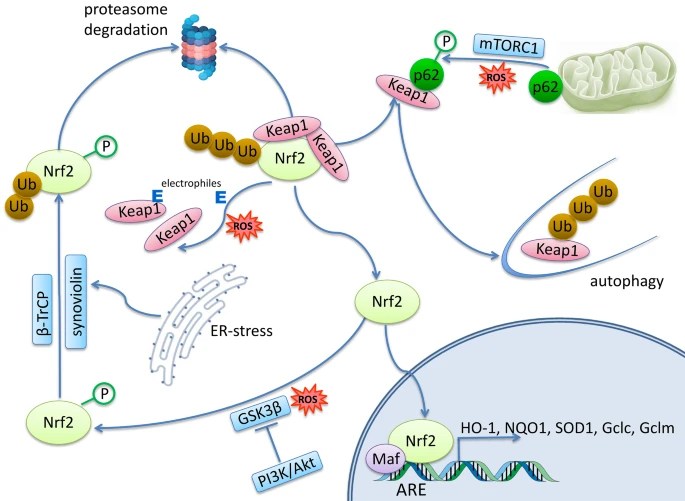
Bridging Nrf2 and autophagy

Three more 2023 papers that cited Precondition your defenses with broccoli sprouts, starting with a review:

“Examining crosstalk between Nrf2 antioxidant signaling and autophagy provides insights into how they are interconnected and proteins that mediate their communication. These factors are potential therapeutic targets for diseases with both autophagy dysfunction and oxidative stress.

A working model illustrates mechanisms of bridging factors (SQSTM1, TFEB, Sestrin2, TRIM16, Ca2+, and miRNAs) connecting autophagy (left) and the main antioxidant Nrf2-Keap1-ARE pathway (right) and feedback loops between these factors.

fcell-11-1232241-g003

  • A network forms that connects Nrf2, SQSTM1, TFEB, and mTOR.
  • Other non-canonical autophagy regulatory proteins like Sestrin2 and tripartite motif-containing protein 16 (TRIM16) also participate in regulation of Nrf2 and mTOR via direct or indirect interactions.
  • Ca2+ is the most widespread intracellular messenger whose role in autophagy has been studied extensively.
  • At post-transcriptional level, microRNAs have been reported to impact both the regulation of autophagy and Nrf2 antioxidant signaling.

Since these regulatory proteins seem intricately entangled, potential side effects in practical scenarios should also be taken into consideration. Further studies on understanding the complex crosstalk between autophagy and antioxidant pathways are yet to be conducted.”

https://www.frontiersin.org/articles/10.3389/fcell.2023.1232241/full “An update on the bridging factors connecting autophagy and Nrf2 antioxidant pathway”


A second review subject was improving autophagy:

Lysosomes are crucial degradative organelles that maintain cellular homeostasis. During the pathogenesis of neurodegenerative diseases and aging, functions of lysosomes are impaired, and lysosomal degradative capacity is consequently reduced.

Transcription factor EB-mediated lysosome biogenesis enhances autolysosome-dependent degradation, which subsequently alleviates neurodegenerative diseases. Small-molecule compounds that enhance TFEB activity and lysosome biogenesis are potential therapeutic agents.”

https://journals.lww.com/nrronline/fulltext/2023/11000/enhancement_of_lysosome_biogenesis_as_a_potential.7.aspx “Enhancement of lysosome biogenesis as a potential therapeutic approach for neurodegenerative diseases”


A third review tied mitochondrial participation into these processes:

“Mitochondria play an essential role in neural function, such as supporting normal energy metabolism, regulating reactive oxygen species, buffering physiological calcium loads, and maintaining the balance of morphology, subcellular distribution, and overall health through mitochondrial dynamics. Given recent technological advances in the assessment of mitochondrial structure and functions, mitochondrial dysfunction has been regarded as the early and key pathophysiological mechanism of cognitive disorders.

Mitochondrial dysfunction caused by acute and chronic brain injury is difficult to be distinguished because they may exhibit similar structural and functional impairments. Mitochondrial physiological function and morphology are integral, so when one is damaged, the other is also involved.

We recommend that all of the above methods can be used to explore mitochondrial dysfunction in different pathological pathways of cognitive disorders. Results may be related to special pathological pathways, sensitivity of the method, experiment cost, and degree of proficiency.”

https://journals.lww.com/nrronline/fulltext/2024/04000/latest_assessment_methods_for_mitochondrial.18.aspx “Latest assessment methods for mitochondrial homeostasis in cognitive diseases”


PXL_20231003_110600182

Neuritogenesis

Three 2023 papers on the initial stage of neuronal differentiation, starting with a rodent study of taurine’s effects:

“We aimed to assess the role of taurine (TAU) in axonal sprouting against cerebral ischemic injury, clarify the function of mitochondria in TAU-induced axonal sprouting, and further determine the underlying potential molecular mechanism.

experiment design

We determined that TAU improved motor function recovery and restored neurogenesis in ischemic stroke. This possibly occurred via improvements in mitochondrial function.

We investigated that the Sonic hedgehog (Shh) pathway exerted an important role in these effects. Our study findings highlighted the novel viewpoint that TAU promoted axonal sprouting by improving Shh-mediated mitochondrial function in cerebral ischemic stroke.”

https://www.scielo.br/j/acb/a/nxKvGXGk9g6gRkHxybMfbYJ/?lang=en “Taurine promotes axonal sprouting via Shh-mediated mitochondrial improvement in stroke”


A rodent study investigated effects of a soy isoflavone gut microbiota metabolite:

“Perinatally-infected adolescents living with HIV-1 (pALHIV) appear uniquely vulnerable to developing substance use disorders (SUD). Medium spiny neurons (MSNs) in the nucleus accumbens core (NAcc), an integrator of cortical and thalamic input, have been implicated as a key structural locus for the pathogenesis of SUD.

Treatment with estrogenic compounds (e.g., 17β-estradiol) induces prominent alterations to neuronal and dendritic spine structure in the NAcc supporting an innovative means to remodel neuronal circuitry. The carcinogenic nature of 17β-estradiol, however, limits its translational utility.

Plant-derived polycyclic phenols, or phytoestrogens, whose chemical structure resembles 17β-estradiol may afford an alternative strategy to target estrogen receptors. The phytoestrogen S-Equol (SE), permeates the blood-brain barrier, exhibits selective affinity for estrogen receptor β (ERβ), and serves as a neuroprotective and/or neurorestorative therapeutic for HIV-1-associated neurocognitive and affective alterations.

Beginning at approximately postnatal day (PD) 28, HIV-1 transgenic (Tg) animals were treated with a daily oral dose of 0.2 mg of SE. The SE dose of 0.2 mg was selected for two primary reasons, including:

  1. A dose-response experimental paradigm established 0.2 mg of SE as the most effective dose for mitigating neurocognitive deficits in sustained attention in the HIV-1 Tg rat; and
  2. The dose, which yielded a daily amount of 0.25–1.0 mg/kg/SE (i.e., approximately 2.5–10 mg in a 60 kg human), is translationally relevant (i.e., well below the daily isoflavone intake of most elderly Japanese.

Daily oral treatment continued through PD 90.

j_nipt-2023-0008_fig_002

HIV-1 Tg animals exhibited an initial increase in dendrite length (A) and the number of dendritic spines (B) early in development; parameters which subsequently decreased across time. In sharp contrast, dendrite length and the number of dendritic spines were stable across development in control animals.

Targeting these alterations with the selective ERβ agonist SE during the formative period induces long-term modifications to synaptodendritic structure, whereby MSNs in the NAcc in HIV-1 Tg animals treated with SE resemble control animals at PD 180.”

https://www.degruyter.com/document/doi/10.1515/nipt-2023-0008/html “Constitutive expression of HIV-1 viral proteins induces progressive synaptodendritic alterations in medium spiny neurons: implications for substance use disorders”


A rodent brain cell study investigated soy isoflavones’ effects on a different estrogen receptor:

“We evaluated effects of isoflavones using mouse primary cerebellar culture, astrocyte-enriched culture, Neuro-2A clonal cells, and co-culture with neurons and astrocytes. Soybean isoflavone-augmented estradiol mediated dendrite arborization in Purkinje cells.

These results indicate that ERα plays an essential role in isoflavone-induced neuritogenesis. However, G-protein-coupled ER (GPER1) signaling is also necessary for astrocyte proliferation and astrocyte–neuron communication, which may lead to isoflavone-induced neuritogenesis.

We highlight the novel possibility that isoflavones enhance dendritogenesis and neuritogenesis, indicating that they can be a useful supplementary compound during brain development or in the injured brain.”

https://www.mdpi.com/1422-0067/24/10/9011 “Isoflavones Mediate Dendritogenesis Mainly through Estrogen Receptor α”

Brain endothelial cells

Six 2023 papers on the subject, starting with a rodent study:

“One of the primary discoveries of our study is that the endothelial cell (EC) transcriptome is dynamically regulated by both aging and heterochronic parabiosis. We found that ECs, when compared with other brain cell types, exhibited one of the highest fractions of aging-related genes that were rescued after heterochronic parabiosis in the old brain, and similarly, the highest fraction of aging-related genes that were disrupted after heterochronic parabiosis in the young brain. This finding supports our previous research that vasculature is strongly affected by aging and disease, and is capable of regrowth after heterochronic parabiosis or systemic GDF11 treatment.

parabiosis

We observed that a subset of ECs was classified as mitogenic. It is reasonable to speculate that the growth of these cells, which is probably prevented or suspended by the inflammatory environment of the aged brain, may be among the cell populations that respond to these interventions.

Although proteostasis in brain ECs has not been thoroughly investigated, they are apparently long-lived cells and, like neurons, might therefore accumulate protein aggregates with age, potentially compromising their function. ECs become senescent with age, but parabiosis may reverse that phenotype as well.

These findings underline the strong susceptibility and malleability of ECs, which are directly exposed to secreted factors in both brain parenchyma and blood, to adapt to changes in their microenvironment. ECs, despite comprising <5% of the total number of brain cells, are a promising and accessible target for treatment of aging and its associated diseases.”

https://www.nature.com/articles/s43587-023-00373-6 “Heterochronic parabiosis reprograms the mouse brain transcriptome by shifting aging signatures in multiple cell types”


A review elaborated on endothelial cell senescence:

“ECs form highly dynamic and differentiated monolayers arranged in a vascular network. Within brain tissue, the ECs of arteries, capillaries, and veins present different molecular characteristics. The main functions of ECs as a major cellular component of the blood-brain barrier (BBB) are to express cell membrane transport proteins, produce inflammatory mediators, deliver nutrients to brain tissue, and prevent drugs and toxins from entering the central nervous system.

ECs are the first echelons of cells affected at the onset of senescence due to their special structural position in the vascular network. Senescent ECs produce reactive oxygen species (ROS), which directly inhibit smooth muscle potassium channels and cause vasoconstriction.

The vascular endothelium is in a constant process of damage and repair, and once damage occurs, ECs replenish themselves to remove damaged cells. EC senescence makes the endothelium less capable of self-repair. With the decline in endothelial function, excess accumulated senescent cells express senescence-associated secretory phenotypes (SASPs), which result in senescence of adjacent cells, and eventually degeneration of vascular function.”

https://www.aginganddisease.org/EN/10.14336/AD.2023.0226-1 “Endothelial Senescence in Neurological Diseases”


A human study investigated above-mentioned differences in brain endothelial cells:

“We performed single nucleus RNAseq on tissue from 32 Alzheimer’s Disease (AD) and non-AD donors each with five cortical regions: entorhinal cortex, inferior temporal gyrus, prefrontal cortex, visual association cortex, and primary visual cortex. Analysis of 51,586 endothelial cells revealed unique gene expression patterns across the five regions in non-AD donors.

Visual cortex areas, which are affected late in AD progression and experience less neurodegeneration, expressed more genes related to vasculogenesis and angiogenesis. Highly vulnerable areas such as the entorhinal cortex expressed more oxidative stress-related genes in normal aged brain, suggesting endothelial dysfunction in this region even in the absence of severe AD pathology.

The present work shows that senescence-related gene signatures are increased across several brain regions, and confirms these changes in endothelial cells in the absence of other vascular cell types. While endothelial cells are not typically associated with protein aggregation, upregulated protein folding pathways suggest that proteostatic stress is a key pathway in this cell type.”

https://www.biorxiv.org/content/10.1101/2023.02.16.528825v1.full “Endothelial Cells are Heterogeneous in Different Brain Regions and are Dramatically Altered in Alzheimer’s Disease”


A human cell study abstract on above-mentioned blood-brain barrier endothelial cells:

“The BBB is a semi-permeable and protective barrier of the brain, primarily composed of endothelial cells interconnected by tight junction proteins, that regulates movement of ions and molecules between blood and neural matter. In pathological conditions such as traumatic brain injury (TBI), disruption of the BBB contributes to leakage of solutes and fluids into brain parenchyma, resulting in onset of cerebral edema and elevation of intracranial pressure.

The objective of this study was to determine upstream regulators of NLRP3 signaling and BBB hyperpermeability, particularly to determine if extracellular adenosine triphosphate (ATP) via P2X7R, a purinergic receptor, promotes NLRP3 inflammasome activation. Extracellular ATP is a major contributor of secondary injuries following TBI.

Our results suggest that extracellular ATP promotes NLRP3 inflammasome activation. Subsequent caspase-1 and MMP-9-mediated tight junction disorganization are major pathways that lead to BBB dysfunction and hyperpermeability following conditions such as TBI.”

https://journals.physiology.org/doi/abs/10.1152/physiol.2023.38.S1.5732827 “Regulation of Blood-Brain Barrier Endothelial Cell Hyperpermeability by NLRP3 Inflammasome Inhibition”


A human study further investigated effects of traumatic brain injury on brain endothelial cells:

“We previously demonstrated that extracellular vesicles (EVs) released from injured brains led to endothelial barrier disruption and vascular leakage. Here, we enriched plasma EVs from TBI patients (TEVs), detected high mobility group box 1 (HMGB1) exposure to 50.33 ± 10.17% of TEVs, and found the number of HMGB1+TEVs correlated with injury severity. We then investigated for the first time the impact of TEVs on endothelial function using adoptive transfer models.

HMGB1 is secreted by activated cells or passively released by necrotic or injured cells. After post-translational modifications, it interacts with receptors such as toll-like receptors (TLRs; e.g., TLRs 2, 4, and 9) and the receptor for advanced glycation end products (RAGE) to trigger multiple signaling pathways and mediate inflammatory and immune responses. Extracellular HMGB1 promotes endothelial dysfunction, leukocyte activation and recruitment, as well as thrombosis.

These results suggest that circulating EVs isolated from patients with TBI alone are sufficient to induce endothelial dysfunction. They contribute to secondary brain injury that are dependent on immunologically active HMGB1 exposed on their surface. This finding provided new insight for development of potential therapeutic targets and diagnostic biomarkers for TBI.”

https://www.sciencedirect.com/science/article/pii/S1043661823001470 “Circulating extracellular vesicles from patients with traumatic brain injury induce cerebrovascular endothelial dysfunction”


To wrap up, eat mushrooms to protect your brain endothelial cells!

“Natural compound ergothioneine (ET), which is synthesised by certain fungi and bacteria, has considerable cytoprotective potential. We previously demonstrated anti-inflammatory effects of ET on 7-ketocholesterol (7KC)-induced endothelial injury in human blood-brain barrier endothelial cells (hCMEC/D3). 7KC is an oxidised form of cholesterol present in atheromatous plaques and sera of patients with hypercholesterolaemia and diabetes mellitus. The aim of this study was to elucidate the protective effect of ET on 7KC-induced mitochondrial damage.

Protective effects of ET were diminished when endothelial cells were coincubated with verapamil hydrochloride (VHCL), a nonspecific inhibitor of the ET transporter OCTN1 (SLC22A4). This outcome demonstrates that ET-mediated protection against 7KC-induced mitochondrial damage occurred intracellularly and not through direct interaction with 7KC.

OCTN1 mRNA expression itself was significantly increased in endothelial cells after 7KC treatment, consistent with the notion that stress and injury may increase ET uptake. Our results indicate that ET can protect against 7KC-induced mitochondrial injury in brain endothelial cells.”

https://www.mdpi.com/1422-0067/24/6/5498 “Protective Effect of Ergothioneine against 7-Ketocholesterol-Induced Mitochondrial Damage in hCMEC/D3 Human Brain Endothelial Cells”

The brain-gut-lung circuit

This 2023 rodent study investigated mechanisms of improving stress-worsened respiratory viral infection:

“Our study demonstrates that chronic psychological stress significantly increases host vulnerability to influenza A virus (IAV) infection characterized by a distorted gut microbiome and deregulated alveolar macrophages (AMs) response. We show that microbiome-derived γ-aminobutyric acid (GABA) functions as a tonic signal to support survival, self-renewing, and immunoregulation of AMs, and hence optimized pulmonary defensive response.

Chronic psychological stress causes gut microbiome dysbiosis and defective GABA generation, leading to loss of AMs homeostasis and aggravated viral pneumonia. The data indicate that:

  1. Microbial GABA is released in the circulation,
  2. Sensed by AMs via the GABAA receptor,
  3. Promoting cellular mitochondrial metabolism,
  4. For increased production of α-ketoglutarate (αKG),
  5. Which triggers Tet2-mediated DNA hydroxymethylation,
  6. To enable PPARγ-centered gene program,
  7. Supporting AMs homeostasis and function.

ga1_lrg

  • Re-localization of GABA-generating probiotics,
  • Supplementation of αKG, or
  • Adoptive transfer of GABA-conditioned macrophages,
  • Substantially rectifies stress-induced disruption inter-organ communication, and
  • Alleviates symptoms of viral pneumonia.

Our current study unveils an unappreciated regulatory circuitry that connects the brain, gut, and lung to mediate neurological modulation of host defensive response.”

https://www.sciencedirect.com/science/article/pii/S2090123223001716 “Gut microbial GABAergic signaling improves stress-associated innate immunity to respiratory viral infection”


consentofthegoverned

A biomarker for impaired cognitive function?

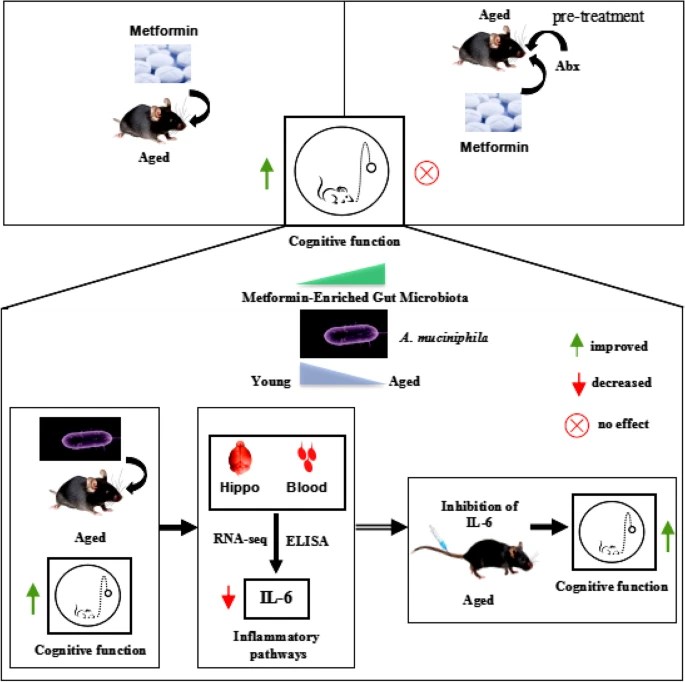
This 2023 rodent study investigated associations between a drug, a gut microbiota species, cognitive function, and proinflammatory cytokine interleukin-6:

“We show that gut microbiota is altered by metformin, which is necessary for protection against ageing-associated cognitive function declines in aged mice.

  • Mice treated with antibiotics did not exhibit metformin-mediated cognitive function protection.
  • Treatment with Akkermansia muciniphila improved cognitive function in aged mice.
  • A. muciniphila decreased proinflammatory-associated pathways, particularly that of proinflammatory cytokine interleukin (IL)-6, in both peripheral blood and hippocampal profiles, which was correlated with cognitive function improvement.
  • An IL-6 antibody protected cognitive function, and an IL-6 recombinant protein abolished the protective effect of A. muciniphila on cognitive function in aged mice.

40168_2023_1567_Figa_HTML

A. muciniphila, which is mediated in gut microbiota by metformin, modulates inflammation-related pathways in the host and improves cognitive function in aged mice by reducing proinflammatory cytokine IL-6 both systemically and in the hippocampus. This is direct evidence to validate that gut microbiota mediate the effect of metformin on cognitive improvement.”

https://microbiomejournal.biomedcentral.com/articles/10.1186/s40168-023-01567-1Akkermansia muciniphila, which is enriched in the gut microbiota by metformin, improves cognitive function in aged mice by reducing the proinflammatory cytokine interleukin-6″


IL-6 may be useful with other biomarkers of impaired cognitive function. It’s too coarse to track improved cognitive function past a certain point, though. Maybe the current IL-6 blood test can be refined as high-specificity CRP and regular CRP blood tests were done?

We don’t need to take this drug or be concerned about this gut bacteria species in order to lower inflammation. Click the IL-6 link above and see blog posts such as Part 2 of Rejuvenation therapy and sulforaphane for other methods.

PXL_20230630_092833465

Nrf2 Week #4: Aging

Two 2023 reviews of Nrf2 and aging, starting with Nrf2-mitochondria interactions:

“We discuss molecular mechanisms of interactions between Nrf2 and mitochondria that influence the rate of aging and lifespan. Nrf2 activity positively affects both mitochondrial dynamics and mitochondrial quality control.

Nrf2 influences mitochondrial function through regulation of nuclear genome-encoded mitochondrial proteins and changes in the balance of ROS or other metabolites. In turn, multiple regulatory proteins functionally associated with mitochondria affect Nrf2 activity and even form mutual regulatory loops with Nrf2. These loops enable fine-tuning of cellular redox balance and, possibly, of the cellular metabolism as a whole.

mtDNA-encoded signal peptides interact with nuclear regulatory systems, first of all, Nrf2, and are possibly involved in regulation of the aging rate. Interactions between regulatory cascades that link programs ensuring maintenance of cellular homeostasis and cellular responses to oxidative stress are a significant part of both aging and anti-aging programs.

Understanding these interactions will be of great help in searching for molecular targets to counteract aging-associated diseases and aging itself. Future research on Nrf2 signaling and ability of various substances that activate the Nrf2 pathway to prevent age-associated chronic diseases will provide further insight into the role of Nrf2 activation as a possible longevity-promoting intervention.”

https://link.springer.com/article/10.1134/S0006297922120057 “Transcription Factor Nrf2 and Mitochondria – Friends or Foes in the Regulation of Aging Rate” (not freely available) Thanks to Dr. Gregory A. Shilovsky for providing a copy.


The second review evaluated whether Nrf2 is a master regulator of aging:

“This paper briefly presents main mechanisms of mammalian aging and roles of inflammation and oxidative stress in this process. Mechanisms of Nrf2 activity regulation, its involvement in aging and development of the senescence-associated secretory phenotype are also discussed.

The age-related decrease in Nrf2 activity is of universal interspecies character:

  • Rodents with high Nrf2 activity have a longer lifespan than rodents with low activity.
  • Genetic knockout of Nrf2 usually leads to the increased senescent phenotype in a variety of animal organs and tissues, and also reduces lifespan of female mice.
  • There are also opposite examples, where Nrf2 knockout in aging mice reduced iron ions deposition in the brain, lowered the level of oxidative damage in the striatum, and also alleviated age-related motor dysfunction.

10541_2022_2401_Fig2

It would be incorrect to consider the effect of Nrf2 transcription factor at the organism level as exclusively antioxidant, anti-inflammatory, and, ultimately, anti-aging. Nrf2 controls many genes, products of which have complex, pleiotropic effects on the body:

  • No experiments that use Nrf2 chemical inducers as anti-aging drugs have been performed so far.
  • Nrf2 is not involved in life extension caused by caloric restriction.
  • Epigenetic clocks do not reveal transcription factors activity of which changes with aging.

Aging is accompanied by changes in gene expression profiles, which are tissue- and species-specific. These changes only to a small extent include genes controlled by Nrf2. At the moment, it cannot be concluded that Nrf2 is the master regulator of the aging process.”

https://link.springer.com/article/10.1134/S0006297922120045 “Does Nrf2 Play a Role of a Master Regulator of Mammalian Aging?”


PXL_20230520_182643299

Do broccoli sprouts treat gout and kidney stones?

This 2022 rodent study investigated glucoraphanin’s effects on reducing uric acid:

“Hyperuricemia is a chronic disease characterized by abnormally elevated serum uric acid levels. Sulforaphane could lower uric acid by decreasing urate synthesis and increasing renal urate excretion in hyperuricemic rats.

A hyperuricemia model was established by administering feedstuffs with 4% potassium oxonate and 20% yeast. Forty male Sprague–Dawley rats were randomly divided into the normal control, hyperuricemia, allopurinol, and sulforaphane groups. Animals were treated by oral gavage for six consecutive weeks, and then phenotypic parameters, metabolomic profiling, and metagenomic sequencing were performed.

1-s2.0-S209012322200251X-ga1_lrg

We identified succinic acid and oxoglutaric acid as critical host-gut microbiome co-metabolites. Sulforaphane improved diversity of microbial ecosystems and functions, as well as metabolic control of the kidney. Sulforaphane exerted its renoprotective effect through epigenetic modification of Nrf2 and interaction between gut microbiota and epigenetic modification in hyperuricemic rats.

Limitations of this study include:

  1. We used glucoraphanin bioactivated with myrosinase for our experiments. Future experiments may directly involve sulforaphane.
  2. Bioinformatics analysis resulted in speculations that require further experimental testing.
  3. Further investigation of interactions between microbiota and the host epigenome is still needed.”

https://www.sciencedirect.com/science/article/pii/S209012322200251X “Sulforaphane-driven reprogramming of gut microbiome and metabolome ameliorates the progression of hyperuricemia”


It was a stretch to label treatment subjects as the “sulforaphane group” by claiming “Glucoraphanin (10 mg/kg) was metabolized to SFN by myrosinase as described in previous studies.” Both this and the referenced 2014 study “(RS)-glucoraphanin purified from Tuscan black kale and bioactivated with myrosinase enzyme protects against cerebral ischemia/reperfusion injury in rats” measured glucoraphanin and myrosinase, but not sulforaphane.

A human equivalent to this study’s daily glucoraphanin intake of 10 mg / kg weight would be (.162 x 10 mg) x 70 kg = 113 mg. Whether 10 mg was dry or wet weight wasn’t disclosed.

If 10 mg was wet, 113 mg is a little more than twice our model clinical trial’s average glucoraphanin intake of 51 mg fresh weight from eating 30 grams / day of super sprouts. In April 2020’s Understanding a clinical trial’s broccoli sprout amount, a study coauthor said:

“We considered 30 g and 60 g to be 1/2 and 1 portion per day, respectively, of broccoli sprouts. When we carried out tests with consumers, previous to the bioavailability studies, higher amounts per day were not easy to consume and to get eaten by participants.”

PXL_20221112_201430280