Transgenerational epigenetic programming with stress and microRNA

This 2015 Pennsylvania rodent study found:

“Sperm miRs [microRNAs, a small non-coding RNA that has a role in gene expression] function to reduce maternal mRNA [messenger RNA, a large RNA that carries codes for protein production] stores in early zygotes, ultimately reprogramming gene expression in the offspring hypothalamus and recapitulating the offspring stress dysregulation phenotype.”

These researchers caused stress-induced changes at an early stage of embryonic development with microRNA injections. Resultant adverse effects weren’t observed until subjects were adults!

Most news coverage focused on it being a male’s stress, not a female’s, that affected a developing embryo. Either or both sexes can epigenetically disadvantage a fetus – okay.

Demonstrating how a damaging influence can begin immediately after conception, but symptoms didn’t present until adulthood made this study newsworthy.


Although the term “transgenerational” was used in the study’s title, abstract, and elsewhere, studied epigenetic effects were intergenerational rather than transgenerational. Per A review of epigenetic transgenerational inheritance of reproductive disease, for the term to apply, researchers need to provide evidence in at least the next 2 male or non-gestating female generations and/or 3 gestating female generations of:

“Altered epigenetic information between generations in the absence of continued environmental exposure.”


From a press release, a study coauthor who also coauthored How to make a child less capable even before they are born: stress the pregnant mother-to-be stated:

“Bale suspects that when a male experiences stress it may trigger the release of miRs contained in exosomes from epithelial cells that line the epididymis, the storage and maturation site for sperm between the testes and the vas deferens. These miRs may be incorporated into maturing sperm and influence development at fertilization.”

Not all stress-related gene expression in pituitary and adrenal glands differed.

http://www.pnas.org/content/112/44/13699.full “Transgenerational epigenetic programming via sperm microRNA recapitulates effects of paternal stress”

The roles of DNA methylation and demethylation in forming memories

This 2015 Alabama combined animal and human review noted:

“Memories can last a lifetime, yet the proteins that enable synaptic plasticity, allowing for the establishment and maintenance of the memory trace, are subject to perpetual turnover.

DNA methylation may likely serve as the principle cellular information storage device capable of stably and perpetually regulating cellular phenotype.”

The authors developed a framework for understanding disparate findings of DNA methylation and demethylation concerning memory.


The dependencies expressed in the framework among the numerous factors – with their relative strengths, timings, and durations – reminded me of this video:

1) If such an error-prone framework accurately reflected the evolved architecture of our memory, we wouldn’t have the variety and number and intensity of memories that we have.

2) The framework neither accounted for prenatal memory processes nor differentiated emotional memories, although some of the referenced studies’ findings were applicable.

3) DNA methylation and demethylation aren’t the entirety of memory formation explanations. For example, they don’t explain state-dependent memories that can be instantiated, reactivated, and amnesia induced without involving “the proteins that enable synaptic plasticity” described in the authors’ framework. For completeness, the authors could have assessed the relative contributions of other memory processes, or at least enumerated them.

4) DNA methylation and demethylation explanations don’t cover all epigenetic biochemical processes. There are also placental interactions, histone/protein interactions, microRNA interactions, etc. For completeness, the authors could have placed the review’s topic within appropriate contexts of other epigenetic processes that influence memory.

This review of DNA methylation and demethylation roles in memory formation opened up a few slats in the blind covering one window. There’s more to be done to fully open that blind, and more window blinds to be opened before the workings of our memory are illuminated.

http://nro.sagepub.com/content/21/5/475.full “DNA Methylation in Memory Formation: Emerging Insights”

A review of the epigenetic basis for mental illness

This 2015 New York combined animal and human review of epigenetic studies noted:

“While genetic factors are important in the etiology of most mental disorders, the relatively high rates of discordance among identical twins, particularly for depression and other stress-related syndromes, clearly indicate the importance of additional mechanisms.

Environmental factors such as stress are known to play a role in the onset of these illnesses.

Exposure to such environmental insults induces stable changes in gene expression, neural circuit function, and ultimately behavior, and these maladaptations appear distinct between developmental versus adult exposures.

Increasing evidence indicates that these sustained abnormalities are maintained by epigenetic modifications in specific brain regions.”

Placing the “maladaptations” and “sustained abnormalities” phrases into their contexts:

  • A fetus biologically adapted to their environment – however toxic it was – in order to best survive.
  • These adaptations for survival were subsequently viewed as Disrupted Neurodevelopment and “maladaptations” from the perspectives of normal development and environments.
  • The “sustained abnormalities” caused within the earlier environments “are maintained by epigenetic modifications.” An improved environment wasn’t impetus enough to change developmental “maladaptations.”

Per the below link, it’s been a month since this review was published. Why has there been ZERO news coverage of it?

One reason may be that the Friedman Brain Institute, Icahn School of Medicine at Mount Sinai, didn’t issue a press release or otherwise publicize it. Another reason may be the groups that are opposed to its findings:

  • Parents who provided harmful environments for their children, beginning at conception;
  • People who feel threatened when scientific causal evidence resonates with what happened in their own lives, and in response, limit their empathetic understanding of others’ problems;
  • Social workers, psychologists, and others in industries whose paychecks depend on efforts that aren’t directed towards ameliorating the causes for these later-life effects;
  • Psychiatrists and medical personnel whose livelihoods depend on pharmaceutical and other treatments that only alleviate symptoms;
  • Researchers whose funding depends on producing non-etiologic findings.

Despite resistance to this review’s findings, a large number of people would benefit from publicizing evidence for:

“These sustained abnormalities are maintained by epigenetic modifications in specific brain regions.”

http://nro.sagepub.com/content/early/2015/09/24/1073858415608147 “Epigenetic Basis of Mental Illness”

Grokking an Adverse Childhood Experiences (ACE) score

What does it take to empathetically understand, to make a part of oneself, to grok an ACE score?

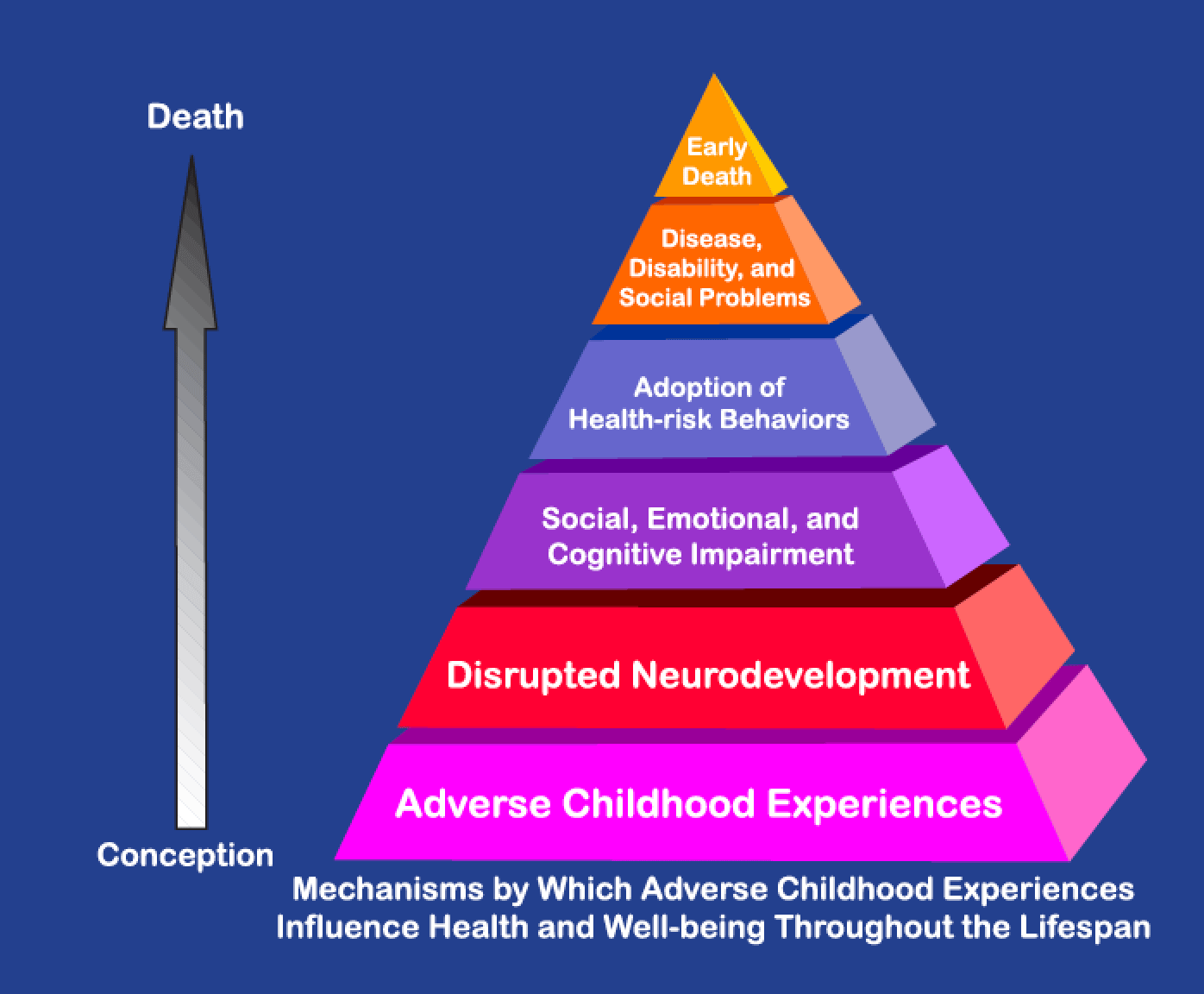
The ACE effort was initiated in 1985 in an era before epigenetics was well-studied. Its artifacts included the ACE pyramid:

The_ACE_PyramidThe historical ACE lifespan continuum on the left began at conception. The pyramid on the right promoted a limited view of ACE that assigned childhood as the pyramid’s base.

Current official depictions of the ACE pyramid assign an expanded view of ACE as the pyramid’s base. The viewer’s attention is directed to “Scientific Gaps” between pyramid layers, but the largest gap remains: the continuum starts at conception but the pyramid still starts at childhood. The narrative claims:

“To provide scientific information that would be useful for developing new and more effective prevention programs.”

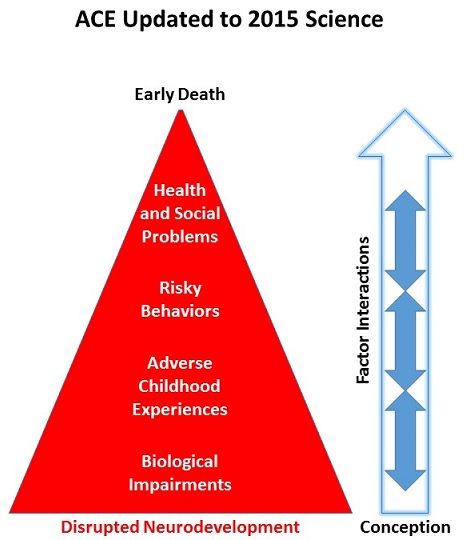
The official ACE pyramid doesn’t accurately reflect current science documented in, for example, Epigenetic effects of early life stress exposure. By downplaying Disrupted Neurodevelopment that may begin at conception, governing agencies implicitly endorse approaches that fail to address prenatal causes for later-life adverse effects.


If the ACE diagram was drawn thirty years later in 2015 to incorporate evidence for epigenetics, Disrupted Neurodevelopment wouldn’t be a consequent layer to an ACE base. The potential start of Disrupted Neurodevelopment would coincide with conception:Updated for 2015 to show Disrupted Neurodevelopment

What’s an example of current ACE-related scientific evidence that wasn’t present three decades ago and also isn’t represented in the official ACE pyramid? Prenatal Disrupted Neurodevelopment may be considered today as a possible consequence of a “Yes” answer to half of the original ACE questions:

  • Were your parents were too drunk or high to take care of you or take you to the doctor?
  • Were your parents ever separated or divorced?
  • Was your mother often or very often pushed, grabbed, slapped, or had something thrown at her?
  • Did you live with anyone who was a problem drinker or alcoholic or who used street drugs?
  • Was a household member depressed or mentally ill?

These threats and other stresses cause a fetus to biologically adapt. When such adaptations occur during prenatal development, they may:

  • Have much larger impacts and
  • Cause Biological Impairments that
  • Don’t unassistedly disappear over time.

Emphasizing Disrupted Neurodevelopment that may begin at conception would encourage:

  • Research that’s directed toward producing causal evidence for adaptations that largely occur during the early periods of an individual’s lifespan; and
  • Research on how these adaptations consistently influence our later-life ideas, biology, and behavior.

The above recommendations for research are neither the current focus of ACE research nor the direction of related efforts to assist affected individuals. Relevant studies that I’ve curated on this blog often only produced symptomatic evidence:

  • If a study couched its findings in non-etiologic phrases such as “is associated with” or “is linked to” or “may relate to,” it didn’t address ACE originating causes.
  • “New and more effective prevention programs” seldom address Disrupted Neurodevelopment and Biological Impairments with efforts to reduce the source of the damage.
  • If a program’s presentation showed multivariate analyses with ACE score probabilities and percentages, it didn’t address originating causes.

Here’s a YouTube search of ACE + adverse. Evaluate the current focus of ACE efforts by people employed in the social sciences and services. What did you notice?

How many presentations emphasized prenatal Disrupted Neurodevelopment, a period during which problems may be prevented by addressing causes? Did you instead see that these were outnumbered by many more presentations that emphasized Health and Social Problems symptom interventions?


So, what does it take to empathetically understand, to make a part of oneself, to grok a person’s ACE score?

Regarding empathy – it’s best to avoid the advice of studies such as:

People who are helped may not recognize it at first, but over time, they’ll sense whether the helper’s empathy is genuine.

Regarding understanding – I feel that people first need to ameliorate the origins of their own problems. Then they may be able to help others therapeutically address causes for ACE symptoms.

Need proof? Think of someone you’ve met whose thoughts and feelings and behavior were caught up in and motivated by their own problems:

  • Did you feel they could empathetically understand others?
  • Wasn’t the welfare of the people who may have been helped truly incidental and secondary to someone who was acting out their own problems?

Stress-induced epigenetic DNA modifications may be inherited

This 2015 Australian plant summary study made several points:

“Non-transmission of epigenetic marks through meiosis may be regarded as an epigenetic modification in itself. We should understand the implications for plant evolution in the context of both selection for and selection against transgenerational epigenetic memory.

Both epigenetic inheritance and resetting are mechanistically directed and targeted. Stress-induced epigenetic modifications may buffer against DNA sequence-based evolution to maintain plasticity, or may form part of plasticity’s adaptive potential.

In some cases the signature of the stress experience remains in the epigenome after relief from the stress, providing a “memory.” If this memory conditions the response to stress during subsequent development, the organism is said to be epigenetically primed. If the memory of the stress experienced by a parent conditions the response of its progeny, this epigenetic priming may be transgenerational.

Epigenetic and genetic variation co-evolve. Epigenetic plasticity does not completely buffer evolvability and reduce the correlation between fitness and genotype, slowing selection.”

One of the summarized studies found that a transgenerational epigenetic change eventually silenced itself after the 40th copy!

The Are stress-induced epigenetic changes to DNA inherited across generations? study was cited, although it argued for the opposing viewpoint.

http://journal.frontiersin.org/article/10.3389/fpls.2015.00699/full “Transgenerational inheritance or resetting of stress-induced epigenetic modifications: two sides of the same coin”

Genetic causes for epigenetic symptoms

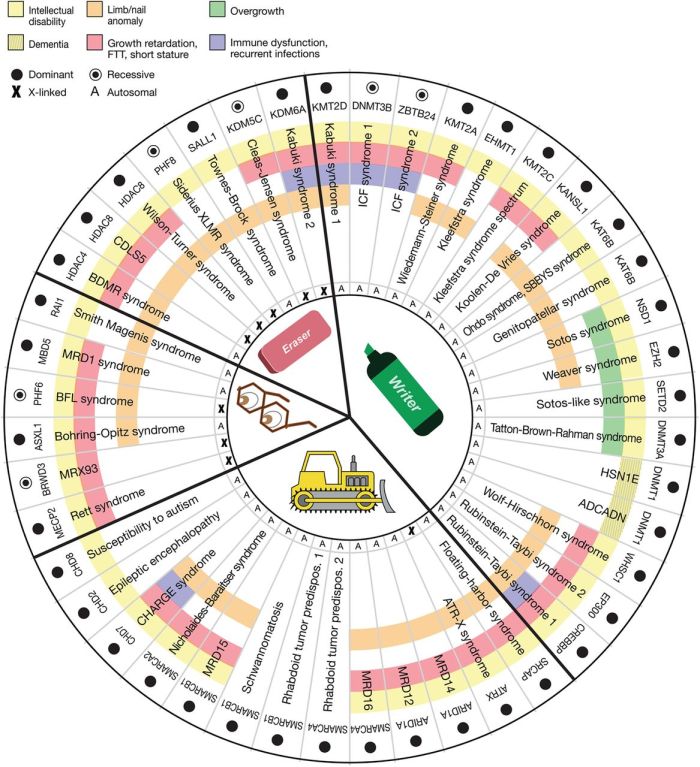
This 2015 human summary study was of 44 genetic disorders that disrupt the maintenance of epigenetic modifications:

“..making them likely to have significant downstream epigenetic consequences. Interestingly, these patients often demonstrate neurological dysfunction, suggesting that precise epigenetic regulation may be critical for neuronal homeostasis. However, at the same time, it is important to keep in mind that many of these proteins have additional non-epigenetic roles.

Mutations in many of these components have now been linked to a number of well-known causes of intellectual disability. Intellectual disability is generally defined as deficits of intellectual function and adaptive behavior that occur during the developmental period.

Given the opposing activity of many of the components of the epigenetic machinery, the pathogenic sequence in these disorders involves an imbalance of chromatin states. Keeping a subset of genes under “pressure” from two opposing systems may allow the cellular system to rapidly respond to environmental stimuli.

These disorders, on average, have unusual phenotypic breadth. Similarly, there is a shift in distribution toward a higher number of organ systems affected.

In addition to developmental phenotypes (multiple congenital anomalies), in some cases there appear to be ongoing defects that remain consequential in post-natal life. An example of the latter is the hippocampal memory defects seen in many of the mouse models.

This raises the question whether cells undergoing neurogenesis and synaptogenesis are particularly sensitive to subtle defects of the epigenetic machinery and downstream epigenetic abnormalities. A major remaining question is whether neurogenesis defects and/or abnormalities of synaptic plasticity are a unifying pathophysiological process.”

The researchers represented the 44 genetic disorders on a wheel graph:

F1.large

I look forward to further research that includes non-genetic disruptors of epigenetic modifications.

http://genome.cshlp.org/content/25/10/1473.full “The Mendelian disorders of the epigenetic machinery”

Identifying epigenetic DNA changes with blood tests

This 2015 Chinese human study found:

“With reference to methylation profiles of different tissues, we developed a general approach for studying the major tissue contributors to the circulating DNA pool. This development has opened up numerous research avenues and diagnostic applications.

Our study takes advantage of the recent availability of reference methylomes of a number of tissues. It is likely that such reference databases would be continually updated to include more sample types and from more individuals.”

Up to 41% of plasma DNA in pregnant women was from the placenta. However, I didn’t understand why the non-pregnant women in the control group had measurable placental DNA of up to 2.9%. Maybe it was leftover from a prior pregnancy?

http://www.pnas.org/content/112/40/E5503.full “Plasma DNA tissue mapping by genome-wide methylation sequencing for noninvasive prenatal, cancer, and transplantation assessments”

Countering the epigenetic effects of obese mothers on their fetuses

This 2015 Colorado rodent study found:

“Maternal ADN [adiponectin, a hormone produced by fat cells, that regulates fat and glucose metabolism] supplementation reversed the adverse effects of maternal obesity on placental function and fetal growth.

Babies of mothers with obesity and/or gestational diabetes mellitus (GDM) are often large at birth and have increased adiposity, which predisposes them to the development of metabolic disease later in life.

Maternal ADN infusion in obese dams from E14.5 to E18.5 [the last 4 days of pregnancy, a period that accounts for 70% of the total fetal growth] normalized maternal insulin sensitivity, placental insulin/mTORC1 and PPARα signaling, nutrient transport, and fetal growth without affecting maternal fat mass.”

As the study may apply to humans:

“This hormone or a similar agent could feasibly do the same thing for humans that it did for mice,” Jansson said.

Jansson said more work needs to be done to track the long-term effects of the hormone treatment on the mice.”

The study focused on epigenetic effects of the mothers’ environment on fetuses, and didn’t assess possible genetic contributions.

As alternatives to adiponectin supplementation:

http://www.pnas.org/content/112/41/12858.full “Adiponectin supplementation in pregnant mice prevents the adverse effects of maternal obesity on placental function and fetal growth”

A study that provided evidence for basic principles of Primal Therapy

This 2015 Northwestern University rodent study found:

“Fear-inducing memories can be state dependent, meaning that they can best be retrieved if the brain states at encoding and retrieval are similar.

Memories formed in a particular mood, arousal or drug-induced state can best be retrieved when the brain is back in that state.

‘It’s difficult for therapists to help these patients,’ Radulovic said, ‘because the patients themselves can’t remember their traumatic experiences that are the root cause of their symptoms.’

The best way to access the memories in this system is to return the brain to the same state of consciousness as when the memory was encoded.”

The study demonstrated one method of activating neurobiological pathways with a drug to remove a hippocampal memory’s protection, which played a part in enabling subjects to relive their remembered experiences. This rodent study’s methods weren’t designed to therapeutically access similarly protected memories with humans.

From the Northwestern press release:

“There are two kinds of GABA [gamma-Aminobutyric acid] receptors. One kind, synaptic GABA receptors, works in tandem with glutamate receptors to balance the excitation of the brain in response to external events such as stress.

The other population, extra-synaptic GABA receptors, are independent agents.

If a traumatic event occurs when these extra-synaptic GABA receptors are activated, the memory of this event cannot be accessed unless these receptors are activated once again.

‘It’s an entirely different system even at the genetic and molecular level than the one that encodes normal memories,’ said lead study author Vladimir Jovasevic, who worked on the study when he was a postdoctoral fellow in Radulovic’s lab.

This different system is regulated by a small microRNA, miR-33, and may be the brain’s protective mechanism when an experience is overwhelmingly stressful.

The findings imply that in response to traumatic stress, some individuals, instead of activating the glutamate system to store memories, activate the extra-synaptic GABA system and form inaccessible traumatic memories.”

I’d point out that “can’t remember” and “inaccessible traumatic memories” phrases used above were in reference to what’s usually called “memory” i.e., a recall initiated by the cerebrum.


The study’s findings should inform memory-study researchers if they care to understand how emotional memories can be formed and re-experienced.

The study provided evidence for fundamentals of Dr. Arthur Janov’s Primal Therapy, such as:

  • Experiences associated with pain can be remembered below our conscious awareness.
  • The retrieval and re-experiencing of emotional memories can engage our lower-level brain areas without our higher-level brain areas’ participation.

The obvious nature of this study’s straightforward experimental methods made me wonder why other researchers hadn’t used the same methods decades ago.

Use of this study’s methodology could have resulted in dozens of informative follow-on study variations by now, and subsequently found whether subjects’ physiological, behavioral, and epigenetic measurements differed from control group subjects, as in:

“miR-33 is downregulated in response to gaboxadol [the drug used to change subjects’ brain state] and modulates its effects on state-dependent fear.”


See Resiliency in stress responses for abstracts of three follow-on papers by these researchers.

http://www.nature.com/neuro/journal/v18/n9/full/nn.4084.html “GABAergic mechanisms regulated by miR-33 encode state-dependent fear”

MP3 with lead researcher Dr. Jelena Radulovic: http://www.thenakedscientists.com/HTML/specials/show/20150825/

Leaky gates, anxiety, and grocery store trips without buying list items

An interview with Jeff Link, the editor of Dr. Arthur Janov’s 2011 book “Life Before Birth: The Hidden Script that Rules Our Lives” with Ken Rose:

“Even further confirmation for some of the views of Janov, that maybe weren’t widely accepted for a time, it’s new research now being done into memory and what a lot of scientist are seeing, a lot of different studies is that memory reactivates the same neuroimpulses that were initially firing off when the event happened.

So a traumatic event when you remember it, the act of remembering it is actually creating a neuromirror of what went on initially.

In a lot of ways that is what Primal Therapy is attempting to do; is to go back to that place and reconnect, or as it’s sometimes referred to, reconsolidate the brain state so that real healing can take place.”

Transcript (part 4 of 6): http://cigognenews.blogspot.com/2015/09/ken-rose-on-life-before-birth-part-46.html

MP3: http://www.pantedmonkey.org/podcastgen/download.php?filename=2011-12-15_1300_what_now_jeff_link.mp3

A hippocampal protein that increases when stress increases

This 2015 Michigan human/rodent study found:

“Gene expression profiling in postmortem human brain and studies using animal models have implicated the fibroblast growth factor (FGF) family in affect regulation and suggest a potential role in the pathophysiology of major depressive disorder (MDD).

We show that FGF9 expression is up-regulated in the hippocampus of individuals with MDD, and that FGF9 expression is inversely related to the expression of FGF2.”

The researchers went down the evolutionary scale from human findings to replicate many of the findings with rodents:

“We found that chronic social defeat stress, an animal model recapitulating some aspects of MDD, leads to a significant increase in hippocampal FGF9 expression.

Collectively, these results suggest that high levels of hippocampal FGF9 play an important role in the development or expression of mood and anxiety disorders.”

http://www.pnas.org/content/112/38/11953.full “Fibroblast growth factor 9 is a novel modulator of negative affect”

Reflections on my four-year anniversary of spine surgery

At age 55, I found out that I’d suffered for maybe 45 to 50 years from a childhood injury, and I didn’t know anything about it. It still seems unbelievable to me that I was physically ill for decades before I received a diagnosis.

As explained to me by two surgeons, the cause of my spondylolisthesis between L5 and S1 was a sudden injury sometime between ages 5 and 10. Here’s a further explanation:

“In children, spondylolisthesis usually occurs between the fifth bone in the lower back (lumbar vertebra) and the first bone in the sacrum (pelvis) area. It is often due to a birth defect in that area of the spine or sudden injury (acute trauma).

Other causes of spondylolisthesis include bone diseases, traumatic fractures, and stress fractures (commonly seen in gymnasts). Certain sport activities, such as gymnastics, weight lifting, and football, put a great deal of stress on the bones in the lower back. They also require that the athlete constantly overstretch (hyperextend) the spine.”

I played a lot of baseball when I was a kid growing up in Miami. I didn’t suffer from a birth defect or bone disease, play football before I was a teenager, do gymnastics, or lift weights.

I don’t remember a specific “sudden injury (acute trauma)” per the above explanation. Maybe I incurred the acute trauma that started my spondylolisthesis sliding into bases playing baseball. Maybe I incurred it playing in the other rough-and-tumble activities that I did as a boy.


Please stop at the first hint of any pain that you feel while reading the rest of this post. I don’t want to cause you pain.

I re-experienced while in Primal Therapy a day when I was seven or eight years old. A most exhilarating day, one that filled me with light and joy.

What brought on my elevated mood? It was the day I finally ran faster than my father did, and he couldn’t catch me to give me a beating as I ran out of the house.

My father never beat me on the sidewalk, the street, or the front yard anyway. That would make the abuse public.

My father’s job was assistant principal/dean of boys at West Miami Junior High School. He whipped boys with a thick belt or paddled them daily as part of his job requirements.

My father kept a wooden paddle with holes in it at home. For me.

I don’t remember that my three siblings ever received a paddling or belting, although they were spanked. I’ve remembered while in Primal Therapy that my younger sister and brother were spanked for crying.

I re-experienced the dread of waiting (in an exact place with visual details), waiting for my father to come home to administer a spanking or belting or paddling to me for some “transgression” my mother observed. She had dozens of rules of conduct for her children.

I re-experienced my early childhood feelings that my father’s punishments depended more on my mother’s mood than on what I did.

I re-experienced my early childhood feelings that I didn’t deserve the beatings. I didn’t deserve any beatings, not one!

My father continued, though, until I was around age 11 or so. I’m sure that the beatings were a factor in how I felt at age 12:

Suicidal. Needing to escape from my life.

When I was a child, I needed my parents’ love.

I re-experienced many times while in Primal Therapy the overwhelming hopelessness, helplessness, worthlessness, and betrayal when the people I needed to love me were cruel to me instead.


My parents knew what they did was wrong. Neither one of them ever told me that, though.

My father never apologized for beating me so much before he died 19 years ago. Even before he retired, 17 years before he died, the Miami-Dade County public school system stopped him and the rest of their employees from spanking, whipping, beating, and paddling children.

What could he even tell me to take away those experiences?

  • That he beat me as a child because he himself was beaten as a child?
  • That he couldn’t help it?
  • That how he and my mother frequently went out of their way to help me along in life after my childhood somehow made up for the beatings?

I’m certain that my father was beaten as a child. I bring this up not as a defense for what he did, but as part of my history, too.

It wasn’t enough for my father’s mother to beat me while she was babysitting my siblings and me at our parents’ house. I re-experienced crying as a five-year old when I was required to go cut off palm fronds from the tree in front of our house for her to use as a switch, and bring them to her.

It was a mark of my grandmother’s cruelty that she threatened to beat me with a broom handle when I tried to not participate in my own torment. I re-experienced exact places of my legs where she switched me with the palm fronds, giving me even more when I cried during the punishment.


These wounds left scars that haven’t gone away.

Run your hand down your spine until you reach the top of your sacrum. That’s the area on which I had surgery four years ago, where I now have a titanium cage, replacement disc, and two rods to keep the area stable.

I received a lot of beatings pretty close to that area. Maybe my boyhood activities didn’t cause the “sudden injury (acute trauma).”


I write frankly about my parents because that’s my history: the realities of who they were.

And the realities of who I needed them to be.

I express it because getting well has to address reality.

From Dr. Arthur Janov’s book, Primal Healing, page 133:

“Another cognitive technique is to help the patient understand and forgive his parents. ‘After all, your parents did the best they could. They had a pretty tough childhood too.’ ‘Oh yes, I understand. They did have it tough and I do forgive’ comes forth from the left side. Still, of course, the right side is crying out its needs and its pain, and will go on with its silent scream for the rest of our lives.

There is no way around need.

‘Forgiveness’ is an idea that has no place in therapy.

We are not here to pardon parents; we are here to address the needs of patients, and what the lack of fulfillment did to them.

I regret to say that much of current therapy and particularly cognitive therapy is about a moral position; well hidden, couched in psychological jargon, but, at bottom, moralizing. The therapist becomes the arbiter of correct behavior.

After all, the therapist is trying to change the patient’s behavior toward some preconceived goal. That goal has a sequestered moral position.”
DNA damage to fat cells may cause obesity and insulin resistance

This 2015 Indiana rodent study found:

“DNA damage is a root cause of adipocyte senescence [fat cells that can no longer replicate], which plays a determining role in the development of obesity and insulin resistance.”

The researchers removed the capability for the subject mice to produce a protein that “plays an essential role in preventing cutaneous cancer caused by UV radiation-induced DNA damage.” They showed that this genetic deficiency:

“Causes obesity with visceral fat accumulation, hepatic steatosis, hyperleptinemia, hyperinsulinemia, and glucose intolerance.”

These researchers – in contrast with the Pulling on the chain of causes and effects with insulin resistance study – investigated causes for the various effects that included insulin resistance. However, the study’s applicability to humans wasn’t clear, since we most often develop symptoms such as insulin resistance due to causes other than genetics.

The study also demonstrated that treatment with a common dietary supplement – N-acetyl cysteine (NAC) – or metformin (Met):

“Reduce[d] adipose DNA damage.

Ameliorated cellular senescence and metabolic abnormalities.”

Body fat

High-fat and high-fructose diets caused the opposite effects in the subject genetic-deficient mice.

http://www.pnas.org/content/112/33/E4556.full “Ablation of XP-V gene causes adipose tissue senescence and metabolic abnormalities”

Genetic statistics don’t necessarily predict the effects of an individual’s genes

I curated this 2015 Howard Hughes Medical Institute rodent study of DNA methylation because of the reason driving the researchers’ efforts:

“Epigenomic analyses are limited by averaging of population-wide dynamics and do not inform behavior of single cells. We observe dynamics at the single-cell level not predicted by epigenomic analysis.”

This rationale was also the driving force behind the Is what’s true for a population what’s true for an individual? study and its companion Changing an individual’s future behavior even before they’re born. The methodology of genome-wide association studies (GWAS) usually:

“Focuses on the average effect of alternative alleles averaged in a population.”

What this methodology often missed was:

“When phenotypic variation results from alleles that modify phenotypic variance rather than the mean, this link between genotype and phenotype will not be detected.”

Population-wide epigenetic statistics don’t necessarily inform us about the epigenetic activities and attributes of an individual’s genes, even down at the single-cell level.

http://www.pnas.org/content/112/31/E4216.full “The Xist RNA-PRC2 complex at 20-nm resolution reveals a low Xist stoichiometry and suggests a hit-and-run mechanism in mouse cells”

Are a child’s genes the causes for their anxiety?

This 2015 Wisconsin macaque study was another attempt to justify the school’s continuing captivity of thousands of monkeys. The researchers performed a study that – if its experimental design was truly informative for helping humans – could have been done with humans.

A problem I saw in the news coverage was that the finding of:

“35 percent of variation in anxiety-like tendencies is explained by family history”

was attributed to genetics, with headlines such as “Anxious Brains Are Inherited, Study Finds.” The lead researcher encouraged this misinterpretation with statements such as:

“Over-activity of these three brain regions are inherited brain alterations that are directly linked to the later life risk to develop anxiety and depression.”

However, the researchers produced this finding by running numbers on family trees, not by studying genetic samples to assess the contributions of genetic and epigenetic factors!

The study’s “family history” correlation was different than finding an inherited genetic causation that wasn’t influenced by the subjects’ caged environments!

The study found:

“Metabolism within a tripartite prefrontal-limbic-midbrain circuit mediates some of the inborn risk for developing anxiety and depression.

The brain circuit that was genetically correlated with individual differences in early-life anxiety involved three survival-related brain regions. These regions were located in the brain stem, the most primitive part of the brain; the amygdala, the limbic brain fear center; and the prefrontal cortex, which is responsible for higher-level reasoning and is fully developed only in humans and their primate cousins.”


The 592 subjects were the human-equivalent ages of 3 to 12 years old. Primate brainstems and limbic systems are fully-developed BEFORE these ages.

The researchers skipped over potential evidence for the important contributions of epigenetic factors to “the later life risk to develop anxiety and depression” that change the studied brain areas during womb-life, infancy, and early childhood. Studies such as:

show:

  1. A developing fetus adapts to being constantly stressed by an anxious mother.
  2. When these adaptations persist after birth, they may present as physiological and behavioral maladaptations of the infant and young child to a non-stressful environment.
  3. Later in life, these enduring changes may be among the causes of symptoms such as the anxious overreactions the current study found.

http://www.pnas.org/content/112/29/9118.full “Intergenerational neural mediators of early-life anxious temperament”