Peripheral vs. brain epigenetic measurements

This 2023 human study investigated associations of peripheral and brain epigenetic measurements:

“Evaluating DNA methylation of brain tissue is challenging owing to the issue of tissue specificity. Consequently, peripheral surrogate tissues are used, resulting in limited progress compared with other epigenetic studies.

Averaging data for each CpG across individuals, saliva–brain correlation (r = 0.90) was higher than that for blood–brain (r = 0.87) and buccal–brain (r = 0.88) comparisons. Among individual CpGs, blood had the highest proportion of CpGs correlated to the brain at nominally significant levels (19.0%), followed by saliva (14.4%) and buccal (9.8%). However, cross-database correlations of correlation coefficients revealed relatively low brain vs. blood: r = 0.27, saliva: r = 0.18, and buccal: r = 0.24.

The majority of methylation in the brain is most likely not synchronized with methylation in the periphery. Despite this, variable CpGs that correlate in the brain and periphery, although in small numbers, may have biological relevance, and could be useful for inferring brain methylation from peripheral tissues.

This study has six major limitations.”

https://www.nature.com/articles/s41398-023-02370-0 “Cross-tissue correlations of genome-wide DNA methylation in Japanese live human brain and blood, saliva, and buccal epithelial tissues”


Real science is messy. Hypotheses are experimentally reevaluated many, many times under varying conditions. I skip over studies where researchers don’t provide meaningful limitation clauses.

PXL_20230305_195313042

Because human nature doesn’t change

Catching up with Martin Armstrong:

“Nero’s reputation has been the consequence of ancient fake news that to this day, distorts the man and what he stood against for his attempt to drain the swamp.

The Deep State conspired to kill Nero for his reforms, reflecting the growing discontent among the ruling class of the Roman state with Nero’s increasing attack upon corruption. Some wished to replace Nero with a better emperor who understood the Deep State was off limits. Others wished to be free of emperors altogether, and restore a purely Republican form of government with all its free-wheeling corruption.”

Nero the Antichrist – Deep State & Fake News


“The question of TIME has puzzled humanity for millennia. What is it? Does it flow like a river?

Cycles exist both on a fixed level of time as well as a dynamic level within TIME – Longitudinal & Transverse.

Legends of massive waves that drag ships to their doom have often been attributed to giant monsters of something supernatural. They can be explained as cyclical convergences whereby numerous cyclical waves combine together and produce an abnormally large wave that causes amplitudes of individual waves to blend together, producing a huge event.”

How to Use the Forecasting Arrays


PXL_20230302_200436134

Sex hormones and epigenetic clocks

This 2023 human study investigated associations among sex hormones and epigenetic clocks:

“We studied associations between sex steroid hormones and DNA methylation-based (DNAm) biomarkers of age and mortality risk including Pheno Age Acceleration (AA), Grim AA, and DNAm-based estimators of Plasminogen Activator Inhibitor 1 (PAI1), and leptin concentrations.

Leptin is a peptide hormone and is associated with regulation of food intake and energy balance. Leptin also influences inflammatory processes, angiogenesis, lipolysis, and neuroplasticity.

PAI1 is a protein that is involved in tissue hemostasis. Previous studies that assessed associations between sex hormones and PAI1 protein concentrations in blood reported conflicting results.

DNAm PAI-1 was shown to be a better surrogate for lifespan than the actual plasma measure, and performs better than Grim AA regarding associations with the comorbidity-index. Another potential benefit of using DNAm-based biomarkers instead of plasma biomarkers is that the DNAm-based biomarkers represent a longer average estimate of biomarker concentration, and are not as affected by day-to-day variations that could bias results.

sex hormones and epigenetic clocks

Associations are represented by colored arrows with the lines’ thickness representing association strength. As the association was measured mainly cross-sectional, association directionality cannot be established.

  • Hormone levels were inversely associated with epigenetic estimators of mortality risk.
  • Sex Hormone Binding Globulin (SHBG) was associated with a decrease in DNAm PAI1 among men and women.
  • Higher testosterone and testosterone/estradiol ratio (TE) were associated with lower DNAm PAI and a younger epigenetic age in men.
  • A decrease in DNAm PAI1 is associated with lower mortality and morbidity risk indicating a potential protective effect of testosterone on lifespan and conceivably cardiovascular health via DNAm PAI1.”

https://www.medrxiv.org/content/10.1101/2023.02.16.23285997v1.full “Higher testosterone and testosterone/estradiol ratio in men are associated with better epigenetic estimators of mortality risk”


Similar to a coauthor’s outstanding A rejuvenation therapy and sulforaphane where he was the lead author, this study may stay in preprint a while because it challenges current paradigms.

Remember that every truth passes through three stages before it’s recognized:

  1. It’s ridiculed; then
  2. It’s opposed; then
  3. It’s regarded as self-evident.

There may be a long lag between Stages 2 and 3 to memory-hole a fading paradigm’s damage. Don’t expect apologies, remediation, or restitution.

PXL_20230216_204431695

The goddess of destiny

A 2023 human study investigated exercise, klotho gene, and epigenetic clock relationships:

“Named after the spinner of the thread of life, klotho (KL) is involved in the aging process and may act as an anti-aging hormone in mammals. We hypothesize that circulating KL is correlated with age-associated methylation of the KL gene promoter region, and this is one reason for age-related decline in circulating KL.

202 subjects between ages 37 and 85 were included in the study. A great percentage of volunteers participated in the World Rowing Masters Regatta in Velence, Hungary. They were considered to be the trained group (TRND): n = 131; 80 males: age 59.14 ± 10.8; 51 females: age 57.24 ± 9.4. Results were compared to the sedentary group (SED): n = 71; 27 males: age 55.63 ± 13.4; 44 females: age 61.91 ± 10.5.

Circulating level of KL showed a negative correlation with chronological age in the TRND group, but not in the SED group.

klotho and exercise

Examining the relationship between circulating KL level and PhenoAge and GrimAge, KL is associated with PhenoAge acceleration in the TRND group only. It appears that higher KL can decelerate the DNA methylation-based aging process assessed by PhenoAge.

The present study revealed that circulating KL level is associated with exercise status level and general strength level, and is greatly dependent upon exercise-induced DNA methylation.”

https://www.mdpi.com/2073-4425/14/2/525 “The Circulating Level of Klotho Is Not Dependent upon Physical Fitness and Age-Associated Methylation Increases at the Promoter Region of the Klotho Gene”


PXL_20230216_200008595

Take inulin for your brain

This 2023 rodent study investigated effects of inulin on gut microbiota and brain inflammation:

“Microglia are the first immune responders in the brain. Their activation leading to neuroinflammation can promote homeostasis, but if unchecked can be pathological.

We evaluated anti-inflammatory effects of short-chain fatty acids (SCFAs) on lipopolysaccharide (LPS)-stimulated microglia from mice fed inulin, a soluble fiber fermented by intestinal microbiota to produce SCFAs, and SCFAs applied to primary microglia in vitro:

  • Feeding mice inulin increased SCFAs in the cecum and in plasma collected from the hepatic portal vein.
  • Microglia isolated from mice fed inulin and stimulated with LPS in vitro secreted less tumor necrosis factor α (TNF-α) compared to microglia from mice not given inulin.
  • Mice fed inulin and injected i.p with LPS ex vivo secretion of TNF-α by isolated microglia was lower than that secreted by microglia from mice not fed inulin and injected with LPS.

41598_2022_27086_Fig8_HTML

in vitro treatment of primary microglia with acetate and butyrate either alone or in combination downregulated microglia cytokine production, with effects being additive. SCFAs reduced histone deacetylase activity and nuclear factor-κB nuclear translocation after LPS treatment in vitro.

If SCFAs produced in the gut regulate microglia directly, it is likely through an epigenetic mechanism following diffusion.”

https://www.nature.com/articles/s41598-022-27086-x “Inhibition of inflammatory microglia by dietary fiber and short-chain fatty acids”


Mice typically eat 4-5 grams of chow daily. A human equivalent of this study’s 2.5% inulin treatment would be:

  • (5,000 mg x .025) = 125 mg;
  • (125 mg x .081) = 10.125 mg;
  • (10.125 mg x 70 kg) = 709 mg.

A daily intake of < 1 gram of inulin isn’t very much. I take < 10 grams.

PXL_20221230_151820047

Week 148 of Changing to a youthful phenotype with sprouts

Ending the week with a thorough 2023 study of microwaving broccoli in a bag:

“Appropriate processing and cooking technologies can effectively improve the content of bioactive compounds in vegetables. Effects of microwave bag cooking on broccoli floret quality attributes, glucosinolates (GLSs) content and hydrolysate production were investigated in this study.

Microwave bag cooking preserved the color of florets, enhanced total phenolic and flavonoid content, as well as total chlorophyll and ascorbic acid content. The majority of microorganisms were inactivated. Floret structure was greatly altered, enhancing antioxidant capacity and promoting release of GLSs and myrosinase activity.

Fresh broccoli (Brassica oleracea L. var. italica) was purchased from a local market. Broccoli balls with uniform size, no pests and no mechanical damage were selected for the experiment. Broccoli was washed with deionized water and dried naturally before being cut at about 1 cm below the flower head. The microwave bag was filled with 25 g florets and sealed with a heat sealer.

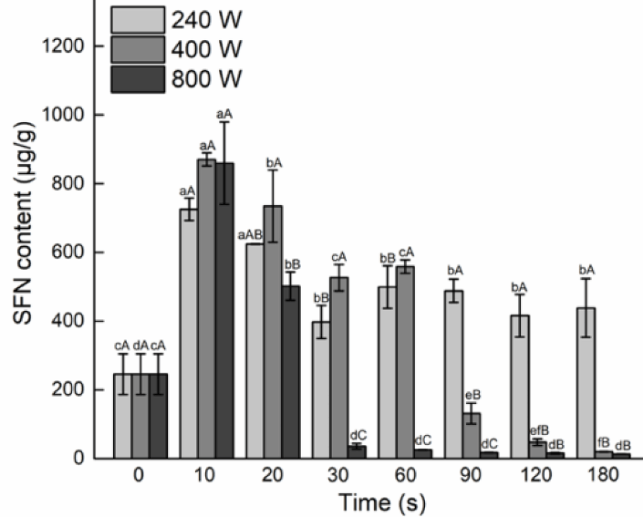
To the best of our knowledge, microwave bag cooking was evaluated for the first time to explore effects on sulforaphane (SFN) and indole-3-carbinol (I3C) content. Microwave bag cooking at 400 W for 10 s resulted in the highest SFN content (870.18 ± 19.14 μg/g), which was about 3.99 times that of untreated florets.

sfn content

Microwave bag cooking at 800 W for 10 s resulted in the highest I3C content, which was 6.16 times that of untreated florets.

i3c content

Our findings demonstrated that I3C in supplements or vegetables also degraded quickly under various processing conditions, such as thermal processing, and that DIM and LTr1 were not only produced in acidic conditions. This filled a gap in the literature regarding effects of vegetable processing, particularly thermal treatment, on content of glucobrassicin degradation products. In brief, under suitable conditions of microwave bag cooking, content of indole hydrolyzate I3C can be significantly increased, whereas content of dimerization and trimerization products did not change as significantly as I3C.

This work demonstrated that microwave bag cooking was a quick and easy cooking method that could preserve potential health benefits of broccoli florets while also satisfying the needs of modern consumers.”

https://www.sciencedirect.com/science/article/abs/pii/S0963996922014594 “Microwave bag cooking affects the quality, glucosinolates content and hydrolysate production of broccoli florets” (not freely available) Thanks to Professor Lei Zheng for providing a copy.


Can’t replicate this study’s cooking method completely. Ziploc bags are microwavable but a little different than heat-sealed bags. I also grow a broccoli / red cabbage / mustard sprout mix.

Using 25 grams of the mix and 40% power on my 1000W microwave for 10 seconds produced a sharper taste than did the method I’ve used. Scooping the mix out of a quart bag was messy.

I put the next 25 grams on a microwavable plate that snugly fit into a sealed bag. 80% power on a 1000W microwave for 10 seconds definitely tastes more cooked.

PXL_20230212_131346050

I’ll alternate between 400W and 800W for a while to see which one I prefer. It’s as quick and easy as claimed.


PXL_20230209_212821487

Ancient parasite DNA within us

Two 2023 papers on endogenous retroviruses (ERVs) and aging relationships, starting with the Introduction section of a comprehensive study:

“Several causal determinants of aging-related molecular changes have been identified, such as epigenetic alterations and stimulation of senescence-associated secretory phenotype (SASP) factors. Although the majority of these studies describe aging determinants originating primarily from protein-coding genes, the non-coding part of the genome has started to garner attention as well.

ERVs belonging to long terminal repeat (LTR) retrotransposons are a relic of ancient retroviral infection, fixed in the genome during evolution, comprising about 8% of the human genome. As a result of evolutionary pressure, most human ERVs (HERVs) accumulate mutations and deletions that prevent their replication and transposition function. However, some evolutionarily young subfamilies of HERV proviruses, such as the recently integrated HERVK, maintain open reading frames encoding proteins required for viral particle formation.

In this study, using cross-species models and multiple techniques, we revealed an uncharacterized role of endogenous retrovirus resurrection as a biomarker and driver for aging. Specifically, we identified endogenous retrovirus expression associated with cellular and tissue aging and that the accumulation of HERVK retrovirus-like particles (RVLPs) mediates the aging-promoting effects in recipient cells. More importantly, we can inhibit endogenous retrovirus-mediated pro-senescence effects to alleviate cellular senescence and tissue degeneration in vivo, suggesting possibilities for developing therapeutic strategies to treat aging-related disorders.”

https://www.cell.com/cell/fulltext/S0092-8674(22)01530-6 “Resurrection of endogenous retroviruses during aging reinforces senescence”


This first paper’s foreword summarized their many experiments and findings:

“The study found that HERVK transcripts, viral proteins, and RVLPs were highly activated in prematurely aged human mesenchymal progenitor cells (hPMCs). This was similarly observed in aged human primary fibroblasts and hPMCs. They also discovered that decreasing silencing epigenetic marks DNA methylation and H3K9me3 while increasing H3K36me3 enabled HERVK expression.

erv aging mechanism

These observations also raise several intriguing questions:

  • HERVK is occasionally activated and eventually suppressed under physiological conditions, for example, in human embryonic cells. It would be fascinating to probe the possibility of mimicking physiological conditions in order to turn off the positive feedback between HERVK and senescence.
  • ERVs are hallmarks of aging in different species, including human, primate, and mouse. Future quantification of the absolute physiological level of ERVs across a broad population of various ages might provide further insights into the relationship between ERVs and organismal age.”

https://academic.oup.com/lifemedi/advance-article/doi/10.1093/lifemedi/lnad001/6982772 “Endogenous retroviruses make aging go viral”


Previously curated papers on these subjects include:

A study of our evolutionary remnants

“Repressive epigenetic marks associated with ERVs, particularly LTRs, show a remarkable switch in silencing mechanisms, depending on evolutionary age:

  • Young LTRs tend to be CpG-rich and are mainly suppressed by DNA methylation, whereas
  • Intermediate age LTRs are associated predominantly with histone modifications, particularly histone H3 lysine 9 (H3K9) methylation.
  • Evolutionarily old LTRs are more likely inactivated by accumulation of loss-of-function genetic mutations.”

Starving awakens ancient parasite DNA within us

Reality is sometimes stranger than what fiction writers dream up. 🙂

PXL_20230209_210243470

Improve your internal environment, improve its constituents’ functions

A third update to Signaling pathways and aging:

“Sima, who was born on 28 February 2019, has lived for 47 months, surpassing the 45.5 months believed to be the oldest age recorded in scientific literature for a female Sprague-Dawley rat, the researchers say. So far, Sima has outlived her closest rival in the study by nearly six months.

‘The real point of our experiments is not so much to extend lifespan, but to extend youthspan, to rejuvenate people, to make their golden years really potentially golden years, instead of years of pain and decrepitude,’ Katcher said. ‘But the fact is, if you manage to do that, you also manage to lengthen life, and that’s not a bad side-effect.'”

https://www.theguardian.com/science/2023/feb/08/anti-ageing-scientists-extend-lifespan-of-oldest-living-lab-rat “Anti-ageing scientists extend lifespan of oldest living lab rat”


Whale funeral

PXL_20230208_211431462

Environmental signaling rescues aging muscle stem cells

This 2023 rodent study applied An environmental signaling paradigm of aging concepts to muscle stem cells:

“The stem cell niche environment represents an important therapeutic target to enhance tissue regeneration in aging. We decoupled age-related cell-intrinsic effects, niche-mediated cell-extrinsic effects, and changes in population dynamics of muscle stem cells (MuSCs) and two key muscle-resident cells in young and aged mice.

in vivo model

We showed that:

  1. Age-related reduction in MuSCs is not stochastic.
  2. Despite differences in transcriptomes of MuSC clusters, the effect of age on gene expression is largely uniform, suggesting that the niche environment has a fundamental role in age-related changes in MuSC gene expression.
  3. A significant fraction of changes in the transcriptome of aging MuSCs can be reversed by exposure to the young muscle environment, i.e. are niche-responsive. Given the high percentage [46.6% at a stringent cutoff of s-value < 0.05] of reversibility in gene expression, our findings indicate that age-related changes in the niche are principal drivers of resulting alterations in the MuSC transcriptome.
  4. Aging is correlated with changes at the level of chromatin accessibility and DNA methylation in MuSCs.

Plasticity of the MuSC transcriptome suggests that modulating the niche environment can be a powerful tool to restore stem cell-mediated endogenous muscle regeneration in aging. Consequently, as opposed to focusing solely on MuSCs themselves to mitigate effects of aging on MuSCs, bioengineering of the niche in its entirety may be a viable therapeutic option.”

https://www.nature.com/articles/s41467-023-36265-x “Transcriptional reprogramming of skeletal muscle stem cells by the niche environment”


This study destroyed extremely well-funded directed research efforts that detract from science, especially those promoting irreversibility of epigenetic changes (but: Rockefeller) and randomness of pro-aging programming (but: Harvard).

These researchers showed they could do more with their ideas and careers than maintain an outdated and easily disproved status quo.

Eat broccoli sprouts to protect your brain from stroke

Starting this blog’s ninth year with a 2022 rodent study of sulforaphane neuroprotection:

“An example of endogenous neuroprotection is ischemia-resistance of the hippocampal regions comprising the CA2, CA3, CA4 and dentate gyrus subfields (here abbreviated to CA2-4,DG) which can be contrasted with the ischemia-vulnerable CA1 region, which is noted in rodents as well as humans.

As with CA2-4,DG, nuclear Nrf2 levels are also higher in the olfactory bulb, while in the cortex, striatum, and cerebellum, they are similar to ones observed in the CA1 region.

brain area comparative Nrf2 activity

We found an in vitro dose-dependent response to administration of sulforaphane on neuronal viability, with an optimal effect noted where the dose was 10 µM. A protective effect was also evident in vivo when a single 5 mg/kg dose of sulforaphane was administered intraperitoneally with delay to ischemia.

Morphology of the CA1 region stratum pyramidale was significantly improved in comparison to ischemia-operated group, with mean numbers of proper cells being 35 ± 19 and 20 ± 7, respectively, for subjects injected during ischemia or 30 min into reperfusion. Morphology of the CA2-4,DG region did not reveal change between the ischemia-operated, SFN-injected, and control groups.

We suggest that high levels of nuclear Nrf2 activity in CA2-4,DG may guarantee resistance of this region to I/R episode, while at the same time offering a potential explanation for the phenomenon of differential sensitivities of hippocampal regions. Our results are in line with the existing view that Nrf2 activation may represent a promising therapeutic strategy against cerebral ischemia.

The uniqueness of Nrf2 lies in its pleiotropic action and subsequent regulation of multiple cytoprotective pathways. This may support more efficient neuroprotection compared to single-target strategies.”

https://link.springer.com/article/10.1007/s12035-022-03166-x “Is Nrf2 Behind Endogenous Neuroprotection of the Hippocampal CA2-4,DG Region?”


Winter beach shock therapy

PXL_20230129_174306200

Broccoli sprout beer?

This 2023 study investigated supplementing broccoli into beer:

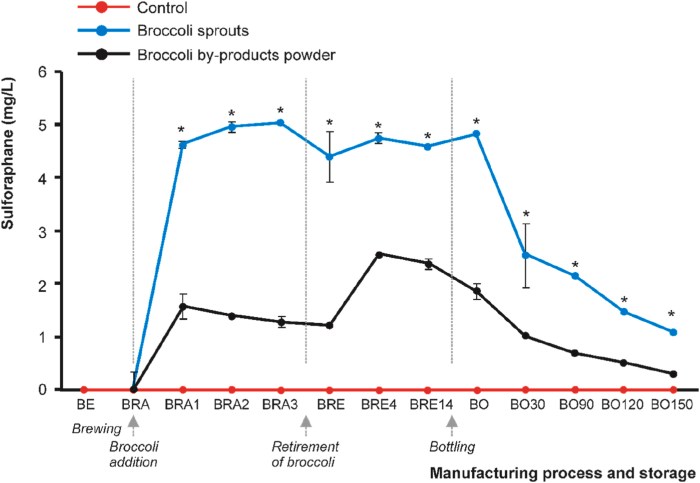
“The objective of this work was to evaluate alternative broccoli materials (sprouts and by-products powder), which could be a sustainable dietary source of bioactive sulforaphane (SFN). Results showed high concentrations of SFN in beers supplemented with broccoli sprouts and powder (5.00 and 2.54 mg/L, respectively, previous to bottling), indicating that formation rate for SFN when adding sprouts and by-products powder were almost 38.5% and 19.5%, correspondingly. These concentrations remained stable until bottling, where they were reduced by >50%.

1-s2.0-S2212429222007180-gr1_lrg

Beers supplemented with broccoli presented a higher alcohol content (6.6%, on average) than control beer, regardless of the broccoli material used. Sensory analysis revealed positive attributes (colour, floral, fruity, and aftertaste as a result of the profile of volatile compounds) of beers developed using sprouts. Future research is still needed to stabilize SFN during bottling.”

https://www.sciencedirect.com/science/article/pii/S2212429222007180 “Broccoli products supplemented beers provide a sustainable source of dietary sulforaphane”


PXL_20221003_163955758

Blinded by their paradigm?

This 2022 human study investigated another type of aging clock:

“The glycan clock of age, based entirely on immunoglobulin G (IgG) N-glycans, can predict biological age with high accuracy. Unlike DNA methylation, glycosylation of IgG does not predict chronological age with high accuracy.

Heritability analysis of plasma glycans revealed that the majority of traits have high heritability estimates, indicating a tight genetic control of glycosylation. To better understand genetic and environmental factors influencing glycan clock variation, we performed a heritability analysis on data from two cohorts included in the TwinsUK registry.

Glycosylation is a series of enzymatic reactions in which carbohydrates are attached to other molecules (e.g., proteins or lipids) resulting in formation of complex carbohydrates and glycoconjugates commonly referred to as ‘glycans.’ Glycosylation of IgG antibody is especially interesting as it dramatically affects its function, and acts as a molecular switch between pro- and anti-inflammatory immune responses.

Heritability of the glycan clock was estimated to decompose observed phenotypic variance into three latent sources of variation:

  • A—additive genetic variance [red] represents cumulative impact of genes;
  • C—shared/common environment variance [purple] results from influences to which both members of a twin pair are exposed; and
  • E—unique environment variance [green] is events occurring to one twin but not the other, and includes measurement error.

fcell-10-982609-g002

Despite tight genetic control of the IgG glycome:

  • Heritability analysis of the glycan clock revealed only a moderate genetic contribution averaging around 39% [A, left side].
  • Including age of the individuals as a covariate in heritability analysis averaged 71% heritability estimates [B, right side].
  • Mean time difference was 7.5 years for points 1 and 2, and 6 years for points 2 and 3.

Observed increase in the genetic component could be a consequence of chronological age as a shared environmental variance characteristic for every individual and determined by their genetic makeup and epigenetic regulation.”

https://www.frontiersin.org/articles/10.3389/fcell.2022.982609/full “Heritability of the glycan clock of biological age”


Although A rejuvenation therapy and sulforaphane was cited, these researchers missed its central premise: Pro-aging epigenetic programming is directional and not purely random. Contrasting their above graphic’s heritability estimates of 39% with the age-regressed, right side’s average 71% could hardly have been more clear in illustrating this fact.

This study instead stated “Aging in general leads to epigenetic mediated deregulation of genes.” This weak sauce accompanied speculations such as “supports the notion that the glycan clock can be rejuvenated by simple lifestyle choices.”

Researchers almost always want to claim being first in finding x, y, or z. These researchers could have done that in this glycan clock study by highlighting an outstanding finding. So what happened?

An alternate explanation to their paradigm blinding them could be sponsor expectations, peer pressures, etc. I’ll ask them about it, and will update here with their response.


PXL_20221231_185407365

Week 144 of Changing to a youthful phenotype with sprouts

Two papers, starting with a 2023 study that investigated the same red radish cultivar as Sulforaphene, a natural analog of sulforaphane:

“Availability of microgreen products is constantly rising, i.e., they are offered for sale in local farmers markets, specialty stores, and in chain grocery stores. Due to the low demands required for their cultivation and easily available LED settings, microgreens are increasingly grown on a small scale in homes and after harvesting, they are stored in kitchen refrigerators at 4 °C.

The aim of this study was to simulate such cultivation and storage conditions to examine antioxidant capacity of home-grown radish microgreens. Seven-day-old radish microgreens, grown under purple and white LED light, were harvested and stored at 4 °C for two weeks.

Measurements of total antioxidant capacity and bioactive substances were conducted on the harvesting day and on the 3rd, 7th, and 14th day of storage. All three radish cultivars (Raphanus sativus L.) with different leaf colorations:

  • Purple radish (R. sativus cult. China Rose, cvP);
  • Red radish (R. sativus cult. Sango, cvR); and
  • Green radish (Raphanus sativus var. longipinnatus, Japanese white or daikon radish, cvG)

were purchased commercially from a local supplier.

The highest contents of total soluble phenolics, proteins, and sugars, dry matter, and monomeric anthocyanin content, as well as higher overall antioxidant capacity determined in the red radish cultivar (cvR), distinguished this cultivar as the most desirable for human consumption regardless of the cultivation light spectrum.”

https://www.mdpi.com/2311-7524/9/1/76 “Antioxidant Capacity and Shelf Life of Radish Microgreens Affected by Growth Light and Cultivars”


A 2021 review summarized what was known about radishes up to then. Here’s part of its Discussion section:

“It is worth considering radish’s organoleptic characteristics since its particular flavor can influence its acceptability among consumers. The main compound associated with its characteristic pungent flavor is raphasatin, which we have found to be the most reported isothiocyanate produced from the breakdown of glucoraphasatin.

Glucoraphasatin ranked as one of the most concentrated glucosinolates in radish, particularly in its sprouts, but also present in other parts like roots and seeds. Pungency differs among radish cultivars, environmental growth factors, agronomic, and cooking practices.”
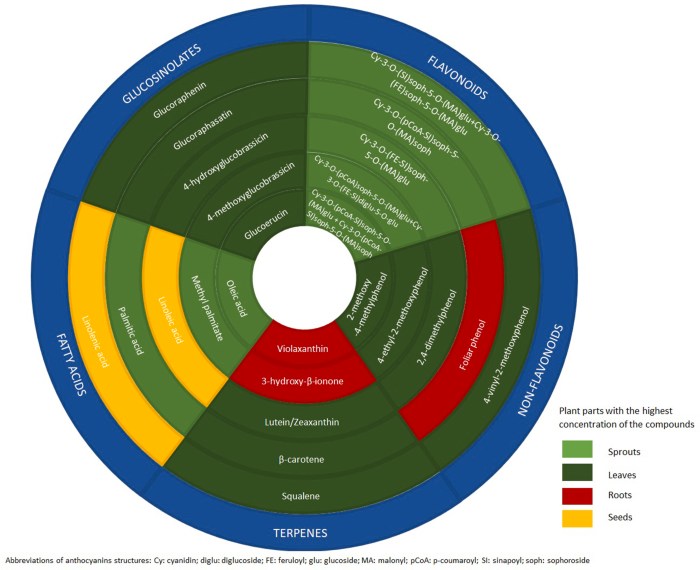
1-s2.0-S0924224421003058-gr3_lrg

https://www.sciencedirect.com/science/article/pii/S0924224421003058 “Nutritional and phytochemical characterization of radish (Raphanus sativus): A systematic review”


Seeds I’ve sprouted this year so far, left to right – red radish (Sango), broccoli, red cabbage (Red Acre), yellow mustard, oat (Avena sativa):
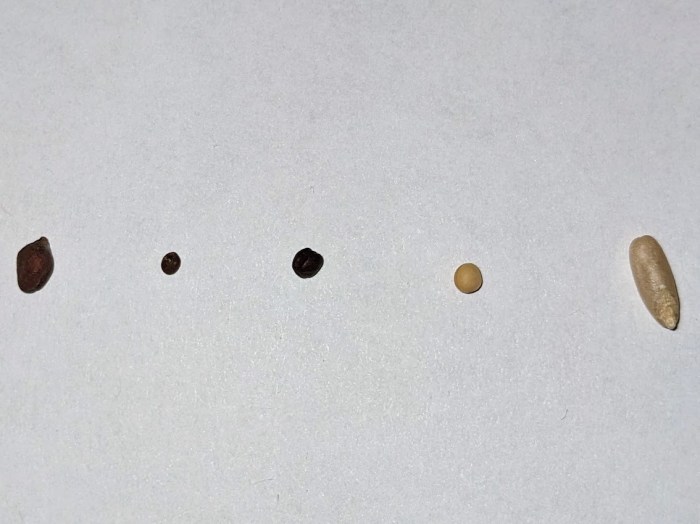
PXL_20230106_121548495

Red radish had similar growth characteristics as broccoli. Started with 3.6 grams of seeds, which increased to 22.2 g after three days using the same soaking and rinsing protocol I use for other sprouts.
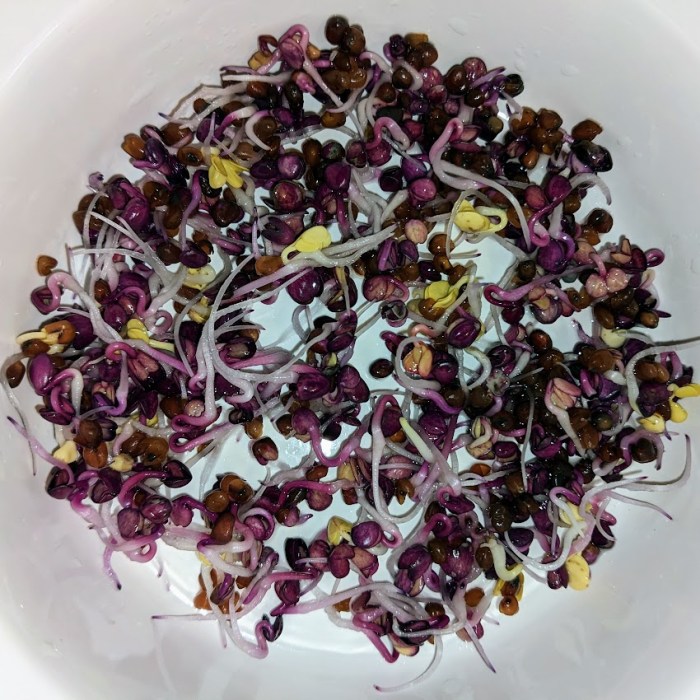
PXL_20230109_121815772

The taste of red radish was too sharp for me to eat by themselves, so I combined them with my broccoli / red cabbage / mustard sprout mix. Bumped up microwaving time to 48 seconds in a 1000 W microwave while staying short of the 60°C (140°F) myrosinase cliff.

The whole mix still had a strong radish taste, though. It was as if two whole red radishes were sliced into a small salad.

Can’t add anything more to dampen that taste and expect beneficial compounds to be unaffected. From Week 19:

A 2018 Netherlands study Bioavailability of Isothiocyanates From Broccoli Sprouts in Protein, Lipid, and Fiber Gels found:

Compared to the control broccoli sprout, incorporation of sprouts in gels led to lower bioavailability for preformed sulforaphane and iberin.”

IAW, eating protein, fats, and fiber along with microwaved broccoli sprouts wouldn’t help. A 2018 review with some of the same researchers Isothiocyanates from Brassica Vegetables-Effects of Processing, Cooking, Mastication, and Digestion offered one possible explanation for protein acting to lower broccoli sprout compounds’ bioavailability:

“In vitro studies show that ITCs can potentially react with amino acids, peptides, and proteins, and this reactivity may reduce the ITC bioavailability in protein‐rich foods. More in vivo studies should be performed to confirm the outcome obtained in vitro.”

Mixing in red radish sprouts also gave me an upset stomach five of the six mornings. So I won’t continue to sprout red radish.

That said, I’d definitely consider sprouting red radish again to accelerate isothiocyanate treatment of problems where symptoms are much worse than an upset stomach, such as:

  • Neurogenerative diseases with their cognitive decline;
  • Immune system disorders;
  • Bacterial and viral infections; and
  • Other damage caused by oxidative stress conditions in eyes, vascular system, kidney function, etc.

Piping in the New Year

PXL_20230101_193048797

Sulforaphene, a natural analog of sulforaphane

Three papers on sulforaphene, starting with a 2022 in vitro digestion study by Our model clinical trial for Changing to a youthful phenotype with broccoli sprouts group:

“This work aims to assess anti-inflammatory potential of bioactive compounds of cruciferous sprouts red radish (RRS) and red cabbage (RCS) in their bioaccessible form (obtained by the digestion of aqueous extracts). We used a well-established in vitro inflammation cellular model consisting of human macrophage-like HL60 cells stimulated with LPS, which mimics systemic chronic inflammatory conditions present in certain non-communicable diseases such as cardiovascular disease, cancer, and diabetes.

d2fo02914f-f1

Composition of RRS and RCS digestates extracts presented differences with a 20% lower content of total isothiocyanates (ITCs) in RRS than in RCS. However, there was more variability in the compounds present in RRS than in RCS extract digestates, including sulforaphene (SFE) and 3,3′-diindolylmethane (DIM), which were exclusively present in RRS.

RCS extract showed a trend of decreasing both TNF-α and IL-6 production under LPS-stimulated conditions, and this inhibitory effect was mainly observed at final protein expression. This activity at higher rates might be related to the inhibitory ability of iberin upon TLRs dimerization, impairing the NF-κB signaling pathway.

On the other hand, RRS exhibited a significant dose–response inhibition of IL-6 production levels. This difference in better performance of RRS compared to RCS could be exerted by the higher concentration of sulforaphane, and the exclusive presence of SFE, DIM, and anthocyanins in RRS.”

https://pubs.rsc.org/en/content/articlelanding/2023/FO/D2FO02914F “Anti-inflammatory potential of digested Brassica sprout extracts in human macrophage-like HL-60 cells”

I was surprised that this study didn’t detect anthocyanins in 8-day-old red cabbage sprout digestates, as they are visibly present in red cabbage sprouts. For example, from Week 56:

PXL_20210504_212505224


Reference 32 of this study was a 2021 review:

“Sulforaphene (SRP), as a product derived from glucoraphenin in the presence of myrosinase, mainly exists in cruciferous plants, especially in dried and mature seeds of radish. The most abundant ITC in juice of R. sativus L. coming from Sango freeze-dried sprouts is SRP. There is no safe and efficient SRP chemical synthesis which could be industrialized.

Structural variation in ITCs, such as the presence of particular functional group, molecular size, and length of a hydrocarbon chain, often results in very diverse antimicrobial activities. SRP, which is similar to sulforaphane in chemical structure but has an extra double bond, shows a much higher antimicrobial activity. However, the exact explanation for this enhanced microbial activity remains unknown.”

https://www.tandfonline.com/doi/full/10.1080/15422119.2021.1944209 “Sulforaphene: Formation, stability, separation, purification, determination and biological activities” (not freely available) Thanks to Dr. Jie Zhang for providing a copy.

Eat broccoli sprouts instead of antibiotics had two papers on ITCs’ antimicrobial actions.


A third paper was a 2022 cell study:

“Acne is a chronic inflammatory disease of the sebaceous gland attached to hair follicles. Cutibacterium acnes is a major cause of inflammation caused by acne.

It is well known that C. acnes secretes a lipolytic enzyme to break down lipids in sebum, and free fatty acids produced at this time accelerate the inflammatory reaction. There are several drugs used to treat acne; however, each one has various side effects.

We examined effects of sulforaphene (SFEN) on bacterial growth and inflammatory cytokine production induced by C. acnes. SFEN showed antibacterial activity against C. acnes and controlled the inflammatory response on keratinocytes and monocytes. This finding means that SFEN has potential as both a cosmetic material for acne prevention and a pharmaceutical material for acne treatment.”

https://www.jmb.or.kr/journal/download_pdf.php?doi=10.4014/jmb.2209.09051 “Sulforaphene Attenuates Cutibacterium acnes-Induced Inflammation”


I ordered the Sango variety of red radish seeds used in this first study, to arrive in two weeks. I expect that their flavor and sulforaphene combination will be a good substitute for the mainly-flavor mustard third of my 3-day-old sprouts brocolli / red cabbage / mustard sprouts morning mix.

Home sprouting cupboard setup, with Avena sativa twice-daily hulled oats sprouts on top:

PXL_20221208_123517082

Do broccoli sprouts treat asthma?

This 2022 rodent study investigated sulforaphane’s effects on airway disease:

“Sulforaphane has been studied in numerous preclinical and clinical models of lung damage and airway diseases. The lack of definitive findings from clinical studies to date most likely reflects issues with extract preparations and dosage regimes.

We investigated effects of administration of L-sulforaphane (LSF), which is also known as (R)-sulforaphane, in a murine model of ovalbumin (OVA)-induced chronic allergic airways disease (AAD). This model of chronic AAD recapitulates several features of human asthma including airway inflammation, airway remodeling, and airway hyper-responsiveness.

Our findings confirmed the efficacy of LSF in attenuating pathologies associated with AAD, involving activation of antioxidant and anti-inflammatory pathways. Inhibition of HDAC enzymes by LSF and accumulation of acetylated core histones and α-tubulin in vivo following LSF administration represent an important epigenetic regulatory mechanism. LSF and its metabolites may modulate HDAC6 and HDAC8 enzymes by binding to the catalytic site.

sulforaphane asthma

Our findings along with accumulated evidence, highlight the clinical potential of sulforaphane as either a prophylactic or a therapeutic in the context of AAD.”

https://link.springer.com/article/10.1007/s00018-022-04609-3 “Sulforaphane prevents and reverses allergic airways disease in mice via anti-inflammatory, antioxidant, and epigenetic mechanisms” (not freely available)


PXL_20221214_200748143