Part 3 of Rejuvenation therapy and sulforaphane

Part 1 focused on the study’s clinical biomarkers. Part 2 highlighted its epigenetic clocks. Now we’ll look at rejuvenation of cognitive function.

Charts for this study’s most relevant human aging applications – measured by the new human-rat relative biological age clock – were in supplementary data due to combining study untreated tissue samples into clock training data. Reanalyses showed:

“Using the final version of the epigenetic clocks, we find that treatment effects become even more significant especially for the hypothalamus.”

Human-rat relative clock percentages of rejuvenation were:

  • “Blood 70.6%
  • Liver 79.4%
  • Heart 61.6%
  • Hypothalamus 20.9%”

The Discussion section addressed hypothalamus rejuvenation:

“Why does plasma fraction treatment not reduce brain epigenetic age by the same magnitude as it does other organs? We can only begin to address this question after having first understood what epigenetic aging entails.

As it stands, our knowledge in this area remains limited, but it is nevertheless clear that:

  1. Epigenetic aging is distinct from the process of cellular senescence and telomere attrition,
  2. Several types of tissue stem cells are epigenetically younger than non-stem cells of the same tissue,
  3. A considerable number of age-related methylation sites, including some clock CpGs, are proximal to genes whose proteins are involved in the process of development,
  4. Epigenetic clocks are associated with developmental timing, and
  5. Relate to an epigenomic maintenance system.

Collectively, these features indicate that epigenetic aging is intimately associated with the process of development and homeostatic maintenance of the body post-maturity.

  • While most organs of the body turnover during the lifetime of the host, albeit at different rates, the brain appears at best to do this at a very much slower rate.
  • While most tissues harbor stem cells that are necessary for replenishment and turnover, stem cells in adult brain have only been detected in a defined and very limited area of the subventricular zone, olfactory bulb (in rats), hippocampus and hypothalamic proliferative region.

As such, if plasma fraction treatment’s rejuvenating effect is:

  • Mediated through the process of development and
  • Involves tissue stem cells

then its effect on epigenetic age of the brain would appear to be modest, which indeed it does.

It is to be noted however, that improving brain function does not depend on neurogenesis as much as it does on synapse formation and factors such as NMDA receptors, which decline in density with age.

Assessment of plasma fraction treatment on cognitive function (learning and memory). Rats were subjected to Barnes maze test – nine consecutive days of test where the time (in seconds) required by rats to find the escape hole (latency) was recorded and plotted. Error bars depict 2 standard errors.

Within a month of plasma fraction treatment, rats exhibited significantly reduced latency to escape, i.e., they learned and remembered better. After the second month, treated rats began with a slightly reduced latency period compared to untreated old rats, and once again, they learned much faster than the latter.

By the third month, it was clear that treated rats remembered the maze much better than untreated ones even from the first day of test as their latency period was significantly reduced. By the end of the test period, their latency was similar to that of young rats. This feature was sustained and repeated in the fourth month.”

Not sure why there’s a 62-day gap between “Second month” and “Third month.” Maybe it had something to do with “First month” starting 10 days after the first treatment and “Third month” similarly starting 13 days after the second treatment?


Many of us know older people who lived well past their time of good cognitive function:

  • We see how they’re helpless and dependent; and
  • We see how others take advantage of them in their morbidity phase, where healthspan stops increasing but lifespan continues.

We can make personal plans for that day, sure. But let’s also put some urgency into applying this study’s new human-rat relative biological age clock, and make:

“A step change in aging research. Although conservation of aging mechanism could be equally deduced from the existence of multiple individual clocks for other mammals (mouse, dog), the single formula of the human-rat clock that is equally applicable to both species effectively demonstrates this fact.”

Somebody’s laughing. How about you?

Doctors Fauci (NIAID), Lane (NIAID), and Redfield (CDC) in the New England Journal of Medicine, March 26, 2020:

“The overall clinical consequences of Covid-19 may ultimately be more akin to those of a severe seasonal influenza (which has a case fatality rate of approximately 0.1%).”

https://www.nejm.org/doi/full/10.1056/NEJMe2002387 “Covid-19 – Navigating the Uncharted”


Any doubt that Rolling back your rights and making you obey was clearly the goal? What’s next?

Unpress a pause button

You can have your own life that’s free of unchosen influences.

“Men, it has been well said, think in herds; it will be seen that they go mad in herds, while they only recover their senses slowly, one by one.”

“We need hope more than we need truth.”

“In the future, people might abandon their own psychological judgments and rely on computers.”

“What is the point of life if we cannot feel and love others? Without feeling, life becomes empty and sterile. It, above all, loses its meaning.”

Week 7 of Changing to a youthful phenotype with broccoli sprouts

To follow up Week 6 of Changing an inflammatory phenotype with broccoli sprouts:

1. I changed this week’s title as a result of reading A rejuvenation therapy and sulforaphane study. It wasn’t about sulforaphane, but its clinical findings had commonalities with this broccoli sprouts effort. It’s become my blog’s most popular post, read by people in 50+ countries.

A close second is An environmental signaling paradigm of aging. The current study’s lead laboratory researcher presented his view five years ago on where aging evidence was pointing.

Part 2 of Rejuvenation therapy and sulforaphane better curated this study’s innovative epigenetic clock results. There are no sulforaphane clinical trials that also use epigenetic clocks.

What effects may broccoli sprout compounds have on human aging? With this new human-rat relative biological age clock, researchers can get reliable answers from rat studies, with human clinical trials needed only to confirm those findings!

2. This week I found out that exercising control over my charges to protect them from disease was counterproductive. I exposed them to harm, destroyed their community, and stunted their growth by forcing them to distance from each other for their own good.

Am I a politician, an unelected bureaucrat, or some other form of busybody? No. I admit my mistakes right away, I apologize, then I immediately try to do better.

A proper context:

  • In Week 2 I switched from sprouting trays with 1/16″ high ridges in the bottom to Russian-doll bowls. That solved a problem of excess moisture, with which broccoli sprouts don’t do well but bacteria do.
  • In Week 3 I rotated in the next larger sized bowl to replace the smallest bowl. My thought was that Day 3 broccoli sprouts were too crowded to dry in the smallest bowl.
  • At the end of Week 5 I doubled my starting amount of broccoli seeds from one to two tablespoons. To accommodate that increase, I again rotated in the next larger size bowl.

Starting in Week 6, I had uneven batch yields. The two larger bowls yielded noticeably fewer sprouts than did batches in the two smaller bowls.

What did bowl size have to do with yield?

Nothing, it was me. Turned out I’d neglected Plant Care 101 instructions to provide adequate moisture.

After rinsing, straining, and wicking out excess moisture with a paper towel twice daily, I then spread out seeds and sprouts to prevent problems with excess moisture. Broccoli seeds and sprouts in the two larger bowls were more separated than in the two smaller bowls.

All of which led to moisture levels that were inadequate for broccoli seeds and sprouts. All batches sprouted less well than their potential yield. The larger the bowl, the more my behavior adversely affected the batch.

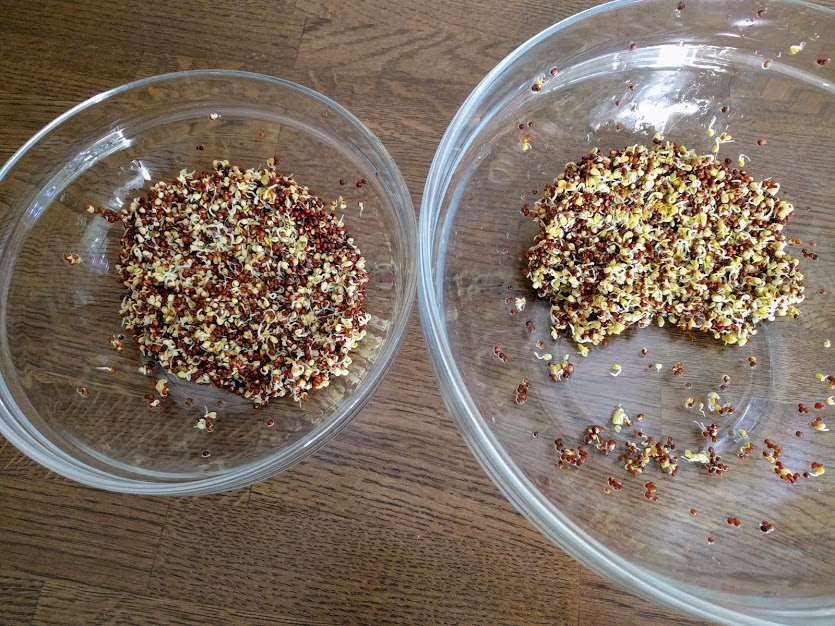
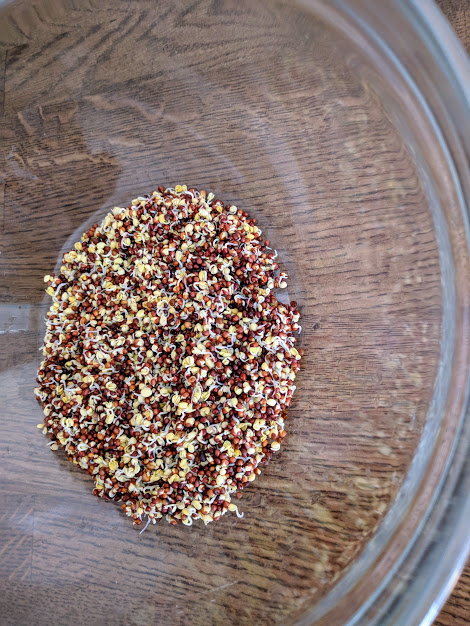
Here’s what Day 2 and Day 3 yields were with my previous practices.  Batch volume of Day 2 in the smaller bowl was larger than Day 3!

I changed practices to group broccoli seeds and sprouts together at a step where I used to spread them out. Here’s the same bowl with my current practice, but at Day 2. It’s a larger volume than the previous practice’s Day 2:

I’ll guess that batch yield volumes have improved by 75%. I increased distilled water from 100 ml to 175 ml before microwaving since 100 ml no longer completely immersed increased Day 3 broccoli sprout volume. My 1000W full power microwave time concomitantly increased from 45 seconds to 65 seconds to achieve 58°C.

Better-developed batches also taste better. I still mix in mustard and eat Day 3 broccoli sprouts with other food.

3. My sulforaphane intake has probably decreased with current practices. 3-day-old broccoli sprouts have the optimal yields study said:

Although germination reduces SF [sulforaphane] yield to some extent, it is beneficial to formation and accumulation of total phenol and flavonoids, ensuring health properties of sprouts. SF contents in sprouts were 46% – 97% of seeds, whereas TP [total phenolic] and TF [total flavonoid] contents in sprouts were 1.12 – 3.58 times higher than seeds among [broccoli] varieties.”

I’m not concerned about less sulforaphane with a two tablespoons starting amount of broccoli seeds. Even a one tablespoon starting amount yields 60 g of broccoli sprouts, twice that of Effects of long-term consumption of broccoli sprouts on inflammatory markers in overweight subjects. See our discussion in Understanding a clinical trial’s broccoli sprout amount.

4. Another week of no inflammatory problems after four-to-six-mile-long beach walks. I’m not pushing myself, just walking often, and working out my upper body every fourth day.

I emphasize eccentric motions in upper body workouts. I haven’t curated the below 2019 papers although they’re informative:

I don’t expect recovery times from workouts to shorten. What’s an appropriate exercise recovery time? found with 26.5 ± 6.5 year-old male subjects that even three days wasn’t enough time for biceps brachii to fully recover from eccentric exercise.

5. During Friday’s walk I accidentally startled a large turkey hen who was on the ground, and she flew up on a fence. Can you see her moments before she hopped down?

Don’t have any idea what bugs a turkey found attractive near a beach.

See Week 8 of Changing to a youthful phenotype with broccoli sprouts for follow ups.

Part 2 of Rejuvenation therapy and sulforaphane

A rejuvenation therapy and sulforaphane focused on the study’s clinical biomarkers and not its biological age measurements. This Part 2 curation of the study highlights its epigenetic clocks because:

“While clinical biomarkers have obvious advantages (being indicative of organ dysfunction or disease), they are neither sufficiently mechanistic nor proximal to fundamental mechanisms of aging to serve as indicators of them. It has long been recognized that epigenetic changes are one of several primary hallmarks of aging.

DNA methylation (DNAm) epigenetic clocks capture aspects of biological age. The discrepancy between DNAm age and chronological age (term as ‘epigenetic age acceleration’) is predictive of all-cause mortality. Pathologies and conditions that are associated with epigenetic age acceleration includes, but are not limited to, cognitive and physical functioning, centenarian status, Down syndrome, HIV infection, obesity, and early menopause.

The [new] human-rat clocks apply to both species. The two human-rat pan-tissue clocks are distinct, by way of measurement parameters. One estimates absolute age (in units of years), while the other estimates relative age, which is the ratio of chronological age to maximum lifespan; with values between 0 and 1. This ratio allows alignment and biologically meaningful comparison between species with very different lifespan (rat and human), which is not afforded by mere measurement of absolute age.

Relative age estimation was made using the formula: Relative age = Age / maxLifespan where the maximum lifespan for rats and humans were set to 3.8 years and 122.5 years, respectively.”

From Supplementary Table 3, old control and old treatment subjects were males 109 weeks old, 55% of their maximum lifespan (109 / 197.6). Young control subjects were males 30 weeks old, 15% of their maximum lifespan.

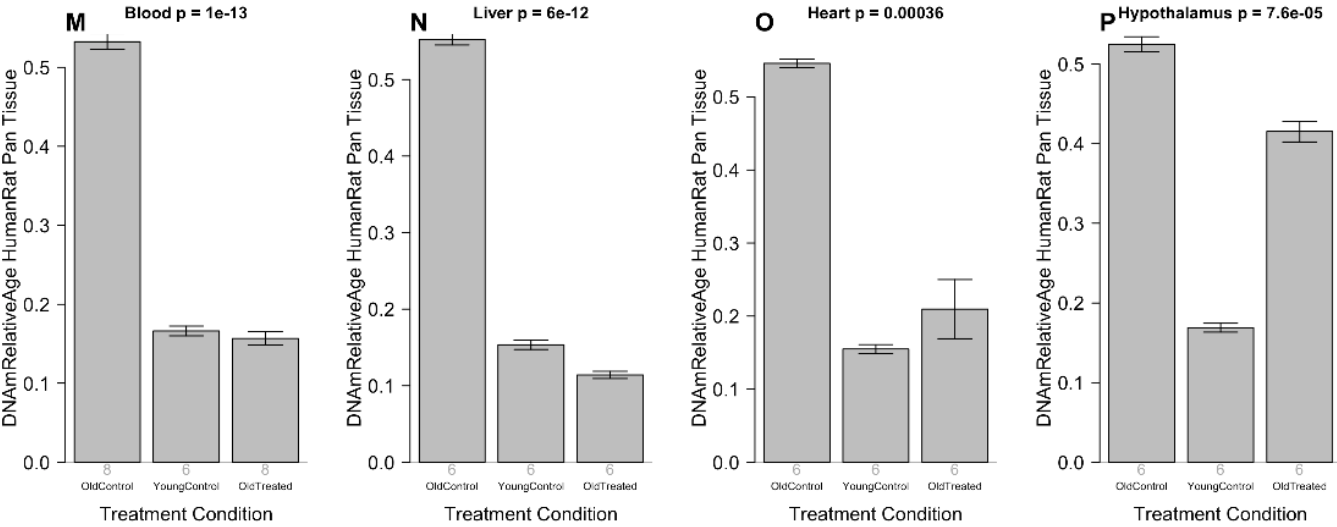
The money charts for this study’s human aging applications – measured by the new human-rat relative biological age clock – were buried in Supplementary Figure 12, bar plots M through P:

“Human-rat clock measure of relative age defined as age/maximum species lifespan. Each bar-plot reports the mean value and one standard error.”

From Supplementary Table 8, the percentages of rejuvenation for the above bar plots, calculated as “(100 * (1 – Old Treated / Old Control)” were:

  • “Blood 70.6%
  • Liver 79.4%
  • Heart 61.6%
  • Hypothalamus 20.9%”

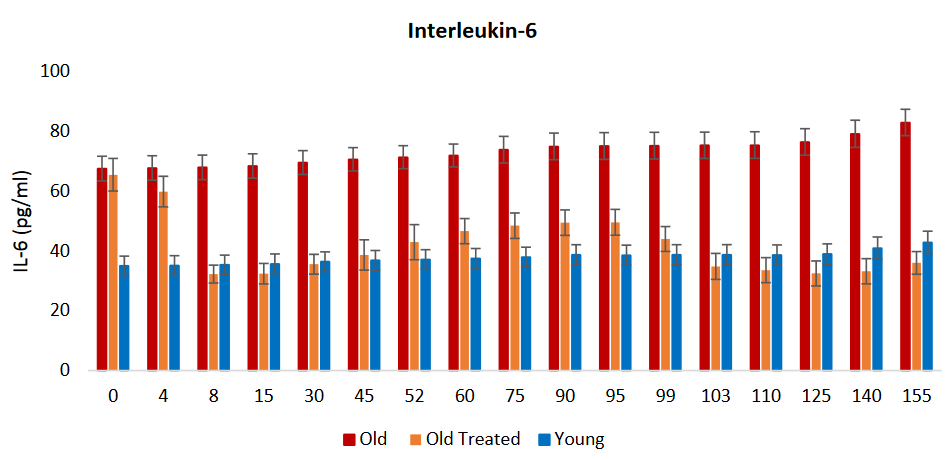
Let’s return to clinical biomarkers for comparison purposes. The current study measured pro-inflammatory cytokine IL-6 blood plasma levels at every time point, but didn’t publish numbers. Bar plots and narrative were:

“Inflammation is an important response that helps protect the body, but excess inflammation especially in terms of duration of this response can have very detrimental effects instead. This occurs when inflammation fails to subside and persists indefinitely; a condition referred to as chronic inflammation, which for reasons not well-understood, increases with age and is associated with a multitude of conditions and pathologies.

The levels of two of the most reliable and common biomarkers of chronic inflammation, interleukin 6 (IL-6) and tumor necrosis factor α (TNF-α), are found to be considerably higher in old rats, and these were very rapidly diminished, within days by plasma fraction treatment, to comparable levels with those of young rats. This was especially stark with IL-6.

In time, the levels of these inflammatory factors began to rise gradually, but they were once again very effectively reduced following the second administration of the plasma fraction on the 95th day.”

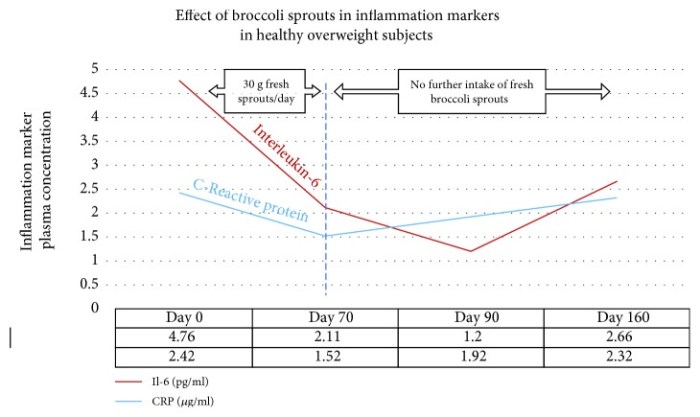
Let’s compare the above IL-6 graphic with IL-6 concentration improvements of our 2018 model clinical trial, Effects of long-term consumption of broccoli sprouts on inflammatory markers in overweight subjects, calculated as (100 * (1 – Day _ mean / Day 0 mean):

Mean pg/ml | % improvement | Period | Broccoli sprout consumption

  • 4.594 | 0% | Day 0 | “One week before the beginning of the intervention period, subjects were asked to avoid the consumption of Brassica vegetables (broccoli, radish, cauliflower, Brussel sprouts, mustards, among others) and their derived products.”
  • 1.748 | 62.0% | Day 0 to 70 | Subjects ate 30 g raw broccoli sprouts every day, and stopped eating them after Day 70.
  • 0.896 | 80.5% | Day 0 to 90 | “After the intervention period, a follow-up recovery period for all subjects continued for another 90 days with no ingestion of broccoli sprouts.”
  • 2.170 | 52.8% | Day 0 to 160 | Subjects had not eaten broccoli sprouts after Day 70.

Results between the studies were similar in that:

  1. IL-6 levels improved during early treatments through rat Day 8 and human Day 70, respectively.
  2. IL-6 levels continued decreasing shortly after treatments for 7 days (through rat Day 15) and 20 days (through human Day 90), respectively.
  3. IL-6 levels rose after rat Day 15 and human Day 90, respectively, but were still significantly below Day 0 values at rat Day 95 and human Day 160.

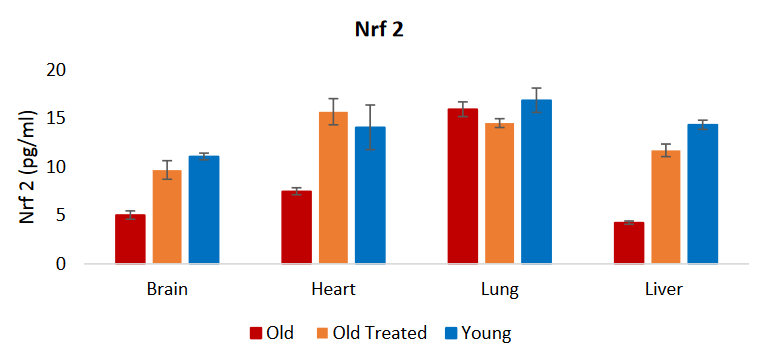
The current study measured Nrf2 but didn’t publish numbers. Bar plots and narrative were:

“The reduction of these inflammation markers is consistent with the profile of the nuclear factor erythroid 2-like 2 protein (Nrf2), which plays a major role in resolving inflammation, in part by inhibiting the expression of IL-6 and TNF-α. Nrf2 also induces the expression of antioxidants that neutralizes ROS [reactive oxygen species], which is also a significant feature in inflammation.”

A PubMed search on “nrf2 sulforaphane human” didn’t turn up relevant 2020 human in vivo studies. I disregarded reviews, cancer studies, disproven hypotheses, and other compounds listed in the below graphic.

I won’t repeat the entire Nrf2 section from the Part 1 curation, just one graphic and paragraph:

It [sulforaphane] is not only a potent Nrf2 inducer but also highly bioavailable [around 80%], so that modest practical doses can produce significant clinical responses. Other Nrf2 activators [shown in the above image] not only lack potency but also lack the bioavailability to be considered as significant intracellular Nrf2 activators.”


As noted in Reviewing clinical trials of broccoli sprouts and their compounds, there are no sulforaphane clinical trials that also use epigenetic clocks. Broccoli sprouts and their compounds’ effects on human aging is an area that hasn’t drawn attention and funding.

What effects may broccoli sprout compounds have on human aging? With this new human-rat relative biological age clock, researchers can get reliable answers from rat studies, with human clinical trials needed only to confirm those findings!

As rejuvenation research continues, what could people do easily, cheaply, and today for our long-term selves? Don’t know about the hypothalamus, but our blood, liver, and heart biological ages may decrease as we reduce inflammation and oxidative stress by eating broccoli sprouts.

I’m at a similar percentage of species maximum lifespan as were the study’s treated subjects. It’s my choice as to what my healthspan will be.

There isn’t evidence today to definitively say that changing my inflammatory phenotype with broccoli sprouts has had / will have rejuvenation effects on biological ages of my cells, organs, and body. But if eating broccoli sprouts every day not only reduces chronic inflammation and oxidative stress as expected, but also makes me younger, I could probably learn to live with that. 🙂

Continued with Part 3 of Rejuvenation therapy and sulforaphane.

An environmental signaling paradigm of aging

To follow up A rejuvenation therapy and sulforaphane, the study’s lead laboratory researcher – Dr. Harold Katcher – provided evidence for an environmental signaling paradigm of aging in this 2015 paper:

“The age-phenotype of a cell or organ depends on its environment and not its history.

Organ dysfunction is not the cause of aging, but is the result of its milieu. Therefore, the aged milieu is the cause. Though it has been thought that the aging immune system is the cause of aging, it can seen to be the result of aging.

The systemic milieu of an organism sets the age-phenotype of its cells, tissues and organs. Cells and organs secrete factors into blood, which are determined by the age-phenotype and repair-states of those cells and organs. The presence and concentrations of these blood-borne factors determine the age-phenotype of cells and organs.

Here we must be a bit more speculative. Changes in concentrations of factors present in blood, rather than their presence or absence, determines age-phenotype.

Interactions between disparate levels of the body’s hierarchy establish a consensus age-phenotype for cells and organs, and this largely occurs via the bloodstream. There appear to be positive factors that promote youthful age-phenotypes and negative factors that promote the aged phenotypes.

We readily consider development as a ‘program’, and it seems clear that we must consider post-adult development as ‘programmed’ as well. But if there is a program it is neither in genes nor chromatin, but in interaction of complex, interconnected systems spanning hierarchical levels.

If these aforementioned principles are correct, it should be easy to verify. If so, whole organism rejuvenation might require little more than:

  • Changing concentrations of all age-determining molecules of the bloodstream and various stem cell niche environments to youthful levels;
  • For a time sufficient to cause rejuvenation at the cellular level.

Once cells start secreting factors appropriate to their new, younger age-phenotypes, cognate changes should propagate through hierarchical levels.

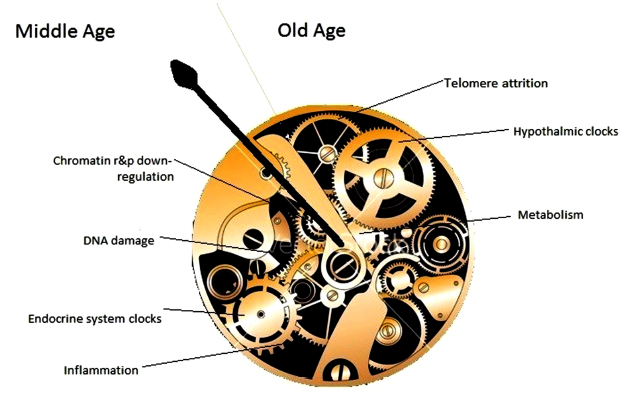
The analogy to workings of a mechanical clock is not very exact. ‘Gears’ represent individual aging clocks, both cellular and organic (shown at different levels within the mechanism) which interact, ultimately resulting in organismic age, i.e. ‘body clock’, represented by the ‘hour hand’ (no minute hand is shown).

In mammals, readout of the clock corresponds to age-related composition of blood plasma. In this model, moving the hour hand backwards should result in a turning back of composite clocks as well – a result obtained when induction to pluripotence is used to reset cellular clocks.

Apart from being slowed down or sped up, the body clock can also be reset. Organisms, organs, and their cells can be reset to different age-phenotypes depending on their environment.

We know that old transplanted tissues and organs can regain function and live for the entire life of the younger host at least in rodents. We must suppose that age-phenotype changes must have taken place at the cellular level to allow this.

Rejuvenation cannot be explained on the basis that aging represents accumulation of irreparable cellular damage.

None of these principles are rigorously established as such, but all are supported by experimental evidence.”

http://www.eurekaselect.com/130538/article “Towards an Evidence-based Model of Aging”


Here are some of his responses to comments on the blog post that first curated his current research:

“We’ve (scientists), spent the past 70 years trying to definitively prove the commonsense ‘wear and tear’ theories and have not succeeded. So I tried something different, looking at results of experiments.

This is not based on ‘theory’ (say mitochondrial aging or ‘wear and tear’) but on experimental evidence. Theory comes in explaining our results, not achieving them. There is a theory becoming clear, one very different from the commonsense view of ‘wear and tear’ aging.

We haven’t examined immune response. All that we know for sure is that chronic inflammation of aging stopped. I can definitively say that chronic inflammation due to aging can be reversed with factors present in young blood.

There are amazing things that Big Pharma won’t touch as there’s not enough profit in them (they can’t be patented). So I guess we’re somewhat the same, but we know what to do and have proven it – for us, it’s not money. However, money allows you to do things.

Being 75 myself puts a time-frame around the project. We plan to propose its use for diseases of aging – eventually, everyone will use it. It will end up changing humanity. As people already seem to have too much free time to begin with, what will people do with those extra years they will be given?”


Sections 3 “Aging Manifestations that Have Hitherto Been Proposed as the Causes of Aging are the Consequences of Aging” and 10 “Several Factors ‘Conspire’ to Promote Inflammation in Old Mammalian Bodies, Inflammation Leads to Several Diseases of Aging and Perhaps to Aging Itself” were especially informative.

The former section discussed cells that were capable of making repairs but didn’t make repairs, with aging being the consequence of this behavior. The latter reviewed topics such as senescence, IL-6, NF-κB, and C-reactive protein in terms of feedback loops.

See Reevaluate findings in another paradigm for comparisons of Section 6 with another view of hypothalamic aging.

A rejuvenation therapy and sulforaphane

The founder of the epigenetic clock methodology with the coauthor of Aging as an unintended consequence released a 2020 rodent study “Reversing age: dual species measurement of epigenetic age with a single clock” at https://www.biorxiv.org/content/10.1101/2020.05.07.082917v1.full.pdf:

“We employed six clocks to investigate the rejuvenation effects of a plasma fraction treatment in different rat tissues. Two of these epigenetic clocks apply to both humans and rats.

The treatment more than halved the epigenetic ages of blood, heart, and liver tissue. A less pronounced, but statistically significant, rejuvenation effect could be observed in the hypothalamus.

The treatment was accompanied by progressive improvement in the function of these organs as ascertained through numerous biochemical/physiological biomarkers and behavioral responses to assess cognitive functions. Cellular senescence, which is not associated with epigenetic aging, was also considerably reduced in vital organs.

Plasma fraction treatment consists of two series of intravenous injections of plasma fraction. Rats were injected four times on alternate days for 8 days. A second identical series of injections were administered 95 days later. In its entirety, the experiment lasted 155 days.

Overall, this study demonstrates that a plasma-derived treatment markedly reverses aging according to epigenetic clocks and benchmark biomarkers of aging.”

The study hasn’t been peer reviewed, so can’t be viewed yet as conclusive. Given that researchers’ single-most valuable asset is their reputations, though, will the findings have major revisions?


I was alerted to the study by Josh Mitteldorf’s blog post Age Reduction Breakthrough, who did his usual excellent curation:

“Most of the explosion in aging research (and virtually all the venture capital startups) are looking to treat aging at the cellular level. Their paradigm is that aging is an accumulation of molecular damage, and they see their job as engineering of appropriate repair mechanisms.

The truth, as Katcher [the lead lab researcher] understands it, is that, to a large extent, aging is coordinated system-wide via signal molecules in the blood. The problem is that there are thousands of constituents represented in tiny concentrations in blood plasma, but conveying messages that cells read. Which of these are responsible for aging?

The two-species clock[s] was [were] a significant innovation, a first bridge for translating results from an animal model into their probable equivalent in humans. Besides the methylation clock[s], the paper presents evidence of rejuvenation by many other measures. For example:

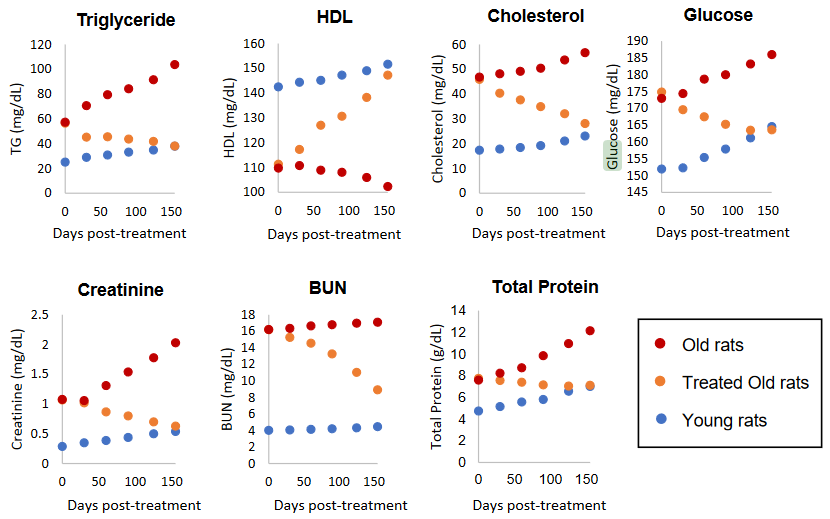
  • IL-6, a marker of inflammation, was restored to low youthful levels;
  • Glutathione (GSH), superoxide dismutase (SOD), and other antioxidants were restored to higher youthful levels;
  • In tests of cognitive function (Barnes maze), treated rats scored better than old rats, but not as well as young rats.;
  • Blood triglycerides were brought down to youthful levels;
  • HDL cholesterol rose to youthful levels; and
  • Blood glucose fell toward youthful levels.

These results bring together three threads that have been gaining credibility over the last decade. Mutually reinforcing, the three have a strength that none of them could offer separately.

  1. The root cause of aging is epigenetic progression = changes in gene expression over a lifetime.
  2. Methylation patterns in nuclear DNA are not merely a marker of aging, but its primary source. Thus aging can be reversed by reprogramming DNA methylation.
  3. Information about the body’s age state is transmitted system-wide via signal molecules in the blood. Locally, tissues respond to these signals and adopt a young or an old cellular phenotype as they are directed.”

Several of these aging measurements are also positively affected by sulforaphane. Using Sulforaphane: Its “Coming of Age” as a Clinically Relevant Nutraceutical in the Prevention and Treatment of Chronic Disease as a reference:

1. “Chronic inflammation”

“Antioxidants in general and glutathione in particular can be depleted rapidly under conditions of oxidative stress, and this can signal inflammatory pathways associated with NF-κB. SFN [sulforaphane] has been shown to inhibit NF-κB in endothelial cells.

Two key inflammatory cytokines were measured at four time points in forty healthy overweight people [our model clinical trial, Effects of long-term consumption of broccoli sprouts on inflammatory markers in overweight subjects]. The levels of both interleukin-6 (Il-6) and C-reactive protein (CRP) declined over the 70 days during which the sprouts were ingested. These biomarkers were measured again at day 90, wherein it was found that Il-6 continued to decline, whereas CRP climbed again. When the final measurement was taken at day 160, CRP, although climbing, had not returned to its baseline value. Il-6 remained significantly below the baseline level at day 160.”

OMCL2019-2716870.010

2. “Oxidative stress”

“As a mediator for amplification of the mammalian defence system against various stressors, Nrf2 [nuclear factor erythroid 2-related factor 2] sits at the interface between our prior understanding of oxidative stress and the endogenous mechanisms cells use to deal with it. Diseases known to be underpinned by oxidative stress are proving to be more responsive to amplification of cellular defences via Nrf2 activation than by administration of direct-acting antioxidant supplements.

SFN, with absolute bioavailability of around 80%, [is] capable of increasing several endogenous antioxidant compounds via the transcription factor, Nrf2.

Nrf2 is ubiquitously expressed with the highest concentrations (in descending order) in the kidney, muscle, lung, heart, liver, and brain. Nrf2 was shown to prevent endothelial cells from exhibiting a proinflammatory state. Nrf2 is required for protection against glucose-induced oxidative stress and cardiomyopathy in the heart.

Well in excess of 500 genes have been identified as being activated by SFN via the Nrf2/ARE [Antioxidant Response Element] pathway, and it is likely that this underestimates the number as others are being discovered. Of the available SFN clinical trials associated with genes induced via Nrf2 activation, many demonstrate a linear dose-response. More recently, it has become apparent that SFN can behave hormetically with different effects responsive to different doses.

It [sulforaphane] is not only a potent Nrf2 inducer but also highly bioavailable so that modest practical doses can produce significant clinical responses. Other Nrf2 activators [shown in the above image] not only lack potency but also lack the bioavailability to be considered as significant intracellular Nrf2 activators.”


The study’s most relentlessly questioned, scrutinized, and criticized findings may be the two new epigenetic clocks that apply to both humans and rats. The researchers invited other researchers to validate these clocks because:

“If validated, this would be a step change in aging research. Although conservation of aging mechanism could be equally deduced from the existence of multiple individual clocks for other mammals (mouse, dog), the single formula of the human-rat clock that is equally applicable to both species effectively demonstrates this fact.”
The commonalities of this study with efforts to change my inflammatory phenotype with broccoli sprouts were summarized in the Discussion section:

“Apart from rejuvenating the vital organs of the treated rats, plasma fraction also impacted two fundamental physiological processes that underlie a great number of pathologies, namely oxidative stress and inflammation. Within a week of treatment, the markers of chronic inflammation (IL-6 and TNF-α) were significantly reduced and remained low throughout the entire experiment.

Likewise, markers of oxidative stress in brain, heart, lung and liver, which were very much higher in control old rats, were at the end of the experimental period, indistinguishable between plasma fraction-treated old rats and young ones. Concomitant with this drastic reduction in oxidative stress was the augmented levels of antioxidants (GSH, Catalase and SOD) in these tissues, indicating that modulating the levels of ROS [reactive oxygen species] to that of youthful rats is at least one way by which plasma fraction suppresses oxidative stress. It remains to be ascertained whether the rate of ROS generation is also reduced.

The levels of Nrf2, a transcription factor that impacts on oxidative stress, as well as inflammation, were raised by plasma fraction treatment of old rats to those of the young ones, indicating yet another level by which this treatment modulates these two critical processes. Collectively, these results show that plasma fraction treatment impacts not only the overt performances of organs, but also the underlying physiological processes that are pivotal for optimal organ function and health.”

Great stuff, huh? Are you ready to change your phenotype?

Continued with Part 2 of Rejuvenation therapy and sulforaphane.

Why is Thailand locked down?

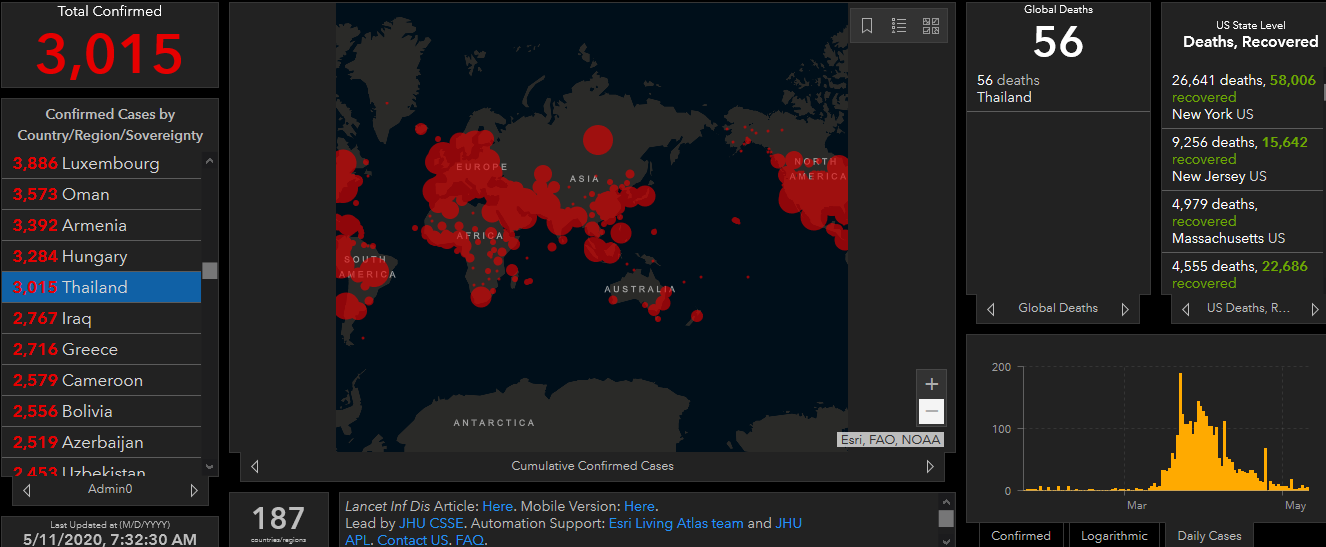
From the John Hopkins panic map:

John Hopkins isn’t allowed to present other countries’ data without also displaying US data? Is the message to Stay Panicked?

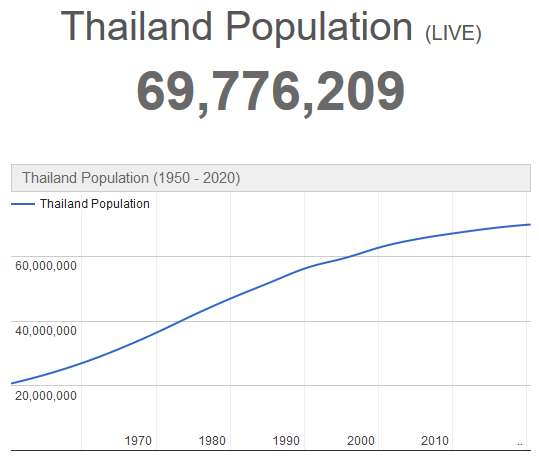
From UN statistics:

Thailand is locked down because fewer than 0.0001% (56 / 69776209) of the population have died from COVID-19?

The Thai people have had their economy and income destroyed, and are standing in food lines because..? To protect their health?


A hundred people in a dozen countries looked at this post today. None of them were in Thailand, which goes a long way toward answering the title’s question. As does this Twitter reply:

“Because here, as in many places, those with power have used the virus panic to seize even more power and demand people obey them without question. The generals can never resist power.”

So Rolling back your rights and making you obey was clearly the goal. Not hard to find examples of the WHO’s involvement in Thailand’s lockdown.

What will people in the US accept?

I’m kind of asleep right now

This should stay up on YouTube for a while since it uses satire. If it used informed opinions like:

YouTube would censor it.

“I’ll stay at home for the rest of my life if they tell me to. Who knows how to make the best choices for my health and my life? Definitely not me.

The last thing you want is for people to have the freedom to make their own choices and then experience the consequences of their choices.

This new scientific data is irrelevant to me. I already made up my mind when I was the most frightened, and I’m going to keep on believing what makes me the most frightened. Because it’s more congruent to my being that way.

The more scared I am, the more obedient I am.

Yes, I would like a mandatory vaccine. Sometimes the best medicine is like the best sex: non-consensual. They work on the same premise.

It’s pretty well proven that being proactive and taking care of your health won’t keep you healthy. Our only hope is in the pharmaceutical companies protecting us. They have a very good track record of never harming anyone.

I’d like two microchips please. Just to keep me extra safe. Or maybe we should just do a baby step, and use a mandatory tracking app on our phone to keep us safe and then go to the microchips.”

Week 6 of Changing an inflammatory phenotype with broccoli sprouts

To follow up Week 5 of Changing an inflammatory phenotype with broccoli sprouts:

1. I had an informative exchange with an author of Microwave broccoli to increase sulforaphane levels. The study provided an optimal sulforaphane end result of “(2.45 µmol/g DW)”. I asked a study author for additional data, and they replied:

“The control GLR and SLR amount was 2.18 and 0.22 µmol/g DW, respectively, while the HL60 GLR amount was 2.78 µmol/g DW.”

Microwaving broccoli florets to 60°C (140°F) increased the sulforaphane amount by 1,114% (2.45 / .22)! That also increased the glucoraphanin amount by 27% (2.78 / 2.18) for further processing into sulforaphane after eating.

I replied: That’s an exciting result, increasing sulforaphane more than 11 times, while also increasing glucoraphanin! I haven’t found similar experiments with broccoli sprouts. Would you expect similar results?

The study author responded:

“We didn’t expect this result, and think microwave irradiation might help to release more conjugated forms of glucosinolates and then get hydrolyzed by released myrosinase. Further studies are being carried out.”

2. I stopped panning out spent broccoli seed coats. The 3-day-old broccoli sprouts have the optimal yields study didn’t directly address coats, and coats were presumably discarded before broccoli sprout analyses.

However, since broccoli seeds were ground, coats were part of broccoli seed analyses. Broccoli seeds had higher sulforaphane weights than did broccoli sprouts. So 3-day-old spent broccoli seed coats probably don’t reduce sulforaphane amounts.

“The SF [sulforaphane] contents were calculated and expressed by mg SF per gram of seeds or fresh sprouts. Furthermore, to be comparable with the seeds, the contents of SF and the following bioactive compounds in 100 fresh sprouts were divided by the weight of 100 seeds and then the contents of bioactive compounds in fresh sprout were expressed as mg per gram of seeds.

Although germination reduces SF yield to some extent, it is beneficial to the formation and accumulation of total phenol and flavonoids, ensuring the health properties of sprouts. SF contents in sprouts were 46% – 97% of seeds, whereas TP [total phenolic] and TF [total flavonoid] contents in sprouts were 1.12 – 3.58 times higher than seeds among varieties.”

3. Doubling the starting amount of broccoli seeds from one to two tablespoons is going well. My traveling companion’s latest measurement of yield for a batch of 3-day-old broccoli sprouts was 84.6 grams. She immersed broccoli sprouts in 350 ml water and microwaved them on full 1000W power for 2 minutes to achieve 61°C.

I put daily batches in 100 ml distilled water, and microwave on full 1000W power for 45 seconds to achieve 58°C. For comparison with the 3-day-old point of starting with one tablespoon of broccoli seeds, that took 35 seconds to achieve 57°C.

Two tablespoons of broccoli seeds produce a lot of broccoli sprouts for me to eat in a single serving. I mix in spicy brown mustard after microwaving and cooling them down. It complements the taste and makes them more palatable. The mixture goes better with a meal than eating it by itself.

4. Not sure what went on with last week’s inflammatory problems after four-to-six-mile-long beach walks. I did similar walks on Thursday and Saturday, and didn’t have those problems afterwards.

Did a small amount of running in Weeks 3 and 4 trigger something? Did my body adapt to a one tablespoon starting amount of broccoli seeds dosage, such that it wasn’t effective anymore?

Did raising the starting amount of broccoli seeds to two tablespoons cause the problems to quiet down this week? Or was the quiescence because I didn’t run even a short distance? This week’s occasional left ankle / left knee twinge makes me think that running, like golf, may not be a future activity.

5. I intend to follow the model clinical trial Effects of long-term consumption of broccoli sprouts on inflammatory markers in overweight subjects curated in How much sulforaphane is suitable for healthy people? and measure IL-6 and C-reactive protein after Week 10. These two weren’t among the 50+ measurements taken during last June’s annual physical, so I’ll request them along with HbA1c.

6. I credit my son for getting me started on the current investigation into broccoli sprouts. He repeatedly asked me for evidence of minimum effective sulforaphane dosage. Still haven’t found complete answers.

The treatments mentioned in Week 1, and the unmentioned months of physical therapy and years of periodic cortisone injections hadn’t worked. I could have been doing more to better address the causes of a long-term problem rather than just treat the symptoms. Now I am, thank you.

See Week 7 of Changing to a youthful phenotype with broccoli sprouts for follow ups.

Papayas and goats test positive for COVID-19

The President of Tanzania John Magufuli exposed one part of the worldwide power grab:


The WHO doesn’t like criticism:

“We are convinced that the tests are not contaminated with the virus.”

Nevermind that this isn’t the cause of all false positives!

And there’s no possibility of test results being wrong because:

“Tanzania was using test kits supplied by the Africa CDC in collaboration with the Chinese Jack Ma Foundation.”

WHO rejects Tanzania claim tests faulty

What happens next with the worldwide lockdown?

1. I’ve been wrong for over a month about young people becoming the driving force to lead us out of this worldwide lockdown. I’d guess that their lifelong behavioral conditioning was too high of a hurdle to overcome.

I’m disappointed when people can’t accurately see what’s in front of them, and expressed that recently with Wake up, young people!! But I also often misperceive, so I understand.

2. Another recent post – It was known to everybody that the lockdown would cause a catastrophe – presented an epidemiologist’s arguments to support that the worldwide lockdowns’ destructive effects were known to everybody beforehand. I agree, and add that when both economic analysis like 1 above and this epidemiologist’s public health analysis show that political actions couldn’t be more wrong, there’s some other agenda going on.

I don’t fully agree with the interviewee, though, as he didn’t adequately present aspects of human behavior. For example, he cited a CDC chart of a drop in hospital reporting of influenza-like symptoms for his arguments without also citing the media frenzy to scare people away from hospitals for fear that they would catch COVID-19. So of course there were fewer instances of influenza-like symptoms reported by hospitals.

The Professor misunderstood the United States form of government. As a general principle, the federal government doesn’t order the states to do such and such.

The state of Florida, for example, did exactly what the Professor suggested, “protect the elderly.” Other states didn’t, like Washington, New Jersey, Virginia, Pennsylvania, and especially New York. Don’t know why those states’ residents don’t demand responsibility and accountability.

He also said “The virus is gone” but that statement had qualifications. Parts of this interview misplaced their relevant contexts.

3. Let me start this third item by acknowledging that I often make a half-dozen mistakes before lunch every workday. Just ask my coworkers. 🙂

I’ll suggest how to prepare for whatever happens next rather then predict what happens next. This suggestion to economically protect yourself is based on cycles, but may not work if aspects of what’s unfolding worldwide are unprecedented.

Harry Browne and Terry Coxon introduced the Permanent Portfolio concept in 1981. The concept is that there’s a best “investment” for each economic cycle. I quote “investment” because I consider positions in both cash and gold as forms of holding – saving – money, which means opting out of investing.

The economic cycle – “investment” matched pairs are:

  • Prosperity – Stocks
  • Inflation – Gold
  • Deflation – Long-term government bonds
  • Recession – Cash

The Permanent Portfolio has four equal 25% positions with periodic rebalancing to those percentages. I suggest investigating the concept, as I’ve always seen it as a way to largely remove one’s own emotions from investing and money.

The most recent search result of “harry browne permanent portfolio” is here from April 8, 2020. That post was fairly informative, and funny in that almost all commentaries on the Permanent Portfolio include similar wording:

“I don’t invest in Harry Browne’s portfolio, but my own asset allocation takes cues from this approach.”

Everybody who talks about the concept thinks they can do better. But who actually does better over the long term?