Do we need to study the brain to understand the mind?

A coauthor of the studies referenced in:

offered an opinion piece in A Paper a Day Keeps the Scientist Okay entitled “Do We Need To Study The Brain To Understand The Mind?”

“The emerging consensus appears to be that implementation is important. Interestingly, the inverse question is also being asked by neurobiologists—do we need consider the mind to understand the brain?—and answered largely and increasingly in the affirmative.

Is pain different from negative emotions such as sadness and anger, or are they variants on a common theme? Pain appears to be distinct from negative emotion, but commonalities suggest ways in which they may share underlying processes such as heightened attention.

One of the biggest pitfalls is the temptation to observe brain activity and make inferences about the psychological state—for example, to infer:

  • Episodic memory retrieval from hippocampal activity,
  • Fear from amygdala activity, or
  • Visual processing from activity in the ‘visual cortex.’

These inferences ignore the scope of processes which may activate each of these areas and involve a fallacy in reasoning: “if memory then hippocampus” is not the same thing as “if hippocampus then memory.”

The fact that few brain areas, including the ‘visual cortex,’ are dedicated to one process means that self-report is still the gold standard for assessing emotional experience and the contents of thought. This is a serious challenge for those who would like, for example, to assess your brand preferences or your political affiliation from a brain scan. (And isn’t it easier just to ask?)”
Epigenetic effects of early life stress exposure

This 2017 Netherlands review subject was the lasting epigenetic effects of early-life stress:

“Exposure to stress during critical periods in development can have severe long-term consequences.

One of the key stress response systems mediating these long-term effects of stress is the hypothalamic-pituitary-adrenal (HPA) axis.

Early life stress (ELS) exposure has been reported to have numerous consequences on HPA-axis function in adulthood.

ELS is able to “imprint” or “program” an organism’s neuroendocrine, neural and behavioral responses to stress. Research focuses along two complementary lines:

  1. ELS during critical stages in brain maturation may disrupt specific developmental processes (by altered neurotransmitter exposure, gene transcription, or neuronal differentiation), leading to aberrant neural circuit function throughout life.
  2. ELS may induce modifications of the epigenome which lastingly affect brain function.

These epigenetic modifications are inducible, stable, and yet reversible, constituting an important emerging mechanism by which transient environmental stimuli can induce persistent changes in gene expression and ultimately behavior.”


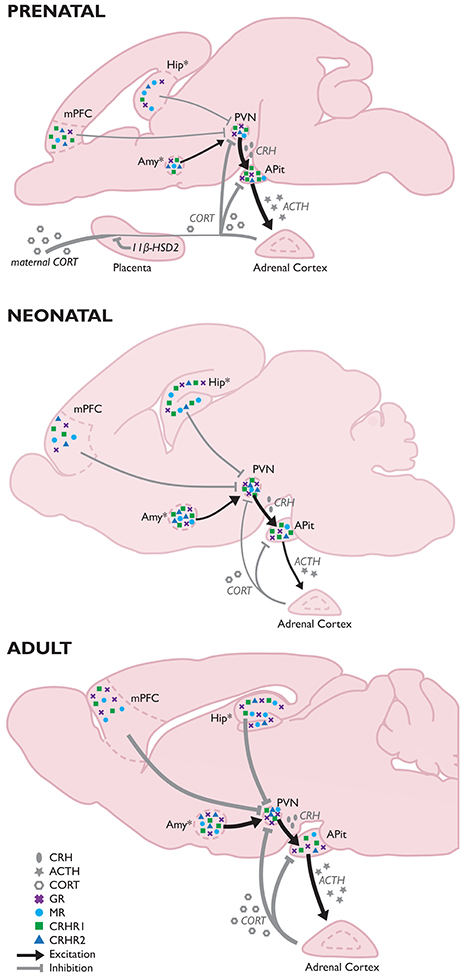
In early life, the lower brain and limbic system brain structures are more developed and dominant, whereas the cerebrum is less developed (use the above rodent graphic as a rough guide). Stress and pain generally have a greater impact on a fetus than an infant, and a greater impact on an infant than an adult.

The reviewers cited 50+ studies from years 2000-2015 in the “Early Life Stress Effects in a “Matching” Stressful Adult Environment” section to argue for the match / mismatch theory:

“Encountering ELS prepares an organism for similar (“matching”) adversities during adulthood, while a mismatching environment results in an increased susceptibility to psychopathology, indicating that ELS can exert either beneficial or disadvantageous effects depending on the environmental context.

Initial evidence for HPA-axis hypo-reactivity is observed for early social deprivation, potentially reflecting the abnormal HPA-axis function as observed in post-traumatic stress disorder.

Experiencing additional (chronic) stress in adulthood seems to normalize these alterations in HPA-axis function, supporting the match / mismatch theory.”

Evidence for this theory was contrasted with the allostatic load theory presented in How one person’s paradigms regarding stress and epigenetics impedes relevant research.


The review mainly cited evidence from rodent studies that mismatched reactions in adulthood may be consequences of early-life events. These events:

“Imprint or program an organism’s neuroendocrine, neural and behavioral responses..leading to aberrant neural circuit function throughout life..which lastingly affect brain function.”

Taking this research to a personal level:

  • Have you had feelings that you were unsafe, although your environment was objectively safe?
  • Have you felt uneasy when people are nice to you?
  • Have you felt anxious when someone pays attention to you, even after you’ve acted to gain their attention?

Mismatched human feelings are one form of mismatched reactions. These may be consequences of early-life experiences, and indicators of personal truths.

If researchers can let go of their biases and Advance science by including emotion in research, they may find that human subjects’ feelings produce better evidence for what actually happened during the subjects’ early lives than do standard scientific methods of:

Incorporating feeling evidence may bring researchers and each individual closer to discovering the major insults that knocked their development processes out of normally robust pathways and/or induced “persistent changes in gene expression and ultimately behavior.”

https://www.frontiersin.org/articles/10.3389/fncel.2017.00087/full “Modulation of the Hypothalamic-Pituitary-Adrenal Axis by Early Life Stress Exposure”


I came across this review as a result of it being cited in http://www.sciencedirect.com/science/article/pii/S1084952117302884 “Long-term effects of early environment on the brain: Lesson from rodent models” (not freely available)

Epigenetic effects of THC differ between female adolescents and adults

This 2017 Italian rodent study found:

“THC [delta9-tetrahydrocannabinol, the psychoactive compound of cannabis] exposure affects histone modifications in the brain of female rats in a region- and age-specific manner. Specifically, THC acts on different targets depending on the considered brain area and, remarkably, the adolescent brain is generally more sensitive to THC than the adult brain.

Adolescent exposure to THC, or to synthetic cannabinoids, induced sex-dependent brain and behavioral alterations at adulthood. In female rats, the phenotype was more complex, as both depressive-like and psychotic-like signs were present.

Development of the depressive/psychotic-like phenotype is restricted to adolescent THC exposure. Not only the behavioral phenotype developed after adolescent, and not adult, exposure, but also changes in both histone modifications and gene expression were more widespread and intense after adolescent treatment, further confirming a specific adolescent susceptibility.

The primary effect in the adolescent brain was represented by changes leading to transcriptional repression, whereas the one observed after adult treatment led to transcriptional activation. Moreover, only in the adolescent brain, the primary effect was followed by a homeostatic response to counterbalance the THC-induced repressive effect, except in the amygdala.”

The authors’ interpretation of the brain area results was:

“The amygdala is more responsive in adult than adolescent animals. Since it has been established that the amygdala is activated during exposure to aversive stimuli, functioning as a “behavioral brake”, different response between adult and adolescent animals could represent the biological bases of the adolescent propensity for risk-taking and novelty-seeking behaviors. Also in adolescent humans, neuroimaging studies have shown a weaker involvement of the amygdala, and a greater contribution of the NAc [nucleus accumbens], in response to negative and positive stimuli compared to adults.”

http://www.mdpi.com/1422-0067/18/10/2094 “Chronic Δ9-THC Exposure Differently Affects Histone Modifications in the Adolescent and Adult Rat Brain”

How one person’s paradigms regarding stress and epigenetics impedes relevant research

This 2017 review laid out the tired, old, restrictive guidelines by which current US research on the epigenetic effects of stress is funded. The reviewer rehashed paradigms circumscribed by his authoritative position in guiding funding, and called for more government funding to support and extend his reach.

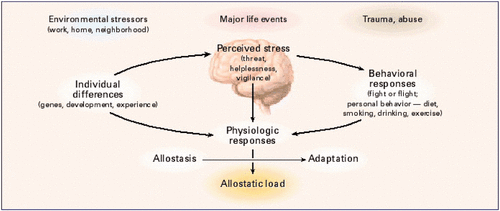
The reviewer won’t change his beliefs regarding individual differences and allostatic load pictured above since he helped to start those memes. US researchers with study hypotheses that would develop evidence beyond such memes may have difficulties finding funding except outside of his sphere of influence.


Here’s one example of the reviewer’s restrictive views taken from the Conclusion section:

Adverse experiences and environments cause problems over the life course in which there is no such thing as “reversibility” (i.e., “rolling the clock back”) but rather a change in trajectory [10] in keeping with the original definition of epigenetics [132] as the emergence of characteristics not previously evident or even predictable from an earlier developmental stage. By the same token, we mean “redirection” instead of “reversibility”—in that changes in the social and physical environment on both a societal and a personal level can alter a negative trajectory in a more positive direction.”

What would happen if US researchers proposed tests of his “there is no such thing as reversibility” axiom? To secure funding, the prospective studies’ experiments would be steered toward altering “a negative trajectory in a more positive direction” instead.

An example of this influence may be found in the press release of Familiar stress opens up an epigenetic window of neural plasticity where the lead researcher stated a goal of:

“Not to ‘roll back the clock’ but rather to change the trajectory of such brain plasticity toward more positive directions.”

I found nothing in citation [10] (of which the reviewer is a coauthor) where the rodent study researchers even attempted to directly reverse the epigenetic changes! The researchers under his guidance simply asserted:

“A history of stress exposure can permanently alter gene expression patterns in the hippocampus and the behavioral response to a novel stressor”

without making any therapeutic efforts to test the permanence assumption!

Never mind that researchers outside the reviewer’s sphere of influence have done exactly that, reverse both gene expression patterns and behavioral responses!!

In any event, citation [10] didn’t support an “there is no such thing as reversibility” axiom.

The reviewer also implied that humans respond just like lab rats and can be treated as such. Notice that the above graphic conflated rodent and human behaviors. Further examples of this inappropriate rodent / human merger of behaviors are in the Conclusion section.


What may be a more promising research approach to human treatments of the epigenetic effects of stress? As pointed out in The current paradigm of child abuse limits pre-childhood causal research:

“If the current paradigm encouraged research into treatment of causes, there would probably already be plenty of evidence to demonstrate that directly reducing the source of the damage would also reverse damaging effects. There would have been enough studies done so that the generalized question of reversibility wouldn’t be asked.

Aren’t people interested in human treatments of originating causes so that their various symptoms don’t keep bubbling up? Why wouldn’t research paradigms be aligned accordingly?”

http://journals.sagepub.com/doi/full/10.1177/2470547017692328 “Neurobiological and Systemic Effects of Chronic Stress”

On Primal Therapy with Drs. Art and France Janov

Experiential feeling therapy addressing the pain of the lack of love.

Contending with epigenetic consequences of violence to women

This 2016 UK review subject was the interplay of genomic imprinting and intergenerational epigenetic information transfer:

“A range of evolutionary adaptations associated with placentation transfers disproportionate control of this process to the matriline, a period unique in mammalian development in that there are three matrilineal genomes interacting in the same organism at the same time (maternal, foetal, and postmeiotic oocytes).

Genomic imprinting is absent in egg laying mammals and only around 6 imprinted genes have been detected in a range of marsupial species; this is in contrast to eutherian mammals where around 150 imprinted genes have been described.

The interactions between the maternal and developing foetal hypothalamus and placenta can provide a template by which a mother can transmit potentially adaptive information concerning potential future environmental conditions to the developing brain.

In circumstances either where the early environment provides inaccurate cues to the environmental conditions prevailing when adult due to rapid environmental change or when disruptions to normal neural development occur, the mismatch between the environmental predictions made during early development and subsequent reality may mean that an organism may have a poorly adapted phenotype to its adult environment. An appreciation of these underlying evolutionary salient processes may provide a novel perspective on the [causal] mechanisms of a range of health problems.

The concept of a brain that is not pathological in the classical sense but it is simply mismatched to its environment has been most extensively studied in the context of ancestral and early developmental nutrition. However, this concept can be extended to provide insights into the development of a range of alternative neural phenotypes.”

The review’s final sentence was:

“Examination of the adaptive potential of a range of neural and cognitive deficits in the context of evolutionary derived foetocentric brain and placental development, epigenetics and environmental adaptation may provide novel insights into the development and potential treatment of a range of health, neurological, and cognitive disorders.”

One of the reviewers was cited in Epigenetic DNA methylation and demethylation with the developing fetus, which the review cited along with Epigenetic changes in the developing brain change behavior.


Researchers who avoid hypotheses that can’t be proven wrong could certainly test the subject matter of this review if they investigated their subjects’ histories.

For example, let’s say a patient/subject had symptoms where the “150 imprinted genes” were implicated. What are the chances a clinician or researcher would be informed by this review’s material and investigate the mother’s and grandmother’s histories?

For clinicians or researchers who view histories as irrelevant busywork: How many tens of millions of people alive today have mothers who were fetuses when their grandmothers were adversely affected by violence? Wouldn’t it be appropriate to assess possible historical contributions of:

“The mismatch between the environmental predictions made during early development and subsequent reality”

to the patient’s/subject’s current symptoms?

http://www.hindawi.com/journals/np/2016/6827135/ “Placental, Matrilineal, and Epigenetic Mechanisms Promoting Environmentally Adaptive Development of the Mammalian Brain”

A human study of pain avoidance

This 2016 UK human study found:

“People differ in how they learn to avoid pain, with some individuals refraining from actions that resulted in painful outcomes, whereas others favor actions that helped prevent pain.

Learning in our task was best explained as driven by an outcome prediction error that reflects the difference between expected and actual outcomes. Consistent with the expression of such a teaching signal, blood-oxygen level-dependent (BOLD) responses to outcomes in the striatum were modulated by expectation.

Positive learners showed significant functional connectivity between the insula and striatal regions, whereas negative learners showed significant functional connectivity between the insula and amygdala regions.

The degree to which a participant tended to learn from success in avoiding than experiencing shocks was predicted by the structure of a participants’ striatum, specifically by higher gray matter density where the response to shocks was consistent with a prediction error signal.

Higher gray matter density in the putamen (and lower gray matter density in the caudate) predicted better learning from shocks and poorer learning from success in avoiding shocks.”

The researchers termed the subjects’ pain responses “learning” instead of conditioning. The difference between the two terms in the experimental contexts was that the subjects weren’t presented with 100%-certain choices to avoid pain.

The experiments were also rigged to force choices at similar rates among subjects because:

“Participants who learned more from painful outcomes developed a propensity to avoid gambling, whereas participants who learned more from success in preventing pain developed a propensity to gamble.”


Human responses to pain don’t arise out of nowhere. The subjects’ pain histories were clearly relevant, but weren’t investigated.

The closest the study came to considering the subjects’ histories was:

“Before the experiment, participants completed an 80-item questionnaire composed of several measures of different mood and anxiety traits. Age, sex and mood and anxiety traits did not differ between participants later classified as positive and negative learners.”

Emotional content was neither included nor solicited. Emotions were inferred:

“Participants biased in favor of passive avoidance learning (i.e., learning what gambles should be avoided), striatal response to painful outcomes was consistent with an aversive prediction error, as seen in fear conditioning.”

As a result, there weren’t causal explanations for the subjects’ differing pain responses. How, when, and why did the behavioral, functional, and structural differences develop?


I didn’t see the level of detail needed to characterize striatal regions into the Empathy, value, pain, control: Psychological functions of the human striatum segments. I’d guess that the findings of “higher gray matter density in the putamen (and lower gray matter density in the caudate)” applied to the posterior putamen and the anterior caudate nucleus.

Two of the coauthors were also coauthors of If a study didn’t measure feelings, then its findings may not pertain to genuine empathy which I rated < 0 Detracted from science. The technique of Why do we cut short our decision-making process? was referenced.

http://www.pnas.org/content/early/2016/04/06/1519829113.full “Striatal structure and function predict individual biases in learning to avoid pain”

A one-sided review of stress

The subject of this 2016 Italian/New York review was the stress response:

“The stress response, involving the activation of the hypothalamic-pituitary-adrenocortical [HPA] axis and the consequent release of corticosteroid hormones, is indeed aimed at promoting metabolic, functional, and behavioral adaptations. However, behavioral stress is also associated with fast and long-lasting neurochemical, structural, and behavioral changes, leading to long-term remodeling of glutamate transmission, and increased susceptibility to neuropsychiatric disorders.

Of note, early-life events, both in utero and during the early postnatal life, trigger reprogramming of the stress response, which is often associated with loss of stress resilience and ensuing neurobehavioral (mal)adaptations.”


The reviewers’ intentional dismissal of the role of GABA in favor of the role of glutamate was a key point:

“The changes in neuronal excitability and synaptic plasticity induced by stress are the result of an imbalance of excitatory (glutamatergic) and inhibitory (GABAergic) transmission, leading to long-lasting (mal)adaptive functional modifications. Although both glutamate and GABA transmission are critically associated with stress-induced alteration of neuronal excitability, the present review will focus on the modulation of glutamate release and transmission induced by stress and glucocorticoids.”

No particular reason was given for this bias. I inferred from the review’s final sentence that the review’s sponsors and funding prompted this decision:

“In-depth studies of changes in glutamate transmission and dendrite remodeling induced by stress in early and late life will help to elucidate the biological underpinnings of the (mal)adaptive strategies the brain adopts to cope with environmental challenges in one’s life.”

The bias led to ignoring evidence for areas the reviewers posed as needing further research. An example of relevant research the reviewers failed to consider was the 2015 Northwestern University study I curated in A study that provided evidence for basic principles of Primal Therapy that found:

“In response to traumatic stress, some individuals, instead of activating the glutamate system to store memories, activate the extra-synaptic GABA system and form inaccessible traumatic memories.”

http://www.ncbi.nlm.nih.gov/pmc/articles/PMC4812483/ “Stress Response and Perinatal Reprogramming: Unraveling (Mal)adaptive Strategies”

The cerebellum ages more slowly than other body and brain areas

This 2015 UCLA human study used the epigenetic clock methodology to find:

“All brain regions have similar DNAm ages in subjects younger than 80, but brain region becomes an increasingly significant determinant of age acceleration in older subjects. The cerebellum has a lower epigenetic age than other brain regions in older subjects.

To study age acceleration effects in non-brain tissues as well, we profiled a total of 30 tissues of a 112 year old woman. The cerebellum exhibited the lowest (negative) age acceleration effect compared to the remaining 29 other regions. In contrast, bone, bone marrow, and blood exhibit relatively older DNAm ages.”

Limitations included:

  • “While the epigenetic age of blood has been shown to relate to biological age, the same cannot yet be said about brain tissue.
  • Cellular heterogeneity may confound these results since the cerebellum involves distinct cell types.
  • This cross-sectional analysis does not lend itself for dissecting cause and effect relationships.”

The study didn’t determine why the cerebellum was relatively younger. Some hypotheses were:

  • “Our findings suggest that cerebellar DNA is epigenetically more stable and requires less ‘maintenance work.’
  • The cerebellum has a lower metabolic rate than cortex.
  • It has far fewer mitochondrial DNA (mtDNA) deletions than cortex especially in older subjects, and it accumulates less oxidative damage to both mtDNA and nuclear DNA than does cortex.”

http://impactaging.com/papers/v7/n5/full/100742.html “The cerebellum ages slowly according to the epigenetic clock”

The current paradigm of child abuse limits pre-childhood causal research

As an adult, what would be your primary concern if you suspected that your early life had something to do with current problems? Would you be interested in effective treatments for causes of your symptoms?

Such information wasn’t available in this 2016 Miami review of the effects of child abuse. The review laid out the current paradigm mentioned in Grokking an Adverse Childhood Experiences (ACE) score, one that limits research into pre-childhood causes for later-life symptoms.

The review’s goal was to describe:

“How numerous clinical and basic studies have contributed to establish the now widely accepted idea that adverse early life experiences can elicit profound effects on the development and function of the nervous system.”

The hidden assumptions of almost all of the cited references were that these distant causes could no longer be addressed. Aren’t such assumptions testable today?

As an example, the Discussion section posed the top nine “most pressing unanswered questions related to the neurobiological effects of early life trauma.” In line with the current paradigm, the reviewer assigned “Are the biological consequences of ELS [early life stress] reversible?” into the sixth position.

If the current paradigm encouraged research into treatment of causes, there would probably already be plenty of evidence to demonstrate that directly reducing the source of damage would also reverse damaging effects. There would have been enough studies done so that the generalized question of reversibility wouldn’t be asked.

Aren’t people interested in treatments of originating causes so that their various symptoms don’t keep bubbling up? Why wouldn’t research paradigms be aligned accordingly?


The review also demonstrated how the current paradigm of child abuse misrepresented items like telomere length and oxytocin. Researchers on the bandwagon tend to forget about the principle Einstein expressed as:

“No amount of experimentation can ever prove me right; a single experiment can prove me wrong.”

That single experiment for telomere length arrived in 2016 with Using an epigenetic clock to distinguish cellular aging from senescence. The review’s seven citations for telomere length that all had findings “associated with” or “linked to” child abuse should now be viewed in a different light.

The same light shone on oxytocin with Testing the null hypothesis of oxytocin’s effects in humans and Oxytocin research null findings come out of the file drawer. See their references, and decide for yourself whether or not:

“Claimed research findings may often be simply accurate measures of the prevailing bias.”

http://www.cell.com/neuron/fulltext/S0896-6273%2816%2900020-9 “Paradise Lost: The Neurobiological and Clinical Consequences of Child Abuse and Neglect”


This post has somehow become a target for spammers, and I’ve disabled comments. Readers can comment on other posts and indicate that they want their comment to apply here, and I’ll re-enable comments.

Beneficial epigenetic effects of mild stress with social support during puberty

This 2016 Pennsylvania rodent study found:

“Stress in the context of social support experienced over the pubertal window can promote epigenetic reprogramming in the brain to increase resilience to age-related cognitive decline in females.

These findings are actually consistent with previous studies showing that some amount of adversity, or adversity under more favorable circumstances such as social support or a protective gene polymorphism, provides a measure of ‘grit’ in coping with later life challenges.

Our findings provide a unique perspective on this relationship, as they highlight the important link between experience during the pubertal window and cognitive health during aging.”

These researchers made efforts to further investigate causes of unexpected results, such as:

“Peripubertal stress alone did not significantly alter Barnes maze performance in aging compared to aged Controls. Mice that had experienced stress with concurrent social support (CVS + SI) actually performed better than Control aged mice, specifically in learning the reversal task faster.

Peripubertal stress had no effect on corticosterone levels in response to an acute restraint stress or in sensorimotor gating and baseline startle reactivity.”

Their investigations led to epigenetic findings:

“Consistent with our behavioral findings, stress in the context of social interaction resulted in long-term reprogramming of gene expression in the PFC [prefrontal cortex]. While there were no differentially expressed genes between Control and CVS females, there were 88 genes that were significantly different between Control and CVS + SI groups. Of genes that were downregulated, a large portion (23 genes; 35%) were microRNAs.

We found that the PFC transcriptome of CVS + SI aged females was significantly enriched for predicted targets of the 23 microRNAs that were downregulated in the PFC in these mice. This suggests that microRNAs represent a mode of regulation capable of enacting far-reaching programmatic effects, and are a critical epigenetic gene expression regulatory mechanism.”

Applicability to humans was suggested by associations such as:

“A single microRNA can target more than a hundred different mRNA targets, and more than 45,000 conserved microRNA binding sites have been annotated in the 3′ UTR of 60% of human genes.”


A few limitations were noted:

“Given that mice at this age (1 year) are commonly compared to ‘late middle aged’ humans, later aging time points may yield differences in this group. Alternatively, it is possible that there was an effect of peripubertal stress that was not long-lasting due to the mild nature of our chronic stress model.

To include early neglect as a part of the stressor experience, CVS females were weaned one week earlier (PN21) than Control and CVS + SI mice. Addition of stress of this earlier weaning likely poses a significant contribution to programming of the PFC.”

One of the study coauthors was also a coauthor of:

https://www.ncbi.nlm.nih.gov/pmc/articles/PMC4870871/ “Peripubertal stress with social support promotes resilience in the face of aging”

A review that inadvertently showed how memory paradigms prevented relevant research

This 2016 Swiss review of enduring memories demonstrated what happens when scientists’ reputations and paychecks interfered with them recognizing new research and evidence in their area but outside their paradigm: “A framework containing the basic assumptions, ways of thinking, and methodology that are commonly accepted by members of a scientific community.”

A. Most of the cited references were from decades ago that established these paradigms of enduring memories. Fine, but the research these paradigms excluded was also significant.

B. All of the newer references were continuations of established paradigms. For example, a 2014 study led by one of the reviewers found:

“Successful reconsolidation-updating paradigms for recent memories fail to attenuate remote (i.e., month-old) ones.

Recalling remote memories fails to induce histone acetylation-mediated plasticity.”

The researchers elected to pursue a workaround of the memory reconsolidation paradigm when the need for a new paradigm of enduring memories directly confronted them!

C. None of the reviewers’ calls for further investigations challenged existing paradigms. For example, when the reviewers suggested research into epigenetic regulation of enduring memories, they somehow found it best to return to 1984, a time when dedicated epigenetics research had barely begun:

“Whether memories might indeed be ‘coded in particular stretches of chromosomal DNA’ as originally proposed by Crick [in 1984] and if so what the enzymatic machinery behind such changes might be remain unclear. In this regard, cell population-specific studies are highly warranted.”


Two examples of relevant research the review failed to consider:

1. A study that provided evidence for basic principles of Primal Therapy went outside existing paradigms to research state-dependent memories:

“If a traumatic event occurs when these extra-synaptic GABA receptors are activated, the memory of this event cannot be accessed unless these receptors are activated once again.

It’s an entirely different system even at the genetic and molecular level than the one that encodes normal memories.”

What impressed me about that study was the obvious nature of its straightforward experimental methods. Why hadn’t other researchers used the same methods decades ago? Doing so could have resulted in dozens of informative follow-on study variations by now, which is my point in Item A. above.

2. A relevant but ignored 2015 French study What can cause memories that are accessible only when returning to the original brain state? which supported state-dependent memories:

“Posttraining/postreactivation treatments induce an internal state, which becomes encoded with the memory, and should be present at the time of testing to ensure a successful retrieval.”


The review also showed the extent to which historical memory paradigms depend on the subjects’ emotional memories. When it comes to human studies, though, designs almost always avoid studying emotional memories.

It’s clearly past time to Advance science by including emotion in research.

http://www.hindawi.com/journals/np/2016/3425908/ “Structural, Synaptic, and Epigenetic Dynamics of Enduring Memories”

Epigenetic effects of diet, and reversing DNA methylation

This 2015 French review focused on:

“The role of maternal health and nutrition in the initiation and progression of metabolic and other disorders.

The effects of various in utero exposures and maternal nutritional status may have different effects on the epigenome. However, critical windows of exposure that seem to exist during development need to be better defined.

The epigenome can be considered as an interface between the genome and the environment that is central to the generation of phenotypes and their stability throughout the life course.”

The reviewer used the term “transgenerational” to refer to effects that were more appropriately termed parental or intergenerational. Per the definition in A review of epigenetic transgenerational inheritance of reproductive disease, for the term to apply there needed to be evidence in at least the next 2 male and/or 3 female generations of:

“Altered epigenetic information between generations in the absence of continued environmental exposure.”

The review had separate sections for animal and human studies.

http://www.ncbi.nlm.nih.gov/pmc/articles/PMC4663595/ “Impact of Maternal Diet on the Epigenome during In Utero Life and the Developmental Programming of Diseases in Childhood and Adulthood”


I arrived at the above review as a result of it citing the 2014 Harvard Reversing DNA Methylation: Mechanisms, Genomics, and Biological Functions. I’ll quote a few items from that review’s informative “Role of DNA demethylation in neural development” section:

“Distinct parts of mammalian brains, including frontal cortex, hippocampus, and cerebellum, all exhibit age-dependent acquisition of 5hmC [an oxidized derivative of 5mC [methylation of the fifth position of cytosine]].

In fact, the genome of mature neurons in adult central nervous system contains the highest level of 5hmC of any mammalian cell-type (~40% as abundant as 5mC in Purkinje neurons in cerebellum). These observations indicate that 5mC oxidation and potentially DNA demethylation may be functionally important for neuronal differentiation and maturation processes.

A comprehensive base-resolution analyses of 5mC and 5hmC in mammalian frontal cortex in both fetal and adult stages indicate that non-CpG methylation (mCH) and CpG hydroxymethylation (hCG) drastically build up in cortical neurons after birth, coinciding with the peak of synaptogenesis and synaptic pruning in the cortex. This study demonstrated that mCH could become a dominant form of cytosine modifications in adult brains, accounting for 53% in adult human cortical neuronal genome.

In mature neurons, intragenic mCH is preferentially enriched at inactive non-neuronal lineage-specific genes, indicating a role in negative regulation of the associated transcripts. By contrast, genic hCG is positively correlated with gene expression levels.”

What’s the underlying question for every brain study to answer?

Is the underlying question for every brain study to answer:

  • How do our brains internally represent the external world?

Is it:

  • How did we learn what we know?
  • How do we forget or disregard what we’ve learned?
  • What keeps us from acquiring and learning newer or better information?

How about:

  • What affects how we pay attention to our environments?
  • How do our various biochemical states affect our perceptions, learning, experiences, and behavior?
  • How do these factors in turn affect our biology?

Or maybe:

  • Why do we do what we do?
  • How is our behavior affected by our experiences?
  • How did we become attracted and motivated toward what we like?
  • How do we develop expectations?
  • Why do we avoid certain situations?

Not to lose sight of:

  • How do the contexts affect all of the above?
  • What happens over time to affect all of the above?

This 2015 UCLA paper reviewed the above questions from the perspective of Pavlovian conditioning:

“The common definition of Pavlovian conditioning, that via repeated pairings of a neutral stimulus with a stimulus that elicits a reflex the neutral stimulus acquires the ability to elicit that the reflex, is neither accurate nor reflective of the richness of Pavlovian conditioning. Rather, Pavlovian conditioning is the way we learn about dependent relationships between stimuli.

Pavlovian conditioning is one of the few areas in biology in which there is direct experimental evidence of biological fitness.”


The most important question unanswered by the review was:

  • How can its information be used to help humans?

How can Pavlovian conditioning answer: What can a human do about the thoughts, feelings, behavior, epigenetic effects – the person – the phenotype – that they’ve been shaped into?

One example of the unanswered question: the review pointed out in a section about fear extinction that this process doesn’t involve unlearning. Fear extinction instead inhibits the symptoms of fear response. The fear memory is still intact, awaiting some other context to be reactivated and expressed.

How can this information be used to help humans?

  • Is inhibiting the symptoms and leaving the fear memory in place costless with humans?
  • Or does this practice have both potential and realized adverse effects?
  • Where’s the human research on methods that may directly address a painful emotional memory?

One relevant hypothesis of Dr. Arthur Janov’s Primal Therapy is that a person continues to be their conditioned self until they address the sources of their pain. A corollary is that efforts to relieve symptoms seldom address causes.

How could it be otherwise? A problem isn’t cured by ameliorating its effects.

http://cshperspectives.cshlp.org/content/8/1/a021717.full “The Origins and Organization of Vertebrate Pavlovian Conditioning”

Empathy, value, pain, control: Psychological functions of the human striatum

This 2016 US human study found:

“A link between existing data on the anatomical and physiological characteristics of striatal regions and psychological functions.

Because we did not limit our metaanalysis to studies that specifically targeted striatal function, our results extend previous knowledge of the involvement of the striatum in reward-related decision-making tasks, and provide a detailed functional map of regional specialization for diverse psychological functions, some of which are sometimes thought of as being the exclusive domain of the PFC [prefrontal cortex].”

The analysis led to dividing the striatum into five segments:

Ventral striatum (VS):

  • Stimulus Value
  • Terms such as “reward,” “losses,” and “craving”
  • The most representative study reported that monetary and social rewards activate overlapping regions within the VS.
  • Together with the above finding of a reliable coactivation with OFC [orbitofrontal cortex] and ventromedial PFC, this finding suggests a broad involvement of this area in representing stimulus value and related stimulus-driven motivational states.

Anterior caudate (Ca) Nucleus:

  • Incentive Behavior
  • Terms such as “grasping,” “reaching,” and “reinforcement”
  • The most representative study reported a stronger blood-oxygen level-dependent (BOLD) response in this region during trials in which participants had a chance of winning or losing money in a card guessing game, in comparison to trials where participants merely received feedback about the accuracy of their guess.
  • This result suggests a role in evaluating the value of different actions, contrasting with the above role of the VS in evaluating the value of stimuli.

Posterior putamen (Pp):

  • Sensorimotor Processes
  • Terms such as “foot,” “noxious,” and “taste”
  • The most representative study reported activation of this region in response to painful stimulation at the back of the left hand and foot of participants. Anatomically, the most reliable and specific coactivation is with sensorimotor cortices, and the posterior and midinsula and operculum (secondary somatosensory cortex SII) in particular, some parts of which are specifically associated with pain.
  • Together, these findings suggest a broad involvement of this area in sensorimotor functions, including aspects of their affective qualities.

Anterior putamen (Pa):

  • Social- and Language-Related Functions
  • Terms such as “read,” “vocal,” and “empathic”
  • The most representative study partially supports a role of this area in social- and language-related functions; it reported a stronger activation of the Pa in experienced singers, but not when novices were singing.
  • It is coactivated with frontal areas anterior to the ones coactivated with the Pp, demonstrating topography in frontostriatal associations. These anterior regions have been implicated in language processes.

Posterior caudate (Cp) Nucleus:

  • Executive Functions
  • Terms such as “causality,” “rehearsal,” and “arithmetic”
  • The representative study reported this region to be part of a network that included dorsolateral PFC and ACC, which supported inhibitory control and task set-shifting.
  • These results suggest a broad, and previously underappreciated, role for the Cp in cognitive control.

The authors presented comparisons of the above striatal segments with other analyses of striatal zones.


One of the coauthors was the lead researcher of the 2015 Advance science by including emotion in research. The current study similarly used a coactivation view rather than a connectivity paradigm of:

“Inferring striatal function indirectly via psychological functions of connected cortical regions.”

Another of the coauthors was a developer of the system used by the current study and by The function of the dorsal ACC is to monitor pain in survival contexts, and he provided feedback to those authors regarding proper use of the system.


The researchers’ “unbiased, data-driven approach” had to work around the cortical biases evident in many of the 5,809 human imaging studies analyzed. The authors referred to the biases in statements such as:

“The majority of studies investigating these psychological functions report activity preferentially in cortical areas, except for studies investigating reward-related and motor functions.”

The methods and results of research with cortical biases influenced the study’s use of:

“Word frequencies of psychological terms in the full text of studies, rather than a detailed analysis of psychological tasks and statistical contrasts.”

http://www.pnas.org/content/113/7/1907.full “Regional specialization within the human striatum for diverse psychological functions”