Don’t eat yourself into disease, Part 2

This blog’s 1000th curation is a 2023 rodent study associating gut microbiota, behavior, memory, and food reward:

“Energy intake and energy expenditure is regulated by the hypothalamus, and is referred to as homeostatic regulation of food intake. The reward system is the non-homeostatic regulation of food intake – pleasure-related consumption of foods enriched in fat and sugar. The pleasure is encoded by dopamine release from dopaminergic neurons projecting from the ventral tegmental area to the striatum, the nucleus accumbens, and the prefrontal cortex.

Food reward can be divided into three components – liking, wanting, and learning:

  • Liking refers to food hedonic value;
  • Wanting to the motivational process to seek out and consume certain foods; and
  • Learning to reinforcing conditioning behavior associated with food intake stimulus.

We confirmed that obese mice have a dysregulation of the learning and the wanting components of  food reward. Our previous data showed that the liking component was transferable through fecal material transplantation.

We demonstrated that gut microbes play a role in the regulation of food reward, and could be responsible for compulsive behavior and excessive motivation to obtain sucrose pellets. Moreover, obese gut microbes affected dopaminergic and opioid markers involved in reward system.

We identified 33HPP (produced exclusively by gut bacteria) as particularly increased in mice recipients of gut microbes from obese mice. We were able to demonstrate its effects as key mediator of the gut-brain axis controlling the reward response to palatable food.”

https://microbiomejournal.biomedcentral.com/articles/10.1186/s40168-023-01526-w “Obese-associated gut microbes and derived phenolic metabolite as mediators of excessive motivation for food reward”


PXL_20230415_195202937

Don’t eat yourself into disease, Part 1

Starting a sample of 2023 papers with a porcine review:

“Epigenetic programing predisposes pigs to insulin insensitivity, but pigs seem to sense this insensitivity and consequently eat less, preventing obesity. Pigs naturally prefer to eat small breakfasts and large dinners.

Deviating from this eating pattern or providing diets with a high glycemic burden can trigger obesity; however, pigs will restrict food intake to prevent serious obesity. In practice, problems with obesity are rarely seen, even when pigs are fed poorly timed diets similar to junk food, likely because swine diets are balanced for every nutrient.

Feeding pigs diets deficient in micronutrients does trigger obesity. For humans, several micronutrient requirements have not been set officially, and diets optimized for all micronutrients are rarely provided.

metabolites-13-00420-g015

Although we could debate whether this is a cause or effect, the above data on hyper-processed diets fed to pigs would indicate that it is causative. Pigs were fed a diet which included ‘human-targeted junk food’ but was adequate in phosphate, and they experienced no issues.

Controlled human studies are generally conducted with very small populations of subjects for very short durations, as emotions come into play. Humans are hard to persuade to follow a boring diet, especially over a longer period of time, and humans are easily tempted to deviate from a protocol if peer pressure or desires are high.

Even worse, in survey type experiments, people are asked what they ate for the past one or several days, and these data may well be subsequently extrapolated to patterns of behavior and then correlated with developments in health. Recalling what and especially how much a person ate yesterday is already a challenge for many, confounded even further by the desire not to include items that may be considered less acceptable.

On the swine side, knowledge on nutrient yield of foods and nutrient requirement appears further advanced, and controlled feeding trials are much easier to perform. Borrowing pig data is arguably much closer to the truth for humans than having no data at all.”

https://onlinelibrary.wiley.com/doi/10.1002/advs.202205346 “Eat like a Pig to Combat Obesity”


One fish in the gullet, another soon on its way

PXL_20230509_094500357

No exit

This 2023 rodent study investigated aging processes and gut microbiota in crowded conditions:

“Our study provides clear evidence that high-density crowding accelerates the aging process of Brandt’s voles. We also found that ‘high-density microbiota’ promote the aging-related phenotype in voles.

Because we minimized effects of direct fighting on mortality of voles, observed changes in lifespan in this study should mostly represent the natural aging processes of voles.

high-density survival

High density increased the level of stress hormone corticosterone, which disrupted gut microbiota composition by:

  • Decreasing abundance of anti-aging or anti-inflammatory bacterial species; and
  • Increasing the proportion of pathogenic bacteria.

This caused an increase in DNA oxidation and inflammation through upregulation of NF-kB and COX-2 pathways.

Although high-density relief and butyric acid administration interventions could reverse aging-related processes of adult voles, it remains unclear whether they could reverse the aging process in terms of lifespan.

Our results suggest that gut microbiota play a significant role in mediating aging-related processes of voles under high-density conditions, and can be used as a potential therapeutic target for treating stress-related diseases in humans.”

https://onlinelibrary.wiley.com/doi/10.1002/advs.202205346 “Gut Microbiota is Associated with Aging-Related Processes of a Small Mammal Species under High-Density Crowding Stress”


I came across this study by it citing Reversing hair greying for effects of stress interventions.

PXL_20230505_185253518.MP

Remembering life before birth

This 2023 primate study investigated the body’s capability to remember prenatal experiences influencing later life:

“Maternal stressors and other environmental factors affect the developing embryo and fetus in ways that lead to increased susceptibility for chronic disease in later life. Developmental programming of chronic low-grade inflammation plays an important role in onset and progression of these diseases.

Establishing innate immune cell memory involves increased glycolysis, reduced oxidative phosphorylation, and expression of transcription factors which prime for pro-inflammatory activity. This memory relies on propagation of epigenetic modifications that develop in hematopoietic stem and progenitor cells (HSPCs), which can be passed on to progeny immune cells (i.e., macrophages).

These changes persist with altered epigenetic regulation for years after weaning – even when offspring are fed a conventional diet – predisposing offspring to inflammatory disease across their lifespans.

cell memory

Several factors may initiate metabolomic reprogramming in fetal HSPCs:

  • We found increased chromatin accessibility of gene regulatory regions and RNA signatures supporting activation of factors with a major role in regulating macrophage inflammatory activation, including FOS/JUN, NF-κB, C/EBPβ, and STAT6.
  • Our prior work demonstrated a persistently altered histone code in liver tissue from juvenile animals.
  • Maternal diet-supplied lipids, including oleic acid, in hematopoietic tissues may play an important role in priming inflammation and metabolism in fetal HSPCs and bone marrow-derived macrophages with postnatal persistence.

Striking changes in fetal bone marrow and liver HSPCs observed here suggest that the primary driver for developmental programming of inflammation takes place in utero. However, we cannot rule out that exposure to maternal diet during lactation postnatally triggers shifts in microbiome composition or function contributing to inflammation.

Components of maternal diet, rather than maternal obesity per se, are a modifiable risk factor with potential to alter developmental programming of offspring immune systems.”

https://www.cell.com/cell-reports/fulltext/S2211-1247(23)00404-7 “Maternal diet alters long-term innate immune cell memory in fetal and juvenile hematopoietic stem and progenitor cells in nonhuman primate offspring”


And there are other ways we remember everything that happened then and along the way. Big clues are in our out-of-context responses to present day events.

PXL_20230326_104753766

Eat broccoli sprouts to protect your lungs

This 2023 human cell study investigated sulforaphane’s effects on tuberculosis infections:

“Basic research efforts on tuberculosis (TB) immunotherapy are currently only the tip of the iceberg. This study highlights the association between autophagy-related genes and immune infiltration in TB, an infectious pathogen that has been around for tens of thousands of years.

Sulforaphane (SFN) is readily absorbed into the bloodstream by the intestine due to its lipophilic nature. Experiments in this study TB patient cells showed that SFN could promote autophagy in macrophages infected with Mycobacterium abscessus (Mab). Intracellular bacterial load of macrophages was associated with SFN-enhanced cellular autophagic processes.

1-s2.0-S156757692300276X-gr4

The relationship between autophagy and immune cells is complex, and recurrence of tuberculosis is significantly influenced by intracellular mycobacteria of macrophages. Macrophages have longer lifespans than neutrophils, and provide shelter for mycobacteria as they are better suited than neutrophils to establish strategies for targeting autophagy.

This is one of the reasons why autophagy in macrophages was the focus of this study. Appropriate autophagy is beneficial for the body and controls Mtb replication, but autophagic programmed cell death can activate tissues to produce an excessive inflammatory response, resulting in severe damage to lung tissues.

Autophagy-related genes regulated by SFN have good diagnostic potential, with FOXO1 potentially serving as a target for TB immunotherapy. Downstream targets of FOXO1 include important pro-inflammatory signaling molecules such as IL-1β and TNF-α, which are important for control of mycobacterium.”

https://www.sciencedirect.com/science/article/pii/S156757692300276X “Identifying autophagy-related genes as potential targets for immunotherapy in tuberculosis”

Take yeast cell wall β-glucan, too, and train your immune system.

Does eating broccoli sprouts influence biological age?

A 2023 review of 28 human clinical trials investigating broccoli sprout compounds brought up this post’s title by omitting discussion of it:

“In order to determine the effective reference dose of a broccoli sprouts beverage for detoxifying carcinogenic air pollutants (benzene), Chen et al. administrated a drink enriched with glucoraphanin (GR) and sulforaphane (SFN) from 3-day-old broccoli sprouts to healthy adults. Researchers focused on excretion of metabolites SFN-NAC, SFN-CYS, and non-esterified SFN, which represent 80–81%, 12–14%, and 5–7% of total SFN forms, respectively.

Excretion percentage did not change during the intervention, indicating that bioavailability remained constant.

Enhanced excretion of the urinary biomarker of benzene detoxification S-phenylmercapturic acid (SPMA) was measured in urine collected every 12 h during the 10-day intervention. Out of 132 samples analyzed, >95% had detectable concentrations of SPMA, being significantly increased after consumption of the high dose of beverage (600 and 40 μmol GR and SFN, correspondingly), suggesting that consumption of >10 μmol SFN per 24 h may represent the lowest effective dose of the BSE affecting this biomarker.

https://www.mdpi.com/2072-6643/15/6/1424 “Systematic Review on the Metabolic Interest of Glucosinolates and Their Bioactive Derivatives for Human Health”


These reviewers did much hand waving to draw their conclusions. They ignored that the only way randomized trials become better than non-randomized trials is in dealing with confounders.

The largest confounder with glucoraphanin is that an individual’s gut microbiota, not their human cells, metabolize it into isothiocyanates. A glucoraphanin randomized trial has to have sufficient numbers of subjects in each group to adequately deal with confounding individual differences in gut microbiota.

I highlighted the largest of the 28 trials:

Basic RGB

Sulforaphane studies have fewer confounders. Even so, Upgrade your brain’s switchboard with broccoli sprouts stated:

“Power analysis calculations suggest that a sample size of n = 50 would yield a significant result.”

An insufficient number of subjects in both the half dose and full dose groups caused that study’s researchers to frame their results as “suggesting that consumption of >10 μmol SFN per 24 h may..” rather than asserting significant results.


Addressing this post’s title, it’s been ten years since epigenetic clocks came into use. This review highlighted by omission that there still hasn’t been even one investigation of isothiocyanates’ effects on human biological age as measured by epigenetic clocks.

A 40 μmol ≈ 7 mg sulforaphane “high” dose of the cited study is easily achievable with microwaved 3-day-old broccoli sprouts. There’s little question that healthy people activating AMPK, Nrf2, and associated signaling pathways, and inhibiting pro-inflammatory pathways such as NF-κB with sulforaphane, will experience beneficial effects.

The cited study found no change in sulforaphane treatment bioavailability over ten days, and a predecessor study found the same over 12 weeks. I’ll guess those bioavailability findings will extend over longer time periods.

Where are the researchers who will take the next step to show isothiocyanate treatments cause positive changes in epigenetic clock / biological age measurements?

PXL_20230304_211250499

Eat broccoli sprouts for depression, Part 3

Here are two papers published after Part 2 that cited the Part 1 rodent study, starting with a 2023 rodent study performed by several Part 1 coauthors:

“We used a low-dose LPS-induced endotoxaemia model to mimic clinical characteristics of sepsis. We found that adolescent LPS treatment was sufficient to increase levels of inflammatory factor TNF-α in both the medial prefrontal cortex (mPFC) and hippocampus at post-natal day P22.

P21 LPS-treated mice were injected with sulforaphane (SFN) or saline intraperitoneally at P49 and then subjected to subthreshold social defeat stress (SSDS). We found that SFN preventative treatment significantly:

  • Decreased the social avoidance, anhedonia, and behavioural despair detected by the social interaction test, sucrose preference test, tail suspension test, and forced swim test, respectively.
  • Decreased anxiety-like behaviours without affecting locomotor activities.
  • Increased Nrf2 and brain-derived neurotrophic factor (BDNF) levels in the mPFC of P21 LPS-treated mice after SSDS compared with saline control mice.

The above results suggest that activation of the Nrf2-BDNF signalling pathway prevents the effect of adolescent LPS-induced endotoxaemia on stress vulnerability during adulthood.

sulforaphane and stress vulnerability

These results suggest that early adolescence is a critical period during which inflammation can promote stress vulnerability during adulthood. This might be due to increased inflammatory response in the mPFC, and mediated by decreased levels of Nrf2 and BDNF. These findings may shed light on the potential use of SFN as an alternative preventative intervention for inflammation-induced stress vulnerability.”

https://link.springer.com/article/10.1007/s00213-022-06285-4 “Lipopolysaccharide-induced endotoxaemia during adolescence promotes stress vulnerability in adult mice via deregulation of nuclear factor erythroid 2-related factor 2 in the medial prefrontal cortex” (not freely available)

This study demonstrated that adolescent diseases and stresses don’t necessarily develop into adult social problems. A timely intervention may even prevent future adult problems.

The one-time 10 mg/kg sulforaphane dose was the same as Part 1’s dose, a human equivalent of which is (10 mg x .081) x 70 kg = 57 mg.

I’d like to know more about how subjects’ memories of adverse events were retained, and subsequently affected their biology and behavior. Pretty sure limbic structures like the hypothalamus as well as lower brain structures played a part.


A 2022 review summarized what was known up to that time regarding Nrf2 and depression:

“Sulforaphane, an organosulfur compound isolated from Brassicaceae plants, is a potent natural NRF2 activator. Sulforaphane:

  • Exerts antidepressant- and anxiolytic-like activities and inhibits HPA axis and inflammatory response.
  • Has both therapeutic and prophylactic effects on inflammation-related depression.
  • Confers stress resilience.
  • Protects neurons via autophagy and promotes mitochondrial biogenesis by activating Nrf2.”

https://www.sciencedirect.com/science/article/pii/S2213231722002944 “Nrf2: An all-rounder in depression”


PXL_20230306_202857493

Oat β-glucan effects

Three papers on oat β-glucan’s effects in humans, starting with a 2023 study that compared different doses:

“Two randomized, double-blind, controlled studies were conducted with asymptomatic subjects between 20 and 40 years of age, male or female, normal weight or overweight.

In the first study – a crossover trial comprising two days of testing (β-glucan and control) separated by at least one week – 14 subjects ingested a breakfast with or without β-glucan from oats (5.2 g). Results indicate that acute intake of 5 g β-glucan slows transit time and decreases hunger sensation and postprandial glycaemia without affecting bile-acid synthesis. These changes were associated with decreased plasma insulin, C-peptide, and ghrelin, and increased plasma gastric inhibitory polypeptide  and pancreatic polypeptide.

In the second study, 32 subjects were distributed into 2 groups to ingest daily foods with (3 g/day) or without β-glucan for 3 weeks. Results indicate a regular daily intake of 3 g β-glucan is not sufficient to have an effect on fecal microbiota composition, suggesting that health-promoting effects at 3 g/d are probably due more to their physiological effect in the proximal part of the gastrointestinal tract than to their prebiotic effect in the colon.”

https://www.mdpi.com/2304-8158/12/4/700 “Modulation of Postprandial Plasma Concentrations of Digestive Hormones and Gut Microbiota by Foods Containing Oat ß-Glucans in Healthy Volunteers”


I’ll use a 2021 study Rapid Determination of β-Glucan Content of Hulled and Naked Oats Using near Infrared Spectroscopy Combined with Chemometrics to estimate my daily β-glucan intake. Those researchers tested 100 varieties of Avena nuda that varied between 3.12% and 5.22% β-glucan. My intake from 82 g (dry weight) of hulless oats (cinnamon sprinkled for taste) is probably between (82 g x .0312) = 3 g and (82 g x .0522) = 4 g.

They also tested 79 varieties of hulled Avena sativa that varied between 3.1% and 5.5% β-glucan. Oat sprouts analysis tested a Avena sativa variety where the β-glucan content decreased from 3.48% to 2.10% over four days of sprouting, a 40% reduction.

My daily β-glucan intake from 40 g (dry weight) of three-day-old hulled oat sprouts is probably 1 g [(40 g x .031) x .6 = 1 g and (40 g x .055) x .6 = 1 g]. That’s okay, because oat sprouts have other benefits per Oat sprouts analysis and Advantages of 3-day-old oat sprouts over oat grains.

My daily oat β-glucan intake is 4 – 5 grams. I’ve maintained that for two years, and don’t see any reason to stop.


A second 2023 paper from a clinical trial investigated effects of combining oat bran along with orange juice:

“Orange juice (OJ) is a rich dietary source of bioactive flavanones, and consuming OJ has been associated with beneficial effects including decreased inflammation and improved lipid profiles. However, dietary recommendations are to limit OJ consumption to one serving per day due to high sugar and low fiber content. Metabolic concerns are increased postprandial insulin response to a high sugar load which in individuals at risk may promote insulin resistance.

Consumption of 22 g oat bran containing 6 g of β-glucan together with 500 mL of OJ by healthy subjects impacts on OJ flavanone bioavailability with the 0-24 post-intake excretion of phase II metabolites, such as hesperetin-7-glucuronide, being reduced ~3-fold. This was not a consequence of bran affecting the rate of gastric transport, and underlying mechanisms behind reduced excretion of OJ flavanone metabolites remain a matter of conjecture.

The pool of bound phenolics in bran linked to polysaccharides appears not to be converted to free phenolics. It was rather principally a consequence of a bran-mediated increase in quantities of flavanones passing from the upper to the lower bowel where they were subjected to microbiota-mediated catabolism.”

https://www.sciencedirect.com/science/article/abs/pii/S0891584923000515 “Bioavailability of orange juice (poly)phenols: β-glucan-rich oat bran decreases urinary excretion of flavanone phase II metabolites and enhances excretion of microbiota-derived phenolic catabolites” (not freely available) Thanks to Dr. José Manuel Moreno-Rojas for providing a copy.

This paper referenced a preliminary study by many of the same coauthors that found oat bran with 3 g of β-glucan didn’t have similar effects.


A 2022 meta-analysis investigated differences between whole oats and purified β-glucan:

“This systematic review and meta-analysis evaluated the impact of oats or β-glucan supplements on the lipid profile. Our findings show that both oat and isolated β-glucan interventions can improve lipid profiles, specifically total cholesterol and low density lipoprotein cholesterol (LDL) concentrations, and should be incorporated into one’s regular eating habits.

Interventions ranged from 14 to 84 days in length. Quantity of β-glucan ingested (oats and isolated β-glucan) ranged from 1.2 g/day to 11.2 g/day.

Limitations and additional considerations include:

  • We did not have enough studies that matched total fiber intake between intervention and control groups, and so could not evaluate if results were exclusively influenced by oat/isolated β-glucan supplementation, or if other types of dietary fiber would have a similar impact on lipidemia.
  • Mechanisms of changes in concentrations of triglycerides (TG) are linked to carbohydrates. An increase in availability of glucose in serum, resulting from absorption of carbohydrates, stimulates secretion of insulin and, as a result, synthesis of fatty acids in the liver is increased. Mixed results found in this and other meta-analyses regarding TG may be related to the fact that oats and isolated β-glucan were frequently administered through day-to-day processed foods which have sugar and other types of refined flour in their recipes.
  • Different oat cooking procedures, processing methods, and molecular weights modify viscosity and impact in cholesterol concentrations differently. Less processed oats appear to be more effective than processed oat products in improving lipidemia. Higher molecular weight is associated with increased viscosity, and greater reduction in LDL. Also, the process used to treat oats affects its molecular weight, and the highest viscosities were observed as a consequence of dry processes in comparison to ones that exhibit enzymatic activity.
  • Reducing saturated fat intake may be, in combination with increased viscous fiber intake from oats or isolated β-glucan, the most effective way to improve dyslipidemia. In future studies, amount and type of fat in diet should be evaluated and considered accordingly.”

http://dx.doi.org/10.1016/j.clnesp.2022.12.019 “The separate effects of whole oats and isolated beta-glucan on lipid profile: A systematic review and meta-analysis of randomized controlled trials” (not freely available)


PXL_20230309_202539345

Peripheral vs. brain epigenetic measurements

This 2023 human study investigated associations of peripheral and brain epigenetic measurements:

“Evaluating DNA methylation of brain tissue is challenging owing to the issue of tissue specificity. Consequently, peripheral surrogate tissues are used, resulting in limited progress compared with other epigenetic studies.

Averaging data for each CpG across individuals, saliva–brain correlation (r = 0.90) was higher than that for blood–brain (r = 0.87) and buccal–brain (r = 0.88) comparisons. Among individual CpGs, blood had the highest proportion of CpGs correlated to the brain at nominally significant levels (19.0%), followed by saliva (14.4%) and buccal (9.8%). However, cross-database correlations of correlation coefficients revealed relatively low brain vs. blood: r = 0.27, saliva: r = 0.18, and buccal: r = 0.24.

The majority of methylation in the brain is most likely not synchronized with methylation in the periphery. Despite this, variable CpGs that correlate in the brain and periphery, although in small numbers, may have biological relevance, and could be useful for inferring brain methylation from peripheral tissues.

This study has six major limitations.”

https://www.nature.com/articles/s41398-023-02370-0 “Cross-tissue correlations of genome-wide DNA methylation in Japanese live human brain and blood, saliva, and buccal epithelial tissues”


Real science is messy. Hypotheses are experimentally reevaluated many, many times under varying conditions. I skip over studies where researchers don’t provide meaningful limitation clauses.

PXL_20230305_195313042

The goddess of destiny

A 2023 human study investigated exercise, klotho gene, and epigenetic clock relationships:

“Named after the spinner of the thread of life, klotho (KL) is involved in the aging process and may act as an anti-aging hormone in mammals. We hypothesize that circulating KL is correlated with age-associated methylation of the KL gene promoter region, and this is one reason for age-related decline in circulating KL.

202 subjects between ages 37 and 85 were included in the study. A great percentage of volunteers participated in the World Rowing Masters Regatta in Velence, Hungary. They were considered to be the trained group (TRND): n = 131; 80 males: age 59.14 ± 10.8; 51 females: age 57.24 ± 9.4. Results were compared to the sedentary group (SED): n = 71; 27 males: age 55.63 ± 13.4; 44 females: age 61.91 ± 10.5.

Circulating level of KL showed a negative correlation with chronological age in the TRND group, but not in the SED group.

klotho and exercise

Examining the relationship between circulating KL level and PhenoAge and GrimAge, KL is associated with PhenoAge acceleration in the TRND group only. It appears that higher KL can decelerate the DNA methylation-based aging process assessed by PhenoAge.

The present study revealed that circulating KL level is associated with exercise status level and general strength level, and is greatly dependent upon exercise-induced DNA methylation.”

https://www.mdpi.com/2073-4425/14/2/525 “The Circulating Level of Klotho Is Not Dependent upon Physical Fitness and Age-Associated Methylation Increases at the Promoter Region of the Klotho Gene”


PXL_20230216_200008595

Take inulin for your brain

This 2023 rodent study investigated effects of inulin on gut microbiota and brain inflammation:

“Microglia are the first immune responders in the brain. Their activation leading to neuroinflammation can promote homeostasis, but if unchecked can be pathological.

We evaluated anti-inflammatory effects of short-chain fatty acids (SCFAs) on lipopolysaccharide (LPS)-stimulated microglia from mice fed inulin, a soluble fiber fermented by intestinal microbiota to produce SCFAs, and SCFAs applied to primary microglia in vitro:

  • Feeding mice inulin increased SCFAs in the cecum and in plasma collected from the hepatic portal vein.
  • Microglia isolated from mice fed inulin and stimulated with LPS in vitro secreted less tumor necrosis factor α (TNF-α) compared to microglia from mice not given inulin.
  • Mice fed inulin and injected i.p with LPS ex vivo secretion of TNF-α by isolated microglia was lower than that secreted by microglia from mice not fed inulin and injected with LPS.

41598_2022_27086_Fig8_HTML

in vitro treatment of primary microglia with acetate and butyrate either alone or in combination downregulated microglia cytokine production, with effects being additive. SCFAs reduced histone deacetylase activity and nuclear factor-κB nuclear translocation after LPS treatment in vitro.

If SCFAs produced in the gut regulate microglia directly, it is likely through an epigenetic mechanism following diffusion.”

https://www.nature.com/articles/s41598-022-27086-x “Inhibition of inflammatory microglia by dietary fiber and short-chain fatty acids”


Mice typically eat 4-5 grams of chow daily. A human equivalent of this study’s 2.5% inulin treatment would be:

  • (5,000 mg x .025) = 125 mg;
  • (125 mg x .081) = 10.125 mg;
  • (10.125 mg x 70 kg) = 709 mg.

A daily intake of < 1 gram of inulin isn’t very much. I take < 10 grams.

PXL_20221230_151820047

Week 148 of Changing to a youthful phenotype with sprouts

Ending the week with a thorough 2023 study of microwaving broccoli in a bag:

“Appropriate processing and cooking technologies can effectively improve the content of bioactive compounds in vegetables. Effects of microwave bag cooking on broccoli floret quality attributes, glucosinolates (GLSs) content and hydrolysate production were investigated in this study.

Microwave bag cooking preserved the color of florets, enhanced total phenolic and flavonoid content, as well as total chlorophyll and ascorbic acid content. The majority of microorganisms were inactivated. Floret structure was greatly altered, enhancing antioxidant capacity and promoting release of GLSs and myrosinase activity.

Fresh broccoli (Brassica oleracea L. var. italica) was purchased from a local market. Broccoli balls with uniform size, no pests and no mechanical damage were selected for the experiment. Broccoli was washed with deionized water and dried naturally before being cut at about 1 cm below the flower head. The microwave bag was filled with 25 g florets and sealed with a heat sealer.

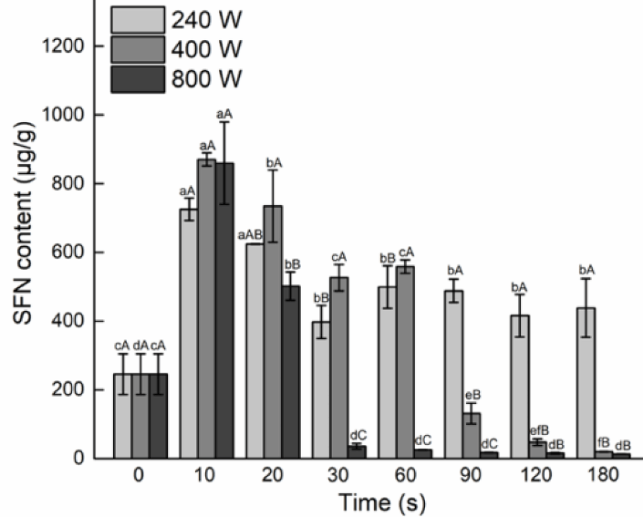
To the best of our knowledge, microwave bag cooking was evaluated for the first time to explore effects on sulforaphane (SFN) and indole-3-carbinol (I3C) content. Microwave bag cooking at 400 W for 10 s resulted in the highest SFN content (870.18 ± 19.14 μg/g), which was about 3.99 times that of untreated florets.

sfn content

Microwave bag cooking at 800 W for 10 s resulted in the highest I3C content, which was 6.16 times that of untreated florets.

i3c content

Our findings demonstrated that I3C in supplements or vegetables also degraded quickly under various processing conditions, such as thermal processing, and that DIM and LTr1 were not only produced in acidic conditions. This filled a gap in the literature regarding effects of vegetable processing, particularly thermal treatment, on content of glucobrassicin degradation products. In brief, under suitable conditions of microwave bag cooking, content of indole hydrolyzate I3C can be significantly increased, whereas content of dimerization and trimerization products did not change as significantly as I3C.

This work demonstrated that microwave bag cooking was a quick and easy cooking method that could preserve potential health benefits of broccoli florets while also satisfying the needs of modern consumers.”

https://www.sciencedirect.com/science/article/abs/pii/S0963996922014594 “Microwave bag cooking affects the quality, glucosinolates content and hydrolysate production of broccoli florets” (not freely available) Thanks to Professor Lei Zheng for providing a copy.


Can’t replicate this study’s cooking method completely. Ziploc bags are microwavable but a little different than heat-sealed bags. I also grow a broccoli / red cabbage / mustard sprout mix.

Using 25 grams of the mix and 40% power on my 1000W microwave for 10 seconds produced a sharper taste than did the method I’ve used. Scooping the mix out of a quart bag was messy.

I put the next 25 grams on a microwavable plate that snugly fit into a sealed bag. 80% power on a 1000W microwave for 10 seconds definitely tastes more cooked.

PXL_20230212_131346050

I’ll alternate between 400W and 800W for a while to see which one I prefer. It’s as quick and easy as claimed.


PXL_20230209_212821487

Ancient parasite DNA within us

Two 2023 papers on endogenous retroviruses (ERVs) and aging relationships, starting with the Introduction section of a comprehensive study:

“Several causal determinants of aging-related molecular changes have been identified, such as epigenetic alterations and stimulation of senescence-associated secretory phenotype (SASP) factors. Although the majority of these studies describe aging determinants originating primarily from protein-coding genes, the non-coding part of the genome has started to garner attention as well.

ERVs belonging to long terminal repeat (LTR) retrotransposons are a relic of ancient retroviral infection, fixed in the genome during evolution, comprising about 8% of the human genome. As a result of evolutionary pressure, most human ERVs (HERVs) accumulate mutations and deletions that prevent their replication and transposition function. However, some evolutionarily young subfamilies of HERV proviruses, such as the recently integrated HERVK, maintain open reading frames encoding proteins required for viral particle formation.

In this study, using cross-species models and multiple techniques, we revealed an uncharacterized role of endogenous retrovirus resurrection as a biomarker and driver for aging. Specifically, we identified endogenous retrovirus expression associated with cellular and tissue aging and that the accumulation of HERVK retrovirus-like particles (RVLPs) mediates the aging-promoting effects in recipient cells. More importantly, we can inhibit endogenous retrovirus-mediated pro-senescence effects to alleviate cellular senescence and tissue degeneration in vivo, suggesting possibilities for developing therapeutic strategies to treat aging-related disorders.”

https://www.cell.com/cell/fulltext/S0092-8674(22)01530-6 “Resurrection of endogenous retroviruses during aging reinforces senescence”


This first paper’s foreword summarized their many experiments and findings:

“The study found that HERVK transcripts, viral proteins, and RVLPs were highly activated in prematurely aged human mesenchymal progenitor cells (hPMCs). This was similarly observed in aged human primary fibroblasts and hPMCs. They also discovered that decreasing silencing epigenetic marks DNA methylation and H3K9me3 while increasing H3K36me3 enabled HERVK expression.

erv aging mechanism

These observations also raise several intriguing questions:

  • HERVK is occasionally activated and eventually suppressed under physiological conditions, for example, in human embryonic cells. It would be fascinating to probe the possibility of mimicking physiological conditions in order to turn off the positive feedback between HERVK and senescence.
  • ERVs are hallmarks of aging in different species, including human, primate, and mouse. Future quantification of the absolute physiological level of ERVs across a broad population of various ages might provide further insights into the relationship between ERVs and organismal age.”

https://academic.oup.com/lifemedi/advance-article/doi/10.1093/lifemedi/lnad001/6982772 “Endogenous retroviruses make aging go viral”


Previously curated papers on these subjects include:

A study of our evolutionary remnants

“Repressive epigenetic marks associated with ERVs, particularly LTRs, show a remarkable switch in silencing mechanisms, depending on evolutionary age:

  • Young LTRs tend to be CpG-rich and are mainly suppressed by DNA methylation, whereas
  • Intermediate age LTRs are associated predominantly with histone modifications, particularly histone H3 lysine 9 (H3K9) methylation.
  • Evolutionarily old LTRs are more likely inactivated by accumulation of loss-of-function genetic mutations.”

Starving awakens ancient parasite DNA within us

Reality is sometimes stranger than what fiction writers dream up. 🙂

PXL_20230209_210243470

Improve your internal environment, improve its constituents’ functions

A third update to Signaling pathways and aging:

“Sima, who was born on 28 February 2019, has lived for 47 months, surpassing the 45.5 months believed to be the oldest age recorded in scientific literature for a female Sprague-Dawley rat, the researchers say. So far, Sima has outlived her closest rival in the study by nearly six months.

‘The real point of our experiments is not so much to extend lifespan, but to extend youthspan, to rejuvenate people, to make their golden years really potentially golden years, instead of years of pain and decrepitude,’ Katcher said. ‘But the fact is, if you manage to do that, you also manage to lengthen life, and that’s not a bad side-effect.'”

https://www.theguardian.com/science/2023/feb/08/anti-ageing-scientists-extend-lifespan-of-oldest-living-lab-rat “Anti-ageing scientists extend lifespan of oldest living lab rat”


Whale funeral

PXL_20230208_211431462

Environmental signaling rescues aging muscle stem cells

This 2023 rodent study applied An environmental signaling paradigm of aging concepts to muscle stem cells:

“The stem cell niche environment represents an important therapeutic target to enhance tissue regeneration in aging. We decoupled age-related cell-intrinsic effects, niche-mediated cell-extrinsic effects, and changes in population dynamics of muscle stem cells (MuSCs) and two key muscle-resident cells in young and aged mice.

in vivo model

We showed that:

  1. Age-related reduction in MuSCs is not stochastic.
  2. Despite differences in transcriptomes of MuSC clusters, the effect of age on gene expression is largely uniform, suggesting that the niche environment has a fundamental role in age-related changes in MuSC gene expression.
  3. A significant fraction of changes in the transcriptome of aging MuSCs can be reversed by exposure to the young muscle environment, i.e. are niche-responsive. Given the high percentage [46.6% at a stringent cutoff of s-value < 0.05] of reversibility in gene expression, our findings indicate that age-related changes in the niche are principal drivers of resulting alterations in the MuSC transcriptome.
  4. Aging is correlated with changes at the level of chromatin accessibility and DNA methylation in MuSCs.

Plasticity of the MuSC transcriptome suggests that modulating the niche environment can be a powerful tool to restore stem cell-mediated endogenous muscle regeneration in aging. Consequently, as opposed to focusing solely on MuSCs themselves to mitigate effects of aging on MuSCs, bioengineering of the niche in its entirety may be a viable therapeutic option.”

https://www.nature.com/articles/s41467-023-36265-x “Transcriptional reprogramming of skeletal muscle stem cells by the niche environment”


This study destroyed extremely well-funded directed research efforts that detract from science, especially those promoting irreversibility of epigenetic changes (but: Rockefeller) and randomness of pro-aging programming (but: Harvard).

These researchers showed they could do more with their ideas and careers than maintain an outdated and easily disproved status quo.