Use it or lose it: the interplay of new brain cells, age, and activity

This 2015 German review was of aging and activity in the context of adult neurogenesis:

“Adult neurogenesis might be of profound functional significance because it occurs at a strategic bottleneck location in the hippocampus.


Age-dependent changes essentially reflect a unidirectional development in that everything builds on what has occurred before. In this sense, aging can also be seen as continued or lifelong development. This idea has limitations but is instructive with regard to adult neurogenesis, because adult neurogenesis is neuronal development under the conditions of the adult brain.

The age-related alterations of adult neurogenesis themselves have quantitative and qualitative components. So far, most research has focused on the quantitative aspects. But there can be little doubt that qualitative changes do not simply follow quantitative changes (e.g., in cell or synapse numbers), but emerge on a systems level and above when an organism ages. With respect to adult neurogenesis, only one multilevel experiment including morphology and behavior has been conducted, and, even in that study, only three time points were investigated.

In old age, adult neurogenesis occurs at only a small fraction of the level in early adulthood. The decline does not seem to be ‘regulated’ but rather the by-product of many age-related changes of other sorts.


From a behavioral level down to a synaptic level, activity increases adult neurogenesis. This regulation does not seem to occur in an all-or-nothing fashion but rather influences different stages of neuronal development differently. Both cell proliferation and survival are influenced by or even depend on activity.

The effects of exercise and environmental enrichment are additive, which indicates that increasing the potential for neurogenesis is sufficient to increase the actual use of the recruitable cells in the case of cognitive stimulation. Physical activity would not by itself provide specific hippocampus-relevant stimuli that induce net neurogenesis but be associated with a greater chance to encounter specific relevant stimuli.


Adult hippocampal neurogenesis might contribute to a structural or neural reserve that if appropriately trained early in life might provide a compensatory buffer of brain plasticity in the face of increasing neurodegeneration or nonpathological age-related functional losses. There is still only limited information on the activity-dependent parameters that help to prevent the age-dependent decrease in adult neurogenesis and maintain cellular plasticity.

The big question is what the functional contribution of so few new neurons over so long periods can be. Any comprehensive concept has to bring together the acute functional contributions of newly generated, highly plastic neurons and the more-or-less lasting changes they introduce to the network.”

I’ve quoted quite a lot, but there are more details that await your reading. A few items from the study referenced in the first paragraph above:

“The hippocampus represents a bottleneck in processing..adult hippocampal neurogenesis occurs at exactly the narrowest spot.

We have derived the theory that the function of adult hippocampal neurogenesis is to enable the brain to accommodate continued bouts of novelty..a mechanism for preparing the hippocampus for processing greater levels of complexity.”


The role of the hippocampus in emotion was ignored as it so often is. The way to address many of the gaps mentioned by the author may be to Advance science by including emotion in research.

For example, from the author’s The mystery of humans’ evolved capability for adults to grow new brain cells:

“Adult neurogenesis is already effective early in life, actually very well before true adulthood, and is at very high levels when sexual maturity has been reached. Behavioral advantages associated with adult neurogenesis must be relevant during the reproductive period.”

When human studies are designed to research how “behavioral advantages associated with adult neurogenesis must be relevant” what purpose does it serve to exclude emotional content?

http://cshperspectives.cshlp.org/content/7/11/a018929.full “Activity Dependency and Aging in the Regulation of Adult Neurogenesis”

Which communities deserve your membership?

This 2015 California/Oxford review described the interplay between an individual and their group membership from an evolutionary biology viewpoint:

“Many central questions in evolutionary biology rely on understanding how individual-level and group-level selective processes interact to shape phenotypic variation and specialisation. Individuals can aggregate into groups, and the composition of these groups, populations, or communities (herein group phenotypic composition or GPC) can affect group-level dynamics and self-organisation.

Research across a range of disparate topics will benefit from simultaneously developing an understanding of how GPC affects individual fitness [genetic fitness, not physical fitness] and exerts selection on individual phenotypes, and assessing how individual phenotypes respond to GPC.

GPC can be a function of the phenotypes of its members or an emergent property that is not attributable to any single individual, such as the mating system. GPC is also an emergent property of genotypes and their patterns of expression.

GPC can affect individual fitness by influencing the overall performance of the group on collective tasks, affecting all the members of any given group equally, or by affecting the relative performance of different phenotypes within groups. For instance, a group with more aggressive individuals can be more successful at foraging, but aggressive individuals can have a higher fitness than non-aggressive individuals because they can monopolise a larger share of the total resources.

Individuals can respond to the effect of GPC by altering the phenotypic composition of the group (for example by controlling access to the group) and/or by changing their own phenotype.”

See my Individual evolution page for more on the topic of human individuals “changing their own phenotype.”


The review provided specific examples to illustrate each point of the overall framework. The authors seldom mentioned human examples, although many of the discussion items applied. Two of their points that weren’t necessarily applicable to human groups were:

  • Benefits from reducing competition
  • Altruism wasn’t viewed as an individual trait.

The authors didn’t use human-specific examples in their framework. For example, they mentioned division of labor, which benefits both animals and humans. There was no mention of applying capital to efforts, which is thought to be specific to humans, although reuse of tools by crows and chimpanzees may be animal examples.

I’d guess that the authors didn’t refer to humans often because that may have added the human trait of unforced individual choice. Unlike other species, we have the capability to direct much of our own lives, and choose the communities to which we belong.


A few questions about our group membership decisions:

  • Do we choose group memberships based on how the group recognizes and facilitates the unique individual each of us is?
  • How do we benefit as an individual when we become default members of communities by not making choices?
  • What individual benefits may we receive by opting out of default groups?

http://www.sciencedirect.com/science/article/pii/S0169534715001846 “From Individuals to Groups and Back: The Evolutionary Implications of Group Phenotypic Composition”

The mystery of humans’ evolved capability for adults to grow new brain cells

This 2016 German review discussed the evolution of human adult neurogenesis:

“Mammalian adult hippocampal neurogenesis is a trait shaped by evolutionary forces that have contributed to the advantages in natural selection that are associated with the mammalian dentate gyrus. Adult hippocampal neurogenesis in mammals originates from an ectopic precursor cell population that resides in a defined stem-cell niche detached from the ventricular wall.

Neurogenesis in the adult olfactory bulb generates a diverse range of interneurons, and is involved in the processing of sensory input. In contrast, adult hippocampal neurogenesis produces only one type of excitatory principal neuron and plays a role in flexible memory formation.

A surplus of new neurons is generated first from which only a subset survives. And it is exactly these new neuronal nodes that, at least for a transient period, are the carriers of synaptic plasticity.

For a number of weeks after they were born, the new neurons have a lower threshold for long-term potentiation. This directs the action to the new cells and results in a bias toward the most plastic cells in the local circuitry.

It is a highly polygenic trait, and numerous genes have already been identified to ultimately have essentially identical effects on net neurogenesis.

Adult neurogenesis is also an individualizing trait. Even before an identical genetic background, subtle individual differences in starting conditions and differential behavioral trajectories result in an increase in phenotypic variation with time.”

The author continued the penultimate paragraph above to pose a question about adult neurogenesis that’s incompletely answered by evolutionary biology theory and evidence todate:

“How genetic variation in single genes (or many genes) would be able to exert a phenotypic change in neurogenesis that can provide a large enough advantage to be selected for.”


The development of new brain cells throughout our lives helps us continually adapt and learn. The “increase in phenotypic variation with time” helps us maintain the unique individual that each of us is.

The review emphasized to me how “individual differences” should neither be viewed as a mystery, nor explained away, nor treated as an etiological factor as researchers often do. Focusing on what caused the differences may provide clearer information.

http://cshperspectives.cshlp.org/content/8/2/a018986.full “Adult Neurogenesis: An Evolutionary Perspective”

A problematic study of oxytocin receptor gene methylation, childhood abuse, and psychiatric symptoms

This 2016 Georgia human study found:

“A role for OXTR [oxytocin receptor gene] in understanding the influence of early environments on adult psychiatric symptoms.

Data on 18 OXTR CpG sites, 44 single nucleotide polymorphisms, childhood abuse, and adult depression and anxiety symptoms were assessed in 393 African American adults. The Childhood Trauma Questionnaire (CTQ), a retrospective self-report inventory, was used to assess physical, sexual, and emotional abuse during childhood.

While OXTR CpG methylation did not serve as a mediator to psychiatric symptoms, we did find that it served as a moderator for abuse and psychiatric symptoms.”

From the Limitations section:

  1. “Additional insight will likely be gained by including a more detailed assessment of abuse timing and type on the development of biological changes and adverse outcomes.
  2. The degree to which methylation remains fixed following sensitive developmental time periods, or continues to change in response to the environment, is still a topic of debate and is not fully known.
  3. Comparability between previous findings and our study is limited given different areas covered.
  4. Our study was limited to utilizing peripheral tissue [blood]. OXTR methylation should ideally be assessed in the tissues that are known to express OXTR and directly involved in psychiatric symptoms. The degree to which methylation of peripheral tissues can be used to study methylation changes in response to the environment or in association with behavioral outcomes is currently a topic of debate.
  5. Our study did not evaluate gene expression and thus cannot explore the role of study CpG sites on regulation and expression.”

Addressing the study’s limitations:

  1. Early-life epigenetic regulation of the oxytocin receptor gene demonstrated – with no hint of abuse – how sensitive an infant’s experience-dependent oxytocin receptor gene DNA methylation was to maternal care. Treating prenatal stress-related disorders with an oxytocin receptor agonist provided evidence for prenatal oxytocin receptor gene epigenetic changes.
  2. No human’s answers to the CTQ, Adverse Childhood Experiences, or other questionnaires will ever be accurate self-reports of their prenatal, infancy, and early childhood experiences. These early development periods were likely when the majority of the subjects’ oxytocin receptor gene DNA methylation took place. The CTQ self-reports were – at best – evidence of experiences at later times and places, distinct from earlier experience-dependent epigenetic changes.
  3. As one example of incomparability, the 2009 Genomic and epigenetic evidence for oxytocin receptor deficiency in autism was cited in the Introduction section and again in the Limitations section item 4. Since that study was sufficiently relevant to be used as a reference twice, the researchers needed to provide a map between its findings and the current study.
  4. Early-life epigenetic regulation of the oxytocin receptor gene answered the question of whether or not an individual’s blood could be used to make inferences about their brain oxytocin receptor gene DNA methylation. The evidence said: NO, it couldn’t.
  5. It’s assumed that oxytocin receptor gene DNA methylation directly impacted gene expression such that increased levels of methylation were associated with decreased gene transcription. The study assumed but didn’t provide evidence that higher levels of methylation indicated decreased ability to use available oxytocin due to decreased receptor expression. The study also had no control group.

To summarize the study’s limitations:

  1. The study zeroed in on childhood abuse, and disregarded evidence for more relevant factors determining an individual’s experience-dependent oxytocin receptor gene DNA methylation. That smelled like an agenda.
  2. The study used CTQ answers as determinants, although what happened during the subjects’ earliest life was likely when the majority of epigenetic changes to the oxytocin receptor gene took place. If links existed between the subjects’ early-life DNA methylation and later-life conditions, they weren’t evidenced by CTQ answers about later life that couldn’t self-report relevant experiences from conception through age three that may have caused DNA methylation.
  3. There was no attempt to make findings comparable with cited studies. That practice and the lack of a control group reminded me of Problematic research with telomere length.
  4. The researchers tortured numbers until they confessed “that CpG methylation may interact with abuse to predict psychiatric symptoms.” But there was no direct evidence that each subject’s blood oxytocin gene receptor DNA methylation interacted as such! Did the “may interact” phrase make the unevidenced inferences more plausible, or permit contrary evidence to be disregarded?
  5. See Testing the null hypothesis of oxytocin’s effects in humans for examples of what happens when researchers compound assumptions and unevidenced inferences.

The study’s institution, Emory University, and one of the study’s authors also conducted Conclusions without evidence regarding emotional memories. That 2015 study similarly disregarded relevant evidence from other research, and made statements that weren’t supported by that study’s evidence.

The current study used “a topic of debate” and other disclaimers to provide cover for unconvincing methods and analyses in pursuit of..what? What overriding goals were achieved? Who did the study really help?

http://onlinelibrary.wiley.com/enhanced/doi/10.1111/cdev.12493/ “Oxytocin Receptor Genetic and Epigenetic Variations: Association With Child Abuse and Adult Psychiatric Symptoms”


This post has somehow become a target for spammers, and I’ve disabled comments. Readers can comment on other posts and indicate that they want their comment to apply here, and I’ll re-enable comments.

Early-life epigenetic regulation of the oxytocin receptor gene

This 2015 US/Canadian rodent study investigated the effects of natural variation in maternal care:

“The effects of early life rearing experience via natural variation in maternal licking and grooming during the first week of life on behavior, physiology, gene expression, and epigenetic regulation of Oxtr [oxytocin receptor gene] across blood and brain tissues (mononucleocytes, hippocampus, striatum, and hypothalamus).

Rats reared by high licking-grooming (HL) and low licking-grooming (LL) rat dams exhibited differences across study outcomes:

  • LL offspring were more active in behavioral arenas,
  • Exhibited lower body mass in adulthood, and
  • Showed reduced corticosterone responsivity to a stressor.

Oxtr DNA methylation was significantly lower at multiple CpGs in the blood of LL versus HL males, but no differences were found in the brain. Across groups, Oxtr transcript levels in the hypothalamus were associated with reduced corticosterone secretion in response to stress, congruent with the role of oxytocin signaling in this region.

Methylation of specific CpGs at a high or low level was consistent across tissues, especially within the brain. However, individual variation in DNA methylation relative to these global patterns was not consistent across tissues.

These results suggest that:

  • Blood Oxtr DNA methylation may reflect early experience of maternal care, and
  • Oxtr methylation across tissues is highly concordant for specific CpGs, but
  • Inferences across tissues are not supported for individual variation in Oxtr methylation.

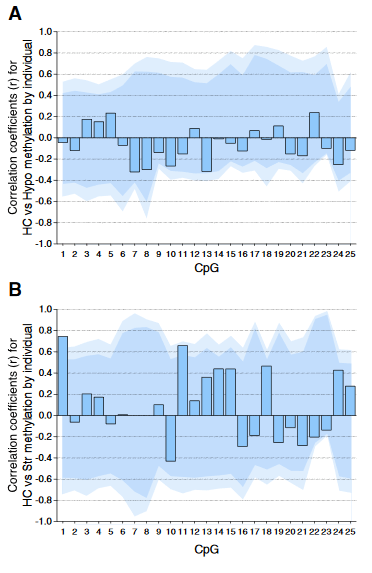
nonsignificance

Individual DNA methylation values were not correlated across brain tissues, despite tissue concordance at the group level.

For each CpG, we computed the Pearson correlation coefficient r between methylation values for matched samples in pairs of brain regions (bars). Dark and light shaded regions represent 95% and 99% thresholds, respectively, of distributions of possible correlation coefficients determined from 10,000 permutations of the measured values among the individuals. These distributions represent the null hypothesis that an individual DNA methylation value in one brain region does not help to predict the value in another region in the same animal.

(A) Correlations based on pyrosequencing data for matched samples passing validation in both hippocampus (HC) and hypothalamus (Hypo). Correlations for individuals at each CpG were either weak (.2 < r < .3) or absent (r < .2), and none were significant, even prior to correction for multiple comparisons.

(B) Correlations for matched samples passing validation in both hippocampus and striatum (Str). Two correlations (CpG 1 and 11) were individually significant prior to but not following correction, and this result could be expected by chance.

Correlations between hippocampus and blood (described in the text) yielded similar results, and no particular CpG yielded consistently high correlation across multiple tissues.”


The study focused on whether or not an individual’s experience-dependent oxytocin receptor gene DNA methylation in one of the four studied tissues could be used to infer a significant effect in the three other tissues. The main finding was NO, it couldn’t!

The researchers’ other findings may have been strengthened had they also examined causes for the observed effects. The “natural variation in maternal licking and grooming” developed from somewhere, didn’t it?

The subjects’ mothers were presumably available for the same tests as the subjects, but nothing was done with them. Investigating at least one earlier generation may have enabled etiologic associations of “the effects of early life rearing experience” and “individual variation in DNA methylation.”

https://www.sciencedirect.com/science/article/abs/pii/S0018506X1500118X “Natural variation in maternal care and cross-tissue patterns of oxytocin receptor gene methylation in rats” (not freely available)

The effects of imposing helplessness

This 2016 New York rodent study found:

“By using unbiased and whole-brain imaging techniques, we uncover a number of cortical and subcortical brain structures that have lower activity in the animals showing helplessness than in those showing resilience following the LH [learned helplessness] procedure. We also identified the LC [locus coeruleus] as the sole subcortical area that had enhanced activity in helpless animals compared with resilient ones.

Some of the brain areas identified in this study – such as areas in the mPFC [medial prefrontal cortex], hippocampus, and amygdala – have been previously implicated in clinical depression or depression-like behavior in animal models. We also identified novel brain regions previously not associated with helplessness. For example, the OT [olfactory tubercle], an area involved in odor processing as well as high cognitive functions including reward processing, and the Edinger–Westphal nucleus containing centrally projecting neurons implicated in stress adaptation.

The brains of helpless animals are locked in a highly stereotypic pathological state.”

Concerning the study’s young adult male subjects:

“To achieve a subsequent detection of neuronal activity related to distinct behavioral responses, we used the c-fosGFP transgenic mice expressing c-FosGFP under the control of a c-fos promoter. The expression of the c-fosGFP transgene has been previously validated to faithfully represent endogenous c-fos expression.

Similar to wild-type mice, approximately 22% (32 of 144) of the c-fosGFP mice showed helplessness.”

The final sentence of the Introduction section:

“Our study..supports the view that defining neuronal circuits underlying stress-induced depression-like behavior in animal models can help identify new targets for the treatment of depression.”


Helplessness is both a learned behavior and a cumulative set of experiences during every human’s early life. Therapeutic approaches to detrimental effects of helplessness can be different with humans than with rodents in that we can address causes.

The researchers categorized activity in brain circuits as causal in the Discussion section:

“Future studies aimed at manipulating these identified neural changes are required for determining whether they are causally related to the expression of helplessness or resilience.”

Studying whether or not activity in brain circuits induces helplessness in rodents may not inform us about causes of helplessness in humans. Our experiences are often the ultimate causes of helplessness effects. Many of our experiential “neural changes” are only effects, as demonstrated by this and other studies’ induced phenotypes such as “Learned Helplessness” and “Prenatally Restraint Stressed.”

Weren’t the researchers satisfied that the study confirmed what was known and made new findings? Why attempt to extend animal models that only treat effects to humans, as implied in the Introduction above and in the final sentence of the Discussion section:

“Future studies aimed at elucidating the specific roles of these regions in the pathophysiology of depression as well as serve as neural circuit-based targets for the development of novel therapeutics.”

http://journal.frontiersin.org/article/10.3389/fncir.2016.00003/full “Whole-Brain Mapping of Neuronal Activity in the Learned Helplessness Model of Depression” (Thanks to A Paper a Day Keeps the Scientist Okay)

Chronic pain causes epigenetic changes in the brain and immune system

This 2015 Canadian rodent study by McGill researchers found:

“The critical involvement of DNA methylation in chronic pain. We show that in the PFC [prefrontal cortex], a brain region strongly implicated in chronic pain, a stunning number of promoters [control gene expression] are differentially methylated 9 months after injury. These changes are distant both in time and space from the original injury.

The changes in DNA methylation are highly organized in functional pathways that have been implicated in pain such as dysregulation of dopaminergic, glutamatergic, opioid and serotoninergic systems and important signaling and inflammatory pathways.

Genome-wide DNA methylation modifications of T cells [circulating white blood cells that control immune response] are also associated with nerve injury.

Most of the promoters (72%) identified as differentially methylated in T cells after nerve injury were also affected in the brain. While the methylation profiles in some of these modules were affected in the same direction in the brain and the T cells, others went in opposite direction. This is consistent with the idea that the brain and the immune system play different roles in chronic pain.

These data suggest that:

  • Persistent pain is associated with broad and highly organized organism-wide changes in DNA methylation, including two critical biological systems: the central nervous and immune systems.
  • This work also provides a possible mechanistic explanation for commonly observed comorbidities observed in chronic pain (i.e anxiety, depression).
  • Finally, the sheer magnitude of the impact of chronic pain, particularly in the prefrontal cortex, illustrates the profound impact that living with chronic pain exerts on an individual.”

http://www.nature.com/articles/srep19615 “Overlapping signatures of chronic pain in the DNA methylation landscape of prefrontal cortex and peripheral T cells”


The news coverage focused on how the study’s findings may lead to non-invasive DNA methylation measurements of chronic pain as well as treatments of the effects. I’d argue that the researchers’ concluding statement of the Discussion section deserved the most focus:

“Beyond the example of chronic pain, the robust and highly organized DNA methylation changes seen here in response to nerve injury provides some of the strongest evidence to date that experience effects DNA methylation landscapes at large distances in time and space.”

The study provided “some of the strongest evidence to date” that experiences caused widespread, long-lasting epigenetic changes. Given experiences’ etiologic functions, research with working hypotheses that experiences may also reverse epigenetic changes should be green-lighted.

“DNA methylation landscapes at large distances in time and space” warrant systematic examination of how experiential epigenetic changes during early life may be reversed by experiential therapies later in life. In the current year, there’s sufficient evidence for modifying research goals to primarily address causes, not just effects.

Epigenetics research that was designed to fall one step short of wonderful

This 2015 Edinburgh rodent study found:

“In utero exposure of rats to the analgesics indomethacin or acetaminophen, both of which target PG [prostaglandin] pathways, alters fetal germ cell number and development in both male and female fetuses. This results in modest but detrimental effects on F1 [children] female, but not F1 male, fertility in adulthood.

Fetal (F1) exposure of rats to either analgesic resulted in an effect in the second generation (F2 grand-daughters) that manifested as reduced ovarian size and markedly reduced follicle number in females but with evidence of increased follicle activation. The impact on F2 fertility (which was not studied) is unclear.

Our analgesic exposure regimen coincided with the period of chromatin/epigenetic remodelling of the (F1) fetal germ cells in both sexes, events which also occur in the human in the first trimester of pregnancy. The analgesic effects on F2 ovaries were transmitted via both paternal and maternal F1 lines.”

The limitations section showed that the rodents’ acetaminophen dosage was equivalent to a human overdose:

“We administered only a single dose of analgesics. The dose of acetaminophen which we used, resulted in blood levels of acetaminophen 2.5- to 8-fold higher than the levels reported in humans after normal therapeutic dosing (~60 mg/kg/day, divided into 4 doses) during pregnancy.”


I’m puzzled that the researchers didn’t take one more step, and design a great study. They knew what the additional effort would be, per statements such as:

“The impact on F2 fertility (which was not studied) is unclear.

The analgesic-induced reduction in fetal ovarian germ cell number was of particular concern, as the lifetime complement of oocytes is formed in utero at/around the time of birth in women and rodents.”

F3 great-grandchildren were needed to demonstrate “the impact on F2 fertility.” Testing of F3 great-grandchildren may have also provided evidence for or against transgenerational epigenetic inheritance, because those subjects’ cells would have had no direct exposure effects from analgesics.

Weren’t the researchers at the MRC Centre for Reproductive Health, The Queen’s Medical Research Institute University of Edinburgh, interested in understanding whether or not a pregnant woman who overdosed during her fetus’ early development on an analgesic available to billions of people, could potentially adversely affect not only her (F0) and her children’s (F1) and grandchildren’s (F2) reproductive health, but also her F3 great-grandchildren?

Weren’t the researchers interested in being a part of a great study, one that may have advanced science, one that may have shown whether or not epigenetic information was transmitted between generations in the absence of continued analgesic exposure?

http://www.nature.com/articles/srep19789 “Analgesic exposure in pregnant rats affects fetal germ cell development with inter-generational reproductive consequences”

Epigenetic memories of stress as therapeutic targets

This 2015 Swedish rodent study found:

Histone modifications induced by glucose are associated with activation of TXNIP gene [a proinflammatory gene involved in diabetic kidney disease] transcription.

Glucose-stimulated TXNIP gene expression can be

  • reversed by inhibition of histone acetyltransferase (HAT), or
  • enhanced by inhibition of histone deacetylase (HDAC).”

A 2016 Japanese commentary expounded on the study:

“Epigenetic changes accumulate as cell memory, and this epigenetic memory plays a crucial role in the long-term consequences of adult-onset diseases and aging.

The first stimulus, which might be high glucose levels or hypoxia, changes the condition of histone modification or chromosomal conformations. The changes are then memorized as epigenetic memory in the cells, which could help to maintain epigenetic status in response to the first stimulus.

Consequently, when a second stimulus occurs, cells with epigenetic memory respond to the stimulus promptly by the upregulation of downstream genes through binding transcriptional factors. The cells without epigenetic memory take longer to upregulate the expression of downstream target genes.

High glucose levels that are sustained for long periods appear to change histone modification, resulting in the prompt response of TXNIP gene upregulation. Considering that TXNIP is an important proinflammatory gene, this prompt response increases the likelihood of diabetic complications. TXNIP is reported to be augmented by high glucose levels and to promote oxidative stress.”

The study and commentary provided specific examples of the wide-ranging forms of physiological memory induced by stress.

http://www.sciencedirect.com/science/article/pii/S0085253815000927 “Epigenetic regulation of the thioredoxin-interacting protein (TXNIP) gene by hyperglycemia in kidney”

Lifelong effects of stress

A 2016 commentary A trilogy of glucocorticoid receptor actions that included two 2015 French rodent studies started out:

Glucocorticoids (GCs) belong to a class of endogenous, stress-stimulated steroid hormones. They have wide ranging physiologic effects capable of impacting metabolism, immunity, development, stress, cognition, and arousal.

GCs exert their cellular effects by binding to the GC receptor (GR), one of a 48-member (in humans) nuclear receptor superfamily of ligand-activated transcription factors.”

The French studies were exceedingly technical. The first GR SUMOylation and formation of an SUMO-SMRT/NCoR1-HDAC3 repressing complex is mandatory for GC-induced IR nGRE-mediated transrepression:

“GCs acting through binding to the GR are peripheral effectors of circadian and stress-related homeostatic functions fundamental for survival.

Unveils, at the molecular level, the mechanisms that underlie the GC-induced GR direct transrepression function mediated by the evolutionary conserved inverted repeated negative response element. This knowledge paves the way to the elucidation of the functions of the GR at the submolecular levels and to the future educated design and screening of drugs, which could be devoid of undesirable debilitating effects on prolonged GC therapy.”

The companion study Glucocorticoid-induced tethered transrepression requires SUMOylation of GR and formation of a SUMO-SMRT/NCoR1-HDAC3 repressing complex stated:

“GCs have been widely used to combat inflammatory and allergic disorders. However, multiple severe undesirable side effects associated with long-term GC treatments, as well as induction of glucocorticoid resistance associated with such treatments, limit their therapeutic usefulness.”

Even when researchers study causes, they often justify their efforts in terms of outcomes that address effects. Is an etiologic advancement in science somehow unsatisfactory in and of itself?


Once in a while I get a series of personal revelations while reading scientific publications. Paradoxically, understanding aspects of myself has seldom been sufficient to address historical problems.

Thoughts are only where some of the effects of problems show up, and clarifying my understanding can – at most – tamp down these effects. The causes are elsewhere, and addressing them at the source is what ultimately needs to happen.

A few glucocorticoid-related items to ponder:

  • How has stress impacted my life? When and where did it start?
  • Why do I feel wonderful after taking prednisone or other anti-inflammatories? What may be the originating causes of such effects?
  • Why have prolonged periods of my life been characterized by muted responses to stress? How did I get that way?
  • Have I really understood why I’ve reflexively put myself into stressful situations? What will break me out of that habit?
  • Why do the feelings I experience while under stressful situations feel familiar? Does my unconsciousness of their origins have something to do with “homeostatic functions fundamental for survival?”
  • Why haven’t I noticed that symptoms of stress keep showing up in my life? There are “physiologic effects capable of impacting metabolism, immunity,” etc. but I don’t do something about it?
  • How else may stress impact my biology? Brain functioning? Ideas and beliefs? Behavior?

The purpose of many epigenetic processes is to control virus-like material

This 2016 Swiss human review’s subject was:

“Transposable elements (TEs) may account for up to two-thirds of the human genome, and as genomic threats they are subjected to epigenetic control mechanisms engaged from the earliest stages of embryonic development.

TEs are present in all organisms from bacteria to humans, and they constitute essential motors of evolution. TEs are phylogenetically and biologically related to viruses.

TEs can disrupt genes, provide novel coding activities, exert a wide range of transcriptional influences, and, because of their repetitive nature, create grounds for recombination events leading to genomic deletions and duplications, yet only a very small minority of TEs present in the human genome are still transposition-competent, accounting for one new germline integrant in 20 to 50 human births, and none is capable of horizontal transfer.

A vast majority of these DNA-binding proteins, including many of those expressed in human differentiated cells, primarily recognize sequences contained within TEs..controlling the transcriptional potential of their TE targets well beyond the early embryonic period..modulating the transcriptional impact of TE-residing sequences that are co-opted to regulate the expression of cellular genes.

A large fraction of the recognizable mobile elements in our genome are unique to humans or close relatives. The impact of this phenomenon on speciation might be particularly pronounced in organs subjected to environmental constraints that are not overly coercive, such as the brain..the central nervous system.”

The author presented evidence that the purpose of many ongoing epigenetic processes is to silence or otherwise “tame” TEs “to regulate the expression of cellular genes.” The author contrasted his view with the view that:

“Beyond this early embryonic period, TEs become permanently silenced, and that the evolutionary selection of TE controllers is the result of a simple evolutionary arms race between the host and these genetics invaders.”

http://symposium.cshlp.org/content/early/2016/01/13/sqb.2015.80.027573.long “Transposable Elements, Polydactyl Proteins, and the Genesis of Human-Specific Transcription Networks”

Treating prenatal stress-related disorders with an oxytocin receptor agonist

This 2015 French/Italian rodent study found:

“Chronic systemic treatment with carbetocin [unavailable in the US] in PRS [prenatally restraint stressed] rats corrected:

  • the defect in glutamate release,
  • anxiety– and depressive-like behavior,

and abnormalities:

  • in social behavior,
  • in the HPA response to stress, and
  • in the expression of stress-related genes in the hippocampus and amygdala.

These findings disclose a novel function of oxytocin receptors in the hippocampus, and encourage the use of oxytocin receptor agonists in the treatment of stress-related psychiatric disorders in adult life.”

carbetocin

The adult male subjects were:

“PRS rats..the offspring of dams exposed to repeated episodes of restraint stress during pregnancy.

These rats display anxiety- and depressive-like behaviors and show an excessive glucocorticoid response to acute stress, which is indicative of a dysregulation of the hypothalamus-pituitary-adrenal (HPA) axis caused by an impaired hippocampal glucocorticoid negative feedback.

PRS rats show a selective reduction in glutamate release in the ventral hippocampus.”

The researchers cited several other studies they have performed with the PRS phenotype. In the current study:

“Carbetocin treatment had no effect on these behavioral and neuroendocrine parameters in prenatally unstressed (control) rats, with the exception of a reduced expression of the oxytocin receptor gene in the amygdala.

Carbetocin displayed a robust therapeutic activity in PRS rats, but had no effect in unstressed rats, therefore discriminating between physiological and pathological conditions.”


The PRS phenotype showed the ease with which a child can be epigenetically changed – even before they’re born – to be less capable over their entire life. Just stress the pregnant mother-to-be.

https://www.sciencedirect.com/science/article/abs/pii/S0306453015002395 “Activation of presynaptic oxytocin receptors enhances glutamate release in the ventral hippocampus of prenatally restraint stressed rats” (not freely available) Thanks to coauthor Dr. Eleonora Gatta for providing the full study.

What was not, is not, and will never be

Neuroskeptic’s blog post Genetic Testing for Autism as an Existential Question related the story of “A Sister, a Father and a Son: Autism, Genetic Testing, and Impossible Decisions.”

“I decided to put the question to my sister, Maria. Although she is autistic, she is of high intelligence.

Maria was excited to be an aunt soon, and was willing to do what she could to help my baby – even if what she was helping with was to avoid her own condition.

She is high enough functioning to know some of what she’s missing in life, and has longed her entire life to be “normal.” If she could save her niece or nephew some of the pain and awkwardness her condition had caused her, she was willing to help.”

In the concluding paragraph:

“What struck me about this story is the way in which the prospect of the genetic test confronted Maria with a very personal decision: will you do something that might help prevent someone else becoming like you?

Isn’t this very close to the ultimate existential question: all things considered, would you wish to live your life over again?”


Aren’t the majority of humans also “high enough functioning to know some of what she’s missing in life?”

Aren’t our feelings of what we’re missing one of the impetuses for us to have also “longed her entire life to be normal?”

This feeling was aired in Dr. Arthur Janov’s blog post What a Waste:

“What it was, was the feeling of great loss, something missing that could never again be duplicated.

It was no love where it could have been the opposite if the parent’s gates could have been open. But it could not be because that would have meant terrible pain and suffering for them; and their whole neurologic system militated against any conscious-awareness.”


We long for what was and is impossible:

  • For many of us, the impossibilities of having normal lives started with prenatal epigenetic changes.
  • Our experiences of our postnatal environment prompted us into adapting to its people, places, and contents. These neurological, biological, and behavioral adaptations were sometimes long-lasting deviations from developmental norms.
  • Other genetic factors combined with the above to largely make us who we were and are.

Our longing for an impossible-to-reconstruct life doesn’t go away.

We often may not be aware of our longing for what “could not be” and of its extensive impacts. Such feelings impel us into many hundreds of ideas, hundreds of beliefs, and hundreds of behaviors, a sample of which were referred to above:

  • Behaviors to “do something that might help prevent someone else becoming like you;”
  • Ideas such as existential philosophy; and
  • Beliefs that manifest the “wish to live your life over again.”

Spending our time on these ideas, beliefs, and behaviors won’t ameliorate their motivating causes. Our efforts distance us from our truths, with real consequences: a wasted life.

What keeps us from understanding our reality? I invite readers to investigate Dr. Arthur Janov’s Primal Therapy for effective therapeutic approaches.

Stress consequences on gut bacteria, behavior, immune system, and neurologic function

This 2015 Canadian rodent study found:

“Chronic social defeat induced behavioral changes that were associated with reduced richness and diversity of the gut microbial community.

The degree of deficits in social, but not exploratory behavior, was correlated with group differences between the microbial community profile.

Defeated mice also exhibited reduced abundance of pathways involved in biosynthesis and metabolism of tyrosine and tryptophan: molecules that serve as precursors for synthesis of dopamine, norepinephrine, serotonin, and melatonin, respectively.

This study indicates that stress-induced disruptions in neurologic function are associated with altered immunoregulatory responses.”

These researchers had an extensive Discussion section where they placed study findings in contexts with other rodent and human studies. For example:

“Our analyses also predicted reduced frequency of fatty acid biosynthesis and metabolism pathways, including that of propanoate and butanoate – byproducts of dietary carbohydrate fermentation by intestinal microorganisms.

Butyrate is a potent histone deacetylase (HDAC) inhibitor that exerts antidepressant-like effects by increasing histone acetylation in the frontal cortex and hippocampus, and consequentially, raising BDNF transcript levels.

Although it was previously unclear whether systemic levels of these metabolites achieved in vivo were sufficient to produce behavioral changes, progress has been made by discovering their presence in cerebrospinal fluid and the brain, and demonstrating that colon-derived SCFAs [short chain fatty acids] cross the blood–brain barrier and preferentially accumulate in the hypothalamus, where they can affect CNS activity.”

http://www.psyneuen-journal.com/article/S0306-4530%2815%2900934-8/fulltext “Structural & functional consequences of chronic psychosocial stress on the microbiome & host”

A problematic study of testosterone’s influence on behavior and brain measurements

This 2015 US/Canadian human study of people ages 6 to 22 years found:

“Testosterone-specific associations between amygdala volume and key prefrontal areas involved in emotional regulation and impulse control:

  1. Testosterone-specific modulation of the covariance between the amygdala and medial prefrontal cortex (mPFC);
  2. A significant relationship between amygdala-mPFC covariance and levels of aggression; and
  3. Mediation effects of amygdala-mPFC covariance on the relationship between testosterone and aggression.

These effects were independent of sex, age, pubertal stage, estradiol levels and anxious-depressed symptoms.

For the great majority of individuals in this sample, higher thickness of the mPFC was associated with lower aggression levels at a given amygdala volume. This effect diminished greatly and disappeared at more extreme amygdala values.”

The study provided noncausal associations among the effects (behavioral, hormonal, and brain measurements).


From the Limitations section:

“No umbilical cord or amniotic measurements were available in this study and we therefore cannot control for testosterone levels in utero, a period during which significant testosterone-related changes in brain structure are thought to occur.”

There’s evidence that too much testosterone for a female fetus and too little testosterone for a male fetus both have lifelong adverse effects. The researchers dismissed this etiologic line of inquiry with a “supporting the notion” referral to noncausal studies.


The researchers were keen to establish:

“A very specific, aggression-related structural brain phenotype.”

This putative phenotype hinged on:

  • Older subjects’ behavioral self-reports, and
  • Parental assessments of younger subjects’ behavior

exhibited during the previous six months, and within six months of their fMRI scan.

These self-reports and interested-party observations were the entire bases for the “aggressive behavior” and “anxious–depressed” associations! The researchers disingenuously provided multiple references and models for the reliability of these assessments.


Experimental behavioral measurements – such as those done to measure performance in decision studies – may have been more accurate and informative than what the older subjects chose to self-report about their own behavior over the previous six months.

People of all ages have an imperative to NOT be completely honest about their own behavior. One motivation for this condition is that some of our historical realities are too painful to enter our conscious awareness and inform us about our own behavior. As a result, our feelings, thoughts, and behavior are sometimes driven by our histories without us being aware of it.

For example, would a teenager/young adult subject self-report an impulsive act, even if they didn’t fully understand why they acted that way? Maybe they would if the act could be viewed as prosocial, but what if it was antisocial?

What are the chances that the lives of these teenager/young adult subjects were NOT filled with impulsive actions during the six months before their fMRI scans? Could complete and accurate self-reports of such behaviors be expected?

Experimental behavioral measurements may have also been more accurate and informative than second-hand, interested-party observations of the younger subjects. Could a parent who provided half of the genes and who was responsible for many of their child’s epigenetic changes make anything other than subjective observations of their handiwork’s behavior?


Epigenetic studies have shown that adaptations to environments are among the long-lasting causes for effects that include behavior, hormones, and brain measurements. Why, in 2015, did researchers spend public funds developing what they knew or should have known would be noncausal associations, while not investigating possible causes for these effects?

Why weren’t the researchers interested enough to gather and assess etiologic genetic and epigenetic evidence? Was it that difficult to get blood samples at the same time the subjects gave saliva samples, and perform selected genetic and DNA methylation analyses?

What did the study contribute towards advancing science? Who did the study really help?

My judgment: less than nothing; and nobody. The researchers only wasted public funds advancing a meme, giving it an imprimatur of science.

http://www.psyneuen-journal.com/article/S0306-4530%2815%2900924-5/fulltext “A testosterone-related structural brain phenotype predicts aggressive behavior from childhood to adulthood”