Epigenetic effects of diet, and reversing DNA methylation

This 2015 French review focused on:

“The role of maternal health and nutrition in the initiation and progression of metabolic and other disorders.

The effects of various in utero exposures and maternal nutritional status may have different effects on the epigenome. However, critical windows of exposure that seem to exist during development need to be better defined.

The epigenome can be considered as an interface between the genome and the environment that is central to the generation of phenotypes and their stability throughout the life course.”

The reviewer used the term “transgenerational” to refer to effects that were more appropriately termed parental or intergenerational. Per the definition in A review of epigenetic transgenerational inheritance of reproductive disease, for the term to apply there needed to be evidence in at least the next 2 male and/or 3 female generations of:

“Altered epigenetic information between generations in the absence of continued environmental exposure.”

The review had separate sections for animal and human studies.

http://www.ncbi.nlm.nih.gov/pmc/articles/PMC4663595/ “Impact of Maternal Diet on the Epigenome during In Utero Life and the Developmental Programming of Diseases in Childhood and Adulthood”


I arrived at the above review as a result of it citing the 2014 Harvard Reversing DNA Methylation: Mechanisms, Genomics, and Biological Functions. I’ll quote a few items from that review’s informative “Role of DNA demethylation in neural development” section:

“Distinct parts of mammalian brains, including frontal cortex, hippocampus, and cerebellum, all exhibit age-dependent acquisition of 5hmC [an oxidized derivative of 5mC [methylation of the fifth position of cytosine]].

In fact, the genome of mature neurons in adult central nervous system contains the highest level of 5hmC of any mammalian cell-type (~40% as abundant as 5mC in Purkinje neurons in cerebellum). These observations indicate that 5mC oxidation and potentially DNA demethylation may be functionally important for neuronal differentiation and maturation processes.

A comprehensive base-resolution analyses of 5mC and 5hmC in mammalian frontal cortex in both fetal and adult stages indicate that non-CpG methylation (mCH) and CpG hydroxymethylation (hCG) drastically build up in cortical neurons after birth, coinciding with the peak of synaptogenesis and synaptic pruning in the cortex. This study demonstrated that mCH could become a dominant form of cytosine modifications in adult brains, accounting for 53% in adult human cortical neuronal genome.

In mature neurons, intragenic mCH is preferentially enriched at inactive non-neuronal lineage-specific genes, indicating a role in negative regulation of the associated transcripts. By contrast, genic hCG is positively correlated with gene expression levels.”

The link between scientific value and content is broken at PNAS.org

Should we expect content posted on the Proceedings of the National Academy of Sciences of the United States of America to have scientific value?

This 2016 Singapore study was a “PNAS Direct Submission” that claimed:

“This paper makes a singular contribution to understanding the association between biological aging indexed by leukocyte telomeres length (LTL) and delay discounting measured in an incentivized behavioral economic task.

LTL is an emerging marker of aging at the cellular level, but little is known regarding its link with poor decision making that often entails being overly impatient.”


1. Whether measured at the level of a human or of a blood cell, in 2016 there wasn’t incontrovertible evidence to support:

  • “Biological aging indexed by leukocyte telomeres length
  • LTL is an emerging marker of aging at the cellular level”

Using an epigenetic clock to distinguish cellular aging from senescence found:

“Cellular ageing is distinct from cellular senescence and independent of DNA damage response and telomere length.”

If that study was too recent, the researchers and reviewer knew or should have known of studies such as this 2009 study that found the correlation between a person’s chronological age and blood cell telomere length was r = −0.51 in women and r = −0.55 in men.

2. A study of biological aging in young adults with limited findings was cited for evidence that “the seeds of biological aging are widely thought to be planted early in life.” That study didn’t elucidate the point, however, as it didn’t fully link its measurements of 38-year-old subjects with measurements taken during the subjects’ early lives.

F2.large

3. Problematic research with telomere length was cited for evidence that “other factors, such as the early family environment, lifestyle, and stress, also have considerable impact on cellular aging.” The researchers had to be willing to overlook that study’s multiple questionable practices in order to cite it as evidence for anything.

4. Deliberately overlooking abundant disconfirming evidence, the current study used a one-to-one correspondence of telomere length and cellular aging.


The researchers went on to speciously model a relationship between telomere length and the behavioral trait “poor decision making that often entails being overly impatient.” That overreach was further stretched to the breaking point:

“We then asked if genes possibly modulate the effect of impatient behavior on LTL.

The oxytocin receptor gene (OXTR) polymorphism rs53576, which has figured prominently in investigations of social cognition and psychological resources, and the estrogen receptor β gene (ESR2) polymorphism rs2978381, one of two gonadal sex hormone genes, significantly mitigate the negative effect of impatience on cellular aging in females.”

The “significantly mitigate” finding was “fun with numbers” that produced false effects rather than solid evidence. Consider that:

  1. The study’s model disregarded the probability that “Cellular ageing is independent of telomere length.”
  2. The researchers provided no mechanisms that plausibly linked performance “in an incentivized behavioral economic task” with telomere length.
  3. The researchers didn’t demonstrate any causal mechanisms whereby two gene variants plausibly affected the task performance’s purported effect on telomere length.

What’s the real reason this poor-quality paper’s reviewer forwarded it to PNAS.org?

http://www.pnas.org/content/113/10/2780.full “Delay discounting, genetic sensitivity, and leukocyte telomere length”

What’s the underlying question for every brain study to answer?

Is the underlying question for every brain study to answer:

  • How do our brains internally represent the external world?

Is it:

  • How did we learn what we know?
  • How do we forget or disregard what we’ve learned?
  • What keeps us from acquiring and learning newer or better information?

How about:

  • What affects how we pay attention to our environments?
  • How do our various biochemical states affect our perceptions, learning, experiences, and behavior?
  • How do these factors in turn affect our biology?

Or maybe:

  • Why do we do what we do?
  • How is our behavior affected by our experiences?
  • How did we become attracted and motivated toward what we like?
  • How do we develop expectations?
  • Why do we avoid certain situations?

Not to lose sight of:

  • How do the contexts affect all of the above?
  • What happens over time to affect all of the above?

This 2015 UCLA paper reviewed the above questions from the perspective of Pavlovian conditioning:

“The common definition of Pavlovian conditioning, that via repeated pairings of a neutral stimulus with a stimulus that elicits a reflex the neutral stimulus acquires the ability to elicit that the reflex, is neither accurate nor reflective of the richness of Pavlovian conditioning. Rather, Pavlovian conditioning is the way we learn about dependent relationships between stimuli.

Pavlovian conditioning is one of the few areas in biology in which there is direct experimental evidence of biological fitness.”


The most important question unanswered by the review was:

  • How can its information be used to help humans?

How can Pavlovian conditioning answer: What can a human do about the thoughts, feelings, behavior, epigenetic effects – the person – the phenotype – that they’ve been shaped into?

One example of the unanswered question: the review pointed out in a section about fear extinction that this process doesn’t involve unlearning. Fear extinction instead inhibits the symptoms of fear response. The fear memory is still intact, awaiting some other context to be reactivated and expressed.

How can this information be used to help humans?

  • Is inhibiting the symptoms and leaving the fear memory in place costless with humans?
  • Or does this practice have both potential and realized adverse effects?
  • Where’s the human research on methods that may directly address a painful emotional memory?

One relevant hypothesis of Dr. Arthur Janov’s Primal Therapy is that a person continues to be their conditioned self until they address the sources of their pain. A corollary is that efforts to relieve symptoms seldom address causes.

How could it be otherwise? A problem isn’t cured by ameliorating its effects.

http://cshperspectives.cshlp.org/content/8/1/a021717.full “The Origins and Organization of Vertebrate Pavlovian Conditioning”

Use it or lose it: the interplay of new brain cells, age, and activity

This 2015 German review was of aging and activity in the context of adult neurogenesis:

“Adult neurogenesis might be of profound functional significance because it occurs at a strategic bottleneck location in the hippocampus.


Age-dependent changes essentially reflect a unidirectional development in that everything builds on what has occurred before. In this sense, aging can also be seen as continued or lifelong development. This idea has limitations but is instructive with regard to adult neurogenesis, because adult neurogenesis is neuronal development under the conditions of the adult brain.

The age-related alterations of adult neurogenesis themselves have quantitative and qualitative components. So far, most research has focused on the quantitative aspects. But there can be little doubt that qualitative changes do not simply follow quantitative changes (e.g., in cell or synapse numbers), but emerge on a systems level and above when an organism ages. With respect to adult neurogenesis, only one multilevel experiment including morphology and behavior has been conducted, and, even in that study, only three time points were investigated.

In old age, adult neurogenesis occurs at only a small fraction of the level in early adulthood. The decline does not seem to be ‘regulated’ but rather the by-product of many age-related changes of other sorts.


From a behavioral level down to a synaptic level, activity increases adult neurogenesis. This regulation does not seem to occur in an all-or-nothing fashion but rather influences different stages of neuronal development differently. Both cell proliferation and survival are influenced by or even depend on activity.

The effects of exercise and environmental enrichment are additive, which indicates that increasing the potential for neurogenesis is sufficient to increase the actual use of the recruitable cells in the case of cognitive stimulation. Physical activity would not by itself provide specific hippocampus-relevant stimuli that induce net neurogenesis but be associated with a greater chance to encounter specific relevant stimuli.


Adult hippocampal neurogenesis might contribute to a structural or neural reserve that if appropriately trained early in life might provide a compensatory buffer of brain plasticity in the face of increasing neurodegeneration or nonpathological age-related functional losses. There is still only limited information on the activity-dependent parameters that help to prevent the age-dependent decrease in adult neurogenesis and maintain cellular plasticity.

The big question is what the functional contribution of so few new neurons over so long periods can be. Any comprehensive concept has to bring together the acute functional contributions of newly generated, highly plastic neurons and the more-or-less lasting changes they introduce to the network.”

I’ve quoted quite a lot, but there are more details that await your reading. A few items from the study referenced in the first paragraph above:

“The hippocampus represents a bottleneck in processing..adult hippocampal neurogenesis occurs at exactly the narrowest spot.

We have derived the theory that the function of adult hippocampal neurogenesis is to enable the brain to accommodate continued bouts of novelty..a mechanism for preparing the hippocampus for processing greater levels of complexity.”


The role of the hippocampus in emotion was ignored as it so often is. The way to address many of the gaps mentioned by the author may be to Advance science by including emotion in research.

For example, from the author’s The mystery of humans’ evolved capability for adults to grow new brain cells:

“Adult neurogenesis is already effective early in life, actually very well before true adulthood, and is at very high levels when sexual maturity has been reached. Behavioral advantages associated with adult neurogenesis must be relevant during the reproductive period.”

When human studies are designed to research how “behavioral advantages associated with adult neurogenesis must be relevant” what purpose does it serve to exclude emotional content?

http://cshperspectives.cshlp.org/content/7/11/a018929.full “Activity Dependency and Aging in the Regulation of Adult Neurogenesis”

Empathy, value, pain, control: Psychological functions of the human striatum

This 2016 US human study found:

“A link between existing data on the anatomical and physiological characteristics of striatal regions and psychological functions.

Because we did not limit our metaanalysis to studies that specifically targeted striatal function, our results extend previous knowledge of the involvement of the striatum in reward-related decision-making tasks, and provide a detailed functional map of regional specialization for diverse psychological functions, some of which are sometimes thought of as being the exclusive domain of the PFC [prefrontal cortex].”

The analysis led to dividing the striatum into five segments:

Ventral striatum (VS):

  • Stimulus Value
  • Terms such as “reward,” “losses,” and “craving”
  • The most representative study reported that monetary and social rewards activate overlapping regions within the VS.
  • Together with the above finding of a reliable coactivation with OFC [orbitofrontal cortex] and ventromedial PFC, this finding suggests a broad involvement of this area in representing stimulus value and related stimulus-driven motivational states.

Anterior caudate (Ca) Nucleus:

  • Incentive Behavior
  • Terms such as “grasping,” “reaching,” and “reinforcement”
  • The most representative study reported a stronger blood-oxygen level-dependent (BOLD) response in this region during trials in which participants had a chance of winning or losing money in a card guessing game, in comparison to trials where participants merely received feedback about the accuracy of their guess.
  • This result suggests a role in evaluating the value of different actions, contrasting with the above role of the VS in evaluating the value of stimuli.

Posterior putamen (Pp):

  • Sensorimotor Processes
  • Terms such as “foot,” “noxious,” and “taste”
  • The most representative study reported activation of this region in response to painful stimulation at the back of the left hand and foot of participants. Anatomically, the most reliable and specific coactivation is with sensorimotor cortices, and the posterior and midinsula and operculum (secondary somatosensory cortex SII) in particular, some parts of which are specifically associated with pain.
  • Together, these findings suggest a broad involvement of this area in sensorimotor functions, including aspects of their affective qualities.

Anterior putamen (Pa):

  • Social- and Language-Related Functions
  • Terms such as “read,” “vocal,” and “empathic”
  • The most representative study partially supports a role of this area in social- and language-related functions; it reported a stronger activation of the Pa in experienced singers, but not when novices were singing.
  • It is coactivated with frontal areas anterior to the ones coactivated with the Pp, demonstrating topography in frontostriatal associations. These anterior regions have been implicated in language processes.

Posterior caudate (Cp) Nucleus:

  • Executive Functions
  • Terms such as “causality,” “rehearsal,” and “arithmetic”
  • The representative study reported this region to be part of a network that included dorsolateral PFC and ACC, which supported inhibitory control and task set-shifting.
  • These results suggest a broad, and previously underappreciated, role for the Cp in cognitive control.

The authors presented comparisons of the above striatal segments with other analyses of striatal zones.


One of the coauthors was the lead researcher of the 2015 Advance science by including emotion in research. The current study similarly used a coactivation view rather than a connectivity paradigm of:

“Inferring striatal function indirectly via psychological functions of connected cortical regions.”

Another of the coauthors was a developer of the system used by the current study and by The function of the dorsal ACC is to monitor pain in survival contexts, and he provided feedback to those authors regarding proper use of the system.


The researchers’ “unbiased, data-driven approach” had to work around the cortical biases evident in many of the 5,809 human imaging studies analyzed. The authors referred to the biases in statements such as:

“The majority of studies investigating these psychological functions report activity preferentially in cortical areas, except for studies investigating reward-related and motor functions.”

The methods and results of research with cortical biases influenced the study’s use of:

“Word frequencies of psychological terms in the full text of studies, rather than a detailed analysis of psychological tasks and statistical contrasts.”

http://www.pnas.org/content/113/7/1907.full “Regional specialization within the human striatum for diverse psychological functions”

A problematic study of oxytocin receptor gene methylation, childhood abuse, and psychiatric symptoms

This 2016 Georgia human study found:

“A role for OXTR [oxytocin receptor gene] in understanding the influence of early environments on adult psychiatric symptoms.

Data on 18 OXTR CpG sites, 44 single nucleotide polymorphisms, childhood abuse, and adult depression and anxiety symptoms were assessed in 393 African American adults. The Childhood Trauma Questionnaire (CTQ), a retrospective self-report inventory, was used to assess physical, sexual, and emotional abuse during childhood.

While OXTR CpG methylation did not serve as a mediator to psychiatric symptoms, we did find that it served as a moderator for abuse and psychiatric symptoms.”

From the Limitations section:

  1. “Additional insight will likely be gained by including a more detailed assessment of abuse timing and type on the development of biological changes and adverse outcomes.
  2. The degree to which methylation remains fixed following sensitive developmental time periods, or continues to change in response to the environment, is still a topic of debate and is not fully known.
  3. Comparability between previous findings and our study is limited given different areas covered.
  4. Our study was limited to utilizing peripheral tissue [blood]. OXTR methylation should ideally be assessed in the tissues that are known to express OXTR and directly involved in psychiatric symptoms. The degree to which methylation of peripheral tissues can be used to study methylation changes in response to the environment or in association with behavioral outcomes is currently a topic of debate.
  5. Our study did not evaluate gene expression and thus cannot explore the role of study CpG sites on regulation and expression.”

Addressing the study’s limitations:

  1. Early-life epigenetic regulation of the oxytocin receptor gene demonstrated – with no hint of abuse – how sensitive an infant’s experience-dependent oxytocin receptor gene DNA methylation was to maternal care. Treating prenatal stress-related disorders with an oxytocin receptor agonist provided evidence for prenatal oxytocin receptor gene epigenetic changes.
  2. No human’s answers to the CTQ, Adverse Childhood Experiences, or other questionnaires will ever be accurate self-reports of their prenatal, infancy, and early childhood experiences. These early development periods were likely when the majority of the subjects’ oxytocin receptor gene DNA methylation took place. The CTQ self-reports were – at best – evidence of experiences at later times and places, distinct from earlier experience-dependent epigenetic changes.
  3. As one example of incomparability, the 2009 Genomic and epigenetic evidence for oxytocin receptor deficiency in autism was cited in the Introduction section and again in the Limitations section item 4. Since that study was sufficiently relevant to be used as a reference twice, the researchers needed to provide a map between its findings and the current study.
  4. Early-life epigenetic regulation of the oxytocin receptor gene answered the question of whether or not an individual’s blood could be used to make inferences about their brain oxytocin receptor gene DNA methylation. The evidence said: NO, it couldn’t.
  5. It’s assumed that oxytocin receptor gene DNA methylation directly impacted gene expression such that increased levels of methylation were associated with decreased gene transcription. The study assumed but didn’t provide evidence that higher levels of methylation indicated decreased ability to use available oxytocin due to decreased receptor expression. The study also had no control group.

To summarize the study’s limitations:

  1. The study zeroed in on childhood abuse, and disregarded evidence for more relevant factors determining an individual’s experience-dependent oxytocin receptor gene DNA methylation. That smelled like an agenda.
  2. The study used CTQ answers as determinants, although what happened during the subjects’ earliest life was likely when the majority of epigenetic changes to the oxytocin receptor gene took place. If links existed between the subjects’ early-life DNA methylation and later-life conditions, they weren’t evidenced by CTQ answers about later life that couldn’t self-report relevant experiences from conception through age three that may have caused DNA methylation.
  3. There was no attempt to make findings comparable with cited studies. That practice and the lack of a control group reminded me of Problematic research with telomere length.
  4. The researchers tortured numbers until they confessed “that CpG methylation may interact with abuse to predict psychiatric symptoms.” But there was no direct evidence that each subject’s blood oxytocin gene receptor DNA methylation interacted as such! Did the “may interact” phrase make the unevidenced inferences more plausible, or permit contrary evidence to be disregarded?
  5. See Testing the null hypothesis of oxytocin’s effects in humans for examples of what happens when researchers compound assumptions and unevidenced inferences.

The study’s institution, Emory University, and one of the study’s authors also conducted Conclusions without evidence regarding emotional memories. That 2015 study similarly disregarded relevant evidence from other research, and made statements that weren’t supported by that study’s evidence.

The current study used “a topic of debate” and other disclaimers to provide cover for unconvincing methods and analyses in pursuit of..what? What overriding goals were achieved? Who did the study really help?

http://onlinelibrary.wiley.com/enhanced/doi/10.1111/cdev.12493/ “Oxytocin Receptor Genetic and Epigenetic Variations: Association With Child Abuse and Adult Psychiatric Symptoms”


This post has somehow become a target for spammers, and I’ve disabled comments. Readers can comment on other posts and indicate that they want their comment to apply here, and I’ll re-enable comments.

Early-life epigenetic regulation of the oxytocin receptor gene

This 2015 US/Canadian rodent study investigated the effects of natural variation in maternal care:

“The effects of early life rearing experience via natural variation in maternal licking and grooming during the first week of life on behavior, physiology, gene expression, and epigenetic regulation of Oxtr [oxytocin receptor gene] across blood and brain tissues (mononucleocytes, hippocampus, striatum, and hypothalamus).

Rats reared by high licking-grooming (HL) and low licking-grooming (LL) rat dams exhibited differences across study outcomes:

  • LL offspring were more active in behavioral arenas,
  • Exhibited lower body mass in adulthood, and
  • Showed reduced corticosterone responsivity to a stressor.

Oxtr DNA methylation was significantly lower at multiple CpGs in the blood of LL versus HL males, but no differences were found in the brain. Across groups, Oxtr transcript levels in the hypothalamus were associated with reduced corticosterone secretion in response to stress, congruent with the role of oxytocin signaling in this region.

Methylation of specific CpGs at a high or low level was consistent across tissues, especially within the brain. However, individual variation in DNA methylation relative to these global patterns was not consistent across tissues.

These results suggest that:

  • Blood Oxtr DNA methylation may reflect early experience of maternal care, and
  • Oxtr methylation across tissues is highly concordant for specific CpGs, but
  • Inferences across tissues are not supported for individual variation in Oxtr methylation.

nonsignificance

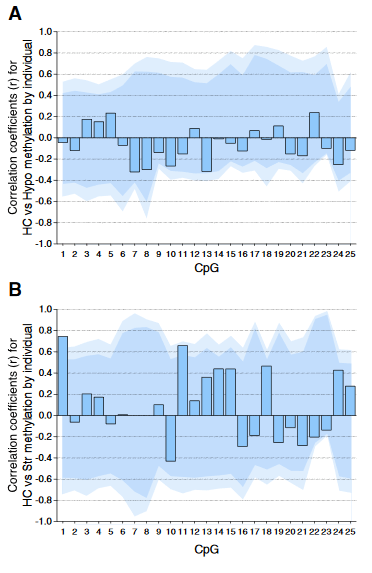
Individual DNA methylation values were not correlated across brain tissues, despite tissue concordance at the group level.

For each CpG, we computed the Pearson correlation coefficient r between methylation values for matched samples in pairs of brain regions (bars). Dark and light shaded regions represent 95% and 99% thresholds, respectively, of distributions of possible correlation coefficients determined from 10,000 permutations of the measured values among the individuals. These distributions represent the null hypothesis that an individual DNA methylation value in one brain region does not help to predict the value in another region in the same animal.

(A) Correlations based on pyrosequencing data for matched samples passing validation in both hippocampus (HC) and hypothalamus (Hypo). Correlations for individuals at each CpG were either weak (.2 < r < .3) or absent (r < .2), and none were significant, even prior to correction for multiple comparisons.

(B) Correlations for matched samples passing validation in both hippocampus and striatum (Str). Two correlations (CpG 1 and 11) were individually significant prior to but not following correction, and this result could be expected by chance.

Correlations between hippocampus and blood (described in the text) yielded similar results, and no particular CpG yielded consistently high correlation across multiple tissues.”


The study focused on whether or not an individual’s experience-dependent oxytocin receptor gene DNA methylation in one of the four studied tissues could be used to infer a significant effect in the three other tissues. The main finding was NO, it couldn’t!

The researchers’ other findings may have been strengthened had they also examined causes for the observed effects. The “natural variation in maternal licking and grooming” developed from somewhere, didn’t it?

The subjects’ mothers were presumably available for the same tests as the subjects, but nothing was done with them. Investigating at least one earlier generation may have enabled etiologic associations of “the effects of early life rearing experience” and “individual variation in DNA methylation.”

https://www.sciencedirect.com/science/article/abs/pii/S0018506X1500118X “Natural variation in maternal care and cross-tissue patterns of oxytocin receptor gene methylation in rats” (not freely available)

Does vasopressin increase mutually beneficial cooperation?

This 2016 German human study found:

“Intranasal administration of arginine vasopressin (AVP), a hormone that regulates mammalian social behaviors such as monogamy and aggression, increases humans’ tendency to engage in mutually beneficial cooperation.

AVP increases humans’ willingness to cooperate. That increase is not due to an increase in the general willingness to bear risks or to altruistically help others.”


One limitation of the study was that the subjects were all males, ages 19-32. The study’s title was “human risky cooperative behavior” while omitting subjects representing the majority of humanity.

Although the researchers claimed brain effects from vasopressin administration, they didn’t provide direct evidence for the internasally administered vasopressin in the subjects’ brains. A similar point was made about studies of vasopressin’s companion neuropeptide, oxytocin, in Testing the null hypothesis of oxytocin’s effects in humans.

A third limitation was that although the researchers correlated brain activity with social behaviors, they didn’t carry out all of the tests necessary to demonstrate the claimed “novel causal evidence for a biological factor underlying cooperation.” Per Confusion may be misinterpreted as altruism and prosocial behavior, the researchers additionally needed to:

“When attempting to measure social behaviors, it is not sufficient to merely record decisions with behavioral consequences and then infer social preferences. One also needs to manipulate these consequences to test whether this affects the behavior.”

http://www.pnas.org/content/113/8/2051.full “Vasopressin increases human risky cooperative behavior”

Advance science by including emotion in research

This 2015 analysis of emotion studies found:

“Emotion categories [fear, anger, disgust, sadness, and happiness] are not contained within any one region or system, but are represented as configurations across multiple brain networks.

For example, among other systems, information diagnostic of emotion category was found in both large, multi-functional cortical networks and in the thalamus, a small region composed of functionally dedicated sub-nuclei.

The dataset consists of activation foci from 397 fMRI and PET [positron emission tomography] studies of emotion published between 1990 and 2011.”

From the fascinating Limitations section:

“Our analyses reflect the composition of the studies available in the literature, and are subject to testing and reporting biases on the part of authors. This is particularly true for the amygdala (e.g., the activation intensity for negative emotions may be over-represented in the amygdala given the theoretical focus on fear and related negative states). Other interesting distinctions were encoded in the thalamus and cerebellum, which have not received the theoretical attention that the amygdala has and are likely to be bias-free.

Some regions—particularly the brainstem—are likely to be much more important for understanding and diagnosing emotion than is apparent in our findings, because neuroimaging methods are only now beginning to focus on the brainstem with sufficient spatial resolution and artifact-suppression techniques.

We should not be too quick to dismiss findings in ‘sensory processing’ areas, etc., as methodological artifacts. Emotional responses may be inherently linked to changes in sensory and motor cortical processes that contribute to the emotional response.

The results we present here provide a co-activation based view of emotion representation. Much of the information processing in the brain that creates co-activation may not relate to direct neural connectivity at all, but rather to diffuse modulatory actions (e.g., dopamine and neuropeptide release, much of which is extrasynaptic and results in volume transmission). Thus, the present results do not imply direct neural connectivity, and may be related to diffuse neuromodulatory actions as well as direct neural communication.”


Why did the researchers use only 397 fMRI and PET studies? Why weren’t there tens or hundreds of times more candidate studies from which to select?

The relative paucity of candidate emotion studies demonstrated the prevalence of other researchers’ biases for cortical brain areas. The lead researcher of the current study was a coauthor of the 2016 Empathy, value, pain, control: Psychological functions of the human striatum, whose researchers mentioned that even their analyses of 5,809 human imaging studies was hampered by other imaging-studies researchers’ cortical biases.

Functional MRI signals depend on the changes in blood flow that follow changes in brain activity. Study designers intentionally limit their findings when they scan brain areas and circuits that are possibly activated by human emotions, yet exclude emotional content that may activate these areas and circuits.

Here are a few examples of limited designs that led to limited findings when there was the potential for so much more:

It’s well past time to change these practices now in the current year.


This study provided many methodological tests that should be helpful for research that includes emotion. It showed that there aren’t impenetrable barriers – other than popular memes, beliefs, and ingrained dogmas – to including emotional content in studies.

Including emotional content may often be appropriate and informative, with the resultant findings advancing science. Here are a few recent studies that did so:

http://journals.plos.org/ploscompbiol/article?id=10.1371%2Fjournal.pcbi.1004066 “A Bayesian Model of Category-Specific Emotional Brain Responses”

Chronic pain causes epigenetic changes in the brain and immune system

This 2015 Canadian rodent study by McGill researchers found:

“The critical involvement of DNA methylation in chronic pain. We show that in the PFC [prefrontal cortex], a brain region strongly implicated in chronic pain, a stunning number of promoters [control gene expression] are differentially methylated 9 months after injury. These changes are distant both in time and space from the original injury.

The changes in DNA methylation are highly organized in functional pathways that have been implicated in pain such as dysregulation of dopaminergic, glutamatergic, opioid and serotoninergic systems and important signaling and inflammatory pathways.

Genome-wide DNA methylation modifications of T cells [circulating white blood cells that control immune response] are also associated with nerve injury.

Most of the promoters (72%) identified as differentially methylated in T cells after nerve injury were also affected in the brain. While the methylation profiles in some of these modules were affected in the same direction in the brain and the T cells, others went in opposite direction. This is consistent with the idea that the brain and the immune system play different roles in chronic pain.

These data suggest that:

  • Persistent pain is associated with broad and highly organized organism-wide changes in DNA methylation, including two critical biological systems: the central nervous and immune systems.
  • This work also provides a possible mechanistic explanation for commonly observed comorbidities observed in chronic pain (i.e anxiety, depression).
  • Finally, the sheer magnitude of the impact of chronic pain, particularly in the prefrontal cortex, illustrates the profound impact that living with chronic pain exerts on an individual.”

http://www.nature.com/articles/srep19615 “Overlapping signatures of chronic pain in the DNA methylation landscape of prefrontal cortex and peripheral T cells”


The news coverage focused on how the study’s findings may lead to non-invasive DNA methylation measurements of chronic pain as well as treatments of the effects. I’d argue that the researchers’ concluding statement of the Discussion section deserved the most focus:

“Beyond the example of chronic pain, the robust and highly organized DNA methylation changes seen here in response to nerve injury provides some of the strongest evidence to date that experience effects DNA methylation landscapes at large distances in time and space.”

The study provided “some of the strongest evidence to date” that experiences caused widespread, long-lasting epigenetic changes. Given experiences’ etiologic functions, research with working hypotheses that experiences may also reverse epigenetic changes should be green-lighted.

“DNA methylation landscapes at large distances in time and space” warrant systematic examination of how experiential epigenetic changes during early life may be reversed by experiential therapies later in life. In the current year, there’s sufficient evidence for modifying research goals to primarily address causes, not just effects.

Lifelong effects of stress

A 2016 commentary A trilogy of glucocorticoid receptor actions that included two 2015 French rodent studies started out:

Glucocorticoids (GCs) belong to a class of endogenous, stress-stimulated steroid hormones. They have wide ranging physiologic effects capable of impacting metabolism, immunity, development, stress, cognition, and arousal.

GCs exert their cellular effects by binding to the GC receptor (GR), one of a 48-member (in humans) nuclear receptor superfamily of ligand-activated transcription factors.”

The French studies were exceedingly technical. The first GR SUMOylation and formation of an SUMO-SMRT/NCoR1-HDAC3 repressing complex is mandatory for GC-induced IR nGRE-mediated transrepression:

“GCs acting through binding to the GR are peripheral effectors of circadian and stress-related homeostatic functions fundamental for survival.

Unveils, at the molecular level, the mechanisms that underlie the GC-induced GR direct transrepression function mediated by the evolutionary conserved inverted repeated negative response element. This knowledge paves the way to the elucidation of the functions of the GR at the submolecular levels and to the future educated design and screening of drugs, which could be devoid of undesirable debilitating effects on prolonged GC therapy.”

The companion study Glucocorticoid-induced tethered transrepression requires SUMOylation of GR and formation of a SUMO-SMRT/NCoR1-HDAC3 repressing complex stated:

“GCs have been widely used to combat inflammatory and allergic disorders. However, multiple severe undesirable side effects associated with long-term GC treatments, as well as induction of glucocorticoid resistance associated with such treatments, limit their therapeutic usefulness.”

Even when researchers study causes, they often justify their efforts in terms of outcomes that address effects. Is an etiologic advancement in science somehow unsatisfactory in and of itself?


Once in a while I get a series of personal revelations while reading scientific publications. Paradoxically, understanding aspects of myself has seldom been sufficient to address historical problems.

Thoughts are only where some of the effects of problems show up, and clarifying my understanding can – at most – tamp down these effects. The causes are elsewhere, and addressing them at the source is what ultimately needs to happen.

A few glucocorticoid-related items to ponder:

  • How has stress impacted my life? When and where did it start?
  • Why do I feel wonderful after taking prednisone or other anti-inflammatories? What may be the originating causes of such effects?
  • Why have prolonged periods of my life been characterized by muted responses to stress? How did I get that way?
  • Have I really understood why I’ve reflexively put myself into stressful situations? What will break me out of that habit?
  • Why do the feelings I experience while under stressful situations feel familiar? Does my unconsciousness of their origins have something to do with “homeostatic functions fundamental for survival?”
  • Why haven’t I noticed that symptoms of stress keep showing up in my life? There are “physiologic effects capable of impacting metabolism, immunity,” etc. but I don’t do something about it?
  • How else may stress impact my biology? Brain functioning? Ideas and beliefs? Behavior?

State-dependent brain functions and adrenaline

This 2015 German/Italian rodent study investigated:

“How a specific neuromodulatory input may influence the information content and the readout of cortical information representations of sensory stimuli.

The locus coeruleus (LC) is a brainstem neuromodulatory nucleus that likely plays a prominent role in shaping cortical states via a highly distributed noradrenaline release in the forebrain. In particular, the LC:

  • Contributes to regulation of arousal and sleep;
  • Is involved in cognitive functions such as vigilance, attention, and selective sensory processing; and
  • Modulates cortical sensory responses and cortical excitability.

An important addition of our work to previous models of state dependence was the inclusion of the contribution of an important neuromodulator – the noradrenergic system. Our results support the hypothesis that the temporal structure of LC firing causally influences cortical dynamics.

Our work highlights the importance of timing of LC burst: suitably timed LC burst (for example, triggered by an alerting stimulus) can very rapidly trigger transitions into excitable cortical states, which in turn decrease the threshold for cortical responses and thus dynamically facilitate the processing of salient or attended events.

State dependence may either:

  • Force neurons to transmit information only using codes that are robust to state fluctuations (e.g., relative firing rates), or may
  • Force downstream neurons to gain information about the state of the networks sending the sensory messages and then to use the knowledge of state to properly interpret neural responses.

Our results suggest that the latter information transmission scheme is feasible, because detecting state by either monitoring the dynamics of cortical ongoing activity alone or by also monitoring the dynamics of noradrenergic modulation substantially increased the amount of information about sensory stimuli in the late response components relevant for behavior.”

The study added to the evidence that state dependencies can’t be overlooked in explanations of brain function and resultant physical and mental activity. Locus coeruleus neural activity “can very rapidly trigger transitions into excitable cortical states..and thus dynamically facilitate the processing of salient or attended events.”

Adrenaline from the locus coeruleus produced a state of arousal in multiple brain and body areas tied into the subjects’ sympathetic nervous systems. Such internal state changes may be accompanied by state-dependent memories, following the findings of What can cause memories that are accessible only when returning to the original brain state?

The study highlighted the capability of a lower brain structure to influence other brain areas. Its findings should inform researchers in attention and behavior studies, especially when investigating causes of attention and behavior difficulties.

http://www.pnas.org/content/112/41/12834.full “Modeling the effect of locus coeruleus firing on cortical state dynamics and single-trial sensory processing”

Treating prenatal stress-related disorders with an oxytocin receptor agonist

This 2015 French/Italian rodent study found:

“Chronic systemic treatment with carbetocin [unavailable in the US] in PRS [prenatally restraint stressed] rats corrected:

  • the defect in glutamate release,
  • anxiety– and depressive-like behavior,

and abnormalities:

  • in social behavior,
  • in the HPA response to stress, and
  • in the expression of stress-related genes in the hippocampus and amygdala.

These findings disclose a novel function of oxytocin receptors in the hippocampus, and encourage the use of oxytocin receptor agonists in the treatment of stress-related psychiatric disorders in adult life.”

carbetocin

The adult male subjects were:

“PRS rats..the offspring of dams exposed to repeated episodes of restraint stress during pregnancy.

These rats display anxiety- and depressive-like behaviors and show an excessive glucocorticoid response to acute stress, which is indicative of a dysregulation of the hypothalamus-pituitary-adrenal (HPA) axis caused by an impaired hippocampal glucocorticoid negative feedback.

PRS rats show a selective reduction in glutamate release in the ventral hippocampus.”

The researchers cited several other studies they have performed with the PRS phenotype. In the current study:

“Carbetocin treatment had no effect on these behavioral and neuroendocrine parameters in prenatally unstressed (control) rats, with the exception of a reduced expression of the oxytocin receptor gene in the amygdala.

Carbetocin displayed a robust therapeutic activity in PRS rats, but had no effect in unstressed rats, therefore discriminating between physiological and pathological conditions.”


The PRS phenotype showed the ease with which a child can be epigenetically changed – even before they’re born – to be less capable over their entire life. Just stress the pregnant mother-to-be.

https://www.sciencedirect.com/science/article/abs/pii/S0306453015002395 “Activation of presynaptic oxytocin receptors enhances glutamate release in the ventral hippocampus of prenatally restraint stressed rats” (not freely available) Thanks to coauthor Dr. Eleonora Gatta for providing the full study.

Are hormone ratios useful in explaining health? Behavior? Neurobiology? Anything?

This 2015 Zurich human review addressed:

“A remarkable lack of discussion on the meaning and interpretation of frequently used hormone ratios.

The interpretation of hormone ratios is complicated and in many cases not sufficiently supported from a theoretical point of view.

Based on the assumption that the balance between two interdependent hormones determines their eventual effects on brain and other tissues, this index has been commonly interpreted as an indicator of the balance between two endocrine systems.

The ratio is typically calculated by simply dividing the raw value of one hormone by the raw value of a second hormone. However, endocrine parameters may fluctuate considerably within individuals across short periods of time on the basis of circadian rhythms or contextual factors. Nevertheless, the ratio method has so far only rarely been applied in the context of repeated endocrine assessments.”

The researchers made a non-exhaustive list of three dozen studies that used hormone ratios among cortisol, dehydroepiandrosterone sulfate (DHEA-S), estradiol, progesterone, testosterone, triiodothyronine (T3), thyroxine (T4), etc., to explain various outcome measures such as:

  • “Health status
  • Aggressive behavior
  • Psychopathy
  • Marital violence
  • fMRI response to angry and happy faces
  • Early life adversity
  • Depression
  • Chronic stress
  • Alexithymia”

Their 2015 study on “endocrine correlates of pro-environmental behavior” was used as an illustrative example. It had 229 male subjects between ages 19 and 77. Salivary cortisol (C) and testosterone (T) was sampled with these results:

“T/C and C/T ratios produce different means, standard deviations and distributional properties which significantly deviate from normality.

Height is not significantly associated with either T/C or C/T. In fact, looking at the original variables, C correlates positively with height while T shows no association.

When we include age as a covariate (assuming that it is associated with both height and hormone status) the partial correlation between T/C and height then is significant while the association between C/T and height is non-significant, even though both ratios are based on the exact same data.

Looking at the negative association between age and T/C the observed age-related ratio decline is mainly due to the fact that the T value in the numerator decreases with age while the C value in the denominator remains relatively constant. In this case, the analysis of the individual variables therefore offers more information and a more accurate picture of the underlying relationships.


A few previous studies have standardized the two underlying hormone distributions before calculating the ratio in order to account for the fact that two hormones often exhibit very different means and standard deviations. Standardization leads to values that express each subject’s hormone concentration relative to the sample mean.

A ratio calculated on the basis of such standardized hormones takes on a different meaning. In particular, the ratio no longer merely represents the proportion of the two hormones within the individual but also incorporates how high the two hormone concentrations are with respect to the sample distributions.”


Practices to improve the use and interpretation of hormone measurements included:

“Regression techniques employed on the original variables constitute a better suited alternative devoid of the problems associated with the ratio method. Moderation analysis, in particular, is a useful approach, which often provides more detailed insight into the relationships of interest.

Ratios should either be analyzed with non-parametric techniques, or be log-transformed before parametric statistical methods are applied.”

Set points and variations in an individual’s hormone balances are usually effects of underlying causes. Researchers will hopefully pay more attention to effectively dealing with ultimate causes as the preferred methods of managing an individual’s health, behavioral, and neurobiological effects.

https://www.sciencedirect.com/science/article/abs/pii/S0306453015009531 “How to use and interpret hormone ratios” (not freely available)

Stress consequences on gut bacteria, behavior, immune system, and neurologic function

This 2015 Canadian rodent study found:

“Chronic social defeat induced behavioral changes that were associated with reduced richness and diversity of the gut microbial community.

The degree of deficits in social, but not exploratory behavior, was correlated with group differences between the microbial community profile.

Defeated mice also exhibited reduced abundance of pathways involved in biosynthesis and metabolism of tyrosine and tryptophan: molecules that serve as precursors for synthesis of dopamine, norepinephrine, serotonin, and melatonin, respectively.

This study indicates that stress-induced disruptions in neurologic function are associated with altered immunoregulatory responses.”

These researchers had an extensive Discussion section where they placed study findings in contexts with other rodent and human studies. For example:

“Our analyses also predicted reduced frequency of fatty acid biosynthesis and metabolism pathways, including that of propanoate and butanoate – byproducts of dietary carbohydrate fermentation by intestinal microorganisms.

Butyrate is a potent histone deacetylase (HDAC) inhibitor that exerts antidepressant-like effects by increasing histone acetylation in the frontal cortex and hippocampus, and consequentially, raising BDNF transcript levels.

Although it was previously unclear whether systemic levels of these metabolites achieved in vivo were sufficient to produce behavioral changes, progress has been made by discovering their presence in cerebrospinal fluid and the brain, and demonstrating that colon-derived SCFAs [short chain fatty acids] cross the blood–brain barrier and preferentially accumulate in the hypothalamus, where they can affect CNS activity.”

http://www.psyneuen-journal.com/article/S0306-4530%2815%2900934-8/fulltext “Structural & functional consequences of chronic psychosocial stress on the microbiome & host”