Familiar stress opens up an epigenetic window of neural plasticity

This 2015 Italian rodent study found:

“There is a window of plasticity that allows familiar and novel experiences to alter anxiety– and depressive-like behaviors, reflected also in electrophysiological changes in the dentate gyrus (DG).

A consistent biomarker of mood-related behaviors in DG is reduced type 2 metabotropic glutamate (mGlu2), which regulates the release of glutamate. Within this window, familiar stress rapidly and epigenetically up-regulates mGlu2..and improves mood behaviors.

These hippocampal responses reveal a window of epigenetic plasticity that may be useful for treatment of disorders in which glutamatergic transmission is dysregulated.”

The current study included two of the authors of A common dietary supplement that has rapid and lasting antidepressant effects.

The supplementary material showed the:

“Light–dark test as a screening method allowed identification of clusters of animals with a different baseline anxiety profile”

for the BDNF Val66Met subjects. This research methodology better handled the individual differences that often confound studies.

The study’s press release provided further details such as:

“Here again, in experiments relevant to humans, we saw the same window of plasticity, with the same up-then-down fluctuations in mGlu2 and P300 in the hippocampus, Nasca says. This result suggests we can take advantage of these windows of plasticity through treatments, including the next generation of drugs, such as acetyl-L-carnitine, that target mGlu2—not to ‘roll back the clock’ but rather to change the trajectory of such brain plasticity toward more positive directions.”


I disagree with the authoring researchers’ extrapolation of these rodent findings to humans, which seemed to favor chemical intervention. Causes of human stress should be removed or otherwise addressed.

I hope that the study’s “familiar stress” findings won’t be use to attempt to justify potentially harmful practices such as Critical Incident Stress Debriefing, which mandatorily guides people to process recent trauma. Instead, An interview with Dr. Rachel Yehuda on biological and conscious responses to stress made a point about “windows of plasticity” that’s relevant to who we are as feeling human beings:

“What I hear from trauma survivors — what I’m always struck with is how upsetting it is when other people don’t help, or don’t acknowledge, or respond very poorly to needs or distress.”

http://www.pnas.org/content/112/48/14960.full “Stress dynamically regulates behavior and glutamatergic gene expression in hippocampus by opening a window of epigenetic plasticity”
An interview with Dr. Rachel Yehuda on biological and conscious responses to stress

How Trauma and Resilience Cross Generations

“The purpose of epigenetic changes, I think, is simply to increase the repertoire of possible responses.

So let’s say, for some reason, your parents transmitted to you biologic changes that are very appropriate to starvation, but you don’t live in a culture where food is not plentiful.

You’re just not optimized, but I think that if we develop an awareness of what the biologic changes from stress and trauma are meant to do, then I think we can develop a better way of explaining to ourselves what our true capabilities and potentials are.


What I hear from trauma survivors — what I’m always struck with is how upsetting it is when other people don’t help, or don’t acknowledge, or respond very poorly to needs or distress.


Feel it instead of running to someone to give you a sleeping pill.”

Transcript: http://www.onbeing.org/program/rachel-yehuda-how-trauma-and-resilience-cross-generations/transcript/7791

A study of methylation’s mechanical effects on DNA molecules

This 2015 Italian study investigated effects of DNA methylation on mechanical properties of single DNA molecules:

As a consequence of cytosine methylation, the binding of proteins that are implicated in transcription to gene promoters is severely hindered, which results in gene regulation and, eventually, gene silencing. To date, the mechanisms by which methylation biases the binding affinities of proteins to DNA are not fully understood; however, it has been proposed that changes in double-strand conformations, such as stretching, bending, and over-twisting, as well as local variations in DNA stiffness/flexibility may play a role.

We observe that methylation induces no relevant variations in DNA contour lengths, but produces measurable incremental changes in persistence lengths [stiffness/flexibility].

The results reported herein support the claim that the biological consequences of the methylation process, specifically difficulties in protein-DNA binding, are at least partially due to DNA conformation modifications.”

http://www.sciencedirect.com/science/article/pii/S0304416515002706 “Effects of cytosine methylation on DNA morphology: An atomic force microscopy study”

A molecular study of the epigenetic regulation of memory

This 2015 Norwegian rodent study provided:

“New insights into the molecular underpinnings of synaptic plasticity.

We report the first global transcriptome [all RNA found in specific cells] analysis of in vivo synaptic plasticity, using the well-established model of LTP [long-term potentiation, an increase in synaptic strength that underlies memory] in the rat dentate gyrus [a region of the hippocampus where neurogenesis occurs].

We have identified a number of novel lncRNAs [long (more than 200 nucleotides) noncoding (non-protein coding) RNA] that are dynamically regulated in response to LTP. In addition, we also observed an altered expression of multiple classes of repeat elements [mobile DNA sequences often involved in mutations] including retrotransposons [a repeat element type formed by copy-and-paste mechanisms].

The results presented here reveal a vast extension of mRNAs [messenger RNA, a large RNA that carries codes for protein production] previously not associated with neuronal plasticity; the discovery of extensive, dynamic regulation of lncRNAs, repeat elements, and tRNA [transfer RNA that links mRNA and amino acids during protein production] following LTP induction in the adult rat brain.

These findings provide a broader foundation for elucidating the transcriptional and epigenetic regulation of synaptic plasticity.”

Regarding lncRNA:

“We annotate a total of 10,256 novel lncRNAs in the rat transcriptome.

To infer possible functions of lncRNAs, we correlated [71] differentially expressed lncRNAs with regulated protein coding genes.

There are no established rules for predicting the function of lncRNAs.”

Regarding repeat elements:

“It is intriguing to consider that expression of repeat elements during LTP is the first step toward retrotransposition and reshaping of the neuronal genome. A hypothetical mechanism for how these repeat elements could be linked to memory, would be that a certain stimuli, whether it is stress or a learning task (here LTP), deregulate the repression of repeat elements which are then rapidly and transiently transcribed. These elements reinsert themselves back into the genome of stimulated neurons where they influence the expression of neighboring genes.

The present work supports the intriguing hypothesis that dynamic retrotransposition may act as a molecular means to reprogram the neuronal genome as part of long-term synaptic plasticity and memory formation.”

See RNA as a proxy signal for context-specific biological activity for more about lncRNA.

http://journal.frontiersin.org/article/10.3389/fnins.2015.00351/full “Dynamic expression of long noncoding RNAs and repeat elements in synaptic plasticity”

Transgenerational epigenetic programming with stress and microRNA

This 2015 Pennsylvania rodent study found:

“Sperm miRs [microRNAs, a small non-coding RNA that has a role in gene expression] function to reduce maternal mRNA [messenger RNA, a large RNA that carries codes for protein production] stores in early zygotes, ultimately reprogramming gene expression in the offspring hypothalamus and recapitulating the offspring stress dysregulation phenotype.”

These researchers caused stress-induced changes at an early stage of embryonic development with microRNA injections. Resultant adverse effects weren’t observed until subjects were adults!

Most news coverage focused on it being a male’s stress, not a female’s, that affected a developing embryo. Either or both sexes can epigenetically disadvantage a fetus – okay.

Demonstrating how a damaging influence can begin immediately after conception, but symptoms didn’t present until adulthood made this study newsworthy.


Although the term “transgenerational” was used in the study’s title, abstract, and elsewhere, studied epigenetic effects were intergenerational rather than transgenerational. Per A review of epigenetic transgenerational inheritance of reproductive disease, for the term to apply, researchers need to provide evidence in at least the next 2 male or non-gestating female generations and/or 3 gestating female generations of:

“Altered epigenetic information between generations in the absence of continued environmental exposure.”


From a press release, a study coauthor who also coauthored How to make a child less capable even before they are born: stress the pregnant mother-to-be stated:

“Bale suspects that when a male experiences stress it may trigger the release of miRs contained in exosomes from epithelial cells that line the epididymis, the storage and maturation site for sperm between the testes and the vas deferens. These miRs may be incorporated into maturing sperm and influence development at fertilization.”

Not all stress-related gene expression in pituitary and adrenal glands differed.

http://www.pnas.org/content/112/44/13699.full “Transgenerational epigenetic programming via sperm microRNA recapitulates effects of paternal stress”

A review of the epigenetic basis for mental illness

This 2015 New York combined animal and human review of epigenetic studies noted:

“While genetic factors are important in the etiology of most mental disorders, the relatively high rates of discordance among identical twins, particularly for depression and other stress-related syndromes, clearly indicate the importance of additional mechanisms.

Environmental factors such as stress are known to play a role in the onset of these illnesses.

Exposure to such environmental insults induces stable changes in gene expression, neural circuit function, and ultimately behavior, and these maladaptations appear distinct between developmental versus adult exposures.

Increasing evidence indicates that these sustained abnormalities are maintained by epigenetic modifications in specific brain regions.”

Placing the “maladaptations” and “sustained abnormalities” phrases into their contexts:

  • A fetus biologically adapted to their environment – however toxic it was – in order to best survive.
  • These adaptations for survival were subsequently viewed as Disrupted Neurodevelopment and “maladaptations” from the perspectives of normal development and environments.
  • The “sustained abnormalities” caused within the earlier environments “are maintained by epigenetic modifications.” An improved environment wasn’t impetus enough to change developmental “maladaptations.”

Per the below link, it’s been a month since this review was published. Why has there been ZERO news coverage of it?

One reason may be that the Friedman Brain Institute, Icahn School of Medicine at Mount Sinai, didn’t issue a press release or otherwise publicize it. Another reason may be the groups that are opposed to its findings:

  • Parents who provided harmful environments for their children, beginning at conception;
  • People who feel threatened when scientific causal evidence resonates with what happened in their own lives, and in response, limit their empathetic understanding of others’ problems;
  • Social workers, psychologists, and others in industries whose paychecks depend on efforts that aren’t directed towards ameliorating the causes for these later-life effects;
  • Psychiatrists and medical personnel whose livelihoods depend on pharmaceutical and other treatments that only alleviate symptoms;
  • Researchers whose funding depends on producing non-etiologic findings.

Despite resistance to this review’s findings, a large number of people would benefit from publicizing evidence for:

“These sustained abnormalities are maintained by epigenetic modifications in specific brain regions.”

http://nro.sagepub.com/content/early/2015/09/24/1073858415608147 “Epigenetic Basis of Mental Illness”

Stress-induced epigenetic DNA modifications may be inherited

This 2015 Australian plant summary study made several points:

“Non-transmission of epigenetic marks through meiosis may be regarded as an epigenetic modification in itself. We should understand the implications for plant evolution in the context of both selection for and selection against transgenerational epigenetic memory.

Both epigenetic inheritance and resetting are mechanistically directed and targeted. Stress-induced epigenetic modifications may buffer against DNA sequence-based evolution to maintain plasticity, or may form part of plasticity’s adaptive potential.

In some cases the signature of the stress experience remains in the epigenome after relief from the stress, providing a “memory.” If this memory conditions the response to stress during subsequent development, the organism is said to be epigenetically primed. If the memory of the stress experienced by a parent conditions the response of its progeny, this epigenetic priming may be transgenerational.

Epigenetic and genetic variation co-evolve. Epigenetic plasticity does not completely buffer evolvability and reduce the correlation between fitness and genotype, slowing selection.”

One of the summarized studies found that a transgenerational epigenetic change eventually silenced itself after the 40th copy!

The Are stress-induced epigenetic changes to DNA inherited across generations? study was cited, although it argued for the opposing viewpoint.

http://journal.frontiersin.org/article/10.3389/fpls.2015.00699/full “Transgenerational inheritance or resetting of stress-induced epigenetic modifications: two sides of the same coin”

Genetic causes for epigenetic symptoms

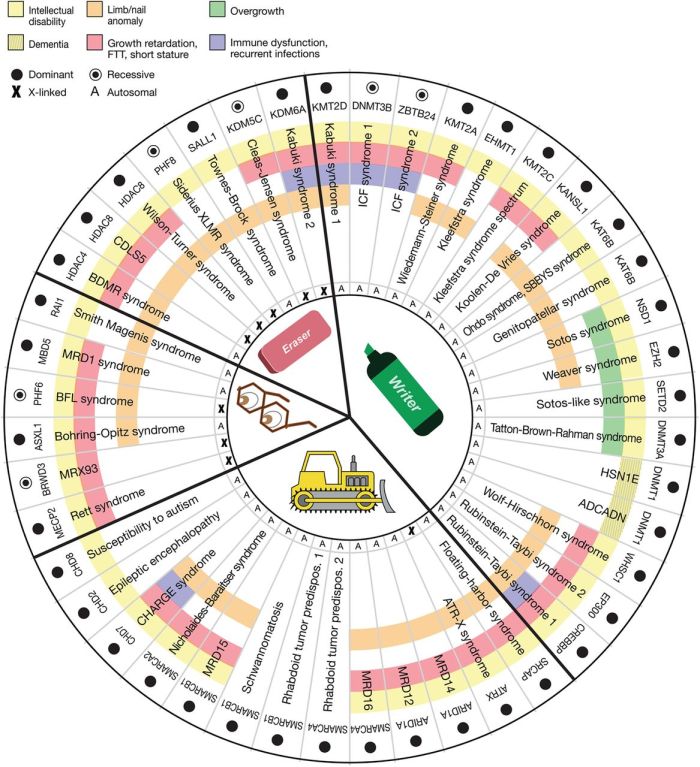
This 2015 human summary study was of 44 genetic disorders that disrupt the maintenance of epigenetic modifications:

“..making them likely to have significant downstream epigenetic consequences. Interestingly, these patients often demonstrate neurological dysfunction, suggesting that precise epigenetic regulation may be critical for neuronal homeostasis. However, at the same time, it is important to keep in mind that many of these proteins have additional non-epigenetic roles.

Mutations in many of these components have now been linked to a number of well-known causes of intellectual disability. Intellectual disability is generally defined as deficits of intellectual function and adaptive behavior that occur during the developmental period.

Given the opposing activity of many of the components of the epigenetic machinery, the pathogenic sequence in these disorders involves an imbalance of chromatin states. Keeping a subset of genes under “pressure” from two opposing systems may allow the cellular system to rapidly respond to environmental stimuli.

These disorders, on average, have unusual phenotypic breadth. Similarly, there is a shift in distribution toward a higher number of organ systems affected.

In addition to developmental phenotypes (multiple congenital anomalies), in some cases there appear to be ongoing defects that remain consequential in post-natal life. An example of the latter is the hippocampal memory defects seen in many of the mouse models.

This raises the question whether cells undergoing neurogenesis and synaptogenesis are particularly sensitive to subtle defects of the epigenetic machinery and downstream epigenetic abnormalities. A major remaining question is whether neurogenesis defects and/or abnormalities of synaptic plasticity are a unifying pathophysiological process.”

The researchers represented the 44 genetic disorders on a wheel graph:

F1.large

I look forward to further research that includes non-genetic disruptors of epigenetic modifications.

http://genome.cshlp.org/content/25/10/1473.full “The Mendelian disorders of the epigenetic machinery”

Leaky gates, anxiety, and grocery store trips without buying list items

An interview with Jeff Link, the editor of Dr. Arthur Janov’s 2011 book “Life Before Birth: The Hidden Script that Rules Our Lives” with Ken Rose:

“Even further confirmation for some of the views of Janov, that maybe weren’t widely accepted for a time, it’s new research now being done into memory and what a lot of scientist are seeing, a lot of different studies is that memory reactivates the same neuroimpulses that were initially firing off when the event happened.

So a traumatic event when you remember it, the act of remembering it is actually creating a neuromirror of what went on initially.

In a lot of ways that is what Primal Therapy is attempting to do; is to go back to that place and reconnect, or as it’s sometimes referred to, reconsolidate the brain state so that real healing can take place.”

Transcript (part 4 of 6): http://cigognenews.blogspot.com/2015/09/ken-rose-on-life-before-birth-part-46.html

MP3: http://www.pantedmonkey.org/podcastgen/download.php?filename=2011-12-15_1300_what_now_jeff_link.mp3

A mechanistic study of neurotransmitters in the hippocampus

This 2015 UK rodent study found:

“A mechanistic understanding of how alterations in dopamine and NMDAR [a type of glutamate receptor that participates in excitatory neurotransmission] function can lead to the disruption of hippocampal–PFC [prefrontal cortex] functional connectivity.

These results show how dopaminergic activation induces long-term hypofunction of NMDARs, which can contribute to disordered functional connectivity, a characteristic that is a hallmark of psychiatric disorders such as schizophrenia.”

One of the experiments applied theta-frequency (5 Hz) waves to the rats’ hippocampi and dampened the electrical activity of the NMDAR type of glutamate receptor.

However, this effect of theta waves was dependent on the activation of D2 dopamine receptors. The study’s findings should inform researchers who treat brain waves as base causes of behavior in studies such as What’s an appropriate control group for a schizophrenia study?

This study’s findings may also inform researchers of studies such as the What causes disconnection between the limbic system and the cerebrum? of a neurochemical basis for “the disruption of hippocampal–PFC functional connectivity.”

http://www.pnas.org/content/112/35/11096.full “Disruption of hippocampal–prefrontal cortex activity by dopamine D2R-dependent LTD of NMDAR transmission”

Words are neither the problem nor the solution

“Words are neither the problem nor the solution. They are the last evolutionary step in processing the feeling or sensation. They are the companions of feelings.

We cannot make progress on the third-line cognitive level alone. We can become aware of why we act the way we do but nothing changes biologically; it is like being aware of a virus and expecting the awareness alone to kill it. Our biology has been left out of the therapeutic equation.”

Janov’s Reflections on the Human Condition: On the Difference Between Abreaction and Feeling (Part 6/9).

Another factor in producing new brain neurons in the adult hippocampus

This 2015 New York rodent study provided further details on the production of new neurons in the adult hippocampus. The researchers found that a protein that regulated a glutamate receptor also:

“Significantly influences hippocampal neurogenesis and that both the proliferation and survival of newborn neurons are impaired in the absence.”

The study showed:

“The effect of Norbin [the protein] on neurogenesis is likely caused by a nonautonomous niche effect.

These results show that Norbin is a regulator of adult hippocampal neurogenesis and that its deletion causes depressive-like behaviors.”

http://www.pnas.org/content/112/31/9745.full “Norbin ablation results in defective adult hippocampal neurogenesis and depressive-like behavior in mice”

Further limits on using monkeys to understand human brains

This 2015 Columbia human/macaque study found:

“Fundamental differences in the attention-related brain areas in the two species, including the complete absence, in monkeys, of a ventral-attention network present in humans.

We did not find functional evidence of a temporoparietal junction in macaques.

The two species last shared a common ancestor 25 million years ago, and in the intervening time the brain areas underlying cognition have likely evolved along different paths.

The results of this study indicate that macaque data should be applied to human models of cognition cautiously, and demonstrate how evolution may shape cortical networks.”

The main point of this study was the same as noted in Limits of dMRI brain studies, which advised – instead of performing studies on monkeys to understand humans:

“Assess human anatomical connections directly and comprehensively.”

We can look forward to times when using macaques in studies such as:

is no longer acceptable.

http://www.pnas.org/content/112/30/9454.full “Functional evolution of new and expanded attention networks in humans”

Genetic statistics don’t necessarily predict the effects of an individual’s genes

I curated this 2015 Howard Hughes Medical Institute rodent study of DNA methylation because of the reason driving the researchers’ efforts:

“Epigenomic analyses are limited by averaging of population-wide dynamics and do not inform behavior of single cells. We observe dynamics at the single-cell level not predicted by epigenomic analysis.”

This rationale was also the driving force behind the Is what’s true for a population what’s true for an individual? study and its companion Changing an individual’s future behavior even before they’re born. The methodology of genome-wide association studies (GWAS) usually:

“Focuses on the average effect of alternative alleles averaged in a population.”

What this methodology often missed was:

“When phenotypic variation results from alleles that modify phenotypic variance rather than the mean, this link between genotype and phenotype will not be detected.”

Population-wide epigenetic statistics don’t necessarily inform us about the epigenetic activities and attributes of an individual’s genes, even down at the single-cell level.

http://www.pnas.org/content/112/31/E4216.full “The Xist RNA-PRC2 complex at 20-nm resolution reveals a low Xist stoichiometry and suggests a hit-and-run mechanism in mouse cells”

How brain neurons remain stable when constantly stimulated

This 2015 UK rodent study provided details of how neurons in the hippocampus respond to stimuli. The researchers found that hippocampal neurons:

“Remain electrically stable when confronted with chronic increases in neuronal activity.”

Changes in electrical potential changed the initial segment of the neuron’s axon.

Synapses formed along the segment, and stayed in place while this highly-plastic segment moved along the axon. The location mismatch:

“Allows the GABAergic [producing gamma-Aminobutyric acid, an inhibitory neurochemical] synapses to strongly oppose action potential generation, and thus downregulate pyramidal cell excitability.”

The researchers also used the two antioxidants endogenous to humans, superoxide dismutase and glutathione, to supplement the culture medium.

http://www.pnas.org/content/112/31/9757.full “Activity-dependent mismatch between axo-axonic synapses and the axon initial segment controls neuronal output”