A smell and taste anecdote

Two 2023 papers, starting with a study of smell and taste disorders:

“This study investigates the impact of etiology on the epidemiologic profile, disease severity, type of treatment, and therapy outcome in smell and taste disorders.

Hyposmia has a prevalence of about 15%, while approximately 5% of the population suffers from anosmia. Multiple innervation of the taste mucosa with fibers from the seventh, ninth, and tenth cranial nerves assures robustness of the gustatory system compared to smell.

Conservative therapy employs corticosteroids, antibiotics, vitamins and and minerals as well as functional rehabilitation by olfactory training. Data regarding outcome of therapy were only available for 71 (26.3%) of patients. Only the sinunasal etiology was significantly more likely to show improvement after therapy (27.4% show improvement vs. 9.6% show no improvement).”

https://link.springer.com/article/10.1007/s00405-023-07967-1 “Characteristics of smell and taste disorders depending on etiology: a retrospective study”

This study was a little light on describing effective treatments for smell and taste problems. For example, olfactory training was said to have good therapeutic response. Looking it up, though, it seems to be whatever each practitioner feels like doing.


A review introduced the subject of olfactory ensheathing cells:

“Olfactory ensheathing cells (OECs) are glial cells of the primary olfactory nervous system, which are composed of the olfactory nerve and outer nerve fiber layer of the olfactory bulb. The primary olfactory nervous system is unique in that it can constantly regenerate.

It is now possible to remove olfactory bulb tissue and olfactory mucosa (outermost layer and lamina propria, which belong to the central nervous system and peripheral nervous system, respectively), which also suggests the potential value of OECs therapy in central nervous system and peripheral nervous system diseases. OECs can survive and renew in the central nervous system, and have been widely used in nerve regeneration and tissue repair.

Schwann cells (SCs) form the myelin sheath of the peripheral nerve, protect and nourish neurons, and play an irreplaceable role in the repair of peripheral nerve injury. There is no transcriptional difference between OECs and SCs. OECs are highly similar to SCs, and express the biomarkers of SCs.

fimmu-14-1280186-g002

Functional mechanisms of OECs in the treatment of neurological diseases include neuroprotection, immune regulation, axon regeneration, improvement of nerve injury microenvironment and myelin regeneration, which also includes secreted bioactive factors. Results obtained in clinical trials are not very satisfactory, and the effectiveness of these cell-based therapies remains to be proved.”

https://www.frontiersin.org/articles/10.3389/fimmu.2023.1280186/full “Potential therapeutic effect of olfactory ensheathing cells in neurological diseases: neurodegenerative diseases and peripheral nerve injuries”


Something interesting may have unexpectedly started with my 90-day trial of Prodrome Glia and Neuro products. Here’s an abbreviated look that omits my intermittent fasting and resistance exercise data:

day 7-15

Both product labels have a loading dose suggestion of 4-8 softgels (2 to 4 times the standard two-softgel dose) for 1-3 months. Two days after I started a Glia loading dose, my sense of smell, then sense of taste, were noticeably better.

I’ll guess that my primary olfactory nervous system glial cells are responding to these changes. At the beginning I thought that my peripheral nervous system Schwann cells might be affected regarding my left ulnar nerve. Since olfactory ensheathing cells are highly similar to Schwann cells, it doesn’t seem to be that much of a stretch to think that they could also be affected by my current regimen.

More testing is warranted, of course. I’ve had diminished smell and taste for decades, though. If the gardenias, roses, magnolias, honeysuckles, and other scents in past summers that had fainter scents than I remembered come across stronger, so much the better.

IMG_20200425_154336

Plasmalogens, Part 3

The 2022 plasmalogen clinical trial mentioned in Parts 1 and 2 bypassed peroxisome metabolism of cognitively impaired people per discussion of the below diagram:

fcell-10-864842-g003

Increasing the body’s fasting state with time-restricted eating, and preventing muscle atrophy with resistance exercise, were offered as the two most important ways to improve peroxisomal function.

I didn’t find any relevant 2023 human studies (where I could access the full study) on different non-drug treatments that I was willing to do. A 2023 review outlined aspects of peroxisomes, to include a few older human studies:

“Peroxisomes are small, single-membrane-bound organelles, which are dynamic and ubiquitous. Peroxisomes directly interact with other organelles, such as endoplasmic reticulum, mitochondria, or lysosomes. Peroxisomes exert different functions in various cells through both catabolic and anabolic pathways.

The main functions of peroxisomes can be categorized as reactive oxygen species (ROS) metabolism, lipid metabolism, and ether-phospholipid biosynthesis. Peroxisomes also play important roles in inflammatory signaling and the innate immune response.”

1-s2.0-S2667325823001425-gr3_lrg

https://www.sciencedirect.com/science/article/pii/S2667325823001425 “Peroxisome and pexophagy in neurological diseases”


1. Since I haven’t recently tried the two main ways to improve peroxisomal function, I’ll give them a go over the next three months:

  • Expect to get my feeding timeframe to within eight hours. Don’t know about making it short like 6 hours, because my first meal of the day is 35 calories of microwaved cruciferous sprouts, then I wait an hour before eating anything else.
  • Resistance exercise progress should be measurable, as I recorded exercises during the first ten weeks of eating broccoli sprouts every day 3.5+ years ago.

2. Don’t know that I’ll recognize any cognitive improvements to the extent I did during Week 9.

  • I don’t have a young brain anymore, and I’m sure some decline could be measured in memory tests. But I’m not going to become a lab rat.
  • There’s an occasional annoyance that’s been going on for some time, especially when I’m distracted. It happens when I think of something to do, and it somehow becomes a short-term memory that I did it, instead of going into a Things To Do queue. It’s largely self-correcting. For example, regardless of what I paid, I’ll drive back to the grocery store self-checkout to retrieve a third bag that didn’t make it home. A pink-haired employee said young people leave their paid-for groceries behind all the time. It’s usually more of a reality disconnect for me than forgetfulness, because I have a memory that I performed the action. Definitely room for improvement.

3. Don’t know that I’d see biochemical changes such as some described in Part 1. Maybe I’ll move up an annual physical to compare it with the last one in May?

  • I already have very little oxidative stress, very little inflammation, low triglycerides, high HDL, and no major improvements are indicated on CBC / CMP / lipid panels.
  • Take supplements to ensure other things like acetylcholine neurotransmitter availability, one-carbon / methylation metabolism, vitamin / mineral adequacy.

4. I started the two Prodrome plasmalogen precursor supplements (ProdromeGlia and ProdromeNeuro) a week ago, and take their standard doses. My thought is that resultant plasmalogens won’t degrade very much if their primary use isn’t to immediately address oxidative stress and inflammation. That could give these extra plasmalogens a chance to make larger homeostatic contributions in myelin and membrane areas.

I don’t expect any particular effects to manifest. But I’m interested to see if these two areas would be affected:

  • My left ulnar nerve has been giving me problems for over five years, and several resistance exercises aggravate it. I’ve had two nerve continuity tests during that time to confirm. Numbness and pain are intermittent, though.
  • I still take acetaminophen several times a day for other pain.

None of the above treatments are specifically indicated. But if time-restricted feeding and/or extra plasmalogens have an effect on left ulnar or other pain, maybe I’ll be able to make better progress on resistance exercise.

Update #1 11/13/2023

Update #2 11/22/2023

Update #3 12/13/2023 comments

Update #4 1/30/2024

Update #5 3/31/2024

Plasmalogens, Part 2

This post compares Dr. Goodenowe’s clinical trial mentioned in Part 1 with other researchers’ human plasmalogen studies this decade. One of its findings was:

“Figure 1A illustrates that plasmalogen precursor DHA-AAG dose-dependently elevated both direct and indirect target species [DHA-PL, DHA-PE, and (LA + AA)-PL] and had no effect on levels of biochemically unrelated PE species index (LA + AA)-PE.

  • DHA-AAG had a greater elevating effect on its direct target, DHA-PL than its indirect targets.
  • The 1-month washout period resulted in decreased levels of both direct and indirect target species and no effect on unrelated PE species.

Figures 1A,B illustrate that DHA-AAG is converted to its direct and indirect target species in humans as predicted from animal studies on similar AAG plasmalogen precursors (Wood et al., 2011d).”

fcell-10-864842-g001A

Given this century’s background of numerous animal studies, there’s a need to know what translates to humans. Here are the three most recent human plasmalogen studies in descending order where I could access the full study:

2022

“Forty unmarried male students aged 18–22 years (20 in the plasmalogen group and 20 in the placebo group) were randomly allocated to either plasmalogen (2 mg per day) or placebo treatment of 4 weeks’ duration and ingested two capsules of 0.5 mg plasmalogen or placebo twice daily.

  • The primary efficacy outcome was the Total Mood Disturbance (TMD) T-score of POMS 2–Adult Short.
  • Secondary outcomes included the seven individual scales of POMS 2, other psychobehavioral measures (Athens Insomnia Scale and Uchida-Kraepelin test), physical performance test (shuttle run, grip muscle strength, and standing long jump), plasmalogen levels in plasma and erythrocytes, plasma levels of brain-derived neurotrophic factor (BDNF), urinary 8-hydroxy-2′-deoxyguanosine (8-OHdG), body mass index, and percent body fat.

Lipid composition of purified ether phospholipids from scallop is shown below. One capsule contained 0.48 mg of ethanolamine plasmalogen and 0.02 mg of choline plasmalogen. Plasmalogen and placebo capsules were prepared by a manufacturer (B&S Corporation, Tokyo).

fcell-10-894734-t001

There were no between-group differences in physical and laboratory measurements. It is suggested that orally administered plasmalogens alleviate negative mood states and sleep problems, and also enhance mental concentration.”

https://www.frontiersin.org/articles/10.3389/fcell.2022.894734/full “Orally Administered Plasmalogens Alleviate Negative Mood States and Enhance Mental Concentration: A Randomized, Double-Blind, Placebo-Controlled Trial”

There was no dose / response investigation, so there’s no data to corroborate that this 2 mg treatment produced these effects. It isn’t difficult to think of other factors that could influence the primary outcome of a 18-22 year-old unmarried male’s moods.


2020

“Effects of ascidian-derived plasmalogens on cognitive performance improvement were assessed in a randomized, double-blind, placebo-controlled study including Japanese adult volunteers age 45.6 ± 11.1 years with mild forgetfulness. An allocation controller who was not directly involved in the study equally, but randomly, assigned participants to either the intervention group (n=33) or the placebo group (n=33), based on normalized Cognitrax composite memory score (the primary outcome), sex, and age at time of screen. Participants were administered either one active capsule (200 mg medium-chain triglyceride (MCT) oil including ascidian plasmalogen oil) or placebo capsule (200 mg MCT oil) per day with water, any time during the day for 12 weeks.

Ascidian plasmalogen oil was extracted from ascidians (Halocynthia roretzi) and sold by NIHON PHARMACEUTICAL CO., LTD. Based on a previous study, 33% of lipids contained in ascidians are phospholipids, 23% of which are plasmalogens, and fatty acids of the sn-2 position of plasmalogens are mainly EPA, DHA, oleic acid, and arachidonic acid. The active capsule contains 1 mg plasmalogen.

Compared to the placebo group, the intervention group showed a significant increase score in composite memory (eight weeks: 3.0 ± 16.3 points, 12 weeks: 6.7 ± 17.5 points), which was defined as the sum of verbal and visual memory scores. These results indicate consumption of ascidian-derived plasmalogen maintains and enhances memory function.”

https://www.jstage.jst.go.jp/article/jos/69/12/69_ess20167/_article “The Impact of Ascidian (Halocynthia roretzi)-derived Plasmalogen on Cognitive Function in Healthy Humans: A Randomized, Double-blind, Placebo-controlled Trial”

Again no dose / response investigation, so no corroborating data. Standard deviations many times larger than a sample’s mean indicated wild variability (aka noise). Maybe intervention participants experienced memory loss (3.0 mean – 16.3 SD = -13.3; 6.7 mean – 17.5 SD = -10.8)? Yet statistics inferred a signal that allowed interpreting this treatment as producing meaningful positive changes in cognitive function.


“Ten Parkinson’s disease (PD) patients age 67.80 (7.41) years received oral administration of 1 mg/day of purified ether phospholipids derived from scallop for 24 weeks. Clinical symptoms and blood tests were checked at 0, 4, 12, 24, and 28 weeks. Blood levels of plasmalogens in patients with PD were compared with those of 39 age-matched normal controls.

B&S Corporation Co. Ltd. (Tokyo) was involved in provision of capsules containing ether phospholipids derived from scallop. Ethanolamine ether phospholipids (ePE) in plasma from PD and relative composition of ethanolamine plasmalogen (plsPE) of erythrocyte membrane in PD were significantly low as compared to those of age-matched normal controls.

Oral administration of purified ether phospholipids derived from scallop for 24 weeks increased plasma ePE and erythrocyte plsPE to almost normal levels, and concomitantly improved some clinical symptoms of patients with PD. Results indicate the efficacy of oral administration of purified ether phospholipids derived from scallop to some nonmotor symptoms of PD. Physiological mechanisms of the efficacy of purified ether phospholipid derived from scallop remained to be elucidated.”

https://www.hindawi.com/journals/pd/2020/2671070/ “Improvement of Blood Plasmalogens and Clinical Symptoms in Parkinson’s Disease by Oral Administration of Ether Phospholipids: A Preliminary Report

Again no dose / response investigation, so no corroborating data. These researchers asserted their 2017 study to be a plasmalogen gold standard, as did the other two above studies.

Here’s part of what Dr. Goodenowe said about that 2017 study in a 2019 review Plasmalogen deficiency and neuropathology in Alzheimer’s disease: Causation or coincidence?:

“They did not observe a significant elevation of plasma levels of plasmalogens in the treated group relative to the baseline. Lower dose of plasmalogens (1 mg twice daily) and the labile nature of the vinyl-ether bond might have limited absorption of the intact molecule and might have contributed to the lack of response in terms of plasmalogen levels in blood as well as the cognitive function. Reported instability of plasmalogens in acidic environments questions the stability of preformed plasmalogens in gastric juice during digestion which might reduce plasmalogen bioavailability.”

Also see Part 1’s explanation of why using age-matched controls in plasmalogen studies is ridiculous.

Continued in Part 3.

Plasmalogens, Part 1

The person who knows the most about this subject is Dayan Goodenowe, PhD. Some recent publications include:

https://www.frontiersin.org/articles/10.3389/fcell.2022.864842/full “Targeted Plasmalogen Supplementation: Effects on Blood Plasmalogens, Oxidative Stress Biomarkers, Cognition, and Mobility in Cognitively Impaired Persons”

https://www.frontiersin.org/articles/10.3389/fcell.2022.866156/full “Brain ethanolamine phospholipids, neuropathology and cognition: A comparative post-mortem analysis of structurally specific plasmalogen and phosphatidyl species”

plasmalogens and cognition


A sample of links freely available at https://drgoodenowe.com/.

1. Presentations to professional groups. Have your mouse ready to click the pause button.

https://drgoodenowe.com/dr-goodenowe-presents-at-the-iagg2023-in-yokohama-japan/ “A rare children’s disease that may be the key to reversing neurological decline in aging”

Includes videos of a treatment’s effects on a child.

https://neomarkgroup.wistia.com/medias/0qln0wy93t “The most influential biomarkers for aging and disease”

Despite the title, a considerable number of studies were presented on prenatal, infant, and early childhood development. He misspoke a few times, so read the slides.

Phenotype is reality. Genotype is possibility. Communications links between different fields are very poorly connected in science.

Peroxisomes are islands. They don’t have DNA like your mitochondria do. Peroxisomal transport issues are important things to understand.

All aging-related cross-sectional analyses are on the rate of decline. You’re declining from a previous well state. Age-matched controls are the most ridiculous thing to do.”


2. I’ll highlight the longest of several interviews because there was plenty of room to expand on points. Maybe the best detailed explanations came as responses to that interviewer challenging with contrasting AD, traumatic brain injury, and cholesterol paradigms. Its transcript is more accurate than a usual YouTube interpretation, but there are still mistakes such as “fossil lipid” vs. phospholipid.

https://www.betterhealthguy.com/episode186 “Plasmalogens with Dr. Dayan Goodenowe, PhD”

“Science is how do you push things to its failure, until you can’t fail it again. We’ve lost that. It’s become more hypothesis proving.

Plasmalogens levels go up for a different reason than people think. The reason why it peaks in our 40s and 50s is because we’ve been myelinating. The white matter of our brain is still increasing. It’s not because we’re making more plasmalogens. It’s because the lake, the reservoir, gets full. What you’re measuring in blood is overflow from the lake. The lower plasmalogens start trickling down in your blood, the bigger drain that’s occurring on that system.

Low plasmalogens don’t just predict dementia in the elderly population. It predicts the rate of decline of that dementia. It predicts the rate of death.

The biggest drivers of plasmalogen manufacturing and the biggest reasons why they decrease with age, or in other circumstances is two things. One, the failure to maintain a fasting state of the human body. The second one is muscle atrophy.

Amyloid has absolutely nothing to do with Alzheimer’s, or dementia. It’s just a bystander on the road watching an accident happen.

Age-related cognitive decline is clearly where plasmalogens have the greatest impact. You’re always going to have mixed pathologies in the brain.

Nutritional availability of plasmalogens is virtually non-existent. As soon as they hit the hydrochloric acid of your stomach, they’re gone. They don’t make it past the stomach, or the upper intestine.”


I came across Dr. Goodenowe’s work last month from clicking a comment on this blog that linked back to her blog. Always be curious.

Continued in Part 2.

Bridging Nrf2 and autophagy

Three more 2023 papers that cited Precondition your defenses with broccoli sprouts, starting with a review:

“Examining crosstalk between Nrf2 antioxidant signaling and autophagy provides insights into how they are interconnected and proteins that mediate their communication. These factors are potential therapeutic targets for diseases with both autophagy dysfunction and oxidative stress.

A working model illustrates mechanisms of bridging factors (SQSTM1, TFEB, Sestrin2, TRIM16, Ca2+, and miRNAs) connecting autophagy (left) and the main antioxidant Nrf2-Keap1-ARE pathway (right) and feedback loops between these factors.

fcell-11-1232241-g003

  • A network forms that connects Nrf2, SQSTM1, TFEB, and mTOR.
  • Other non-canonical autophagy regulatory proteins like Sestrin2 and tripartite motif-containing protein 16 (TRIM16) also participate in regulation of Nrf2 and mTOR via direct or indirect interactions.
  • Ca2+ is the most widespread intracellular messenger whose role in autophagy has been studied extensively.
  • At post-transcriptional level, microRNAs have been reported to impact both the regulation of autophagy and Nrf2 antioxidant signaling.

Since these regulatory proteins seem intricately entangled, potential side effects in practical scenarios should also be taken into consideration. Further studies on understanding the complex crosstalk between autophagy and antioxidant pathways are yet to be conducted.”

https://www.frontiersin.org/articles/10.3389/fcell.2023.1232241/full “An update on the bridging factors connecting autophagy and Nrf2 antioxidant pathway”


A second review subject was improving autophagy:

Lysosomes are crucial degradative organelles that maintain cellular homeostasis. During the pathogenesis of neurodegenerative diseases and aging, functions of lysosomes are impaired, and lysosomal degradative capacity is consequently reduced.

Transcription factor EB-mediated lysosome biogenesis enhances autolysosome-dependent degradation, which subsequently alleviates neurodegenerative diseases. Small-molecule compounds that enhance TFEB activity and lysosome biogenesis are potential therapeutic agents.”

https://journals.lww.com/nrronline/fulltext/2023/11000/enhancement_of_lysosome_biogenesis_as_a_potential.7.aspx “Enhancement of lysosome biogenesis as a potential therapeutic approach for neurodegenerative diseases”


A third review tied mitochondrial participation into these processes:

“Mitochondria play an essential role in neural function, such as supporting normal energy metabolism, regulating reactive oxygen species, buffering physiological calcium loads, and maintaining the balance of morphology, subcellular distribution, and overall health through mitochondrial dynamics. Given recent technological advances in the assessment of mitochondrial structure and functions, mitochondrial dysfunction has been regarded as the early and key pathophysiological mechanism of cognitive disorders.

Mitochondrial dysfunction caused by acute and chronic brain injury is difficult to be distinguished because they may exhibit similar structural and functional impairments. Mitochondrial physiological function and morphology are integral, so when one is damaged, the other is also involved.

We recommend that all of the above methods can be used to explore mitochondrial dysfunction in different pathological pathways of cognitive disorders. Results may be related to special pathological pathways, sensitivity of the method, experiment cost, and degree of proficiency.”

https://journals.lww.com/nrronline/fulltext/2024/04000/latest_assessment_methods_for_mitochondrial.18.aspx “Latest assessment methods for mitochondrial homeostasis in cognitive diseases”


PXL_20231003_110600182

Take Vitamin K2 to protect against aluminum toxicity

This 2023 rodent study investigated relationships of MK-7 menaquinone, aluminum trichloride, and brain health:

“A variety of endogenous and exogenous agents, such as metals and environmental toxins (aluminum, mercury, etc.), can contribute to neurodegeneration, which is of multifactorial clinical occurrence.

The current study showed that Alzheimer’s Disease (AD)-like condition was induced in mice by AlCl3 treatment affecting spatial and recognition memory. Neuropathological alterations included neuroinflammation, oxidative stress, an increase in brain amyloid β levels, and loss of hippocampal neurons.

Aluminium chloride (AlCl3; 100 mg/kg for 3 weeks orally) was administered to Swiss albino mice to induce neurodegeneration and Vitamin K2 (100 mcg/kg for 3 weeks orally) was applied as treatment. This was followed by behavioral studies to determine memory changes.

Antioxidants like glutathione and SOD were low compared to the control group, while oxidative stress marker MDA was elevated. BDNF levels increased in the Vitamin K2 treated animals, suggesting its neuroprotective functions.

k2 abstract

vitamin K2 BDNF

Vitamin K2 could partially reverse AlCl3-mediated cognitive decline. It increased hippocampal acetylcholine and BDNF levels while reducing oxidative stress, neuroinflammation, and β-amyloid deposition, protecting hippocampal neurons from AlCl3-mediated damage.

https://link.springer.com/article/10.1007/s10787-023-01290-1 “Vitamin K2 protects against aluminium chloride-mediated neurodegeneration” (not freely available)


This study’s human equivalent Vitamin K2 dose is (100 mcg x .081) x 70 kg = 567 mcg. I’ve taken 600 mcg MK-7 every day for the past two years.

Found out last week that I’ve also been inadvertently dosing myself with aluminum every day. This is the underside of my former 3-year-old drip coffee maker with its cover removed:

PXL_20230813_172709641

I’m certain its aluminum tubing that heats reservoir water started to corrode a long time ago. Currently trying out methods of making aluminum-free coffee.

Neuritogenesis

Three 2023 papers on the initial stage of neuronal differentiation, starting with a rodent study of taurine’s effects:

“We aimed to assess the role of taurine (TAU) in axonal sprouting against cerebral ischemic injury, clarify the function of mitochondria in TAU-induced axonal sprouting, and further determine the underlying potential molecular mechanism.

experiment design

We determined that TAU improved motor function recovery and restored neurogenesis in ischemic stroke. This possibly occurred via improvements in mitochondrial function.

We investigated that the Sonic hedgehog (Shh) pathway exerted an important role in these effects. Our study findings highlighted the novel viewpoint that TAU promoted axonal sprouting by improving Shh-mediated mitochondrial function in cerebral ischemic stroke.”

https://www.scielo.br/j/acb/a/nxKvGXGk9g6gRkHxybMfbYJ/?lang=en “Taurine promotes axonal sprouting via Shh-mediated mitochondrial improvement in stroke”


A rodent study investigated effects of a soy isoflavone gut microbiota metabolite:

“Perinatally-infected adolescents living with HIV-1 (pALHIV) appear uniquely vulnerable to developing substance use disorders (SUD). Medium spiny neurons (MSNs) in the nucleus accumbens core (NAcc), an integrator of cortical and thalamic input, have been implicated as a key structural locus for the pathogenesis of SUD.

Treatment with estrogenic compounds (e.g., 17β-estradiol) induces prominent alterations to neuronal and dendritic spine structure in the NAcc supporting an innovative means to remodel neuronal circuitry. The carcinogenic nature of 17β-estradiol, however, limits its translational utility.

Plant-derived polycyclic phenols, or phytoestrogens, whose chemical structure resembles 17β-estradiol may afford an alternative strategy to target estrogen receptors. The phytoestrogen S-Equol (SE), permeates the blood-brain barrier, exhibits selective affinity for estrogen receptor β (ERβ), and serves as a neuroprotective and/or neurorestorative therapeutic for HIV-1-associated neurocognitive and affective alterations.

Beginning at approximately postnatal day (PD) 28, HIV-1 transgenic (Tg) animals were treated with a daily oral dose of 0.2 mg of SE. The SE dose of 0.2 mg was selected for two primary reasons, including:

  1. A dose-response experimental paradigm established 0.2 mg of SE as the most effective dose for mitigating neurocognitive deficits in sustained attention in the HIV-1 Tg rat; and
  2. The dose, which yielded a daily amount of 0.25–1.0 mg/kg/SE (i.e., approximately 2.5–10 mg in a 60 kg human), is translationally relevant (i.e., well below the daily isoflavone intake of most elderly Japanese.

Daily oral treatment continued through PD 90.

j_nipt-2023-0008_fig_002

HIV-1 Tg animals exhibited an initial increase in dendrite length (A) and the number of dendritic spines (B) early in development; parameters which subsequently decreased across time. In sharp contrast, dendrite length and the number of dendritic spines were stable across development in control animals.

Targeting these alterations with the selective ERβ agonist SE during the formative period induces long-term modifications to synaptodendritic structure, whereby MSNs in the NAcc in HIV-1 Tg animals treated with SE resemble control animals at PD 180.”

https://www.degruyter.com/document/doi/10.1515/nipt-2023-0008/html “Constitutive expression of HIV-1 viral proteins induces progressive synaptodendritic alterations in medium spiny neurons: implications for substance use disorders”


A rodent brain cell study investigated soy isoflavones’ effects on a different estrogen receptor:

“We evaluated effects of isoflavones using mouse primary cerebellar culture, astrocyte-enriched culture, Neuro-2A clonal cells, and co-culture with neurons and astrocytes. Soybean isoflavone-augmented estradiol mediated dendrite arborization in Purkinje cells.

These results indicate that ERα plays an essential role in isoflavone-induced neuritogenesis. However, G-protein-coupled ER (GPER1) signaling is also necessary for astrocyte proliferation and astrocyte–neuron communication, which may lead to isoflavone-induced neuritogenesis.

We highlight the novel possibility that isoflavones enhance dendritogenesis and neuritogenesis, indicating that they can be a useful supplementary compound during brain development or in the injured brain.”

https://www.mdpi.com/1422-0067/24/10/9011 “Isoflavones Mediate Dendritogenesis Mainly through Estrogen Receptor α”

Brain endothelial cells

Six 2023 papers on the subject, starting with a rodent study:

“One of the primary discoveries of our study is that the endothelial cell (EC) transcriptome is dynamically regulated by both aging and heterochronic parabiosis. We found that ECs, when compared with other brain cell types, exhibited one of the highest fractions of aging-related genes that were rescued after heterochronic parabiosis in the old brain, and similarly, the highest fraction of aging-related genes that were disrupted after heterochronic parabiosis in the young brain. This finding supports our previous research that vasculature is strongly affected by aging and disease, and is capable of regrowth after heterochronic parabiosis or systemic GDF11 treatment.

parabiosis

We observed that a subset of ECs was classified as mitogenic. It is reasonable to speculate that the growth of these cells, which is probably prevented or suspended by the inflammatory environment of the aged brain, may be among the cell populations that respond to these interventions.

Although proteostasis in brain ECs has not been thoroughly investigated, they are apparently long-lived cells and, like neurons, might therefore accumulate protein aggregates with age, potentially compromising their function. ECs become senescent with age, but parabiosis may reverse that phenotype as well.

These findings underline the strong susceptibility and malleability of ECs, which are directly exposed to secreted factors in both brain parenchyma and blood, to adapt to changes in their microenvironment. ECs, despite comprising <5% of the total number of brain cells, are a promising and accessible target for treatment of aging and its associated diseases.”

https://www.nature.com/articles/s43587-023-00373-6 “Heterochronic parabiosis reprograms the mouse brain transcriptome by shifting aging signatures in multiple cell types”


A review elaborated on endothelial cell senescence:

“ECs form highly dynamic and differentiated monolayers arranged in a vascular network. Within brain tissue, the ECs of arteries, capillaries, and veins present different molecular characteristics. The main functions of ECs as a major cellular component of the blood-brain barrier (BBB) are to express cell membrane transport proteins, produce inflammatory mediators, deliver nutrients to brain tissue, and prevent drugs and toxins from entering the central nervous system.

ECs are the first echelons of cells affected at the onset of senescence due to their special structural position in the vascular network. Senescent ECs produce reactive oxygen species (ROS), which directly inhibit smooth muscle potassium channels and cause vasoconstriction.

The vascular endothelium is in a constant process of damage and repair, and once damage occurs, ECs replenish themselves to remove damaged cells. EC senescence makes the endothelium less capable of self-repair. With the decline in endothelial function, excess accumulated senescent cells express senescence-associated secretory phenotypes (SASPs), which result in senescence of adjacent cells, and eventually degeneration of vascular function.”

https://www.aginganddisease.org/EN/10.14336/AD.2023.0226-1 “Endothelial Senescence in Neurological Diseases”


A human study investigated above-mentioned differences in brain endothelial cells:

“We performed single nucleus RNAseq on tissue from 32 Alzheimer’s Disease (AD) and non-AD donors each with five cortical regions: entorhinal cortex, inferior temporal gyrus, prefrontal cortex, visual association cortex, and primary visual cortex. Analysis of 51,586 endothelial cells revealed unique gene expression patterns across the five regions in non-AD donors.

Visual cortex areas, which are affected late in AD progression and experience less neurodegeneration, expressed more genes related to vasculogenesis and angiogenesis. Highly vulnerable areas such as the entorhinal cortex expressed more oxidative stress-related genes in normal aged brain, suggesting endothelial dysfunction in this region even in the absence of severe AD pathology.

The present work shows that senescence-related gene signatures are increased across several brain regions, and confirms these changes in endothelial cells in the absence of other vascular cell types. While endothelial cells are not typically associated with protein aggregation, upregulated protein folding pathways suggest that proteostatic stress is a key pathway in this cell type.”

https://www.biorxiv.org/content/10.1101/2023.02.16.528825v1.full “Endothelial Cells are Heterogeneous in Different Brain Regions and are Dramatically Altered in Alzheimer’s Disease”


A human cell study abstract on above-mentioned blood-brain barrier endothelial cells:

“The BBB is a semi-permeable and protective barrier of the brain, primarily composed of endothelial cells interconnected by tight junction proteins, that regulates movement of ions and molecules between blood and neural matter. In pathological conditions such as traumatic brain injury (TBI), disruption of the BBB contributes to leakage of solutes and fluids into brain parenchyma, resulting in onset of cerebral edema and elevation of intracranial pressure.

The objective of this study was to determine upstream regulators of NLRP3 signaling and BBB hyperpermeability, particularly to determine if extracellular adenosine triphosphate (ATP) via P2X7R, a purinergic receptor, promotes NLRP3 inflammasome activation. Extracellular ATP is a major contributor of secondary injuries following TBI.

Our results suggest that extracellular ATP promotes NLRP3 inflammasome activation. Subsequent caspase-1 and MMP-9-mediated tight junction disorganization are major pathways that lead to BBB dysfunction and hyperpermeability following conditions such as TBI.”

https://journals.physiology.org/doi/abs/10.1152/physiol.2023.38.S1.5732827 “Regulation of Blood-Brain Barrier Endothelial Cell Hyperpermeability by NLRP3 Inflammasome Inhibition”


A human study further investigated effects of traumatic brain injury on brain endothelial cells:

“We previously demonstrated that extracellular vesicles (EVs) released from injured brains led to endothelial barrier disruption and vascular leakage. Here, we enriched plasma EVs from TBI patients (TEVs), detected high mobility group box 1 (HMGB1) exposure to 50.33 ± 10.17% of TEVs, and found the number of HMGB1+TEVs correlated with injury severity. We then investigated for the first time the impact of TEVs on endothelial function using adoptive transfer models.

HMGB1 is secreted by activated cells or passively released by necrotic or injured cells. After post-translational modifications, it interacts with receptors such as toll-like receptors (TLRs; e.g., TLRs 2, 4, and 9) and the receptor for advanced glycation end products (RAGE) to trigger multiple signaling pathways and mediate inflammatory and immune responses. Extracellular HMGB1 promotes endothelial dysfunction, leukocyte activation and recruitment, as well as thrombosis.

These results suggest that circulating EVs isolated from patients with TBI alone are sufficient to induce endothelial dysfunction. They contribute to secondary brain injury that are dependent on immunologically active HMGB1 exposed on their surface. This finding provided new insight for development of potential therapeutic targets and diagnostic biomarkers for TBI.”

https://www.sciencedirect.com/science/article/pii/S1043661823001470 “Circulating extracellular vesicles from patients with traumatic brain injury induce cerebrovascular endothelial dysfunction”


To wrap up, eat mushrooms to protect your brain endothelial cells!

“Natural compound ergothioneine (ET), which is synthesised by certain fungi and bacteria, has considerable cytoprotective potential. We previously demonstrated anti-inflammatory effects of ET on 7-ketocholesterol (7KC)-induced endothelial injury in human blood-brain barrier endothelial cells (hCMEC/D3). 7KC is an oxidised form of cholesterol present in atheromatous plaques and sera of patients with hypercholesterolaemia and diabetes mellitus. The aim of this study was to elucidate the protective effect of ET on 7KC-induced mitochondrial damage.

Protective effects of ET were diminished when endothelial cells were coincubated with verapamil hydrochloride (VHCL), a nonspecific inhibitor of the ET transporter OCTN1 (SLC22A4). This outcome demonstrates that ET-mediated protection against 7KC-induced mitochondrial damage occurred intracellularly and not through direct interaction with 7KC.

OCTN1 mRNA expression itself was significantly increased in endothelial cells after 7KC treatment, consistent with the notion that stress and injury may increase ET uptake. Our results indicate that ET can protect against 7KC-induced mitochondrial injury in brain endothelial cells.”

https://www.mdpi.com/1422-0067/24/6/5498 “Protective Effect of Ergothioneine against 7-Ketocholesterol-Induced Mitochondrial Damage in hCMEC/D3 Human Brain Endothelial Cells”

The brain-gut-lung circuit

This 2023 rodent study investigated mechanisms of improving stress-worsened respiratory viral infection:

“Our study demonstrates that chronic psychological stress significantly increases host vulnerability to influenza A virus (IAV) infection characterized by a distorted gut microbiome and deregulated alveolar macrophages (AMs) response. We show that microbiome-derived γ-aminobutyric acid (GABA) functions as a tonic signal to support survival, self-renewing, and immunoregulation of AMs, and hence optimized pulmonary defensive response.

Chronic psychological stress causes gut microbiome dysbiosis and defective GABA generation, leading to loss of AMs homeostasis and aggravated viral pneumonia. The data indicate that:

  1. Microbial GABA is released in the circulation,
  2. Sensed by AMs via the GABAA receptor,
  3. Promoting cellular mitochondrial metabolism,
  4. For increased production of α-ketoglutarate (αKG),
  5. Which triggers Tet2-mediated DNA hydroxymethylation,
  6. To enable PPARγ-centered gene program,
  7. Supporting AMs homeostasis and function.

ga1_lrg

  • Re-localization of GABA-generating probiotics,
  • Supplementation of αKG, or
  • Adoptive transfer of GABA-conditioned macrophages,
  • Substantially rectifies stress-induced disruption inter-organ communication, and
  • Alleviates symptoms of viral pneumonia.

Our current study unveils an unappreciated regulatory circuitry that connects the brain, gut, and lung to mediate neurological modulation of host defensive response.”

https://www.sciencedirect.com/science/article/pii/S2090123223001716 “Gut microbial GABAergic signaling improves stress-associated innate immunity to respiratory viral infection”


consentofthegoverned

A biomarker for impaired cognitive function?

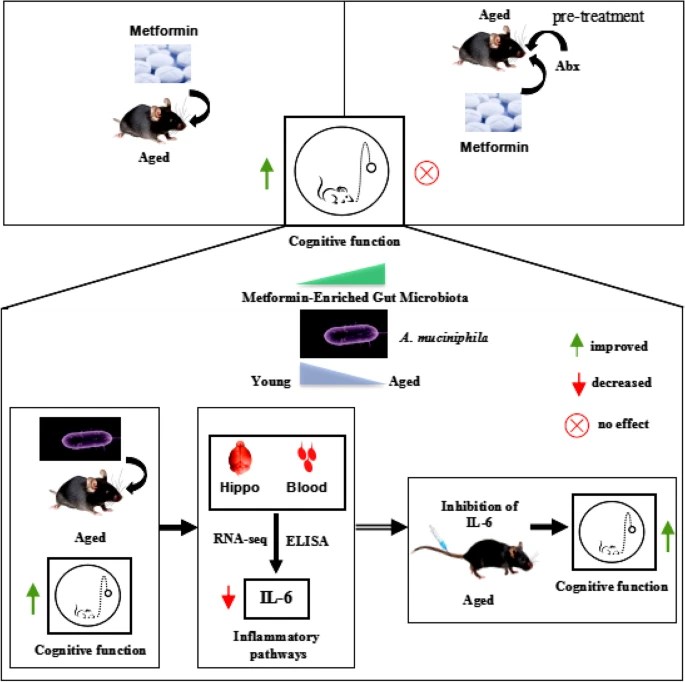
This 2023 rodent study investigated associations between a drug, a gut microbiota species, cognitive function, and proinflammatory cytokine interleukin-6:

“We show that gut microbiota is altered by metformin, which is necessary for protection against ageing-associated cognitive function declines in aged mice.

  • Mice treated with antibiotics did not exhibit metformin-mediated cognitive function protection.
  • Treatment with Akkermansia muciniphila improved cognitive function in aged mice.
  • A. muciniphila decreased proinflammatory-associated pathways, particularly that of proinflammatory cytokine interleukin (IL)-6, in both peripheral blood and hippocampal profiles, which was correlated with cognitive function improvement.
  • An IL-6 antibody protected cognitive function, and an IL-6 recombinant protein abolished the protective effect of A. muciniphila on cognitive function in aged mice.

40168_2023_1567_Figa_HTML

A. muciniphila, which is mediated in gut microbiota by metformin, modulates inflammation-related pathways in the host and improves cognitive function in aged mice by reducing proinflammatory cytokine IL-6 both systemically and in the hippocampus. This is direct evidence to validate that gut microbiota mediate the effect of metformin on cognitive improvement.”

https://microbiomejournal.biomedcentral.com/articles/10.1186/s40168-023-01567-1Akkermansia muciniphila, which is enriched in the gut microbiota by metformin, improves cognitive function in aged mice by reducing the proinflammatory cytokine interleukin-6″


IL-6 may be useful with other biomarkers of impaired cognitive function. It’s too coarse to track improved cognitive function past a certain point, though. Maybe the current IL-6 blood test can be refined as high-specificity CRP and regular CRP blood tests were done?

We don’t need to take this drug or be concerned about this gut bacteria species in order to lower inflammation. Click the IL-6 link above and see blog posts such as Part 2 of Rejuvenation therapy and sulforaphane for other methods.

PXL_20230630_092833465

Nrf2 Week #6: Phytochemicals

This 2023 review explored Nrf2 relationships with plant chemicals:

“This review focuses on possible mechanisms of Nrf2 activation by natural phytochemicals in preventing or treating chronic diseases, and regulating oxidative stress. Excess oxidative stress is closely related to many kinds of chronic diseases, such as cardiovascular diseases, cancer, neurodegenerative diseases, diabetes, obesity, and other inflammatory diseases.

Mitochondrial dysfunction and hyperglycemia lead to the massive production of ROS, which triggers molecular damage, inflammation, ferroptosis, insulin resistance, and β-cell dysfunction.

antioxidants-12-00236-g001

Crosstalk between Keap1-Nrf2-ARE pathway and other signaling pathways endows it with high complexity and significance in the multi-function of phytochemicals. Limited human data makes an urgent need to open the new field of phytochemical-original supplement application in human chronic disease prevention.”

https://www.mdpi.com/2076-3921/12/2/236 “The Regulatory Effect of Phytochemicals on Chronic Diseases by Targeting Nrf2-ARE Signaling Pathway”


Top ten mentions, not including references:

  • 21 Sulforaphane
  • 16 Broccoli
  • 9 Curcumin
  • 5 Resveratrol
  • 5 Green tea catechins
  • 4 Luteolin
  • 3 Garlic
  • 3 Soy isoflavones
  • 3 Lycopene
  • 3 Quercetin

PXL_20230518_191008431

Don’t eat yourself into disease, Part 2

This blog’s 1000th curation is a 2023 rodent study associating gut microbiota, behavior, memory, and food reward:

“Energy intake and energy expenditure is regulated by the hypothalamus, and is referred to as homeostatic regulation of food intake. The reward system is the non-homeostatic regulation of food intake – pleasure-related consumption of foods enriched in fat and sugar. The pleasure is encoded by dopamine release from dopaminergic neurons projecting from the ventral tegmental area to the striatum, the nucleus accumbens, and the prefrontal cortex.

Food reward can be divided into three components – liking, wanting, and learning:

  • Liking refers to food hedonic value;
  • Wanting to the motivational process to seek out and consume certain foods; and
  • Learning to reinforcing conditioning behavior associated with food intake stimulus.

We confirmed that obese mice have a dysregulation of the learning and the wanting components of  food reward. Our previous data showed that the liking component was transferable through fecal material transplantation.

We demonstrated that gut microbes play a role in the regulation of food reward, and could be responsible for compulsive behavior and excessive motivation to obtain sucrose pellets. Moreover, obese gut microbes affected dopaminergic and opioid markers involved in reward system.

We identified 33HPP (produced exclusively by gut bacteria) as particularly increased in mice recipients of gut microbes from obese mice. We were able to demonstrate its effects as key mediator of the gut-brain axis controlling the reward response to palatable food.”

https://microbiomejournal.biomedcentral.com/articles/10.1186/s40168-023-01526-w “Obese-associated gut microbes and derived phenolic metabolite as mediators of excessive motivation for food reward”


PXL_20230415_195202937

Broccoli sprouts activate the AMPK pathway, Part 4

Today someone viewed the 2020 Part 3 of Broccoli sprouts activate the AMPK pathway which lacked citations at the time. Checking again, here are three citing 2022 papers, starting with a review:

“Nrf2 is an important transcription factor that regulates expression of a large number of genes in healthy and disease states. Nrf2 regulates expression of several key components of oxidative stress, mitochondrial biogenesis, mitophagy, autophagy, and mitochondrial function in all organs of the human body, and in the peripheral and central nervous systems.

Overall, therapeutic drugs including sulforaphane that target Nrf2 expression and Nrf2/ARE pathway are promising. This article proposes additional research in Nrf2’s role within Parkinson’s disease, Huntington’s disease, and ischemic stroke in preclinical mouse models and humans with age-related neurodegenerative diseases.”

https://www.sciencedirect.com/science/article/pii/S1568163722001982 “Role of Nrf2 in aging, Alzheimer’s and other neurodegenerative diseases” (not freely available) Thanks to Dr. P. Hemachandra Reddy for providing a copy.


One of the Part 3 study’s coauthors contributed to this very detailed review:

“Due to observed overlapping cellular responses upon AMPK or NRF2 activation and common stressors impinging on both AMPK and NRF2 signaling, it is plausible to assume that AMPK and NRF2 signaling may interdepend and cooperate to readjust cellular homeostasis.

1-s2.0-S089158492200497X-gr3_lrg

The outcome and underlying signaling events of AMPK-NRF2 crosstalk may diverge between:

  1. in vitro and in vivo studies (one cell type in isolation vs inter-organ crosstalk in living organisms);
  2. Different cell types/organs/organisms of different cultivation conditions, genetic background, age or sex;
  3. Different stress-regimens (chronic vs acute, nature of stress (lipotoxicity, redox stress, xenobiotic, starvation, etc));
  4. Different modes of Nrf2 or AMPK activation and inhibition (genetic vs pharmacological, constitutive vs transient/intermittent, systemic vs organ-specific, electrophilic vs PPI, allosteric vs covalent, or pan vs subtype-specific);
  5. Different target genes with distinct promoter and enhancer structure; or
  6. Different timing of activation.

The latter should deserve increased attention as Nrf2 is one of the most cycling genes under control of the circadian clock. Feeding behavior, metabolism and hence AMPK activity follow and substantiate the biological clock, indicating an entangled circadian regulation of metabolic and redox homeostasis.”

https://www.sciencedirect.com/science/article/pii/S089158492200497X “AMPK and NRF2: Interactive players in the same team for cellular homeostasis?”


A third citing paper was a study of lens cells that provided an example of similar metformin effects noted in Part 2 of Broccoli sprouts activate the AMPK pathway:

“Loss of Nrf2 and Nrf2 antioxidant genes expression and activity in aging cells leads to an array of oxidative-induced deleterious responses, impaired function, and aging pathologies. This deterioration is proposed to be the primary risk factor for age-related diseases such as cataracts.

AMPK regulates energy at physiological levels during metabolic imbalance and stress. AMPK is a redox sensing molecule, and can be activated under cellular accumulation of reactive oxygen species, which are endogenously produced due to loss of antioxidant enzymes.

The therapeutic potential of AMPK activation has context-dependent beneficial effects, from cell survival to cell death. AMPK activation was a requisite for Bmal1/Nrf2-antioxidants-mediated defense, as pharmacologically inactivating AMPK impeded metformin’s effect.

Using lens epithelial cell lines (LECs) of human or mouse aging primary LECs along with lenses as model systems, we demonstrated that metformin could correct deteriorated Bmal1/Nrf2/ARE pathway by reviving AMPK-activation and transcriptional activities of Bmal1/Nrf2, resulting in increased antioxidants enzymatic activity and expression of Phase II enzymes. Results uncovered crosstalk between AMPK and Bmal1/Nrf2/antioxidants mediated by metformin for blunting oxidative/aging-linked pathobiology.”

https://www.mdpi.com/2073-4409/11/19/3021/htm “Obligatory Role of AMPK Activation and Antioxidant Defense Pathway in the Regulatory Effects of Metformin on Cellular Protection and Prevention of Lens Opacity”


PXL_20221027_185754842

Non-patentable boron benefits

To follow up Is boron important to health? I’ll highlight a 2022 review of boron intake:

“Boron is essential for activity of several metabolic enzymes, hormones, and micronutrients. It is important for growth and maintenance of bone, reduction in inflammatory biomarkers, and increasing levels of antioxidant enzymes.

The average person’s daily diet contains 1.5 to 3 milligrams of boron. Boron intakes of 1–3 mg/day have been shown to improve bone and brain health in adults when compared to intakes of 0.25–0.50 mg/day.

One week of 10 mg/d boron supplementation resulted in a 20% reduction in inflammatory biomarkers TNF-α, as well as significant reductions (nearly 50%) in plasma concentrations of hs-CRP and IL-6. Calcium fructoborate, a naturally occurring, plant-based boron-carbohydrate complex, had beneficial effects on osteoarthritis (OA) symptoms. A double-blind study in middle-aged patients with primary OA found that all groups except the placebo group saw a reduction in inflammatory biomarkers after 15 days of food supplementation with calcium fructoborate.

Dietary boron intake significantly improves brain function and cognitive functioning in humans. Electroencephalograms showed that boron pharmacological intervention after boron deficiency improved functioning in older men and women, such as less drowsiness and mental alertness, better psychomotor skills (for example, motor speed and dexterity), and better cognitive processing (e.g., attention and short-term memory). Boron compounds can help with both impaired recognition and spatial memory problems.

We discussed the role of boron-based diet in memory, boron and microbiome relation, boron as anti-inflammatory agents, and boron in neurodegenerative diseases. Boron reagents will play a significant role to improve dysbiosis.”

https://www.mdpi.com/1420-3049/27/11/3402/htm “The Role of Microbiome in Brain Development and Neurodegenerative Diseases”


PXL_20220814_101418757

Broccoli sprouts and your brain

A 2022 review of Nrf2 signaling hilariously avoided mentioning sulforaphane, although of ~4,000 sulforaphane published articles, two were cited. I’ll curate it anyway to highlight referenced brain effects.

“A good stability of NRF2 activity is crucial to maintain redox balance and therefore brain homeostasis. In this review, we have gathered recent data about the contribution of the NRF2 pathway in the healthy brain as well as during metabolic diseases, ageing, and ageing-related neurodegenerative diseases.

A functional NRF2 system is important to regulate both neuroinflammation, i.e., activation of microglia and astrocytes, and oxidative stress in the brain. NRF2 and NF-κB transcription factors regulate cellular responses to inflammation and oxidative stress in order to maintain brain homeostasis. Both pathways have been described to inhibit each other.

Nrf2 brain aging

Future challenges will be to establish novel therapies to:

  • Increase NRF2 activation in specific cell types and/or brain regions; and
  • Modulate NRF2 pathway in senescent cells.

Modulation of NRF2 signalling pathway by using specific food products [like unmentioned broccoli sprouts] and phytochemicals [like unmentioned sulforaphane], dietary supplements [like unmentioned Vitamin D3], drugs, and epigenetic modifiers, alone or in combination, will help to limit inflammatory diseases, ageing process, and subsequently ageing-related diseases.”

https://www.mdpi.com/2076-3921/11/8/1426/htm “Normal and Pathological NRF2 Signalling in the Central Nervous System”


PXL_20220808_095334058