Genetic imprinting, sleep, and parent-offspring conflict

This 2016 Italian review subject was the interplay of genetic imprinting and sleep regulation:

“Sleep results from the synergism between at least two major processes: a homeostatic regulatory mechanism that depends on the accumulation of the sleep drive during wakefulness, and a circadian self-sustained mechanism that sets the time for sleeping and waking throughout the 24-hour daily cycle.

REM sleep apparently contravenes the restorative aspects of sleep; however, the function of this ‘paradoxical’ state remains unknown. Although REM sleep may serve important functions, a lack of REM sleep has no major consequences for survival in humans; however, severe detrimental effects have been observed in rats.

Opposite imprinting defects at chromosome 15q11–13 are responsible for opposite sleep phenotypes as well as opposite neurodevelopmental abnormalities, namely the Prader-Willi syndrome (PWS) and the Angelman syndrome (AS). Whilst the PWS is due to loss of paternal expression of alleles, the AS is due to loss of maternal expression.

Maternal additions or paternal deletions of alleles at chromosome 15q11–13 are characterized by temperature control abnormalities, excessive sleepiness, and specific sleep architecture changes, particularly REM sleep deficits. Conversely, paternal additions or maternal deletions at chromosome 15q11–13 are characterized by reductions in sleep and frequent and prolonged night wakings.

The ‘genomic imprinting hypothesis of sleep’ remains in its infancy, and several aspects require attention and further investigation.”

http://journals.plos.org/plosgenetics/article?id=10.1371/journal.pgen.1006004 “Genomic Imprinting: A New Epigenetic Perspective of Sleep Regulation”


A commenter to the review referenced a 2014 study Troubled sleep: night waking, breastfeeding, and parent–offspring conflict that received several reactions, including one by the same commenter. Here are a few quotes from the study author’s consolidated response:

“‘Troubled sleep’ had two major purposes. The first was to draw attention to the oppositely perturbed sleep of infants with PWS and AS and explore its evolutionary implications. The involvement of imprinted genes suggests that infant sleep has been subject to antagonistic selection on genes of maternal and paternal origin with genes of maternal origin favoring less disrupted sleep.

My second major purpose was a critique of the idea that children would be happier, healthier and better-adjusted if we could only return to natural methods of child care. This way of thinking is often accompanied by a belief that modern practices put children at risk of irrevocable harm.

The truth of such claims is ultimately an empirical question, but the claims are sometimes presented as if they had the imprimatur of evolutionary biology. This appeal to scientific authority often seems to misrepresent what evolutionary theory predicts: that which evolves is not necessarily that which is healthy.

Why should pregnancy not be more efficient and more robust than other physiological systems, rather than less? Crucial checks, balances and feedback controls are lacking in the shared physiology of the maternal–fetal unit.

Infant sleep may similarly lack the exquisite organization of systems without evolutionary conflict. Postnatal development, like prenatal development, is subject to difficulties of evolutionarily credible communication between mothers and offspring.”

The author addressed comments related to attachment theory:

“Infants are classified as having insecure-resistant attachment if they maintain close proximity to their mother after a brief separation while expressing negative emotions and exhibiting contradictory behaviors that seem to both encourage and resist interaction. By contrast, infants are classified as having insecure-avoidant attachment if they do not express negative emotion and avoid contact with their mother after reunion.

Insecure-avoidant and insecure-resistant behaviors might be considered antithetic accommodations of infants to less responsive mothers; the former associated with reduced demands on maternal attention, the latter with increased demands. A parallel pattern is seen in effects on maternal sleep. Insecure-avoidant infants wake their mothers less frequently, and insecure-resistant infants more frequently, than securely attached infants.

Parent–child interactions are transformed once children can speak. Infants with more fragmented sleep at 6 months had less language at 18 and 30 months.

Infants with AS have unconsolidated sleep and never learn to speak. The absence of language in the absence of expression of one or more MEGs [maternally expressed imprinted genes] is compatible with a hypothesis in which earlier development of language reduces infant demands on mothers.”

Regarding cultural differences:

“China, Taiwan and Hong Kong have both high rates of bed-sharing and high rates of problematic sleep compared with western countries. Within this grouping, however, more children sleep in their own room but parents report fewer sleep problems in Hong Kong than in either China or Taiwan.

Clearly, cultural differences are significant, and the causes of this variation should be investigated, but the differences cannot be summarized simply as ‘west is worst’.

The fitness [genetic rather than physical fitness] gain to mothers of an extra child and the benefits for infants of longer IBIs [interbirth intervals] are substantial. These selective forces are unlikely to be orders of magnitude weaker than the advantages of lactase persistence, yet the selective forces associated with dairying have been sufficient to result in adaptive genetic differentiation among populations.

The possibility of gene–culture coevolution should not be discounted for behaviors associated with infant-care practices.”

Regarding a mismatch between modern and ancestral environments:

“I remain skeptical of a tendency to ascribe most modern woes to incongruence between our evolved nature and western cultural practices. We did not evolve to be happy or healthy but to leave genetic descendants, and an undue emphasis on mismatch risks conflating health and fitness.

McKenna [a commenter] writes ‘It isn’t really nice nor maybe even possible to fool mother nature.’ Here I disagree. Our genetic adaptations often try to fool us into doing things that enhance fitness at costs to our happiness.

Our genes do not care about us and we should have no compunction about fooling them to deliver benefits without serving their ends. Contraception, to take one obvious example, allows those who choose childlessness to enjoy the pleasures of sexual activity without the fitness-enhancing risk of conception.

Night waking evolved in environments in which there were strong fitness costs from short IBIs and in which parents lacked artificial means of birth-spacing. If night waking evolved because it prolonged IBIs, then it may no longer serve the ends for which it evolved.

Nevertheless, optimal infant development might continue to depend on frequent night feeds as part of our ingrained evolutionary heritage.

It could also be argued that when night waking is not reinforced by feeding, and infants sleep through the night, then conflict within their genomes subsides. Infants would then gain the benefit of unfragmented sleep without the pleiotropic costs of intragenomic conflict. Plausible arguments could be presented for either hypothesis and a choice between them must await discriminating evidence.”


Commenters on the 2014 study also said:

[Crespi] The profound implications of Haig’s insights into the roles of evolutionary conflicts in fetal, infant and maternal health are matched only by the remarkable absence of understanding, appreciation or application of such evolutionary principles among the research and clinical medical communities, or the general public.

[Wilkins] A mutation may be selected for its effect on the trait that is the basis of the conflict, but that mutation also likely affects other traits. In general, we expect that these pleiotropic effects to be deleterious: conflict over one trait can actually drive other traits to be less adapted. Natural selection does not necessarily guarantee positive health outcomes.

[McNamara] Assuming that AS/REM is differentially influenced by genes of paternal origin then both REM properties and REM-associated awakenings can be better explained by mechanisms of genomic conflict than by traditional claims that REM functions as an anti-predator ‘sentinel’ for the sleeping organism.

[Hinde] Given this context of simultaneous coordination and conflict between mother and infant, distinguishing honest signals of infant need from self-interested, care-extracting signals poses a challenge.

A limited study of parental transmission of anxiety/stress-reactive traits

BehavioralTraitsThis 2016 New York rodent study found:

“Parental behavioural traits can be transmitted by non-genetic mechanisms to the offspring.

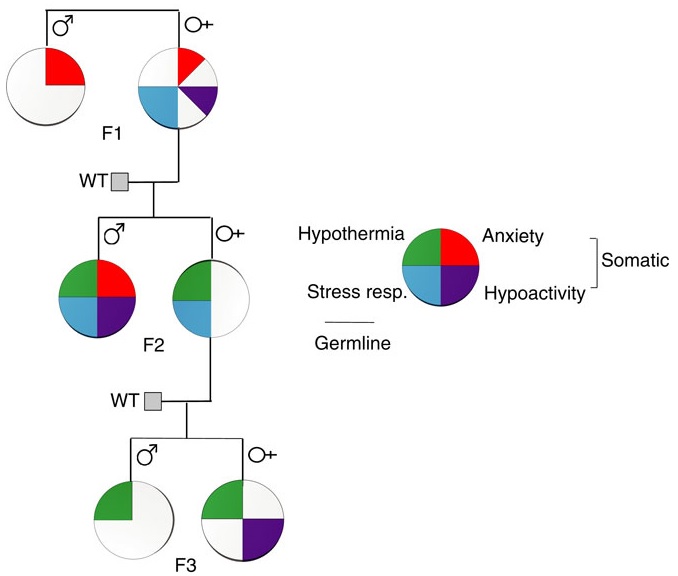
We show that four anxiety/stress-reactive traits are transmitted via independent iterative-somatic and gametic epigenetic mechanisms across multiple generations.

As the individual traits/pathways each have their own generation-dependent penetrance and gender specificity, the resulting cumulative phenotype is pleiotropic. In the context of genetic diseases, it is typically assumed that this phenomenon arises from individual differences in vulnerability to the various effects of the causative gene. However, the work presented here reveals that pleiotropy can be produced by the variable distribution and segregated transmission of behavioural traits.”


A primary focus was how anxiety was transmitted from parents to offspring:

“The iterative propagation of the male-specific anxiety-like behaviour is most compatible with a model in which proinflammatory state is propagated from H [serotonin1A receptor heterozygote] F0 to F1 [children] females and in which the proinflammatory state is acquired by F1 males from their H mothers, and then by F2 [grandchildren] males from their F1 mothers.

We propose that increased levels of gestational MIP-1β [macrophage inflammatory protein 1β] in H and F1 mothers, together with additional proinflammatory cytokines and bioactive proteins, are required to produce immune system activation in their newborn offspring, which in turn promotes the development of the anxiety-like phenotype in males.

In particular, increase in the number of monocytes and their transmigration to the brain parenchyma in F1 and F2 males could be central to the development of anxiety.”


The researchers studied transmission of behavioral traits and epigenetic changes. Due to my quick take on the study title – “Behavioural traits propagate across generations..” – I had expectations of this study that weren’t born out. What could the researchers have done versus what they did?

The study design removed prenatal and postnatal parental behavioral transmission of behavioral traits and epigenetic changes as each generation’s embryos were implanted into foster wild-type (WT) mothers.

The study design substituted the foster mothers’ prenatal and postnatal parental environments for the biological parents’ environments. So we didn’t find out, for example:

  • To what extents the overly stress-reactive F1 female children’s prenatal environments and postnatal behaviors induced behaviors and/or epigenetic changes in their children; and
  • Whether the F2 grandchildren’s parental behaviors subsequently induced behaviors and/or epigenetic changes in the F3 great-grandchildren.

How did the study meet the overall goal of rodent studies: to help humans?

    1. Only a minority of humans experienced an early-life environment that included primary caregivers other than our biological parents.
    2. Very, very few of us experienced a prenatal environment other than our biological mothers.
    3. The study’s thorough removal of parental behavior was an outstanding methodology to confirm by falsifiability whether parental behavior was both an intergenerational and transgenerational epigenetic inheritance mechanism.
    4. Maybe the researchers filled in some gaps in previous rodent studies, such as determining what is or isn’t a “true transgenerational mechanism.”

As an example of a rodent study that more closely approximated human conditions, the behavior of a mother whose DNA was epigenetically changed by stress induced the same epigenetic changes to her child’s DNA when her child was stressed per One way that mothers cause fear and emotional trauma in their infants:

“Our results provide clues to understanding transmission of specific fears across generations and its dependence upon maternal induction of pups’ stress response paired with the cue to induce amygdala-dependent learning plasticity.”


How did parental behavioral transmission of behavioral traits and epigenetic changes become a subject not worth investigating? These traits and effects can be seen everyday in real-life human interactions, and in every human’s physiology.

But when investigating human correlates with behavioral epigenetic changes of rodents in the laboratory, parental behavioral transmission of behavioral traits is often treated the way this study treated it: as a confounder.

I doubt that people who have reached some degree of honesty about their early lives and concomitant empathy for others would agree with this prioritization. The papers of Transgenerational epigenetic inheritance week show the spectrum of opportunities to advance science that were intentionally missed.

http://www.nature.com/ncomms/2016/160513/ncomms11492/full/ncomms11492.html “Behavioural traits propagate across generations via segregated iterative-somatic and gametic epigenetic mechanisms”

A human study of pain avoidance

This 2016 UK human study found:

“People differ in how they learn to avoid pain, with some individuals refraining from actions that resulted in painful outcomes, whereas others favor actions that helped prevent pain.

Learning in our task was best explained as driven by an outcome prediction error that reflects the difference between expected and actual outcomes. Consistent with the expression of such a teaching signal, blood-oxygen level-dependent (BOLD) responses to outcomes in the striatum were modulated by expectation.

Positive learners showed significant functional connectivity between the insula and striatal regions, whereas negative learners showed significant functional connectivity between the insula and amygdala regions.

The degree to which a participant tended to learn from success in avoiding than experiencing shocks was predicted by the structure of a participants’ striatum, specifically by higher gray matter density where the response to shocks was consistent with a prediction error signal.

Higher gray matter density in the putamen (and lower gray matter density in the caudate) predicted better learning from shocks and poorer learning from success in avoiding shocks.”

The researchers termed the subjects’ pain responses “learning” instead of conditioning. The difference between the two terms in the experimental contexts was that the subjects weren’t presented with 100%-certain choices to avoid pain.

The experiments were also rigged to force choices at similar rates among subjects because:

“Participants who learned more from painful outcomes developed a propensity to avoid gambling, whereas participants who learned more from success in preventing pain developed a propensity to gamble.”


Human responses to pain don’t arise out of nowhere. The subjects’ pain histories were clearly relevant, but weren’t investigated.

The closest the study came to considering the subjects’ histories was:

“Before the experiment, participants completed an 80-item questionnaire composed of several measures of different mood and anxiety traits. Age, sex and mood and anxiety traits did not differ between participants later classified as positive and negative learners.”

Emotional content was neither included nor solicited. Emotions were inferred:

“Participants biased in favor of passive avoidance learning (i.e., learning what gambles should be avoided), striatal response to painful outcomes was consistent with an aversive prediction error, as seen in fear conditioning.”

As a result, there weren’t causal explanations for the subjects’ differing pain responses. How, when, and why did the behavioral, functional, and structural differences develop?


I didn’t see the level of detail needed to characterize striatal regions into the Empathy, value, pain, control: Psychological functions of the human striatum segments. I’d guess that the findings of “higher gray matter density in the putamen (and lower gray matter density in the caudate)” applied to the posterior putamen and the anterior caudate nucleus.

Two of the coauthors were also coauthors of If a study didn’t measure feelings, then its findings may not pertain to genuine empathy which I rated < 0 Detracted from science. The technique of Why do we cut short our decision-making process? was referenced.

http://www.pnas.org/content/early/2016/04/06/1519829113.full “Striatal structure and function predict individual biases in learning to avoid pain”

A one-sided review of stress

The subject of this 2016 Italian/New York review was the stress response:

“The stress response, involving the activation of the hypothalamic-pituitary-adrenocortical [HPA] axis and the consequent release of corticosteroid hormones, is indeed aimed at promoting metabolic, functional, and behavioral adaptations. However, behavioral stress is also associated with fast and long-lasting neurochemical, structural, and behavioral changes, leading to long-term remodeling of glutamate transmission, and increased susceptibility to neuropsychiatric disorders.

Of note, early-life events, both in utero and during the early postnatal life, trigger reprogramming of the stress response, which is often associated with loss of stress resilience and ensuing neurobehavioral (mal)adaptations.”


The reviewers’ intentional dismissal of the role of GABA in favor of the role of glutamate was a key point:

“The changes in neuronal excitability and synaptic plasticity induced by stress are the result of an imbalance of excitatory (glutamatergic) and inhibitory (GABAergic) transmission, leading to long-lasting (mal)adaptive functional modifications. Although both glutamate and GABA transmission are critically associated with stress-induced alteration of neuronal excitability, the present review will focus on the modulation of glutamate release and transmission induced by stress and glucocorticoids.”

No particular reason was given for this bias. I inferred from the review’s final sentence that the review’s sponsors and funding prompted this decision:

“In-depth studies of changes in glutamate transmission and dendrite remodeling induced by stress in early and late life will help to elucidate the biological underpinnings of the (mal)adaptive strategies the brain adopts to cope with environmental challenges in one’s life.”

The bias led to ignoring evidence for areas the reviewers posed as needing further research. An example of relevant research the reviewers failed to consider was the 2015 Northwestern University study I curated in A study that provided evidence for basic principles of Primal Therapy that found:

“In response to traumatic stress, some individuals, instead of activating the glutamate system to store memories, activate the extra-synaptic GABA system and form inaccessible traumatic memories.”

http://www.ncbi.nlm.nih.gov/pmc/articles/PMC4812483/ “Stress Response and Perinatal Reprogramming: Unraveling (Mal)adaptive Strategies”

The current paradigm of child abuse limits pre-childhood causal research

As an adult, what would be your primary concern if you suspected that your early life had something to do with current problems? Would you be interested in effective treatments for causes of your symptoms?

Such information wasn’t available in this 2016 Miami review of the effects of child abuse. The review laid out the current paradigm mentioned in Grokking an Adverse Childhood Experiences (ACE) score, one that limits research into pre-childhood causes for later-life symptoms.

The review’s goal was to describe:

“How numerous clinical and basic studies have contributed to establish the now widely accepted idea that adverse early life experiences can elicit profound effects on the development and function of the nervous system.”

The hidden assumptions of almost all of the cited references were that these distant causes could no longer be addressed. Aren’t such assumptions testable today?

As an example, the Discussion section posed the top nine “most pressing unanswered questions related to the neurobiological effects of early life trauma.” In line with the current paradigm, the reviewer assigned “Are the biological consequences of ELS [early life stress] reversible?” into the sixth position.

If the current paradigm encouraged research into treatment of causes, there would probably already be plenty of evidence to demonstrate that directly reducing the source of damage would also reverse damaging effects. There would have been enough studies done so that the generalized question of reversibility wouldn’t be asked.

Aren’t people interested in treatments of originating causes so that their various symptoms don’t keep bubbling up? Why wouldn’t research paradigms be aligned accordingly?


The review also demonstrated how the current paradigm of child abuse misrepresented items like telomere length and oxytocin. Researchers on the bandwagon tend to forget about the principle Einstein expressed as:

“No amount of experimentation can ever prove me right; a single experiment can prove me wrong.”

That single experiment for telomere length arrived in 2016 with Using an epigenetic clock to distinguish cellular aging from senescence. The review’s seven citations for telomere length that all had findings “associated with” or “linked to” child abuse should now be viewed in a different light.

The same light shone on oxytocin with Testing the null hypothesis of oxytocin’s effects in humans and Oxytocin research null findings come out of the file drawer. See their references, and decide for yourself whether or not:

“Claimed research findings may often be simply accurate measures of the prevailing bias.”

http://www.cell.com/neuron/fulltext/S0896-6273%2816%2900020-9 “Paradise Lost: The Neurobiological and Clinical Consequences of Child Abuse and Neglect”


This post has somehow become a target for spammers, and I’ve disabled comments. Readers can comment on other posts and indicate that they want their comment to apply here, and I’ll re-enable comments.

A review that inadvertently showed how memory paradigms prevented relevant research

This 2016 Swiss review of enduring memories demonstrated what happens when scientists’ reputations and paychecks interfered with them recognizing new research and evidence in their area but outside their paradigm: “A framework containing the basic assumptions, ways of thinking, and methodology that are commonly accepted by members of a scientific community.”

A. Most of the cited references were from decades ago that established these paradigms of enduring memories. Fine, but the research these paradigms excluded was also significant.

B. All of the newer references were continuations of established paradigms. For example, a 2014 study led by one of the reviewers found:

“Successful reconsolidation-updating paradigms for recent memories fail to attenuate remote (i.e., month-old) ones.

Recalling remote memories fails to induce histone acetylation-mediated plasticity.”

The researchers elected to pursue a workaround of the memory reconsolidation paradigm when the need for a new paradigm of enduring memories directly confronted them!

C. None of the reviewers’ calls for further investigations challenged existing paradigms. For example, when the reviewers suggested research into epigenetic regulation of enduring memories, they somehow found it best to return to 1984, a time when dedicated epigenetics research had barely begun:

“Whether memories might indeed be ‘coded in particular stretches of chromosomal DNA’ as originally proposed by Crick [in 1984] and if so what the enzymatic machinery behind such changes might be remain unclear. In this regard, cell population-specific studies are highly warranted.”


Two examples of relevant research the review failed to consider:

1. A study that provided evidence for basic principles of Primal Therapy went outside existing paradigms to research state-dependent memories:

“If a traumatic event occurs when these extra-synaptic GABA receptors are activated, the memory of this event cannot be accessed unless these receptors are activated once again.

It’s an entirely different system even at the genetic and molecular level than the one that encodes normal memories.”

What impressed me about that study was the obvious nature of its straightforward experimental methods. Why hadn’t other researchers used the same methods decades ago? Doing so could have resulted in dozens of informative follow-on study variations by now, which is my point in Item A. above.

2. A relevant but ignored 2015 French study What can cause memories that are accessible only when returning to the original brain state? which supported state-dependent memories:

“Posttraining/postreactivation treatments induce an internal state, which becomes encoded with the memory, and should be present at the time of testing to ensure a successful retrieval.”


The review also showed the extent to which historical memory paradigms depend on the subjects’ emotional memories. When it comes to human studies, though, designs almost always avoid studying emotional memories.

It’s clearly past time to Advance science by including emotion in research.

http://www.hindawi.com/journals/np/2016/3425908/ “Structural, Synaptic, and Epigenetic Dynamics of Enduring Memories”

What’s the underlying question for every brain study to answer?

Is the underlying question for every brain study to answer:

  • How do our brains internally represent the external world?

Is it:

  • How did we learn what we know?
  • How do we forget or disregard what we’ve learned?
  • What keeps us from acquiring and learning newer or better information?

How about:

  • What affects how we pay attention to our environments?
  • How do our various biochemical states affect our perceptions, learning, experiences, and behavior?
  • How do these factors in turn affect our biology?

Or maybe:

  • Why do we do what we do?
  • How is our behavior affected by our experiences?
  • How did we become attracted and motivated toward what we like?
  • How do we develop expectations?
  • Why do we avoid certain situations?

Not to lose sight of:

  • How do the contexts affect all of the above?
  • What happens over time to affect all of the above?

This 2015 UCLA paper reviewed the above questions from the perspective of Pavlovian conditioning:

“The common definition of Pavlovian conditioning, that via repeated pairings of a neutral stimulus with a stimulus that elicits a reflex the neutral stimulus acquires the ability to elicit that the reflex, is neither accurate nor reflective of the richness of Pavlovian conditioning. Rather, Pavlovian conditioning is the way we learn about dependent relationships between stimuli.

Pavlovian conditioning is one of the few areas in biology in which there is direct experimental evidence of biological fitness.”


The most important question unanswered by the review was:

  • How can its information be used to help humans?

How can Pavlovian conditioning answer: What can a human do about the thoughts, feelings, behavior, epigenetic effects – the person – the phenotype – that they’ve been shaped into?

One example of the unanswered question: the review pointed out in a section about fear extinction that this process doesn’t involve unlearning. Fear extinction instead inhibits the symptoms of fear response. The fear memory is still intact, awaiting some other context to be reactivated and expressed.

How can this information be used to help humans?

  • Is inhibiting the symptoms and leaving the fear memory in place costless with humans?
  • Or does this practice have both potential and realized adverse effects?
  • Where’s the human research on methods that may directly address a painful emotional memory?

One relevant hypothesis of Dr. Arthur Janov’s Primal Therapy is that a person continues to be their conditioned self until they address the sources of their pain. A corollary is that efforts to relieve symptoms seldom address causes.

How could it be otherwise? A problem isn’t cured by ameliorating its effects.

http://cshperspectives.cshlp.org/content/8/1/a021717.full “The Origins and Organization of Vertebrate Pavlovian Conditioning”

Early-life epigenetic regulation of the oxytocin receptor gene

This 2015 US/Canadian rodent study investigated the effects of natural variation in maternal care:

“The effects of early life rearing experience via natural variation in maternal licking and grooming during the first week of life on behavior, physiology, gene expression, and epigenetic regulation of Oxtr [oxytocin receptor gene] across blood and brain tissues (mononucleocytes, hippocampus, striatum, and hypothalamus).

Rats reared by high licking-grooming (HL) and low licking-grooming (LL) rat dams exhibited differences across study outcomes:

  • LL offspring were more active in behavioral arenas,
  • Exhibited lower body mass in adulthood, and
  • Showed reduced corticosterone responsivity to a stressor.

Oxtr DNA methylation was significantly lower at multiple CpGs in the blood of LL versus HL males, but no differences were found in the brain. Across groups, Oxtr transcript levels in the hypothalamus were associated with reduced corticosterone secretion in response to stress, congruent with the role of oxytocin signaling in this region.

Methylation of specific CpGs at a high or low level was consistent across tissues, especially within the brain. However, individual variation in DNA methylation relative to these global patterns was not consistent across tissues.

These results suggest that:

  • Blood Oxtr DNA methylation may reflect early experience of maternal care, and
  • Oxtr methylation across tissues is highly concordant for specific CpGs, but
  • Inferences across tissues are not supported for individual variation in Oxtr methylation.

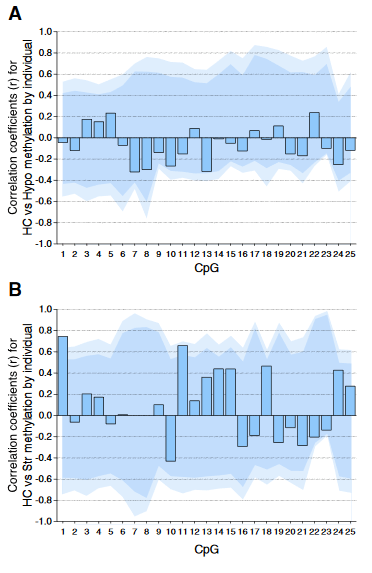
nonsignificance

Individual DNA methylation values were not correlated across brain tissues, despite tissue concordance at the group level.

For each CpG, we computed the Pearson correlation coefficient r between methylation values for matched samples in pairs of brain regions (bars). Dark and light shaded regions represent 95% and 99% thresholds, respectively, of distributions of possible correlation coefficients determined from 10,000 permutations of the measured values among the individuals. These distributions represent the null hypothesis that an individual DNA methylation value in one brain region does not help to predict the value in another region in the same animal.

(A) Correlations based on pyrosequencing data for matched samples passing validation in both hippocampus (HC) and hypothalamus (Hypo). Correlations for individuals at each CpG were either weak (.2 < r < .3) or absent (r < .2), and none were significant, even prior to correction for multiple comparisons.

(B) Correlations for matched samples passing validation in both hippocampus and striatum (Str). Two correlations (CpG 1 and 11) were individually significant prior to but not following correction, and this result could be expected by chance.

Correlations between hippocampus and blood (described in the text) yielded similar results, and no particular CpG yielded consistently high correlation across multiple tissues.”


The study focused on whether or not an individual’s experience-dependent oxytocin receptor gene DNA methylation in one of the four studied tissues could be used to infer a significant effect in the three other tissues. The main finding was NO, it couldn’t!

The researchers’ other findings may have been strengthened had they also examined causes for the observed effects. The “natural variation in maternal licking and grooming” developed from somewhere, didn’t it?

The subjects’ mothers were presumably available for the same tests as the subjects, but nothing was done with them. Investigating at least one earlier generation may have enabled etiologic associations of “the effects of early life rearing experience” and “individual variation in DNA methylation.”

https://www.sciencedirect.com/science/article/abs/pii/S0018506X1500118X “Natural variation in maternal care and cross-tissue patterns of oxytocin receptor gene methylation in rats” (not freely available)

Does vasopressin increase mutually beneficial cooperation?

This 2016 German human study found:

“Intranasal administration of arginine vasopressin (AVP), a hormone that regulates mammalian social behaviors such as monogamy and aggression, increases humans’ tendency to engage in mutually beneficial cooperation.

AVP increases humans’ willingness to cooperate. That increase is not due to an increase in the general willingness to bear risks or to altruistically help others.”


One limitation of the study was that the subjects were all males, ages 19-32. The study’s title was “human risky cooperative behavior” while omitting subjects representing the majority of humanity.

Although the researchers claimed brain effects from vasopressin administration, they didn’t provide direct evidence for the internasally administered vasopressin in the subjects’ brains. A similar point was made about studies of vasopressin’s companion neuropeptide, oxytocin, in Testing the null hypothesis of oxytocin’s effects in humans.

A third limitation was that although the researchers correlated brain activity with social behaviors, they didn’t carry out all of the tests necessary to demonstrate the claimed “novel causal evidence for a biological factor underlying cooperation.” Per Confusion may be misinterpreted as altruism and prosocial behavior, the researchers additionally needed to:

“When attempting to measure social behaviors, it is not sufficient to merely record decisions with behavioral consequences and then infer social preferences. One also needs to manipulate these consequences to test whether this affects the behavior.”

http://www.pnas.org/content/113/8/2051.full “Vasopressin increases human risky cooperative behavior”

The effects of imposing helplessness

This 2016 New York rodent study found:

“By using unbiased and whole-brain imaging techniques, we uncover a number of cortical and subcortical brain structures that have lower activity in the animals showing helplessness than in those showing resilience following the LH [learned helplessness] procedure. We also identified the LC [locus coeruleus] as the sole subcortical area that had enhanced activity in helpless animals compared with resilient ones.

Some of the brain areas identified in this study – such as areas in the mPFC [medial prefrontal cortex], hippocampus, and amygdala – have been previously implicated in clinical depression or depression-like behavior in animal models. We also identified novel brain regions previously not associated with helplessness. For example, the OT [olfactory tubercle], an area involved in odor processing as well as high cognitive functions including reward processing, and the Edinger–Westphal nucleus containing centrally projecting neurons implicated in stress adaptation.

The brains of helpless animals are locked in a highly stereotypic pathological state.”

Concerning the study’s young adult male subjects:

“To achieve a subsequent detection of neuronal activity related to distinct behavioral responses, we used the c-fosGFP transgenic mice expressing c-FosGFP under the control of a c-fos promoter. The expression of the c-fosGFP transgene has been previously validated to faithfully represent endogenous c-fos expression.

Similar to wild-type mice, approximately 22% (32 of 144) of the c-fosGFP mice showed helplessness.”

The final sentence of the Introduction section:

“Our study..supports the view that defining neuronal circuits underlying stress-induced depression-like behavior in animal models can help identify new targets for the treatment of depression.”


Helplessness is both a learned behavior and a cumulative set of experiences during every human’s early life. Therapeutic approaches to detrimental effects of helplessness can be different with humans than with rodents in that we can address causes.

The researchers categorized activity in brain circuits as causal in the Discussion section:

“Future studies aimed at manipulating these identified neural changes are required for determining whether they are causally related to the expression of helplessness or resilience.”

Studying whether or not activity in brain circuits induces helplessness in rodents may not inform us about causes of helplessness in humans. Our experiences are often the ultimate causes of helplessness effects. Many of our experiential “neural changes” are only effects, as demonstrated by this and other studies’ induced phenotypes such as “Learned Helplessness” and “Prenatally Restraint Stressed.”

Weren’t the researchers satisfied that the study confirmed what was known and made new findings? Why attempt to extend animal models that only treat effects to humans, as implied in the Introduction above and in the final sentence of the Discussion section:

“Future studies aimed at elucidating the specific roles of these regions in the pathophysiology of depression as well as serve as neural circuit-based targets for the development of novel therapeutics.”

http://journal.frontiersin.org/article/10.3389/fncir.2016.00003/full “Whole-Brain Mapping of Neuronal Activity in the Learned Helplessness Model of Depression” (Thanks to A Paper a Day Keeps the Scientist Okay)

Advance science by including emotion in research

This 2015 analysis of emotion studies found:

“Emotion categories [fear, anger, disgust, sadness, and happiness] are not contained within any one region or system, but are represented as configurations across multiple brain networks.

For example, among other systems, information diagnostic of emotion category was found in both large, multi-functional cortical networks and in the thalamus, a small region composed of functionally dedicated sub-nuclei.

The dataset consists of activation foci from 397 fMRI and PET [positron emission tomography] studies of emotion published between 1990 and 2011.”

From the fascinating Limitations section:

“Our analyses reflect the composition of the studies available in the literature, and are subject to testing and reporting biases on the part of authors. This is particularly true for the amygdala (e.g., the activation intensity for negative emotions may be over-represented in the amygdala given the theoretical focus on fear and related negative states). Other interesting distinctions were encoded in the thalamus and cerebellum, which have not received the theoretical attention that the amygdala has and are likely to be bias-free.

Some regions—particularly the brainstem—are likely to be much more important for understanding and diagnosing emotion than is apparent in our findings, because neuroimaging methods are only now beginning to focus on the brainstem with sufficient spatial resolution and artifact-suppression techniques.

We should not be too quick to dismiss findings in ‘sensory processing’ areas, etc., as methodological artifacts. Emotional responses may be inherently linked to changes in sensory and motor cortical processes that contribute to the emotional response.

The results we present here provide a co-activation based view of emotion representation. Much of the information processing in the brain that creates co-activation may not relate to direct neural connectivity at all, but rather to diffuse modulatory actions (e.g., dopamine and neuropeptide release, much of which is extrasynaptic and results in volume transmission). Thus, the present results do not imply direct neural connectivity, and may be related to diffuse neuromodulatory actions as well as direct neural communication.”


Why did the researchers use only 397 fMRI and PET studies? Why weren’t there tens or hundreds of times more candidate studies from which to select?

The relative paucity of candidate emotion studies demonstrated the prevalence of other researchers’ biases for cortical brain areas. The lead researcher of the current study was a coauthor of the 2016 Empathy, value, pain, control: Psychological functions of the human striatum, whose researchers mentioned that even their analyses of 5,809 human imaging studies was hampered by other imaging-studies researchers’ cortical biases.

Functional MRI signals depend on the changes in blood flow that follow changes in brain activity. Study designers intentionally limit their findings when they scan brain areas and circuits that are possibly activated by human emotions, yet exclude emotional content that may activate these areas and circuits.

Here are a few examples of limited designs that led to limited findings when there was the potential for so much more:

It’s well past time to change these practices now in the current year.


This study provided many methodological tests that should be helpful for research that includes emotion. It showed that there aren’t impenetrable barriers – other than popular memes, beliefs, and ingrained dogmas – to including emotional content in studies.

Including emotional content may often be appropriate and informative, with the resultant findings advancing science. Here are a few recent studies that did so:

http://journals.plos.org/ploscompbiol/article?id=10.1371%2Fjournal.pcbi.1004066 “A Bayesian Model of Category-Specific Emotional Brain Responses”

Treating prenatal stress-related disorders with an oxytocin receptor agonist

This 2015 French/Italian rodent study found:

“Chronic systemic treatment with carbetocin [unavailable in the US] in PRS [prenatally restraint stressed] rats corrected:

  • the defect in glutamate release,
  • anxiety– and depressive-like behavior,

and abnormalities:

  • in social behavior,
  • in the HPA response to stress, and
  • in the expression of stress-related genes in the hippocampus and amygdala.

These findings disclose a novel function of oxytocin receptors in the hippocampus, and encourage the use of oxytocin receptor agonists in the treatment of stress-related psychiatric disorders in adult life.”

carbetocin

The adult male subjects were:

“PRS rats..the offspring of dams exposed to repeated episodes of restraint stress during pregnancy.

These rats display anxiety- and depressive-like behaviors and show an excessive glucocorticoid response to acute stress, which is indicative of a dysregulation of the hypothalamus-pituitary-adrenal (HPA) axis caused by an impaired hippocampal glucocorticoid negative feedback.

PRS rats show a selective reduction in glutamate release in the ventral hippocampus.”

The researchers cited several other studies they have performed with the PRS phenotype. In the current study:

“Carbetocin treatment had no effect on these behavioral and neuroendocrine parameters in prenatally unstressed (control) rats, with the exception of a reduced expression of the oxytocin receptor gene in the amygdala.

Carbetocin displayed a robust therapeutic activity in PRS rats, but had no effect in unstressed rats, therefore discriminating between physiological and pathological conditions.”


The PRS phenotype showed the ease with which a child can be epigenetically changed – even before they’re born – to be less capable over their entire life. Just stress the pregnant mother-to-be.

https://www.sciencedirect.com/science/article/abs/pii/S0306453015002395 “Activation of presynaptic oxytocin receptors enhances glutamate release in the ventral hippocampus of prenatally restraint stressed rats” (not freely available) Thanks to coauthor Dr. Eleonora Gatta for providing the full study.

A problematic study of testosterone’s influence on behavior and brain measurements

This 2015 US/Canadian human study of people ages 6 to 22 years found:

“Testosterone-specific associations between amygdala volume and key prefrontal areas involved in emotional regulation and impulse control:

  1. Testosterone-specific modulation of the covariance between the amygdala and medial prefrontal cortex (mPFC);
  2. A significant relationship between amygdala-mPFC covariance and levels of aggression; and
  3. Mediation effects of amygdala-mPFC covariance on the relationship between testosterone and aggression.

These effects were independent of sex, age, pubertal stage, estradiol levels and anxious-depressed symptoms.

For the great majority of individuals in this sample, higher thickness of the mPFC was associated with lower aggression levels at a given amygdala volume. This effect diminished greatly and disappeared at more extreme amygdala values.”

The study provided noncausal associations among the effects (behavioral, hormonal, and brain measurements).


From the Limitations section:

“No umbilical cord or amniotic measurements were available in this study and we therefore cannot control for testosterone levels in utero, a period during which significant testosterone-related changes in brain structure are thought to occur.”

There’s evidence that too much testosterone for a female fetus and too little testosterone for a male fetus both have lifelong adverse effects. The researchers dismissed this etiologic line of inquiry with a “supporting the notion” referral to noncausal studies.


The researchers were keen to establish:

“A very specific, aggression-related structural brain phenotype.”

This putative phenotype hinged on:

  • Older subjects’ behavioral self-reports, and
  • Parental assessments of younger subjects’ behavior

exhibited during the previous six months, and within six months of their fMRI scan.

These self-reports and interested-party observations were the entire bases for the “aggressive behavior” and “anxious–depressed” associations! The researchers disingenuously provided multiple references and models for the reliability of these assessments.


Experimental behavioral measurements – such as those done to measure performance in decision studies – may have been more accurate and informative than what the older subjects chose to self-report about their own behavior over the previous six months.

People of all ages have an imperative to NOT be completely honest about their own behavior. One motivation for this condition is that some of our historical realities are too painful to enter our conscious awareness and inform us about our own behavior. As a result, our feelings, thoughts, and behavior are sometimes driven by our histories without us being aware of it.

For example, would a teenager/young adult subject self-report an impulsive act, even if they didn’t fully understand why they acted that way? Maybe they would if the act could be viewed as prosocial, but what if it was antisocial?

What are the chances that the lives of these teenager/young adult subjects were NOT filled with impulsive actions during the six months before their fMRI scans? Could complete and accurate self-reports of such behaviors be expected?

Experimental behavioral measurements may have also been more accurate and informative than second-hand, interested-party observations of the younger subjects. Could a parent who provided half of the genes and who was responsible for many of their child’s epigenetic changes make anything other than subjective observations of their handiwork’s behavior?


Epigenetic studies have shown that adaptations to environments are among the long-lasting causes for effects that include behavior, hormones, and brain measurements. Why, in 2015, did researchers spend public funds developing what they knew or should have known would be noncausal associations, while not investigating possible causes for these effects?

Why weren’t the researchers interested enough to gather and assess etiologic genetic and epigenetic evidence? Was it that difficult to get blood samples at the same time the subjects gave saliva samples, and perform selected genetic and DNA methylation analyses?

What did the study contribute towards advancing science? Who did the study really help?

My judgment: less than nothing; and nobody. The researchers only wasted public funds advancing a meme, giving it an imprimatur of science.

http://www.psyneuen-journal.com/article/S0306-4530%2815%2900924-5/fulltext “A testosterone-related structural brain phenotype predicts aggressive behavior from childhood to adulthood”

The cerebellum’s role in human behavior and emotions

This 2016 Italian human review considered the lower brain’s contributions to an individual’s behavior and temperament:

“In evidencing associations between personality factors and neurobiological measures, it seems evident that the cerebellum has not been up to now thought as having a key role in personality.

Cerebellar volumes correlate positively with novelty seeking scores and negatively with harm avoidance scores. Subjects who search for new situations as a novelty seeker does (and a harm avoiding does not do) show a different engagement of their cerebellar circuitries in order to rapidly adapt to changing environments.

Cerebellar abilities in planning, controlling, and putting into action the behavior are associated to normal or abnormal personality constructs. In this framework, it is worth reporting that increased cerebellar volumes are even associated with high scores in alexithymia, construct of personality characterized by impairment in cognitive, emotional, and affective processing.”

The full paper wasn’t freely available, but a list of the 173 references was. 17 references were of alexithymia, also mentioned in the title.


One freely available reference was The embodied emotion in cerebellum: a neuroimaging study of alexithymia, a 2014 study performed by these same authors, which found:

“Alexithymia scores were linked directly with cerebellar areas and inversely with limbic and para-limbic system, proposing a possible functional modality for the cerebellar involvement in emotional processing.

The increased volumes in Crus 1 of subjects with high alexithymic traits may be related to an altered embodiment process leading to not-cognitively interpreted emotions.”

“Alexithymia scores” referred to one of the methods used to characterize alexithymia symptoms, self-reported answers to questionnaires such as this one. Sample questions from the questionnaire used by the referenced study are:

  • “I am often confused about what emotion I am feeling
  • It is difficult for me to reveal my innermost feelings, even to close friends”

The questionnaire mainly engages a person’s cerebrum. The person may recall emotions, and form ideas as framed by each question. Then they’ll describe these ideas in terms of a scaled answer.

Cerebral answers may provide historical contexts for feelings. However, the person’s cerebellum and other brain areas aren’t necessarily engaged by the diagnostic questionnaire.

Without this engagement, the person may not experience feelings when providing answers about feelings. The answers may be more along the lines of “This is what I think I should be feeling” or “This is what I think I should tell the researchers about what I think I should feel.”


  • Can a questionnaire accurately determine associations among engaged and unengaged brain areas?
  • What can be done regarding “impairment in cognitive, emotional, and affective processing?”
  • What’s the lower brain’s “involvement in emotional processing?”
  • How does the lower brain shape a person’s behavior and traits?
  • When and where in an individual’s lifespan does their cerebellum develop?

http://link.springer.com/article/10.1007/s12311-015-0754-9 “Viewing the Personality Traits Through a Cerebellar Lens: a Focus on the Constructs of Novelty Seeking, Harm Avoidance, and Alexithymia”

Epigenetic consequences of early-life trauma: What are we waiting for?

This 2015 UK human review discussed:

“The progress that has been made by studies that have investigated the relationship between depression, early trauma, the HPA axis and the NR3C1 [glucocorticoid receptor] (GR) gene.

Gene linkage studies for depression, as well as for other common complex disorders, have been perceived by some to be of only limited success; hence the focus on GWAS [genome-wide association studies]. However, even for simple traits, genetic variants identified by GWAS are rarely shown to account for more than 20% of the heritability.

Epigenetic changes are potentially reversible and therefore amenable to intervention, as has been seen in cancer, cardiovascular disease and neurological disorders.”


Five of the review’s references included FKBP5 (a gene that produces a protein that dampens glucocorticoid receptor sensitivity) in their titles, but it wasn’t mentioned in the review itself. A search on FKBP5 also showed human studies such as the 2014 Placental FKBP5 Genetic and Epigenetic Variation Is Associated with Infant Neurobehavioral Outcomes in the RICHS Cohort that found:

“Adverse maternal environments can lead to increased fetal exposure to maternal cortisol, which can cause infant neurobehavioral deficits. The placenta regulates fetal cortisol exposure and response, and placental DNA methylation can influence this function.

Placental FKBP5 methylation reduces expression in a genotype specific fashion, and genetic variation supersedes this effect. These genetic and epigenetic differences in expression may alter the placenta’s ability to modulate cortisol response and exposure, leading to altered neurobehavioral outcomes.”


The authors listed seven human studies conducted 2008-2015 “investigating interactions between methylation of NR3C1, depression and early adversity”:

“Newborn offspring exposed to maternal depression in utero had increased methylation at [a GR CpG site] as well as adverse neurobehavioural outcomes.

Unlike the majority of animal studies examining NR3C1 methylation, many types of potential stressors, sometimes at different developmental stages, have been used to represent early human adversity.

Substantial differences can be expected in the nature of stresses prenatally compared with postnatally, as well as their developmental consequences.”

Seven human studies over the past eight years was a very small number considering both the topic’s importance and the number of relevant animal studies during the period.

Is the topic too offensive for human studies? What makes people pretend that adverse prenatal and perinatal environments have no lasting consequences to the child?

“Many more studies will be needed before effects directly attributable to early life trauma can be separated from those relating to tissue type.

Although investigators have amassed a considerable amount of evidence for an association between differential methylation and HPA axis function in humans, a causal relationship still needs to be fully established.”

Factors that disrupt neurodevelopment may be the largest originators of epigenetic changes that are sustained throughout an individual’s entire lifespan.

Are the multitude of agendas that have resources thrown at them more important than ensuring the well-being of a human before and after they are born?

https://www.researchgate.net/publication/282048312_Early_life_trauma_depression_and_the_glucocorticoid_receptor_gene_-_an_epigenetic_perspective “Early life trauma, depression and the glucocorticoid receptor gene–an epigenetic perspective”