Ideaesthesia!

This 2018 UK review subject was colored-hearing experiences from music:

“Music-colour synaesthesia has a broad scope encompassing not only tone-colour synaesthesia elicited on hearing individual tones, but a complex and idiosyncratic mixture of phenomenological experiences often mediated by timbre, tempo, emotion and differing musical style.

Possession of synaesthesia or absolute pitch was shown to have very little effect on the actual colours chosen for each of the musical excerpts. But it might be reasonable to expect that music that elicits a strong emotional response may be more likely to induce synaesthesia than music that does not.

Examination of eight neuroimaging studies were found to be largely inconclusive in respect of confirming the perceptual nature of music-colour synaesthesia. Neither the hyperconnectivity nor the disinhibited feedback theory currently holds as a single categorical explanation for synaesthesia.

Theories promoting the notion of ‘ideaesthesia’ have highlighted the importance of role of concept and meaning in understanding of synaesthesia..and a replacement definition: Synaesthesia is a phenomenon in which a mental activation of a certain concept or idea is associated consistently with a certain perception-like experience.”

https://www.sciencedirect.com/science/article/pii/S1053810017305883 “Music-colour synaesthesia: Concept, context and qualia” (not freely available)


Much of the review was philosophizing and casting around for clues. The review cited interesting studies and reviews, including The Merit of Synesthesia for Consciousness Research.

One relevant element missed by the underlying research and review was critical periods of human development. A cited reference in How brains mature during critical periods was Sensitive periods in human development: Evidence from musical training (not freely available) illuminated some aspects:

“In contrast to a critical period, where a function cannot be acquired outside the specific developmental window, a sensitive period denotes a time where sensory experience has a relatively greater influence on behavioral and cortical development. Sensitive periods may also be times when exposure to specific stimuli stimulates plasticity, enhancing changes at neuronal and behavioral levels.

The developmental window for absolute pitch may be more similar to a critical than a sensitive period.

The auditory cortex appears to have an unusually long period of developmental plasticity compared with other sensory systems; changes in its cellular organization and connectivity continue into late childhood.

Effects of musical training have been shown to impact auditory processing in the brainstem as well.”


Let’s say that a researcher wanted – as one cited study did – to examine absolute pitch, a rare trait, present in a subset of synesthetes – music-color, another rare trait. The study as designed would probably be underpowered due to an insufficient number of subjects, and it would subsequently find “very little effect.”

Let’s say another researcher focused on cerebral brain areas – and like eight cited studies – ignored brainstem pons nuclei which are the first brain recipients of sound and equilibrium information from the inner ear via the eighth cranial nerve. Like those studies, the researcher was also biased against including limbic brain areas that would indicate “a strong emotional response.”

A study design that combined leaving out important brain-area participants in the synesthesia process with a few number of synesthetes would be unlikely to find conclusive evidence.

The reviewer viewed a lack of evidence from “eight neuroimaging studies” as indicating something about the “perceptual nature of music-colour synaesthesia.” An alternative view is that “inconclusive” evidence had more to do with study designs that:

  • Had a small number of subjects;
  • Omitted brain areas relevant to the music-color synesthesia process;
  • Didn’t investigate likely music-color synesthesia development periods; and
  • Didn’t investigate associations of music-color synesthesia with epigenetic states.

Consider the magnitude of omitting the thalamus brain area from synesthesia studies as one “perceptual nature of music-colour synaesthesia” example. Just background information of Thalamus gating and control of the limbic system and cerebrum is a form of memory indicated its relevance to synesthesia:

Despite fundamental differences between visual, auditory and somatosensory signals, basic layouts of thalamocortical systems for each modality are quite similar.

For a given stimulus, output neural response will not be static, but will depend on recent stimulus and response history.

Sensory signals en route to the cortex undergo profound signal transformations in the thalamus. A key thalamic transformation is sensory adaptation in which neural output adjusts to statistics and dynamics of past stimuli.”

One of this study’s researchers described ways that an individual’s “stimulus and response history” became unconscious memories with the thalamus. Including the thalamus in synesthesia studies may also have findings that involve reliving or re-experiencing a memory, possibly an emotional memory.

In such future research, it could be a design element to ask synesthetes before and after an experiment to identify feelings and memories accompanying synesthesia experiences.

It shouldn’t be a requirement, however, to insist that memories and emotions be consciously identified in order to be included in findings. Human studies such as Unconscious stimuli have a pervasive effect on our brain function and behavior have found:

“Pain responses can be shaped by learning that takes place outside conscious awareness.

Our results support the notion that nonconscious stimuli have a pervasive effect on human brain function and behavior and may affect learning of complex cognitive processes such as psychologically mediated analgesic and hyperalgesic responses.”


Does an orangey twilight of aging sunflowers help you feel?

Resiliency in stress responses

This 2018 US Veterans Administration review subject was resiliency and stress responses:

Neurobiological and behavioral responses to stress are highly variable. Exposure to a similar stressor can lead to heterogeneous outcomes — manifesting psychopathology in one individual, but having minimal effect, or even enhancing resilience, in another.

We highlight aspects of stress response modulation related to early life development and epigenetics, selected neurobiological and neurochemical systems, and a number of emotional, cognitive, psychosocial, and behavioral factors important in resilience.”

The review cited studies I’ve previously curated:


There were two things I didn’t understand about this review. The first was why the paper isn’t freely available. It’s completely paid for by the US taxpayer, and no copyright is claimed. I recommend contacting the authors for a copy.

The second was why the VA hasn’t participated in either animal or human follow-on studies to the 2015 Northwestern University GABAergic mechanisms regulated by miR-33 encode state-dependent fear. That study’s relevance to PTSD, this review’s subject, and the VA’s mission is too important to ignore. For example:

“Fear-inducing memories can be state dependent, meaning that they can best be retrieved if the brain states at encoding and retrieval are similar.

“It’s difficult for therapists to help these patients,” Radulovic said, “because the patients themselves can’t remember their traumatic experiences that are the root cause of their symptoms.”

The findings imply that in response to traumatic stress, some individuals, instead of activating the glutamate system to store memories, activate the extra-synaptic GABA system and form inaccessible traumatic memories.”

I curated the research in A study that provided evidence for basic principles of Primal Therapy. These researchers have published several papers since then. Here are the abstracts from three of them:

Experimental Methods for Functional Studies of microRNAs in Animal Models of Psychiatric Disorders

“Pharmacological treatments for psychiatric illnesses are often unsuccessful. This is largely due to the poor understanding of the molecular mechanisms underlying these disorders. We are particularly interested in elucidating the mechanism of affective disorders rooted in traumatic experiences.

To date, the research of mental disorders in general has focused on the causal role of individual genes and proteins, an approach that is inconsistent with the proposed polygenetic nature of these disorders. We recently took an alternative direction, by establishing the role of miRNAs in the coding of stress-related, fear-provoking memories.

Here we describe in detail our work on the role of miR-33 in state-dependent learning, a process implicated in dissociative amnesia, wherein memories formed in a certain brain state can best be retrieved if the brain is in the same state. We present the specific experimental approaches we apply to study the role of miRNAs in this model and demonstrate that miR-33 regulates the susceptibility to state-dependent learning induced by inhibitory neurotransmission.”

Neurobiological mechanisms of state-dependent learning

“State-dependent learning (SDL) is a phenomenon relating to information storage and retrieval restricted to discrete states. While extensively studied using psychopharmacological approaches, SDL has not been subjected to rigorous neuroscientific study.

Here we present an overview of approaches historically used to induce SDL, and highlight some of the known neurobiological mechanisms, in particular those related to inhibitory neurotransmission and its regulation by microRNAs (miR).

We also propose novel cellular and circuit mechanisms as contributing factors. Lastly, we discuss the implications of advancing our knowledge on SDL, both for most fundamental processes of learning and memory as well as for development and maintenance of psychopathology.”

Neurobiological correlates of state-dependent context fear

“Retrieval of fear memories can be state-dependent, meaning that they are best retrieved if the brain states at encoding and retrieval are similar. Such states can be induced by activating extrasynaptic γ-aminobutyric acid type A receptors (GABAAR) with the broad α-subunit activator gaboxadol. However, the circuit mechanisms and specific subunits underlying gaboxadol’s effects are not well understood.

Here we show that gaboxadol induces profound changes of local and network oscillatory activity, indicative of discoordinated hippocampal-cortical activity, that were accompanied by robust and long-lasting state-dependent conditioned fear. Episodic memories typically are hippocampus-dependent for a limited period after learning, but become cortex-dependent with the passage of time.

In contrast, state-dependent memories continued to rely on hippocampal GABAergic mechanisms for memory retrieval. Pharmacological approaches with α- subunit-specific agonists targeting the hippocampus implicated the prototypic extrasynaptic subunits (α4) as the mediator of state-dependent conditioned fear.

Together, our findings suggest that continued dependence on hippocampal rather than cortical mechanisms could be an important feature of state-dependent memories that contributes to their conditional retrieval.”


Here’s an independent 2017 Netherlands/UC San Diego review that should bring these researchers’ efforts to the VA’s attention:

MicroRNAs in Post-traumatic Stress Disorder

“Post-traumatic stress disorder (PTSD) is a psychiatric disorder that can develop following exposure to or witnessing of a (potentially) threatening event. A critical issue is to pinpoint the (neuro)biological mechanisms underlying the susceptibility to stress-related disorder such as PTSD, which develops in the minority of ~15% of individuals exposed to trauma.

Over the last few years, a first wave of epigenetic studies has been performed in an attempt to identify the molecular underpinnings of the long-lasting behavioral and mental effects of trauma exposure. The potential roles of non-coding RNAs (ncRNAs) such as microRNAs (miRNAs) in moderating or mediating the impact of severe stress and trauma are increasingly gaining attention. To date, most studies focusing on the roles of miRNAs in PTSD have, however, been completed in animals, using cross-sectional study designs and focusing almost exclusively on subjects with susceptible phenotypes.

Therefore, there is a strong need for new research comprising translational and cross-species approaches that use longitudinal designs for studying trajectories of change contrasting susceptible and resilient subjects. The present review offers a comprehensive overview of available studies of miRNAs in PTSD and discusses the current challenges, pitfalls, and future perspectives of this field.”

Here’s a 2017 Netherlands human study that similarly merits the US Veterans Administration’s attention:

Circulating miRNA associated with posttraumatic stress disorder in a cohort of military combat veterans

“Posttraumatic stress disorder (PTSD) affects many returning combat veterans, but underlying biological mechanisms remain unclear. In order to compare circulating micro RNA (miRNA) of combat veterans with and without PTSD, peripheral blood from 24 subjects was collected following deployment, and isolated miRNA was sequenced.

PTSD was associated with 8 differentially expressed miRNA. Pathway analysis shows that PTSD is related to the axon guidance and Wnt signaling pathways, which work together to support neuronal development through regulation of growth cones. PTSD is associated with miRNAs that regulate biological functions including neuronal activities, suggesting that they play a role in PTSD symptomatology.”


See the below comments for reasons why I downgraded this review’s rating.

https://link.springer.com/article/10.1007/s11920-018-0887-x “Stress Response Modulation Underlying the Psychobiology of Resilience” (not freely available)

The epigenetic clock theory of aging

My 400th curation is a 2018 US/UK paper by coauthors of Using an epigenetic clock to distinguish cellular aging from senescence. They reviewed the current state of epigenetic clock research, and proposed a new theory of aging:

“The proposed epigenetic clock theory of ageing views biological ageing as an unintended consequence of both developmental programmes and maintenance programmes, the molecular footprints of which give rise to DNAm [DNA methylation] age estimators.

It is best to interpret epigenetic age estimates as a higher-order property of a large number of CpGs much in the same way that the temperature of a gas is a higher-order property that reflects the average kinetic energy of the underlying molecules. This interpretation does not imply that DNAm age simply measures entropy across the entire genome.

To date, the most effective in vitro intervention against epigenetic ageing is achieved through expression of Yamanaka factors, which convert somatic cells into pluripotent stem cells, thereby completely resetting the epigenetic clock. In vivo, haematopoietic stem cell therapy resets the epigenetic age of blood of the recipient to that of the donor.

Future epidemiological studies should consider other sources of DNA (for example, buccal cells), because more powerful estimates of organismal age can be obtained by evaluating multiple tissues. Other types of epigenetic modifications such as adenine methylation or histone modifications may lend themselves for developing epigenetic age estimators.”


https://www.nature.com/articles/s41576-018-0004-3 “DNA methylation-based biomarkers and the epigenetic clock theory of ageing” (not freely available)


I curated four other papers cited in this review:

Do you want your quality of life to be under or over this curve?

What are you doing to reverse epigenetic processes and realize what you want?

  • Do you have ideas and/or behaviors that interfere with taking constructive actions to change your phenotype?
  • If you aren’t doing anything, are you honest with yourself about feelings of helplessness?
  • Do your beliefs in fate, or in technology, or in divine interventions justify inactions?

The role of DNMT3a in fear memories

This 2018 Chinese rodent study found:

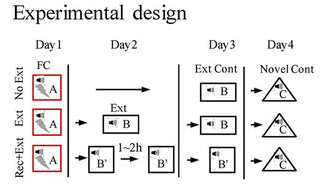
“Elevated Dnmt3a [a DNA methyltransferase] level in the dorsal dentate gyrus (dDG) of hippocampus was associated with the absence of fear renewal in an altered context after extinction training. Overexpression and knockdown of Dnmt3a in the dDG regulated the occurrence of fear renewal in a bi-directional manner.

We found that renewal of remote fear memory can be prevented, and the absence of renewal was concurrent with an elevated Dnmt3a level.

Our results indicate that Dnmt3a in the dDG is a key regulator of fear renewal after extinction, and Dnmt3a may play a critical role in controlling fear memory return and thus has therapeutic values.”


The study was a collection of five experiments investigating causes and effects of biology and behavior. The researchers used different techniques to achieve their goals. I’ve quoted extensively below to show some background and results.

“Alterations in histone acetylation and DNA methylation are involved in the formation and extinction of long-term memory. DNMTs catalyze the cytosine methylation and are required to establish and maintain genomic methylation.

Dnmt3a and Dnmt3b are de novo DNA methyltransferases. Dnmt1 is the maintenance DNA methyltransferase.

  1. Dnmt3a expression was elevated in the dDG after extinction training followed by a brief memory retrieval (Rec+Ext), which was associated with the absence of fear renewal when tested in an altered context.
  2. Increasing Dnmt3a expression in the dDG using AAV [recombinant adeno-associated virus] expression led to the prevention of fear renewal following a standard extinction training protocol. 
  3. Knockdown of Dnmt3a in the dDG using CRISPR/Cas9 resulted in fear renewal following Rec+Ext protocol.
  4. Renewal of remote fear memory can be prevented using the Rec+Ext protocol.
  5. The absence of renewal was concurrent with an elevated Dnmt3a level.

Current exposure therapy, although effective in many patients, suffers from the inability to generalize its efficacy over time, or is limited by the potential return of adverse memory in the new/novel contexts. These limitations are caused by the context-dependent nature of extinction which is widely viewed as the biological basis of exposure therapy.

Achieving a context-independent extinction may significantly reduce fear renewal to improve the efficacy of exposure therapy. Our current study suggests that the effectiveness of these approaches, and ultimately the occurrence of fear renewal, is determined by the level of Dnmt3a after extinction training, especially in the dDG.

There are two potential mechanisms underlying extinction, one is erasure or updating of the formed memory, and the other is the formation of a new extinction memory which suppresses or competes with the existing memory in a context-dependent manner. While most studies favor the suppression mechanism in the adult, limited studies do suggest that erasure occurs in the immature animals.

We propose that if Dnmt3a level is elevated with extinction training (such as with Rec+Ext protocol), modification to the existing memory occurs and as a consequence extinction does not act as a separate mechanism or form a new memory; but if Dnmt3a level is unaltered with extinction training, a separate extinction memory is formed which acts to suppress or compete with the existing memory.”


The relevant difference between humans and lab rats is that we can ourselves individually change our responses to experiential causes of ongoing adverse effects. Standard methodologies can only apply external treatments such as exposure therapy and manipulating Dnmt3a levels.

https://www.nature.com/articles/s41598-018-23533-w “Dnmt3a in the dorsal dentate gyrus is a key regulator of fear renewal”

What are the chances?

This 2018 UC Davis anthropology study was on dice changes over two centuries:

“In Roman times, many dice were visibly lopsided..It did not matter what the objects were made of (metal, clay, bone, antler and ivory), or whether they were precisely symmetrical or consistent in size or shape, because, like the weather, rolls were predetermined by gods or other supernatural elements.

Dice, like many material objects, reflect a lot about people’s changing worldviews, Eerkens said. In this case, we believe it follows changing ideas about chance and fate.”


Think of a significant event in your life. Was it brought about by:

  1. Fate?
  2. Karma, divine intervention?
  3. A prayer, belief, placebo-effect process?
  4. Randomness?
  5. A coin-flip, card-draw, dice-roll decision process?
  6. A weighted-probability decision process?
  7. Chosen behavior, thoughts, and feelings?
  8. Unconscious behavior, thoughts, and feelings?
  9. Culturally-guided motivations?
  10. Non-arbitrary influences of other parties?

Which one or more of these factors would you now prefer to have been involved?

https://www.ucdavis.edu/news/it-not-how-you-play-game-how-dice-were-made “It’s Not How You Play the Game, but How the Dice Were Made”

Your need to feel important will run your life, and you’ll never feel satisfied

Yesterday’s team meeting at work provided one display after another of a person’s need to feel important. These eye-openers were the reason the scheduled 30-minute meeting lasted 45 minutes.

Although half of the forty or so attendees are under the age of 40, curiously, only two of them spoke during the meeting. I wasn’t among the older people who had something to say.

Not that I wasn’t tempted by the team-building exercise with its Skittles prompts:

  • Red – Tell us something you do well
  • Orange – Tell us something about your childhood
  • Purple – What could you live without?
  • Yellow – What couldn’t you live without?

Participation in the exercise was voluntary. Yes, I drew an orange Skittle.

Everyone knew there wasn’t enough time for each of us to speak and have the exercise become team-building, yet a dozen people piped up. Every one of the self-selected responses could have been prefaced with “I’m important because..”


There are many needs a person develops and tries to satisfy as substitutes for real needs that weren’t fulfilled. In this blog I’ve focused on the need to feel important.

I started with How do we assess “importance” in our lives? An example from scientists’ research choices and highlighted it on the Welcome page:

“Do you agree that an individual’s need to feel important is NOT a basic human need on the same level as nourishment, protection, and socialization? How does this need arise in our lives?”

I supported an explanation of the need to feel important with evidence and arguments on the Scientific evidence page and said:

“If the explanation is true yet someone rejected it, they at least wouldn’t have suffered from exposure to it. They’ll just remain in our world’s default mode of existence:

  1. Unaware of their own unconscious act-outs to feel important;
  2. Unaware of what’s driving such personal behavior; and
  3. Uninformed of other people’s behavioral origins as a consequence of 1 and 2.”

Other examples of substitute needs include:

What do you think? Any arguments for or against interrupting our default mode of existence?

The pain societies instill into children

The human subjects of this 2017 Swiss study had previously been intentionally traumatized by Swiss society:

“Swiss former indentured child laborers (Verdingkinder) were removed as children from their families by the authorities due to different reasons (poverty, being born out of wedlock) and were placed to live and work on farms. This was a practice applied until the 1950s and many of the Verdingkinder were subjected to childhood trauma and neglect during the indentured labor.

DNA methylation modifications indicated experiment-wide significant associations with the following complex posttraumatic symptom domains: dissociation, tension reduction behavior and dysfunctional sexual behavior.”


https://bmcresnotes.biomedcentral.com/articles/10.1186/s13104-017-3082-y “A pilot investigation on DNA methylation modifications associated with complex posttraumatic symptoms in elderly traumatized in childhood”


Imagine being taken away from your family during early childhood for no other reason than your parents weren’t married.

Consider just a few of the painful feelings such a child had to deal with then and ever since:

  • I’m unloved.
  • Alone.
  • No one can help me.

Imagine some of the ways a child had to adapt during their formative years because of this undeserved punishment:

  • How fulfilling it would be to believe that they were loved, even by someone they couldn’t see, touch, or hear.
  • How fulfilling it would be to get attention from someone, anyone.
  • How a child became conditioned to do things by themself without asking for help.

The study described a minute set of measurements of the subjects’ traumatic experiences and their consequential symptoms. The researchers tried to group this tiny sample of the subjects’ symptoms into a new invented category.


Another example was provided in Is IQ an adequate measure of the quality of a young man’s life?:

“During this time period [between 1955 and 1990], because private adoptions were prohibited by Swedish law, children were taken into institutional care by the municipalities shortly after birth and adopted at a median age of 6 mo, with very few children adopted after 12 mo of age.”

Swedish society deemed local institutional care the initial destination for disenfranchised infants, regardless of whether suitable families were willing and able to adopt the infants. What happened to infants who weren’t adopted by age 1?

Did Swedish society really need any further research to know that an adoptive family’s care would be better for a child than living in an institution?


It’s hard to recognize when our own thoughts, feelings, and behavior provide evidence of childhood pain that’s still with us.

Let’s not hope and believe that the societies we live in will resolve adverse effects of childhood trauma its members caused. Other people may guide us, but each of us has to individually get our life back:

“What is the point of life if we cannot feel and love others? Without feeling, life becomes empty and sterile.

It, above all, loses its meaning.

Every society has its horror stories. People who have reached some degree of honesty about their early lives and concomitant empathy for others can document these terrible circumstances and events.

Have traumatic effects on children from societal policies ceased?

Searching for personal truths – a review of Blade Runner 2049

I saw Blade Runner 2049 yesterday with my 22-year old son. We chose seats with no one in front of us, and got the full impact of sight and sound.

The primary story was one person’s search for his truths: of his origins; of his memories; of his feelings. Who was the infant in the woman’s arms? Are my earliest memories real? Are my feelings true?

The lead character might as well have been lifeless. His activities were dictated by his designated role in society, by what was expected of him. It was no surprise that he preferred ethereal company over people.

He constantly repressed the memories and feelings that were most important to him, that could have given his life meaning. Despite being repressed, his memories and feelings impelled him to discover and confront his truths.

It was a defining moment when his earliest memory was recognized as real:

  • He could feel at last.
  • He could cry at last.
  • He could scream through the cracks in the repression that had produced an unreal, unfeeling existence.

The miracle of life was celebrated, especially at the end. Like the first Blade Runner, society’s members who were deemed unworthy of life were the ones who cherished this fleeting moment most dearly.

See it up close and personal, in a theater with a good screen and sound system.


This post has somehow become a target for spammers, and I’ve disabled comments. Readers can comment on other posts and indicate that they want their comment to apply here, and I’ll re-enable comments.

Review of The Honest Truth About Dishonesty: How We Lie to Everyone–Especially Ourselves

Here’s an Amazon book review I wrote six years ago when I regularly read 2-3 books a week while on the train to and from work. The book served as an example of how behavioral researchers couldn’t reach their stated goals by using standard scientific methods.

Review of The Honest Truth About Dishonesty: How We Lie to Everyone–Especially Ourselves by Dan Ariely

Everybody would benefit from reading this collection of experiments with human behavior.

It would be fair to compare the book’s accomplishments with its declared goals. The author stated the book’s primary goal early on when he wrote:

“We need to first figure out what forces really cause people to cheat and then apply this improved understanding to curb dishonesty. That’s exactly what this book is about.

Once we more clearly understand the forces that really drive us, we discover that we are not helpless in the face of our human follies (dishonesty included), that we can restructure our environment, and that by doing so we can achieve better behaviors and outcomes.”

I appreciated the author’s research that described and delineated what his experiments chose to observe. For example, in one series of experiments, people lied in order to get tokens that a few seconds later were exchanged into money. These subjects cheated to an extent that was almost twice the amount of people who lied in order to directly get money.

Another series of experiments showed that when people were tired or stressed, they were more likely to cheat. The amount that mentally exhausted subjects cheated was almost three times the amount of non-stressed subjects.

There was also a series of experiments that tested the “what the hell” effect. The researchers found that the amount of cheating was not linear. A point was frequently reached where the subjects apparently decided to abandon a little bit of cheating, and started to cheat at every opportunity.

The author proposed that a “fake it until you make it” approach doesn’t ultimately lead to honest behavior. He suggested that it would probably start a chain of events that proceeded through the “what the hell” context, where a little bit of cheating became a lot, and ended up with suffering when the truth was eventually revealed.


What these experiments examined wasn’t the origins of dishonest behavior, but rather the middle and ending parts of dishonest behaviors. As such, I didn’t see how the book’s primary goal could be achieved.

Without exploring the precedents to dishonest behavior, we’re also left with a patchwork approach to achieving the secondary goal of changing outcomes by influencing the salient aspects of behavior.

Understanding that I’m not an expert or a researcher, let me offer an approach that could be more conducive to achieving the primary and secondary goals of the book. The necessary but unexplored research area would be along the lines of “What do I feel just before I act dishonestly?”

The subjects’ probable answers to this unasked question would indicate that the person’s unfulfilled needs were in play. These needs are for the most part unconscious, and are the sources of automatic behavior that seeks to fulfill these needs. The outward manifestations of this automatic behavior will lead the subjects to symbolic fulfillment of their old needs.

The subjects in the experiments may not be able to make the connection between their behaviors of say, cheating on a pledge to quit smoking, and their driving forces. This is probably because the subjects weren’t consciously aware of the feelings they had just before they acted.

The researchers may be able to bridge this gap with information obtained from measurements done by fMRIs and other instruments. They can integrate these measurements with the subjects’ reports of their feelings.

To meet the goals of the book, it’s important that the researchers uncover the subjects’ underlying feelings. This is necessary because feelings are usually closer to the causes of a person’s behavior.

The subjects’ behaviors were symptoms of their problems, not the problems themselves. The researchers would be better served to study the entire situation as best they can.


All of us anticipate while we read a book that there will be prescriptions and answers to the circumstances and troubles presented. But because The (Honest) Truth About Dishonesty didn’t identify “what forces really cause people to cheat,” the primary goal, to “clearly understand the forces that really drive us” wasn’t attained.

Realization of the secondary goal is undecided. The author presented several examples of how environments affect people’s dishonesty, such as conflicts of interests. He showed how people’s rationalizations allow them to permit a level of dishonesty that doesn’t harm their ideas about their own morality.

But how can effective and enduring solutions arise “so we can achieve better behaviors and outcomes” when the roots of the behaviors aren’t examined?

Epigenetic effects of early life stress exposure

This 2017 Netherlands review subject was the lasting epigenetic effects of early-life stress:

“Exposure to stress during critical periods in development can have severe long-term consequences.

One of the key stress response systems mediating these long-term effects of stress is the hypothalamic-pituitary-adrenal (HPA) axis.

Early life stress (ELS) exposure has been reported to have numerous consequences on HPA-axis function in adulthood.

ELS is able to “imprint” or “program” an organism’s neuroendocrine, neural and behavioral responses to stress. Research focuses along two complementary lines:

  1. ELS during critical stages in brain maturation may disrupt specific developmental processes (by altered neurotransmitter exposure, gene transcription, or neuronal differentiation), leading to aberrant neural circuit function throughout life.
  2. ELS may induce modifications of the epigenome which lastingly affect brain function.

These epigenetic modifications are inducible, stable, and yet reversible, constituting an important emerging mechanism by which transient environmental stimuli can induce persistent changes in gene expression and ultimately behavior.”


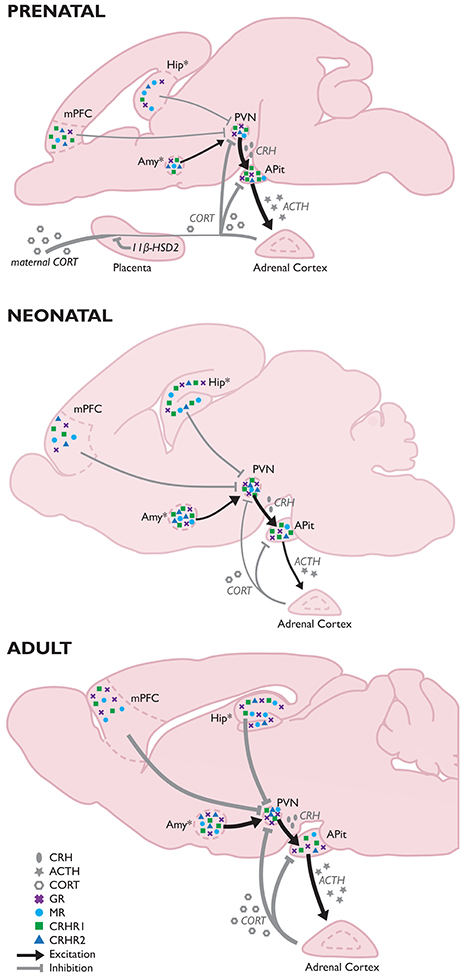
In early life, the lower brain and limbic system brain structures are more developed and dominant, whereas the cerebrum is less developed (use the above rodent graphic as a rough guide). Stress and pain generally have a greater impact on a fetus than an infant, and a greater impact on an infant than an adult.

The reviewers cited 50+ studies from years 2000-2015 in the “Early Life Stress Effects in a “Matching” Stressful Adult Environment” section to argue for the match / mismatch theory:

“Encountering ELS prepares an organism for similar (“matching”) adversities during adulthood, while a mismatching environment results in an increased susceptibility to psychopathology, indicating that ELS can exert either beneficial or disadvantageous effects depending on the environmental context.

Initial evidence for HPA-axis hypo-reactivity is observed for early social deprivation, potentially reflecting the abnormal HPA-axis function as observed in post-traumatic stress disorder.

Experiencing additional (chronic) stress in adulthood seems to normalize these alterations in HPA-axis function, supporting the match / mismatch theory.”

Evidence for this theory was contrasted with the allostatic load theory presented in How one person’s paradigms regarding stress and epigenetics impedes relevant research.


The review mainly cited evidence from rodent studies that mismatched reactions in adulthood may be consequences of early-life events. These events:

“Imprint or program an organism’s neuroendocrine, neural and behavioral responses..leading to aberrant neural circuit function throughout life..which lastingly affect brain function.”

Taking this research to a personal level:

  • Have you had feelings that you were unsafe, although your environment was objectively safe?
  • Have you felt uneasy when people are nice to you?
  • Have you felt anxious when someone pays attention to you, even after you’ve acted to gain their attention?

Mismatched human feelings are one form of mismatched reactions. These may be consequences of early-life experiences, and indicators of personal truths.

If researchers can let go of their biases and Advance science by including emotion in research, they may find that human subjects’ feelings produce better evidence for what actually happened during the subjects’ early lives than do standard scientific methods of:

Incorporating feeling evidence may bring researchers and each individual closer to discovering the major insults that knocked their development processes out of normally robust pathways and/or induced “persistent changes in gene expression and ultimately behavior.”

https://www.frontiersin.org/articles/10.3389/fncel.2017.00087/full “Modulation of the Hypothalamic-Pituitary-Adrenal Axis by Early Life Stress Exposure”


I came across this review as a result of it being cited in http://www.sciencedirect.com/science/article/pii/S1084952117302884 “Long-term effects of early environment on the brain: Lesson from rodent models” (not freely available)

Prisoners of our childhoods

Same old shit – another failed relationship.

Coincident with the start of our relationship, I was struck by a phrase by Dr. Janov, posted in Beyond Belief: What we do instead of getting well:

“It doesn’t matter about the facts we know if we cannot maintain a relationship with someone else.”

I kept that thought in the forefront.

Both of us are prisoners of our childhoods. I’ve tried to see and feel the walls and bars for what they are.

Like all of us, J hadn’t tried to process the reality of her childhood and life. For example, on her birthday I asked her how she celebrated her birthdays when she was growing up. She provided a few details, then mentioned that her parents had skipped some of her birthdays. Although I had no immediate reaction, she quickly said that she had a happy childhood.

I was at fault, too, of course. I again asked a woman to marry me who hadn’t ever told me she loved me, except in jest.

I asked J to marry me around the six-month point of our relationship. I felt wonderful, in love with her that August morning after she slept with me at my house. I made an impromptu plan: in the middle of a four-mile walk, I asked her to marry me while kneeling before her as she sat on a bench outside a jewelry store. But she wouldn’t go in to choose a ring. She said she’d think about it.

A month later, after several dates, sleepovers at her house, and a four-day trip to Montreal, I again brought up marriage while we rested on her large couch in her nice sun room. The thing I felt would be wonderful brought about the end.

I tried to understand why she couldn’t accept me for the person who I intentionally showed her I am. She abstracted everything that she said.

I tried to get her to identify why, after all the times we cared for each other, after all our shared experiences, she didn’t want me around anymore.

Didn’t happen. She didn’t tell me things that made sense as answers to my questions.

One thing she said without abstraction was that I was weak for showing my feelings. She told me I was clingy.

Another thing she communicated at the end shocked me. She somehow thought that I was going to dump her. I said that the thought never even crossed my mind.

I didn’t recognize it as projection at the time. Prompted by her underlying feelings, she attributed to me the actions and thoughts that only she herself had.

I’ve tried to put myself in J’s place.

  • How horrible must it have been for her to be steadily intimate with a man and not feel that his touches, kisses, words, affection, expressed love?
  • That he couldn’t really love me, and so I couldn’t love him?
  • That he was actually after something else, because it was impossible that he loved me?

One thing I’ve felt after the end was that the need underlying my only stated relationship goal – to live with a woman I love who also loves me – is again ruining my life. My latest efforts towards that goal were rife with unconscious symbolic act outs of an unsatisfied need from my early life.

That unrelenting need is for a woman’s love. The women I’ve chosen, though, have always given me what I got from my mother: they wouldn’t accept me as I am, and didn’t love me.

And there can never be a substitute. Most of my Primal Therapy sessions included the PAIN OF FEELING exactly that.

My prison cell is what Dr. Janov calls the imprint where I – as a child, teenager, young man, middle-aged man, old man – futilely ATTEMPT TO CHANGE THE PAST.

“Standing next to me in this lonely crowd
Is a man who swears he’s not to blame
All day long I hear him shout so loud
Crying out that he was framed

I see my light come shining
From the west down to the east
Any day now, any day now
I shall be released”


P.S. – We got back together seven months later, and are still going strong.

Beyond Belief: What we do instead of getting well

Continuing Dr. Arthur Janov’s May 2016 book Beyond Belief:

“p. 61 Heavy pains with no place to go just pressures the cortex into concocting an idea commensurate with the feeling.

The feeling itself makes no sense since the original feeling has no scene with it nor verbal capacity; it was laid down in a preverbal time without context, save for the feeling itself.

We cling to those ideas as strongly as the feelings driving us are.

Sometimes we argue with someone not realizing that we are battling a defense which is implacable. They don’t want to hear what we have to say. They want to protect their psyche.

p. 63 Suffocation at birth is registered not as an idea, but as a physiologic fact. It becomes an idea when the brain evolves enough to produce ideas. Then it can produce, ‘There is no air in here.’

A slightly stifling atmosphere in the present can set off this great pain and with it an exaggerated response. ‘I have to leave this woman because she stifles me.’

p. 64 It doesn’t matter about the facts we know if we cannot stop drinking or if we cannot maintain a relationship with someone else.

p. 68 My task is to examine why individuals adopt belief systems, whatever they are, and how certain feelings provoke specific kinds of belief systems..to demonstrate how feeling feelings can alter those beliefs without once addressing the beliefs at all.

Deprogramming is not necessary. Probing need is. Resolving feelings seems to render belief systems inoperative.

p. 71 We are a nation and a world of seekers, a people who seek refuge in all manner of beliefs.

p. 75-76 Later in life, equipped with the cortical ability to substitute ideation for feeling, the traumatized baby can call upon a god to save him from his inner pain, even when he doesn’t know where the pain originated, or even that there is pain. He just calls upon a god to watch over him, to see that he gets justice, who won’t let him down, and above all, who will help him make it into life.

p. 106 Neurosis is the only malady on the face of this earth that feels good..numbs the feeling. Numb feels good – not ‘good’ in the absolute sense, just not ‘bad.’

So we settle..we get numbed out and feel no pain and in return, life is blah blah. The person then feels she is not getting anything out of life and seeks out salvation or a guru in one form or another.”


“We are a nation and a world of seekers, a people who seek refuge in all manner of beliefs.” The patient’s story on pages 89 – 105 told of HORRIFIC damages inflicted by believers and the subsequent consequences!

Variations of his story with its adverse childhood experiences could be told by tens of millions of people in the US alone!

Why isn’t the internet flooded with 10+ million similar stories of people who have faced their realities, and effectively addressed the real causes of what’s wrong in their lives?

Said another way: Why is the internet instead flooded with stories of 10+ million people

  • NOT facing their realities,
  • Doing things to prolong their conditions, and
  • Avoiding getting well?

The many reasons why people do things that don’t truly get them well are covered in Beyond Belief and Dr. Janov’s other publications. One obstacle for people who want enduring therapeutic help is the intentional misrepresentation of Primal Therapy.

Every day I look at the results of an automated search that uses “primal therapy” as the search term. Along with the scams and irrelevancies are the “scream” results.

This misrepresentation is addressed here:

“Primal Therapy is not Primal ‘Scream’ Therapy. Primal Therapy is not just making people scream; it was never ‘screaming’ therapy. The Primal Scream was the name of the 1st book by Dr. Janov about Primal Therapy.”

People who perpetuate the “scream” meme are only a few seconds away from search results that would inform them and their readers of accurate representations of Primal Therapy.

What purpose does it serve to misdirect people away from doing something to effectively address the real causes of what’s wrong in their lives?

Beyond Belief: The impact of merciless beatings on beliefs

Continuing with Dr. Arthur Janov’s May 2016 book Beyond Belief:

“p. 17 When someone insults us, we immediately create reasons and rationales for it. We cover the pain. Now imagine a whole early childhood of insults and assaults and how that leaves a legacy that must be dealt with.

The mind of ideas and philosophies doesn’t know it is being used; doesn’t know it serves as a barricade against the danger of feeling.

It is why no one can convince the person out of her ideas. They serve a key purpose and should not be tampered with. We are tampering with a survival function.

p. 19 It seems like a miracle that something as intangible and invisible as an idea has the power to transform our biologic system. It makes us see what doesn’t exist and sometimes not see what does. What greater power exists than that? To be fooled is not only to convince someone to believe the false, but also to convince others to not believe the truth.

The unloved child who cannot bear the terrible feelings of hopelessness shuts down his own feeling centers and grows insensitive, not only to his pain, but to that of others. So he commits the same error on his child that was visited upon him, and he does so because of the way he was unloved early on. He cannot see his own hopelessness or that of his child.

p. 56 All defensive beliefs must have a kernel of hope inside of them. It is the embedded hopelessness that gives rise to its opposite – hope – and its accompanying biochemistry of inhibition or gating.

To be even more precise, it is the advent of pain surrounding hopelessness that produces the belief entwined with hope. All defensive belief serves the same function – repression, absorbing the energy of pain.

p. 57 An unloved child is a potential future believer.

p. 58 NO ONE HAS THE ANSWER TO LIFE’S QUESTIONS BUT YOU. How you should lead your life depends on you, not outside counsel.

We do not direct patients, nor dispense wisdom upon them. We have only to put them in touch with themselves; the rest is up to them.

Everything the patient has to learn already resides inside. The patient can make herself conscious. No one else can.”


“p. 29 The personal experience stories throughout the book are written by my patients and, with the exception of a few grammatical corrections, they are presented here exactly as they were given to me.”

All of the Primal Therapy patients’ stories started with HORRENDOUS childhoods that produced correspondingly strong beliefs!

I came across a public figure example today in 10 Defining Moments In The Childhood Of Martin Luther King Jr. The author included two items germane to an understanding of how beliefs may develop from adverse childhood experiences:

  • 8. King Sr. “Would beat Martin and his brother, Alfred, senseless for any infraction, usually with a belt.”
  • 6. “By the time King was 13, he’d tried to kill himself twice.”

Every reference I found tied King Jr.’s suicide attempts to his grandmother’s death. What an implausible narrative!

A whole early childhood of insults and assaultscertainly had more to do with the causes for his preteen suicide attempts.

Consider a child’s feelings of helplessness, worthlessness, pain, and betrayal when the people who are supposed to love them are cruel to them instead. Feelings like what I expressed in Reflections on my four-year anniversary of spine surgery.

Consider the appeal of escaping from this life when “The unloved child cannot bear the terrible feelings of hopelessness.”

Granted that it’s only the patient who can put together what happened in their life so that it’s therapeutic. Beyond Belief and Dr. Janov’s other publications outline the framework.

On Primal Therapy with Drs. Art and France Janov

Experiential feeling therapy addressing the pain of the lack of love.

What do our time preferences reveal about our pasts?

This 2016 Swedish human study found:

“Time discounting significantly predicts criminal activity and that high discount rates predict crime more strongly at the extensive margin rather than for total crime. The link is much stronger for property crime and among males with low intelligence.”

The subjects were 13-year-old students in Stockholm County who were asked as a part of a school survey in 1966:

“If you had to choose between SEK 900 [USD 138] now versus SEK 9,000 [USD 1,380] in five years, what would you choose?

  1. Certainly SEK 900 now
  2. Probably SEK 900 now
  3. Cannot choose
  4. Probably SEK 9,000 in five years
  5. Certainly SEK 9,000 in five years”

A choice of Answer 1 to get something immediately and not get ten times the nominal value in five years corresponds to a 58.4% annual discount rate.

These answers to a hypothetical monetary trade-off were correlated to other measures such as intelligence and father’s income. However, the researchers didn’t investigate possible origins:

“We focus on the predictive value of time discounting and avoid claims about causality.”


We know from proper economic theory that time preferences are part of human nature. Discount rates and money don’t necessarily have to be involved because humans will value something today more than a similar item in the future.

I’d guess that most of the answers reflected conditioned behaviors. Did the 13-year olds who answered #1 even roughly calculate the problem? I wonder if they felt they would still be alive at age 18?

http://www.pnas.org/content/113/22/6160.full “Time discounting and criminal behavior”