The roles of DNA methylation and demethylation in forming memories

This 2015 Alabama combined animal and human review noted:

“Memories can last a lifetime, yet the proteins that enable synaptic plasticity, allowing for the establishment and maintenance of the memory trace, are subject to perpetual turnover.

DNA methylation may likely serve as the principle cellular information storage device capable of stably and perpetually regulating cellular phenotype.”

The authors developed a framework for understanding disparate findings of DNA methylation and demethylation concerning memory.


The dependencies expressed in the framework among the numerous factors – with their relative strengths, timings, and durations – reminded me of this video:

1) If such an error-prone framework accurately reflected the evolved architecture of our memory, we wouldn’t have the variety and number and intensity of memories that we have.

2) The framework neither accounted for prenatal memory processes nor differentiated emotional memories, although some of the referenced studies’ findings were applicable.

3) DNA methylation and demethylation aren’t the entirety of memory formation explanations. For example, they don’t explain state-dependent memories that can be instantiated, reactivated, and amnesia induced without involving “the proteins that enable synaptic plasticity” described in the authors’ framework. For completeness, the authors could have assessed the relative contributions of other memory processes, or at least enumerated them.

4) DNA methylation and demethylation explanations don’t cover all epigenetic biochemical processes. There are also placental interactions, histone/protein interactions, microRNA interactions, etc. For completeness, the authors could have placed the review’s topic within appropriate contexts of other epigenetic processes that influence memory.

This review of DNA methylation and demethylation roles in memory formation opened up a few slats in the blind covering one window. There’s more to be done to fully open that blind, and more window blinds to be opened before the workings of our memory are illuminated.

http://nro.sagepub.com/content/21/5/475.full “DNA Methylation in Memory Formation: Emerging Insights”
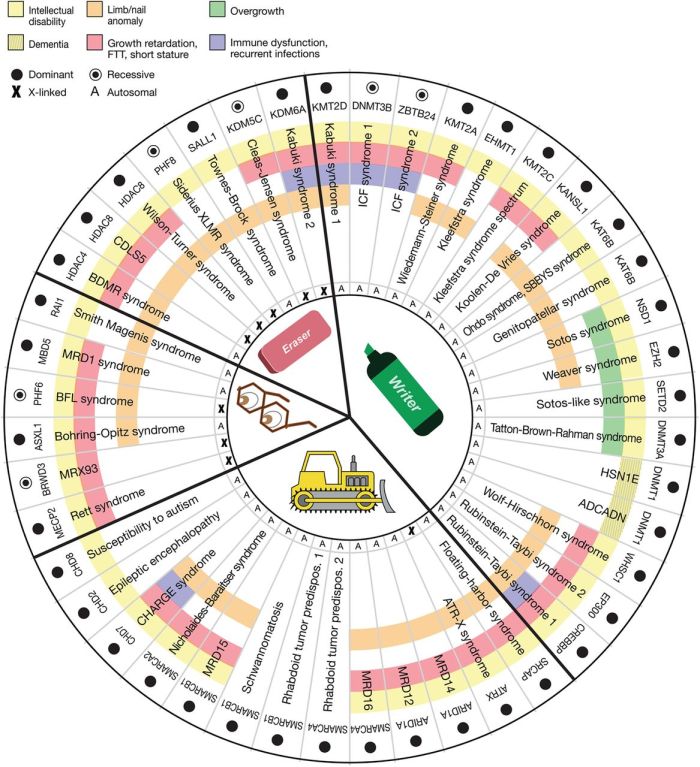
Genetic causes for epigenetic symptoms

This 2015 human summary study was of 44 genetic disorders that disrupt the maintenance of epigenetic modifications:

“..making them likely to have significant downstream epigenetic consequences. Interestingly, these patients often demonstrate neurological dysfunction, suggesting that precise epigenetic regulation may be critical for neuronal homeostasis. However, at the same time, it is important to keep in mind that many of these proteins have additional non-epigenetic roles.

Mutations in many of these components have now been linked to a number of well-known causes of intellectual disability. Intellectual disability is generally defined as deficits of intellectual function and adaptive behavior that occur during the developmental period.

Given the opposing activity of many of the components of the epigenetic machinery, the pathogenic sequence in these disorders involves an imbalance of chromatin states. Keeping a subset of genes under “pressure” from two opposing systems may allow the cellular system to rapidly respond to environmental stimuli.

These disorders, on average, have unusual phenotypic breadth. Similarly, there is a shift in distribution toward a higher number of organ systems affected.

In addition to developmental phenotypes (multiple congenital anomalies), in some cases there appear to be ongoing defects that remain consequential in post-natal life. An example of the latter is the hippocampal memory defects seen in many of the mouse models.

This raises the question whether cells undergoing neurogenesis and synaptogenesis are particularly sensitive to subtle defects of the epigenetic machinery and downstream epigenetic abnormalities. A major remaining question is whether neurogenesis defects and/or abnormalities of synaptic plasticity are a unifying pathophysiological process.”

The researchers represented the 44 genetic disorders on a wheel graph:

F1.large

I look forward to further research that includes non-genetic disruptors of epigenetic modifications.

http://genome.cshlp.org/content/25/10/1473.full “The Mendelian disorders of the epigenetic machinery”

Leaky gates, anxiety, and grocery store trips without buying list items

An interview with Jeff Link, the editor of Dr. Arthur Janov’s 2011 book “Life Before Birth: The Hidden Script that Rules Our Lives” with Ken Rose:

“Even further confirmation for some of the views of Janov, that maybe weren’t widely accepted for a time, it’s new research now being done into memory and what a lot of scientist are seeing, a lot of different studies is that memory reactivates the same neuroimpulses that were initially firing off when the event happened.

So a traumatic event when you remember it, the act of remembering it is actually creating a neuromirror of what went on initially.

In a lot of ways that is what Primal Therapy is attempting to do; is to go back to that place and reconnect, or as it’s sometimes referred to, reconsolidate the brain state so that real healing can take place.”

Transcript (part 4 of 6): http://cigognenews.blogspot.com/2015/09/ken-rose-on-life-before-birth-part-46.html

MP3: http://www.pantedmonkey.org/podcastgen/download.php?filename=2011-12-15_1300_what_now_jeff_link.mp3

Adverse effects of inflammation and stress on hippocampal synapses

This dense and highly-jargoned 2015 rodent study found:

“The suppression of BDNF [brain-derived neurotrophic factor] signaling, LTP [long-term potentiation], and memory may be driven by an increased sensitivity to IL-1β [the proinflammatory cytokine interleukin 1β] that occurs directly at synapses.”

The researchers reversed the adverse effects of IL-1β after they induced stress and inflammation. Blocking IL-1β when there wasn’t stress or inflammation, however, also caused adverse effects:

“Interestingly, administration of AS1 [the compound that blocked the proinflammatory responses] in the absence of LPS [the bacterial compound used to stress the subjects’ immune systems] treatment also impaired OLM [the object location memory test where control group rodents exhibited a preference for a novel location over a familiar location].

This finding is consistent with the notion that endogenous IL-1β at physiologically low levels may be essential for hippocampal memory function.”


The researchers asserted:

“Our data reveal a previously unidentified mechanism that explains the age-related vulnerability of hippocampal function to impairment by inflammation.”

Instead of couching their findings with a non-causal “age-related” term, could the researchers have specifically identified causes?

“IL-1β activates different pathways via AcP (proinflammatory) or AcPb (prosurvival) IL-1 receptor subunits.

This study demonstrates that the IL-1 receptor subunit system undergoes an age-dependent reconfiguration in hippocampal synapses.

This previously undescribed reconfiguration, characterized by an increase in the AcP/AcPb ratio, is responsible for potentiating impairments of synaptic plasticity and memory by IL-1β.”

What were the underlying causes for the relatively increased AcP activation over AcPb activation? The researchers didn’t say. Their explanations were left hanging at a correlated-but-not-causal “age-dependent” level rather than a “mechanism that explains.”

http://www.pnas.org/content/112/36/E5078.full “Synapse-specific IL-1 receptor subunit reconfiguration augments vulnerability to IL-1β in the aged hippocampus”

How brain neurons remain stable when constantly stimulated

This 2015 UK rodent study provided details of how neurons in the hippocampus respond to stimuli. The researchers found that hippocampal neurons:

“Remain electrically stable when confronted with chronic increases in neuronal activity.”

Changes in electrical potential changed the initial segment of the neuron’s axon.

Synapses formed along the segment, and stayed in place while this highly-plastic segment moved along the axon. The location mismatch:

“Allows the GABAergic [producing gamma-Aminobutyric acid, an inhibitory neurochemical] synapses to strongly oppose action potential generation, and thus downregulate pyramidal cell excitability.”

The researchers also used the two antioxidants endogenous to humans, superoxide dismutase and glutathione, to supplement the culture medium.

http://www.pnas.org/content/112/31/9757.full “Activity-dependent mismatch between axo-axonic synapses and the axon initial segment controls neuronal output”

How brains mature during critical periods

This 2015 German rodent study found:

“Once silent synapses are consolidated in any neural circuit, initial experience-dependent functional optimization and critical periods end.

Silent synapses are thought to be immature, still-developing excitatory synapses.”

The number of silent synapses related to visual processing was measured at ~50% at eye opening. Visual experience reduced this to 5% or less by adulthood in the study’s control group. Removing a protein in the subjects’ hippocampus silenced the synapses back up to ~50%, even in adults.

Critical periods are:

“Characterized by the absolute requirement for experience in a restricted time window for neural network optimization.

Although some functions can be substantially ameliorated after the CP [critical period], they are rarely optimally restored.”

Two human studies were cited on critical periods in second-language and musical skills development, Sensitive periods in human development: Evidence from musical training (not freely available).

The researchers generalized their findings as:

“Experience-dependent unsilencing of silent synapses constitutes an important general maturational process during CPs of cortical development of different functional domains and suggest an interplay with inhibitory circuits in regulating plasticity.”

http://www.pnas.org/content/112/24/E3131.full “Progressive maturation of silent synapses governs the duration of a critical period”

The effects of inescapable, uncontrollable, repeated stress on the hippocampus

This 2015 MIT rodent study found:

Behavioral stress impairs cognitive function via activation of a specific direct neural circuit from the basolateral amygdala to the dorsal hippocampus. Moreover, we delineate a molecular mechanism by which behavioral stress is translated to hippocampal dysfunction via a p25/Cdk5 (cyclin-dependent kinase 5)-dependent pathway and epigenetic alterations of neuroplasticity-related gene expression.”

The researchers made several intermediate findings to develop their main finding:

1. “Repeated stress is accompanied by

  • generation of p25,
  • up-regulation and phosphorylation of glucocorticoid receptors,
  • increased HDAC2 [the gene encoding the histone deacetylase 2 enzyme] expression, and
  • reduced expression of memory-related genes [most, but not all that were tested] in the hippocampus.”

2. “BLA [basolateral amygdala] activation is both necessary and sufficient for stress-associated molecular changes and memory impairments.”

3. “This effect [2. above] relies on direct glutamatergic projections from the BLA to the dorsal hippocampus.”

4. “p25 generation is necessary for the stress-induced memory dysfunction.”

From the Results section:

“Control mice showed a significant preference for the novel over the familiar object or location, whereas RFS [repetitive foot shock]-treated mice performed no better than chance.”

The subject adult mice underwent:

“Inescapable, uncontrollable repeated stress.”

Do humans also experience impaired “cognitive function” and “hippocampal dysfunction” and “epigenetic alterations of neuroplasticity-related gene expression” caused by “inescapable, uncontrollable repeated stress”?

And what are the real histories of people who aren’t curious, who don’t show “a significant preference for the novel over the familiar object or location”?

http://www.pnas.org/content/112/23/7291.full “Basolateral amygdala bidirectionally modulates stress-induced hippocampal learning and memory deficits through a p25/Cdk5-dependent pathway”

Epigenetic changes in the developing brain change behavior

This 2015 review cited 143 studies to tie together findings in epigenetic chemistry and behavioral neuroscience.

In addition to studies I’ve previously curated, other research included:

  • a 2012 study which completely abolished mouse maternal behavior by silencing a gene encoding an estrogen receptor;
  • a 2012 study which found that stress-induced changes in the rat hippocampus were heritable;
  • a 2014 study that distinguished between transgenerational and intergenerational epigenetic effects such as:

    in utero exposure to nutritional status, stress, or toxic environmental factors that act on the developing embryo and its germ line”

  • a 2013 study that showed how genomic imprinting coordinated:

    “Genetic coadaptation where beneficially interacting alleles evolve to become coinherited.”

The current status of research incorporating both epigenetic chemistry and behavioral neuroscience was summed up as:

“A large number of behavioral epigenetic studies attempt to correlate epigenetic marker changes at global levels and in mixed populations of cells with phenotypic changes.

Specific changes at specific gene levels and at single cell levels correlating with behavioral changes remain largely unknown.”

http://www.pnas.org/content/112/22/6789.full “Epigenetic changes in the developing brain: Effects on behavior”

Stress in early life can alter physiology and behavior across the entire lifespan

I’ll quote a few sections of this 2014 summary of 111 studies concerning stress, including the authors’ research:

“The brain is the central organ of stress and adaptation to stressors because:

  • It not only perceives what is threatening or potentially threatening and initiates behavioral and physiological responses to those challenges,
  • But also is a target of the stressful experiences and the hormones and other mediators of the stress response.

The stress history of parents is a significant factor in the resilience of their offspring.

Environmental stress transduces its effects into lasting changes on physiology and behavior, which can vary even among genetically identical individuals.

Stress in early life can alter physiology and behavior across the entire lifespan.

Structural stress memory is even more apparent with regard to gene expression in stress-sensitive brain regions like the hippocampus.

Individual history is important and that there is a memory of stress history retained by neurons at the cellular level in regions like the hippocampus.

Stress has a number of known effects on epigenetic marks in the brain, producing alterations in DNA methylation and histone modifications in most of the stress-sensitive brain regions examined, including the hippocampus, amygdala, and prefrontal cortex.”


It seemed to be taboo to note that most of – and the largest of – detrimental effects of stress occurred during womb-life in the mother’s environment. The authors instead opted for a politically correct “the stress history of parents” phrase.

Referenced studies had findings relevant to the earliest periods of life, including Figure 1:

interactions

“Those organs that show the highest levels of retrotransposon [a repeat element (mobile DNA sequences often involved in mutations) type formed by copy-and-paste mechanisms] activity, such as the brain and placenta, also seem to be both steroidogenic and steroid-sensitive.”

However, Figure 1 was given a beneficial context, and other studies’ findings weren’t mentioned in their contexts of detrimental effects on fetuses of mothers who were stressed while pregnant.

http://www.pnas.org/content/112/22/6828.full “Stress and the dynamic genome: Steroids, epigenetics, and the transposome”

The critical period for some aspects of human sight can be extended past childhood

This 2013 human study provided further details of critical periods in human development. The study subjects were:

“11 children enrolled in a humanitarian and scientific effort in India that provides corrective surgery to children with treatable cataracts and subsequently studies their visual abilities.”

The researchers found:

“The human visual system can retain plasticity beyond critical periods, even after early and extended blindness.

We define “early-onset” blindness as occurring before 1 y of age. We define “extended” blindness as lasting at least until early childhood, when many visual abilities in normally developing children reach adult levels. Contrast sensitivity in particular develops until approximately age 7 in normally sighted humans.

Of the 11 children, five had no discernible improvement, whereas one child’s vision grew worse, probably because of post-surgical complications. Five of the patients showed remarkable enhancement, however, and of these, an 11-year-old and a 15-year-old showed 30-fold improvement in contrast sensitivity.

“The visual brain can be plastic for longer than we originally thought,” concludes Kalia. “Many of the kids dramatically improve their quality of life.”

http://www.pnas.org/content/111/5/2035.full “Development of pattern vision following early and extended blindness”

Would you deprive your infant in order to be in a researcher’s control group?

This 2015 Harvard study found that exposing extremely premature babies to sounds of their mothers enlarged their auditory cortex.

The lead researcher stated:

“Our findings do not prove that the brains of these babies are necessarily better, and we cannot conclude that they will end up with no developmental disabilities.

We don’t know the advantages of having a bigger auditory cortex.”

It’s too bad that studies like this one have to take deprived infants and further deprive them for use as a control group. I suppose it’s possible that the control group members’ development could just be shifted, similar to the Maternal depression and antidepressants epigenetically change infant language development study.

However, given the findings of the Our early experiences are maintained and unconsciously influence us for years, if not indefinitely study, it’s also possible that the last trimester of womb life is a critical period for a child’s auditory cortex. If timely development doesn’t take place within the environment provided by the mother, there may not be another period to fully catch up on growth and learning, even given the effects of neural plasticity.

http://www.pnas.org/content/112/10/3152.full “Mother’s voice and heartbeat sounds elicit auditory plasticity in the human brain before full gestation”

Neural plasticity trumps genetics in the hippocampus part of the limbic system

This 2015 rodent study used a genetic strain of mice that was bred to not express a gene that enabled long-term memory in the hippocampus. The mice were not memory-impaired, however, due to their brains’ neural plasticity.

The researchers found:

“Deletion of genes in organisms does not always give rise to phenotypes because of the existence of compensation.

The current work provides an example of how a complex brain system may adjust to the effects of gene deletion to recover function.”

The Early human brain development can be greatly modified by environmental factors study showed even greater plasticity in another part of the human brain where the people faced much larger obstacles than gene deletion.

I view this finding as a cautionary tale to reference any time a study comes out stating that A and B genes are found to cause X and Y symptoms or behavior. Researchers don’t have enough evidence in 2015 to unequivocally describe what rodent brains are capable of, much less human brains.

The researchers implied how they kept faith in their work with the phrase:

“The compensatory mechanism is imperfect and does not fully restore cGKII-dependent function.”

Is perfection the standard to which their research is also held?

http://www.pnas.org/content/112/10/3122.full “Network compensation of cyclic GMP-dependent protein kinase II knockout in the hippocampus by Ca2+-permeable AMPA receptors”

Do the impacts of early experiences of hunger affect our behavior, thoughts, and feelings today?

This 2015 worldwide human study Hunger promotes acquisition of nonfood objects found that people’s current degree of hungriness affected their propensity to acquire nonfood items.

The researchers admitted that they didn’t demonstrate cause and effect with the five experiments they performed, although the findings had merit. News articles poked good-natured fun at the findings with headlines such as “Why Hungry People Want More Binder Clips.”

The research caught my eye with these statements:

“Hunger’s influence extends beyond food consumption to the acquisition of nonfood items that cannot satisfy the underlying need.

We conclude that a basic biologically based motivation can affect substantively unrelated behaviors that cannot satisfy the motivation.”

The concept of the quotes relates to a principle of Dr. Arthur Janov’s Primal Therapy – symbolic satisfaction of needs.


I stated two fundamentals of Primal Therapy in An agenda-driven study on beliefs, smoking and addiction that found nothing of substance:

  1. The physiological impacts of our early unmet needs drive our behavior, thoughts, and feelings.
  2. The painful impacts of our unfulfilled needs impel us to be constantly vigilant for some way to fulfill them.

Corollary principles of Primal Therapy are:

  • Our present efforts to fulfill our early unmet needs will seldom be satisfying. It’s too late.
  • We acquire substitutes now for what we really needed back then.
  • Acquiring these symbols of our early unmet needs may, at best, temporarily satisfy derivative needs.

But the symbolic satisfaction of derived needs – the symptoms – never resolves the impacts of early unfulfilled needs – the motivating causes:

  • We repeat the acquisition behavior, and get caught in a circle of acting out our feelings and impulses driven by these conditions.
  • The unconscious act-outs become sources of misery both to us and to the people around us.

In his book “Primal Healing” Dr. Arthur Janov gives two examples of critical periods only during which early needs can be satisfied:

  1. Being touched in the first months of life is crucial to a child’s development. The lack of close contact after the age of 5 wouldn’t have the same effect.
  2. Conversely, the need for praise at 6 months of age may not be essential, but it’s crucial for children at age 5.

As this study’s finding showed, there’s every reason for us to want researchers to provide a factual blueprint of causes for our hunger sensation effects, such as “unrelated behaviors that cannot satisfy the motivation.”

Why not start with hunger research? Objectives of the research should include answering:

  • What enduring physiological changes occurred as a result of past hunger?
  • How do these changes affect the subjects’ present behaviors, thoughts, and feelings?

Hunger research that would likely provide causal evidence for the effect of why people acquire “items that cannot satisfy the underlying need” should include studying where to start the timelines for the impacts of hunger. The impacts would potentially go back at least to infancy when we were completely dependent on our caregivers.

Infants can’t get up to go to the refrigerator to satisfy their hunger. All a hungry infant can do is call attention to their need, and feel pain from the deprivation of their need.

Is infancy far back enough, though, to understand the beginnings of potential impacts of hunger? The Non-PC alert: Treating the mother’s obesity symptoms positively affects the post-surgery offspring study referenced an older study of how the hunger of mothers-to-be had lifelong ill effects for the fetuses they carried during the Dutch hunger winter of 1944. The exposed children had epigenetic DNA changes from their mothers’ starvation, which resulted in relative obesity compared with their unexposed siblings.

Is it science, or is it a silly and sad farce when researchers “make up” missing data?

This 2014 French study was a parody of science.

The researchers “made up” missing data on over 50% of the men and over 47% of the women! All to satisfy their model that drove an agenda of the effects of adverse childhood experiences.

As an example of how silly and sad this was:

  • Two of the seven subject ages of interest were 23 and 33 consecutively, and
  • One of the nine factors was education level.

If I was a subject, and wasn’t around to give data at age 33 and later, how would the researchers have extrapolated a measurement of my education level of “high school” at age 23?

I’m pretty sure their imputation method would have “made up” education level data points for me of “high school” for ages 33 and beyond. I doubt that the model would have produced my actual education levels of a Bachelors and two Masters degrees at age 33.

Everything I said about the Problematic research on stress that will never make a contribution toward advancing science study applied to this study, including the “allostatic load” buzzword and the same compliant reviewer.

Studies like this both detract from science and are a misallocation of scarce resources. Their design and data aren’t able to reach levels where they can provide etiologic evidence.

Such studies also have limiting effects on how we “do something” about real problems, because the researchers won’t be permitted to produce findings that aren’t politically correct.

http://www.pnas.org/content/112/7/E738.full “Adverse childhood experiences and physiological wear-and-tear in midlife: Findings from the 1958 British birth cohort”

Dr. Arthur Janov interview on his 2011 book Life Before Birth: The hidden script that rules our lives

Dr. Arthur Janov’s 2011 book “Life Before Birth: The hidden script that rules our lives” describes problems that start in the earliest parts of our lives, when epigenetic changes due to trauma in the womb affect our development.

“The science has changed. When I first started out 44 years ago, there was nobody who could understand it, or agree, especially the professionals. Now all, or a great deal of the current research, is backing up everything I say.

I’m saying that this therapy is really a matter of life and death now. I should probably start at the beginning and say that there’s trauma in the womb. We need to set back the clock so that we take account of trauma that occurs while our mother is carrying that has lifelong consequences for how long we live, for example. There’s a current research study that shows that as you get more traumatized in the womb, your life expectancy is much shorter.

When you get rid of the childhood pain that happened way back when – and there are ways to do it – you will live much longer. So truly, a proper therapy now is a matter of life and death. Not only because your life expectancy is shorter when you have trauma, but you get sick earlier, you have diabetes, Alzheimer’s, all kinds of diseases on your way to your death, which makes life very uncomfortable.

But that’s just part of what we do. The idea is that we found a way to take the pain out of the system, going all the way back. And what we’re finding is that pain starts way, way earlier than we thought.

I used to think that the greatest point was the birth trauma. Well that’s no longer true. Way before the birth trauma there are traumas from the smoking mothers, the anxious mothers, the depressed mothers, that have lifelong effects on the baby, the offspring.”

https://www.youtube.com/watch?v=dbUhjZhpEyct


This post has somehow become a target for spammers, and I’ve disabled comments. Readers can comment on other posts and indicate that they want their comment to apply here, and I’ll re-enable comments.