The pain societies instill into children

The human subjects of this 2017 Swiss study had previously been intentionally traumatized by Swiss society:

“Swiss former indentured child laborers (Verdingkinder) were removed as children from their families by the authorities due to different reasons (poverty, being born out of wedlock) and were placed to live and work on farms. This was a practice applied until the 1950s and many of the Verdingkinder were subjected to childhood trauma and neglect during the indentured labor.

DNA methylation modifications indicated experiment-wide significant associations with the following complex posttraumatic symptom domains: dissociation, tension reduction behavior and dysfunctional sexual behavior.”


https://bmcresnotes.biomedcentral.com/articles/10.1186/s13104-017-3082-y “A pilot investigation on DNA methylation modifications associated with complex posttraumatic symptoms in elderly traumatized in childhood”


Imagine being taken away from your family during early childhood for no other reason than your parents weren’t married.

Consider just a few of the painful feelings such a child had to deal with then and ever since:

  • I’m unloved.
  • Alone.
  • No one can help me.

Imagine some of the ways a child had to adapt during their formative years because of this undeserved punishment:

  • How fulfilling it would be to believe that they were loved, even by someone they couldn’t see, touch, or hear.
  • How fulfilling it would be to get attention from someone, anyone.
  • How a child became conditioned to do things by themself without asking for help.

The study described a minute set of measurements of the subjects’ traumatic experiences and their consequential symptoms. The researchers tried to group this tiny sample of the subjects’ symptoms into a new invented category.


Another example was provided in Is IQ an adequate measure of the quality of a young man’s life?:

“During this time period [between 1955 and 1990], because private adoptions were prohibited by Swedish law, children were taken into institutional care by the municipalities shortly after birth and adopted at a median age of 6 mo, with very few children adopted after 12 mo of age.”

Swedish society deemed local institutional care the initial destination for disenfranchised infants, regardless of whether suitable families were willing and able to adopt the infants. What happened to infants who weren’t adopted by age 1?

Did Swedish society really need any further research to know that an adoptive family’s care would be better for a child than living in an institution?


It’s hard to recognize when our own thoughts, feelings, and behavior provide evidence of childhood pain that’s still with us.

Let’s not hope and believe that the societies we live in will resolve adverse effects of childhood trauma its members caused. Other people may guide us, but each of us has to individually get our life back:

“What is the point of life if we cannot feel and love others? Without feeling, life becomes empty and sterile.

It, above all, loses its meaning.

Every society has its horror stories. People who have reached some degree of honesty about their early lives and concomitant empathy for others can document these terrible circumstances and events.

Have traumatic effects on children from societal policies ceased?

How to cure the ultimate causes of migraines?

Most of the spam I get on this blog comes in as ersatz comments on The hypothalamus couples with the brainstem to cause migraines. I don’t know what it is about the post that attracts internet bots.

The unwanted attention is too bad because the post represents a good personal illustration of “changes in the neural response to painful stimuli.” Last year I experienced three three-day migraines in one month as did the study’s subject. This led to me cycling through a half-dozen medications in an effort to address the migraine causes.

None of the medications proved to be effective at treating the causes. I found one that interrupted the progress of migraines – sumatriptan, a serotonin receptor agonist. I’ve used it when symptoms start, and the medication has kept me from having a full-blown migraine episode in the past year.

1. It may be argued that migraine headache tendencies are genetically inherited. Supporting personal evidence is that both my mother and younger sister have migraine problems. My father, older sister, and younger brother didn’t have migraine problems. Familial genetic inheritance usually isn’t the whole story of diseases, though.

2. Migraine headaches may be an example of diseases that are results of how humans have evolved. From Genetic imprinting, sleep, and parent-offspring conflict:

“Evolutionary theory predicts: that which evolves is not necessarily that which is healthy.

Why should pregnancy not be more efficient and more robust than other physiological systems, rather than less? Crucial checks, balances and feedback controls are lacking in the shared physiology of the maternal–fetal unit.

Both migraine causes and effects may be traced back to natural lacks of feedback loops. These lacks demonstrate that such physiological feedback wasn’t evolutionarily necessary in order for humans to survive and reproduce.

3. Examples of other processes occurring during prenatal development that also lack feedback loops, and their subsequent diseases, are:

A. Hypoxic conditions per Lack of oxygen’s epigenetic effects are causes of the fetus later developing:

  • “age-related macular degeneration
  • cancer progression
  • chronic kidney disease
  • cardiomyopathies
  • adipose tissue fibrosis
  • inflammation
  • detrimental effects which are linked to epigenetic changes.”

B. Stressing pregnant dams per Treating prenatal stress-related disorders with an oxytocin receptor agonist caused fetuses to develop a:

and abnormalities:

  • in social behavior,
  • in the HPA response to stress, and
  • in the expression of stress-related genes in the hippocampus and amygdala.”

1. What would be a treatment that could cure genetic causes for migraines?

I don’t know of any gene therapies.

2. What treatments could cure migraines caused by an evolved lack of feedback mechanisms?

We humans are who we have become, unless and until we can change original causes. Can we deal with “changes in the neural response to painful stimuli” without developing hopes for therapies or technologies per Differing approaches to a life wasted on beliefs?

3. What treatments could cure prenatal epigenetic causes for migraines?

The only effective solution I know of that’s been studied in humans is to prevent adverse conditions like hypoxia from taking place during pregnancy. The critical periods of our physical development are over once we’re adults, and we can’t unbake a cake.

Maybe science will offer other possibilities. Maybe researchers could do more than their funding sponsors expect?

Differing approaches to a life wasted on beliefs

Let’s start by observing that people structure their lives around beliefs. As time goes on, what actions would a person have taken to ward off non-confirming evidence?

One response may be that they would engage in ever-increasing efforts to develop new beliefs that justified how they spent their one precious life’s time so far.

Such was my take on beliefs embedded in https://www.ncbi.nlm.nih.gov/pmc/articles/PMC5684598/pdf/PSYCHIATRY2017-5491812.pdf “Epigenetic and Neural Circuitry Landscape of Psychotherapeutic Interventions”:

“Animal models have shown the benefits of continued environmental enrichment (EE) on psychopathological phenotypes, which carries exciting translational value.

This paper posits that psychotherapy serves as a positive environmental input (something akin to EE).”

The author conveyed his belief that wonderful interventions were going to happen in the future. However, when scrutinized, most human studies have demonstrated NULL effects of psychotherapeutic interventions on causes. Without sound evidence that treatments affect causes, his belief seemed driven by something else.

The author cited findings of research like A problematic study of oxytocin receptor gene methylation, childhood abuse, and psychiatric symptoms as supporting external interventions to tamp down symptoms of patients’ presenting problems. Did any of the 300+ cited references concern treatments where patients instead therapeutically addressed their problems’ root causes?


For an analogous religious example, a person’s belief caused him to spend years of his life trying to convince men to act so that they could get their own planet after death, and trying to convince women to latch onto men who had this belief. A new and apparently newsworthy belief developed from his underlying causes:

“The founder and CEO of neuroscience company Kernel wants “to expand the bounds of human intelligence.” He is planning to do this with neuroprosthetics; brain augmentations that can improve mental function and treat disorders. Put simply, Kernel hopes to place a chip in your brain.

He was raised as a Mormon in Utah and it was while carrying out two years of missionary work in Ecuador that he was struck by what he describes as an “overwhelming desire to improve the lives of others.”

He suffered from chronic depression from the ages of 24 to 34, and has seen his father and stepfather face huge mental health struggles.”

https://www.theguardian.com/small-business-network/2017/dec/14/humans-20-meet-the-entrepreneur-who-wants-to-put-a-chip-in-your-brain “Humans 2.0: meet the entrepreneur who wants to put a chip in your brain”

The article stated that he had given up Mormonism. There was nothing to suggest, though, that he had therapeutically addressed any underlying causes for his misdirected thoughts, feelings, and behavior.

So he developed other beliefs instead.


What can people do to keep their lives from being wasted on beliefs? As mentioned in What was not, is not, and will never be:

“The problem is that spending our time and efforts on these ideas, beliefs, and behaviors won’t ameliorate their motivating causes. Our efforts only push us further away from our truths, with real consequences: a wasted life.

The goal of the therapeutic approach advocated by Dr. Arthur Janov’s Primal Therapy is to remove the force of presenting problems’ motivating causes. Success in reaching this goal is realized when patients become better able to live their own lives.

One example of how experience changes the brain

This 2017 California rodent study found:

“Neural representations within the mouse hypothalamus, that underlie innate social behaviours, are shaped by social experience.

In sexually and socially experienced adult males, divergent and characteristic neural ensembles represented male versus female conspecifics [members of the same species]. However, in inexperienced adult males, male and female intruders activated overlapping neuronal populations.

Sex-specific neuronal ensembles gradually separated as the mice acquired social and sexual experience. In mice permitted to investigate but not to mount or attack conspecifics, ensemble divergence did not occur. However, 30 minutes of sexual experience with a female was sufficient to promote the separation of male and female ensembles.

These observations uncover an unexpected social experience-dependent component to the formation of hypothalamic neural assemblies controlling innate social behaviours. More generally, they reveal plasticity and dynamic coding in an evolutionarily ancient deep subcortical structure that is traditionally viewed as a ‘hard-wired’ system.”

Hat tip to Neuroskeptic for both alerting me to the study and simplifying its overly-dense graphics.

http://www.nature.com/nature/journal/v550/n7676/full/nature23885.html “Social behaviour shapes hypothalamic neural ensemble representations of conspecific sex” (not freely available)

Searching for personal truths – a review of Blade Runner 2049

I saw Blade Runner 2049 yesterday with my 22-year old son. We chose seats with no one in front of us, and got the full impact of sight and sound.

The primary story was one person’s search for his truths: of his origins; of his memories; of his feelings. Who was the infant in the woman’s arms? Are my earliest memories real? Are my feelings true?

The lead character might as well have been lifeless. His activities were dictated by his designated role in society, by what was expected of him. It was no surprise that he preferred ethereal company over people.

He constantly repressed the memories and feelings that were most important to him, that could have given his life meaning. Despite being repressed, his memories and feelings impelled him to discover and confront his truths.

It was a defining moment when his earliest memory was recognized as real:

  • He could feel at last.
  • He could cry at last.
  • He could scream through the cracks in the repression that had produced an unreal, unfeeling existence.

The miracle of life was celebrated, especially at the end. Like the first Blade Runner, society’s members who were deemed unworthy of life were the ones who cherished this fleeting moment most dearly.

See it up close and personal, in a theater with a good screen and sound system.


This post has somehow become a target for spammers, and I’ve disabled comments. Readers can comment on other posts and indicate that they want their comment to apply here, and I’ll re-enable comments.

“Transgenerationally” inherited epigenetic effects of fetal alcohol exposure

The fourth paper of Transgenerational epigenetic inheritance week was a 2016 German rodent study of of improperly-termed “transgenerational” epigenetic effects of alcohol:

“We investigated 2 generations of offspring born to alcohol-treated mothers. Here, we show that memory impairment and reduced synthesis of acetylcholine occurs in both F1 (exposed to ethanol in utero) and F2 generation (never been exposed to ethanol). Effects in the F2 generation are most likely consequences of transgenerationally transmitted epigenetic modifications in stem cells induced by alcohol.

The results further suggest an epigenetic trait for an anticholinergic endophenotype associated with cognitive dysfunction which might be relevant to our understanding of mental impairment in neurodegenerative disorders such as Alzheimer’s disease and related disorders.”

F0 generation mothers modeled human fetal alcohol syndrome. They were exposed to ethanol gradually up to 20%, then mated. The 20% ethanol intake level was maintained until the F1 generation pups were born, then gradually diminished to 0%. After a ten-day wait, an eight-week handling and shaping period started, followed by five weeks of behavioral testing.

The F1 children and F2 grandchildren started an eight-week handling and shaping period after young adulthood, followed by five weeks of behavioral testing. The F1 children were mated after behavioral testing.

The F0 parents showed no significant differences in working memory and reference memory compared with controls. Both the F1 children and F2 grandchildren were significantly impaired in the same tests compared with controls, with the F1 children performing worse than the F2 grandchildren. No sex-dependent differences were noted.

After behavioral impairments due to intergenerational epigenetic modifications were established, the F2 grandchildren received treatments to ascertain the contribution of cholinergic dysfunction in their behavioral impairments. It was confirmed, as an acetylcholine esterase inhibitor that crosses the blood-brain barrier almost completely erased working-memory and reference-memory performance deficits.

Items in the Discussion section included:

  • A dozen studies from 2014-2016 were cited for epigenetic mechanisms of inheritance stemming from parental alcohol consumption; and
  • Transgenerational inheritance of alcohol-induced neurodevelopmental deficits may involve epigenetic mechanisms that are resistant to developmental clearance.

As argued in Transgenerational effects of early environmental insults on aging and disease and A review of epigenetic transgenerational inheritance of reproductive disease, testing of F3 great-grandchildren was needed in order to establish transgenerational vs. intergenerational results. A F3 generation necessarily controls for the variable of F2 direct germline exposure.

http://www.neurobiologyofaging.org/article/S0197-4580(16)30303-7/pdf “Transgenerational transmission of an anticholinergic endophenotype with memory dysfunction” (not freely available)

Experience-induced transgenerational programming of neuronal structure and functions

The second paper of Transgenerational epigenetic inheritance week was a 2017 German/Israeli review focused on:

“The inter- and transgenerational effects of stress experience prior to and during gestation..the concept of stress-induced (re-)programming in more detail by highlighting epigenetic mechanisms and particularly those affecting the development of monoaminergic transmitter systems, which constitute the brain’s reward system.

We offer some perspectives on the development of protective and therapeutic interventions in cognitive and emotional disturbances resulting from preconception and prenatal stress.”

The reviewers noted that human studies have difficulties predicting adult responses to stress that are based on gene expression and early life experience. Clinical studies that experimentally manipulate the type, level and timing of the stressful exposure aren’t possible. Clinical studies are also predicated on the symptoms being recognized as disorders and/or diseases.

The researchers noted difficulties in human interventions and treatments. Before and during pregnancy, and perinatal periods are where stress effects are largest. But current human research hasn’t gathered sufficient findings to develop practical guidelines for early intervention programs.


I’m not persuaded by arguments that cite the difficulties of performing human research on transgenerational epigenetic inheritance. There are overwhelming numbers of people who have obvious stress symptoms: these didn’t develop in a vacuum.

Researchers:

  • Design human studies to test what’s known from transgenerational epigenetic inheritance animal studies that will include documenting the subjects’ detailed histories with sufficient biometric samples and data obtained from their lineage.
  • Induce pregnant subjects to at least temporarily avoid what’s harmful for them and/or the offspring, in favor of what’s beneficial.
  • Document the subjects’ actions with history and samples.

I acknowledge that economic incentives may not be enough to get people to participate. I’m familiar with a juvenile sickle-cell study that didn’t get enough subjects despite offering free transportation and hundreds of dollars to the caregivers per visit. The main problem seemed to be that the additional income would be reported and threaten the caregivers’ welfare benefits.

Stop whining that your jobs are difficult, researchers. Society doesn’t owe you a job. EARN IT – get yourself and the people in your organization motivated to advance science!

http://www.sciencedirect.com/science/article/pii/S014976341630731X “Experience-induced transgenerational (re-)programming of neuronal structure and functions: Impact of stress prior and during pregnancy” (not freely available)

It’s transgenerational epigenetic inheritance week!

Transgenerational epigenetic inheritance is a subject whose time has come. This week I sequentially curated two 2017 reviews and two 2016 studies of the subject, and ended with a meta-analysis of human preventive treatments:


It’s the opposite of advancing science for those in the funding chain to give lip service to the subject, and then create an atmosphere where proposals to extend experiments to subsequent generations to study possible transgenerational epigenetic effects are neither encouraged nor funded.

Do we need to study the brain to understand the mind?

A coauthor of the studies referenced in:

offered an opinion piece in A Paper a Day Keeps the Scientist Okay entitled “Do We Need To Study The Brain To Understand The Mind?”

“The emerging consensus appears to be that implementation is important. Interestingly, the inverse question is also being asked by neurobiologists—do we need consider the mind to understand the brain?—and answered largely and increasingly in the affirmative.

Is pain different from negative emotions such as sadness and anger, or are they variants on a common theme? Pain appears to be distinct from negative emotion, but commonalities suggest ways in which they may share underlying processes such as heightened attention.

One of the biggest pitfalls is the temptation to observe brain activity and make inferences about the psychological state—for example, to infer:

  • Episodic memory retrieval from hippocampal activity,
  • Fear from amygdala activity, or
  • Visual processing from activity in the ‘visual cortex.’

These inferences ignore the scope of processes which may activate each of these areas and involve a fallacy in reasoning: “if memory then hippocampus” is not the same thing as “if hippocampus then memory.”

The fact that few brain areas, including the ‘visual cortex,’ are dedicated to one process means that self-report is still the gold standard for assessing emotional experience and the contents of thought. This is a serious challenge for those who would like, for example, to assess your brand preferences or your political affiliation from a brain scan. (And isn’t it easier just to ask?)”

Epigenetic effects of early life stress exposure

This 2017 Netherlands review subject was the lasting epigenetic effects of early-life stress:

“Exposure to stress during critical periods in development can have severe long-term consequences.

One of the key stress response systems mediating these long-term effects of stress is the hypothalamic-pituitary-adrenal (HPA) axis.

Early life stress (ELS) exposure has been reported to have numerous consequences on HPA-axis function in adulthood.

ELS is able to “imprint” or “program” an organism’s neuroendocrine, neural and behavioral responses to stress. Research focuses along two complementary lines:

  1. ELS during critical stages in brain maturation may disrupt specific developmental processes (by altered neurotransmitter exposure, gene transcription, or neuronal differentiation), leading to aberrant neural circuit function throughout life.
  2. ELS may induce modifications of the epigenome which lastingly affect brain function.

These epigenetic modifications are inducible, stable, and yet reversible, constituting an important emerging mechanism by which transient environmental stimuli can induce persistent changes in gene expression and ultimately behavior.”


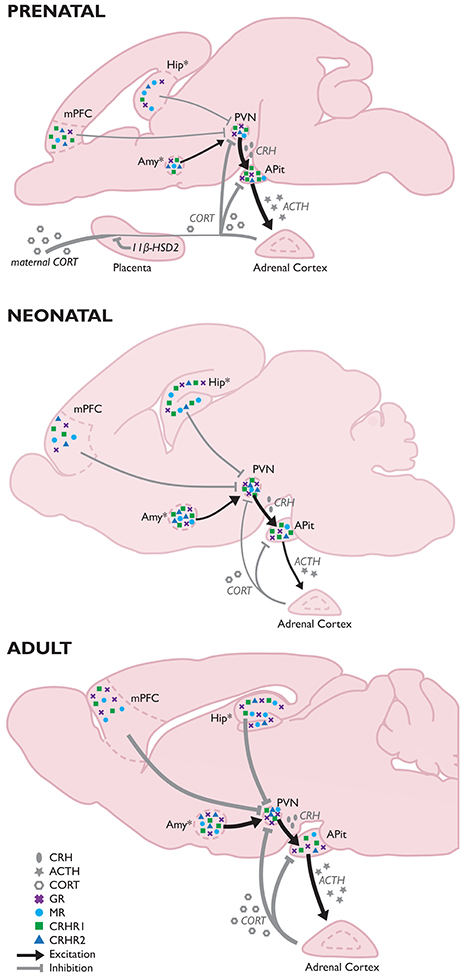
In early life, the lower brain and limbic system brain structures are more developed and dominant, whereas the cerebrum is less developed (use the above rodent graphic as a rough guide). Stress and pain generally have a greater impact on a fetus than an infant, and a greater impact on an infant than an adult.

The reviewers cited 50+ studies from years 2000-2015 in the “Early Life Stress Effects in a “Matching” Stressful Adult Environment” section to argue for the match / mismatch theory:

“Encountering ELS prepares an organism for similar (“matching”) adversities during adulthood, while a mismatching environment results in an increased susceptibility to psychopathology, indicating that ELS can exert either beneficial or disadvantageous effects depending on the environmental context.

Initial evidence for HPA-axis hypo-reactivity is observed for early social deprivation, potentially reflecting the abnormal HPA-axis function as observed in post-traumatic stress disorder.

Experiencing additional (chronic) stress in adulthood seems to normalize these alterations in HPA-axis function, supporting the match / mismatch theory.”

Evidence for this theory was contrasted with the allostatic load theory presented in How one person’s paradigms regarding stress and epigenetics impedes relevant research.


The review mainly cited evidence from rodent studies that mismatched reactions in adulthood may be consequences of early-life events. These events:

“Imprint or program an organism’s neuroendocrine, neural and behavioral responses..leading to aberrant neural circuit function throughout life..which lastingly affect brain function.”

Taking this research to a personal level:

  • Have you had feelings that you were unsafe, although your environment was objectively safe?
  • Have you felt uneasy when people are nice to you?
  • Have you felt anxious when someone pays attention to you, even after you’ve acted to gain their attention?

Mismatched human feelings are one form of mismatched reactions. These may be consequences of early-life experiences, and indicators of personal truths.

If researchers can let go of their biases and Advance science by including emotion in research, they may find that human subjects’ feelings produce better evidence for what actually happened during the subjects’ early lives than do standard scientific methods of:

Incorporating feeling evidence may bring researchers and each individual closer to discovering the major insults that knocked their development processes out of normally robust pathways and/or induced “persistent changes in gene expression and ultimately behavior.”

https://www.frontiersin.org/articles/10.3389/fncel.2017.00087/full “Modulation of the Hypothalamic-Pituitary-Adrenal Axis by Early Life Stress Exposure”


I came across this review as a result of it being cited in http://www.sciencedirect.com/science/article/pii/S1084952117302884 “Long-term effects of early environment on the brain: Lesson from rodent models” (not freely available)

A gaping hole in a review of nutritional psychiatry

This December 2016 Australian review published in September 2017 concerned:

“..the nutritional psychiatry field..the neurobiological mechanisms likely modulated by diet, the use of dietary and nutraceutical interventions in mental disorders, and recommendations for further research.”


The reviewers inexplicably omitted acetyl-L-carnitine, which I first covered in A common dietary supplement that has rapid and lasting antidepressant effects. A PubMed search on “acetyl carnitine” showed over a dozen studies from the past twelve months that were relevant to the review’s subject areas. Here’s a sample, beginning with follow-on research published in June 2016 of the study I linked above:

Reply to Arduini et al.: Acetyl-l-carnitine and the brain: Epigenetics, energetics, and stress

Dietary supplementation with acetyl-l-carnitine counteracts age-related alterations of mitochondrial biogenesis, dynamics and antioxidant defenses in brain of old rats

Neuroprotective effects of acetyl-l-carnitine on lipopolysaccharide-induced neuroinflammation in mice: Involvement of brain-derived neurotrophic factor

ALCAR promote adult hippocampal neurogenesis by regulating cell-survival and cell death-related signals in rat model of Parkinson’s disease like-phenotypes

Analgesia induced by the epigenetic drug, L-acetylcarnitine, outlasts the end of treatment in mouse models of chronic inflammatory and neuropathic pain

The cited references in these recent studies were older, of course, and in the time scope of the review. There’s no excuse for this review’s omission of acetyl-L-carnitine.

https://www.cambridge.org/core/journals/proceedings-of-the-nutrition-society/article/nutritional-psychiatry-the-present-state-of-the-evidence/88924C819D21E3139FBC48D4D9DF0C08 “Nutritional psychiatry: the present state of the evidence” (not freely available)

How one person’s paradigms regarding stress and epigenetics impedes relevant research

This 2017 review laid out the tired, old, restrictive guidelines by which current US research on the epigenetic effects of stress is funded. The reviewer rehashed paradigms circumscribed by his authoritative position in guiding funding, and called for more government funding to support and extend his reach.

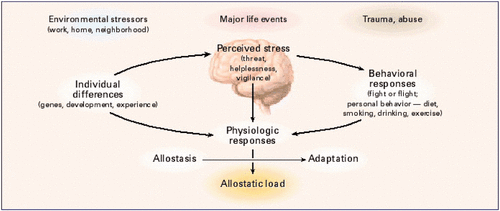
The reviewer won’t change his beliefs regarding individual differences and allostatic load pictured above since he helped to start those memes. US researchers with study hypotheses that would develop evidence beyond such memes may have difficulties finding funding except outside of his sphere of influence.


Here’s one example of the reviewer’s restrictive views taken from the Conclusion section:

Adverse experiences and environments cause problems over the life course in which there is no such thing as “reversibility” (i.e., “rolling the clock back”) but rather a change in trajectory [10] in keeping with the original definition of epigenetics [132] as the emergence of characteristics not previously evident or even predictable from an earlier developmental stage. By the same token, we mean “redirection” instead of “reversibility”—in that changes in the social and physical environment on both a societal and a personal level can alter a negative trajectory in a more positive direction.”

What would happen if US researchers proposed tests of his “there is no such thing as reversibility” axiom? To secure funding, the prospective studies’ experiments would be steered toward altering “a negative trajectory in a more positive direction” instead.

An example of this influence may be found in the press release of Familiar stress opens up an epigenetic window of neural plasticity where the lead researcher stated a goal of:

“Not to ‘roll back the clock’ but rather to change the trajectory of such brain plasticity toward more positive directions.”

I found nothing in citation [10] (of which the reviewer is a coauthor) where the rodent study researchers even attempted to directly reverse the epigenetic changes! The researchers under his guidance simply asserted:

“A history of stress exposure can permanently alter gene expression patterns in the hippocampus and the behavioral response to a novel stressor”

without making any therapeutic efforts to test the permanence assumption!

Nevermind that researchers outside the reviewer’s sphere of influence have done exactly that, reverse both gene expression patterns and behavioral responses!!

In any event, citation [10] didn’t support an “there is no such thing as reversibility” axiom.

The reviewer also implied that humans respond just like lab rats and can be treated as such. Notice that the above graphic conflated rodent and human behaviors. Further examples of this inappropriate rodent / human merger of behaviors are in the Conclusion section.


What may be a more promising research approach to human treatments of the epigenetic effects of stress? As pointed out in The current paradigm of child abuse limits pre-childhood causal research:

“If the current paradigm encouraged research into treatment of causes, there would probably already be plenty of evidence to demonstrate that directly reducing the source of the damage would also reverse damaging effects. There would have been enough studies done so that the generalized question of reversibility wouldn’t be asked.

Aren’t people interested in human treatments of originating causes so that their various symptoms don’t keep bubbling up? Why wouldn’t research paradigms be aligned accordingly?”

http://journals.sagepub.com/doi/full/10.1177/2470547017692328 “Neurobiological and Systemic Effects of Chronic Stress”

Epigenetics account for two-thirds of Alzheimer’s disease

The genetics percentage from a 2017 summary of Alzheimer’s disease research caught my eye:

“Although numerous single nucleotide polymorphisms (SNPs) have now been robustly associated with AD via genome-wide association studies and subsequent meta-analyses, collectively these common SNPs are believed to only account for 33% of attributable risk and the mechanism behind their action remains largely unknown.”

This citation aligned with other studies’ findings per Using twins to estimate the extent of epigenetic effects that on cellular levels, our experiences account for two-thirds of who we are.


The promise of this category of epigenetics research?

“One of the most exciting aspects of identifying disease-associated epigenomic dysfunction is that these mechanisms are potentially reversible.”

Let’s make research on reversing epigenetic changes a priority for funding, and get studies underway here in 2017!

https://www.epigenomicsnet.com/users/27784-katie-lunnon/posts/14634-robust-evidence-for-dna-methylomic-variation-in-alzheimer-s-disease “Robust evidence for DNA methylomic variation in Alzheimer’s disease” (Registration required)

Epigenetics and addiction

Dr. Moshe Szyf of McGill University explains current rodent epigenetic research into addiction in this October 2016 interview.

“What happens during the time when there’s no drug [cocaine] exposure, there’s just the memory of the original drug exposure? And we found huge epigenetics changes during this time, the time of abstinence.

It actually suggests that abstinence cannot cure addiction. It might even aggravate it.

We found out that timing is very important. Pairing the drug [a DNA methylation inhibitor] administration with the cue was critical with reversing the epigenetic effects and the behavioral effects.

Epigenetic treatment should theoretically reprogram the animal to forget or erase the epigenetic consequences of the initial exposure. And therefore the animal should be protected from addiction for a long time if indeed we found what we thought we did with epigenetic reprogramming.”

https://www.epigenomicsnet.com/users/3002-georgia-patey/videos/13003-video2

On Primal Therapy with Drs. Art and France Janov

Experiential feeling therapy addressing the pain of the lack of love.