Epigenetic study methodologies improved in 2017

Let’s start out 2018 paying more attention to advancements in science that provide sound empirical data and methodology. Let’s ignore and de-emphasize studies and reviews that aren’t much more than beliefs couched in models and memes, whatever their presumed authority.

Let sponsors direct researchers to focus on ultimate causes of diseases. Let’s put research of treatments affecting causes ahead of those that only address symptoms.

Here are two areas of epigenetic research that improved in 2017.


Improved methodologies enabled DNA methylation studies of adenine, one of the four bases of DNA, to advance, such as this 2017 Wisconsin/Minnesota study N6-methyladenine is an epigenetic marker of mammalian early life stress:

“6 mA is present in the mammalian brain, is altered within the Htr2a gene promoter by early life stress and biological sex, and increased 6 mA is associated with gene repression. These data suggest that methylation of adenosine within mammalian DNA may be used as an additional epigenetic biomarker for investigating the development of stress-induced neuropathology.”

Most DNA methylation research is performed on the cytosine and guanine bases.


Other examples of improved methodologies were discussed in this 2017 Japanese study Genome-wide identification of inter-individually variable DNA methylation sites improves the efficacy of epigenetic association studies:

“A strategy focusing on CpG sites with high DNA methylation level variability may attain an improved efficacy..estimated to be 3.7-fold higher than that of the most frequently used strategy.

With ~90% coverage of human CpGs, whole-genome bisulfite sequencing (WGBS) provides the highest coverage among the currently available DNAm [DNA methylation] profiling technologies. However, because of its high cost, it is presently infeasible to apply WGBS to large-scale EWASs [epigenome-wide association studies], which require DNAm profiling of hundreds or thousands of subjects. Therefore, microarrays and targeted bisulfite sequencing are currently practicable for large-scale EWASs and thus, effective strategies to select target regions are essentially needed to improve the efficacy of epigenetic association studies.

DNAm levels measured with microarrays are invariable for most CpG sites in the study populations. As invariable DNAm signatures cannot be associated with exposures, intermediate phenotypes, or diseases, current designs of probe sets are inefficient for blood-based EWASs.”
How to cure the ultimate causes of migraines?

Most of the spam I get on this blog comes in as ersatz comments on The hypothalamus couples with the brainstem to cause migraines. I don’t know what it is about the post that attracts internet bots.

The unwanted attention is too bad because the post represents a good personal illustration of “changes in the neural response to painful stimuli.” Last year I experienced three three-day migraines in one month as did the study’s subject. This led to me cycling through a half-dozen medications in an effort to address the migraine causes.

None of the medications proved to be effective at treating the causes. I found one that interrupted the progress of migraines – sumatriptan, a serotonin receptor agonist. I’ve used it when symptoms start, and the medication has kept me from having a full-blown migraine episode in the past year.

1. It may be argued that migraine headache tendencies are genetically inherited. Supporting personal evidence is that both my mother and younger sister have migraine problems. My father, older sister, and younger brother didn’t have migraine problems. Familial genetic inheritance usually isn’t the whole story of diseases, though.

2. Migraine headaches may be an example of diseases that are results of how humans have evolved. From Genetic imprinting, sleep, and parent-offspring conflict:

“Evolutionary theory predicts: that which evolves is not necessarily that which is healthy.

Why should pregnancy not be more efficient and more robust than other physiological systems, rather than less? Crucial checks, balances and feedback controls are lacking in the shared physiology of the maternal–fetal unit.

Both migraine causes and effects may be traced back to natural lacks of feedback loops. These lacks demonstrate that such physiological feedback wasn’t evolutionarily necessary in order for humans to survive and reproduce.

3. Examples of other processes occurring during prenatal development that also lack feedback loops, and their subsequent diseases, are:

A. Hypoxic conditions per Lack of oxygen’s epigenetic effects are causes of the fetus later developing:

  • “age-related macular degeneration
  • cancer progression
  • chronic kidney disease
  • cardiomyopathies
  • adipose tissue fibrosis
  • inflammation
  • detrimental effects which are linked to epigenetic changes.”

B. Stressing pregnant dams per Treating prenatal stress-related disorders with an oxytocin receptor agonist caused fetuses to develop a:

and abnormalities:

  • in social behavior,
  • in the HPA response to stress, and
  • in the expression of stress-related genes in the hippocampus and amygdala.”

1. What would be a treatment that could cure genetic causes for migraines?

I don’t know of any gene therapies.

2. What treatments could cure migraines caused by an evolved lack of feedback mechanisms?

We humans are who we have become, unless and until we can change original causes. Can we deal with “changes in the neural response to painful stimuli” without developing hopes for therapies or technologies per Differing approaches to a life wasted on beliefs?

3. What treatments could cure prenatal epigenetic causes for migraines?

The only effective solution I know of that’s been studied in humans is to prevent adverse conditions like hypoxia from taking place during pregnancy. The critical periods of our physical development are over once we’re adults, and we can’t unbake a cake.

Maybe science will offer other possibilities. Maybe researchers could do more than their funding sponsors expect?

Differing approaches to a life wasted on beliefs

Let’s start by observing that people structure their lives around beliefs. As time goes on, what actions would a person have taken to ward off non-confirming evidence?

One response may be that they would engage in ever-increasing efforts to develop new beliefs that justified how they spent their one precious life’s time so far.

Such was my take on beliefs embedded in https://www.ncbi.nlm.nih.gov/pmc/articles/PMC5684598/pdf/PSYCHIATRY2017-5491812.pdf “Epigenetic and Neural Circuitry Landscape of Psychotherapeutic Interventions”:

“Animal models have shown the benefits of continued environmental enrichment (EE) on psychopathological phenotypes, which carries exciting translational value.

This paper posits that psychotherapy serves as a positive environmental input (something akin to EE).”

The author conveyed his belief that wonderful interventions were going to happen in the future. However, when scrutinized, most human studies have demonstrated NULL effects of psychotherapeutic interventions on causes. Without sound evidence that treatments affect causes, his belief seemed driven by something else.

The author cited findings of research like A problematic study of oxytocin receptor gene methylation, childhood abuse, and psychiatric symptoms as supporting external interventions to tamp down symptoms of patients’ presenting problems. Did any of the 300+ cited references concern treatments where patients instead therapeutically addressed their problems’ root causes?


For an analogous religious example, a person’s belief caused him to spend years of his life trying to convince men to act so that they could get their own planet after death, and trying to convince women to latch onto men who had this belief. A new and apparently newsworthy belief developed from his underlying causes:

“The founder and CEO of neuroscience company Kernel wants “to expand the bounds of human intelligence.” He is planning to do this with neuroprosthetics; brain augmentations that can improve mental function and treat disorders. Put simply, Kernel hopes to place a chip in your brain.

He was raised as a Mormon in Utah and it was while carrying out two years of missionary work in Ecuador that he was struck by what he describes as an “overwhelming desire to improve the lives of others.”

He suffered from chronic depression from the ages of 24 to 34, and has seen his father and stepfather face huge mental health struggles.”

https://www.theguardian.com/small-business-network/2017/dec/14/humans-20-meet-the-entrepreneur-who-wants-to-put-a-chip-in-your-brain “Humans 2.0: meet the entrepreneur who wants to put a chip in your brain”

The article stated that he had given up Mormonism. There was nothing to suggest, though, that he had therapeutically addressed any underlying causes for his misdirected thoughts, feelings, and behavior.

So he developed other beliefs instead.


What can people do to keep their lives from being wasted on beliefs? As mentioned in What was not, is not, and will never be:

“The problem is that spending our time and efforts on these ideas, beliefs, and behaviors won’t ameliorate their motivating causes. Our efforts only push us further away from our truths, with real consequences: a wasted life.

The goal of the therapeutic approach advocated by Dr. Arthur Janov’s Primal Therapy is to remove the force of presenting problems’ motivating causes. Success in reaching this goal is realized when patients become better able to live their own lives.

What is a father’s role in epigenetic inheritance?

The agenda of this 2017 Danish review was to establish a paternal role in intergenerational and transgenerational epigenetic inheritance of metabolic diseases:

“There are four windows of susceptibility which have major importance for epigenetic inheritance of acquired paternal epigenetic changes:

  1. paternal primordial germ cell (PGC) development,
  2. prospermatogonia stages,
  3. spermatogenesis, and
  4. during preimplantation.”

The review was a long read as the authors discussed animal studies. When it came to human studies near the paper’s end, though, the tone was of a “we know this is real, we just have to find it” variety. The authors acknowledged:

“To what extent the described DNA methylation changes influence the future health status of offspring by escaping remodeling in the preimplantation period as well as in future generations by escaping remodeling in PGC remodeling has yet to be determined.

These studies have not yet provided an in-depth understanding of the specific mechanisms behind epigenetic inheritance or exact effect size for the disease risk in offspring.

Pharmacological approaches have reached their limits..”

before presenting their belief that a hypothetical series of future CRISPR-Cas9 experiments will demonstrate the truth of their agenda.


The review focused on 0.0001% of the prenatal period for what matters with the human male – who he was at the time of a Saturday night drunken copulation – regarding intergenerational and transgenerational epigenetic inheritance of metabolic diseases.

The human female’s role – who she was at conception AND THEN what she does or doesn’t do during the remaining 99.9999% of the prenatal period to accommodate the fetus and prevent further adverse epigenetic effects from being intergenerationally and transgenerationally transmitted  – wasn’t discussed.

Who benefits from this agenda’s narrow focus?

If the review authors sincerely want to:

“Raise societal awareness of behavior to prevent a further rise in the prevalence of metabolic diseases in future generations..”

then EARN IT! Design and implement HUMAN studies to test what’s already known from epigenetic inheritance animal studies per Experience-induced transgenerational programming of neuronal structure and functions. Don’t disguise beliefs with the label of science.

http://jme.endocrinology-journals.org/content/early/2017/12/04/JME-17-0189.full.pdf “DNA methylation in epigenetic inheritance of metabolic diseases through the male germ line”

Beliefs about genetic and environmental influences in twin studies

This 2017 Penn State simulation found:

“By taking advantage of the natural variation in genetic relatedness among identical (monozygotic: MZ) and fraternal (dizygotic: DZ) twins, twin studies are able to estimate genetic and environmental contributions to complex human behaviors.

In the standard biometric model when MZ or DZ twin similarity differs from 1.00 or 0.50, respectively, the variance that should be attributed to genetic influences is instead attributed to nonshared environmental influences, thus deflating the estimates of genetic influences and inflating the estimates of nonshared environmental influences.

Although estimates of genetic and nonshared environmental influences from the standard biometric model were found to deviate from “true” values, the bias was usually smaller than 10% points indicating that the interpretations of findings from previous twin studies are mostly correct.”

The study model’s input was five phenotypes that varied the degrees of:

  1. Genetic and epigenetic heritability;
  2. Shared environmental factors; and
  3. Nonshared environmental factors.

Item 1 above was different than the standard model’s treatment of heritable factors, which considers only additive genetic influences.

The authors cited studies for moderate and significant shared environmental influences in child and adolescent psychopathology and parenting to support the model’s finding that overall, item 2 above wasn’t underestimated.


I wasn’t satisfied with the simulation’s description of item 1 above. With

  1. Environmental influences accounted for elsewhere, and
  2. No references to transgenerational epigenetic inheritance,
  3. Randomness seemed to be the only remaining explanation for an epigenetic heritability factor.

Inserting the model’s non-environmental randomness explanation for epigenetic heritability into the abstract’s statement above exposed the non sequitur:

In the standard biometric model when MZ or DZ twin similarity differs from 1.00 or 0.50, respectively, the variance that should be attributed to genetic [and non-environmental stochastic heritability] influences is instead attributed to nonshared environmental influences, thus deflating the estimates of genetic [and non-environmental stochastic heritability] influences and inflating the estimates of nonshared environmental influences.

Why did the researchers design their model with an adjustment for non-environmental epigenetic heritability? Maybe it had something to do with:

“Estimates of genetic and nonshared environmental influences from the standard biometric model were found to deviate from “true” values.”

In any event, I didn’t see that this simulation was much more than an attempt to reaffirm a belief that:

“The interpretations of findings from previous twin studies are mostly correct.”


Empirical rather than simulated findings in human twin study research are more compelling, such as The primary causes of individual differences in DNA methylation are environmental factors with its finding:

“Differential methylation is primarily non-genetic in origin, with non-shared environment accounting for most of the variance. These non-genetic effects are mainly tissue-specific.

The full scope of environmental variation remains underappreciated.”

https://link.springer.com/article/10.1007/s10519-017-9875-x “The Impact of Variation in Twin Relatedness on Estimates of Heritability and Environmental Influences” (not freely available)

Do preventive interventions for children of mentally ill parents work?

The fifth and final paper of Transgenerational epigenetic inheritance week was a 2017 German/Italian meta-analysis of psychiatric treatments involving human children:

“The transgenerational transmission of mental disorders is one of the most significant causes of psychiatric morbidity. Several risk factors for children of parents with mental illness (COPMI) have been identified in numerous studies and meta-analyses.

There is a dearth of high quality studies that effectively reduce the high risk of COPMI for the development of mental disorders.”


I found the study by searching a medical database on the “transgenerational” term. The authors fell into the trap of misusing “transgenerational” instead of “intergenerational” to describe individuals in different generations.

Per the definitions in A review of epigenetic transgenerational inheritance of reproductive disease and Transgenerational effects of early environmental insults on aging and disease, for the term “transgenerational transmission” to apply, the researchers needed to provide evidence in at least the next 2 male and/or 3 female generations of:

“Altered epigenetic information between generations in the absence of continued environmental exposure.”

The meta-analysis didn’t provide evidence for “transgenerational transmission of mental disorders.”


Several aspects of the meta-analysis stood out:

  1. Infancy was the earliest period of included studies, and studies of treatments before the children were born were excluded;
  2. Parents had to be diagnosed with a mental illness for the study to be included;
  3. Studies with children diagnosed with a mental illness were excluded; and
  4. Studies comparing more than one type of intervention were excluded.

Fifty worldwide studies from 1983 through 2014 were selected for the meta-analysis.

Per item 1 above, if a researcher doesn’t look for something, it’s doubtful that they will find it. As shown in the preceding papers of Transgenerational epigenetic inheritance week, the preconception through prenatal periods are where the largest epigenetic effects on an individual are found. There are fewer opportunities for effective “preventive interventions” in later life compared with these early periods.

Science provides testable explanations and predictions. The overall goal of animal studies is to help humans.

Animal studies provide explanations and predictions for the consequences of environmental insults to the human fetus – predictable disrupted neurodevelopment with subsequent deviated behaviors and other lifelong damaging effects in the F1 children. The first four papers I curated during Transgenerational epigenetic inheritance week provided samples of which of these and/or other harmful effects may be predictably found in F2 grandchildren, F3 great-grandchildren, and future human generations.

When will human transgenerational epigenetic inheritance be taken seriously? Is the root problem that human societies don’t give humans in the fetal stage of life a constituency, or protection against mistreatment, or even protection against being arbitrarily killed?


The default answer to the meta-analysis title “Do preventive interventions for children of mentally ill parents work?” is No. As for the “dearth of high quality studies” complaint: when treatments aren’t effective, is the solution to do more of them?

No.

The researchers provided an example of the widespread belief that current treatments for “psychiatric morbidity” are on the right path, and that the usual treatments – only done more rigorously – will eventually provide unquestionable evidence that they are effective.

This belief is already hundreds of years old. How much longer will this unevidenced belief infect us?

http://journals.lww.com/co-psychiatry/Abstract/2017/07000/Do_preventive_interventions_for_children_of.9.aspx “Do preventive interventions for children of mentally ill parents work? Results of a systematic review and meta-analysis” (not freely available)

Prisoners of our childhoods

Same old shit – another failed relationship.

Coincident with the start of our relationship, I was struck by a phrase by Dr. Janov, posted in Beyond Belief: What we do instead of getting well:

“It doesn’t matter about the facts we know if we cannot maintain a relationship with someone else.”

I kept that thought in the forefront.

Both of us are prisoners of our childhoods. I’ve tried to see and feel the walls and bars for what they are.

Like all of us, J hadn’t tried to process the reality of her childhood and life. For example, on her birthday I asked her how she celebrated her birthdays when she was growing up. She provided a few details, then mentioned that her parents had skipped some of her birthdays. Although I had no immediate reaction, she quickly said that she had a happy childhood.

I was at fault, too, of course. I again asked a woman to marry me who hadn’t ever told me she loved me, except in jest.

I asked J to marry me around the six-month point of our relationship. I felt wonderful, in love with her that August morning after she slept with me at my house. I made an impromptu plan: in the middle of a four-mile walk, I asked her to marry me while kneeling before her as she sat on a bench outside a jewelry store. But she wouldn’t go in to choose a ring. She said she’d think about it.

A month later, after several dates, sleepovers at her house, and a four-day trip to Montreal, I again brought up marriage while we rested on her large couch in her nice sun room. The thing I felt would be wonderful brought about the end.

I tried to understand why she couldn’t accept me for the person who I intentionally showed her I am. She abstracted everything that she said.

I tried to get her to identify why, after all the times we cared for each other, after all our shared experiences, she didn’t want me around anymore.

Didn’t happen. She didn’t tell me things that made sense as answers to my questions.

One thing she said without abstraction was that I was weak for showing my feelings. She told me I was clingy.

Another thing she communicated at the end shocked me. She somehow thought that I was going to dump her. I said that the thought never even crossed my mind.

I didn’t recognize it as projection at the time. Prompted by her underlying feelings, she attributed to me the actions and thoughts that only she herself had.

I’ve tried to put myself in J’s place.

  • How horrible must it have been for her to be steadily intimate with a man and not feel that his touches, kisses, words, affection, expressed love?
  • That he couldn’t really love me, and so I couldn’t love him?
  • That he was actually after something else, because it was impossible that he loved me?

One thing I’ve felt after the end was that the need underlying my only stated relationship goal – to live with a woman I love who also loves me – is again ruining my life. My latest efforts towards that goal were rife with unconscious symbolic act outs of an unsatisfied need from my early life.

That unrelenting need is for a woman’s love. The women I’ve chosen, though, have always given me what I got from my mother: they wouldn’t accept me as I am, and didn’t love me.

And there can never be a substitute. Most of my Primal Therapy sessions included the PAIN OF FEELING exactly that.

My prison cell is what Dr. Janov calls the imprint where I – as a child, teenager, young man, middle-aged man, old man – futilely ATTEMPT TO CHANGE THE PAST.

“Standing next to me in this lonely crowd
Is a man who swears he’s not to blame
All day long I hear him shout so loud
Crying out that he was framed

I see my light come shining
From the west down to the east
Any day now, any day now
I shall be released”


P.S. – We got back together seven months later, and are still going strong.

How one person’s paradigms regarding stress and epigenetics impedes relevant research

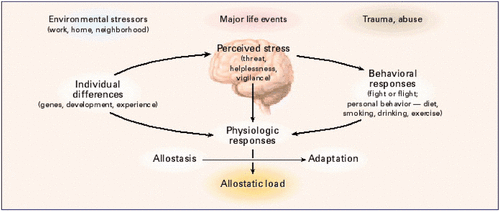
This 2017 review laid out the tired, old, restrictive guidelines by which current US research on the epigenetic effects of stress is funded. The reviewer rehashed paradigms circumscribed by his authoritative position in guiding funding, and called for more government funding to support and extend his reach.

The reviewer won’t change his beliefs regarding individual differences and allostatic load pictured above since he helped to start those memes. US researchers with study hypotheses that would develop evidence beyond such memes may have difficulties finding funding except outside of his sphere of influence.


Here’s one example of the reviewer’s restrictive views taken from the Conclusion section:

Adverse experiences and environments cause problems over the life course in which there is no such thing as “reversibility” (i.e., “rolling the clock back”) but rather a change in trajectory [10] in keeping with the original definition of epigenetics [132] as the emergence of characteristics not previously evident or even predictable from an earlier developmental stage. By the same token, we mean “redirection” instead of “reversibility”—in that changes in the social and physical environment on both a societal and a personal level can alter a negative trajectory in a more positive direction.”

What would happen if US researchers proposed tests of his “there is no such thing as reversibility” axiom? To secure funding, the prospective studies’ experiments would be steered toward altering “a negative trajectory in a more positive direction” instead.

An example of this influence may be found in the press release of Familiar stress opens up an epigenetic window of neural plasticity where the lead researcher stated a goal of:

“Not to ‘roll back the clock’ but rather to change the trajectory of such brain plasticity toward more positive directions.”

I found nothing in citation [10] (of which the reviewer is a coauthor) where the rodent study researchers even attempted to directly reverse the epigenetic changes! The researchers under his guidance simply asserted:

“A history of stress exposure can permanently alter gene expression patterns in the hippocampus and the behavioral response to a novel stressor”

without making any therapeutic efforts to test the permanence assumption!

Never mind that researchers outside the reviewer’s sphere of influence have done exactly that, reverse both gene expression patterns and behavioral responses!!

In any event, citation [10] didn’t support an “there is no such thing as reversibility” axiom.

The reviewer also implied that humans respond just like lab rats and can be treated as such. Notice that the above graphic conflated rodent and human behaviors. Further examples of this inappropriate rodent / human merger of behaviors are in the Conclusion section.


What may be a more promising research approach to human treatments of the epigenetic effects of stress? As pointed out in The current paradigm of child abuse limits pre-childhood causal research:

“If the current paradigm encouraged research into treatment of causes, there would probably already be plenty of evidence to demonstrate that directly reducing the source of the damage would also reverse damaging effects. There would have been enough studies done so that the generalized question of reversibility wouldn’t be asked.

Aren’t people interested in human treatments of originating causes so that their various symptoms don’t keep bubbling up? Why wouldn’t research paradigms be aligned accordingly?”

http://journals.sagepub.com/doi/full/10.1177/2470547017692328 “Neurobiological and Systemic Effects of Chronic Stress”

What are we to believe?

This 2017 blog post from Antiwar.com’s Justin Raimondo outlines the latest instance of exploiting beliefs:

“Neither the sources of this story nor those who are reporting it can be trusted. Journalism is not a means of discovering knowledge, but a weapon to be deployed in a political-ideological conflict.”

Similar to the development of other beliefs, the reporting of the referenced story discouraged inquiries into “Information about the real world..giving us a highly distorted version of events.” It followed the blueprint of Using citations to develop beliefs instead of evidence in that once the faulty information became widely cited, refuting evidence would be ignored, and the false belief was used for other purposes.

http://original.antiwar.com/justin/2017/08/10/what-are-we-to-believe/ “What Are We To Believe? Fake news plus phony “intelligence” equals disaster”


This post has somehow become a target for spammers, and I’ve disabled comments. Readers can comment on other posts and indicate that they want their comment to apply here, and I’ll re-enable comments.

Using citations to develop beliefs instead of evidence

This 2009 Harvard study analyzed how citations were used as tools to establish a belief.

The researched data was gathered from 1992 to 2007 on a specific subject of Alzheimer’s research. The belief was:

“β amyloid is produced by inclusion body myositis myofibres or is uniquely present in inclusion body myositis muscle.”

The author used social network analysis to determine:

“Four primary data papers, five model papers, and one review paper constituted the 10 most authoritative papers that the claim was true.

The supportive papers received 94% of the 214 citations to these primary data, whereas the six papers containing data that weakened or refuted the claim received only 6% of these citations.

95% of all citation paths flow through four review papers by the same research group.

Amplification of a claim is instead introduced into belief systems through the citing of review papers and other papers that lack data addressing the claim.”

Some of the benefits believers received included:

  1. It became easier to build models if a researcher believed:

    “Animal and cell culture experiments are valid models of inclusion body myositis”

    although:

    “The uncited data suggest that the animal and cell culture experiments are no more models of inclusion body myositis than any other neuromuscular disease in which muscle regeneration occurs.”

  2. Believers used exaggerations in their confirming research that diverted the original claim’s meaning. As an example:

    “Three supportive citations developed into 7,848 supportive citation paths—chains of false claim in the network.”

  3. Citation biases and diversions could be used to support proposals for new funding.

Just imagine how compressed this phenomenon’s timeframe is now with our social networks! The tools available for creating memes and widespread nonfactual distortions are children’s play.

A few questions for the current year:

  1. What do we believe in that isn’t thoroughly investigated, where we haven’t found the time or inclination to search for opposing results?
  2. What causes us to believe these things?
  3. What are the positive and negative consequences of our beliefs?

http://www.bmj.com/content/339/bmj.b2680 “How citation distortions create unfounded authority: analysis of a citation network”

Hat tip to Jon in the comments section of Neuroskeptic’s blog post “The Ethics of Citation” http://blogs.discovermagazine.com/neuroskeptic/2017/03/12/the-ethics-of-citation

Hope sells

I used a browser yesterday that didn’t have ad blocker software installed. The below pictures came from one of the ads that displayed:

helpless

hope

A young girl in a dance position and outfit juxtaposed with an appeal: “No situation is HELPLESS because there is HOPE.” How interesting!

I didn’t click through the ad yesterday to see what was being sold by engaging customers’ beliefs, within which lay hope. When I clicked the ad today, it asked for donations to “Sponsor a Child,” develop “the perfect recipe for sustainable success,” and, at the bottom of the page, “We love because Jesus loves.”

What do we know about this ad’s appeal from reading Dr. Arthur Janov’s May 2016 book Beyond Belief? Can hope change a helpless situation per the ad?

On one level – yes, in a believer’s brain, by blocking helpless feelings. Otherwise – no. Hope ultimately isn’t a remedy for the causes of what created helpless feelings.

I donated to a similar organization for a few years, but not anymore.

Beyond Belief: What we do instead of getting well

Continuing Dr. Arthur Janov’s May 2016 book Beyond Belief:

“p. 61 Heavy pains with no place to go just pressures the cortex into concocting an idea commensurate with the feeling.

The feeling itself makes no sense since the original feeling has no scene with it nor verbal capacity; it was laid down in a preverbal time without context, save for the feeling itself.

We cling to those ideas as strongly as the feelings driving us are.

Sometimes we argue with someone not realizing that we are battling a defense which is implacable. They don’t want to hear what we have to say. They want to protect their psyche.

p. 63 Suffocation at birth is registered not as an idea, but as a physiologic fact. It becomes an idea when the brain evolves enough to produce ideas. Then it can produce, ‘There is no air in here.’

A slightly stifling atmosphere in the present can set off this great pain and with it an exaggerated response. ‘I have to leave this woman because she stifles me.’

p. 64 It doesn’t matter about the facts we know if we cannot stop drinking or if we cannot maintain a relationship with someone else.

p. 68 My task is to examine why individuals adopt belief systems, whatever they are, and how certain feelings provoke specific kinds of belief systems..to demonstrate how feeling feelings can alter those beliefs without once addressing the beliefs at all.

Deprogramming is not necessary. Probing need is. Resolving feelings seems to render belief systems inoperative.

p. 71 We are a nation and a world of seekers, a people who seek refuge in all manner of beliefs.

p. 75-76 Later in life, equipped with the cortical ability to substitute ideation for feeling, the traumatized baby can call upon a god to save him from his inner pain, even when he doesn’t know where the pain originated, or even that there is pain. He just calls upon a god to watch over him, to see that he gets justice, who won’t let him down, and above all, who will help him make it into life.

p. 106 Neurosis is the only malady on the face of this earth that feels good..numbs the feeling. Numb feels good – not ‘good’ in the absolute sense, just not ‘bad.’

So we settle..we get numbed out and feel no pain and in return, life is blah blah. The person then feels she is not getting anything out of life and seeks out salvation or a guru in one form or another.”


“We are a nation and a world of seekers, a people who seek refuge in all manner of beliefs.” The patient’s story on pages 89 – 105 told of HORRIFIC damages inflicted by believers and the subsequent consequences!

Variations of his story with its adverse childhood experiences could be told by tens of millions of people in the US alone!

Why isn’t the internet flooded with 10+ million similar stories of people who have faced their realities, and effectively addressed the real causes of what’s wrong in their lives?

Said another way: Why is the internet instead flooded with stories of 10+ million people

  • NOT facing their realities,
  • Doing things to prolong their conditions, and
  • Avoiding getting well?

The many reasons why people do things that don’t truly get them well are covered in Beyond Belief and Dr. Janov’s other publications. One obstacle for people who want enduring therapeutic help is the intentional misrepresentation of Primal Therapy.

Every day I look at the results of an automated search that uses “primal therapy” as the search term. Along with the scams and irrelevancies are the “scream” results.

This misrepresentation is addressed here:

“Primal Therapy is not Primal ‘Scream’ Therapy. Primal Therapy is not just making people scream; it was never ‘screaming’ therapy. The Primal Scream was the name of the 1st book by Dr. Janov about Primal Therapy.”

People who perpetuate the “scream” meme are only a few seconds away from search results that would inform them and their readers of accurate representations of Primal Therapy.

What purpose does it serve to misdirect people away from doing something to effectively address the real causes of what’s wrong in their lives?

Beyond Belief: The impact of merciless beatings on beliefs

Continuing with Dr. Arthur Janov’s May 2016 book Beyond Belief:

“p. 17 When someone insults us, we immediately create reasons and rationales for it. We cover the pain. Now imagine a whole early childhood of insults and assaults and how that leaves a legacy that must be dealt with.

The mind of ideas and philosophies doesn’t know it is being used; doesn’t know it serves as a barricade against the danger of feeling.

It is why no one can convince the person out of her ideas. They serve a key purpose and should not be tampered with. We are tampering with a survival function.

p. 19 It seems like a miracle that something as intangible and invisible as an idea has the power to transform our biologic system. It makes us see what doesn’t exist and sometimes not see what does. What greater power exists than that? To be fooled is not only to convince someone to believe the false, but also to convince others to not believe the truth.

The unloved child who cannot bear the terrible feelings of hopelessness shuts down his own feeling centers and grows insensitive, not only to his pain, but to that of others. So he commits the same error on his child that was visited upon him, and he does so because of the way he was unloved early on. He cannot see his own hopelessness or that of his child.

p. 56 All defensive beliefs must have a kernel of hope inside of them. It is the embedded hopelessness that gives rise to its opposite – hope – and its accompanying biochemistry of inhibition or gating.

To be even more precise, it is the advent of pain surrounding hopelessness that produces the belief entwined with hope. All defensive belief serves the same function – repression, absorbing the energy of pain.

p. 57 An unloved child is a potential future believer.

p. 58 NO ONE HAS THE ANSWER TO LIFE’S QUESTIONS BUT YOU. How you should lead your life depends on you, not outside counsel.

We do not direct patients, nor dispense wisdom upon them. We have only to put them in touch with themselves; the rest is up to them.

Everything the patient has to learn already resides inside. The patient can make herself conscious. No one else can.”


“p. 29 The personal experience stories throughout the book are written by my patients and, with the exception of a few grammatical corrections, they are presented here exactly as they were given to me.”

All of the Primal Therapy patients’ stories started with HORRENDOUS childhoods that produced correspondingly strong beliefs!

I came across a public figure example today in 10 Defining Moments In The Childhood Of Martin Luther King Jr. The author included two items germane to an understanding of how beliefs may develop from adverse childhood experiences:

  • 8. King Sr. “Would beat Martin and his brother, Alfred, senseless for any infraction, usually with a belt.”
  • 6. “By the time King was 13, he’d tried to kill himself twice.”

Every reference I found tied King Jr.’s suicide attempts to his grandmother’s death. What an implausible narrative!

A whole early childhood of insults and assaultscertainly had more to do with the causes for his preteen suicide attempts.

Consider a child’s feelings of helplessness, worthlessness, pain, and betrayal when the people who are supposed to love them are cruel to them instead. Feelings like what I expressed in Reflections on my four-year anniversary of spine surgery.

Consider the appeal of escaping from this life when “The unloved child cannot bear the terrible feelings of hopelessness.”

Granted that it’s only the patient who can put together what happened in their life so that it’s therapeutic. Beyond Belief and Dr. Janov’s other publications outline the framework.

Beyond Belief: Why do we accept being propagandized?

Continuing to read Dr. Arthur Janov’s May 2016 book Beyond Belief:

“p.13 Beliefs are medicine for the hopeless. They attenuate despair, vitiate loneliness, and dissipate helplessness.

p. 14 We need hope more than we need truth. Beliefs divert us from past traumas and current pains because inside the belief lies hope.

p.15 Hope is ‘the meaning of life.’ It shimmers and sparkles and blinds us from seeing the bars of our prisons of belief.

We are all, in one way or another, victims of early unfulfilled need. Never think that intelligence prohibits this kind of behavior.

We search for hope here and there based on early hopelessness of which we are unaware. Nothing in one’s current life points to the problem, and nothing even in one’s childhood clarifies it.

One’s expectations may exceed reality when feelings are thrust into the arena of ideas. One no longer sees reality, but rather a projection of need.”


“We need hope more than we need truth.” Is this part of why we accept headlines as facts, and don’t pay attention to the stories’ subsequent corrections? Why do we accept as facts news articles that don’t link to the cited sources?

I had dinner earlier this week with an intelligent woman. She mentioned that she constantly listened to National Public Radio. I asked her what value she got from it, and she replied that it kept her current with events.

I asked what other news sources she sought out. She said that she didn’t usually have the time, and that NPR was a reliable source.

I didn’t further challenge her beliefs. It’s up to each individual to realize that their beliefs are symptoms of what’s ruining their one precious life.

Last weekend I engaged in essentially the same conversation over lunch with another intelligent woman who relied on conservative news sources. She also became defensive, and ended that part of our conversation as a matter of “agreeing to disagree.”

Why does intelligence seem to have little to do with accepting being propagandized?

Beyond Belief: Symptoms of hopelessness

I’ve started to read Dr. Arthur Janov’s May 2016 book Beyond Belief. Here are a few thoughts I’ve expressed to friends that were prompted by the first dozen pages of the paperback version.

“p. 5 We need a painless liberation from our insidious emotional wounds..a leader who will take the place of an emotionally distant parent for whom we will sacrifice anything just for the promise of love, protection, and caring.”

The elections of the past two presidents were symptoms of the hopelessness that most Americans feel. Both elections promised hope.

“p. 6 Beliefs sell and sell well. People will pay dearly for even the promise of fulfillment, even if it is in the next life.”

Religion can have a much worse and lasting effect on people than any politician or political system can. Politicians can drag out and delay living up to their promises.

Religious leaders don’t have to deliver much at all during their followers’ lives. In fact, it works in the leaders’ favor to minimally address their followers’ current sufferings, as that strengthens the appeal of the imaginary next life!


The past three weeks I’ve gone to 7-11 to get a morning coffee. More often than not, I see people buying lottery tickets during the 2-3 minutes when I’m there.

What accounts for this behavior? Not everyone who buys a lottery ticket is innumerate.

I’d guess that it’s a symptom of hopelessness. Feelings of hopelessness cause us to generate a faith that an exceedingly-improbable event will benefit our life. Lottery-ticket behavior follows.

State governments are responsible for these lotteries. It’s one of the ways governments prey upon their citizens’ feelings of hopelessness.

I once worked as a contractor in a government office where everyone except me pooled money every week to buy lottery tickets. I was also the only nonreligious person there.

Coincidence?