Epigenetic remodeling creates immune system memory

This 2016 German review subject was memory characteristics of immune cells:

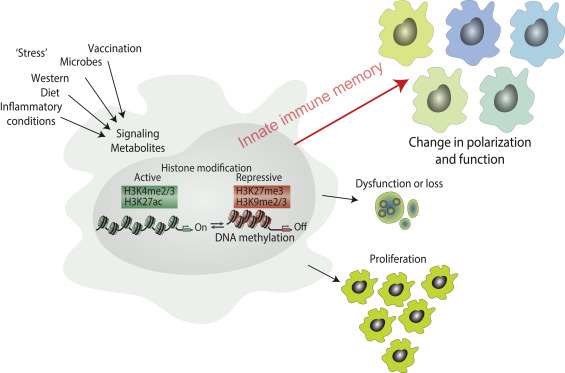
“Innate immune memory has likely evolved as an ancient mechanism to protect against pathogens. However, dysregulated processes of immunological imprinting mediated by trained innate immunity may also be detrimental under certain conditions.

Evidence is rapidly accumulating that innate immune cells can adopt a persistent pro-inflammatory phenotype after brief exposure to a variety of stimuli, a phenomenon that has been termed ‘trained innate immunity.’ The epigenome of myeloid (progenitor) cells is presumably modified for prolonged periods of time, which, in turn, could evoke a condition of continuous immune cell over-activation.”

These reviewers focused on an example of atherosclerosis, although other examples were discussed of epigenetic remodeling to acquire immune memory:

“In the last ten years, several novel non-traditional risk factors for atherosclerosis have been identified that are all associated with activation of the immune system. These include chronic inflammatory diseases such as:

  • Rheumatoid arthritis,
  • Gout,
  • Psoriatic arthritis, and
  • Ankylosing spondylitis,

as well as infections with bacteria or viruses.”

Innate immune memory

http://www.sciencedirect.com/science/article/pii/S1044532316300185 “Long-term activation of the innate immune system in atherosclerosis”


Diets were discussed, mainly regarding their various negative effects. I was interested to see a study that referenced a common dietary supplement:

“Pathway analysis of promoters that were potentiated by β-glucan identified several innate immune and signaling pathways upregulated in trained cells that are responsible for induction of trained immunity.”

Other curated research into epigenetic remodeling of immune system memory includes:

Lack of oxygen’s epigenetic effects

This 2016 Finnish review subject was epigenetic effects of hypoxia:

“Ever since the Cambrian period, oxygen availability has been in the center of energy metabolism. Hypoxia stabilizes expression of hypoxia-inducible transcription factor-1α (HIF-1α), which controls expression of hundreds of survival genes related to enhanced energy metabolism and autophagy.

There are several other signals, mostly related to stresses, which can increase expression of HIF factors and thus improve cellular survival. However, a chronic activation of HIF factors can have detrimental effects, e.g. stimulate cellular senescence and tissue fibrosis commonly enhanced in age-related diseases.

Stabilization of HIF-1α increases expression of histone lysine demethylases (KDM). Hypoxia-inducible KDMs support locally the gene transcription induced by HIF-1α, although they can also control genome-wide chromatin landscape, especially KDMs which demethylate H3K9 and H3K27 sites (repressive epigenetic marks).”

Gene areas where HIF-1α is involved include:

  • “angiogenesis
  • autophagy
  • glucose uptake
  • glycolytic enzymes
  • immune responses
  • embryonic development
  • tumorigenesis
  • generation of miRNAs.”

HIF-1a signaling

Figure 1 above was instructive in that the reviewers pointed out the lack of a feedback mechanism in HIF-1α signaling. A natural lack of feedback to the HIF-1α signaling source contributed to diseases such as:

  • “age-related macular degeneration
  • cancer progression
  • chronic kidney disease
  • cardiomyopathies
  • adipose tissue fibrosis
  • inflammation
  • detrimental effects which are linked to epigenetic changes.”

The point was similar to a study referenced in The PRice “equation” for individually evolving: Which equation describes your life? that:

“Evolution may preferentially mitigate damage to a biological system than reduce the source of this damage.”


This review subject has many interdependencies and timings within a complex network. Contexts are important:

“Cross-talk between NF-κB [nuclear factor kappa B] and HIF-1α in inflammation might be organized in cell type and context-dependent manner.

It seems that ROS [reactive oxygen species] affect HIF-1α signaling in a context-dependent manner.

Hypoxia stimulated expression of KDM3A and KDM4B genes in different cellular contexts. Given that KDM3A and KDM4B are the major histone demethylases which remove repressive H3K9 sites, their role as transcriptional cofactors seems to be important in activation of HIF-1α signaling. Members of KDM4 subfamily have a crucial role in DNA repair systems, although responses seem to be enzyme-specific and appear in a context-dependent manner.

Acute hypoxia can stimulate cell-cycle arrest but does not provoke cellular senescence in all contexts.”

It wasn’t mentioned that hypoxia evokes cellular Adaptations to stress encourage mutations in a DNA area that causes diseases.

The review was tailored for the publishing journal Aging and Disease, and the subject was best summed up by:

“HIF-1α can control cellular fate in adult animals, either stimulating proliferation or triggering cellular senescence, by regulating the expression of different KDMs in a context-dependent manner.”


This review covered hypoxic conditions during human development that are clearly origins of many immediate and later-life diseases. However, cited remedies only addressed symptoms.

That these distant causes can no longer be addressed is a hidden assumption of research and treatment of effects of health problems. Aren’t such assumptions testable here in the current year?

http://www.aginganddisease.org/article/2016/2152-5250/ad-7-2-180.shtml “Hypoxia-Inducible Histone Lysine Demethylases: Impact on the Aging Process and Age-Related Diseases”
The inevitable effects of avoidable wars

“It was like Tom had tried to return home,” says Jacky Sweetnam. “But he didn’t quite make it.”

http://news.nationalpost.com/features/the-ghosts-of-vietnam-the-last-days-of-a-decorated-canadian-vet “The Ghosts of Vietnam”


In memoriam to my father who died twenty years ago last week. World War II ruined his life with undiagnosed PTSD, some of the effects of which affected his children.

His brother – my uncle – was a Navy hospital corpsman during the slaughter at Iwo Jima, and was even more afflicted.

Neither of them were ever treated.

Using epigenetic outliers to diagnose cancer

This 2016 Chinese/UK human cancer cell study tested five algorithms and found:

“Most of the novel proposed algorithms lack the sensitivity to detect epigenetic field defects at genome-wide significance. In contrast, algorithms which recognise heterogeneous outlier DNA methylation patterns are able to identify many sites in pre-neoplastic lesions, which display progression in invasive cancer.

Many DNA methylation outliers are not technical artefacts, but define epigenetic field defects which are selected for during cancer progression.”

The usual method of epigenetic studies involves:

“Identify genomic sites where the mean level of DNAm [DNA methylation] differs as much as possible between the two phenotypes. As we have seen however, such an approach is seriously underpowered in cancer studies where tissue availability is a major obstacle.

In addition to allelic frequency, we also need to take the magnitude of the alteration into consideration. As shown here, infrequent but bigger changes in DNAm (thus defining outliers) are more likely to define cancer field defects, than more frequent yet smaller DNAm changes.”

A similar point was made in Genetic statistics don’t necessarily predict the effects of an individual’s genes:

“Epigenomic analyses are limited by averaging of population-wide dynamics and do not inform behavior of single cells.”

One of the five tested algorithms was made freely available by the researchers. The limitations on its use were discussed, and included:

“Studies conducted in a surrogate tissue such as blood are scenarios where DNAm outliers are probably not of direct biological relevance to cancer development.”

http://bmcbioinformatics.biomedcentral.com/articles/10.1186/s12859-016-1056-z “Stochastic epigenetic outliers can define field defects in cancer”

Using salivary microRNA to diagnose autism

This 2016 New York human study found:

“Measurement of salivary miRNA in this pilot study of subjects with mild ASD [autism spectrum disorder] demonstrated differential expression of 14 miRNAs that are:

  • expressed in the developing brain,
  • impact mRNAs related to brain development, and
  • correlate with neurodevelopmental measures of adaptive behavior.”

Some problems with current diagnostic methods for autism are:

“The first sign of ASD commonly recognized by pediatricians is a deficit in communication and language that does not manifest until 18–24 months of age.

The mean age of diagnosis for children with ASD is 3 years, and approximately half of these are false-positives.

Despite a substantial genetic component, no single gene variant accounts for >1 % of ASD incidence.

Nearly 2000 individual genes have been implicated in ASD, but none are specific to the disorder.”

Study limitations included:

“Aside from the sample size and cross-sectional nature of this pilot study, another limitation is the age of ASD and control subjects it describes (4–14 years) which are not representative of the target population in which ASD biomarkers would ideally be utilized (0–2 years). However, selecting a homogenous group of subjects with mild ASD (as measured by ADOS) that was well-established and diagnosed by a developmental specialist requires subjects with long-standing diagnoses.”


Understanding later-life consequences of disrupted neurodevelopment is critical for tracing symptoms back to their causes, as noted in Grokking an Adverse Childhood Experiences (ACE) score. I wonder how long it will take for researchers in other fields to stop wasting resources and do what this study did: focus on epigenetic biomarkers that have developmental origins.

http://bmcpediatr.biomedcentral.com/articles/10.1186/s12887-016-0586-x “Salivary miRNA profiles identify children with autism spectrum disorder, correlate with adaptive behavior, and implicate ASD candidate genes involved in neurodevelopment”

Contending with epigenetic consequences of violence to women

This 2016 UK review subject was the interplay of genomic imprinting and intergenerational epigenetic information transfer:

“A range of evolutionary adaptations associated with placentation transfers disproportionate control of this process to the matriline, a period unique in mammalian development in that there are three matrilineal genomes interacting in the same organism at the same time (maternal, foetal, and postmeiotic oocytes).

Genomic imprinting is absent in egg laying mammals and only around 6 imprinted genes have been detected in a range of marsupial species; this is in contrast to eutherian mammals where around 150 imprinted genes have been described.

The interactions between the maternal and developing foetal hypothalamus and placenta can provide a template by which a mother can transmit potentially adaptive information concerning potential future environmental conditions to the developing brain.

In circumstances either where the early environment provides inaccurate cues to the environmental conditions prevailing when adult due to rapid environmental change or when disruptions to normal neural development occur, the mismatch between the environmental predictions made during early development and subsequent reality may mean that an organism may have a poorly adapted phenotype to its adult environment. An appreciation of these underlying evolutionary salient processes may provide a novel perspective on the [causal] mechanisms of a range of health problems.

The concept of a brain that is not pathological in the classical sense but it is simply mismatched to its environment has been most extensively studied in the context of ancestral and early developmental nutrition. However, this concept can be extended to provide insights into the development of a range of alternative neural phenotypes.”

The review’s final sentence was:

“Examination of the adaptive potential of a range of neural and cognitive deficits in the context of evolutionary derived foetocentric brain and placental development, epigenetics and environmental adaptation may provide novel insights into the development and potential treatment of a range of health, neurological, and cognitive disorders.”

One of the reviewers was cited in Epigenetic DNA methylation and demethylation with the developing fetus, which the review cited along with Epigenetic changes in the developing brain change behavior.


Researchers who avoid hypotheses that can’t be proven wrong could certainly test the subject matter of this review if they investigated their subjects’ histories.

For example, let’s say a patient/subject had symptoms where the “150 imprinted genes” were implicated. What are the chances a clinician or researcher would be informed by this review’s material and investigate the mother’s and grandmother’s histories?

For clinicians or researchers who view histories as irrelevant busywork: How many tens of millions of people alive today have mothers who were fetuses when their grandmothers were adversely affected by violence? Wouldn’t it be appropriate to assess possible historical contributions of:

“The mismatch between the environmental predictions made during early development and subsequent reality”

to the patient’s/subject’s current symptoms?

http://www.hindawi.com/journals/np/2016/6827135/ “Placental, Matrilineal, and Epigenetic Mechanisms Promoting Environmentally Adaptive Development of the Mammalian Brain”

A one-sided review of stress

The subject of this 2016 Italian/New York review was the stress response:

“The stress response, involving the activation of the hypothalamic-pituitary-adrenocortical [HPA] axis and the consequent release of corticosteroid hormones, is indeed aimed at promoting metabolic, functional, and behavioral adaptations. However, behavioral stress is also associated with fast and long-lasting neurochemical, structural, and behavioral changes, leading to long-term remodeling of glutamate transmission, and increased susceptibility to neuropsychiatric disorders.

Of note, early-life events, both in utero and during the early postnatal life, trigger reprogramming of the stress response, which is often associated with loss of stress resilience and ensuing neurobehavioral (mal)adaptations.”


The reviewers’ intentional dismissal of the role of GABA in favor of the role of glutamate was a key point:

“The changes in neuronal excitability and synaptic plasticity induced by stress are the result of an imbalance of excitatory (glutamatergic) and inhibitory (GABAergic) transmission, leading to long-lasting (mal)adaptive functional modifications. Although both glutamate and GABA transmission are critically associated with stress-induced alteration of neuronal excitability, the present review will focus on the modulation of glutamate release and transmission induced by stress and glucocorticoids.”

No particular reason was given for this bias. I inferred from the review’s final sentence that the review’s sponsors and funding prompted this decision:

“In-depth studies of changes in glutamate transmission and dendrite remodeling induced by stress in early and late life will help to elucidate the biological underpinnings of the (mal)adaptive strategies the brain adopts to cope with environmental challenges in one’s life.”

The bias led to ignoring evidence for areas the reviewers posed as needing further research. An example of relevant research the reviewers failed to consider was the 2015 Northwestern University study I curated in A study that provided evidence for basic principles of Primal Therapy that found:

“In response to traumatic stress, some individuals, instead of activating the glutamate system to store memories, activate the extra-synaptic GABA system and form inaccessible traumatic memories.”

http://www.ncbi.nlm.nih.gov/pmc/articles/PMC4812483/ “Stress Response and Perinatal Reprogramming: Unraveling (Mal)adaptive Strategies”

The cerebellum ages more slowly than other body and brain areas

This 2015 UCLA human study used the epigenetic clock methodology to find:

“All brain regions have similar DNAm ages in subjects younger than 80, but brain region becomes an increasingly significant determinant of age acceleration in older subjects. The cerebellum has a lower epigenetic age than other brain regions in older subjects.

To study age acceleration effects in non-brain tissues as well, we profiled a total of 30 tissues of a 112 year old woman. The cerebellum exhibited the lowest (negative) age acceleration effect compared to the remaining 29 other regions. In contrast, bone, bone marrow, and blood exhibit relatively older DNAm ages.”

Limitations included:

  • “While the epigenetic age of blood has been shown to relate to biological age, the same cannot yet be said about brain tissue.
  • Cellular heterogeneity may confound these results since the cerebellum involves distinct cell types.
  • This cross-sectional analysis does not lend itself for dissecting cause and effect relationships.”

The study didn’t determine why the cerebellum was relatively younger. Some hypotheses were:

  • “Our findings suggest that cerebellar DNA is epigenetically more stable and requires less ‘maintenance work.’
  • The cerebellum has a lower metabolic rate than cortex.
  • It has far fewer mitochondrial DNA (mtDNA) deletions than cortex especially in older subjects, and it accumulates less oxidative damage to both mtDNA and nuclear DNA than does cortex.”

http://impactaging.com/papers/v7/n5/full/100742.html “The cerebellum ages slowly according to the epigenetic clock”

Epigenetic contributions to hypertension

This 2016 Australian review subject was epigenetic contributions to hypertension:

“Hypertension (HT) affects more than 1 billion people globally and is a major risk factor for stroke, chronic kidney disease, and myocardial infarction.

Essential hypertension (EH) is a complex, polygenic condition with no single causative agent. There is increasing evidence that epigenetic modifications are as important as genetic predisposition in the development of EH.

Many epigenetic studies are, however, limited by the fact that only blood is studied rather than the effector tissues. The utility of blood methylation status in epigenetic research is yet to be determined. Furthermore, the polygenic complexity of HT and the limited knowledge on some of the non-coding RNAs makes it more challenging to decipher the exact mechanisms involved.”

The review had sections for hypertension studies on DNA methylation, histone modification, and microRNA/other non-coding RNA types. Here’s a sample of the findings:

“HSD11B2-mediated degradation of cortisol to cortisone is disrupted when the promoter region of the HSD11B2 gene is hypermethylated. The resulting imbalance in the active metabolites of cortisol and cortisone, tetrahydrocortisol, and tetrahydocortisone, respectively, promotes the onset of HT.

Histone modification affecting arterial pressure levels has been documented in a variety of human and animal tissues, including vascular smooth muscle. Vascular oxidative stress can contribute to endothelial dysfunction—a hallmark of HT—and the development of HT.

Two miRNAs (has-miR-181a and has-miR-663) with the ability to bind to the 3′ UTR of renin mRNA were found to be under-expressed in EH. These miRNAs were able to regulate the expression of a reporter gene and renin-mRNA itself, which explains over-expression of renin mRNA seen in EH kidney.”


The publisher, International Journal of Molecular Sciences, makes ALL of its articles open access. Another of its requirements is:

“The full experimental details must be provided so that the results can be reproduced.”

There also aren’t artificial limitations on either the length of the study or the number of supplementary files.

http://www.mdpi.com/1422-0067/17/4/451/htm “Epigenetic Modifications in Essential Hypertension”

What is epigenetic inheritance?

This 2016 review by Eric Nestler, a well-known and well-funded researcher, entitled Transgenerational Epigenetic Contributions to Stress Responses: Fact or Fiction? concluded:

“Further work is needed to understand whether and to what extent true epigenetic inheritance of stress vulnerability adds to the well-established and powerful influence of genetics and environmental exposures in determining an individual’s susceptibility versus resilience to stress throughout life.

There is growing evidence for at least some contribution of epigenetic regulation – perhaps achieved by miRNAs – in mediating part of the ability of parental behavioral experience to influence stress vulnerability in their offspring.”


The reviewer applied the terms involved to exclude behavioral inheritance mechanisms. The extent of what is “epigenetic inheritance” seemed to be lost in the process.

For example, his own 2011 research Paternal Transmission of Stressed-Induced Pathologies was cited for evidence that:

“Adult male mice subjected to chronic social defeat stress generate offspring that are more vulnerable to a range of stressful stimuli than the offspring of control mice.”

Yet that finding was dismissed in the review and in that study as behavioral:

“While epigenetic changes in sperm might be a small factor in transgenerational transmission of stress vulnerability, a large portion of the observed transmission may be behavioral.

The fact that most of the transgenerational transmission of stress vulnerability observed in our experiments was not seen with IVF argues against the preponderance of epigenetic mechanisms. Rather, our data would suggest that the bulk of the vulnerabilities are passed on to subsequent generations behaviorally.”


A few questions:

  1. If the experimental subjects had no more control over their behavioral stress-response effects than they had over their DNA methylation, histone modification, or microRNA stress-response effects, then why was such behavior not included in the “epigenetic mechanisms” term?
  2. How do behavioral inheritance mechanisms fall outside the “true epigenetic inheritance” term when behavioral stress-response effects are shown to be reliably transmitted generation after generation?
  3. Wouldn’t the cessation of behavioral inheritance mechanisms confirm their status by falsifiability? This was done with studies such as the 1995 Adoption reverses the long-term impairment in glucocorticoid feedback induced by prenatal stress.

A followup study of DNA methylation and age

This 2016 Finnish human study was a followup to A study of DNA methylation and age:

“At the 2.55-year follow-up, we identified 19 mortality-associated CpG sites that mapped to genes functionally clustering around the nuclear factor kappa B (NF-κB) complex. None of the mortality-associated CpG sites overlapped with the established aging-associated DNAm sites.

Our results are in line with previous findings on the role of NF-κB in controlling animal life spans and demonstrate the role of this complex in human longevity.”


I was again impressed with the researchers’ frankness in the Discussion section:

“Our data do not provide a mechanistic link between the hypomethylation of these CpG sites and the risk of mortality.

Our data do not allow us to determine whether disrupted regulation of chromatin permissiveness underlies the increased mortality risk.

None of our top 250 mortality-associated methylomic sites were among the 525 common age-associated CpG sites that have been observed in more than one study.”

Regarding the lack of confirmation at the 4-year followup:

“The number of mortality-associated CpG sites was markedly reduced from the 2.55-years follow-up to the 4-years follow-up.

A substantial part of the genomic CpG sites might be constantly remodeled, and during 4 years, their methylation levels are likely to change to an extent that their predictive ability in our population is reduced. The longer follow-up time also allows more time for stochastic mortality determinants, such as trauma, to operate, which may thus weaken the role of the genomic predictors.”

The epigenetic clock method was investigated:

“The DNAm age has also been recently demonstrated to predict all-cause mortality in four different cohorts of elderly individuals and in Danish twins. However, the DNAm age was not predictive of mortality in our study.

One reason for the negative finding might be that individuals in our cohort were all very old at baseline (90 years), and death at this age likely has different underpinnings than at younger old ages and when assessed in cohorts with wider age spectra.”

http://www.impactjournals.com/oncotarget/index.php?journal=oncotarget&page=article&op=view&path[]=8278&path[]=24504 “Methylomic predictors demonstrate the role of NF-κB in old-age mortality and are unrelated to the aging-associated epigenetic drift”

A study of how genetic factors determined diet-induced epigenetic changes

This 2016 California rodent study found:

“HF [high fat] diet leads to persistent alterations of chromatin accessibility that are partially mediated by transcription factors and histone post-translational modifications. These chromatin alterations are furthermore strain specific, indicating a genetic component to the response.

These results suggest that persistent epigenetic modifications induced by HF diet have the potential to impact the long-term risk for metabolic diseases.”

The experimental procedure was that 7-8 week old subjects of two mice strains “were placed on three diet regimens:

  1. control diet for sixteen weeks,
  2. HF diet for sixteen weeks, or
  3. HF diet for an initial eight weeks followed by control diet for eight weeks (diet reversal).”

On diet regimen 3, one of the mouse strains wasn’t able to reverse the epigenetic changes caused by eight weeks of a high-fat diet. The symptoms included:

  • Elevated lipid accumulation and triglyceride levels
  • 15% of chromatin sites were more accessible, with the HNF4α transcription factor implicated
  • 6% of chromatin sites were less accessible due to H3K9 methylation
  • Persistently up-regulated genes were more likely to be in the vicinity of a persistently accessible site
  • A set of persistently up-regulated genes enriched for mitochondrial genes was present only with diet regimen 3 subjects.

A second mouse strain “known to display differences in metabolic dysfunction under HF diet” compared to the first strain didn’t experience the same symptoms on diet regimen 3:

  • Lipid accumulation and triglyceride levels weren’t elevated
  • The majority of diet-induced chromatin remodeling [was] reversible
  • Little overlap with the first strain in the set of genes that changed expression.

The study didn’t suggest any specific human applicability.

http://www.jbc.org/content/early/2016/03/22/jbc.M115.711028.long (pdf) “Persistent chromatin modifications induced by high fat diet”


A skin study that could have benefited from preregistration

This 2016 German human skin study found:

“An age-related erosion of DNA methylation patterns that is characterized by a reduced dynamic range and increased heterogeneity of global methylation patterns. These changes in methylation variability were accompanied by a reduced connectivity of transcriptional networks.”


The study could have benefited from preregistration using an approach such as Registered Reports. As it was, the study gave the impression of a fishing expedition.

For example, the initial subjects were 24 women ages 18-27 and 24 women ages 61-78. The barbell shape of the subjects’ age distribution wouldn’t make sense if the researchers knew they were going to later use the epigenetic clock method.

The researchers did so, although the method’s instructive study noted:

“The standard deviation of age has a strong relationship with age correlation”

and provided further details in “The age correlation in a data set is determined by the standard deviation of age” section.

A second round of subjects were recruited, 60 women aged 20-79, “that also included intermediate ages.” No discrete numbers were provided, but from eyeballing Figure S1 in the supplementary material, the ages of the second group appeared to be evenly distributed.

The subject groups were lumped together to make findings such as:

“We observed a significant age-related hypermethylation of CpG island-associated probes. This effect was strongly enriched during two specific age windows, at 40–45 and 50–55 years.

Considering that our samples were exclusively derived from female volunteers, it seems reasonable to link the latter window to menopause, which is also known to distinctly accelerate skin aging.”

The study didn’t state that the second group of subjects were screened for menopause, or for use of hormone therapies or skin creams.

If the ages of the second group of subjects were evenly distributed, 6 of the 108 subjects would be ages 50-55. It wasn’t “reasonable to link” a small number of subjects to conditions for which they hadn’t been screened.

http://onlinelibrary.wiley.com/enhanced/doi/10.1111/acel.12470/ “Reduced DNA methylation patterning and transcriptional connectivity define human skin aging”

Mechanisms of stress memories in plants

This 2016 Australian review’s subject was plant memory mechanisms:

“Plants are adept at rapidly acclimating to stressful conditions and are able to further fortify their defenses by retaining memories of stress to enable stronger or more rapid responses should an environmental perturbation recur.

The recovery process entails a balancing act between resetting and memory formation. During recovery, RNA metabolism, posttranscriptional gene silencing, and RNA-directed DNA methylation have the potential to play key roles in resetting the epigenome and transcriptome and in altering memory.”

Many of the principles applied to animals, and several animal studies were cited for illustration. Here’s one of the graphics:

F6.large


I disagreed with the Summary statement:

“Memory, in particular epigenetic memory, is likely a relatively rare event.”

The reviewers cited a 2015 Australian study Stress induced gene expression drives transient DNA methylation changes at adjacent repetitive elements which found the opposite conclusion with rice:

“Despite 21 days of starvation, resupplying phosphate for just 1 day reversed expression of 40% of induced genes, further increasing to 80% after 3 days and corresponding with a reestablished internal root phosphate concentration. Interestingly though, 80 genes remained differentially regulated even after 31 days of resupply.”

The cited study’s researchers attributed their epigenetic memory finding to several factors, including their study design:

“The majority of DNA methylation analyses performed in plants to date have focused on Arabidopsis, despite being relatively depleted of TEs [transposable elements] (15–20% of the genome) and being poorly methylated compared to other plant genomes.

To date, only a limited number of studies have comprehensively investigated the involvement of DNA methylation in response to adverse environmental conditions. Several studies have reported that changes in the environment can affect the methylation status of some regions of the genome, using low resolution and non-quantitative techniques. These studies have lacked the resolution to provide the specific context and genomic location of the changes in DNA methylation, thus offering limited insights into the potential role of stress-induced changes in DNA methylation.”

So, the current review judging “memory, in particular epigenetic memory” to be “a relatively rare event” probably had more to do with study designs rather than what actually occurs in nature. See one of the coauthor’s response below.

http://advances.sciencemag.org/content/2/2/e1501340.full “Reconsidering plant memory: Intersections between stress recovery, RNA turnover, and epigenetics”

The epigenetic influence of obese parents at conception

This 2016 German rodent study found:

“Using in vitro fertilization to ensure exclusive inheritance via the gametes, we show that a parental high-fat diet renders offspring more susceptible to developing obesity and diabetes in a sex- and parent of origin–specific mode.”

It would have benefited the researchers to have made the full study freely available. As it is, an interested reader has to ferret out information such as the basic study design (provided in a graphic) which had in the caption that both the parental and offspring diets were normal until:

  • “Between 9 [young adult] and 15 weeks of age.
  • This experiment was replicated at least three times for each F1 cohort, using sperm and oocytes from independent donors.”

Compare that information with the description provided by the study’s most thorough news coverage:

“Researchers raised genetically similar mice for six weeks [beginning at 9 weeks of age] on one of three diets: standard mouse chow [13.5% fat], a low-fat diet [11% fat], or a high-fat [60% fat], high-calorie diet. The latter became obese and developed severe glucose intolerance (a precursor to type 2 diabetes), while the other mice stayed slim.

Harvesting the eggs and sperm from mice in each of the diet groups, the researchers then used in vitro fertilization to make specific, controlled crosses. All of the embryos were transferred to healthy, skinny [actually, the foster mothers were on the standard mouse chow diet] foster mothers. To see if the diet of their biological parents affected their metabolism, all of the pups [actually, young adults at age 9 weeks] were challenged with a high-fat, high-calorie diet [beginning at 9 weeks of age].

Unsurprisingly, the female pups with two obese parents had a high degree of insulin resistance and gained at least 20 percent more weight than the offspring of parents on standard or low-fat diets. Female pups with only one obese parent, either the mother or the father, also gained more weight than the control groups—but only between 8 and 14 percent. The result suggests that the metabolic influence of each parent may be additive.

But in a puzzling finding, the male pups didn’t have the same pattern. The male pups of obese parents did tend to be a bit heavier than those from the control groups, but the difference wasn’t statistically significant, the authors report. They did, however, also have a high degree of insulin resistance.

Examining the glucose intolerance more closely, the researchers noted that offspring (both male and female) tended to have more severe glucose intolerance if their mothers were obese. This backs up epidemiological data in humans that suggests a stronger maternal influence over type 2 diabetes development.”


The study didn’t determine causal biological mechanisms for the observed epigenetic effects. No measurements of DNA methylation, histone modifications, or microRNAs were taken.

I look forward to further research into epigenetic contributions at conception to adulthood symptoms.

http://www.nature.com/ng/journal/vaop/ncurrent/full/ng.3527.html “Epigenetic germline inheritance of diet-induced obesity and insulin resistance” Thanks to the lead author Peter Huypens for providing a copy of the full study