The roles of DNA methylation and demethylation in forming memories

This 2015 Alabama combined animal and human review noted:

“Memories can last a lifetime, yet the proteins that enable synaptic plasticity, allowing for the establishment and maintenance of the memory trace, are subject to perpetual turnover.

DNA methylation may likely serve as the principle cellular information storage device capable of stably and perpetually regulating cellular phenotype.”

The authors developed a framework for understanding disparate findings of DNA methylation and demethylation concerning memory.


The dependencies expressed in the framework among the numerous factors – with their relative strengths, timings, and durations – reminded me of this video:

1) If such an error-prone framework accurately reflected the evolved architecture of our memory, we wouldn’t have the variety and number and intensity of memories that we have.

2) The framework neither accounted for prenatal memory processes nor differentiated emotional memories, although some of the referenced studies’ findings were applicable.

3) DNA methylation and demethylation aren’t the entirety of memory formation explanations. For example, they don’t explain state-dependent memories that can be instantiated, reactivated, and amnesia induced without involving “the proteins that enable synaptic plasticity” described in the authors’ framework. For completeness, the authors could have assessed the relative contributions of other memory processes, or at least enumerated them.

4) DNA methylation and demethylation explanations don’t cover all epigenetic biochemical processes. There are also placental interactions, histone/protein interactions, microRNA interactions, etc. For completeness, the authors could have placed the review’s topic within appropriate contexts of other epigenetic processes that influence memory.

This review of DNA methylation and demethylation roles in memory formation opened up a few slats in the blind covering one window. There’s more to be done to fully open that blind, and more window blinds to be opened before the workings of our memory are illuminated.

http://nro.sagepub.com/content/21/5/475.full “DNA Methylation in Memory Formation: Emerging Insights”
A review of the epigenetic basis for mental illness

This 2015 New York combined animal and human review of epigenetic studies noted:

“While genetic factors are important in the etiology of most mental disorders, the relatively high rates of discordance among identical twins, particularly for depression and other stress-related syndromes, clearly indicate the importance of additional mechanisms.

Environmental factors such as stress are known to play a role in the onset of these illnesses.

Exposure to such environmental insults induces stable changes in gene expression, neural circuit function, and ultimately behavior, and these maladaptations appear distinct between developmental versus adult exposures.

Increasing evidence indicates that these sustained abnormalities are maintained by epigenetic modifications in specific brain regions.”

Placing the “maladaptations” and “sustained abnormalities” phrases into their contexts:

  • A fetus biologically adapted to their environment – however toxic it was – in order to best survive.
  • These adaptations for survival were subsequently viewed as Disrupted Neurodevelopment and “maladaptations” from the perspectives of normal development and environments.
  • The “sustained abnormalities” caused within the earlier environments “are maintained by epigenetic modifications.” An improved environment wasn’t impetus enough to change developmental “maladaptations.”

Per the below link, it’s been a month since this review was published. Why has there been ZERO news coverage of it?

One reason may be that the Friedman Brain Institute, Icahn School of Medicine at Mount Sinai, didn’t issue a press release or otherwise publicize it. Another reason may be the groups that are opposed to its findings:

  • Parents who provided harmful environments for their children, beginning at conception;
  • People who feel threatened when scientific causal evidence resonates with what happened in their own lives, and in response, limit their empathetic understanding of others’ problems;
  • Social workers, psychologists, and others in industries whose paychecks depend on efforts that aren’t directed towards ameliorating the causes for these later-life effects;
  • Psychiatrists and medical personnel whose livelihoods depend on pharmaceutical and other treatments that only alleviate symptoms;
  • Researchers whose funding depends on producing non-etiologic findings.

Despite resistance to this review’s findings, a large number of people would benefit from publicizing evidence for:

“These sustained abnormalities are maintained by epigenetic modifications in specific brain regions.”

http://nro.sagepub.com/content/early/2015/09/24/1073858415608147 “Epigenetic Basis of Mental Illness”

Genetic causes for epigenetic symptoms

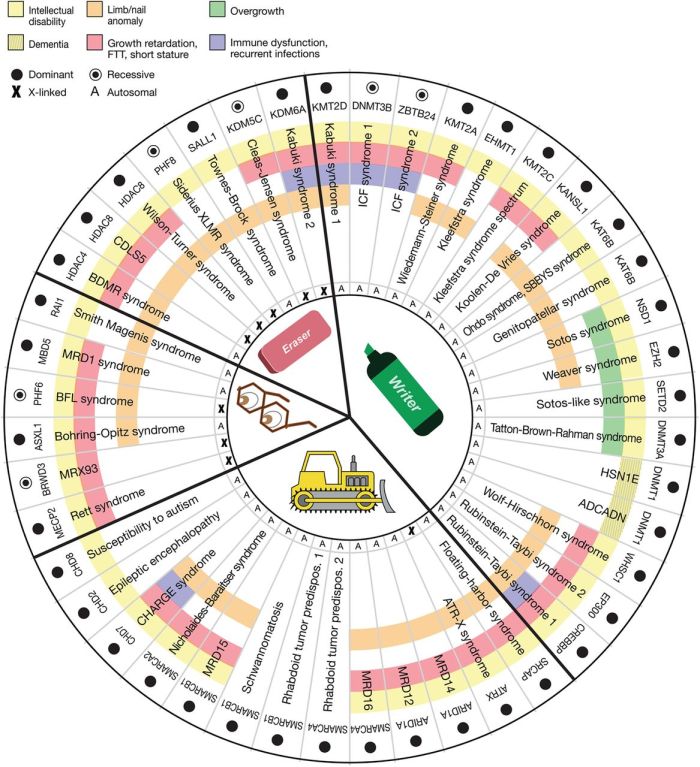
This 2015 human summary study was of 44 genetic disorders that disrupt the maintenance of epigenetic modifications:

“..making them likely to have significant downstream epigenetic consequences. Interestingly, these patients often demonstrate neurological dysfunction, suggesting that precise epigenetic regulation may be critical for neuronal homeostasis. However, at the same time, it is important to keep in mind that many of these proteins have additional non-epigenetic roles.

Mutations in many of these components have now been linked to a number of well-known causes of intellectual disability. Intellectual disability is generally defined as deficits of intellectual function and adaptive behavior that occur during the developmental period.

Given the opposing activity of many of the components of the epigenetic machinery, the pathogenic sequence in these disorders involves an imbalance of chromatin states. Keeping a subset of genes under “pressure” from two opposing systems may allow the cellular system to rapidly respond to environmental stimuli.

These disorders, on average, have unusual phenotypic breadth. Similarly, there is a shift in distribution toward a higher number of organ systems affected.

In addition to developmental phenotypes (multiple congenital anomalies), in some cases there appear to be ongoing defects that remain consequential in post-natal life. An example of the latter is the hippocampal memory defects seen in many of the mouse models.

This raises the question whether cells undergoing neurogenesis and synaptogenesis are particularly sensitive to subtle defects of the epigenetic machinery and downstream epigenetic abnormalities. A major remaining question is whether neurogenesis defects and/or abnormalities of synaptic plasticity are a unifying pathophysiological process.”

The researchers represented the 44 genetic disorders on a wheel graph:

F1.large

I look forward to further research that includes non-genetic disruptors of epigenetic modifications.

http://genome.cshlp.org/content/25/10/1473.full “The Mendelian disorders of the epigenetic machinery”

Identifying epigenetic DNA changes with blood tests

This 2015 Chinese human study found:

“With reference to methylation profiles of different tissues, we developed a general approach for studying the major tissue contributors to the circulating DNA pool. This development has opened up numerous research avenues and diagnostic applications.

Our study takes advantage of the recent availability of reference methylomes of a number of tissues. It is likely that such reference databases would be continually updated to include more sample types and from more individuals.”

Up to 41% of plasma DNA in pregnant women was from the placenta. However, I didn’t understand why the non-pregnant women in the control group had measurable placental DNA of up to 2.9%. Maybe it was leftover from a prior pregnancy?

http://www.pnas.org/content/112/40/E5503.full “Plasma DNA tissue mapping by genome-wide methylation sequencing for noninvasive prenatal, cancer, and transplantation assessments”

Leaky gates, anxiety, and grocery store trips without buying list items

An interview with Jeff Link, the editor of Dr. Arthur Janov’s 2011 book “Life Before Birth: The Hidden Script that Rules Our Lives” with Ken Rose:

“Even further confirmation for some of the views of Janov, that maybe weren’t widely accepted for a time, it’s new research now being done into memory and what a lot of scientist are seeing, a lot of different studies is that memory reactivates the same neuroimpulses that were initially firing off when the event happened.

So a traumatic event when you remember it, the act of remembering it is actually creating a neuromirror of what went on initially.

In a lot of ways that is what Primal Therapy is attempting to do; is to go back to that place and reconnect, or as it’s sometimes referred to, reconsolidate the brain state so that real healing can take place.”

Transcript (part 4 of 6): http://cigognenews.blogspot.com/2015/09/ken-rose-on-life-before-birth-part-46.html

MP3: http://www.pantedmonkey.org/podcastgen/download.php?filename=2011-12-15_1300_what_now_jeff_link.mp3

Genetic statistics don’t necessarily predict the effects of an individual’s genes

I curated this 2015 Howard Hughes Medical Institute rodent study of DNA methylation because of the reason driving the researchers’ efforts:

“Epigenomic analyses are limited by averaging of population-wide dynamics and do not inform behavior of single cells. We observe dynamics at the single-cell level not predicted by epigenomic analysis.”

This rationale was also the driving force behind the Is what’s true for a population what’s true for an individual? study and its companion Changing an individual’s future behavior even before they’re born. The methodology of genome-wide association studies (GWAS) usually:

“Focuses on the average effect of alternative alleles averaged in a population.”

What this methodology often missed was:

“When phenotypic variation results from alleles that modify phenotypic variance rather than the mean, this link between genotype and phenotype will not be detected.”

Population-wide epigenetic statistics don’t necessarily inform us about the epigenetic activities and attributes of an individual’s genes, even down at the single-cell level.

http://www.pnas.org/content/112/31/E4216.full “The Xist RNA-PRC2 complex at 20-nm resolution reveals a low Xist stoichiometry and suggests a hit-and-run mechanism in mouse cells”

Using epigenetic DNA methylation markers to estimate biological age

I curated this 2015 Georgia human study only for its use of two methods of estimating biological age. The researchers misguidedly used these techniques to help paint a scientific patina on an agenda.

One of the methods was originated by a coauthor of The degree of epigenetic DNA methylation may be used as a proxy to measure biological age study. He compared his epigenetic clock technique with the other technique here:

  • His technique used the same 353 DNA regions (CpGs, cytosine and guanine separated by only one phosphate link) across different tissues to compare tissue/organ ages;
  • “The DNA methylation levels of 193 of these markers increase with age but the remaining 160 markers show the opposite behavior.”

  • His technique had a Pearson correlation coefficient of r=0.96 with chronological age in this 2013 study;
  • The other technique:

    “Works poorly for blood samples from subjects who are younger than 20.”

That such methods were available calls into question why the researchers of A study of biological aging in young adults with limited findings didn’t avail themselves of these techniques. They used techniques that were less informative such as telomere length. As an example of how that study’s methods were known to be limited, this 2009 study found that the correlation between chronological age and telomere length was r = −0.51 in women and r = −0.55 in men.

http://www.pnas.org/content/112/33/10325.full “Self-control forecasts better psychosocial outcomes but faster epigenetic aging in low-SES youth”

A study of biological aging in young adults with limited findings

This 2015 New Zealand human study used the same subjects of the More from the researchers that found people have the same personalities at age 26 that they had at age 3 study. These researchers used 10 biologic age markers of subjects at age 38 to find that their biological ages ranged from 28 to 61.

F2.large

Researchers assessed subjects’ pace of aging at ages 26, 32, and 38 with 11 more biomarkers, including leukocyte telomere length. Three of the initial 10 biomarkers weren’t used because measurements were taken only at age 38.

These researchers also assessed physical functioning, physical limitations, cognitive testing, retinal imaging, self-rated health, and facial aging. There was a fascinating graph in the supplementary material of the effect on each of these assessments of successively leaving out each of 18 pace-of-aging biomarkers.


There were three areas I expected to see covered that weren’t addressed in this study:

  1. Where were links back to all relevant measurements and predictions made when these subjects were ages 3, 5, 7..? Other studies of these same subjects made such links, but only cognitive testing was linked back in this study. Were these researchers trying to pretend that these dramatic later-life physical measurements weren’t effects of earlier-life causes?
  2. Where were psychological measurements? Are we to believe that subjects’ states of mind had no relationships to their biomarkers?
  3. I didn’t see any effort to use newer measures such as The degree of epigenetic DNA methylation may be used as a proxy to measure biological age study. I’d expect that these subjects’ historical tissue samples were available. The peer reviewer certainly was familiar with newer biomarkers.

http://www.pnas.org/content/112/30/E4104.full “Quantification of biological aging in young adults”

Stress in early life can alter physiology and behavior across the entire lifespan

I’ll quote a few sections of this 2014 summary of 111 studies concerning stress, including the authors’ research:

“The brain is the central organ of stress and adaptation to stressors because:

  • It not only perceives what is threatening or potentially threatening and initiates behavioral and physiological responses to those challenges,
  • But also is a target of the stressful experiences and the hormones and other mediators of the stress response.

The stress history of parents is a significant factor in the resilience of their offspring.

Environmental stress transduces its effects into lasting changes on physiology and behavior, which can vary even among genetically identical individuals.

Stress in early life can alter physiology and behavior across the entire lifespan.

Structural stress memory is even more apparent with regard to gene expression in stress-sensitive brain regions like the hippocampus.

Individual history is important and that there is a memory of stress history retained by neurons at the cellular level in regions like the hippocampus.

Stress has a number of known effects on epigenetic marks in the brain, producing alterations in DNA methylation and histone modifications in most of the stress-sensitive brain regions examined, including the hippocampus, amygdala, and prefrontal cortex.”


It seemed to be taboo to note that most of – and the largest of – detrimental effects of stress occurred during womb-life in the mother’s environment. The authors instead opted for a politically correct “the stress history of parents” phrase.

Referenced studies had findings relevant to the earliest periods of life, including Figure 1:

interactions

“Those organs that show the highest levels of retrotransposon [a repeat element (mobile DNA sequences often involved in mutations) type formed by copy-and-paste mechanisms] activity, such as the brain and placenta, also seem to be both steroidogenic and steroid-sensitive.”

However, Figure 1 was given a beneficial context, and other studies’ findings weren’t mentioned in their contexts of detrimental effects on fetuses of mothers who were stressed while pregnant.

http://www.pnas.org/content/112/22/6828.full “Stress and the dynamic genome: Steroids, epigenetics, and the transposome”

Is what’s true for a population what’s true for an individual?

This 2015 Harvard fruit fly study found:

“Genetically identical individuals display variability in their behaviors even when reared in essentially identical environments.

Individual flies exhibit significant bias in their left vs. right locomotor choices during exploratory locomotion.”

Here’s an example of why population statistics such as in GWAS didn’t necessarily apply to an individual:

“The probability of turning right averaged across all individuals within each line was statistically indistinguishable from 50%. However, an individual fly’s probability of turning right often diverged markedly from the population average.

For example, nearly one quarter (23.5%) of CS [Canton-S] flies turned right greater than 70% of the time or less than 30% of the time. This distribution would be unlikely indeed if all flies were choosing to turn right with identical probabilities.”

The researchers noted other species with similar findings:

“Individuals can develop idiosyncratic behaviors, morphology, and gene expression profiles. For example, stochastic DNA methylation may contribute to phenotypic variation that is uncorrelated to genetic variation.”

This study should inform other studies such as the Separating genetic from environmental factors when assessing educational achievement, to the degree its findings apply to humans.


As the findings applied to neurological areas:

“The magnitude of locomotor handedness is under the control of neurons within a brain region implicated in motor planning and execution.”

I was surprised that the study’s news coverage included this opinion:

“They are suggesting that variation [read: individuality] itself might be a genetic trait.”

The researchers stated their case in the companion study Changing an individual’s future behavior even before they’re born.

http://www.pnas.org/content/112/21/6700.full “Neuronal control of locomotor handedness in Drosophila”

Separating genetic from environmental factors when assessing educational achievement

This 2014 UK study of identical and fraternal twins found that an average of 62% of the differences among their scores on a significant test given at age 16 were due to genetic factors:

“Genetic influence is greater for achievement than for intelligence, and other behavioral traits are related to educational achievement largely for genetic reasons.”

However, the “genetic reasons” term didn’t mean that the researchers actually took genetic samples. From one news article:

“Identical twins share 100 percent of their genes while non-identical twins share just 50 percent of their genes. Because these sets of twins share the same environment, the scientists were able to compare identical and non-identical twins to estimate the relative contributions of genetic and environmental factors.”

This estimation method produced an artificial divide between genetic and environmental factors. Identical twins start out sharing 100% of their genes, but then their genes become expressed differently – often because of environmental factors – to produce unique individuals even before birth.

The sets of identical twins were definitely not the 100% same genetic makeup between themselves at age 16 as they were at conception, and that assumption was the foundation of the researchers’ model:

F2

“Bivariate estimates for additive genetic (A), shared environmental (C), and nonshared environmental (E) contributions to the correlations between GCSE and nine predictors. The total length of the bar indicates the phenotypic correlations.”

The researchers didn’t provide evidence that “genetic reasons” were causal factors to the stated extent. Although the model’s numbers may have indicated that the method’s results were valid, that didn’t necessarily mean that the reality of genetic and epigenetic influences on the subjects were represented to the stated precision by the results.

The weather analogy of Scientific evidence applies to this study’s methods:

“We can think about what we mean by evidence. For example, that when you see dark storm clouds overhead, that’s strong evidence that it’s about to rain. If you smell a certain scent, that’s maybe weak evidence that it’s about to rain. And if we see the dark storm clouds and then we smell the scent, the evidence doesn’t get weaker: if anything, it gets stronger.

But P-values in a circumstance like that, where you have a very small P-value in one dataset and a not-so-small P-value in a second dataset, you put the data together and the P-value will tend to sort of average.

So the P-value is not behaving like evidence.”

Better methods of estimating “the relative contributions of genetic and environmental factors” are available with actual genetic sampling. One way is to measure the degree of DNA methylation of genes as did:


The study and its news coverage were full of politically-correct buzzwords – for example, the researchers’ statement:

“The results also support the trend in education toward personalized learning.”

This “personalized learning” is a teacher not telling a student:

“You’re doing poorly at math. You need to pay attention in class and do the homework.”

but instead saying:

“You have a different learning style. We’ll tailor the math lessons to your style.”

The funniest thing I saw in the study’s news coverage was this one where someone argued that the researchers were wrong and that they needed educational psychologists on their staff to interpret the data. Guess the profession of the arguer!

http://www.pnas.org/content/111/42/15273.full “The high heritability of educational achievement reflects many genetically influenced traits, not just intelligence”

A missed opportunity to research the oxytocin receptor gene and autism

This 2013 study:

“Examined whether genetic variants of the OXTR [oxytocin receptor] affect face recognition memory in families with an autistic child.

We investigated whether common polymorphisms in the genes encoding the oxytocin and vasopressin 1a receptors influence social memory for faces.”

I feel that the researchers missed an opportunity to improve their assessment of the autism-related genetic contribution to the study’s findings by separating the degree of environmental influence on the oxytocin receptor gene expression, as did the How epigenetic DNA methylation of the oxytocin receptor gene affects the perception of anger and fear study.

An assessment of epigenetic DNA methylation of the oxytocin receptor gene may have been even more compelling because the researchers genetically sampled one non-autistic sibling in each of the autistic children’s families. I hope the study’s samples are still available, because they may offer the possibility of evaluating the contribution of the autistic children’s historical environment with potential confirmation from their siblings.

Both studies gave their subjects similar facial emotion recognition tests, with the current one deriving from findings about autism, and the second from findings about the amygdala. The studies also had common references, such as a 2010 study, A common allele in the oxytocin receptor gene (OXTR) impacts prosocial temperament and human hypothalamic-limbic structure and function.

http://www.pnas.org/content/111/5/1987.full “Common polymorphism in the oxytocin receptor gene (OXTR) is associated with human social recognition skills”

A common dietary supplement that has rapid and lasting antidepressant effects

This 2012 Italian rodent study found that a common dietary supplement had rapid and lasting antidepressant effects:

“Remarkably, L-acetylcarnitine displayed a clear-cut antidepressant effect already after 3 and 7 d[ays] of daily dosing. No tolerance was developed to the action of L-acetylcarnitine. The drug was even more effective after 21 d[ays], and the effect persisted for at least 2 w[ee]k[s] after drug withdrawal.”

The researchers studied stressed mice and rats to determine that:

  1. An effect of the stress was to epigenetically change the hippocampus to produce less of an important molecule – type 2 metabotropic glutamate (mGlu2).
  2. A reduction of the mGlu2 molecule decreased the hippocampus’ regulation of the glutamate neurotransmitter.
  3. Under-regulation of glutamate, in turn, caused symptoms of depression.

L-acetylcarnitine reversed the immediate causes of stress-induced symptoms by acetylating histone proteins. These control the transcription of the brain-derived neurotrophic factor (BDNF) and mGlu2 receptors in the hippocampus and prefrontal cortex.


LAC putative action

A commentary on this research, Next generation antidepressants, had the above graphic that showed possible mechanisms for the effects of L-acetylcarnitine. Epigenetic histone modifications seem to be more easily reversible than epigenetic DNA methylation.


“Currently, depression is diagnosed only by its symptoms,” Nasca says. “But these results put us on track to discover molecular signatures in humans that may have the potential to serve as markers for certain types of depression.”

It’s tempting to extrapolate this study to humans and test whether depression symptoms could be effectively treated with some multiple of a normal acetyl-L-carnitine dietary supplement dose of 500 mg at $.25 a day. This dietary supplement is better for depression symptoms than placebo analyzed randomized control trials that tested and demonstrated its efficacy.

To cure stress-induced illnesses in humans, though, ultimate causes of stress should be removed or otherwise addressed.

http://www.pnas.org/content/110/12/4804.full “L-acetylcarnitine causes rapid antidepressant effects through the epigenetic induction of mGlu2 receptors”

Epigenetic DNA methylation and demethylation with the developing fetus

This extremely dense and informative 2014 UK summary study provided details about genomic imprinting:

“An unusual epigenetic process in that it is heritable and results in autosomal gene expression according to parent of origin.”

Several notes of interest:

  • Figure 3 had a fascinating sketch of how the fetus caused the mother’s hypothalamus to:

    “Determine forward maternal planning by directing/orchestrating maternal physiology and postnatal maternalism to synchronize with development of the fetus.”

  • Figure 4 followed up with a flowchart of how – with a female fetus – coexistence of three matrilineal generations in the pregnant female (her, the fetus, and the grandmother’s influence on the developing fetus’ ovarian oocytes) enabled intergenerational forward planning.
  • The study briefly noted significance of genomic imprinting on male sexual behavior, where, if processes didn’t proceed normally at this early stage of a male fetus’ development, could result in suboptimal adult behavior that didn’t change with experience.

F4.large

I’ll quote a few other unrelated passages that caught my eye.

“Reproductive success of mammals also places a considerable burden on matrilineal time and energy, with some 95% of mammalian female adult life committed to pregnancy, lactation, and maternal care.

Offspring that receive optimal nourishment and improved maternal care will be predisposed to develop a hypothalamus that is both genetically and epigenetically predisposed to this same type of good mothering.

The fetus controls its own destiny in times of acute starvation, especially in the last trimester of pregnancy, by short-term sacrifice of its placenta to preserve resources critical for brain development.”

http://www.pnas.org/content/112/22/6834.full “Genomic imprinting, action, and interaction of maternal and fetal genomes”


This post has somehow become a target for spammers, and I’ve disabled comments. Readers can comment on other posts and indicate that they want their comment to apply here, and I’ll re-enable comments.

Epigenetic DNA methylation of the oxytocin receptor gene affected the perception of anger and fear

This 2015 Virginia human study:

“Reveals how epigenetic variability in the endogenous oxytocin system impacts brain systems supporting social cognition and is an important step to better characterize relationships between genes, brain, and behavior.”

The researchers did a lot of things right:

  • They studied a priori selected brain areas, followed by whole brain analyses;
  • Their subjects were carefully selected

    “Because methylation levels have been shown to differ as a function of race, we restricted our sample to Caucasians of European descent”

    but they didn’t restrict subjects to the same gender;

  • They acknowledged as a limitation:

    “A lack of behavioral evidence to reveal how these epigenetic and neural markers impact the overt social phenotype.”


One thing on which I disagree with the researchers is their assessment of what needs to be done next. Their news release stated:

“When imagining the future possibilities and implications this DNA methylation and oxytocin receptor research may have, the investigators think a blood test could be developed in order to predict how an individual may behave in social situations.”

Nice idea, but the next step should be to complete the research. The next step is to develop evidence for how the oxytocin receptor gene became methylated.

The subjects had a wide range of DNA methylation at the studied gene site – from 33% to 72% methylated!

Why?

At the same gene site:

“There was a significant effect of sex such that females have a higher level of methylation than males.”

Why?

Given these significant effects, why was there no research into likely causes?

Aren’t early periods in people’s lives the most likely times when the “Epigenetic modification of the oxytocin receptor gene” that “influences the perception of anger and fear in the human brain” takes place?

Wouldn’t findings from research on the subjects’ histories potentially help other people?

http://www.pnas.org/content/112/11/3308.full “Epigenetic modification of the oxytocin receptor gene influences the perception of anger and fear in the human brain”