Early-life epigenetic regulation of the oxytocin receptor gene

This 2015 US/Canadian rodent study investigated the effects of natural variation in maternal care:

“The effects of early life rearing experience via natural variation in maternal licking and grooming during the first week of life on behavior, physiology, gene expression, and epigenetic regulation of Oxtr [oxytocin receptor gene] across blood and brain tissues (mononucleocytes, hippocampus, striatum, and hypothalamus).

Rats reared by high licking-grooming (HL) and low licking-grooming (LL) rat dams exhibited differences across study outcomes:

  • LL offspring were more active in behavioral arenas,
  • Exhibited lower body mass in adulthood, and
  • Showed reduced corticosterone responsivity to a stressor.

Oxtr DNA methylation was significantly lower at multiple CpGs in the blood of LL versus HL males, but no differences were found in the brain. Across groups, Oxtr transcript levels in the hypothalamus were associated with reduced corticosterone secretion in response to stress, congruent with the role of oxytocin signaling in this region.

Methylation of specific CpGs at a high or low level was consistent across tissues, especially within the brain. However, individual variation in DNA methylation relative to these global patterns was not consistent across tissues.

These results suggest that:

  • Blood Oxtr DNA methylation may reflect early experience of maternal care, and
  • Oxtr methylation across tissues is highly concordant for specific CpGs, but
  • Inferences across tissues are not supported for individual variation in Oxtr methylation.
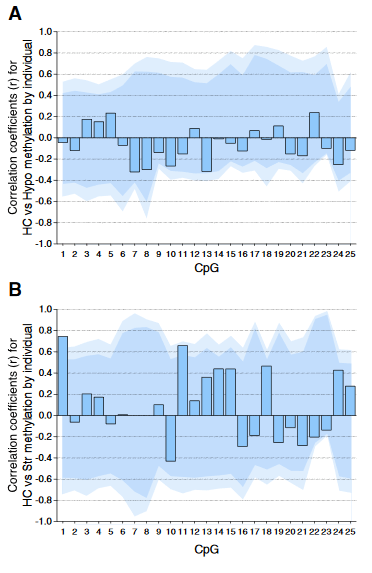
nonsignificance

Individual DNA methylation values were not correlated across brain tissues, despite tissue concordance at the group level.

For each CpG, we computed the Pearson correlation coefficient r between methylation values for matched samples in pairs of brain regions (bars). Dark and light shaded regions represent 95% and 99% thresholds, respectively, of distributions of possible correlation coefficients determined from 10,000 permutations of the measured values among the individuals. These distributions represent the null hypothesis that an individual DNA methylation value in one brain region does not help to predict the value in another region in the same animal.

(A) Correlations based on pyrosequencing data for matched samples passing validation in both hippocampus (HC) and hypothalamus (Hypo). Correlations for individuals at each CpG were either weak (.2 < r < .3) or absent (r < .2), and none were significant, even prior to correction for multiple comparisons.

(B) Correlations for matched samples passing validation in both hippocampus and striatum (Str). Two correlations (CpG 1 and 11) were individually significant prior to but not following correction, and this result could be expected by chance.

Correlations between hippocampus and blood (described in the text) yielded similar results, and no particular CpG yielded consistently high correlation across multiple tissues.”


The study focused on whether or not an individual’s experience-dependent oxytocin receptor gene DNA methylation in one of the four studied tissues could be used to infer a significant effect in the three other tissues. The main finding was NO, it couldn’t!

The researchers’ other findings may have been strengthened had they also examined causes for the observed effects. The “natural variation in maternal licking and grooming” developed from somewhere, didn’t it?

The subjects’ mothers were presumably available for the same tests as the subjects, but nothing was done with them. Investigating at least one earlier generation may have enabled etiologic associations of “the effects of early life rearing experience” and “individual variation in DNA methylation.”

https://www.sciencedirect.com/science/article/abs/pii/S0018506X1500118X “Natural variation in maternal care and cross-tissue patterns of oxytocin receptor gene methylation in rats” (not freely available)

Does vasopressin increase mutually beneficial cooperation?

This 2016 German human study found:

“Intranasal administration of arginine vasopressin (AVP), a hormone that regulates mammalian social behaviors such as monogamy and aggression, increases humans’ tendency to engage in mutually beneficial cooperation.

AVP increases humans’ willingness to cooperate. That increase is not due to an increase in the general willingness to bear risks or to altruistically help others.”


One limitation of the study was that the subjects were all males, ages 19-32. The study’s title was “human risky cooperative behavior” while omitting subjects representing the majority of humanity.

Although the researchers claimed brain effects from vasopressin administration, they didn’t provide direct evidence for the internasally administered vasopressin in the subjects’ brains. A similar point was made about studies of vasopressin’s companion neuropeptide, oxytocin, in Testing the null hypothesis of oxytocin’s effects in humans.

A third limitation was that although the researchers correlated brain activity with social behaviors, they didn’t carry out all of the tests necessary to demonstrate the claimed “novel causal evidence for a biological factor underlying cooperation.” Per Confusion may be misinterpreted as altruism and prosocial behavior, the researchers additionally needed to:

“When attempting to measure social behaviors, it is not sufficient to merely record decisions with behavioral consequences and then infer social preferences. One also needs to manipulate these consequences to test whether this affects the behavior.”

http://www.pnas.org/content/113/8/2051.full “Vasopressin increases human risky cooperative behavior”

The effects of imposing helplessness

This 2016 New York rodent study found:

“By using unbiased and whole-brain imaging techniques, we uncover a number of cortical and subcortical brain structures that have lower activity in the animals showing helplessness than in those showing resilience following the LH [learned helplessness] procedure. We also identified the LC [locus coeruleus] as the sole subcortical area that had enhanced activity in helpless animals compared with resilient ones.

Some of the brain areas identified in this study – such as areas in the mPFC [medial prefrontal cortex], hippocampus, and amygdala – have been previously implicated in clinical depression or depression-like behavior in animal models. We also identified novel brain regions previously not associated with helplessness. For example, the OT [olfactory tubercle], an area involved in odor processing as well as high cognitive functions including reward processing, and the Edinger–Westphal nucleus containing centrally projecting neurons implicated in stress adaptation.

The brains of helpless animals are locked in a highly stereotypic pathological state.”

Concerning the study’s young adult male subjects:

“To achieve a subsequent detection of neuronal activity related to distinct behavioral responses, we used the c-fosGFP transgenic mice expressing c-FosGFP under the control of a c-fos promoter. The expression of the c-fosGFP transgene has been previously validated to faithfully represent endogenous c-fos expression.

Similar to wild-type mice, approximately 22% (32 of 144) of the c-fosGFP mice showed helplessness.”

The final sentence of the Introduction section:

“Our study..supports the view that defining neuronal circuits underlying stress-induced depression-like behavior in animal models can help identify new targets for the treatment of depression.”


Helplessness is both a learned behavior and a cumulative set of experiences during every human’s early life. Therapeutic approaches to detrimental effects of helplessness can be different with humans than with rodents in that we can address causes.

The researchers categorized activity in brain circuits as causal in the Discussion section:

“Future studies aimed at manipulating these identified neural changes are required for determining whether they are causally related to the expression of helplessness or resilience.”

Studying whether or not activity in brain circuits induces helplessness in rodents may not inform us about causes of helplessness in humans. Our experiences are often the ultimate causes of helplessness effects. Many of our experiential “neural changes” are only effects, as demonstrated by this and other studies’ induced phenotypes such as “Learned Helplessness” and “Prenatally Restraint Stressed.”

Weren’t the researchers satisfied that the study confirmed what was known and made new findings? Why attempt to extend animal models that only treat effects to humans, as implied in the Introduction above and in the final sentence of the Discussion section:

“Future studies aimed at elucidating the specific roles of these regions in the pathophysiology of depression as well as serve as neural circuit-based targets for the development of novel therapeutics.”

http://journal.frontiersin.org/article/10.3389/fncir.2016.00003/full “Whole-Brain Mapping of Neuronal Activity in the Learned Helplessness Model of Depression” (Thanks to A Paper a Day Keeps the Scientist Okay)

Advance science by including emotion in research

This 2015 analysis of emotion studies found:

“Emotion categories [fear, anger, disgust, sadness, and happiness] are not contained within any one region or system, but are represented as configurations across multiple brain networks.

For example, among other systems, information diagnostic of emotion category was found in both large, multi-functional cortical networks and in the thalamus, a small region composed of functionally dedicated sub-nuclei.

The dataset consists of activation foci from 397 fMRI and PET [positron emission tomography] studies of emotion published between 1990 and 2011.”

From the fascinating Limitations section:

“Our analyses reflect the composition of the studies available in the literature, and are subject to testing and reporting biases on the part of authors. This is particularly true for the amygdala (e.g., the activation intensity for negative emotions may be over-represented in the amygdala given the theoretical focus on fear and related negative states). Other interesting distinctions were encoded in the thalamus and cerebellum, which have not received the theoretical attention that the amygdala has and are likely to be bias-free.

Some regions—particularly the brainstem—are likely to be much more important for understanding and diagnosing emotion than is apparent in our findings, because neuroimaging methods are only now beginning to focus on the brainstem with sufficient spatial resolution and artifact-suppression techniques.

We should not be too quick to dismiss findings in ‘sensory processing’ areas, etc., as methodological artifacts. Emotional responses may be inherently linked to changes in sensory and motor cortical processes that contribute to the emotional response.

The results we present here provide a co-activation based view of emotion representation. Much of the information processing in the brain that creates co-activation may not relate to direct neural connectivity at all, but rather to diffuse modulatory actions (e.g., dopamine and neuropeptide release, much of which is extrasynaptic and results in volume transmission). Thus, the present results do not imply direct neural connectivity, and may be related to diffuse neuromodulatory actions as well as direct neural communication.”


Why did the researchers use only 397 fMRI and PET studies? Why weren’t there tens or hundreds of times more candidate studies from which to select?

The relative paucity of candidate emotion studies demonstrated the prevalence of other researchers’ biases for cortical brain areas. The lead researcher of the current study was a coauthor of the 2016 Empathy, value, pain, control: Psychological functions of the human striatum, whose researchers mentioned that even their analyses of 5,809 human imaging studies was hampered by other imaging-studies researchers’ cortical biases.

Functional MRI signals depend on the changes in blood flow that follow changes in brain activity. Study designers intentionally limit their findings when they scan brain areas and circuits that are possibly activated by human emotions, yet exclude emotional content that may activate these areas and circuits.

Here are a few examples of limited designs that led to limited findings when there was the potential for so much more:

It’s well past time to change these practices now in the current year.


This study provided many methodological tests that should be helpful for research that includes emotion. It showed that there aren’t impenetrable barriers – other than popular memes, beliefs, and ingrained dogmas – to including emotional content in studies.

Including emotional content may often be appropriate and informative, with the resultant findings advancing science. Here are a few recent studies that did so:

http://journals.plos.org/ploscompbiol/article?id=10.1371%2Fjournal.pcbi.1004066 “A Bayesian Model of Category-Specific Emotional Brain Responses”

Chronic pain causes epigenetic changes in the brain and immune system

This 2015 Canadian rodent study by McGill researchers found:

“The critical involvement of DNA methylation in chronic pain. We show that in the PFC [prefrontal cortex], a brain region strongly implicated in chronic pain, a stunning number of promoters [control gene expression] are differentially methylated 9 months after injury. These changes are distant both in time and space from the original injury.

The changes in DNA methylation are highly organized in functional pathways that have been implicated in pain such as dysregulation of dopaminergic, glutamatergic, opioid and serotoninergic systems and important signaling and inflammatory pathways.

Genome-wide DNA methylation modifications of T cells [circulating white blood cells that control immune response] are also associated with nerve injury.

Most of the promoters (72%) identified as differentially methylated in T cells after nerve injury were also affected in the brain. While the methylation profiles in some of these modules were affected in the same direction in the brain and the T cells, others went in opposite direction. This is consistent with the idea that the brain and the immune system play different roles in chronic pain.

These data suggest that:

  • Persistent pain is associated with broad and highly organized organism-wide changes in DNA methylation, including two critical biological systems: the central nervous and immune systems.
  • This work also provides a possible mechanistic explanation for commonly observed comorbidities observed in chronic pain (i.e anxiety, depression).
  • Finally, the sheer magnitude of the impact of chronic pain, particularly in the prefrontal cortex, illustrates the profound impact that living with chronic pain exerts on an individual.”

http://www.nature.com/articles/srep19615 “Overlapping signatures of chronic pain in the DNA methylation landscape of prefrontal cortex and peripheral T cells”


The news coverage focused on how the study’s findings may lead to non-invasive DNA methylation measurements of chronic pain as well as treatments of the effects. I’d argue that the researchers’ concluding statement of the Discussion section deserved the most focus:

“Beyond the example of chronic pain, the robust and highly organized DNA methylation changes seen here in response to nerve injury provides some of the strongest evidence to date that experience effects DNA methylation landscapes at large distances in time and space.”

The study provided “some of the strongest evidence to date” that experiences caused widespread, long-lasting epigenetic changes. Given experiences’ etiologic functions, research with working hypotheses that experiences may also reverse epigenetic changes should be green-lighted.

“DNA methylation landscapes at large distances in time and space” warrant systematic examination of how experiential epigenetic changes during early life may be reversed by experiential therapies later in life. In the current year, there’s sufficient evidence for modifying research goals to primarily address causes, not just effects.

Stress consequences on gut bacteria, behavior, immune system, and neurologic function

This 2015 Canadian rodent study found:

“Chronic social defeat induced behavioral changes that were associated with reduced richness and diversity of the gut microbial community.

The degree of deficits in social, but not exploratory behavior, was correlated with group differences between the microbial community profile.

Defeated mice also exhibited reduced abundance of pathways involved in biosynthesis and metabolism of tyrosine and tryptophan: molecules that serve as precursors for synthesis of dopamine, norepinephrine, serotonin, and melatonin, respectively.

This study indicates that stress-induced disruptions in neurologic function are associated with altered immunoregulatory responses.”

These researchers had an extensive Discussion section where they placed study findings in contexts with other rodent and human studies. For example:

“Our analyses also predicted reduced frequency of fatty acid biosynthesis and metabolism pathways, including that of propanoate and butanoate – byproducts of dietary carbohydrate fermentation by intestinal microorganisms.

Butyrate is a potent histone deacetylase (HDAC) inhibitor that exerts antidepressant-like effects by increasing histone acetylation in the frontal cortex and hippocampus, and consequentially, raising BDNF transcript levels.

Although it was previously unclear whether systemic levels of these metabolites achieved in vivo were sufficient to produce behavioral changes, progress has been made by discovering their presence in cerebrospinal fluid and the brain, and demonstrating that colon-derived SCFAs [short chain fatty acids] cross the blood–brain barrier and preferentially accumulate in the hypothalamus, where they can affect CNS activity.”

http://www.psyneuen-journal.com/article/S0306-4530%2815%2900934-8/fulltext “Structural & functional consequences of chronic psychosocial stress on the microbiome & host”

Epigenetic effects of cow’s milk

This 2015 German paper with 342 references described:

“Increasing evidence that milk is not “just food” but represents a sophisticated signaling system of mammals.

This paper highlights the potential role of milk as an epigenetic modifier of the human genome paying special attention to cow milk-mediated overactivation of FTO [a gene associated with fat mass and obesity] and its impact on the transcriptome of the human milk consumer.”

The author declared “no competing interests” and “There are no sources of funding.” He presumably wasn’t pressured into writing this paper.

The paper wasn’t agenda-free, however. The main thesis was:

“Persistent milk-mediated epigenetic FTO signaling may explain the epidemic of age-related diseases of civilization.”

There were separate sections on how milk may promote:

  • Breast cancer
  • Prostate cancer
  • Obesity
  • Metabolic syndrome
  • Coronary heart disease
  • Early menarche
  • Type 2 diabetes
  • Neurodegenerative diseases

I don’t eat or drink dairy products because I’m lactose-intolerant. I coincidentally don’t have any of the diseases mentioned in the paper.

My life experiences haven’t led me to share the author’s sense of alarm, or to attribute other people’s problems to their consumption of milk products. However, more than a few problems I’ve had are things I’ve done to myself through actions or inaction that may have turned out differently if I had better information.

So I curated this article in case we’re insufficiently informed about the harmful epigenetic effects of milk. What do you think?

http://www.ncbi.nlm.nih.gov/pmc/articles/PMC4687119/ “Milk: an epigenetic amplifier of FTO-mediated transcription? Implications for Western diseases”

Epigenetic consequences of early-life trauma: What are we waiting for?

This 2015 UK human review discussed:

“The progress that has been made by studies that have investigated the relationship between depression, early trauma, the HPA axis and the NR3C1 [glucocorticoid receptor] (GR) gene.

Gene linkage studies for depression, as well as for other common complex disorders, have been perceived by some to be of only limited success; hence the focus on GWAS [genome-wide association studies]. However, even for simple traits, genetic variants identified by GWAS are rarely shown to account for more than 20% of the heritability.

Epigenetic changes are potentially reversible and therefore amenable to intervention, as has been seen in cancer, cardiovascular disease and neurological disorders.”


Five of the review’s references included FKBP5 (a gene that produces a protein that dampens glucocorticoid receptor sensitivity) in their titles, but it wasn’t mentioned in the review itself. A search on FKBP5 also showed human studies such as the 2014 Placental FKBP5 Genetic and Epigenetic Variation Is Associated with Infant Neurobehavioral Outcomes in the RICHS Cohort that found:

“Adverse maternal environments can lead to increased fetal exposure to maternal cortisol, which can cause infant neurobehavioral deficits. The placenta regulates fetal cortisol exposure and response, and placental DNA methylation can influence this function.

Placental FKBP5 methylation reduces expression in a genotype specific fashion, and genetic variation supersedes this effect. These genetic and epigenetic differences in expression may alter the placenta’s ability to modulate cortisol response and exposure, leading to altered neurobehavioral outcomes.”


The authors listed seven human studies conducted 2008-2015 “investigating interactions between methylation of NR3C1, depression and early adversity”:

“Newborn offspring exposed to maternal depression in utero had increased methylation at [a GR CpG site] as well as adverse neurobehavioural outcomes.

Unlike the majority of animal studies examining NR3C1 methylation, many types of potential stressors, sometimes at different developmental stages, have been used to represent early human adversity.

Substantial differences can be expected in the nature of stresses prenatally compared with postnatally, as well as their developmental consequences.”

Seven human studies over the past eight years was a very small number considering both the topic’s importance and the number of relevant animal studies during the period.

Is the topic too offensive for human studies? What makes people pretend that adverse prenatal and perinatal environments have no lasting consequences to the child?

“Many more studies will be needed before effects directly attributable to early life trauma can be separated from those relating to tissue type.

Although investigators have amassed a considerable amount of evidence for an association between differential methylation and HPA axis function in humans, a causal relationship still needs to be fully established.”

Factors that disrupt neurodevelopment may be the largest originators of epigenetic changes that are sustained throughout an individual’s entire lifespan.

Are the multitude of agendas that have resources thrown at them more important than ensuring the well-being of a human before and after they are born?

https://www.researchgate.net/publication/282048312_Early_life_trauma_depression_and_the_glucocorticoid_receptor_gene_-_an_epigenetic_perspective “Early life trauma, depression and the glucocorticoid receptor gene–an epigenetic perspective”

Fat made rats fat with dysfunctional brains

This 2015 New York rodent study found:

“Early stage [diet-induced] obesity, before the onset of diabetes or metabolic syndrome, produced deficits on cognitive tasks that require the prefrontal cortex.

These results strongly suggest that obesity must be considered as a contributing factor to brain dysfunction.”

The difference in the diets of the adult male subjects was that the control group ate 10% fat (20% protein, 70% carbohydrates) whereas the obese group ate 45% fat (20% protein, 35% carbohydrates). Significant changes in body weight were present after the first two weeks on the diets, but testing didn’t begin until after eight weeks.


I thought the study design prematurely terminated the experiments. The study didn’t justify the ultimate purpose of conducting rodent experiments, which is to find possible human applicability.

One study design possibility would have been to continue through old age to find how the conditions progressed. Another possibility would have been to reverse the high-fat diet to find whether the conditions reversed.

http://www.pnas.org/content/112/51/15731.full “Obesity diminishes synaptic markers, alters microglial morphology, and impairs cognitive function”

It is known: Are a study’s agendas more important than its evidence?

This 2015 Swiss human study’s Abstract began:

“It is known that increased circulating glucocorticoids in the wake of excessive, chronic, repetitive stress increases anxiety and impairs Brain-Derived Neurotrophic Factor (BDNF) signaling.”


The study had several statements that were unconvincingly supported by the study’s findings. One such statement in the Conclusions section was:

“This study supports the view that early-life adversity may induce long-lasting epigenetic changes in stress-related genes, thus offering clues as to how intergenerational transmission of anxiety and trauma could occur.”

However, the study’s evidence for “intergenerational transmission of anxiety and trauma” as summarized in the Limitations section was:

“This study did not directly associate child behavior or biology to maternal behavior and biology.”

In another example, the Discussion section began with:

“The severity of maternal anxiety was significantly correlated with mean overall methylation of 4 CpG sites located in exon IV of the BDNF promoter region as measured from DNA extracted from mothers’ saliva.

In addition, methylation at CpG3 was also significantly associated with maternal exposure to domestic violence during childhood, suggesting that BDNF gene methylation levels are modulated by early adverse experiences.”

The researchers assessed five DNA methylation values (four individual sites and the overall average). The CpG3 site was “significantly associated with maternal exposure to domestic violence during childhood” and the three other CpG sites’ methylation values were not.

IAW, the researchers found only one of four sites’ methylation values significantly associated to only one of many studied early adverse experiences. This finding didn’t provide sufficient evidence to support the overarching statement:

“BDNF gene methylation levels are modulated by early adverse experiences.”

To make such a generally applicable statement – more than one BDNF gene’s methylation levels could be directly altered by more than one early adverse experience – the researchers would, AT A MINIMUM, need to provide evidence that:

  1. The one category of significantly associated early adverse experience directly altered the one significantly associated CpG site’s DNA methylation level
  2. Other categories of early adverse experiences were fairly represented by the one significantly associated experience category
  3. Other categories of early adverse experiences could directly alter other BDNF genes’ DNA methylation levels
  4. The significantly associated DNA methylation level of only one out of four CpG sites was fairly represented by the overall average of the four sites
  5. Other BDNF gene’s methylation levels were fairly represented by the overall average of the four sites

If researchers and sponsors must have agendas, a worthwhile, evidence-supported one would be to investigate prenatal and perinatal epigenetic causes for later-life adverse effects.

As Grokking an Adverse Childhood Experiences (ACE) score pointed out, environmental factors that disrupt neurodevelopment may be the largest originators of epigenetic changes that are sustained throughout an individual’s entire lifespan.

What’s the downside of conducting studies that may “directly associate child behavior or biology to maternal behavior and biology” during time periods when a child’s environment has the greatest impact on their development?

When prenatal and perinatal periods aren’t addressed, researchers and sponsors neglect the times during which many harmful epigenetic consequences may be prevented. It is known.

http://journals.plos.org/plosone/article?id=10.1371/journal.pone.0143427 “BDNF Methylation and Maternal Brain Activity in a Violence-Related Sample”

Improved methodology in studying epigenetic DNA methylation

This 2015 New York human study was of:

“The two major populations of human prefrontal cortex neurons..the excitatory glutamatergic projection neurons and the inhibitory GABAergic interneurons which constitute about 80% and 20% of all cortical neurons, respectively.

Major differences between the neuronal subtypes were revealed in CpG, non-CpG and hydroxymethylation (hCpG).

A dramatically greater number of undermethylated CpG sites in GLU versus GABA neurons were identified. These differences did not directly translate into differences in gene expression and did not stem from the differences in hCpG methylation, as more hCpG methylation was detected in GLU versus GABA neurons.

Notably, a comparable number of undermethylated non-CpG sites were identified in GLU and GABA neurons, and non-CpG methylation was a better predictor of subtype-specific gene expression compared to CpG methylation.”

The researchers performed numerous cross checks to test the results of their methodologies. This was necessary because, for example, studies such as A human study of changes in gene expression point out that current technologies such as the 450K array:

“Queries only 1.6% of all CpGs in the genome and the CpG selection is biased towards CpG islands.”

From the Discussion section:

“The higher abundance of hmCpG sites in GLU versus GABA neurons appears indicative of a difference in transcriptional potential between the neuronal subtypes. The increased hydroxymethylation could enable certain genes (e.g. activity-dependent genes) to be more readily induced in GLU versus GABA neurons.

These findings emphasize the importance of even subtle differences in the promoter CpG methylation for neuron subtype-specific gene expression. They also suggest that differences in CpG methylation within gene bodies and distal regulatory elements are not always directly reflected in differences in gene expression between neuronal subtypes.

The functional relevance of the association between gene expression and distal non-CpG methylation remains to be characterized.

Our data suggest that, compared to GABA interneurons, GLU projection neurons are characterized by more permissive chromatin state that is less constrained by repressive DNA methylation marks and is instead controlled by more dynamic means of transcription inhibition, such as non-coding RNAs and/or histone modifications.”

This study was similar to A problematic study of DNA methylation in frontal cortex development and schizophrenia in examining:

“If common risk variants determined by the recent genome wide associated studies (GWAS) for several neuropsychiatric diseases including schizophrenia (SCZ), autism spectrum disorder (ASD), major depressive disorder (MDD), and Alzheimer’s disease (AD) significantly overlap.

These findings strongly suggest an association between the epigenetic specification of both GABA and GLU neurons and SCZ. Risk variants associates with ASD, MD, or AD were not enriched.

An alternative explanation of our negative results could be the involvement of different developmental stages and/or brain regions in different diseases.”

The current study performed more detailed analyses, but on fewer subjects. The emphasis was on demonstrating an improved methodology.

Both studies’ findings regarding disease were of effects, not causes. That both study designs were limited to the postmortem prefrontal cortex reminded me of the old joke about looking for lost keys under the street light because the light was better there. At least the current study acknowledged the existence of other areas to search.

http://nar.oxfordjournals.org/content/early/2015/11/25/nar.gkv1304.full “Substantial DNA methylation differences between two major neuronal subtypes in human brain”

A problematic study of DNA methylation in frontal cortex development and schizophrenia

This 2015 Baltimore human study found:

CpGs that differ between schizophrenia patients and controls that were enriched for genes related to development and neurodifferentiation.

The schizophrenia-associated CpGs strongly correlate with changes related to the prenatal-postnatal transition and show slight enrichment for GWAS [genome-wide association study] risk loci while not corresponding to CpGs differentiating adolescence from later adult life.

Only a fraction of the illness-associated CpGs, 4.6%, showed association to nearby genetic variants in the meQTL [methylation quantitative trait loci] analysis, further suggesting that these findings may be more related to the epiphenomena of the illness state than to the genetic causes of the disorder.

These data implicate an epigenetic component to the developmental origins of this disorder.”

It wasn’t surprising in 2015 to find “an epigenetic component to the developmental origins of this disorder.” From the supplementary material:

“Diverse chromatin states suggest vastly different epigenetic landscapes of the prenatal versus postnatal human brain.

Approximately half of the CpGs had DNAm [DNA methylation] levels positively correlated with expression across the lifespan, and half had DNAm levels negatively correlated.

These results suggest that many of the epigenetic changes occurring between prenatal and postnatal life in prefrontal cortex manifest in the transcriptome, and that the directionality of association is not strictly linked to the location of the CpG or DMR [differentially methylated region] with respect to an annotated gene.

Diagnosis-associated CpGs were relatively small compared with those differentially methylated between fetal and postnatal samples.”


The studied brain area was limited to the dorsolateral portion of the prefrontal cortex, which isn’t mature in humans until we’re in our late teens/early twenties.

The researchers ignored brain areas that were fully developed or further along in development – such as the limbic system – during “the prenatal-postnatal transition.”

The researchers intentionally blinded themselves from discovering “many of the epigenetic changes occurring between prenatal and postnatal life” possibly associated with schizophrenia and these more-developed brain areas.

Where’s the evidence that the developmental origins of schizophrenia have no associations with brain structures whose development closely approximates their lifelong functionalities at birth?


The study’s limitations didn’t hamper researcher hubris in a press release for a site that touts business news, such as:

“This conclusion, while perhaps not the final verdict on the subject, is hard to resist given this remarkable evidence”

Did the spokesperson really understand GWAS? Or was he trying to exploit public ignorance of GWAS?

There’s a scientist’s view of GWAS at What do GWAS signals mean? that better puts this study’s findings into perspective. When understanding GWAS at an individual level, it should also be acknowledged that Genetic statistics don’t necessarily predict the effects of an individual’s genes.

http://www.nature.com/neuro/journal/vaop/ncurrent/full/nn.4181.html “Mapping DNA methylation across development, genotype and schizophrenia in the human frontal cortex” (not freely available). Use the full study link from the above-mentioned press release.

A review of genetic and epigenetic approaches to autism

This 2015 Chicago review noted:

“Recent developments in the research of ASD [autistic spectrum disorder] with a focus on epigenetic pathways as a complement to current genetic screening.

Not all children with a predisposing genotype develop ASD. This suggests that additional environmental factors likely interact with the genome in producing ASD.

Increased risk of ASD is associated with mutations in genes that overlap with chromatin remodeling proteins, transcriptional regulators and synapse-associated proteins. Interestingly, these genes are also targets of environmentally induced changes in gene expression.”

Evidence was discussed for both broad and specific epigenetic ASD causes originating in the prenatal environment:

  • Maternal stress:

    “Prenatal stress exerts a profound epigenetic influence on GABAergic interneurons by altering the levels of proteins such as DNMT1 and Tet1 and decreasing the expression of various targets such as BDNF.

    Ultimately, this results in reducing the numbers of fully functional GABAergic neurons postnatally and a concomitant increased susceptibility toward hyperexcitability. The delayed migration of GABAergic interneuron progenitors results in reduced gene expression postnatally which is likely the consequence of increased amounts of DNA methylation.

    The net effect of stress during early development is to disrupt the balance of excitatory/inhibitory neuronal firing due to the loss of function associated with disrupted neuronal migration and maturation.”

  • Prenatal nutrition:

    “Exposure to a wide range of environmental toxins that impact neurodevelopment also result in global DNA hypomethylation. This model was extended to connect pathways between dietary nutrition and environmental exposures in the context of DNA hypomethylation. More recently, this hypothesis was expanded to show how dietary nutrients, environmental toxins, genome instability and neuroinflammation interact to produce changes to the DNA methylome.”

  • Maternal infections:

    “Inflammation, autoimmunity and maternal immune activation have long been suspected in the context of aberrant neurodevelopment and ASD risk.”

  • Exposure to pollutants, medications, alcohol

This was a current review with many 2015 and 2014 references. However, one word in the reviewers’ vernacular that’s leftover from previous centuries was “idiopathic,” as in:

“Idiopathic (nonsyndromic) ASD, for which an underlying cause has not been identified, represent the majority of cases.”

It wasn’t sufficiently explanatory to use categorization terminology from thousands of years ago.

Science has progressed enough with measured evidence from the referenced studies that the reviewers could have discarded the “idiopathic” category and expressed probabilistic understanding of causes. They could have generalized conditional origins of a disease, and not reverted to “an underlying cause has not been identified.”


Another word the reviewers used was “pharmacotherapeutic,” as in:

“The goal for the foreseeable future is to provide a better understanding of how specific genes function to disrupt specific biological pathways and whether these pathways are amenable to pharmacotherapeutic interventions.”

Taking “idiopathic” and “pharmacotherapeutic” together – causes for the disease weren’t specifically identified, but the goal of research should be to find specific drug treatments?

Of course reviewers from the Department of Psychiatry, The Psychiatric Institute, University of Illinois at Chicago are biased to believe that “the design of better pharmacotherapeutic treatments” will fulfill peoples’ needs.

Are their beliefs supported by evidence? Without using drugs, are humans largely incapable of therapeutic actions such as:

  • Preventing epigenetic diseases from beginning in the prenatal environment?
  • Treating epigenetic causes for and alleviating symptoms of their own disease?

http://www.futuremedicine.com/doi/full/10.2217/epi.15.92 “Merging data from genetic and epigenetic approaches to better understand autistic spectrum disorder”

Conclusions without evidence regarding emotional memories

The last sentence in the Significance section of this 2015 Emory/Harvard rodent study was:

“These data highlight the potential to exploit sensory system plasticity as a means of ameliorating negative emotional memories that may be tied to peripheral sensory systems.”

The “ameliorating negative emotional memories” part of this statement was incongruent with what the study actually found, as summarized by the Abstract’s last sentence:

“These data suggest that learning-induced freezing behavior, structural alterations, and enhanced neural sensory representation can be reversed in adult mice following extinction training.”

The study performed fear extinction experiments. The researchers and reviewer knew or should have known about prior studies such as Fear extinction is the learned inhibition of retrieval of previously acquired responses whose findings demonstrated that fear extinction doesn’t depend on memory retrieval.

Based on the previous research, the subjects’ “negative emotional memories” possibly weren’t affected at all by the current study’s extinction experiments!

The researchers provided neither direct evidence for “ameliorating negative emotional memories” nor studied areas of the subjects’ brains that contained or processed emotional memories, such as the hippocampus, amygdala, and prefrontal cortex. But – after all – Harvard.

What purposes did it serve for the researchers to make a Significance statement about “ameliorating negative emotional memories” when this wasn’t supported by the study’s findings? What part did the reviewer play in approving this statement?


Where was the study’s evidence to support the headline and statements in the news release such as:

“New Study Indicates That Sense of Smell Could Play Major Role in New Approaches to Treating PTSD

It’s possible for fear behaviors associated with emotional learning to be reversed through exposure-based talk therapy.”

Could this rodent study’s olfactory system findings be properly extrapolated to human talk therapy?

NO! But – Harvard.

http://www.pnas.org/content/112/41/12846.full “Extinction reverses olfactory fear-conditioned increases in neuron number and glomerular size”

Leaky gates, anxiety, and grocery store trips without buying list items

An interview with Jeff Link, the editor of Dr. Arthur Janov’s 2011 book “Life Before Birth: The Hidden Script that Rules Our Lives” with Ken Rose:

“Even further confirmation for some of the views of Janov, that maybe weren’t widely accepted for a time, it’s new research now being done into memory and what a lot of scientist are seeing, a lot of different studies is that memory reactivates the same neuroimpulses that were initially firing off when the event happened.

So a traumatic event when you remember it, the act of remembering it is actually creating a neuromirror of what went on initially.

In a lot of ways that is what Primal Therapy is attempting to do; is to go back to that place and reconnect, or as it’s sometimes referred to, reconsolidate the brain state so that real healing can take place.”

Transcript (part 4 of 6): http://cigognenews.blogspot.com/2015/09/ken-rose-on-life-before-birth-part-46.html

MP3: http://www.pantedmonkey.org/podcastgen/download.php?filename=2011-12-15_1300_what_now_jeff_link.mp3