The roles of DNA methylation and demethylation in forming memories

This 2015 Alabama combined animal and human review noted:

“Memories can last a lifetime, yet the proteins that enable synaptic plasticity, allowing for the establishment and maintenance of the memory trace, are subject to perpetual turnover.

DNA methylation may likely serve as the principle cellular information storage device capable of stably and perpetually regulating cellular phenotype.”

The authors developed a framework for understanding disparate findings of DNA methylation and demethylation concerning memory.


The dependencies expressed in the framework among the numerous factors – with their relative strengths, timings, and durations – reminded me of this video:

1) If such an error-prone framework accurately reflected the evolved architecture of our memory, we wouldn’t have the variety and number and intensity of memories that we have.

2) The framework neither accounted for prenatal memory processes nor differentiated emotional memories, although some of the referenced studies’ findings were applicable.

3) DNA methylation and demethylation aren’t the entirety of memory formation explanations. For example, they don’t explain state-dependent memories that can be instantiated, reactivated, and amnesia induced without involving “the proteins that enable synaptic plasticity” described in the authors’ framework. For completeness, the authors could have assessed the relative contributions of other memory processes, or at least enumerated them.

4) DNA methylation and demethylation explanations don’t cover all epigenetic biochemical processes. There are also placental interactions, histone/protein interactions, microRNA interactions, etc. For completeness, the authors could have placed the review’s topic within appropriate contexts of other epigenetic processes that influence memory.

This review of DNA methylation and demethylation roles in memory formation opened up a few slats in the blind covering one window. There’s more to be done to fully open that blind, and more window blinds to be opened before the workings of our memory are illuminated.

http://nro.sagepub.com/content/21/5/475.full “DNA Methylation in Memory Formation: Emerging Insights”
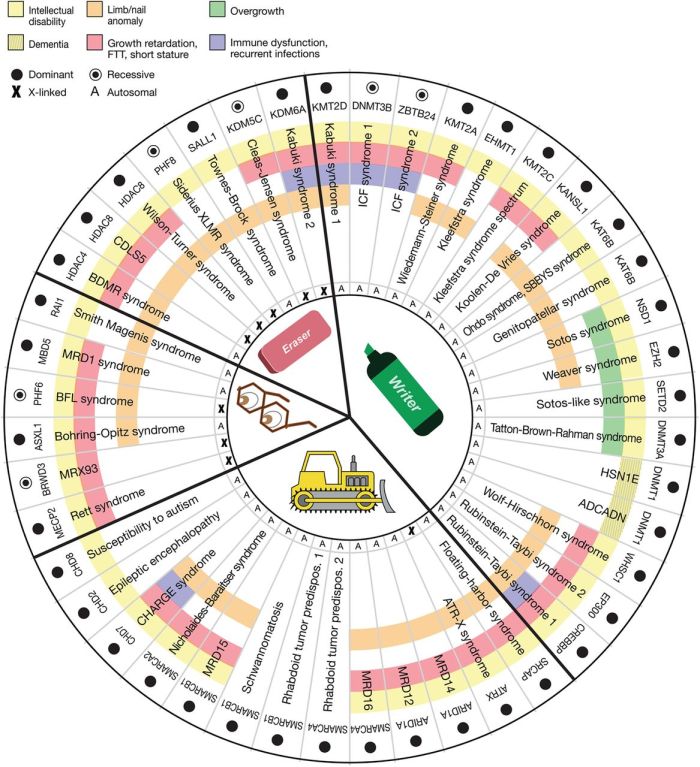
Genetic causes for epigenetic symptoms

This 2015 human summary study was of 44 genetic disorders that disrupt the maintenance of epigenetic modifications:

“..making them likely to have significant downstream epigenetic consequences. Interestingly, these patients often demonstrate neurological dysfunction, suggesting that precise epigenetic regulation may be critical for neuronal homeostasis. However, at the same time, it is important to keep in mind that many of these proteins have additional non-epigenetic roles.

Mutations in many of these components have now been linked to a number of well-known causes of intellectual disability. Intellectual disability is generally defined as deficits of intellectual function and adaptive behavior that occur during the developmental period.

Given the opposing activity of many of the components of the epigenetic machinery, the pathogenic sequence in these disorders involves an imbalance of chromatin states. Keeping a subset of genes under “pressure” from two opposing systems may allow the cellular system to rapidly respond to environmental stimuli.

These disorders, on average, have unusual phenotypic breadth. Similarly, there is a shift in distribution toward a higher number of organ systems affected.

In addition to developmental phenotypes (multiple congenital anomalies), in some cases there appear to be ongoing defects that remain consequential in post-natal life. An example of the latter is the hippocampal memory defects seen in many of the mouse models.

This raises the question whether cells undergoing neurogenesis and synaptogenesis are particularly sensitive to subtle defects of the epigenetic machinery and downstream epigenetic abnormalities. A major remaining question is whether neurogenesis defects and/or abnormalities of synaptic plasticity are a unifying pathophysiological process.”

The researchers represented the 44 genetic disorders on a wheel graph:

F1.large

I look forward to further research that includes non-genetic disruptors of epigenetic modifications.

http://genome.cshlp.org/content/25/10/1473.full “The Mendelian disorders of the epigenetic machinery”

A study that provided evidence for basic principles of Primal Therapy

This 2015 Northwestern University rodent study found:

“Fear-inducing memories can be state dependent, meaning that they can best be retrieved if the brain states at encoding and retrieval are similar.

Memories formed in a particular mood, arousal or drug-induced state can best be retrieved when the brain is back in that state.

‘It’s difficult for therapists to help these patients,’ Radulovic said, ‘because the patients themselves can’t remember their traumatic experiences that are the root cause of their symptoms.’

The best way to access the memories in this system is to return the brain to the same state of consciousness as when the memory was encoded.”

The study demonstrated one method of activating neurobiological pathways with a drug to remove a hippocampal memory’s protection, which played a part in enabling subjects to relive their remembered experiences. This rodent study’s methods weren’t designed to therapeutically access similarly protected memories with humans.

From the Northwestern press release:

“There are two kinds of GABA [gamma-Aminobutyric acid] receptors. One kind, synaptic GABA receptors, works in tandem with glutamate receptors to balance the excitation of the brain in response to external events such as stress.

The other population, extra-synaptic GABA receptors, are independent agents.

If a traumatic event occurs when these extra-synaptic GABA receptors are activated, the memory of this event cannot be accessed unless these receptors are activated once again.

‘It’s an entirely different system even at the genetic and molecular level than the one that encodes normal memories,’ said lead study author Vladimir Jovasevic, who worked on the study when he was a postdoctoral fellow in Radulovic’s lab.

This different system is regulated by a small microRNA, miR-33, and may be the brain’s protective mechanism when an experience is overwhelmingly stressful.

The findings imply that in response to traumatic stress, some individuals, instead of activating the glutamate system to store memories, activate the extra-synaptic GABA system and form inaccessible traumatic memories.”

I’d point out that “can’t remember” and “inaccessible traumatic memories” phrases used above were in reference to what’s usually called “memory” i.e., a recall initiated by the cerebrum.


The study’s findings should inform memory-study researchers if they care to understand how emotional memories can be formed and re-experienced.

The study provided evidence for fundamentals of Dr. Arthur Janov’s Primal Therapy, such as:

  • Experiences associated with pain can be remembered below our conscious awareness.
  • The retrieval and re-experiencing of emotional memories can engage our lower-level brain areas without our higher-level brain areas’ participation.

The obvious nature of this study’s straightforward experimental methods made me wonder why other researchers hadn’t used the same methods decades ago.

Use of this study’s methodology could have resulted in dozens of informative follow-on study variations by now, and subsequently found whether subjects’ physiological, behavioral, and epigenetic measurements differed from control group subjects, as in:

“miR-33 is downregulated in response to gaboxadol [the drug used to change subjects’ brain state] and modulates its effects on state-dependent fear.”


See Resiliency in stress responses for abstracts of three follow-on papers by these researchers.

http://www.nature.com/neuro/journal/v18/n9/full/nn.4084.html “GABAergic mechanisms regulated by miR-33 encode state-dependent fear”

MP3 with lead researcher Dr. Jelena Radulovic: http://www.thenakedscientists.com/HTML/specials/show/20150825/

Adverse effects of inflammation and stress on hippocampal synapses

This dense and highly-jargoned 2015 rodent study found:

“The suppression of BDNF [brain-derived neurotrophic factor] signaling, LTP [long-term potentiation], and memory may be driven by an increased sensitivity to IL-1β [the proinflammatory cytokine interleukin 1β] that occurs directly at synapses.”

The researchers reversed the adverse effects of IL-1β after they induced stress and inflammation. Blocking IL-1β when there wasn’t stress or inflammation, however, also caused adverse effects:

“Interestingly, administration of AS1 [the compound that blocked the proinflammatory responses] in the absence of LPS [the bacterial compound used to stress the subjects’ immune systems] treatment also impaired OLM [the object location memory test where control group rodents exhibited a preference for a novel location over a familiar location].

This finding is consistent with the notion that endogenous IL-1β at physiologically low levels may be essential for hippocampal memory function.”


The researchers asserted:

“Our data reveal a previously unidentified mechanism that explains the age-related vulnerability of hippocampal function to impairment by inflammation.”

Instead of couching their findings with a non-causal “age-related” term, could the researchers have specifically identified causes?

“IL-1β activates different pathways via AcP (proinflammatory) or AcPb (prosurvival) IL-1 receptor subunits.

This study demonstrates that the IL-1 receptor subunit system undergoes an age-dependent reconfiguration in hippocampal synapses.

This previously undescribed reconfiguration, characterized by an increase in the AcP/AcPb ratio, is responsible for potentiating impairments of synaptic plasticity and memory by IL-1β.”

What were the underlying causes for the relatively increased AcP activation over AcPb activation? The researchers didn’t say. Their explanations were left hanging at a correlated-but-not-causal “age-dependent” level rather than a “mechanism that explains.”

http://www.pnas.org/content/112/36/E5078.full “Synapse-specific IL-1 receptor subunit reconfiguration augments vulnerability to IL-1β in the aged hippocampus”

A mechanistic study of neurotransmitters in the hippocampus

This 2015 UK rodent study found:

“A mechanistic understanding of how alterations in dopamine and NMDAR [a type of glutamate receptor that participates in excitatory neurotransmission] function can lead to the disruption of hippocampal–PFC [prefrontal cortex] functional connectivity.

These results show how dopaminergic activation induces long-term hypofunction of NMDARs, which can contribute to disordered functional connectivity, a characteristic that is a hallmark of psychiatric disorders such as schizophrenia.”

One of the experiments applied theta-frequency (5 Hz) waves to the rats’ hippocampi and dampened the electrical activity of the NMDAR type of glutamate receptor.

However, this effect of theta waves was dependent on the activation of D2 dopamine receptors. The study’s findings should inform researchers who treat brain waves as base causes of behavior in studies such as What’s an appropriate control group for a schizophrenia study?

This study’s findings may also inform researchers of studies such as the What causes disconnection between the limbic system and the cerebrum? of a neurochemical basis for “the disruption of hippocampal–PFC functional connectivity.”

http://www.pnas.org/content/112/35/11096.full “Disruption of hippocampal–prefrontal cortex activity by dopamine D2R-dependent LTD of NMDAR transmission”

Another factor in producing new brain neurons in the adult hippocampus

This 2015 New York rodent study provided further details on the production of new neurons in the adult hippocampus. The researchers found that a protein that regulated a glutamate receptor also:

“Significantly influences hippocampal neurogenesis and that both the proliferation and survival of newborn neurons are impaired in the absence.”

The study showed:

“The effect of Norbin [the protein] on neurogenesis is likely caused by a nonautonomous niche effect.

These results show that Norbin is a regulator of adult hippocampal neurogenesis and that its deletion causes depressive-like behaviors.”

http://www.pnas.org/content/112/31/9745.full “Norbin ablation results in defective adult hippocampal neurogenesis and depressive-like behavior in mice”

How brain neurons remain stable when constantly stimulated

This 2015 UK rodent study provided details of how neurons in the hippocampus respond to stimuli. The researchers found that hippocampal neurons:

“Remain electrically stable when confronted with chronic increases in neuronal activity.”

Changes in electrical potential changed the initial segment of the neuron’s axon.

Synapses formed along the segment, and stayed in place while this highly-plastic segment moved along the axon. The location mismatch:

“Allows the GABAergic [producing gamma-Aminobutyric acid, an inhibitory neurochemical] synapses to strongly oppose action potential generation, and thus downregulate pyramidal cell excitability.”

The researchers also used the two antioxidants endogenous to humans, superoxide dismutase and glutathione, to supplement the culture medium.

http://www.pnas.org/content/112/31/9757.full “Activity-dependent mismatch between axo-axonic synapses and the axon initial segment controls neuronal output”

How brains mature during critical periods

This 2015 German rodent study found:

“Once silent synapses are consolidated in any neural circuit, initial experience-dependent functional optimization and critical periods end.

Silent synapses are thought to be immature, still-developing excitatory synapses.”

The number of silent synapses related to visual processing was measured at ~50% at eye opening. Visual experience reduced this to 5% or less by adulthood in the study’s control group. Removing a protein in the subjects’ hippocampus silenced the synapses back up to ~50%, even in adults.

Critical periods are:

“Characterized by the absolute requirement for experience in a restricted time window for neural network optimization.

Although some functions can be substantially ameliorated after the CP [critical period], they are rarely optimally restored.”

Two human studies were cited on critical periods in second-language and musical skills development, Sensitive periods in human development: Evidence from musical training (not freely available).

The researchers generalized their findings as:

“Experience-dependent unsilencing of silent synapses constitutes an important general maturational process during CPs of cortical development of different functional domains and suggest an interplay with inhibitory circuits in regulating plasticity.”

http://www.pnas.org/content/112/24/E3131.full “Progressive maturation of silent synapses governs the duration of a critical period”

The effects of inescapable, uncontrollable, repeated stress on the hippocampus

This 2015 MIT rodent study found:

Behavioral stress impairs cognitive function via activation of a specific direct neural circuit from the basolateral amygdala to the dorsal hippocampus. Moreover, we delineate a molecular mechanism by which behavioral stress is translated to hippocampal dysfunction via a p25/Cdk5 (cyclin-dependent kinase 5)-dependent pathway and epigenetic alterations of neuroplasticity-related gene expression.”

The researchers made several intermediate findings to develop their main finding:

1. “Repeated stress is accompanied by

  • generation of p25,
  • up-regulation and phosphorylation of glucocorticoid receptors,
  • increased HDAC2 [the gene encoding the histone deacetylase 2 enzyme] expression, and
  • reduced expression of memory-related genes [most, but not all that were tested] in the hippocampus.”

2. “BLA [basolateral amygdala] activation is both necessary and sufficient for stress-associated molecular changes and memory impairments.”

3. “This effect [2. above] relies on direct glutamatergic projections from the BLA to the dorsal hippocampus.”

4. “p25 generation is necessary for the stress-induced memory dysfunction.”

From the Results section:

“Control mice showed a significant preference for the novel over the familiar object or location, whereas RFS [repetitive foot shock]-treated mice performed no better than chance.”

The subject adult mice underwent:

“Inescapable, uncontrollable repeated stress.”

Do humans also experience impaired “cognitive function” and “hippocampal dysfunction” and “epigenetic alterations of neuroplasticity-related gene expression” caused by “inescapable, uncontrollable repeated stress”?

And what are the real histories of people who aren’t curious, who don’t show “a significant preference for the novel over the familiar object or location”?

http://www.pnas.org/content/112/23/7291.full “Basolateral amygdala bidirectionally modulates stress-induced hippocampal learning and memory deficits through a p25/Cdk5-dependent pathway”

Measuring the signal-to-noise ratio of a brain neuron

This 2015 study found that a single brain neuron’s

“Spiking history is often a more informative predictor of spiking propensity than the signal or stimulus activating the neuron.

Characterizing the reliability with which neurons represent and transmit information is an important question in computational neuroscience.”

Three of the four brain neuron areas studied were of the limbic system: a rat thalamus, a monkey hippocampus, and a human subthalamus area.

http://www.pnas.org/content/112/23/7141.full.pdf “Measuring the signal-to-noise ratio of a neuron” (pdf file is linked because the html has errors)

An inhibitory gene that affects alcohol binge behavior

This 2015 La Jolla rodent study found that an inhibitory gene affected alcohol binging behavior:

“Our study reveals the behavioral impact of this cellular effect, whereby the level of GIRK3 [the gene] expression in the VTA [ventral tegmental area] tunes ethanol intake under binge-type conditions: the more GIRK3, the less ethanol drinking.”

GIRK3-silenced mice still binged, though, and got alcohol’s rewarding effects through dopamine’s other neural pathways.

High concentrations of the gene were found in the thalamus part of the limbic system of wild-type mice, the control group. Per the study’s title, this gene presumably contributes to the thalamus’ overall function of gating information from limbic system and lower brain areas to reach the cerebrum and vice versa.

And the potential causes for reduced GIRK3 expression are..?? Hopefully – someday – researchers will be focused on finding causes for abnormal gene expression rather than being content to just study effects of abnormal gene expression. Until then, the usual practice of considering only the effects led these researchers to:

“Believe that a compound selectively targeting GIRK3-containing channels may hold promise for reducing alcohol consumption in heavy binge drinkers.”

http://www.pnas.org/content/112/22/7091.full “GIRK3 gates activation of the mesolimbic dopaminergic pathway by ethanol”

Epigenetic changes in the developing brain change behavior

This 2015 review cited 143 studies to tie together findings in epigenetic chemistry and behavioral neuroscience.

In addition to studies I’ve previously curated, other research included:

  • a 2012 study which completely abolished mouse maternal behavior by silencing a gene encoding an estrogen receptor;
  • a 2012 study which found that stress-induced changes in the rat hippocampus were heritable;
  • a 2014 study that distinguished between transgenerational and intergenerational epigenetic effects such as:

    in utero exposure to nutritional status, stress, or toxic environmental factors that act on the developing embryo and its germ line”

  • a 2013 study that showed how genomic imprinting coordinated:

    “Genetic coadaptation where beneficially interacting alleles evolve to become coinherited.”

The current status of research incorporating both epigenetic chemistry and behavioral neuroscience was summed up as:

“A large number of behavioral epigenetic studies attempt to correlate epigenetic marker changes at global levels and in mixed populations of cells with phenotypic changes.

Specific changes at specific gene levels and at single cell levels correlating with behavioral changes remain largely unknown.”

http://www.pnas.org/content/112/22/6789.full “Epigenetic changes in the developing brain: Effects on behavior”

Stress in early life can alter physiology and behavior across the entire lifespan

I’ll quote a few sections of this 2014 summary of 111 studies concerning stress, including the authors’ research:

“The brain is the central organ of stress and adaptation to stressors because:

  • It not only perceives what is threatening or potentially threatening and initiates behavioral and physiological responses to those challenges,
  • But also is a target of the stressful experiences and the hormones and other mediators of the stress response.

The stress history of parents is a significant factor in the resilience of their offspring.

Environmental stress transduces its effects into lasting changes on physiology and behavior, which can vary even among genetically identical individuals.

Stress in early life can alter physiology and behavior across the entire lifespan.

Structural stress memory is even more apparent with regard to gene expression in stress-sensitive brain regions like the hippocampus.

Individual history is important and that there is a memory of stress history retained by neurons at the cellular level in regions like the hippocampus.

Stress has a number of known effects on epigenetic marks in the brain, producing alterations in DNA methylation and histone modifications in most of the stress-sensitive brain regions examined, including the hippocampus, amygdala, and prefrontal cortex.”


It seemed to be taboo to note that most of – and the largest of – detrimental effects of stress occurred during womb-life in the mother’s environment. The authors instead opted for a politically correct “the stress history of parents” phrase.

Referenced studies had findings relevant to the earliest periods of life, including Figure 1:

interactions

“Those organs that show the highest levels of retrotransposon [a repeat element (mobile DNA sequences often involved in mutations) type formed by copy-and-paste mechanisms] activity, such as the brain and placenta, also seem to be both steroidogenic and steroid-sensitive.”

However, Figure 1 was given a beneficial context, and other studies’ findings weren’t mentioned in their contexts of detrimental effects on fetuses of mothers who were stressed while pregnant.

http://www.pnas.org/content/112/22/6828.full “Stress and the dynamic genome: Steroids, epigenetics, and the transposome”

One way beliefs produce pleasure and reward in the cerebrum

This 2014 Singapore human study found:

“Differences in belief learning – the degree to which players were able to anticipate and respond to the actions of others, or to imagine what their competitor is thinking and respond strategically – was associated with variation in three genes which primarily affect dopamine functioning in the medial prefrontal cortex.

In contrast, differences in trial-and-error reinforcement learning – how quickly they forget past experiences and how quickly they change strategy – was associated with variation in two genes that primarily affect striatal dopamine.”

One of the researchers said:

“The findings correlate well with previous brain studies showing that the prefrontal cortex is involved in belief learning, while the striatum is involved in reinforcement learning.”

The study didn’t demonstrate cause and effect, however, and the researchers cautioned:

“It would be mistaken to interpret our results as suggesting that dopamine genes function as “belief learning genes.”

The study added to the science of how beliefs act on the pleasure and reward parts of the cerebrum.

http://www.pnas.org/content/111/26/9615.full.pdf “Dissociable contribution of prefrontal and striatal dopaminergic genes to learning in economic games” (the pdf file is linked because the html had errors)

Changing an individual’s future behavior even before they’re born

This 2015 Harvard fruit fly research was a companion of the Is what’s true for a population what’s true for an individual? study.

The researchers began with the question:

“If we could rear genetically identical individuals from a variety of genetic backgrounds and rear them in the same environment, how much phenotypic variation between individuals of the same genotype would we see?”

They answered with:

“We show that different genotypes vary dramatically in their propensity for variability, that phenotypic variability itself, as a trait, can be heritable, and that loci affecting variability can be mapped.”


The specific problem that probably prompted this study was that the methodology of genome-wide association studies (GWAS) usually:

“Focuses on the average effect of alternative alleles averaged in a population.”

What this methodology often missed was:

“When phenotypic variation results from alleles that modify phenotypic variance rather than the mean, this link between genotype and phenotype will not be detected.”


The researchers altered the environment during a critical period of fruit flies’ development in order to induce epigenetic changes in the fruit fly pupae brains:

“Disruption of Ten-a [the synaptic target recognition gene Tenascin accessory] expression in midpupa affects behavioral variance [the standard statistical dispersion parameter].

In all cases, disrupting Ten-a increased the variability [the median of the absolute deviation from each observation’s median] in turning bias with no effect on the mean.”

I fully expect researchers to demonstrate that this finding has general applicability for humans, especially during womb-life. Research such as:

are steps in this direction just for one factor in the human fetal environment – stress. The effects of stressing a human fetus should be at least as significant as the effects produced on the study’s subjects with increased temperature during pupation.

http://www.pnas.org/content/112/21/6706.full “Behavioral idiosyncrasy reveals genetic control of phenotypic variability”