What was not, is not, and will never be

Neuroskeptic’s blog post Genetic Testing for Autism as an Existential Question related the story of “A Sister, a Father and a Son: Autism, Genetic Testing, and Impossible Decisions.”

“I decided to put the question to my sister, Maria. Although she is autistic, she is of high intelligence.

Maria was excited to be an aunt soon, and was willing to do what she could to help my baby – even if what she was helping with was to avoid her own condition.

She is high enough functioning to know some of what she’s missing in life, and has longed her entire life to be “normal.” If she could save her niece or nephew some of the pain and awkwardness her condition had caused her, she was willing to help.”

In the concluding paragraph:

“What struck me about this story is the way in which the prospect of the genetic test confronted Maria with a very personal decision: will you do something that might help prevent someone else becoming like you?

Isn’t this very close to the ultimate existential question: all things considered, would you wish to live your life over again?”


Aren’t the majority of humans also “high enough functioning to know some of what she’s missing in life?”

Aren’t our feelings of what we’re missing one of the impetuses for us to have also “longed her entire life to be normal?”

This feeling was aired in Dr. Arthur Janov’s blog post What a Waste:

“What it was, was the feeling of great loss, something missing that could never again be duplicated.

It was no love where it could have been the opposite if the parent’s gates could have been open. But it could not be because that would have meant terrible pain and suffering for them; and their whole neurologic system militated against any conscious-awareness.”


We long for what was and is impossible:

  • For many of us, the impossibilities of having normal lives started with prenatal epigenetic changes.
  • Our experiences of our postnatal environment prompted us into adapting to its people, places, and contents. These neurological, biological, and behavioral adaptations were sometimes long-lasting deviations from developmental norms.
  • Other genetic factors combined with the above to largely make us who we were and are.

Our longing for an impossible-to-reconstruct life doesn’t go away.

We often may not be aware of our longing for what “could not be” and of its extensive impacts. Such feelings impel us into many hundreds of ideas, hundreds of beliefs, and hundreds of behaviors, a sample of which were referred to above:

  • Behaviors to “do something that might help prevent someone else becoming like you;”
  • Ideas such as existential philosophy; and
  • Beliefs that manifest the “wish to live your life over again.”

Spending our time on these ideas, beliefs, and behaviors won’t ameliorate their motivating causes. Our efforts distance us from our truths, with real consequences: a wasted life.

What keeps us from understanding our reality? I invite readers to investigate Dr. Arthur Janov’s Primal Therapy for effective therapeutic approaches.

The primary causes of individual differences in DNA methylation are environmental factors

This 2015 Canadian human study by McGill researchers found:

“Differential methylation is primarily non-genetic in origin, with non-shared environment accounting for most of the variance. These non-genetic effects are mainly tissue-specific.

The full scope of environmental variation remains underappreciated.”

The researchers developed their findings using adipose and blood samples from monozygotic and dizygotic twins in the UK Adult Twin registry of Caucasian females aged 40 to 87. The goal of their techniques was to develop:

“A guide to design targeted panels for cost-effective and comprehensive evaluation of only variable methylation in investigated tissues.”

The researchers used whole-genome bisulfite sequencing (WGBS) because:

“Most genome-wide methylation studies of inter-individual variation to date have been biased towards promoter and CpG-dense regions.

A main limitation with studies using the Illumina 450 K array is that the platform only covers ~1.5 % of overall genomic CpGs, which are biased towards promoters and strongly underrepresented in distal regulatory elements, i.e., enhancers.

WGBS offers single-site resolution CpG methylation interrogation at full genomic coverage.

Another advantage of WGBS is its ability to access patterns of non-CpG methylation.”

The researchers provided several examples of how environmental exposure impacted CpG methylation. In one, a pair of monozygotic twins who had both smoked for over 40 years was compared with a monozygotic pair who hadn’t smoked for 20 years. Previous studies’ findings were replicated both as to the patterns of methylation and to methylation of a specific CpG site “involved in asthma with interaction of environmental tobacco smoke.”

http://www.genomebiology.com/content/16/1/290 “Population whole-genome bisulfite sequencing across two tissues highlights the environment as the principal source of human methylome variation”

Trapped, suffocating, unable to move – a Primal imprint

“The malady of needing to move constantly: organizing trips, making reasons to go here and there, and in general, keeping on the move..below all that movement is a giant, silent scream.

The price we pay is never knowing our feelings or where they come from.

We have the mechanism for our own liberation inside of us, if we only knew it.

When we see constant motion we understand, but we never see the agony. Why no agony? Because it is busy being acted-out to relieve the agony before it is fully felt.”

http://cigognenews.blogspot.com/2015/11/epigenetics-and-primal-therapy-cure-for_30.html “The Miracle of Memory – Epigenetics and Primal Therapy: The Cure for Neurosis (Part 13/20)”

The emotional power of environmental sounds affects our sensory experiences

This 2015 Chinese/Australian study found:

“Human emotions systematically track changes in the acoustic environment, affecting not only how we experience those sounds but also how we perceive facial expressions in other people.

Three changes in acoustic attributes known to signal emotional states in speech and music [frequency spectrum, intensity, and rate] were imposed upon 24 environmental sounds.

Evolution promotes development in the direction toward selective advantage. Thus, it is reasonable to suggest that the capacity to track changes in the acoustic environment evolved before the development of a vocalization system for emotional communication.

Regardless of the evolutionary implications of the effect, the findings illustrate the emotional power of environmental sounds on both our experience of sounds and our evaluations of accompanying visual stimuli.”

Here are the sounds used in the study:

“Human actions (breathing, chatting, chewing, clapping, stepping, typing), animal sounds (bird, cat, cricket, horse, mosquito, rooster), machine noise (car engine, electrical drill, helicopter, jet plane, screeching tires, train), and sounds in nature (dripping water, rain, river, thunder, waves, wind)”


Does this emotional communication’s frequency spectrum, intensity, and rate affect your perception of her face?

http://www.pnas.org/content/112/47/14563.full “Human emotions track changes in the acoustic environment”

A study of DNA methylation and age

This 2014 Finnish human study compared and contrasted the DNA methylation levels of young adults with people age 90:

“We identified 8540 high-confidence CpG [cytosine and guanine separated by only one phosphate link] sites that show a large difference in methylation levels between nonagenarians and young controls and that present high statistical significance in a regression model adjusted for the leukocyte proportion.

The majority of frequently reported CpG sites are hypermethylated with increasing age.

Ageing-associated hypermethylation is concentrated in genes associated with developmental processes as well as DNA-binding and transcription of genes, whereas hypomethylation is not enriched among a specific set of genes.

The largest percentage of the variation in our methylation data was associated with the proportions of different leukocyte subtypes.

We found that only a minority of ageing-associated CpG sites showed an association between methylation and expression levels. Furthermore, only a minority of these genes have been identified as differentially expressed between nonagenarians and young individuals.”

The finding concerning:

“Ageing-associated hypermethylation is concentrated in genes associated with developmental processes as well as DNA-binding and transcription of genes”

was in concert with a referenced 2013 review Aging is not programmed that stated:

“Aging is not and cannot be programmed. Instead, aging is a continuation of developmental growth, driven by genetic pathways.

Aging is a shadow. Its shape is determined by the developmental growth.

Genetic programs determine developmental growth and the onset of reproduction. When these programs are completed, they are not switched off.

Aging has no purpose (neither for individuals nor for group), no intention. Nature does not select for quasi-programs. It selects for robust developmental growth.

Whereas the growth of the body is programmed, the emergence of the shadow is not. Natural selection cannot eliminate the shadow without hurting the “body”.”


The researchers made several points relating the current study and other epigenetic studies.

Regarding DNA methylation and gene expression:

“Due to the methods applied in the present study, not all the effects of DNA methylation on gene expression could be detected; this limitation is also true for previously reported results.

The textbook case of DNA methylation regulating gene expression (the methylation of a promoter and silencing of a gene) remains undetected in many cases because in an array analysis, an unexpressed gene shows no signal that can be distinguished from background and is therefore typically omitted from the analysis.”

Regarding biological age and chronological age:

“It remains to be investigated whether these [CpG] sites are only associated with chronological age or if there are also associations with phenotypic changes related to (successful) ageing.

If these frequently reported sites are only markers of chronological age, markers of biological age are yet to be identified.”

Regarding the rapid progression of technology used in epigenetic studies, they noted several times how what they used was significantly improved over pre-2014 technologies with statements such as:

“Global hypomethylation has been associated with an increasing risk of frailty, but very few other associations between phenotype and DNA methylation have been reported. However, this may be due to technical concerns, as the study by Bell et al. was performed with the 27K array, which almost exclusively contains promoter-associated probes that are not methylated at baseline and can therefore primarily acquire hypermethylation. Phenotype association studies performed with the 450K array or using sequencing techniques are necessary to clarify if hypomethylation is associated with typical ageing-associated phenotypes.”

Compare that with the limitations of the same 450K array acknowledged in A human study of changes in gene expression 2015 study:

“This array queries only 1.6% of all CpGs in the genome and the CpG selection is biased towards CpG islands. Other techniques – whole-genome bisulfite sequencing and methylC-capture (MCC) sequencing, for example – have definite technical advantages (higher resolution and no CpG island selection bias).”

http://www.biomedcentral.com/1471-2164/16/179 “Ageing-associated changes in the human DNA methylome: genomic locations and effects on gene expression”

Grokking an Adverse Childhood Experiences (ACE) score

What does it take to empathetically understand, to make a part of oneself, to grok an ACE score?

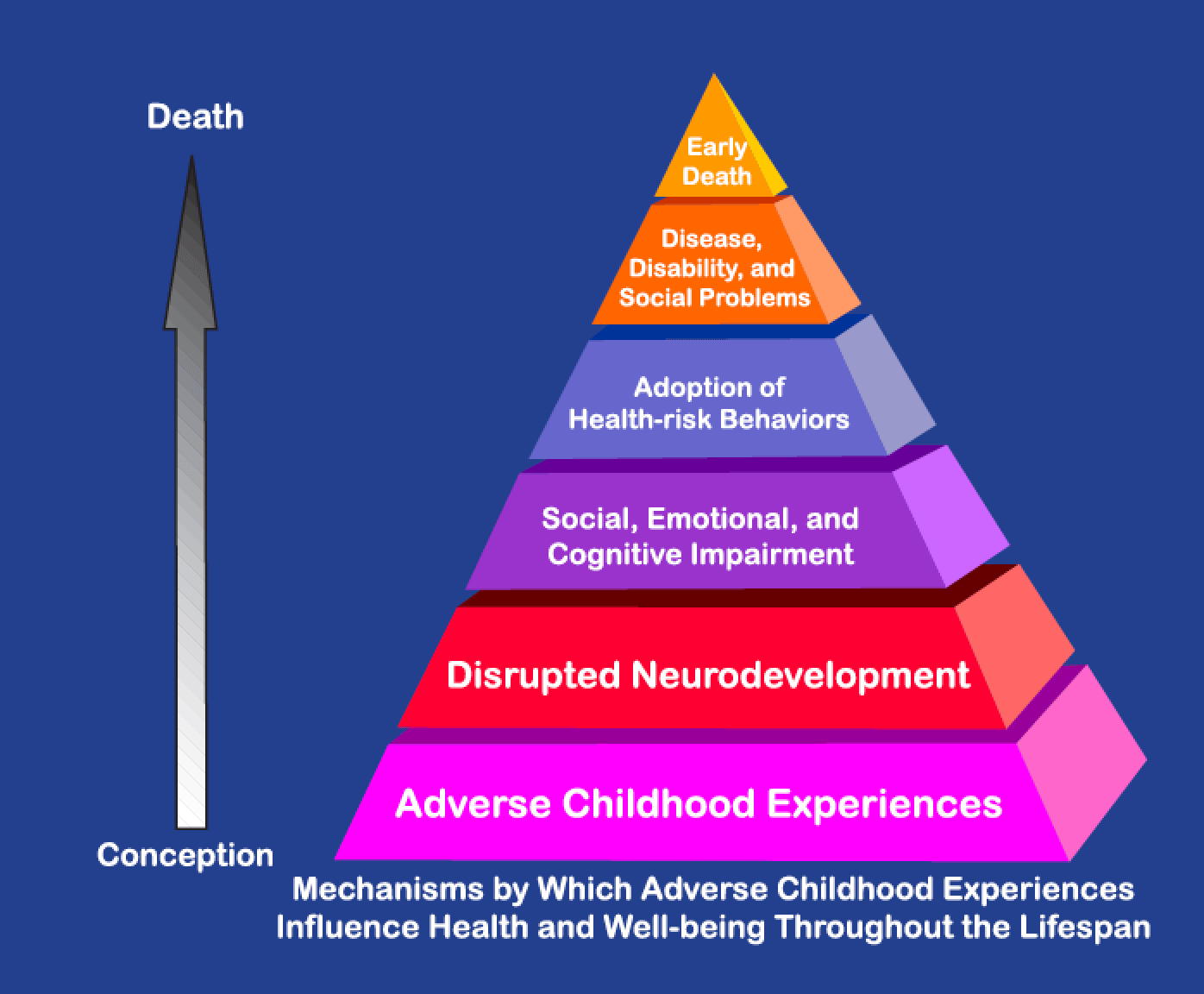
The ACE effort was initiated in 1985 in an era before epigenetics was well-studied. Its artifacts included the ACE pyramid:

The_ACE_PyramidThe historical ACE lifespan continuum on the left began at conception. The pyramid on the right promoted a limited view of ACE that assigned childhood as the pyramid’s base.

Current official depictions of the ACE pyramid assign an expanded view of ACE as the pyramid’s base. The viewer’s attention is directed to “Scientific Gaps” between pyramid layers, but the largest gap remains: the continuum starts at conception but the pyramid still starts at childhood. The narrative claims:

“To provide scientific information that would be useful for developing new and more effective prevention programs.”

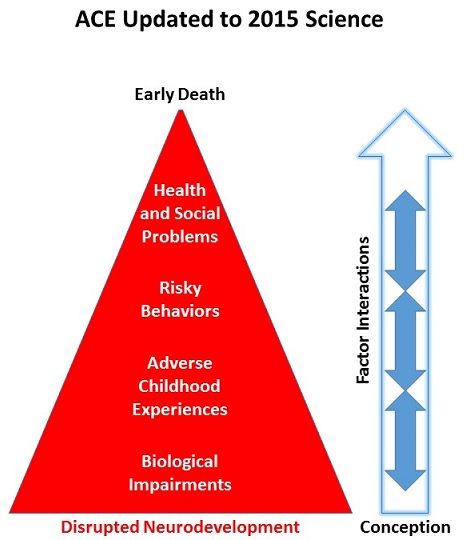
The official ACE pyramid doesn’t accurately reflect current science documented in, for example, Epigenetic effects of early life stress exposure. By downplaying Disrupted Neurodevelopment that may begin at conception, governing agencies implicitly endorse approaches that fail to address prenatal causes for later-life adverse effects.


If the ACE diagram was drawn thirty years later in 2015 to incorporate evidence for epigenetics, Disrupted Neurodevelopment wouldn’t be a consequent layer to an ACE base. The potential start of Disrupted Neurodevelopment would coincide with conception:Updated for 2015 to show Disrupted Neurodevelopment

What’s an example of current ACE-related scientific evidence that wasn’t present three decades ago and also isn’t represented in the official ACE pyramid? Prenatal Disrupted Neurodevelopment may be considered today as a possible consequence of a “Yes” answer to half of the original ACE questions:

  • Were your parents were too drunk or high to take care of you or take you to the doctor?
  • Were your parents ever separated or divorced?
  • Was your mother often or very often pushed, grabbed, slapped, or had something thrown at her?
  • Did you live with anyone who was a problem drinker or alcoholic or who used street drugs?
  • Was a household member depressed or mentally ill?

These threats and other stresses cause a fetus to biologically adapt. When such adaptations occur during prenatal development, they may:

  • Have much larger impacts and
  • Cause Biological Impairments that
  • Don’t unassistedly disappear over time.

Emphasizing Disrupted Neurodevelopment that may begin at conception would encourage:

  • Research that’s directed toward producing causal evidence for adaptations that largely occur during the early periods of an individual’s lifespan; and
  • Research on how these adaptations consistently influence our later-life ideas, biology, and behavior.

The above recommendations for research are neither the current focus of ACE research nor the direction of related efforts to assist affected individuals. Relevant studies that I’ve curated on this blog often only produced symptomatic evidence:

  • If a study couched its findings in non-etiologic phrases such as “is associated with” or “is linked to” or “may relate to,” it didn’t address ACE originating causes.
  • “New and more effective prevention programs” seldom address Disrupted Neurodevelopment and Biological Impairments with efforts to reduce the source of the damage.
  • If a program’s presentation showed multivariate analyses with ACE score probabilities and percentages, it didn’t address originating causes.

Here’s a YouTube search of ACE + adverse. Evaluate the current focus of ACE efforts by people employed in the social sciences and services. What did you notice?

How many presentations emphasized prenatal Disrupted Neurodevelopment, a period during which problems may be prevented by addressing causes? Did you instead see that these were outnumbered by many more presentations that emphasized Health and Social Problems symptom interventions?


So, what does it take to empathetically understand, to make a part of oneself, to grok a person’s ACE score?

Regarding empathy – it’s best to avoid the advice of studies such as:

People who are helped may not recognize it at first, but over time, they’ll sense whether the helper’s empathy is genuine.

Regarding understanding – I feel that people first need to ameliorate the origins of their own problems. Then they may be able to help others therapeutically address causes for ACE symptoms.

Need proof? Think of someone you’ve met whose thoughts and feelings and behavior were caught up in and motivated by their own problems:

  • Did you feel they could empathetically understand others?
  • Wasn’t the welfare of the people who may have been helped truly incidental and secondary to someone who was acting out their own problems?

What can cause memories that are accessible only when returning to the original brain state?

This 2015 French rodent study found:

“Memories can be established and maintained without de novo protein synthesis and that experimental amnesia may not result from a disruption of memory consolidation/reconsolidation.

Posttraining/postreactivation treatments induce an internal state, which becomes encoded with the memory, and should be present at the time of testing to ensure a successful retrieval.

This integration concept includes most of the previous explanations of memory recovery after retrograde amnesia and critically challenges the traditional memory consolidation/reconsolidation hypothesis, providing a more dynamic and flexible view of memory.”

From Neuroskeptic’s analysis of the study:

“A different drug, lithium chloride, produces the same pattern of effects – it blocks ‘reconsolidation’, but this can be reversed by a second dose at the time of recall. However, lithium chloride is not an amnestic [a drug that blocks memory formation] – it doesn’t block protein synthesis. Rather, it causes nausea.

The implication of the lithium experiment is that any drug that causes an ‘internal state change’, even if it’s just nausea, can trigger state-dependent memory and behave just like an ‘amnestic’.”


As this study may apply to humans, a drug wouldn’t necessarily be required to “induce an internal state.” If the findings of studies such as Are 50 Shades of Grey behaviors learned in infancy? extend to humans, an emotional or physical experience may be sufficient to produce a state-dependent memory. For example, A study that provided evidence for basic principles of Primal Therapy found, albeit with rodents and use of a drug:

“Fear-inducing memories can be state dependent, meaning that they can best be retrieved if the brain states at encoding and retrieval are similar.”

Memories triggered while in a brain state reentered through an emotion or a physical reaction are experienced by Primal Therapy patients and observed by therapists every day. However, as mentioned in What scientific evidence can be offered for Primal Therapy’s capability to benefit people’s lives? there’s a difficulty in developing human evidence for such state-dependent emotional memories.

Standard procedures would use human subjects and control groups in a way that retrieved memories according to the researchers’ schedule and experimental parameters. In order for the retrieval of an emotional memory to be therapeutic, though, the methods of an experiential therapy such as Dr. Arthur Janov’s Primal Therapy leave the timing of entering a triggering brain state up to the patient.

When a brain state protects a human emotional memory from being accessed, it probably wouldn’t be therapeutic to:

  • Force a return to that brain state, and thereby
  • Remove the memory’s protection, then
  • Retrieve and re-experience the memory

just for the sake of research.

The evidence for retrieving and re-experiencing a state-dependent memory lies mainly within the individual’s experiences.

A challenge is to find innovative ways to document human evidence for state-dependent emotional memories while ensuring a therapeutic process.

http://www.jneurosci.org/content/35/33/11623 “Integration of New Information with Active Memory Accounts for Retrograde Amnesia: A Challenge to the Consolidation/Reconsolidation Hypothesis?”

A study that provided evidence for basic principles of Primal Therapy

This 2015 Northwestern University rodent study found:

“Fear-inducing memories can be state dependent, meaning that they can best be retrieved if the brain states at encoding and retrieval are similar.

Memories formed in a particular mood, arousal or drug-induced state can best be retrieved when the brain is back in that state.

‘It’s difficult for therapists to help these patients,’ Radulovic said, ‘because the patients themselves can’t remember their traumatic experiences that are the root cause of their symptoms.’

The best way to access the memories in this system is to return the brain to the same state of consciousness as when the memory was encoded.”

The study demonstrated one method of activating neurobiological pathways with a drug to remove a hippocampal memory’s protection, which played a part in enabling subjects to relive their remembered experiences. This rodent study’s methods weren’t designed to therapeutically access similarly protected memories with humans.

From the Northwestern press release:

“There are two kinds of GABA [gamma-Aminobutyric acid] receptors. One kind, synaptic GABA receptors, works in tandem with glutamate receptors to balance the excitation of the brain in response to external events such as stress.

The other population, extra-synaptic GABA receptors, are independent agents.

If a traumatic event occurs when these extra-synaptic GABA receptors are activated, the memory of this event cannot be accessed unless these receptors are activated once again.

‘It’s an entirely different system even at the genetic and molecular level than the one that encodes normal memories,’ said lead study author Vladimir Jovasevic, who worked on the study when he was a postdoctoral fellow in Radulovic’s lab.

This different system is regulated by a small microRNA, miR-33, and may be the brain’s protective mechanism when an experience is overwhelmingly stressful.

The findings imply that in response to traumatic stress, some individuals, instead of activating the glutamate system to store memories, activate the extra-synaptic GABA system and form inaccessible traumatic memories.”

I’d point out that “can’t remember” and “inaccessible traumatic memories” phrases used above were in reference to what’s usually called “memory” i.e., a recall initiated by the cerebrum.


The study’s findings should inform memory-study researchers if they care to understand how emotional memories can be formed and re-experienced.

The study provided evidence for fundamentals of Dr. Arthur Janov’s Primal Therapy, such as:

  • Experiences associated with pain can be remembered below our conscious awareness.
  • The retrieval and re-experiencing of emotional memories can engage our lower-level brain areas without our higher-level brain areas’ participation.

The obvious nature of this study’s straightforward experimental methods made me wonder why other researchers hadn’t used the same methods decades ago.

Use of this study’s methodology could have resulted in dozens of informative follow-on study variations by now, and subsequently found whether subjects’ physiological, behavioral, and epigenetic measurements differed from control group subjects, as in:

“miR-33 is downregulated in response to gaboxadol [the drug used to change subjects’ brain state] and modulates its effects on state-dependent fear.”


See Resiliency in stress responses for abstracts of three follow-on papers by these researchers.

http://www.nature.com/neuro/journal/v18/n9/full/nn.4084.html “GABAergic mechanisms regulated by miR-33 encode state-dependent fear”

MP3 with lead researcher Dr. Jelena Radulovic: http://www.thenakedscientists.com/HTML/specials/show/20150825/

Reflections on my four-year anniversary of spine surgery

At age 55, I found out that I’d suffered for maybe 45 to 50 years from a childhood injury, and I didn’t know anything about it. It still seems unbelievable to me that I was physically ill for decades before I received a diagnosis.

As explained to me by two surgeons, the cause of my spondylolisthesis between L5 and S1 was a sudden injury sometime between ages 5 and 10. Here’s a further explanation:

“In children, spondylolisthesis usually occurs between the fifth bone in the lower back (lumbar vertebra) and the first bone in the sacrum (pelvis) area. It is often due to a birth defect in that area of the spine or sudden injury (acute trauma).

Other causes of spondylolisthesis include bone diseases, traumatic fractures, and stress fractures (commonly seen in gymnasts). Certain sport activities, such as gymnastics, weight lifting, and football, put a great deal of stress on the bones in the lower back. They also require that the athlete constantly overstretch (hyperextend) the spine.”

I played a lot of baseball when I was a kid growing up in Miami. I didn’t suffer from a birth defect or bone disease, play football before I was a teenager, do gymnastics, or lift weights.

I don’t remember a specific “sudden injury (acute trauma)” per the above explanation. Maybe I incurred the acute trauma that started my spondylolisthesis sliding into bases playing baseball. Maybe I incurred it playing in the other rough-and-tumble activities that I did as a boy.


Please stop at the first hint of any pain that you feel while reading the rest of this post. I don’t want to cause you pain.

I re-experienced while in Primal Therapy a day when I was seven or eight years old. A most exhilarating day, one that filled me with light and joy.

What brought on my elevated mood? It was the day I finally ran faster than my father did, and he couldn’t catch me to give me a beating as I ran out of the house.

My father never beat me on the sidewalk, the street, or the front yard anyway. That would make the abuse public.

My father’s job was assistant principal/dean of boys at West Miami Junior High School. He whipped boys with a thick belt or paddled them daily as part of his job requirements.

My father kept a wooden paddle with holes in it at home. For me.

I don’t remember that my three siblings ever received a paddling or belting, although they were spanked. I’ve remembered while in Primal Therapy that my younger sister and brother were spanked for crying.

I re-experienced the dread of waiting (in an exact place with visual details), waiting for my father to come home to administer a spanking or belting or paddling to me for some “transgression” my mother observed. She had dozens of rules of conduct for her children.

I re-experienced my early childhood feelings that my father’s punishments depended more on my mother’s mood than on what I did.

I re-experienced my early childhood feelings that I didn’t deserve the beatings. I didn’t deserve any beatings, not one!

My father continued, though, until I was around age 11 or so. I’m sure that the beatings were a factor in how I felt at age 12:

Suicidal. Needing to escape from my life.

When I was a child, I needed my parents’ love.

I re-experienced many times while in Primal Therapy the overwhelming hopelessness, helplessness, worthlessness, and betrayal when the people I needed to love me were cruel to me instead.


My parents knew what they did was wrong. Neither one of them ever told me that, though.

My father never apologized for beating me so much before he died 19 years ago. Even before he retired, 17 years before he died, the Miami-Dade County public school system stopped him and the rest of their employees from spanking, whipping, beating, and paddling children.

What could he even tell me to take away those experiences?

  • That he beat me as a child because he himself was beaten as a child?
  • That he couldn’t help it?
  • That how he and my mother frequently went out of their way to help me along in life after my childhood somehow made up for the beatings?

I’m certain that my father was beaten as a child. I bring this up not as a defense for what he did, but as part of my history, too.

It wasn’t enough for my father’s mother to beat me while she was babysitting my siblings and me at our parents’ house. I re-experienced crying as a five-year old when I was required to go cut off palm fronds from the tree in front of our house for her to use as a switch, and bring them to her.

It was a mark of my grandmother’s cruelty that she threatened to beat me with a broom handle when I tried to not participate in my own torment. I re-experienced exact places of my legs where she switched me with the palm fronds, giving me even more when I cried during the punishment.


These wounds left scars that haven’t gone away.

Run your hand down your spine until you reach the top of your sacrum. That’s the area on which I had surgery four years ago, where I now have a titanium cage, replacement disc, and two rods to keep the area stable.

I received a lot of beatings pretty close to that area. Maybe my boyhood activities didn’t cause the “sudden injury (acute trauma).”


I write frankly about my parents because that’s my history: the realities of who they were.

And the realities of who I needed them to be.

I express it because getting well has to address reality.

From Dr. Arthur Janov’s book, Primal Healing, page 133:

“Another cognitive technique is to help the patient understand and forgive his parents. ‘After all, your parents did the best they could. They had a pretty tough childhood too.’ ‘Oh yes, I understand. They did have it tough and I do forgive’ comes forth from the left side. Still, of course, the right side is crying out its needs and its pain, and will go on with its silent scream for the rest of our lives.

There is no way around need.

‘Forgiveness’ is an idea that has no place in therapy.

We are not here to pardon parents; we are here to address the needs of patients, and what the lack of fulfillment did to them.

I regret to say that much of current therapy and particularly cognitive therapy is about a moral position; well hidden, couched in psychological jargon, but, at bottom, moralizing. The therapist becomes the arbiter of correct behavior.

After all, the therapist is trying to change the patient’s behavior toward some preconceived goal. That goal has a sequestered moral position.”
How brains mature during critical periods

This 2015 German rodent study found:

“Once silent synapses are consolidated in any neural circuit, initial experience-dependent functional optimization and critical periods end.

Silent synapses are thought to be immature, still-developing excitatory synapses.”

The number of silent synapses related to visual processing was measured at ~50% at eye opening. Visual experience reduced this to 5% or less by adulthood in the study’s control group. Removing a protein in the subjects’ hippocampus silenced the synapses back up to ~50%, even in adults.

Critical periods are:

“Characterized by the absolute requirement for experience in a restricted time window for neural network optimization.

Although some functions can be substantially ameliorated after the CP [critical period], they are rarely optimally restored.”

Two human studies were cited on critical periods in second-language and musical skills development, Sensitive periods in human development: Evidence from musical training (not freely available).

The researchers generalized their findings as:

“Experience-dependent unsilencing of silent synapses constitutes an important general maturational process during CPs of cortical development of different functional domains and suggest an interplay with inhibitory circuits in regulating plasticity.”

http://www.pnas.org/content/112/24/E3131.full “Progressive maturation of silent synapses governs the duration of a critical period”

Unconscious stimuli have a pervasive effect on our brain function and behavior

This 2015 Swedish human study, performed at the institution that awards the Nobel Prize in Physiology or Medicine, found:

“Pain responses can be shaped by learning that takes place outside conscious awareness.”

Images of neutral male faces were used as conditioning stimuli which the subjects were trained to associate with levels of pain.

The concluding sentence of the study:

“Our results demonstrate that conscious awareness of conditioned stimuli is not required during either acquisition or activation of conditioned analgesic and hyperalgesic responses, and that low levels of the brain’s hierarchical organization are susceptible for learning that affects higher-order cognitive processes.”

From the study’s abstract:

“Our results support the notion that nonconscious stimuli have a pervasive effect on human brain function and behavior and may affect learning of complex cognitive processes such as psychologically mediated analgesic and hyperalgesic responses.”


Principles of Dr. Arthur Janov’s Primal Therapy related to this study’s findings are:

  • Experiences associated with pain can be remembered below our conscious awareness.
  • Unconscious memories associated with pain, when activated, have varying forms of expression as they pass up through our levels of consciousness.
  • These memories, when activated, have effects on our feelings, thinking, health, brain functioning, and behavior that are usually below our conscious awareness.

I’ll use one of Dr. Janov’s 2011 blog posts, On Being Alone, to show an example of how the study’s findings of:

  • “Conscious awareness of conditioned stimuli is not required during either acquisition or activation of conditioned..responses” and
  • “Nonconscious stimuli have a pervasive effect on human brain function and behavior”

are seen through the lens of Primal Therapy:

Unconscious memories associated with the pain of being left alone may be stored, especially in the developing brain, in our lower brain areas below conscious awareness: “Pain of being left alone a lot in childhood and infancy, added to the ultimate aloneness right after birth when no one was there for the newborn. That imprints a primal terror where a naïve, innocent and vulnerable baby has no one to lean on, to be held by, to snuggle up to, to be comforted. To be loved.”
As we develop, the cumulative memories associated with the pain of being left alone, when activated, may affect our feelings, thoughts, and behavior: “And that also has multiple meanings: no one wants me; there is no one there for me: no one wants to be with me; I have no love and no one who cares. One races to phone others so as not to feel alone. One runs from the feeling and struggles mightily not to be alone. Or, depending on earlier events one stays alone out of that same feeling. These are by and large the depressives.”
Although memories associated with the pain of being left alone may be formed in our early lives, they remain decades later, and can be activated below our conscious awareness: “When something in the present occurs which is similar to an old feeling “I am all alone and no one wants me,” the old feelings are triggered off..and the whole feeling rises toward conscious/awareness where it must be combated. Either the person wallows in the feeling and is overwhelmed by it even when she doesn’t even know what “it” is. Or the compounded feeling drives the act-out, forcing the person into some kind of social contact.”

A PNAS commentary on the study stated:

“Pain, analgesia, and hyperalgesia represent higher-order cognitive functions.”

and attempted to draw conclusions from this reasoning.

The commentator was incorrect regarding pain. I didn’t see where this study showed or even postulated that pain was always a higher-order cognitive function. In fact, the researchers cited a sea slug study and stated:

“It would not be surprising if vestiges of simpler nonconscious processes would also be operative under some conditions.”

Maybe it would have provided clarifications if the researchers specifically defined “low” and “higher” used throughout the study in statements such as the closing sentence:

“Low levels of the brain’s hierarchical organization are susceptible for learning that affects higher-order cognitive processes.”

http://www.pnas.org/content/112/25/7863.full “Classical conditioning of analgesic and hyperalgesic pain responses without conscious awareness”


This post has somehow become a target for spammers, and I’ve disabled comments. Readers can comment on other posts and indicate that they want their comment to apply here, and I’ll re-enable comments.

Changing an individual’s future behavior even before they’re born

This 2015 Harvard fruit fly research was a companion of the Is what’s true for a population what’s true for an individual? study.

The researchers began with the question:

“If we could rear genetically identical individuals from a variety of genetic backgrounds and rear them in the same environment, how much phenotypic variation between individuals of the same genotype would we see?”

They answered with:

“We show that different genotypes vary dramatically in their propensity for variability, that phenotypic variability itself, as a trait, can be heritable, and that loci affecting variability can be mapped.”


The specific problem that probably prompted this study was that the methodology of genome-wide association studies (GWAS) usually:

“Focuses on the average effect of alternative alleles averaged in a population.”

What this methodology often missed was:

“When phenotypic variation results from alleles that modify phenotypic variance rather than the mean, this link between genotype and phenotype will not be detected.”


The researchers altered the environment during a critical period of fruit flies’ development in order to induce epigenetic changes in the fruit fly pupae brains:

“Disruption of Ten-a [the synaptic target recognition gene Tenascin accessory] expression in midpupa affects behavioral variance [the standard statistical dispersion parameter].

In all cases, disrupting Ten-a increased the variability [the median of the absolute deviation from each observation’s median] in turning bias with no effect on the mean.”

I fully expect researchers to demonstrate that this finding has general applicability for humans, especially during womb-life. Research such as:

are steps in this direction just for one factor in the human fetal environment – stress. The effects of stressing a human fetus should be at least as significant as the effects produced on the study’s subjects with increased temperature during pupation.

http://www.pnas.org/content/112/21/6706.full “Behavioral idiosyncrasy reveals genetic control of phenotypic variability”

Is what’s true for a population what’s true for an individual?

This 2015 Harvard fruit fly study found:

“Genetically identical individuals display variability in their behaviors even when reared in essentially identical environments.

Individual flies exhibit significant bias in their left vs. right locomotor choices during exploratory locomotion.”

Here’s an example of why population statistics such as in GWAS didn’t necessarily apply to an individual:

“The probability of turning right averaged across all individuals within each line was statistically indistinguishable from 50%. However, an individual fly’s probability of turning right often diverged markedly from the population average.

For example, nearly one quarter (23.5%) of CS [Canton-S] flies turned right greater than 70% of the time or less than 30% of the time. This distribution would be unlikely indeed if all flies were choosing to turn right with identical probabilities.”

The researchers noted other species with similar findings:

“Individuals can develop idiosyncratic behaviors, morphology, and gene expression profiles. For example, stochastic DNA methylation may contribute to phenotypic variation that is uncorrelated to genetic variation.”

This study should inform other studies such as the Separating genetic from environmental factors when assessing educational achievement, to the degree its findings apply to humans.


As the findings applied to neurological areas:

“The magnitude of locomotor handedness is under the control of neurons within a brain region implicated in motor planning and execution.”

I was surprised that the study’s news coverage included this opinion:

“They are suggesting that variation [read: individuality] itself might be a genetic trait.”

The researchers stated their case in the companion study Changing an individual’s future behavior even before they’re born.

http://www.pnas.org/content/112/21/6700.full “Neuronal control of locomotor handedness in Drosophila”

Chaos – not balance – and competition for resources are the natural order

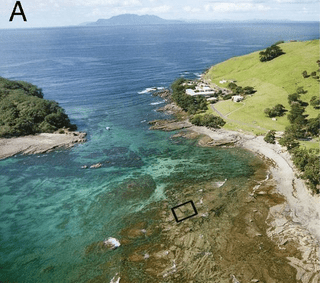
This 2015 Amsterdam/New Zealand/Cornell shore-life study found:

“Species abundances in natural ecosystems may never settle at a stable equilibrium.

Species in one of the world’s oldest marine reserves showed chaotic fluctuations for more than 20 years. The species replaced each other in cyclic order, yet the exact timing and abundances of the species were unpredictable.

Our findings provide a field demonstration of nonequilibrium coexistence of competing species through a cyclic succession at the edge of chaos.

Our findings show that natural ecosystems can sustain continued changes in species abundances.”

chaos

http://www.pnas.org/content/112/20/6389.full “Species fluctuations sustained by a cyclic succession at the edge of chaos”


The University of Amsterdam also participated in a 2013 study Evolution of microbial markets where evolutionary biologists studied microbes. Their related findings included:

“Cooperative interactions between individuals of different species.

Strategies important for microbes to optimize their success in potential biological markets:

  • (i) avoid bad trading partners;
  • (ii) build local business ties;
  • (iii) diversify or specialize;
  • (iv) become indispensable;
  • (v) save for a rainy day; and
  • (vi) eliminate the competition.”

A 2015 study How a well-adapted immune system is organized (the *.pdf file is linked because the html has errors) had a related finding that applied to our body’s immune system. The researchers found that the primary reason why each of our immune systems is unique is due to the effect of:

“Competition between receptor clones..NOT a biologically implausible centralized mechanism distributing resources system-wide.

The repertoire of lymphocyte receptors in the adaptive immune system protects organisms from diverse pathogens. A well-adapted repertoire should be tuned to the pathogenic environment to reduce the cost of infections.

Competitive dynamics can allow the immune repertoire to self-organize into a state that confers high protection against infections.”

Chaos and competition for resources are facts of life observed within ourselves and in nature from ocean life down to the microbe level.

Why are we often presented – as a fact of life – that what’s natural is for all aspects of our lives to be in balance? Emotional, economic, social, intellectual – you name it, we’re told that the natural model is one of “stable equilibrium.”


Two hypotheses of Dr. Arthur Janov’s Primal Therapy are relevant:

Trying for closure, though, becomes an act-out – a temporary fulfillment of a substitute need. But the underlying need remains unsatisfied, and soon drives further act-outs. Balance is never achieved.

With this viewpoint, can you see how behavior like the following shows the internal state of the actor as they attempt to thwart the natural reality of the situation?

  • A person in authority who demands that people cease their competition for a resource and instead, accept what the authority figure determines is fair and balanced. An example is limiting supplies with price controls after a disaster.
  • A person who disrupts cooperative behavior that provides a solution for the cooperators’ needs/wants and instead, interposes themselves in a directed solution. An example is requiring licenses for cooperative childcare.
  • A person who insists that peoples’ responses to chaos to form an optimal adaptation cease, and instead, conform to some other responses. An example is prohibiting free movement after a disaster.

It reveals even more about the internal states of people that the above examples become codified. Children are taught that the natural and solely acceptable way to behave is in accordance with these unnatural solutions.


There are some signs that unnatural solutions in society can be reversed. For example, here is a 2013 article about a UK village that benefited from removing all of its traffic signals and reverting to the natural order of human cooperation and competition.

At the individual level, though, it’s up to each one of us to recognize and reverse our unnatural states. We and the people around us will be pleased when we and they are no longer adversely affected by our unconscious act-outs that are driven by our internal states. There’s enough natural chaos without adding more with act-outs.

Our internal systems will suffer damage, for example, when our unconscious act-out is to be busy, always doing something, and we can’t relax. Stress adversely affects our internal systems until we understand and reverse the driving unnatural states.

Why is it so difficult to live your own life?

This 2015 Princeton/German study of fish schooling behavior reminded me of one of the difficulties an individual has in living a life of their own choosing. The study showed that the way social animals have evolved makes the individual likely to do what the group does.

Before looking at some details of the study, I’ll point out a natural pro and con of an individual going along with the crowd. A major survival advantage is that a predator won’t find it as easy to single out an individual from the group.

A major survival disadvantage is that a group is easily manipulated into a fate that each individual wouldn’t experience on their own. Here’s one instance of such an event:
Alfred Jacob Miller “Hunting buffalo” 1837

The difference in this study as compared with other literature on the subject was that there were a lot of equations presented:

“We demonstrate that we can predict complex cascades of behavioral change at their moment of initiation, before they actually occur.

Establishing the hidden communication networks in large self-organized groups facilitates a quantitative understanding of behavioral contagion.”

Does this sound like it could apply to humans?

“We define susceptibility as the likelihood of a fish responding given that it observes the initiator.

An individual will be more likely to respond (is more susceptible) if it:

  • Is strongly connected to the initiator (short path length), and
  • Has neighbors which are strongly connected to each other.

Shortest paths represent most probable paths.”

This passage definitely applied to humans:

“Such waves of evasion can spread extensively or may rapidly die out, resulting in a broad distribution of cascade magnitudes (number of responding individuals), a property shared with other spreading processes [e.g., neural activity, human communication].

In contrast to analyses of social contagion for online social networks, such as Twitter and Facebook, individuals’ proximity to the core of the network is not predictive of social influence.”


Schooling and herding behaviors are largely no longer needed for humans to survive in today’s world. However, these can be seen all day every day.

Why are such leftover behaviors still around? They are certainly misplaced from their original contexts.

The places and times in which these actions and reactions were relevant to survival have passed. They don’t make sense in other contexts in the present.

To lead to answers, purchase Dr. Arthur Janov’s 2011 book “Life Before Birth: The Hidden Script that Rules Our Lives” and read the passages listed in the index under the “survival” term. I’ll quote the beginning of a paragraph from page 52:

“What’s happening here is that the body, in the interest of survival, is continually reacting to imprinted memory..”

An individual may find it difficult to live a life of their own choosing due to external influences such as those presented in this study. There are also difficulties in living your own life that have other origins, as delineated by principles of Primal Therapy.

http://www.pnas.org/content/112/15/4690.full “Revealing the hidden networks of interaction in mobile animal groups allows prediction of complex behavioral contagion”