Observing pain in others had long-lasting brain effects

This 2016 Israeli human study used whole-head magnetoencephalography (MEG) to study pain perception in military veterans:

Our findings demonstrate alterations in pain perception following extreme pain exposure, chart the sequence from automatic to evaluative pain processing, and emphasize the importance of considering past experiences in studying the neural response to others’ states.

Differences in brain activation to ‘pain’ and ‘no pain’ in the PCC [posterior cingulate cortex] emerged only among controls. This suggests that prior exposure to extreme pain alters the typical brain response to pain by blurring the distinction between painful and otherwise identical but nonpainful stimuli, and that this blurring of the ‘pain effect’ stems from increased responses to ‘no pain’ rather than from attenuated response to pain.”


Limitations included:

  • “The pain-exposed participants showed posttraumatic symptoms, which may also be related to the observed alterations in the brain response to pain.
  • We did not include pain threshold measurements. However, the participants’ sensitivity to experienced pain may have had an effect on the processing of observed pain.
  • The regions of interest for the examination of pain processing in the pain-exposed group were defined on the basis of the results identified in the control group.
  • We did not detect pain-related activations in additional regions typically associated with pain perception, such as the anterior insula and ACC. This may be related to differences between the MEG and fMRI neuroimaging approaches.”

The subjects self-administered oxytocin or placebo per the study’s design. However:

“We chose to focus on the placebo condition and to test group differences at baseline only, in light of the recent criticism on underpowered oxytocin administration studies, and thus all following analyses are reported for the placebo condition.”


A few questions:

  1. If observing others’ pain caused “increased responses to ‘no pain’,” wouldn’t the same effect or more be expected from experiencing one’s own pain?
  2. If there’s evidence for item 1, then why aren’t “increased responses to ‘no pain'” of affected people overtly evident in everyday life?
  3. If item 2 is often observed, then what are the neurobiological consequences for affected people’s suppression of “increased responses to ‘no pain’?”
  4. Along with the effects of item 3, what may be behavioral, emotional, and other evidence of this suppressed pain effect?
  5. What would it take for affected people to regain a normal processing of others’ “‘pain’ and ‘no pain’?”

https://www.researchgate.net/publication/299546838_Prior_exposure_to_extreme_pain_alters_neural_response_to_pain_in_others “Prior exposure to extreme pain alters neural response to pain in others” Thanks to one of the authors, Ruth Feldman, for providing the full study

Oxytocin research null findings come out of the file drawer

In 2016 Belgian researchers released their previously unpublished studies:

“Is there a file drawer problem in intranasal oxytocin research?

We submitted several studies yielding null-findings to different journals but they were rejected time and time again.

The aggregated effect size was not reliably different from zero [including all of the researchers’ previously unpublished intranasal oxytocin studies].”

Neuroskeptic comments:

“By publishing these results, Lane et al. have ensured that future meta-analysts will be able to include the full dataset in their calculations.”

http://blogs.discovermagazine.com/neuroskeptic/2016/03/17/open-the-file-drawer/ “Psychologists Throw Open the File Drawer”

See Testing the null hypothesis of oxytocin’s effects in humans for more on the topic.


The current paradigm of child abuse limits pre-childhood causal research

As an adult, what would be your primary concern if you suspected that your early life had something to do with current problems? Would you be interested in effective treatments for causes of your symptoms?

Such information wasn’t available in this 2016 Miami review of the effects of child abuse. The review laid out the current paradigm mentioned in Grokking an Adverse Childhood Experiences (ACE) score, one that limits research into pre-childhood causes for later-life symptoms.

The review’s goal was to describe:

“How numerous clinical and basic studies have contributed to establish the now widely accepted idea that adverse early life experiences can elicit profound effects on the development and function of the nervous system.”

The hidden assumptions of almost all of the cited references were that these distant causes could no longer be addressed. Aren’t such assumptions testable today?

As an example, the Discussion section posed the top nine “most pressing unanswered questions related to the neurobiological effects of early life trauma.” In line with the current paradigm, the reviewer assigned “Are the biological consequences of ELS [early life stress] reversible?” into the sixth position.

If the current paradigm encouraged research into treatment of causes, there would probably already be plenty of evidence to demonstrate that directly reducing the source of damage would also reverse damaging effects. There would have been enough studies done so that the generalized question of reversibility wouldn’t be asked.

Aren’t people interested in treatments of originating causes so that their various symptoms don’t keep bubbling up? Why wouldn’t research paradigms be aligned accordingly?


The review also demonstrated how the current paradigm of child abuse misrepresented items like telomere length and oxytocin. Researchers on the bandwagon tend to forget about the principle Einstein expressed as:

“No amount of experimentation can ever prove me right; a single experiment can prove me wrong.”

That single experiment for telomere length arrived in 2016 with Using an epigenetic clock to distinguish cellular aging from senescence. The review’s seven citations for telomere length that all had findings “associated with” or “linked to” child abuse should now be viewed in a different light.

The same light shone on oxytocin with Testing the null hypothesis of oxytocin’s effects in humans and Oxytocin research null findings come out of the file drawer. See their references, and decide for yourself whether or not:

“Claimed research findings may often be simply accurate measures of the prevailing bias.”

http://www.cell.com/neuron/fulltext/S0896-6273%2816%2900020-9 “Paradise Lost: The Neurobiological and Clinical Consequences of Child Abuse and Neglect”


This post has somehow become a target for spammers, and I’ve disabled comments. Readers can comment on other posts and indicate that they want their comment to apply here, and I’ll re-enable comments.

The link between scientific value and content is broken at PNAS.org

Should we expect content posted on the Proceedings of the National Academy of Sciences of the United States of America to have scientific value?

This 2016 Singapore study was a “PNAS Direct Submission” that claimed:

“This paper makes a singular contribution to understanding the association between biological aging indexed by leukocyte telomeres length (LTL) and delay discounting measured in an incentivized behavioral economic task.

LTL is an emerging marker of aging at the cellular level, but little is known regarding its link with poor decision making that often entails being overly impatient.”


1. Whether measured at the level of a human or of a blood cell, in 2016 there wasn’t incontrovertible evidence to support:

  • “Biological aging indexed by leukocyte telomeres length
  • LTL is an emerging marker of aging at the cellular level”

Using an epigenetic clock to distinguish cellular aging from senescence found:

“Cellular ageing is distinct from cellular senescence and independent of DNA damage response and telomere length.”

If that study was too recent, the researchers and reviewer knew or should have known of studies such as this 2009 study that found the correlation between a person’s chronological age and blood cell telomere length was r = −0.51 in women and r = −0.55 in men.

2. A study of biological aging in young adults with limited findings was cited for evidence that “the seeds of biological aging are widely thought to be planted early in life.” That study didn’t elucidate the point, however, as it didn’t fully link its measurements of 38-year-old subjects with measurements taken during the subjects’ early lives.

F2.large

3. Problematic research with telomere length was cited for evidence that “other factors, such as the early family environment, lifestyle, and stress, also have considerable impact on cellular aging.” The researchers had to be willing to overlook that study’s multiple questionable practices in order to cite it as evidence for anything.

4. Deliberately overlooking abundant disconfirming evidence, the current study used a one-to-one correspondence of telomere length and cellular aging.


The researchers went on to speciously model a relationship between telomere length and the behavioral trait “poor decision making that often entails being overly impatient.” That overreach was further stretched to the breaking point:

“We then asked if genes possibly modulate the effect of impatient behavior on LTL.

The oxytocin receptor gene (OXTR) polymorphism rs53576, which has figured prominently in investigations of social cognition and psychological resources, and the estrogen receptor β gene (ESR2) polymorphism rs2978381, one of two gonadal sex hormone genes, significantly mitigate the negative effect of impatience on cellular aging in females.”

The “significantly mitigate” finding was “fun with numbers” that produced false effects rather than solid evidence. Consider that:

  1. The study’s model disregarded the probability that “Cellular ageing is independent of telomere length.”
  2. The researchers provided no mechanisms that plausibly linked performance “in an incentivized behavioral economic task” with telomere length.
  3. The researchers didn’t demonstrate any causal mechanisms whereby two gene variants plausibly affected the task performance’s purported effect on telomere length.

What’s the real reason this poor-quality paper’s reviewer forwarded it to PNAS.org?

http://www.pnas.org/content/113/10/2780.full “Delay discounting, genetic sensitivity, and leukocyte telomere length”

A problematic study of oxytocin receptor gene methylation, childhood abuse, and psychiatric symptoms

This 2016 Georgia human study found:

“A role for OXTR [oxytocin receptor gene] in understanding the influence of early environments on adult psychiatric symptoms.

Data on 18 OXTR CpG sites, 44 single nucleotide polymorphisms, childhood abuse, and adult depression and anxiety symptoms were assessed in 393 African American adults. The Childhood Trauma Questionnaire (CTQ), a retrospective self-report inventory, was used to assess physical, sexual, and emotional abuse during childhood.

While OXTR CpG methylation did not serve as a mediator to psychiatric symptoms, we did find that it served as a moderator for abuse and psychiatric symptoms.”

From the Limitations section:

  1. “Additional insight will likely be gained by including a more detailed assessment of abuse timing and type on the development of biological changes and adverse outcomes.
  2. The degree to which methylation remains fixed following sensitive developmental time periods, or continues to change in response to the environment, is still a topic of debate and is not fully known.
  3. Comparability between previous findings and our study is limited given different areas covered.
  4. Our study was limited to utilizing peripheral tissue [blood]. OXTR methylation should ideally be assessed in the tissues that are known to express OXTR and directly involved in psychiatric symptoms. The degree to which methylation of peripheral tissues can be used to study methylation changes in response to the environment or in association with behavioral outcomes is currently a topic of debate.
  5. Our study did not evaluate gene expression and thus cannot explore the role of study CpG sites on regulation and expression.”

Addressing the study’s limitations:

  1. Early-life epigenetic regulation of the oxytocin receptor gene demonstrated – with no hint of abuse – how sensitive an infant’s experience-dependent oxytocin receptor gene DNA methylation was to maternal care. Treating prenatal stress-related disorders with an oxytocin receptor agonist provided evidence for prenatal oxytocin receptor gene epigenetic changes.
  2. No human’s answers to the CTQ, Adverse Childhood Experiences, or other questionnaires will ever be accurate self-reports of their prenatal, infancy, and early childhood experiences. These early development periods were likely when the majority of the subjects’ oxytocin receptor gene DNA methylation took place. The CTQ self-reports were – at best – evidence of experiences at later times and places, distinct from earlier experience-dependent epigenetic changes.
  3. As one example of incomparability, the 2009 Genomic and epigenetic evidence for oxytocin receptor deficiency in autism was cited in the Introduction section and again in the Limitations section item 4. Since that study was sufficiently relevant to be used as a reference twice, the researchers needed to provide a map between its findings and the current study.
  4. Early-life epigenetic regulation of the oxytocin receptor gene answered the question of whether or not an individual’s blood could be used to make inferences about their brain oxytocin receptor gene DNA methylation. The evidence said: NO, it couldn’t.
  5. It’s assumed that oxytocin receptor gene DNA methylation directly impacted gene expression such that increased levels of methylation were associated with decreased gene transcription. The study assumed but didn’t provide evidence that higher levels of methylation indicated decreased ability to use available oxytocin due to decreased receptor expression. The study also had no control group.

To summarize the study’s limitations:

  1. The study zeroed in on childhood abuse, and disregarded evidence for more relevant factors determining an individual’s experience-dependent oxytocin receptor gene DNA methylation. That smelled like an agenda.
  2. The study used CTQ answers as determinants, although what happened during the subjects’ earliest life was likely when the majority of epigenetic changes to the oxytocin receptor gene took place. If links existed between the subjects’ early-life DNA methylation and later-life conditions, they weren’t evidenced by CTQ answers about later life that couldn’t self-report relevant experiences from conception through age three that may have caused DNA methylation.
  3. There was no attempt to make findings comparable with cited studies. That practice and the lack of a control group reminded me of Problematic research with telomere length.
  4. The researchers tortured numbers until they confessed “that CpG methylation may interact with abuse to predict psychiatric symptoms.” But there was no direct evidence that each subject’s blood oxytocin gene receptor DNA methylation interacted as such! Did the “may interact” phrase make the unevidenced inferences more plausible, or permit contrary evidence to be disregarded?
  5. See Testing the null hypothesis of oxytocin’s effects in humans for examples of what happens when researchers compound assumptions and unevidenced inferences.

The study’s institution, Emory University, and one of the study’s authors also conducted Conclusions without evidence regarding emotional memories. That 2015 study similarly disregarded relevant evidence from other research, and made statements that weren’t supported by that study’s evidence.

The current study used “a topic of debate” and other disclaimers to provide cover for unconvincing methods and analyses in pursuit of..what? What overriding goals were achieved? Who did the study really help?

http://onlinelibrary.wiley.com/enhanced/doi/10.1111/cdev.12493/ “Oxytocin Receptor Genetic and Epigenetic Variations: Association With Child Abuse and Adult Psychiatric Symptoms”


This post has somehow become a target for spammers, and I’ve disabled comments. Readers can comment on other posts and indicate that they want their comment to apply here, and I’ll re-enable comments.

Early-life epigenetic regulation of the oxytocin receptor gene

This 2015 US/Canadian rodent study investigated the effects of natural variation in maternal care:

“The effects of early life rearing experience via natural variation in maternal licking and grooming during the first week of life on behavior, physiology, gene expression, and epigenetic regulation of Oxtr [oxytocin receptor gene] across blood and brain tissues (mononucleocytes, hippocampus, striatum, and hypothalamus).

Rats reared by high licking-grooming (HL) and low licking-grooming (LL) rat dams exhibited differences across study outcomes:

  • LL offspring were more active in behavioral arenas,
  • Exhibited lower body mass in adulthood, and
  • Showed reduced corticosterone responsivity to a stressor.

Oxtr DNA methylation was significantly lower at multiple CpGs in the blood of LL versus HL males, but no differences were found in the brain. Across groups, Oxtr transcript levels in the hypothalamus were associated with reduced corticosterone secretion in response to stress, congruent with the role of oxytocin signaling in this region.

Methylation of specific CpGs at a high or low level was consistent across tissues, especially within the brain. However, individual variation in DNA methylation relative to these global patterns was not consistent across tissues.

These results suggest that:

  • Blood Oxtr DNA methylation may reflect early experience of maternal care, and
  • Oxtr methylation across tissues is highly concordant for specific CpGs, but
  • Inferences across tissues are not supported for individual variation in Oxtr methylation.

nonsignificance

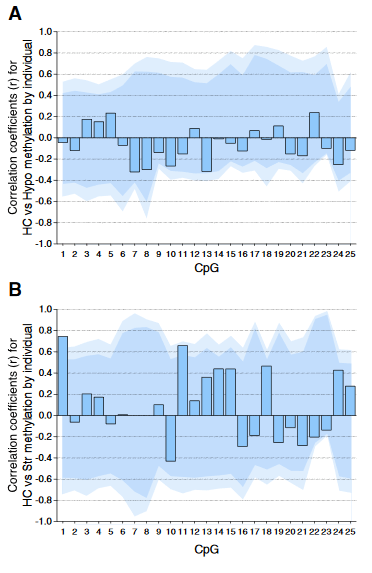
Individual DNA methylation values were not correlated across brain tissues, despite tissue concordance at the group level.

For each CpG, we computed the Pearson correlation coefficient r between methylation values for matched samples in pairs of brain regions (bars). Dark and light shaded regions represent 95% and 99% thresholds, respectively, of distributions of possible correlation coefficients determined from 10,000 permutations of the measured values among the individuals. These distributions represent the null hypothesis that an individual DNA methylation value in one brain region does not help to predict the value in another region in the same animal.

(A) Correlations based on pyrosequencing data for matched samples passing validation in both hippocampus (HC) and hypothalamus (Hypo). Correlations for individuals at each CpG were either weak (.2 < r < .3) or absent (r < .2), and none were significant, even prior to correction for multiple comparisons.

(B) Correlations for matched samples passing validation in both hippocampus and striatum (Str). Two correlations (CpG 1 and 11) were individually significant prior to but not following correction, and this result could be expected by chance.

Correlations between hippocampus and blood (described in the text) yielded similar results, and no particular CpG yielded consistently high correlation across multiple tissues.”


The study focused on whether or not an individual’s experience-dependent oxytocin receptor gene DNA methylation in one of the four studied tissues could be used to infer a significant effect in the three other tissues. The main finding was NO, it couldn’t!

The researchers’ other findings may have been strengthened had they also examined causes for the observed effects. The “natural variation in maternal licking and grooming” developed from somewhere, didn’t it?

The subjects’ mothers were presumably available for the same tests as the subjects, but nothing was done with them. Investigating at least one earlier generation may have enabled etiologic associations of “the effects of early life rearing experience” and “individual variation in DNA methylation.”

https://www.sciencedirect.com/science/article/abs/pii/S0018506X1500118X “Natural variation in maternal care and cross-tissue patterns of oxytocin receptor gene methylation in rats” (not freely available)

Does vasopressin increase mutually beneficial cooperation?

This 2016 German human study found:

“Intranasal administration of arginine vasopressin (AVP), a hormone that regulates mammalian social behaviors such as monogamy and aggression, increases humans’ tendency to engage in mutually beneficial cooperation.

AVP increases humans’ willingness to cooperate. That increase is not due to an increase in the general willingness to bear risks or to altruistically help others.”


One limitation of the study was that the subjects were all males, ages 19-32. The study’s title was “human risky cooperative behavior” while omitting subjects representing the majority of humanity.

Although the researchers claimed brain effects from vasopressin administration, they didn’t provide direct evidence for the internasally administered vasopressin in the subjects’ brains. A similar point was made about studies of vasopressin’s companion neuropeptide, oxytocin, in Testing the null hypothesis of oxytocin’s effects in humans.

A third limitation was that although the researchers correlated brain activity with social behaviors, they didn’t carry out all of the tests necessary to demonstrate the claimed “novel causal evidence for a biological factor underlying cooperation.” Per Confusion may be misinterpreted as altruism and prosocial behavior, the researchers additionally needed to:

“When attempting to measure social behaviors, it is not sufficient to merely record decisions with behavioral consequences and then infer social preferences. One also needs to manipulate these consequences to test whether this affects the behavior.”

http://www.pnas.org/content/113/8/2051.full “Vasopressin increases human risky cooperative behavior”

Treating prenatal stress-related disorders with an oxytocin receptor agonist

This 2015 French/Italian rodent study found:

“Chronic systemic treatment with carbetocin [unavailable in the US] in PRS [prenatally restraint stressed] rats corrected:

  • the defect in glutamate release,
  • anxiety– and depressive-like behavior,

and abnormalities:

  • in social behavior,
  • in the HPA response to stress, and
  • in the expression of stress-related genes in the hippocampus and amygdala.

These findings disclose a novel function of oxytocin receptors in the hippocampus, and encourage the use of oxytocin receptor agonists in the treatment of stress-related psychiatric disorders in adult life.”

carbetocin

The adult male subjects were:

“PRS rats..the offspring of dams exposed to repeated episodes of restraint stress during pregnancy.

These rats display anxiety- and depressive-like behaviors and show an excessive glucocorticoid response to acute stress, which is indicative of a dysregulation of the hypothalamus-pituitary-adrenal (HPA) axis caused by an impaired hippocampal glucocorticoid negative feedback.

PRS rats show a selective reduction in glutamate release in the ventral hippocampus.”

The researchers cited several other studies they have performed with the PRS phenotype. In the current study:

“Carbetocin treatment had no effect on these behavioral and neuroendocrine parameters in prenatally unstressed (control) rats, with the exception of a reduced expression of the oxytocin receptor gene in the amygdala.

Carbetocin displayed a robust therapeutic activity in PRS rats, but had no effect in unstressed rats, therefore discriminating between physiological and pathological conditions.”


The PRS phenotype showed the ease with which a child can be epigenetically changed – even before they’re born – to be less capable over their entire life. Just stress the pregnant mother-to-be.

https://www.sciencedirect.com/science/article/abs/pii/S0306453015002395 “Activation of presynaptic oxytocin receptors enhances glutamate release in the ventral hippocampus of prenatally restraint stressed rats” (not freely available) Thanks to coauthor Dr. Eleonora Gatta for providing the full study.

Testing the null hypothesis of oxytocin’s effects in humans

“There are so many reports of relationships between oxytocin and social behaviors. It is impossible that not a single one of these effects is real.

Isn’t it?

When running a battery of three tasks for every subject who underwent oxytocin treatment..finding false effects becomes almost guaranteed – over 90%.”

http://theneuroeconomist.com/2016/01/the-self-justification-molecule-how-have-we-accumulated-a-vast-behavioral-oxytocin-literature-for-over-a-decade/ “The self-justification molecule: how have we accumulated a vast behavioral oxytocin literature for over a decade”


From one of the references, Why Most Published Research Findings Are False:

“For many current scientific fields, claimed research findings may often be simply accurate measures of the prevailing bias.”


Also see the researcher’s response on their blog post Does oxytocin increase trust in humans? Frequently asked questions:

“Scientists publish only positive findings and not negative ones, and I cannot think of a single study in the vast human oxytocin literature that was replicated by an independent research group.”

Beliefs about medical treatments affected perceived stress

This 2015 New Zealand human study found:

“Placebo effects can be translated to a real-life setting in the short-term reduction of stress, anxiety and symptoms of depression in a non-patient population.

In treating psychological distress, placebos may be useful addition to the treatment repertoire.

The researchers provided a self-administered 3-day course of fake “anti-stress treatment spray” and told the participants the spray was either “oxytocin” or “serotonin” with these results:

“Both the ‘serotonin’ and ‘oxytocin’ treatment sprays were effective in reducing symptoms of depression; however, only those in the ‘oxytocin’ group reported less stress and anxiety as compared with controls. Overall, the ‘oxytocin’ was perceived as more effective.”


Will this study of non-patients be used to try to justify manipulating patients’ perceptions of their stress, anxiety, and depression?

http://anp.sagepub.com/content/early/2015/12/16/0004867415621390 “A take-home placebo treatment can reduce stress, anxiety and symptoms of depression in a non-patient population”

Leaky gates, anxiety, and grocery store trips without buying list items

An interview with Jeff Link, the editor of Dr. Arthur Janov’s 2011 book “Life Before Birth: The Hidden Script that Rules Our Lives” with Ken Rose:

“Even further confirmation for some of the views of Janov, that maybe weren’t widely accepted for a time, it’s new research now being done into memory and what a lot of scientist are seeing, a lot of different studies is that memory reactivates the same neuroimpulses that were initially firing off when the event happened.

So a traumatic event when you remember it, the act of remembering it is actually creating a neuromirror of what went on initially.

In a lot of ways that is what Primal Therapy is attempting to do; is to go back to that place and reconnect, or as it’s sometimes referred to, reconsolidate the brain state so that real healing can take place.”

Transcript (part 4 of 6): http://cigognenews.blogspot.com/2015/09/ken-rose-on-life-before-birth-part-46.html

MP3: http://www.pantedmonkey.org/podcastgen/download.php?filename=2011-12-15_1300_what_now_jeff_link.mp3

A mixed bag of findings about oxytocin, its receptor, and autism

This 2014 Stanford human study found:

“No empirical support for the OXT [oxytocin] deficit hypothesis of ASD [autism spectrum disorder], nor did plasma OXT concentrations differ by sex, OXTR [oxytocin receptor] SNPs [single nucleotide polymorphisms], or their interactions.”

Apparently, there was a:

“Prevalent but not well-interrogated OXT deficit hypothesis of ASD.”

The researchers followed up this worthwhile finding with three weak findings. The first, as stated by one of the study’s lead researchers, was:

“It didn’t matter if you were a typically developing child, a sibling or an individual with autism: Your social ability was related to a certain extent to your oxytocin levels.”

The second weak finding was that, regarding OXTR SNPs:

“The minor allele of rs2254298 predicted global social impairments on the SRS [Social Responsiveness Scale] and diagnostic severity on the ADI-R [Autism Diagnostic Interview-Revised]. In contrast, the major allele of rs53576 predicted impaired affect recognition performance on the NEPSY [A Developmental NEuroPSYchological Assessment].”

This was at odds with other relevant research, leading the researchers to state:

The functional significance of these two intronic variants remains unknown.”

The third weak finding irked me:

“Plasma OXT concentrations were highly heritable.”

because the researchers didn’t attempt to differentiate the contribution of the environment for the observed blood oxytocin levels, as did the similar How epigenetic DNA methylation of the oxytocin receptor gene affects the perception of anger and fear study.

I wonder what the reviewer’s feedback was about these weak findings. Did he make the researchers insert specific language into the lengthy paragraph about the study’s limitations, or did he give them a pass?

http://www.pnas.org/content/111/33/12258.full “Plasma oxytocin concentrations and OXTR polymorphisms predict social impairments in children with and without autism spectrum disorder”

A missed opportunity to research the oxytocin receptor gene and autism

This 2013 study:

“Examined whether genetic variants of the OXTR [oxytocin receptor] affect face recognition memory in families with an autistic child.

We investigated whether common polymorphisms in the genes encoding the oxytocin and vasopressin 1a receptors influence social memory for faces.”

I feel that the researchers missed an opportunity to improve their assessment of the autism-related genetic contribution to the study’s findings by separating the degree of environmental influence on the oxytocin receptor gene expression, as did the How epigenetic DNA methylation of the oxytocin receptor gene affects the perception of anger and fear study.

An assessment of epigenetic DNA methylation of the oxytocin receptor gene may have been even more compelling because the researchers genetically sampled one non-autistic sibling in each of the autistic children’s families. I hope the study’s samples are still available, because they may offer the possibility of evaluating the contribution of the autistic children’s historical environment with potential confirmation from their siblings.

Both studies gave their subjects similar facial emotion recognition tests, with the current one deriving from findings about autism, and the second from findings about the amygdala. The studies also had common references, such as a 2010 study, A common allele in the oxytocin receptor gene (OXTR) impacts prosocial temperament and human hypothalamic-limbic structure and function.

http://www.pnas.org/content/111/5/1987.full “Common polymorphism in the oxytocin receptor gene (OXTR) is associated with human social recognition skills”

Epigenetic DNA methylation and demethylation with the developing fetus

This extremely dense and informative 2014 UK summary study provided details about genomic imprinting:

“An unusual epigenetic process in that it is heritable and results in autosomal gene expression according to parent of origin.”

Several notes of interest:

  • Figure 3 had a fascinating sketch of how the fetus caused the mother’s hypothalamus to:

    “Determine forward maternal planning by directing/orchestrating maternal physiology and postnatal maternalism to synchronize with development of the fetus.”

  • Figure 4 followed up with a flowchart of how – with a female fetus – coexistence of three matrilineal generations in the pregnant female (her, the fetus, and the grandmother’s influence on the developing fetus’ ovarian oocytes) enabled intergenerational forward planning.
  • The study briefly noted significance of genomic imprinting on male sexual behavior, where, if processes didn’t proceed normally at this early stage of a male fetus’ development, could result in suboptimal adult behavior that didn’t change with experience.

F4.large

I’ll quote a few other unrelated passages that caught my eye.

“Reproductive success of mammals also places a considerable burden on matrilineal time and energy, with some 95% of mammalian female adult life committed to pregnancy, lactation, and maternal care.

Offspring that receive optimal nourishment and improved maternal care will be predisposed to develop a hypothalamus that is both genetically and epigenetically predisposed to this same type of good mothering.

The fetus controls its own destiny in times of acute starvation, especially in the last trimester of pregnancy, by short-term sacrifice of its placenta to preserve resources critical for brain development.”

http://www.pnas.org/content/112/22/6834.full “Genomic imprinting, action, and interaction of maternal and fetal genomes”


This post has somehow become a target for spammers, and I’ve disabled comments. Readers can comment on other posts and indicate that they want their comment to apply here, and I’ll re-enable comments.

Epigenetic DNA methylation of the oxytocin receptor gene affected the perception of anger and fear

This 2015 Virginia human study:

“Reveals how epigenetic variability in the endogenous oxytocin system impacts brain systems supporting social cognition and is an important step to better characterize relationships between genes, brain, and behavior.”

The researchers did a lot of things right:

  • They studied a priori selected brain areas, followed by whole brain analyses;
  • Their subjects were carefully selected

    “Because methylation levels have been shown to differ as a function of race, we restricted our sample to Caucasians of European descent”

    but they didn’t restrict subjects to the same gender;

  • They acknowledged as a limitation:

    “A lack of behavioral evidence to reveal how these epigenetic and neural markers impact the overt social phenotype.”


One thing on which I disagree with the researchers is their assessment of what needs to be done next. Their news release stated:

“When imagining the future possibilities and implications this DNA methylation and oxytocin receptor research may have, the investigators think a blood test could be developed in order to predict how an individual may behave in social situations.”

Nice idea, but the next step should be to complete the research. The next step is to develop evidence for how the oxytocin receptor gene became methylated.

The subjects had a wide range of DNA methylation at the studied gene site – from 33% to 72% methylated!

Why?

At the same gene site:

“There was a significant effect of sex such that females have a higher level of methylation than males.”

Why?

Given these significant effects, why was there no research into likely causes?

Aren’t early periods in people’s lives the most likely times when the “Epigenetic modification of the oxytocin receptor gene” that “influences the perception of anger and fear in the human brain” takes place?

Wouldn’t findings from research on the subjects’ histories potentially help other people?

http://www.pnas.org/content/112/11/3308.full “Epigenetic modification of the oxytocin receptor gene influences the perception of anger and fear in the human brain”