Early-life epigenetic regulation of the oxytocin receptor gene

This 2015 US/Canadian rodent study investigated the effects of natural variation in maternal care:

“The effects of early life rearing experience via natural variation in maternal licking and grooming during the first week of life on behavior, physiology, gene expression, and epigenetic regulation of Oxtr [oxytocin receptor gene] across blood and brain tissues (mononucleocytes, hippocampus, striatum, and hypothalamus).

Rats reared by high licking-grooming (HL) and low licking-grooming (LL) rat dams exhibited differences across study outcomes:

  • LL offspring were more active in behavioral arenas,
  • Exhibited lower body mass in adulthood, and
  • Showed reduced corticosterone responsivity to a stressor.

Oxtr DNA methylation was significantly lower at multiple CpGs in the blood of LL versus HL males, but no differences were found in the brain. Across groups, Oxtr transcript levels in the hypothalamus were associated with reduced corticosterone secretion in response to stress, congruent with the role of oxytocin signaling in this region.

Methylation of specific CpGs at a high or low level was consistent across tissues, especially within the brain. However, individual variation in DNA methylation relative to these global patterns was not consistent across tissues.

These results suggest that:

  • Blood Oxtr DNA methylation may reflect early experience of maternal care, and
  • Oxtr methylation across tissues is highly concordant for specific CpGs, but
  • Inferences across tissues are not supported for individual variation in Oxtr methylation.
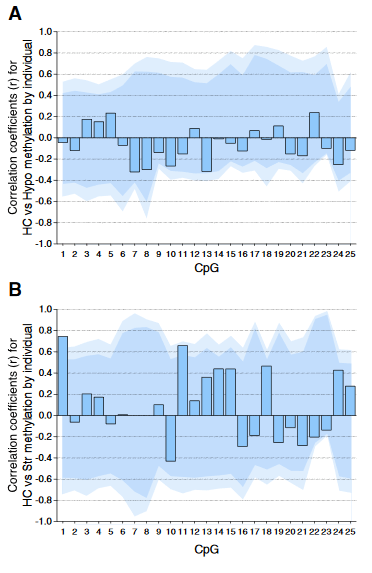
nonsignificance

Individual DNA methylation values were not correlated across brain tissues, despite tissue concordance at the group level.

For each CpG, we computed the Pearson correlation coefficient r between methylation values for matched samples in pairs of brain regions (bars). Dark and light shaded regions represent 95% and 99% thresholds, respectively, of distributions of possible correlation coefficients determined from 10,000 permutations of the measured values among the individuals. These distributions represent the null hypothesis that an individual DNA methylation value in one brain region does not help to predict the value in another region in the same animal.

(A) Correlations based on pyrosequencing data for matched samples passing validation in both hippocampus (HC) and hypothalamus (Hypo). Correlations for individuals at each CpG were either weak (.2 < r < .3) or absent (r < .2), and none were significant, even prior to correction for multiple comparisons.

(B) Correlations for matched samples passing validation in both hippocampus and striatum (Str). Two correlations (CpG 1 and 11) were individually significant prior to but not following correction, and this result could be expected by chance.

Correlations between hippocampus and blood (described in the text) yielded similar results, and no particular CpG yielded consistently high correlation across multiple tissues.”


The study focused on whether or not an individual’s experience-dependent oxytocin receptor gene DNA methylation in one of the four studied tissues could be used to infer a significant effect in the three other tissues. The main finding was NO, it couldn’t!

The researchers’ other findings may have been strengthened had they also examined causes for the observed effects. The “natural variation in maternal licking and grooming” developed from somewhere, didn’t it?

The subjects’ mothers were presumably available for the same tests as the subjects, but nothing was done with them. Investigating at least one earlier generation may have enabled etiologic associations of “the effects of early life rearing experience” and “individual variation in DNA methylation.”

https://www.sciencedirect.com/science/article/abs/pii/S0018506X1500118X “Natural variation in maternal care and cross-tissue patterns of oxytocin receptor gene methylation in rats” (not freely available)

The effects of imposing helplessness

This 2016 New York rodent study found:

“By using unbiased and whole-brain imaging techniques, we uncover a number of cortical and subcortical brain structures that have lower activity in the animals showing helplessness than in those showing resilience following the LH [learned helplessness] procedure. We also identified the LC [locus coeruleus] as the sole subcortical area that had enhanced activity in helpless animals compared with resilient ones.

Some of the brain areas identified in this study – such as areas in the mPFC [medial prefrontal cortex], hippocampus, and amygdala – have been previously implicated in clinical depression or depression-like behavior in animal models. We also identified novel brain regions previously not associated with helplessness. For example, the OT [olfactory tubercle], an area involved in odor processing as well as high cognitive functions including reward processing, and the Edinger–Westphal nucleus containing centrally projecting neurons implicated in stress adaptation.

The brains of helpless animals are locked in a highly stereotypic pathological state.”

Concerning the study’s young adult male subjects:

“To achieve a subsequent detection of neuronal activity related to distinct behavioral responses, we used the c-fosGFP transgenic mice expressing c-FosGFP under the control of a c-fos promoter. The expression of the c-fosGFP transgene has been previously validated to faithfully represent endogenous c-fos expression.

Similar to wild-type mice, approximately 22% (32 of 144) of the c-fosGFP mice showed helplessness.”

The final sentence of the Introduction section:

“Our study..supports the view that defining neuronal circuits underlying stress-induced depression-like behavior in animal models can help identify new targets for the treatment of depression.”


Helplessness is both a learned behavior and a cumulative set of experiences during every human’s early life. Therapeutic approaches to detrimental effects of helplessness can be different with humans than with rodents in that we can address causes.

The researchers categorized activity in brain circuits as causal in the Discussion section:

“Future studies aimed at manipulating these identified neural changes are required for determining whether they are causally related to the expression of helplessness or resilience.”

Studying whether or not activity in brain circuits induces helplessness in rodents may not inform us about causes of helplessness in humans. Our experiences are often the ultimate causes of helplessness effects. Many of our experiential “neural changes” are only effects, as demonstrated by this and other studies’ induced phenotypes such as “Learned Helplessness” and “Prenatally Restraint Stressed.”

Weren’t the researchers satisfied that the study confirmed what was known and made new findings? Why attempt to extend animal models that only treat effects to humans, as implied in the Introduction above and in the final sentence of the Discussion section:

“Future studies aimed at elucidating the specific roles of these regions in the pathophysiology of depression as well as serve as neural circuit-based targets for the development of novel therapeutics.”

http://journal.frontiersin.org/article/10.3389/fncir.2016.00003/full “Whole-Brain Mapping of Neuronal Activity in the Learned Helplessness Model of Depression” (Thanks to A Paper a Day Keeps the Scientist Okay)

Advance science by including emotion in research

This 2015 analysis of emotion studies found:

“Emotion categories [fear, anger, disgust, sadness, and happiness] are not contained within any one region or system, but are represented as configurations across multiple brain networks.

For example, among other systems, information diagnostic of emotion category was found in both large, multi-functional cortical networks and in the thalamus, a small region composed of functionally dedicated sub-nuclei.

The dataset consists of activation foci from 397 fMRI and PET [positron emission tomography] studies of emotion published between 1990 and 2011.”

From the fascinating Limitations section:

“Our analyses reflect the composition of the studies available in the literature, and are subject to testing and reporting biases on the part of authors. This is particularly true for the amygdala (e.g., the activation intensity for negative emotions may be over-represented in the amygdala given the theoretical focus on fear and related negative states). Other interesting distinctions were encoded in the thalamus and cerebellum, which have not received the theoretical attention that the amygdala has and are likely to be bias-free.

Some regions—particularly the brainstem—are likely to be much more important for understanding and diagnosing emotion than is apparent in our findings, because neuroimaging methods are only now beginning to focus on the brainstem with sufficient spatial resolution and artifact-suppression techniques.

We should not be too quick to dismiss findings in ‘sensory processing’ areas, etc., as methodological artifacts. Emotional responses may be inherently linked to changes in sensory and motor cortical processes that contribute to the emotional response.

The results we present here provide a co-activation based view of emotion representation. Much of the information processing in the brain that creates co-activation may not relate to direct neural connectivity at all, but rather to diffuse modulatory actions (e.g., dopamine and neuropeptide release, much of which is extrasynaptic and results in volume transmission). Thus, the present results do not imply direct neural connectivity, and may be related to diffuse neuromodulatory actions as well as direct neural communication.”


Why did the researchers use only 397 fMRI and PET studies? Why weren’t there tens or hundreds of times more candidate studies from which to select?

The relative paucity of candidate emotion studies demonstrated the prevalence of other researchers’ biases for cortical brain areas. The lead researcher of the current study was a coauthor of the 2016 Empathy, value, pain, control: Psychological functions of the human striatum, whose researchers mentioned that even their analyses of 5,809 human imaging studies was hampered by other imaging-studies researchers’ cortical biases.

Functional MRI signals depend on the changes in blood flow that follow changes in brain activity. Study designers intentionally limit their findings when they scan brain areas and circuits that are possibly activated by human emotions, yet exclude emotional content that may activate these areas and circuits.

Here are a few examples of limited designs that led to limited findings when there was the potential for so much more:

It’s well past time to change these practices now in the current year.


This study provided many methodological tests that should be helpful for research that includes emotion. It showed that there aren’t impenetrable barriers – other than popular memes, beliefs, and ingrained dogmas – to including emotional content in studies.

Including emotional content may often be appropriate and informative, with the resultant findings advancing science. Here are a few recent studies that did so:

http://journals.plos.org/ploscompbiol/article?id=10.1371%2Fjournal.pcbi.1004066 “A Bayesian Model of Category-Specific Emotional Brain Responses”

Lifelong effects of stress

A 2016 commentary A trilogy of glucocorticoid receptor actions that included two 2015 French rodent studies started out:

Glucocorticoids (GCs) belong to a class of endogenous, stress-stimulated steroid hormones. They have wide ranging physiologic effects capable of impacting metabolism, immunity, development, stress, cognition, and arousal.

GCs exert their cellular effects by binding to the GC receptor (GR), one of a 48-member (in humans) nuclear receptor superfamily of ligand-activated transcription factors.”

The French studies were exceedingly technical. The first GR SUMOylation and formation of an SUMO-SMRT/NCoR1-HDAC3 repressing complex is mandatory for GC-induced IR nGRE-mediated transrepression:

“GCs acting through binding to the GR are peripheral effectors of circadian and stress-related homeostatic functions fundamental for survival.

Unveils, at the molecular level, the mechanisms that underlie the GC-induced GR direct transrepression function mediated by the evolutionary conserved inverted repeated negative response element. This knowledge paves the way to the elucidation of the functions of the GR at the submolecular levels and to the future educated design and screening of drugs, which could be devoid of undesirable debilitating effects on prolonged GC therapy.”

The companion study Glucocorticoid-induced tethered transrepression requires SUMOylation of GR and formation of a SUMO-SMRT/NCoR1-HDAC3 repressing complex stated:

“GCs have been widely used to combat inflammatory and allergic disorders. However, multiple severe undesirable side effects associated with long-term GC treatments, as well as induction of glucocorticoid resistance associated with such treatments, limit their therapeutic usefulness.”

Even when researchers study causes, they often justify their efforts in terms of outcomes that address effects. Is an etiologic advancement in science somehow unsatisfactory in and of itself?


Once in a while I get a series of personal revelations while reading scientific publications. Paradoxically, understanding aspects of myself has seldom been sufficient to address historical problems.

Thoughts are only where some of the effects of problems show up, and clarifying my understanding can – at most – tamp down these effects. The causes are elsewhere, and addressing them at the source is what ultimately needs to happen.

A few glucocorticoid-related items to ponder:

  • How has stress impacted my life? When and where did it start?
  • Why do I feel wonderful after taking prednisone or other anti-inflammatories? What may be the originating causes of such effects?
  • Why have prolonged periods of my life been characterized by muted responses to stress? How did I get that way?
  • Have I really understood why I’ve reflexively put myself into stressful situations? What will break me out of that habit?
  • Why do the feelings I experience while under stressful situations feel familiar? Does my unconsciousness of their origins have something to do with “homeostatic functions fundamental for survival?”
  • Why haven’t I noticed that symptoms of stress keep showing up in my life? There are “physiologic effects capable of impacting metabolism, immunity,” etc. but I don’t do something about it?
  • How else may stress impact my biology? Brain functioning? Ideas and beliefs? Behavior?

State-dependent brain functions and adrenaline

This 2015 German/Italian rodent study investigated:

“How a specific neuromodulatory input may influence the information content and the readout of cortical information representations of sensory stimuli.

The locus coeruleus (LC) is a brainstem neuromodulatory nucleus that likely plays a prominent role in shaping cortical states via a highly distributed noradrenaline release in the forebrain. In particular, the LC:

  • Contributes to regulation of arousal and sleep;
  • Is involved in cognitive functions such as vigilance, attention, and selective sensory processing; and
  • Modulates cortical sensory responses and cortical excitability.

An important addition of our work to previous models of state dependence was the inclusion of the contribution of an important neuromodulator – the noradrenergic system. Our results support the hypothesis that the temporal structure of LC firing causally influences cortical dynamics.

Our work highlights the importance of timing of LC burst: suitably timed LC burst (for example, triggered by an alerting stimulus) can very rapidly trigger transitions into excitable cortical states, which in turn decrease the threshold for cortical responses and thus dynamically facilitate the processing of salient or attended events.

State dependence may either:

  • Force neurons to transmit information only using codes that are robust to state fluctuations (e.g., relative firing rates), or may
  • Force downstream neurons to gain information about the state of the networks sending the sensory messages and then to use the knowledge of state to properly interpret neural responses.

Our results suggest that the latter information transmission scheme is feasible, because detecting state by either monitoring the dynamics of cortical ongoing activity alone or by also monitoring the dynamics of noradrenergic modulation substantially increased the amount of information about sensory stimuli in the late response components relevant for behavior.”

The study added to the evidence that state dependencies can’t be overlooked in explanations of brain function and resultant physical and mental activity. Locus coeruleus neural activity “can very rapidly trigger transitions into excitable cortical states..and thus dynamically facilitate the processing of salient or attended events.”

Adrenaline from the locus coeruleus produced a state of arousal in multiple brain and body areas tied into the subjects’ sympathetic nervous systems. Such internal state changes may be accompanied by state-dependent memories, following the findings of What can cause memories that are accessible only when returning to the original brain state?

The study highlighted the capability of a lower brain structure to influence other brain areas. Its findings should inform researchers in attention and behavior studies, especially when investigating causes of attention and behavior difficulties.

http://www.pnas.org/content/112/41/12834.full “Modeling the effect of locus coeruleus firing on cortical state dynamics and single-trial sensory processing”

The cerebellum’s role in human behavior and emotions

This 2016 Italian human review considered the lower brain’s contributions to an individual’s behavior and temperament:

“In evidencing associations between personality factors and neurobiological measures, it seems evident that the cerebellum has not been up to now thought as having a key role in personality.

Cerebellar volumes correlate positively with novelty seeking scores and negatively with harm avoidance scores. Subjects who search for new situations as a novelty seeker does (and a harm avoiding does not do) show a different engagement of their cerebellar circuitries in order to rapidly adapt to changing environments.

Cerebellar abilities in planning, controlling, and putting into action the behavior are associated to normal or abnormal personality constructs. In this framework, it is worth reporting that increased cerebellar volumes are even associated with high scores in alexithymia, construct of personality characterized by impairment in cognitive, emotional, and affective processing.”

The full paper wasn’t freely available, but a list of the 173 references was. 17 references were of alexithymia, also mentioned in the title.


One freely available reference was The embodied emotion in cerebellum: a neuroimaging study of alexithymia, a 2014 study performed by these same authors, which found:

“Alexithymia scores were linked directly with cerebellar areas and inversely with limbic and para-limbic system, proposing a possible functional modality for the cerebellar involvement in emotional processing.

The increased volumes in Crus 1 of subjects with high alexithymic traits may be related to an altered embodiment process leading to not-cognitively interpreted emotions.”

“Alexithymia scores” referred to one of the methods used to characterize alexithymia symptoms, self-reported answers to questionnaires such as this one. Sample questions from the questionnaire used by the referenced study are:

  • “I am often confused about what emotion I am feeling
  • It is difficult for me to reveal my innermost feelings, even to close friends”

The questionnaire mainly engages a person’s cerebrum. The person may recall emotions, and form ideas as framed by each question. Then they’ll describe these ideas in terms of a scaled answer.

Cerebral answers may provide historical contexts for feelings. However, the person’s cerebellum and other brain areas aren’t necessarily engaged by the diagnostic questionnaire.

Without this engagement, the person may not experience feelings when providing answers about feelings. The answers may be more along the lines of “This is what I think I should be feeling” or “This is what I think I should tell the researchers about what I think I should feel.”


  • Can a questionnaire accurately determine associations among engaged and unengaged brain areas?
  • What can be done regarding “impairment in cognitive, emotional, and affective processing?”
  • What’s the lower brain’s “involvement in emotional processing?”
  • How does the lower brain shape a person’s behavior and traits?
  • When and where in an individual’s lifespan does their cerebellum develop?

http://link.springer.com/article/10.1007/s12311-015-0754-9 “Viewing the Personality Traits Through a Cerebellar Lens: a Focus on the Constructs of Novelty Seeking, Harm Avoidance, and Alexithymia”

A problematic study of beliefs and dopamine

This 2015 Virginia Tech human study found:

“Dopamine fluctuations encode an integration of RPEs [reward prediction errors, the difference between actual and expected outcomes] with counterfactual prediction errors, the latter defined by how much better or worse the experienced outcome could have been.

How dopamine fluctuations combine the actual and counterfactual is unknown.”

From the study’s news coverage:

“The idea that “what could have been” is part of how people evaluate actual outcomes is not new. But no one expected that dopamine would be doing the job of combining this information in the human brain.”

Some caveats applied:

  • Measurements of dopamine were taken only from basal ganglia areas. These may not act the same as dopamine processes in other brain and nervous system areas.
  • The number of subjects was small (17), they all had Parkinson’s disease, and the experiment’s electrodes accompanied deep brain stimulation implantations.
  • Because there was no control group, findings of a study performed on a sample of people who all had dysfunctional brains and who were all being treated for neurodegenerative disease may not apply to a population of people who weren’t similarly afflicted.

The researchers didn’t provide evidence for the Significance section statement:

“The observed compositional encoding of “actual” and “possible” is consistent with how one should “feel” and may be one example of how the human brain translates computations over experience to embodied states of subjective feeling.”

The subjects weren’t asked for corroborating evidence about their feelings. Evidence for “embodied states of subjective feeling” wasn’t otherwise measured in studied brain areas. The primary argument for “embodied states of subjective feeling” was the second paragraph of the Discussion section where the researchers talked about their model and how they thought it incorporated what people should feel.

The study’s experimental evidence didn’t support the researchers’ assertion – allowed by the reviewer – that the study demonstrated something about “states of subjective feeling.” That the model inferred such “findings” along with the researchers’ statement that it “is consistent with how one should “feel” reminded me of a warning in The function of the dorsal ACC is to monitor pain in survival contexts:

“The more general message you should take away from this is that it’s probably a bad idea to infer any particular process on the basis of observed activity.”


The same researcher who hyped An agenda-driven study on beliefs, smoking and addiction that found nothing of substance was back again with statements such as:

“These precise, real-time measurements of dopamine-encoded events in the living human brain will help us understand the mechanisms of decision-making in health and disease.”

It’s likely that repeated hubris is one way researchers respond to their own history and feelings, such as their need to feel important as mentioned on my Welcome page.

The Parkinson’s patients were willing to become lab rats with extra electrodes that accompanied brain implantations to relieve their symptoms. Findings based on their playing a stock market game didn’t inform us about “mechanisms of decision-making in health and disease” in unafflicted humans. As one counter example, what evidence did the study provide that’s relevant to healthy humans’ decisions to remain healthy by taking actions to prevent disease?

The unwarranted extrapolations revealed a belief that the goal of research should be to explain human actions by explaining the actions of molecules. One problem caused by the preconceptions of this widespread belief is that it leads to study designs and models that omit relevant etiologic evidence embedded in each of the subjects’ historical experiences.

This belief may have factored into why the subjects weren’t asked about their feelings. Why didn’t the study’s design consider as relevant subject-provided evidence for feelings? Because the model already contrived explanations for feelings underlying the subjects’ actions.

http://www.pnas.org/content/113/1/200.full “Subsecond dopamine fluctuations in human striatum encode superposed error signals about actual and counterfactual reward”

A problematic study of DNA methylation in frontal cortex development and schizophrenia

This 2015 Baltimore human study found:

CpGs that differ between schizophrenia patients and controls that were enriched for genes related to development and neurodifferentiation.

The schizophrenia-associated CpGs strongly correlate with changes related to the prenatal-postnatal transition and show slight enrichment for GWAS [genome-wide association study] risk loci while not corresponding to CpGs differentiating adolescence from later adult life.

Only a fraction of the illness-associated CpGs, 4.6%, showed association to nearby genetic variants in the meQTL [methylation quantitative trait loci] analysis, further suggesting that these findings may be more related to the epiphenomena of the illness state than to the genetic causes of the disorder.

These data implicate an epigenetic component to the developmental origins of this disorder.”

It wasn’t surprising in 2015 to find “an epigenetic component to the developmental origins of this disorder.” From the supplementary material:

“Diverse chromatin states suggest vastly different epigenetic landscapes of the prenatal versus postnatal human brain.

Approximately half of the CpGs had DNAm [DNA methylation] levels positively correlated with expression across the lifespan, and half had DNAm levels negatively correlated.

These results suggest that many of the epigenetic changes occurring between prenatal and postnatal life in prefrontal cortex manifest in the transcriptome, and that the directionality of association is not strictly linked to the location of the CpG or DMR [differentially methylated region] with respect to an annotated gene.

Diagnosis-associated CpGs were relatively small compared with those differentially methylated between fetal and postnatal samples.”


The studied brain area was limited to the dorsolateral portion of the prefrontal cortex, which isn’t mature in humans until we’re in our late teens/early twenties.

The researchers ignored brain areas that were fully developed or further along in development – such as the limbic system – during “the prenatal-postnatal transition.”

The researchers intentionally blinded themselves from discovering “many of the epigenetic changes occurring between prenatal and postnatal life” possibly associated with schizophrenia and these more-developed brain areas.

Where’s the evidence that the developmental origins of schizophrenia have no associations with brain structures whose development closely approximates their lifelong functionalities at birth?


The study’s limitations didn’t hamper researcher hubris in a press release for a site that touts business news, such as:

“This conclusion, while perhaps not the final verdict on the subject, is hard to resist given this remarkable evidence”

Did the spokesperson really understand GWAS? Or was he trying to exploit public ignorance of GWAS?

There’s a scientist’s view of GWAS at What do GWAS signals mean? that better puts this study’s findings into perspective. When understanding GWAS at an individual level, it should also be acknowledged that Genetic statistics don’t necessarily predict the effects of an individual’s genes.

http://www.nature.com/neuro/journal/vaop/ncurrent/full/nn.4181.html “Mapping DNA methylation across development, genotype and schizophrenia in the human frontal cortex” (not freely available). Use the full study link from the above-mentioned press release.

Trapped, suffocating, unable to move – a Primal imprint

“The malady of needing to move constantly: organizing trips, making reasons to go here and there, and in general, keeping on the move..below all that movement is a giant, silent scream.

The price we pay is never knowing our feelings or where they come from.

We have the mechanism for our own liberation inside of us, if we only knew it.

When we see constant motion we understand, but we never see the agony. Why no agony? Because it is busy being acted-out to relieve the agony before it is fully felt.”

http://cigognenews.blogspot.com/2015/11/epigenetics-and-primal-therapy-cure-for_30.html “The Miracle of Memory – Epigenetics and Primal Therapy: The Cure for Neurosis (Part 13/20)”

A review of the epigenetic basis for mental illness

This 2015 New York combined animal and human review of epigenetic studies noted:

“While genetic factors are important in the etiology of most mental disorders, the relatively high rates of discordance among identical twins, particularly for depression and other stress-related syndromes, clearly indicate the importance of additional mechanisms.

Environmental factors such as stress are known to play a role in the onset of these illnesses.

Exposure to such environmental insults induces stable changes in gene expression, neural circuit function, and ultimately behavior, and these maladaptations appear distinct between developmental versus adult exposures.

Increasing evidence indicates that these sustained abnormalities are maintained by epigenetic modifications in specific brain regions.”

Placing the “maladaptations” and “sustained abnormalities” phrases into their contexts:

  • A fetus biologically adapted to their environment – however toxic it was – in order to best survive.
  • These adaptations for survival were subsequently viewed as Disrupted Neurodevelopment and “maladaptations” from the perspectives of normal development and environments.
  • The “sustained abnormalities” caused within the earlier environments “are maintained by epigenetic modifications.” An improved environment wasn’t impetus enough to change developmental “maladaptations.”

Per the below link, it’s been a month since this review was published. Why has there been ZERO news coverage of it?

One reason may be that the Friedman Brain Institute, Icahn School of Medicine at Mount Sinai, didn’t issue a press release or otherwise publicize it. Another reason may be the groups that are opposed to its findings:

  • Parents who provided harmful environments for their children, beginning at conception;
  • People who feel threatened when scientific causal evidence resonates with what happened in their own lives, and in response, limit their empathetic understanding of others’ problems;
  • Social workers, psychologists, and others in industries whose paychecks depend on efforts that aren’t directed towards ameliorating the causes for these later-life effects;
  • Psychiatrists and medical personnel whose livelihoods depend on pharmaceutical and other treatments that only alleviate symptoms;
  • Researchers whose funding depends on producing non-etiologic findings.

Despite resistance to this review’s findings, a large number of people would benefit from publicizing evidence for:

“These sustained abnormalities are maintained by epigenetic modifications in specific brain regions.”

http://nro.sagepub.com/content/early/2015/09/24/1073858415608147 “Epigenetic Basis of Mental Illness”

Leaky gates, anxiety, and grocery store trips without buying list items

An interview with Jeff Link, the editor of Dr. Arthur Janov’s 2011 book “Life Before Birth: The Hidden Script that Rules Our Lives” with Ken Rose:

“Even further confirmation for some of the views of Janov, that maybe weren’t widely accepted for a time, it’s new research now being done into memory and what a lot of scientist are seeing, a lot of different studies is that memory reactivates the same neuroimpulses that were initially firing off when the event happened.

So a traumatic event when you remember it, the act of remembering it is actually creating a neuromirror of what went on initially.

In a lot of ways that is what Primal Therapy is attempting to do; is to go back to that place and reconnect, or as it’s sometimes referred to, reconsolidate the brain state so that real healing can take place.”

Transcript (part 4 of 6): http://cigognenews.blogspot.com/2015/09/ken-rose-on-life-before-birth-part-46.html

MP3: http://www.pantedmonkey.org/podcastgen/download.php?filename=2011-12-15_1300_what_now_jeff_link.mp3

Reflections on my four-year anniversary of spine surgery

At age 55, I found out that I’d suffered for maybe 45 to 50 years from a childhood injury, and I didn’t know anything about it. It still seems unbelievable to me that I was physically ill for decades before I received a diagnosis.

As explained to me by two surgeons, the cause of my spondylolisthesis between L5 and S1 was a sudden injury sometime between ages 5 and 10. Here’s a further explanation:

“In children, spondylolisthesis usually occurs between the fifth bone in the lower back (lumbar vertebra) and the first bone in the sacrum (pelvis) area. It is often due to a birth defect in that area of the spine or sudden injury (acute trauma).

Other causes of spondylolisthesis include bone diseases, traumatic fractures, and stress fractures (commonly seen in gymnasts). Certain sport activities, such as gymnastics, weight lifting, and football, put a great deal of stress on the bones in the lower back. They also require that the athlete constantly overstretch (hyperextend) the spine.”

I played a lot of baseball when I was a kid growing up in Miami. I didn’t suffer from a birth defect or bone disease, play football before I was a teenager, do gymnastics, or lift weights.

I don’t remember a specific “sudden injury (acute trauma)” per the above explanation. Maybe I incurred the acute trauma that started my spondylolisthesis sliding into bases playing baseball. Maybe I incurred it playing in the other rough-and-tumble activities that I did as a boy.


Please stop at the first hint of any pain that you feel while reading the rest of this post. I don’t want to cause you pain.

I re-experienced while in Primal Therapy a day when I was seven or eight years old. A most exhilarating day, one that filled me with light and joy.

What brought on my elevated mood? It was the day I finally ran faster than my father did, and he couldn’t catch me to give me a beating as I ran out of the house.

My father never beat me on the sidewalk, the street, or the front yard anyway. That would make the abuse public.

My father’s job was assistant principal/dean of boys at West Miami Junior High School. He whipped boys with a thick belt or paddled them daily as part of his job requirements.

My father kept a wooden paddle with holes in it at home. For me.

I don’t remember that my three siblings ever received a paddling or belting, although they were spanked. I’ve remembered while in Primal Therapy that my younger sister and brother were spanked for crying.

I re-experienced the dread of waiting (in an exact place with visual details), waiting for my father to come home to administer a spanking or belting or paddling to me for some “transgression” my mother observed. She had dozens of rules of conduct for her children.

I re-experienced my early childhood feelings that my father’s punishments depended more on my mother’s mood than on what I did.

I re-experienced my early childhood feelings that I didn’t deserve the beatings. I didn’t deserve any beatings, not one!

My father continued, though, until I was around age 11 or so. I’m sure that the beatings were a factor in how I felt at age 12:

Suicidal. Needing to escape from my life.

When I was a child, I needed my parents’ love.

I re-experienced many times while in Primal Therapy the overwhelming hopelessness, helplessness, worthlessness, and betrayal when the people I needed to love me were cruel to me instead.


My parents knew what they did was wrong. Neither one of them ever told me that, though.

My father never apologized for beating me so much before he died 19 years ago. Even before he retired, 17 years before he died, the Miami-Dade County public school system stopped him and the rest of their employees from spanking, whipping, beating, and paddling children.

What could he even tell me to take away those experiences?

  • That he beat me as a child because he himself was beaten as a child?
  • That he couldn’t help it?
  • That how he and my mother frequently went out of their way to help me along in life after my childhood somehow made up for the beatings?

I’m certain that my father was beaten as a child. I bring this up not as a defense for what he did, but as part of my history, too.

It wasn’t enough for my father’s mother to beat me while she was babysitting my siblings and me at our parents’ house. I re-experienced crying as a five-year old when I was required to go cut off palm fronds from the tree in front of our house for her to use as a switch, and bring them to her.

It was a mark of my grandmother’s cruelty that she threatened to beat me with a broom handle when I tried to not participate in my own torment. I re-experienced exact places of my legs where she switched me with the palm fronds, giving me even more when I cried during the punishment.


These wounds left scars that haven’t gone away.

Run your hand down your spine until you reach the top of your sacrum. That’s the area on which I had surgery four years ago, where I now have a titanium cage, replacement disc, and two rods to keep the area stable.

I received a lot of beatings pretty close to that area. Maybe my boyhood activities didn’t cause the “sudden injury (acute trauma).”


I write frankly about my parents because that’s my history: the realities of who they were.

And the realities of who I needed them to be.

I express it because getting well has to address reality.

From Dr. Arthur Janov’s book, Primal Healing, page 133:

“Another cognitive technique is to help the patient understand and forgive his parents. ‘After all, your parents did the best they could. They had a pretty tough childhood too.’ ‘Oh yes, I understand. They did have it tough and I do forgive’ comes forth from the left side. Still, of course, the right side is crying out its needs and its pain, and will go on with its silent scream for the rest of our lives.

There is no way around need.

‘Forgiveness’ is an idea that has no place in therapy.

We are not here to pardon parents; we are here to address the needs of patients, and what the lack of fulfillment did to them.

I regret to say that much of current therapy and particularly cognitive therapy is about a moral position; well hidden, couched in psychological jargon, but, at bottom, moralizing. The therapist becomes the arbiter of correct behavior.

After all, the therapist is trying to change the patient’s behavior toward some preconceived goal. That goal has a sequestered moral position.”

Words are neither the problem nor the solution

“Words are neither the problem nor the solution. They are the last evolutionary step in processing the feeling or sensation. They are the companions of feelings.

We cannot make progress on the third-line cognitive level alone. We can become aware of why we act the way we do but nothing changes biologically; it is like being aware of a virus and expecting the awareness alone to kill it. Our biology has been left out of the therapeutic equation.”

Janov’s Reflections on the Human Condition: On the Difference Between Abreaction and Feeling (Part 6/9).

Emotionless brain research that didn’t deal with human reality

Are tasks you do at work and home never influenced by emotional content or contexts?

Does your ability to focus on a task always have nothing to do with your emotional state?

The researchers who designed this 2015 Boston human study acted as if both of your answers to these questions were “Yes” by stripping out any emotional content from their experiments. As a result, this study which purported to:

“Have the potential to provide additional insights into how inhibitory control may break down in a wide variety of individuals with neurological or psychiatric difficulties”

couldn’t achieve anything near its goal.


This study included fMRI scans of subjects’ entire brains. Limbic system areas were in 3 of the 5 modules, and lower brain areas were in one.

Functional MRI signals depend on changes in blood flow that follow changes in brain activity. Given this study’s goal, did it make sense for researchers to design experiments that didn’t actively engage scanned areas of subjects’ brains?

It wasn’t all that difficult to include emotional content that could potentially contribute to the purported goal. This 1996 review described studies that developed varieties of emotional content with the same test type (Stroop) used. Presumably these approaches had made progress since 1996 incorporating emotional content in Stroop tests given to normal people, who were subjects in this study.

http://www.pnas.org/content/112/32/10020.full “Flexible brain network reconfiguration supporting inhibitory control”

Are a child’s genes the causes for their anxiety?

This 2015 Wisconsin macaque study was another attempt to justify the school’s continuing captivity of thousands of monkeys. The researchers performed a study that – if its experimental design was truly informative for helping humans – could have been done with humans.

A problem I saw in the news coverage was that the finding of:

“35 percent of variation in anxiety-like tendencies is explained by family history”

was attributed to genetics, with headlines such as “Anxious Brains Are Inherited, Study Finds.” The lead researcher encouraged this misinterpretation with statements such as:

“Over-activity of these three brain regions are inherited brain alterations that are directly linked to the later life risk to develop anxiety and depression.”

However, the researchers produced this finding by running numbers on family trees, not by studying genetic samples to assess the contributions of genetic and epigenetic factors!

The study’s “family history” correlation was different than finding an inherited genetic causation that wasn’t influenced by the subjects’ caged environments!

The study found:

“Metabolism within a tripartite prefrontal-limbic-midbrain circuit mediates some of the inborn risk for developing anxiety and depression.

The brain circuit that was genetically correlated with individual differences in early-life anxiety involved three survival-related brain regions. These regions were located in the brain stem, the most primitive part of the brain; the amygdala, the limbic brain fear center; and the prefrontal cortex, which is responsible for higher-level reasoning and is fully developed only in humans and their primate cousins.”


The 592 subjects were the human-equivalent ages of 3 to 12 years old. Primate brainstems and limbic systems are fully-developed BEFORE these ages.

The researchers skipped over potential evidence for the important contributions of epigenetic factors to “the later life risk to develop anxiety and depression” that change the studied brain areas during womb-life, infancy, and early childhood. Studies such as:

show:

  1. A developing fetus adapts to being constantly stressed by an anxious mother.
  2. When these adaptations persist after birth, they may present as physiological and behavioral maladaptations of the infant and young child to a non-stressful environment.
  3. Later in life, these enduring changes may be among the causes of symptoms such as the anxious overreactions the current study found.

http://www.pnas.org/content/112/29/9118.full “Intergenerational neural mediators of early-life anxious temperament”