Observing pain in others had long-lasting brain effects

This 2016 Israeli human study used whole-head magnetoencephalography (MEG) to study pain perception in military veterans:

Our findings demonstrate alterations in pain perception following extreme pain exposure, chart the sequence from automatic to evaluative pain processing, and emphasize the importance of considering past experiences in studying the neural response to others’ states.

Differences in brain activation to ‘pain’ and ‘no pain’ in the PCC [posterior cingulate cortex] emerged only among controls. This suggests that prior exposure to extreme pain alters the typical brain response to pain by blurring the distinction between painful and otherwise identical but nonpainful stimuli, and that this blurring of the ‘pain effect’ stems from increased responses to ‘no pain’ rather than from attenuated response to pain.”


Limitations included:

  • “The pain-exposed participants showed posttraumatic symptoms, which may also be related to the observed alterations in the brain response to pain.
  • We did not include pain threshold measurements. However, the participants’ sensitivity to experienced pain may have had an effect on the processing of observed pain.
  • The regions of interest for the examination of pain processing in the pain-exposed group were defined on the basis of the results identified in the control group.
  • We did not detect pain-related activations in additional regions typically associated with pain perception, such as the anterior insula and ACC. This may be related to differences between the MEG and fMRI neuroimaging approaches.”

The subjects self-administered oxytocin or placebo per the study’s design. However:

“We chose to focus on the placebo condition and to test group differences at baseline only, in light of the recent criticism on underpowered oxytocin administration studies, and thus all following analyses are reported for the placebo condition.”


A few questions:

  1. If observing others’ pain caused “increased responses to ‘no pain’,” wouldn’t the same effect or more be expected from experiencing one’s own pain?
  2. If there’s evidence for item 1, then why aren’t “increased responses to ‘no pain'” of affected people overtly evident in everyday life?
  3. If item 2 is often observed, then what are the neurobiological consequences for affected people’s suppression of “increased responses to ‘no pain’?”
  4. Along with the effects of item 3, what may be behavioral, emotional, and other evidence of this suppressed pain effect?
  5. What would it take for affected people to regain a normal processing of others’ “‘pain’ and ‘no pain’?”

https://www.researchgate.net/publication/299546838_Prior_exposure_to_extreme_pain_alters_neural_response_to_pain_in_others “Prior exposure to extreme pain alters neural response to pain in others” Thanks to one of the authors, Ruth Feldman, for providing the full study
Empathy, value, pain, control: Psychological functions of the human striatum

This 2016 US human study found:

“A link between existing data on the anatomical and physiological characteristics of striatal regions and psychological functions.

Because we did not limit our metaanalysis to studies that specifically targeted striatal function, our results extend previous knowledge of the involvement of the striatum in reward-related decision-making tasks, and provide a detailed functional map of regional specialization for diverse psychological functions, some of which are sometimes thought of as being the exclusive domain of the PFC [prefrontal cortex].”

The analysis led to dividing the striatum into five segments:

Ventral striatum (VS):

  • Stimulus Value
  • Terms such as “reward,” “losses,” and “craving”
  • The most representative study reported that monetary and social rewards activate overlapping regions within the VS.
  • Together with the above finding of a reliable coactivation with OFC [orbitofrontal cortex] and ventromedial PFC, this finding suggests a broad involvement of this area in representing stimulus value and related stimulus-driven motivational states.

Anterior caudate (Ca) Nucleus:

  • Incentive Behavior
  • Terms such as “grasping,” “reaching,” and “reinforcement”
  • The most representative study reported a stronger blood-oxygen level-dependent (BOLD) response in this region during trials in which participants had a chance of winning or losing money in a card guessing game, in comparison to trials where participants merely received feedback about the accuracy of their guess.
  • This result suggests a role in evaluating the value of different actions, contrasting with the above role of the VS in evaluating the value of stimuli.

Posterior putamen (Pp):

  • Sensorimotor Processes
  • Terms such as “foot,” “noxious,” and “taste”
  • The most representative study reported activation of this region in response to painful stimulation at the back of the left hand and foot of participants. Anatomically, the most reliable and specific coactivation is with sensorimotor cortices, and the posterior and midinsula and operculum (secondary somatosensory cortex SII) in particular, some parts of which are specifically associated with pain.
  • Together, these findings suggest a broad involvement of this area in sensorimotor functions, including aspects of their affective qualities.

Anterior putamen (Pa):

  • Social- and Language-Related Functions
  • Terms such as “read,” “vocal,” and “empathic”
  • The most representative study partially supports a role of this area in social- and language-related functions; it reported a stronger activation of the Pa in experienced singers, but not when novices were singing.
  • It is coactivated with frontal areas anterior to the ones coactivated with the Pp, demonstrating topography in frontostriatal associations. These anterior regions have been implicated in language processes.

Posterior caudate (Cp) Nucleus:

  • Executive Functions
  • Terms such as “causality,” “rehearsal,” and “arithmetic”
  • The representative study reported this region to be part of a network that included dorsolateral PFC and ACC, which supported inhibitory control and task set-shifting.
  • These results suggest a broad, and previously underappreciated, role for the Cp in cognitive control.

The authors presented comparisons of the above striatal segments with other analyses of striatal zones.


One of the coauthors was the lead researcher of the 2015 Advance science by including emotion in research. The current study similarly used a coactivation view rather than a connectivity paradigm of:

“Inferring striatal function indirectly via psychological functions of connected cortical regions.”

Another of the coauthors was a developer of the system used by the current study and by The function of the dorsal ACC is to monitor pain in survival contexts, and he provided feedback to those authors regarding proper use of the system.


The researchers’ “unbiased, data-driven approach” had to work around the cortical biases evident in many of the 5,809 human imaging studies analyzed. The authors referred to the biases in statements such as:

“The majority of studies investigating these psychological functions report activity preferentially in cortical areas, except for studies investigating reward-related and motor functions.”

The methods and results of research with cortical biases influenced the study’s use of:

“Word frequencies of psychological terms in the full text of studies, rather than a detailed analysis of psychological tasks and statistical contrasts.”

http://www.pnas.org/content/113/7/1907.full “Regional specialization within the human striatum for diverse psychological functions”

What was not, is not, and will never be

Neuroskeptic’s blog post Genetic Testing for Autism as an Existential Question related the story of “A Sister, a Father and a Son: Autism, Genetic Testing, and Impossible Decisions.”

“I decided to put the question to my sister, Maria. Although she is autistic, she is of high intelligence.

Maria was excited to be an aunt soon, and was willing to do what she could to help my baby – even if what she was helping with was to avoid her own condition.

She is high enough functioning to know some of what she’s missing in life, and has longed her entire life to be “normal.” If she could save her niece or nephew some of the pain and awkwardness her condition had caused her, she was willing to help.”

In the concluding paragraph:

“What struck me about this story is the way in which the prospect of the genetic test confronted Maria with a very personal decision: will you do something that might help prevent someone else becoming like you?

Isn’t this very close to the ultimate existential question: all things considered, would you wish to live your life over again?”


Aren’t the majority of humans also “high enough functioning to know some of what she’s missing in life?”

Aren’t our feelings of what we’re missing one of the impetuses for us to have also “longed her entire life to be normal?”

This feeling was aired in Dr. Arthur Janov’s blog post What a Waste:

“What it was, was the feeling of great loss, something missing that could never again be duplicated.

It was no love where it could have been the opposite if the parent’s gates could have been open. But it could not be because that would have meant terrible pain and suffering for them; and their whole neurologic system militated against any conscious-awareness.”


We long for what was and is impossible:

  • For many of us, the impossibilities of having normal lives started with prenatal epigenetic changes.
  • Our experiences of our postnatal environment prompted us into adapting to its people, places, and contents. These neurological, biological, and behavioral adaptations were sometimes long-lasting deviations from developmental norms.
  • Other genetic factors combined with the above to largely make us who we were and are.

Our longing for an impossible-to-reconstruct life doesn’t go away.

We often may not be aware of our longing for what “could not be” and of its extensive impacts. Such feelings impel us into many hundreds of ideas, hundreds of beliefs, and hundreds of behaviors, a sample of which were referred to above:

  • Behaviors to “do something that might help prevent someone else becoming like you;”
  • Ideas such as existential philosophy; and
  • Beliefs that manifest the “wish to live your life over again.”

Spending our time on these ideas, beliefs, and behaviors won’t ameliorate their motivating causes. Our efforts distance us from our truths, with real consequences: a wasted life.

What keeps us from understanding our reality? I invite readers to investigate Dr. Arthur Janov’s Primal Therapy for effective therapeutic approaches.

Where do our beliefs about our children come from? An autism example

A 2015 case study by Ohio physicians highlighted:

“Although only a small minority of patients with autism have a mitochondrial disease, many patients with mitochondrial myopathies have autism spectrum disorder symptoms.

These symptoms may be the presenting symptoms, which presents a diagnostic challenge for clinicians.

The case of a 15-year-old boy with a history of autism spectrum disorder and neurocardiogenic syncope, admitted to the inpatient unit for self-injury, whose young mother, age 35, was discovered to suffer from mitochondrial myopathy, dysautonomia, neurocardiogenic syncope, Ehler-Danlos syndrome, and other uncommon multisystem pathologies likely related to mitochondrial dysfunction.”

I was somewhat taken aback by the Abstract and Introduction statements:

“All autism spectrum disorders are known to be heritable, via genetic and/or epigenetic mechanisms, but specific modes of inheritance are not well characterized.

This form of ASD is known to be heritable, as are all forms of ASD, despite the previous belief to the contrary, though the mechanisms of inheritance, both genetic and epigenetic, are not well characterized.”

The definition of heritable as used was “able to be passed from parent to child before birth.” The reference provided was a 2014 French review Gene × Environment Interactions in Autism Spectrum Disorders: Role of Epigenetic Mechanisms.

I didn’t see the “known to be heritable” phrase mentioned in the referenced review. However, I also didn’t see anything stated in the review or cited from its 217 references that disproved this phrase.


I shouldn’t have been surprised by “despite the previous belief to the contrary” in the above quotation. I’d guess that the physicians frequently encountered parents who needed such beliefs when faced with their child’s condition.

A relevant hypothesis of Dr. Arthur Janov’s Primal Therapy is: a major function that our cerebrums have evolutionarily adapted is to use ideas and beliefs to repress pain and make us more comfortable.

I value this inference as an empathetic method of interpreting people’s behaviors and expressions of thoughts and feelings.

When a “known to be heritable” phrase can unleash pain, it likely won’t be understood in its appropriate context. Among the physicians’ challenges was a barrier that kept the parent’s pain from being felt – the belief.

http://innovationscns.com/autism-in-the-son-of-a-woman-with-mitochondrial-myopathy-and-dysautonomia-a-case-report/ “Autism in the Son of a Woman with Mitochondrial Myopathy and Dysautonomia: A Case Report”


2023 update – After all the medical gaslighting on display this decade, I don’t what it would take for me to trust a medical professional anymore. These doctors ‘knew’ somehow that autism was heritable, yet couldn’t describe mechanisms of inheritance? Please. Why were medical professionals trusted in the first place?

Is the purpose of research to define opportunities for interventions?

In this 2014 review, a social scientist first presented an interpretive history of what he found to be important in the emergence of epigenetics. He proceeded into his ideas of “a possible agenda of the social studies of the life-sciences” in the “postgenomic age” with headings such as “Postgenomic biopolitics: “upgrade yourself” or born damaged for ever?”

This perspective included:

“The upgradable epigenome may become the basis for a new motivation to intervene, control and improve it through pharmacological agents or social interventions.

An important trend is the use of epigenetic and developmental findings in the so-called early-intervention programmes.

It is possible that epigenetic findings will become increasingly relevant in social policy strategies.”


In this blog I often highlight research that may help us understand details of how each of us is a unique individual. It’s my view that insofar as research helps each of us understand our unique, real self, we may be able to empathetically understand others’ unique qualities.

Click individual differences for a sample of how researchers explain away uniqueness in order to converge on a study’s desired objectives. There’s seldom an attempt to further understand what caused each subject to develop their unique qualities.

Why would this reviewer advocate that

  • Researchers,
  • People working in the social sciences,
  • People employed or involved in social services, and
  • Their sponsors and employers

intentionally disregard another individual’s unique qualities?

I’ll answer this question from a perspective that explains how this common, reflexive action derives from a person being unable to face the facts of their own life. Pertinent fundamentals of Dr Arthur Janov’s Primal Therapy are:

  1. Pain motivates a person’s unconscious act-outs of their underlying problems.
  2. The behavior that caused a problem is sometimes also the act-out behavior.
  3. Act-outs enable a person to re-experience the feelings of their historical struggles, in a vain attempt to resolve them.
  4. Due to pain barriers, people seldom become consciously aware of and – more importantly – address the causes for their own problematic behavior.
  5. “The patient has the power to heal himself.”

A consequent hypothesis is that a person will often glorify their unconscious act-outs and surround themself with justifications for these actions. For example, a person who can’t sit still may refer to their incessant activity with socially acceptable phrases such as “I’m always busy” or “I love to travel.” They’ll structure their life to enable their unconscious behavior, never questioning how they were attracted to an always-on-the-go occupation such as flight attendant, only vaguely feeling that they were made for it.

The behavior relevant to the current review may be exhibited by a person with a history of having no control over their own life. Following the above first two fundamentals, the pain of historically not having control over their life may motivate them to control other people’s lives.

Unfortunately for everyone who’s affected, such unconscious act-outs don’t resolve anything:

  1. The initiator may achieve some symbolic satisfaction by controlling others’ lives.
  2. This temporary satisfaction doesn’t make the initiator’s underlying problems less painful.
  3. The motivation impelling these unconscious act-outs isn’t thereby reduced.
  4. So the initiator soon repeats their controlling behavior, stuck in a loop of unresolved feelings.
  5. Since the self-chosen interests of someone who’s being controlled are lesser concerns to the initiator than exercising control, the controlled person may or may not be helped by the controller’s act-outs.

Research provides abundant evidence that we are unique individuals.

This is a strong indicator of who is best qualified to direct each of our unique lives.

A person who is driven to control others’ lives won’t accept epigenetic research as instructive for understanding, honoring, and respecting others as unique individuals. They’ll use research as a way to enable their own unconscious act-outs, and view it as offering opportunities for interventions into the lives of others.

This is the way that “pharmacological agents or social interventions” are often the intended “use of epigenetic and developmental findings.” Interventions receive justifications with “a possible agenda of the social studies of the life-sciences.”

Becoming aware of one’s own act-outs – and then individually addressing one’s own underlying problems – often take backseats to employment and other concerns to keep enabling one’s own behavior. That makes it likely that interventions justified by “epigenetic findings..in social policy” will continue, whether or not the subjects agree that they’re being helped.

For examples, take a look at a few of the YouTube presentations by people employed in the social sciences and social services on a topic of epigenetics. Compare them with the current state of epigenetic research in Grokking an Adverse Childhood Experiences (ACE) score.

What did you notice? How many presentations emphasized disrupted prenatal development – a period when problems can be prevented? Did you instead see that many more of the presentations emphasized controlling behavior?

http://journal.frontiersin.org/article/10.3389/fnhum.2014.00309/full “The social brain meets the reactive genome: neuroscience, epigenetics and the new social biology

A review of the epigenetic basis for mental illness

This 2015 New York combined animal and human review of epigenetic studies noted:

“While genetic factors are important in the etiology of most mental disorders, the relatively high rates of discordance among identical twins, particularly for depression and other stress-related syndromes, clearly indicate the importance of additional mechanisms.

Environmental factors such as stress are known to play a role in the onset of these illnesses.

Exposure to such environmental insults induces stable changes in gene expression, neural circuit function, and ultimately behavior, and these maladaptations appear distinct between developmental versus adult exposures.

Increasing evidence indicates that these sustained abnormalities are maintained by epigenetic modifications in specific brain regions.”

Placing the “maladaptations” and “sustained abnormalities” phrases into their contexts:

  • A fetus biologically adapted to their environment – however toxic it was – in order to best survive.
  • These adaptations for survival were subsequently viewed as Disrupted Neurodevelopment and “maladaptations” from the perspectives of normal development and environments.
  • The “sustained abnormalities” caused within the earlier environments “are maintained by epigenetic modifications.” An improved environment wasn’t impetus enough to change developmental “maladaptations.”

Per the below link, it’s been a month since this review was published. Why has there been ZERO news coverage of it?

One reason may be that the Friedman Brain Institute, Icahn School of Medicine at Mount Sinai, didn’t issue a press release or otherwise publicize it. Another reason may be the groups that are opposed to its findings:

  • Parents who provided harmful environments for their children, beginning at conception;
  • People who feel threatened when scientific causal evidence resonates with what happened in their own lives, and in response, limit their empathetic understanding of others’ problems;
  • Social workers, psychologists, and others in industries whose paychecks depend on efforts that aren’t directed towards ameliorating the causes for these later-life effects;
  • Psychiatrists and medical personnel whose livelihoods depend on pharmaceutical and other treatments that only alleviate symptoms;
  • Researchers whose funding depends on producing non-etiologic findings.

Despite resistance to this review’s findings, a large number of people would benefit from publicizing evidence for:

“These sustained abnormalities are maintained by epigenetic modifications in specific brain regions.”

http://nro.sagepub.com/content/early/2015/09/24/1073858415608147 “Epigenetic Basis of Mental Illness”

Grokking an Adverse Childhood Experiences (ACE) score

What does it take to empathetically understand, to make a part of oneself, to grok an ACE score?

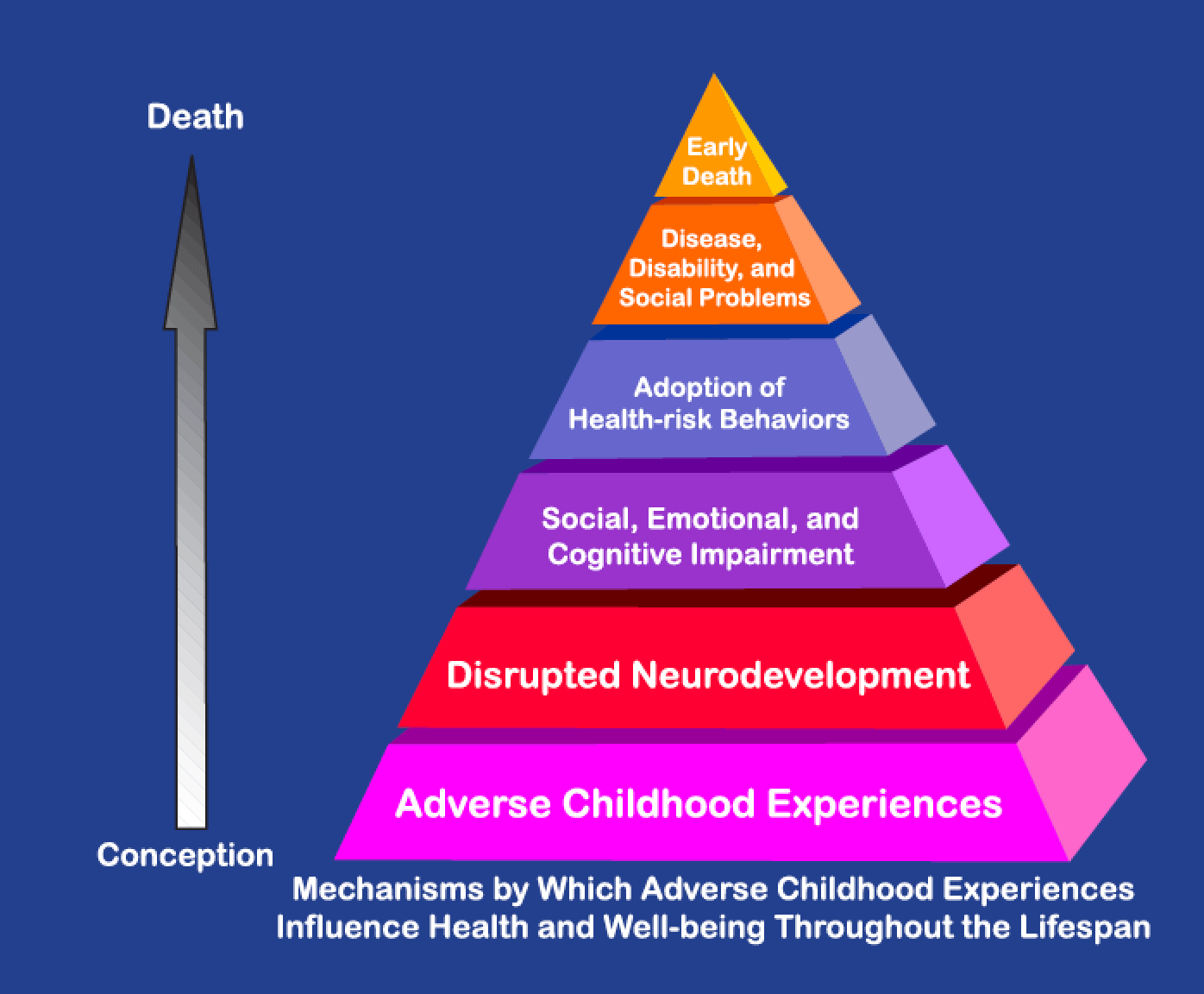
The ACE effort was initiated in 1985 in an era before epigenetics was well-studied. Its artifacts included the ACE pyramid:

The_ACE_PyramidThe historical ACE lifespan continuum on the left began at conception. The pyramid on the right promoted a limited view of ACE that assigned childhood as the pyramid’s base.

Current official depictions of the ACE pyramid assign an expanded view of ACE as the pyramid’s base. The viewer’s attention is directed to “Scientific Gaps” between pyramid layers, but the largest gap remains: the continuum starts at conception but the pyramid still starts at childhood. The narrative claims:

“To provide scientific information that would be useful for developing new and more effective prevention programs.”

The official ACE pyramid doesn’t accurately reflect current science documented in, for example, Epigenetic effects of early life stress exposure. By downplaying Disrupted Neurodevelopment that may begin at conception, governing agencies implicitly endorse approaches that fail to address prenatal causes for later-life adverse effects.


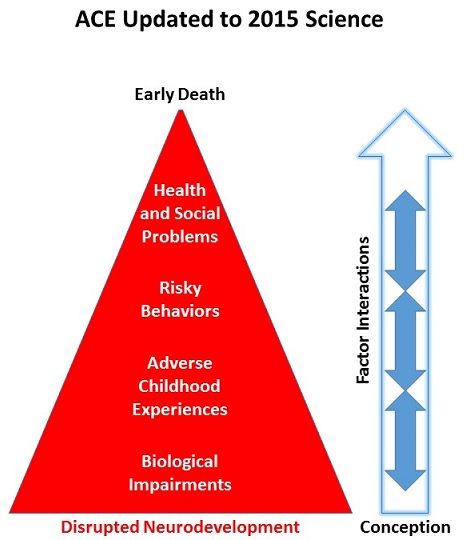
If the ACE diagram was drawn thirty years later in 2015 to incorporate evidence for epigenetics, Disrupted Neurodevelopment wouldn’t be a consequent layer to an ACE base. The potential start of Disrupted Neurodevelopment would coincide with conception:Updated for 2015 to show Disrupted Neurodevelopment

What’s an example of current ACE-related scientific evidence that wasn’t present three decades ago and also isn’t represented in the official ACE pyramid? Prenatal Disrupted Neurodevelopment may be considered today as a possible consequence of a “Yes” answer to half of the original ACE questions:

  • Were your parents were too drunk or high to take care of you or take you to the doctor?
  • Were your parents ever separated or divorced?
  • Was your mother often or very often pushed, grabbed, slapped, or had something thrown at her?
  • Did you live with anyone who was a problem drinker or alcoholic or who used street drugs?
  • Was a household member depressed or mentally ill?

These threats and other stresses cause a fetus to biologically adapt. When such adaptations occur during prenatal development, they may:

  • Have much larger impacts and
  • Cause Biological Impairments that
  • Don’t unassistedly disappear over time.

Emphasizing Disrupted Neurodevelopment that may begin at conception would encourage:

  • Research that’s directed toward producing causal evidence for adaptations that largely occur during the early periods of an individual’s lifespan; and
  • Research on how these adaptations consistently influence our later-life ideas, biology, and behavior.

The above recommendations for research are neither the current focus of ACE research nor the direction of related efforts to assist affected individuals. Relevant studies that I’ve curated on this blog often only produced symptomatic evidence:

  • If a study couched its findings in non-etiologic phrases such as “is associated with” or “is linked to” or “may relate to,” it didn’t address ACE originating causes.
  • “New and more effective prevention programs” seldom address Disrupted Neurodevelopment and Biological Impairments with efforts to reduce the source of the damage.
  • If a program’s presentation showed multivariate analyses with ACE score probabilities and percentages, it didn’t address originating causes.

Here’s a YouTube search of ACE + adverse. Evaluate the current focus of ACE efforts by people employed in the social sciences and services. What did you notice?

How many presentations emphasized prenatal Disrupted Neurodevelopment, a period during which problems may be prevented by addressing causes? Did you instead see that these were outnumbered by many more presentations that emphasized Health and Social Problems symptom interventions?


So, what does it take to empathetically understand, to make a part of oneself, to grok a person’s ACE score?

Regarding empathy – it’s best to avoid the advice of studies such as:

People who are helped may not recognize it at first, but over time, they’ll sense whether the helper’s empathy is genuine.

Regarding understanding – I feel that people first need to ameliorate the origins of their own problems. Then they may be able to help others therapeutically address causes for ACE symptoms.

Need proof? Think of someone you’ve met whose thoughts and feelings and behavior were caught up in and motivated by their own problems:

  • Did you feel they could empathetically understand others?
  • Wasn’t the welfare of the people who may have been helped truly incidental and secondary to someone who was acting out their own problems?

Can a Romanian orphan give informed consent to be an experimental subject?

This 2015 study used Romanian orphans as lab rats for findings of which I failed to see the value. The world didn’t really need any further research to demonstrate that foster care would be better for a child than staying in an orphanage.

The researchers placed the orphans in five separate stressful situations, and measured their cortisol and DHEA-S levels, along with their electrocardiograph and impedance cardiograph activity. The findings were:

“Children who were removed from the Romanian institutions and placed with foster parents before the age of 24 months had stress system responses similar to those of children being raised by families in the community.

The children raised in institutions showed blunted responses in the sympathetic nervous system, associated with the flight or fight response, and in the HPA axis, which regulates cortisol.”

One unsupported assertion from the researchers was:

“We provide evidence for a causal link between the early caregiving environment and stress response system reactivity in humans with effects that differ markedly from those observed in rodent models.”

The researchers stated that rodent studies have converged to find:

“Early-life adversity results in hyperreactivity of the sympathetic nervous system (SNS) and hypothalamic–pituitary–adrenal (HPA) axis.”

It’s baloney that the same results from early life adversity in rodents haven’t also been present in humans. Even the lead researcher herself said in a news article:

“More significantly, McLaughlin said, their [the orphans] stress response systems might have been initially hyperactive at earlier points in development, then adapted to high levels of stress hormones.”

The difference was that the rodents were monitored 24/7 until researchers killed and dissected them. The children’s periods of adversity likely started while in the womb, and their lives had been monitored for research purposes sporadically after their births.

Everybody knows that just because adverse events and effects in these children’s lives weren’t recorded by researchers didn’t mean these effects weren’t present at some point.

Particularly irksome was another unsupported assertion from the lead reviewer:

“The children involved in the study are now about 16 years old, and researchers next plan to investigate whether puberty has an impact on their stress responses. It could have a positive effect, McLaughlin said, since puberty might represent another sensitive period when stress response systems are particularly tuned to environmental inputs. “It’s possible that the environment during that period could reverse the impacts of early adversity on the system,” she said.”

No, this is NOT possible. We may as well expect an apple to fall upward.

The impacts of early adversity persist with enduring physiological changes as shown in experimental studies. Studies have NOT provided evidence that the subjects’ environment can cause the effects of complete reversal of all these changes, no matter the stage of life of the subjects.

This point was addressed in The effects of early-life stress are permanent alterations in the child’s brain circuitry and function rodent study:

The current study manipulates the type and timing of a stressor and the specific task and age of testing to parallel early-life stress in humans reared in orphanages.

The results provide evidence of both early and persistent alterations in amygdala circuitry and function following early-life stress.

These effects are not reversed when the stressor is removed nor diminished with the development of prefrontal regulation regions.

That study had the same reviewer as the current study. The current study’s lead researcher knew or should have known of this and other relevant research. She knew or should have known of the irreversibility of critical periods, during which developments either occurred or were forever missed.

Did the lead researcher make assertions not supported by the study or relevant research – assertions made counter to her scientific knowledge – show her unease about treating the orphans as lab rats? Was there was some other agenda in play?

The larger problem was the study’s informed consent with this group of Romanian orphans. If you were in contact with a damaged person, and implicitly gave them hope that you would improve their life, then who are you as a feeling human being when you don’t personally carry through? Does the legal documentation matter?


Also, I’ve noticed problems with several studies that had this particular reviewer:

Add the current study to the list.

http://www.pnas.org/content/112/18/5637.full “Causal effects of the early caregiving environment on development of stress response systems in children”


This post has somehow become a target for spammers, and I’ve disabled comments. Readers can comment on other posts and indicate that they want their comment to apply here, and I’ll re-enable comments.

Do the impacts of early experiences of hunger affect our behavior, thoughts, and feelings today?

This 2015 worldwide human study Hunger promotes acquisition of nonfood objects found that people’s current degree of hungriness affected their propensity to acquire nonfood items.

The researchers admitted that they didn’t demonstrate cause and effect with the five experiments they performed, although the findings had merit. News articles poked good-natured fun at the findings with headlines such as “Why Hungry People Want More Binder Clips.”

The research caught my eye with these statements:

“Hunger’s influence extends beyond food consumption to the acquisition of nonfood items that cannot satisfy the underlying need.

We conclude that a basic biologically based motivation can affect substantively unrelated behaviors that cannot satisfy the motivation.”

The concept of the quotes relates to a principle of Dr. Arthur Janov’s Primal Therapy – symbolic satisfaction of needs.


I stated two fundamentals of Primal Therapy in An agenda-driven study on beliefs, smoking and addiction that found nothing of substance:

  1. The physiological impacts of our early unmet needs drive our behavior, thoughts, and feelings.
  2. The painful impacts of our unfulfilled needs impel us to be constantly vigilant for some way to fulfill them.

Corollary principles of Primal Therapy are:

  • Our present efforts to fulfill our early unmet needs will seldom be satisfying. It’s too late.
  • We acquire substitutes now for what we really needed back then.
  • Acquiring these symbols of our early unmet needs may, at best, temporarily satisfy derivative needs.

But the symbolic satisfaction of derived needs – the symptoms – never resolves the impacts of early unfulfilled needs – the motivating causes:

  • We repeat the acquisition behavior, and get caught in a circle of acting out our feelings and impulses driven by these conditions.
  • The unconscious act-outs become sources of misery both to us and to the people around us.

In his book “Primal Healing” Dr. Arthur Janov gives two examples of critical periods only during which early needs can be satisfied:

  1. Being touched in the first months of life is crucial to a child’s development. The lack of close contact after the age of 5 wouldn’t have the same effect.
  2. Conversely, the need for praise at 6 months of age may not be essential, but it’s crucial for children at age 5.

As this study’s finding showed, there’s every reason for us to want researchers to provide a factual blueprint of causes for our hunger sensation effects, such as “unrelated behaviors that cannot satisfy the motivation.”

Why not start with hunger research? Objectives of the research should include answering:

  • What enduring physiological changes occurred as a result of past hunger?
  • How do these changes affect the subjects’ present behaviors, thoughts, and feelings?

Hunger research that would likely provide causal evidence for the effect of why people acquire “items that cannot satisfy the underlying need” should include studying where to start the timelines for the impacts of hunger. The impacts would potentially go back at least to infancy when we were completely dependent on our caregivers.

Infants can’t get up to go to the refrigerator to satisfy their hunger. All a hungry infant can do is call attention to their need, and feel pain from the deprivation of their need.

Is infancy far back enough, though, to understand the beginnings of potential impacts of hunger? The Non-PC alert: Treating the mother’s obesity symptoms positively affects the post-surgery offspring study referenced an older study of how the hunger of mothers-to-be had lifelong ill effects for the fetuses they carried during the Dutch hunger winter of 1944. The exposed children had epigenetic DNA changes from their mothers’ starvation, which resulted in relative obesity compared with their unexposed siblings.

An agenda-driven study on beliefs, smoking and addiction that found nothing of substance

The researchers of this 2014 Virginia Tech study said that they found something profound about beliefs and the brain and addiction and smoking.


I’ll assert the short versions of some relevant understandings before assessing the study.

1) A principle of Dr. Arthur Janov’s Primal Therapy is: we all have needs that start at the beginning of our lives. Our needs change as we grow.

If our basic needs aren’t satisfied anywhere along the way, we feel pain.

When the unmet needs are early in our lives and the painful conditions persist, enduring physiological changes may occur.

This basic truth is supported by the findings of much of the recent research I’ve curated on this blog, the references in those studies, and older research elsewhere.

2) Another fundamental of Primal Therapy is that the physiological impacts of these unmet needs drive our behavior, thoughts, and feelings.

The painful impacts of our unfulfilled needs impel us to be constantly vigilant for some way to fulfill them.

This is a richly insightful and truly empathetic method of interpreting people’s behaviors and expressions of thoughts and feelings.

3) A hypothesis of Primal Therapy is: a major function that our cerebrums have evolutionarily adapted is to use ideas and beliefs to repress pain and make us more comfortable.

I value this inference as an empathetic method of interpreting people’s expressions of thoughts and feelings. Click the Beliefs category to view samples of how beliefs, expectations, and predictions are studied using cerebral measurements.


So – what did this study contribute to science about beliefs and the underlying causes of addiction and smoking as found by measuring the subjects’ brains?

Nothing new, really. The study was all about the effects, the symptoms. There was nothing about:

  • Impelling physical conditions and causes,
  • What primarily drives people’s beliefs and addiction behaviors, and
  • What may permanently help someone with their need for the next cigarette.

I wonder what the study’s reviewer saw that factually advanced science.

Everybody already knew that beliefs can temporarily substitute for addicting substances, as well as temporarily change behaviors. It’s a foundation of AA and detox centers.

It’s also a foundation of AA and detox centers that these beliefs have to be constantly reinforced. That fact in and of itself demonstrates that underlying causes aren’t addressed in the AA and detox center approaches. The symptoms always bubble up, and require thought remedies and other interventions in order to stay suppressed.


The research provided details about an approach that wasn’t capable of anything more than temporarily suppressing symptoms. What does the following quote from the Significance statement sound like to you?

“Our findings suggest that subjective beliefs can override the physical presence of a powerful drug like nicotine by modulating learning signals processed in the brain’s reward system.”

Any human therapeutic approach won’t supply the addicting substance. That leaves just beliefs and their required constant reinforcement.

The unsupported overconfidence of the researchers that:

“The implications of these findings may be far ranging”

led to one of the most ridiculous statements I’ve seen in a while:

“Just as drugs micromanage the belief state,” Montague said, “maybe we can micromanage beliefs to better effect behavior change in addiction.”

This hubris just added to the stench of an agenda.

Since smoking isn’t politically correct, I’d guess that it wasn’t that difficult for this study to be funded and promoted. It apparently wasn’t an obstacle that the research DETRACTED from science and didn’t really help people.

http://www.pnas.org/content/112/8/2539.full “Belief about nicotine selectively modulates value and reward prediction error signals in smokers”

If a study didn’t measure feelings, then its findings may not pertain to genuine empathy

This 2014 UK study tried to show that empathetic actions were very context-dependent. It mainly studied causing overt pain to another person.

The lead researcher stated:

“We were interested in quantifying how much people care about others, relative to themselves. A lack of concern for others’ suffering lies at the heart of many psychiatric disorders such as psychopathy, so developing precise laboratory measures of empathy and altruism will be important for probing the brain processes that underlie antisocial behavior.”

The researchers didn’t provide direct evidence of genuine empathy – the subjects’ emotions of sensing and sharing the emotions of another person.

The study was designed to cause sensations of pain and draw conclusions about empathetic feelings. The subjects’ limbic system and lower brains were never measured, however.

Why did the researchers decide to only infer these feelings and sensations from actions and reports? Why wasn’t this inferred evidence confirmed with direct measurements of the brain areas that primarily process feelings and sensations?


  1. At no time during the experiment did the subjects see or hear or touch the person whom they caused pain. Wouldn’t it be difficult for the subjects to feel authentic empathy for a disembodied presence?
  2. We’re informed by the Task performance and beliefs about task responses are solely cerebral exercises study that it’s inaccurate to characterize subjects’ task responses as feelings.
  3. We know from the Problematic research: If you don’t feel empathy for a patient, is the solution to fake it? study that people’s cerebrums are easily capable of generating a proxy for empathy.

This study’s findings concerning empathy involved inauthentic empathy – the non-feeling, cerebral exercise, faking-it kind.

http://www.pnas.org/content/111/48/17320.full “Harm to others outweighs harm to self in moral decision making”

Do researchers have to be cruel to our fellow primates to adequately research oxytocin?

This 2014 primate study found:

“Oxytocin increased infants’ affiliative communicative gestures and decreased salivary cortisol, and higher oxytocin levels were associated with greater social interest.”

One would have to take an anti-evolutionist stance and believe that primates do not feel what humans feel to consider this process to NOT be cruel:

“To test these macaques, we took advantage of ongoing experiments requiring infants to be separated from their mother on the day of birth. Infants were nursery-reared, housed individually, with a cloth surrogate mother. They could see and hear other infants, but could not touch them.”

We know that primate infants, like humans, need nourishment, transportation, warmth, protection, and socialization from their mothers. What level of findings about oxytocin can a research study make that would justify this deprivation?

It surely wasn’t the findings this study made. We knew without doing the study that getting oxytocin from a nebulizer would be nowhere near an acceptable substitute for a mother’s touch and care.

http://www.pnas.org/content/111/19/6922.full “Inhaled oxytocin increases positive social behaviors in newborn macaques”

Problematic research on oxytocin: If the study design excludes women, its findings cannot include women

This 2014 study’s findings that “the hormone oxytocin promotes group-serving dishonesty” can’t apply generally to humans because its subjects were ALL men.

Regarding oxytocin, the researchers certainly knew or should have known previous studies’ findings about sex differences, as did Is oxytocin why more women than men like horror movies? which cited:

“Oxytocin modulates brain activity differently in male and female subjects.”

Regarding differing reciprocal behaviors, the researchers also knew or should have been better informed about associated brain areas through studies such as Reciprocity behaviors differ as to whether we seek cerebral vs. limbic system rewards and its references.

And how could the study produce reliable, replicable evidence of:

Dishonesty to be plastic and rooted in evolved neurobiological circuitries”

when the researchers performed NO measurements of “neurobiological circuitries” that supported that finding?

What was the agenda in play here? What did the female Princeton reviewer see in this study that advanced science?

http://www.pnas.org/content/111/15/5503.full “Oxytocin promotes group-serving dishonesty”


This post has somehow become a target for spammers, and I’ve disabled comments. Readers can comment on other posts and indicate that they want their comment to apply here, and I’ll re-enable comments.

Can psychologists exclude the limbic system and adequately study awareness and social cognition?

This 2014 Princeton human study was proof that cognitive researchers are stuck in the cerebrum. That and gadgets.

The researchers didn’t measure limbic system or lower brain areas, yet from their use of cartoon faces and magnetically zapping their subjects’ brains they proclaimed:

“The findings suggest a fundamental connection between private awareness and social cognition.”

For just one example of the gross omissions of the study’s design, look at the limbic system’s part in “social cognition” for The amygdala is where we integrate our perception of human facial emotion.

And it’s a very limited scope of “private awareness” that excludes conscious awareness of what’s in our own feeling, instinctual, and impulsive levels of consciousness.

http://www.pnas.org/content/111/13/5012.full “Attributing awareness to oneself and to others”


This post has somehow become a target for spammers, and I’ve disabled comments. Readers can comment on other posts and indicate that they want their comment to apply here, and I’ll re-enable comments.

Problematic research: If you don’t feel empathy for a patient, is the solution to fake it?

If you don’t experience empathy for another person, this 2014 Harvard study showed how to use your cerebrum to manipulate your limbic system into displaying a proxy of empathy.

Is this what we want from our human interactions? To have a way to produce an emotion the same way that an actor would as they read their lines?

How to finesse the effect of “no empathy” was the focus. Because these researchers didn’t define a lack of genuine empathy as a symptom of a fundamental problem, they absolved themselves from investigating any underlying causes.

Nice trick in the academic world.


In the real world, in which we are feeling human beings, what may be a cause of no empathy?

Let’s say that someone is in a position that helps people. They have daily encounters where they may be expected to be empathetic, but they seldom have these feelings for others.

One hypothesis of Dr. Arthur Janov’s Primal Therapy is this condition’s origin may be that in the past, a person needed help as a matter of survival, and they weren’t helped. Their unconscious memories of being helpless impel them to act out being helpful in their current life.

This person’s frequent reaction to any hint in the present of the agony of not receiving help back when they desperately needed it is to act out what they needed to have done back then. Helping others also gives them momentary distraction from such painful memories, but any relief is transitory. So they repeat the process.

Let’s say that unconscious needs pressed them into making a career choice of actively helping people. They’re usually too caught up in their own thoughts and feelings and behavior, though, to sense feelings of the people they’re helping.

Something isn’t right, but what’s the problem? They see indicators such as: their actions that should feel fulfilling aren’t fulfilling, they seldom feel empathy, and so on.


Primal Therapy allows patients to therapeutically address origins of such conditions. A symptom such as lack of empathy for others will resolve as historical pains are ameliorated.

Or we can do as this study suggested: produce an inauthentic display – and thereby ignore the lack of empathy as a symptom – and never address causes of no empathy.

http://www.pnas.org/content/111/12/4415.full “Episodic simulation and episodic memory can increase intentions to help others”