Autism biomarkers and sulforaphane

This 2020 US human study investigated autism improvements with sulforaphane:

“Autism Spectrum Disorder (ASD) is one of the most common neurodevelopmental disorders that, in the United States, is currently estimated to affect 1 out of 59 children who are 8 years old. Despite decades of research and advances in our knowledge of etiologies of ASD, treatments and biomarkers for ASD remain limited.

The primary diagnosis of ASD still relies on observational tools that are by nature subjective. There are currently no drugs approved to treat core symptoms of ASD, nor are there any studies using SF [sulforaphane] in genetic mouse models of ASD.

In our previous placebo-controlled, double-blinded, randomized clinical trial, daily administration of SF for 4-18 weeks substantially improved behavioral abnormalities of the majority of 26 young males with moderate to severe ASD without significant toxicity. The multi-functional phytochemical sulforaphane affects many biochemical abnormalities associated with ASD.

We investigated potential molecular markers from three ASD-associated physiological pathways that can be affected by sulforaphane:

  1. Redox metabolism / oxidative stress;
  2. Heat shock response; and
  3. Immune dysregulation / inflammation

in peripheral blood mononuclear cells (PBMCs) from healthy donors and patients with ASD.

Three representative Nrf2 [nuclear factor erythroid 2-related factor 2]-dependent enzymes:

  1. AKR1C1 [aldo-keto reductase family 1 member C1];
  2. NQO1 [dehydrogenase quinone 1]; and
  3. HO-1 [heme oxygenase]

were significantly induced by 6 h of 2 μM or 5 μM SF ex vivo treatments in PBMCs from healthy donors. This time point was chosen based on our earlier observations of kinetics of upregulation of Nrf2-dependent genes by SF, and was expected to capture increased mRNA production of both very fast (HO-1) and relatively slow (NQO1) responders.

There was no concentration-dependence in induction of any genes examined, with higher (5 μM) concentration of SF even showing a slightly diminished effect for induction of AKR1C1 and NQO1. Although this concentration is achievable in vivo, more typical peak concentrations of SF (and its metabolites) in human plasma are 1-2 μM.

SF ex vivo pre-treatment significantly decreased the LPS [lipopolysaccharides]-stimulated inflammatory gene (

  • COX-2,
  • TNF-α,
  • IL-6 and
  • IL-1β

) expression levels in PBMCs from healthy donors.

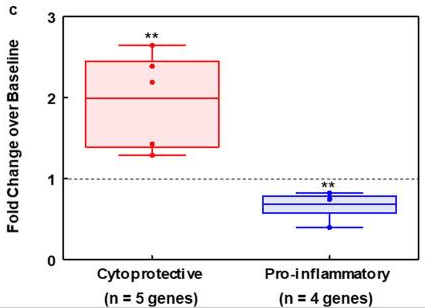
As a pilot study for a clinical trial of SF in children with ASD, we evaluated the same biomarkers from the ex vivo studies in 10 young males with ASD, 6-12 years of age, who received SF (in the form of a dietary supplement containing GR [glucoraphanin] and myrosinase), 2.2 μmol/kg/d for 14 days. Grouping by broad functionality (e.g. cytoprotective or pro-inflammatory), differences from baseline were highly significant.

asd gene expression

Individually none is sufficiently specific or sensitive, but when grouped by function as two panels, these biomarkers show promise for monitoring pharmacodynamic responses to sulforaphane in both healthy and autistic humans, and providing guidance for biomedical interventions. We conducted this study in the context of ASD, however our findings have broader implications and suggest that these biomarkers can be used in any study involving an intervention with SF.

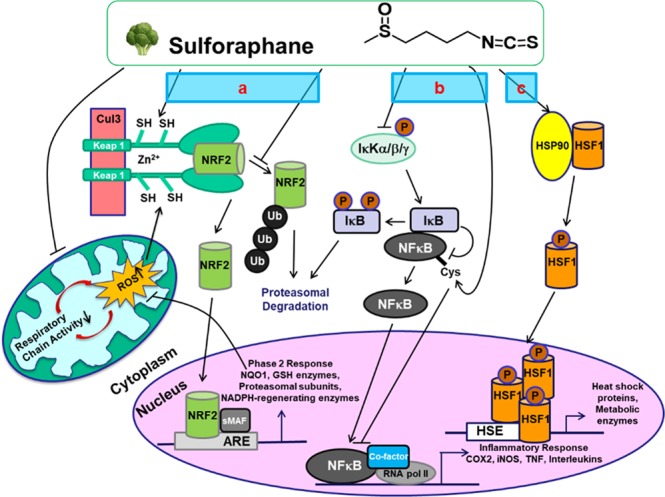
Major signaling pathways for protective mechanisms against ASD by SF:

  • (a) Keap1/Nrf2/ARE pathway,
  • (b) NF-κB inflammatory pathway,
  • (c) Heat-shock responses.”

https://www.ncbi.nlm.nih.gov/pmc/articles/PMC7118069/ “Biomarker Exploration in Human Peripheral Blood Mononuclear Cells for Monitoring Sulforaphane Treatment Responses in Autism Spectrum Disorder”


This was a pilot study. Does sulforaphane treat autism? was its follow-on clinical trial.

Broccoli sprouts and sulforaphane aren’t panaceas. Their research is becoming more intensive and focused, though.

Microwave broccoli seeds to create sulforaphane

Two sulforaphane topics came up in discussions with my traveling companion. Our first was an inference:

  1. 3-day-old broccoli sprouts have the optimal yields found that broccoli sprout sulforaphane content (after processing for analysis) ranged from 46% to 97% of broccoli seeds.
  2. Microwave broccoli to increase sulforaphane levels found that microwaving broccoli florets to 60°C (140°F) increased the sulforaphane amount from .22 to 2.45 µmol / g (1,114%!!).
  3. Wouldn’t broccoli seeds’ sulforaphane be more than broccoli sprouts by microwaving seeds up to 60°C in the same amount of water?

The 3-day study broccoli sprout measurements were relative to each variety’s seeds:

“To be comparable, the content of these bioactive compounds from 100 fresh sprouts was divided by the weight (gram) of 100 seeds, and then this value was compared with their content from one gram seeds.”

Broccoli compounds are similar among broccoli florets, sprouts, and seeds. A major difference is that broccoli sprouts and seeds have no initial sulforaphane content because hydrolization hasn’t occurred yet. The above graphic’s seed and sprout sulforaphane content was created by processing for analysis.

I’ll reason that sulforaphane would be created by:

  • Microwaving one tablespoon of broccoli seeds with a 1000W microwave in 100 ml of distilled water for 30 seconds to ≤ 60°C; then
  • Straining out the water; then
  • Allowing further myrosinase hydrolization of glucoraphanin and other glucosinolates into sulforaphane and other healthy compounds.

Broccoli seeds are dry, and microwaving acts directly on a material’s water content. The 3-day study methods “immersed [broccoli seeds] in distilled water and soaked at 30°C for 2 h” to start germination. I’ll stipulate two hours as a minimum broccoli seed soaking time before microwaving.

I’ve tried microwaving broccoli seeds five times so far to see if they’re palatable. Seeds soaked for at least two hours then microwaved for 30 seconds swell to almost twice their dry size. They’re easier to strain, chew thoroughly to ensure hydrolization, and swallow.

The 3-day study also found “total phenolic and flavonoid contents in sprouts were 1.12 to 3.58 times higher than seeds.” I won’t stop eating broccoli sprouts, but sometimes it may be expedient to reduce a 72-hour preparation time to 2 hours and still benefit from sulforaphane and other healthy broccoli compounds.

Let’s use Estimating daily consumption of broccoli sprout compounds runt-of-the-litter calculations and assumptions to make a worst-case estimate of sulforaphane content in one tablespoon of broccoli seeds:

  • Broccoli seed weight of one tablespoon is 10.7 grams.
  • Worst-case sulforaphane weight in one tablespoon of broccoli seeds (10.7 g x 2.43 mg sulforaphane per gram of seeds) = 26.0 mg.

I won’t calculate sulforaphane weight after microwaving because part of the 3-day study processing for analysis was:

“Broccoli seeds were comminuted by analysis grinder. Seed powder (0.5g) was immersed in distilled water at 55 °C for 5 min to inactivate the epithiospecifier protein.”

Grinding seeds into powder then heating it probably incorporates any effects of microwaving intact broccoli seeds up to 60°C.


Our second discussion topic came by gathering study data from Broccoli or Sulforaphane: Is It the Source or Dose That Matters?

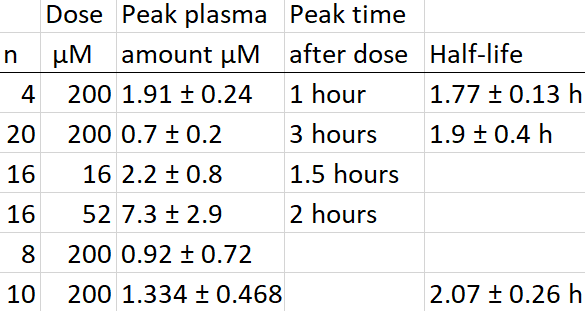
Assessing these 200 μmol amount / 35 mg weight sulforaphane supplement dose studies:

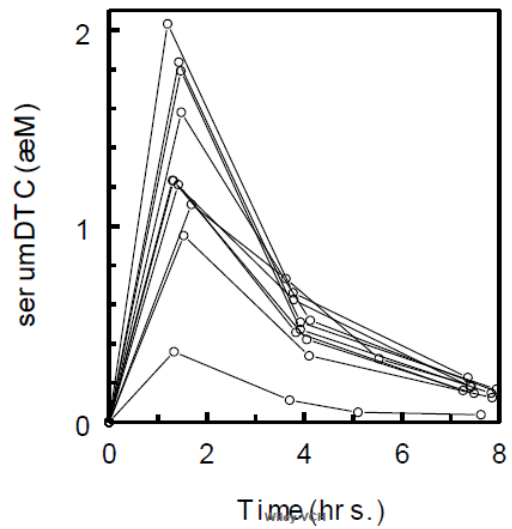
  1. Peak plasma statistics ranged from 0.5 μmol in Row 2 (n = 20) to 2.15 (n = 4) μmol in Row 1. Row 4 (n = 10) statistics don’t show it, but its individual peak plasma ranges per the below graphic were 0.359 μmol to 2.032 μmol. Coincidentally, the Row 4 subject (#2) who had the lowest peak plasma amount also had the lowest urinary % of dose excreted (also termed bioavailability) of 19.5%, and the Row 4 subject (#8) who had the highest peak plasma amount also had the highest sulforaphane bioavailability of 86.9%.
  2. From the Row 4 study: “The half-life of SF in the body was 2.07 ± 0.26 h as calculated from serum area-under-the-curve determinations.” Its Subject #2 had the longest sulforaphane half-life at 2.709 hours.
  3. The peak time after dose ranged from 1 to 3 hours. Not sure why Row 4 didn’t calculate a peak time, but eyeballing the above graphic showed that all subjects peaked between 1 and 2 hours. Row 2’s time was at the study’s first of three measurement intervals (3, 6, and 12 hours). Its peak time after dose probably also took place between 1 and 2 hours.

These four studies showed that there’s wide variation among individual responses to sulforaphane supplements. Row 4 study’s Concluding Remarks ended with:

“Innate metabolic differences must not be discounted when assessing the metabolism of SF alone, delivered in supplements.”


The first of A pair of broccoli sprout studies was Row 2 (n = 20) above. Its sulforaphane supplement statistics – repeated in the below graphic’s BSE (broccoli sprout extract) column – demonstrated how humans’ sulforaphane supplement metabolic profiles were different than our fresh broccoli sprout metabolic profiles:
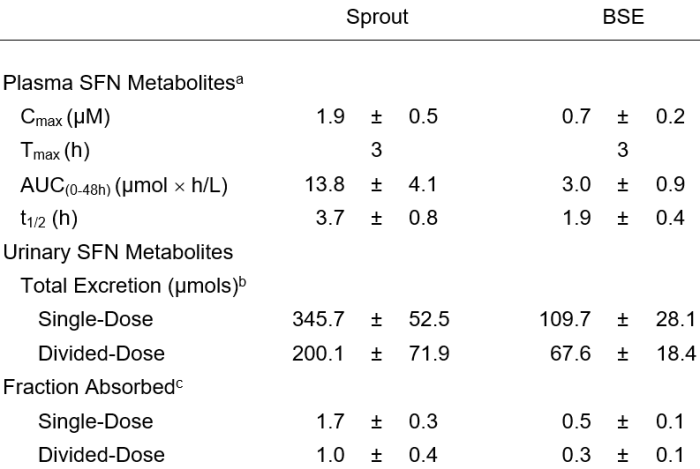
The divided dose was twelve hours apart at breakfast and dinner times. Also, its first measurements weren’t taken until 3 hours after ingesting, which explains its later times with lesser amounts than the above sulforaphane supplement studies’ earlier times with greater amounts.

During Week 9 of Changing to a youthful phenotype with broccoli sprouts I changed my practices to eat microwaved broccoli sprouts at breakfast and dinner times from its finding:

“In sprout consumers, plasma concentrations were 2.4-fold higher after consuming the second dose than after the first dose.”

A metabolic profile resulting from my current practices is probably between the Sprout and BSE divided-dose statistics:

  • Sulforaphane intake is greater than eating raw broccoli sprouts because microwaving 3-day-old broccoli sprouts creates sulforaphane in them before eating.
  • Sulforaphane uptake from microwaved broccoli sprouts is quicker than eating raw broccoli sprouts. It may not be as immediate as taking sulforaphane supplements, which are usually powders.
  • Sulforaphane dose from microwaved broccoli sprouts is less dependent on an individual’s metabolism than eating raw broccoli sprouts.
  • Sulforaphane release from microwaved broccoli sprouts probably continues on to the gut as does eating raw broccoli sprouts. Sulforaphane release from supplements may not per Does sulforaphane reach the colon?.

The microwaving study processed 10 grams of broccoli florets immersed in 500 ml water with a 950W microwave on full power for 108 seconds to achieve 60°C. I microwave 65.5 grams of 3-day-old broccoli sprouts immersed in 100 ml water with a 1000W microwave on full power for 35 seconds to ≤ 60°C.

After microwaving I wait five minutes to allow further myrosinase hydrolization of glucoraphanin and other glucosinolates into sulforaphane and other healthy compounds. Enhancing sulforaphane content provided evidence that myrosinase hydrolization peaks at one minute after achieving 60°C per the below graphic:
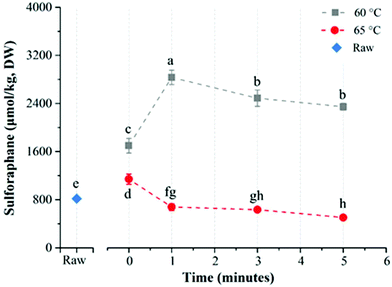
I interpret the above sulforaphane degradation from minutes 1 to 5 to be leaching caused by leaving the broccoli sample immersed in water. I strain water from broccoli sprouts after microwaving – the Time 0 mark of the above graphic – because without leaching water, further hydrolization may increase sulforaphane.


Sulforaphane supplements:

  • Are readily metabolized,
  • Blood plasma levels peak by two hours, and
  • Blood plasma levels dissipate by eight hours.

To the extent a metabolism resulting from my current practices is closer to a sulforaphane supplement profile than a raw broccoli sprouts profile, maybe that leaves the door open to a microwaved broccoli seed dose at lunch time? In any event, there are seeds in each batch that don’t germinate after soaking for 12 hours and rinsing three times a day, and I eat them after microwaving anyway.

See Caution on broccoli seed erucic acid content? if you’re concerned about that.
Measuring sulforaphane plasma compounds

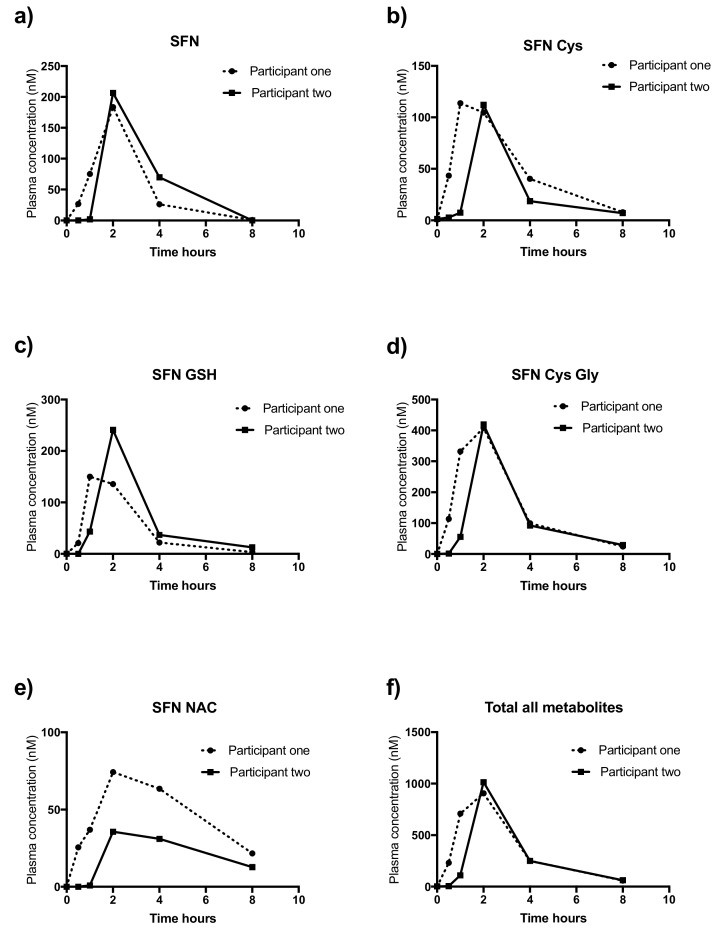
This 2020 Australian human study investigated methods of measuring sulforaphane plasma compounds:

“A simplified methodology to allow high-throughput LC–MS [Liquid Chromatography-Mass Spectrometry] analysis of plasma samples for measurement of sulforaphane and its metabolites is described. Analysis time is greatly reduced by employing fast chromatography and simple plasma extraction procedure.

Participants were observed consuming four Broccomax capsules, each containing 30 mg of broccoli seed extract and a dose of 8 mg of sulforaphane, as per manufacturer certificate of analysis, resulting in a total dose of 32 mg of sulforaphane (120 mg of broccoli seed extract).

Mean peak of combined metabolites from our study (0.9 and 1 μM) using 120 mg of broccoli seed extract (~32 mg of SFN) was similar to work by Fahey et al. who investigated pharmacokinetics of 350 mg of purified broccoli seed powder (mean 1.3 μM ± 0.5 μM), though our dose was almost three-times less. Pharmacokinetic profiles of our study mirrored those of Fahey et al. in that excretion was complete 8 hrs after consumption. Our intervention peaked slightly later (~2hrs), than that of Fahey (~1 hr), likely due to our use of a capsule rather than liquid.”

https://www.ncbi.nlm.nih.gov/pmc/articles/PMC7070302/ “Measuring Sulforaphane and Its Metabolites in Human Plasma: A High Throughput Method”


This study was thin on comparing their n = 2 results to previous work. Here are comparables from Broccoli or Sulforaphane: Is It the Source or Dose That Matters?


These researchers set up a strawman by stating a false comparison:

“Our dose was almost three-times less.”

The compared study was the n = 10 subjects row above, which stated its dose as:

“200 μmol of SF was contained in about 350 mg of SF-αCD powder dissolved in 25 mL of distilled water, which subjects were given to drink upon arrival at the clinic.”

If the current study wanted a true comparison, they would measure and compare sulforaphane dose weights or amounts:

  • https://pubchem.ncbi.nlm.nih.gov/compound/sulforaphane lists sulforaphane’s molecular weight as 177.3 g / mol.
  • A 5.64 μmol sulforaphane amount (.001 / 177.3) equals a 1 mg weight of sulforaphane.
  • 200 μmol / 5.64 μmol = 35 mg sulforaphane used in the compared study.

But these researchers couldn’t even do that! They asserted a 32 mg sulforaphane dose “per manufacturer certificate of analysis” when they had the resources to do otherwise!

What kind of study design would go to all the trouble of measuring plasma sulforaphane metabolite outputs, but not measure their sulforaphane input dose???

Had they closely read the compared study, they may have also noticed that its commercial supplement, Prostaphane, was tested to verify stated dosage. These researchers could have done the same with Broccomax.

Are sulforaphane supplements better than microwaved broccoli sprouts?

Armando asked a good question in Upgrade your brain’s switchboard with broccoli sprouts:

“Is there any way to consume sulphorafane in a supplement form? Rather than have to jump so many hops to consume it from broccoli.”

That blog post referenced a 2017 study, whose sulforaphane amount was:

“100 µmol [17.3 mg] sulforaphane as standardized broccoli sprout extract in the form of 2 gel capsules.”

One answer in A pair of broccoli sprout studies was No:

  • “Plasma and urinary levels of total SFN [sulforaphane] metabolites were ~3–5 times higher in sprout consumers compared to BSE [broccoli sprout extract] consumers.
  • In sprout consumers, plasma concentrations were 2.4-fold higher after consuming the second dose than after the first dose.
  • Calculated SFN bioavailability from broccoli sprouts exceeded 100%.”

That study was from 2015, though. Are better products than broccoli sprout extracts available now?


Image from the US Library of Congress

During Week 5 of Changing an inflammatory phenotype with broccoli sprouts, back in May when I still believed impossible things like we would:

I contacted a distributor of a dried broccoli sprout powder for evidence of their claim:

“Independent assays confirm that EnduraCELL yields more Sulforaphane per gram and per dose than any other broccoli sprout ingredient available! These assays showed that EnduraCell yields around 3.5 times more SULFORAPHANE than the next highest broccoli sprout product.”

I’ve asked three times for the lab assays. They declined each time to provide the data. In correspondence the company founder said:

“Each 700 mg capsules yields around 15mg sulforaphane.”

The company founder has written several reviews, one of which is entitled Sulforaphane and Other Nutrigenomic Nrf2 Activators: Can the Clinician’s Expectation Be Matched by the Reality? In Section 6.5 Sulforaphane it stated:

“By calculation, MYR [myrosinase]-active whole broccoli sprout supplement yielding 1% SFN could deliver 10 mg SFN per gram of powder, corresponding to ~12 grams of fresh broccoli sprouts (dried powder retains ~8% moisture).

The 2017 study’s dosage of “100 µmol [17.3 mg] sulforaphane as standardized broccoli sprout extract” weighed a gram or less, for a 1.73% sulforaphane yield. A broccoli sprout powder may have a 15 mg / 700 mg = 2.14% sulforaphane yield.

Using calculations from Estimating daily consumption of broccoli sprout compounds and Our model clinical trial for Changing to a youthful phenotype with broccoli sprouts, I eat 131 grams of 3-day-old broccoli sprouts daily. That would be 131 g / 12 = 10.9 grams of a broccoli sprout powder.

The equivalent sulforaphane dosage would be 10.9 g x 21.4 mg per gram = 233.3 mg! That’s obviously too high. What isn’t right?

Subsequent investigation of a distributor’s site found this table:

autism sprout powder

The study referenced for equivalence was Sulforaphane treatment of autism spectrum disorder (ASD). Calculations:

  • The 100 µmol sulforaphane amount for 90 kg participants weighed 17.73 mg per https://pubchem.ncbi.nlm.nih.gov/compound/sulforaphane.
  • The equivalent broccoli sprout powder sulforaphane yield is 0.01773 / 3.6 g = 0.4925%. That’s 5 mg of sulforaphane per gram of broccoli sprout powder.
  • 0.4925% / 2.14 % = 0.23. Decrementing the above sulforaphane weight gives 233.3 mg x .23 = 54 mg.

The answer to my question What isn’t right? I relied on private correspondence rather than what a vendor publicly disclosed.


I’m not particularly concerned about analytical uncertainties for myself. Whatever the numbers are, microwaving techniques for fresh broccoli sprouts increase them.

I immerse 3-day-old broccoli sprouts in 100 ml distilled water, then microwave them on 1000W full power for 35 seconds to ≤ 60°C (140°F) per Microwave broccoli to increase sulforaphane levels. Worst-case estimates are 52 mg sulforaphane with microwaving.


My answer to Armando’s question would be No for sulforaphane supplements. I’d consider a whole broccoli sprout powder after lab assays were personally verified.