The brainstem’s parabrachial nucleus

I often reread blog posts that you read. Yesterday, a reader clicked Treat your gut microbiota as one of your organs. On rereading, I saw that I didn’t properly reference the parabrachial nucleus as being part of the brainstem.

A “parabrachial nucleus” search led me to a discussion of two 2020 rodent studies:

“Nociceptive signals entering the brain via the spinothalamic pathway allow us to detect location and intensity of a painful sensation. But, at least as importantly, nociceptive inputs also reach other brain regions that give pain its emotional texture.

Key to that circuitry is the parabrachial nucleus (PBN), a tiny cluster of cells in the brainstem associated with homeostatic regulation of things like temperature and food intake, response to aversive stimuli, and perceptions of many kinds. Two new papers advance understanding of PBN’s role in pain:

  1. The PBN receives inhibitory inputs from GABAergic neurons in the central nucleus of the amygdala (CeA). Those inputs are diminished in chronic pain conditions, leading to PBN hyperactivity and increased pain perception. Disinhibition of the amygdalo-parabrachial pathway may be crucial to establishing chronic pain.
  2. The dorsal PBN is the first receiver of spinal nociceptive input. It transmits certain inputs to the ventral medial hypothalamus and lateral periaqueductal gray. Certain of its neurons transmit noxious inputs to the external lateral PBN, which then transmits those inputs to the CeA and bed nucleus of the stria terminalis. This is quite new, that nociceptive information the CeA receives has already been processed by the PBN. They measured many pain-related behaviors: place aversion, avoidance, and escape. That allowed them to dissect different pain-related behaviors in relation to distinct subnuclei of the PBN.

1Inline2

Chronic pain is manufactured by the brain. It’s not a one-way process driven by something coming up from the periphery. The brain is actively constructing a chronic pain state in part by this recurring circuit.

A role of the PBN is to sound an alarm when an organism is in danger, but its roles go further. It is a key homeostatic center, weighing short-term versus long-term survival. If you’re warm, fed, and comfortable, organisms can address long-term directives like procreation. When you’re unsafe, though, you need to put those things off and deal with the emergency.”

https://www.painresearchforum.org/news/147704-parabrachial-nucleus-takes-pain-limelight “The Parabrachial Nucleus Takes the Pain Limelight”

https://www.jneurosci.org/content/40/17/3424 “An Amygdalo-Parabrachial Pathway Regulates Pain Perception and Chronic Pain”

https://www.sciencedirect.com/science/article/pii/S089662732030221X “Divergent Neural Pathways Emanating from the Lateral Parabrachial Nucleus Mediate Distinct Components of the Pain Response”


Two dozen papers have since cited these two studies. One that caught my eye was a 2021 rodent study:

“Migraines cause significant disability and contribute heavily to healthcare costs. Irritation of the meninges’ outermost layer (the dura mater), and trigeminal ganglion activation contribute to migraine initiation.

Dura manipulation in humans during neurosurgery is often painful, and dura irritation is considered an initiating factor in migraine. In rodents, dura irritation models migraine-like symptoms.

Maladaptive changes in central pain-processing regions are also important in maintaining pain. The parabrachial complex (PB) receives diverse sensory information, including a direct input from the trigeminal ganglion.

PB-projecting trigeminal ganglion neurons project also to the dura. These neurons represent a direct pathway between the dura, a structure implicated in migraine, and PB, a key node in chronic pain and aversion.”

https://www.sciencedirect.com/science/article/pii/S2452073X21000015 “Parabrachial complex processes dura inputs through a direct trigeminal ganglion-to-parabrachial connection”

PXL_20210704_095710109

Vitamin K2 forms and effects

Two human studies using two forms of Vitamin K2. The first published in 2021 was with premenopausal women taking the MK-7 form:

“The aim of this 6-month randomised, controlled trial was to examine effects on bone metabolism of a nutritional supplement in women aged 25 to 44. The nutritional supplement was a protein-rich beverage powder fortified with multi-micronutrients including calcium (600 mg), vitamin D (400 IU), and vitamin K (55 mcg) per daily serving.

Co-primary outcome variables were the changes from baseline after 6 months of treatment in:

  • Bone resorption marker serum C-terminal cross-linking telopeptide of type I collagen (s-CTX-I); and
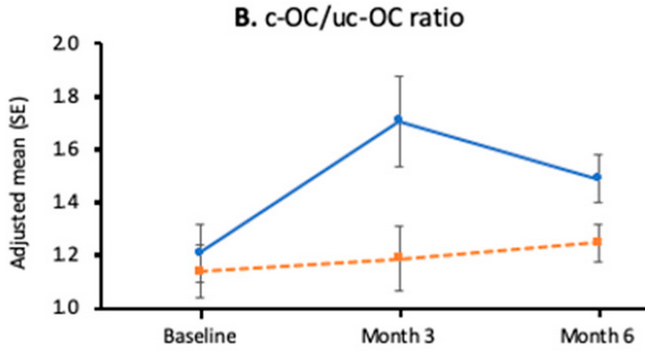
  • Bone formation marker expressed as ratio of carboxylated osteocalcin to under carboxylated-osteocalcin (c-OC/uc-OC).

The ratio of carboxylated to undercarboxylated OC is a marker of vitamin K status:

c-OC to uc-OC ratio

A meta-analysis of randomised controlled trials indicated that vitamin K2 administration reduces uc-OC and increases c-OC, and is associated with reduced bone loss and possibly a reduction in risk of fractures. The MK-7 dose of 55 mcg given in this study had a significant benefit (increase) at 3 months, but not at 6 months.

This randomised controlled 6-month trial of a nutritional supplement showed favorable changes in bone turnover markers (decreased) and calcium homeostasis. Such changes in older adults have been associated with slowing of bone loss and reduced fracture risk.”

https://www.mdpi.com/2072-6643/13/2/364/htm “Randomised Controlled Trial of Nutritional Supplement on Bone Turnover Markers in Indian Premenopausal Women”


A second study published in 2019 was with postmenopausal women taking the MK-4 form:

“This study assessed improvement in carboxylation of osteocalcin (OC) in response to escalating doses of MK-4 supplementation. A nine-week, open-labeled, prospective cohort study was conducted in 29 postmenopausal women who suffered hip or vertebral compression fractures. Mean ± SD age of participants was 69 ± 9 years.

Participants took:

  • Low-dose MK-4 (0.5 mg) for 3 weeks; then
  • Medium-dose MK-4 (5 mg) for 3 weeks; then
  • High-dose MK-4 (45 mg) for 3 weeks.

MK-4 dose, but neither age nor other relevant medications (e.g. bisphosphonates), correlated with improvement in %ucOC. Compared with baseline concentrations of 16.8 ± 2.4:

  • 0.5 mg supplementation halved %ucOC to 8.7 ± 2.2; and
  • 5-mg dose halved %ucOC again to 3.9 ± 2.2.

However, compared to 5 mg/day, there was no additional benefit of 45 mg/day (%ucOC 4.6).

MK-4 supplementation resulted in borderline increases in γ-carboxylated osteocalcin (glaOC; p = 0.07). There were no major side effects of MK-4 supplementation.

In postmenopausal women with osteoporotic fractures, supplementation with either 5 or 45 mg/day of MK-4 reduced ucOC to concentrations typical of healthy premenopausal women.”

https://econtent.hogrefe.com/doi/10.1024/0300-9831/a000554 “Maximal dose-response of vitamin K2 (menaquinone-4) on undercarboxylated osteocalcin in women with osteoporosis” (not freely available)


I asked coauthors of the first study for an estimate of MK-7 trans isomer content. Will update with their answer.

PXL_20210628_091432077.NIGHT

Eat broccoli sprouts every day

This 2020 rodent study demonstrated benefits from daily cooked broccoli intake, even when it contained no myrosinase enzyme and no sulforaphane:

“Broccoli consumption by rats influenced several metabolic pathways that impact liver health. Plasma metabolite changes are potential biomarkers of liver health, and also monitor broccoli benefits.

Rats fed a broccoli diet exhibited an enhanced Nrf2-Nqo1 pathway by day 4:

nrf2-nq01 pathway activation

Amino acid synthesis and glutathione (GSH) synthesis pathways were upregulated by Day 7. Fatty acid synthesis pathways, specifically α-linoleic acid synthesis pathways, were downregulated by Day 14.

Glucosinolate (GSL) metabolite sulforaphane alters liver GSH metabolism. It might be that consumption of any brassica, since all have GSLs, may lead to plasma glutamine and S-methyl-L-cysteine (SMC) as biomarkers. Future studies are needed to confirm whether glutamine and SMC are broccoli-specific or GSL-specific biomarkers.

Dietary broccoli caused plasma metabolite changes that correlate with:

  • Improved GSH status, suggesting protection from oxidative stress; and
  • Diversity and abundance of gut microbiota, suggesting that changes in gut microbiome may contribute to health benefits caused by dietary broccoli.”

https://www.mdpi.com/2072-6643/12/9/2514/htm “Biomarkers of Broccoli Consumption: Implications for Glutathione Metabolism and Liver Health”


I came across this study as a result of it citing the second study of A pair of broccoli sprout studies:

“A human clinical study reported changes in plasma fatty acids and GSH/GSH component levels after even a single meal of broccoli sprouts, similar to pathways we report here for rat plasma. We saw levels drop initially, then rise.

In that 2-day study, levels dropped like ours, but it was not sufficiently long to see the recovery and overshoot that we saw by 14 days when glutamine abundance and liver Nrf2 and NQO1 expression were all increased, suggesting increased GSH production, which might provide protection of liver from reactive oxygen species.”

Maybe a better comparison would have been against 0, 1-day, and 2-day rodent measurements, since the human study sampled at 0, 3, 6, 12, 24, and 48-hour intervals? People ate fresh broccoli sprouts only at time 0, though, whereas rodents ate a 10% cooked broccoli diet (0.11 mg/g glucoraphanin) ad libitum.


PXL_20210628_092632681