Problematic rodent sulforaphane studies

I was asked to give an example of Human relevance of rodent sulforaphane studies. I’ll use the 2020 Sulforaphane Diminishes the Formation of Mammary Tumors in Rats Exposed to 17β-Estradiol.

1. This study’s sulforaphane dose was “100 μmol/kg SFN..gavage regimen on Monday, Wednesday and Friday for 56 weeks.” From the October 2019 Broccoli or Sulforaphane: Is It the Source or Dose That Matters? “Allometric scaling uses the correction factor for rat doses 0.162” and this graphic:

Interpreting the human-relevant range:

Interpreting that 8% of the rodent studies were clinically relevant to human sulforaphane doses as a lower boundary (1.43 µmol / kg) and tolerable to humans as an upper boundary (4 µmol / kg):

A human equivalent of this study’s dose is (100 μmol/kg x .162) = 16.2 µmol / kg. See the original blog post for a study showing that a majority of both treatment and control group subjects will refuse and stop with sulforaphane doses less than half of this study’s human equivalent.

2. From Week 28, “The maximum lifespan for rats and humans were set to 3.8 years and 122.5 years, respectively.” A human-equivalent multiplication factor that can be applied to a rat post-development time period is 122.5 / 3.8 = 32.2.

Assuming this study’s subjects could achieve maximum lifespan, a human equivalent of 56 weeks is (56 x 32.2) ≈ 1,803 weeks, or ≈ 34.7 years.

3. Let’s assert that the main purpose of animal studies is to help humans.

Was it possible for this study to achieve this goal when it used intolerable human-equivalent sulforaphane doses for a period equivalent to over three decades of our lives?

Yet its Discussion section proposed that it’s useful for human guidance on:

  • Obesity;
  • Breast cancer in premenopausal and postmenopausal women;
  • Hormone status;
  • Phospholipids for cellular health and homeostasis;
  • Serum free fatty acids and triglycerides; and
  • Lipid metabolism and DNA damage.

4. These researchers definitely knew what this study was going to do. A coauthor of the above referenced 2019 paper was also a coauthor of this study, who “conceived the original study design and supervised the project.”

Why did they do it? The coauthor’s shared apology – published in the October 2019 paper – for these types of studies was:

“Animal studies have not delivered all that might be expected of them. Pre-clinical experimentalists have not thought carefully about the selection of dose (or route) and its relevance to clinical utility.

Authors of this review have contributed to this dose skewing.”

This study was published in July 2020.

It wasn’t just a waste of resources. It detracted from science because people won’t recognize that its findings are inapplicable to humans.

Part 2 of Switch on your Nrf2 signaling pathway

To follow up topics of Part 1‘s interview:

1. “We each have a unique microbial signature in the gut. Metabolites that you produce might not be the same ones that I produce. This makes clinical studies very difficult because you don’t have a level playing field.”

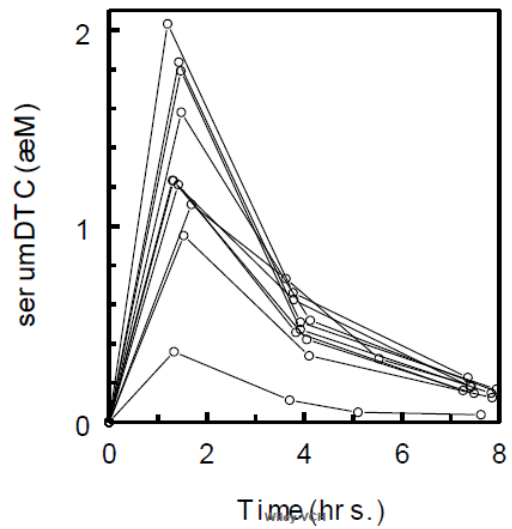
This description of inter-individual variability could inform researchers’ investigations prior to receiving experimental results such as:

Post-experimental analysis with statistical packages of these types of results is required. But it doesn’t produce meaningful explanations for such individual effects.

Analysis of individual differences in metabolism can better inform explanations, because it would investigate causes for widely-variable effects. Better predictive hypotheses could be a result.

2. Today I’m starting my 40th week of eating a clinically-relevant amount of microwaved 3-day-old broccoli sprouts every day. To encourage sulforaphane’s main effect of Nrf2 signaling pathway activation, I won’t combine broccoli sprouts with anything else either during or an hour before or after.

I had been taking supplements at the same time. This interview got me thinking about the 616,645 possible combinations of my 19 supplements and broccoli sprouts.

That’s way too many to be adequately investigated by humans. Especially because contexts for each combination’s synergistic, antagonistic, or additive activities may be influenced by other combinations’ results.

I’ll just eat food and take supplements outside of this sulforaphane window.

I’ve taken 750 mg fructo-oligosaccharides (FOS) twice a day for sixteen years. I’ve considered it as my only prebiotic. Hadn’t thought of either of these points:

  • “Polyphenols are now considered to be a prebiotic food for microflora in the gut. They tend to focus on producing additional amounts of lesser known species like Akkermansia muciniphila, and have a direct prebiotic effect. Microbiota break these big, bulky molecules down into smaller metabolites, which clearly are absorbed. Some beneficial effects that come from polyphenols are not from the original molecule itself, but from a variety of metabolites produced in the gut.
  • We use a prebiotic, actually called an immunobiotic, which is a dead lactobacillus plantarum cell optimised for its cell wall content of lipoteichoic acid. Lipoteichoic acid attaches to toll-like receptor 2, and that sets off a whole host of immune-modulating processes, which tend to enhance infection control and downregulate inflammation and downregulate allergenicity.”

3. “Quinone reductase is critical because it is the final enzyme in the phase two detox pathway that stops DNA being mutated or prevents deformation of DNA adducts which are mutagenic. I want to look at genes that govern redox balance, inflammation, detoxification processes, cellular energetics, and methylation.”

Gene functional group classifications are apparently required in studies, to accompany meaningless statistics. When I’ve read papers attaching significance to gene functional groups, it often seemed like hypothesis-seeking efforts to overcome limited findings.

I’ll start looking closer when study findings include Nrf2 signaling pathway targets quinone reductase, DNA damage marker 8-hydroxydeoxyguanosine, and enzymes glutathione peroxidase and glutathione S-transferase.

4. I bolded “unregulated inflammation” in Part 1 because it’s a phrase I’d ask to be defined if that site enabled comments. Thinking on inflammation seems to come from:

“We focus on the intestinal epithelial cell as a key player because if you enhance function of that cell, and Nrf2 is part of that story, once you get those cells working as they should, they are modulating this whole underlying immune network.”

An environmental signaling paradigm of aging and Reevaluate findings in another paradigm have a different focus. That paradigm looks at inflammation in the context of aging:

“A link between inflammation and aging is the finding that inflammatory and stress responses activate NF-κB in the hypothalamus and induce a signaling pathway that reduces production of gonadotropin-releasing hormone (GnRH) by neurons.

The case is particularly interesting when we realize that the aging phenotype can only be maintained by continuous activation of NF-κB. So here we have a multi-level interaction:

  1. Activation of NF-κB leads to
  2. Cellular aging, leading to
  3. Diminished production of GnRH, which then
  4. Acts (through cells with a receptor for it, or indirectly as a result of changes to GnRH-receptor-possessing cells) to decrease lifespan.

Cell energetics is not the solution, and will never lead to a solution because it makes the assumption that cells age. Cells take on the age-phenotype the body gives them.

Aging is not a defect – it’s a programmed progressive process, a continuation of development with the body doing more to kill itself with advancing years. Progressive life-states where each succeeding life-stage has a higher mortality (there are rare exceptions).

Cellular aging is externally controlled (cell non-autonomous). None of those remedies that slow ‘cell aging’ (basically all anti-aging medicines) can significantly extend anything but old age.

For change at the epigenomic/cellular level to travel up the biological hierarchy from cells to organ systems seems to take time. But the process can be repeated indefinitely (so far as we know).”


Switch on your Nrf2 signaling pathway

An informative interview to start this year with the author of Sulforaphane: Its “Coming of Age” as a Clinically Relevant Nutraceutical in the Prevention and Treatment of Chronic Disease:

The Antioxidant Dilemma with Dr. Christine Houghton

“The thing about science is, the more you know, the more you realise you don’t know. And I have this enormous respect now for signalling processes that are going on within the cell, and not just signalling. The way mother nature switches on, switches off, foot on brake, foot on accelerator, continuously all of the time.

Things have changed in understanding the function of Nrf2 for a start, in controlling in many ways those cellular defences. We could then switch on Nrf2. You switch on a whole host of protective molecules all at the same time.

We use NAC [N-acetyl-cysteine] in the lab all the time because it stops an Nrf2 activation. So, that weak pro-oxidant signal that you use to activate Nrf2, you switch it off by giving a dose of NAC. It’s a potent antioxidant in that right, but it’s blocking signalling. And that’s what I don’t like about its broad use.

The real advantage of sulforaphane is not only is it the most potent inducer of Nrf2, or activator, but it’s also highly bioavailable. It’s a very tiny, low-molecular weight, lipophilic molecule that just glides straight in through cell membranes. It’s about 80% bioavailable. Whereas big, bulky polyphenols are about 1% bioavailable just simply because of their chemical structure.

We focus on the intestinal epithelial cell as a key player because if you enhance function of that cell, and Nrf2 is part of that story, once you get those cells working as they should, they are modulating this whole underlying immune network.

I’m particularly interested in looking at core upstream factors that govern cellular defences. So, I want to look at genes that govern redox balance, inflammation, detoxification processes, cellular energetics, and methylation.

Intestinal epithelial, just like any other cell in the body, will respond to Nrf2 activation. It will respond to NF-κB downregulation. That’s going to enhance redox control. It’s going to reduce unregulated inflammation. It’s going to enhance detoxification processes. It’ll increase glutathione synthesis.

All of those core factors that any cell needs to work normally will be enhanced by activating Nrf2. And I use a high-yielding sulforaphane supplement of about 20 milligrams a day to do that. So, that’s the beginning.

Probiotics don’t typically colonise in an adult. That’s where we come back to this idea of restoring the gut ecosystem and using prebiotic foods.

In an ideal world, we’d be looking at 600 to 800 grams of non-starchy plant foods a day. In a real world, that isn’t always going to happen.

I never use the term leaky gut because it isn’t that. It’s a dynamic structure that becomes unresponsive.”


Hadn’t thought about weighing my daily AGE-less Chicken Vegetable Soup dinner (half) then tomorrow for lunch. Its total weight tonight was 2,575.5 grams.

  • Subtract 207.2 g wine, 985.6 g chicken broth, and 64.2 g noodles;
  • Add 131 g 3-day-old broccoli sprouts microwaved to ≤ 60°C (140°F) eaten earlier;
  • Subtract an estimated 170 g (6 oz.) chicken, didn’t measure juice squeezed from one lemon, didn’t estimate evaporation from 20 minutes cooking; and
  • Didn’t include either 81 g dry weight steel-cut oats which becomes 308 g for breakfast, or 103.8 g 3-day-old hulled oat sprouts.
  • Net 1,279.5 grams non-starchy plant foods

I’m doing alright by the “600 to 800 grams of non-starchy plant foods a day” guideline. Should exercise more, though, because I eat a lot.

Topics continued in Part 2.