A 2026 review argued for a Nrf2 biomarker panel to evaluate Nrf2 insufficiency:
“NRF2 is a central transcriptional regulator of cellular defence against oxidative and electrophilic stress. By coordinating antioxidant buffering, xenobiotic detoxification, and recovery programs, NRF2 helps tissues maintain function despite continual exposure to metabolic by-products and environmental challenges.
In healthy physiology, NRF2 signalling is tightly controlled by the Keap1-NRF2 axis and ubiquitin-mediated degradation, which keeps basal activity low while preserving rapid inducibility when stress rises. Because NRF2 signalling is dynamic and cell-type-specific, interpretation improves when localization, target induction, and functional assays agree. Such triangulation reduces misclassification in heterogeneous clinical samples collected outside peak responses.
We discuss practical readouts, including NRF2 target gene panels, oxidative damage biomarkers, and functional proxies that capture mitochondrial function, inflammatory tone, and barrier integrity in accessible samples. We then evaluate strategies to counteract NRF2 reduction, from exposome and lifestyle change to nutritional, pharmacologic, and targeted delivery approaches, with emphasis on benefit, risk, and reproducibility.
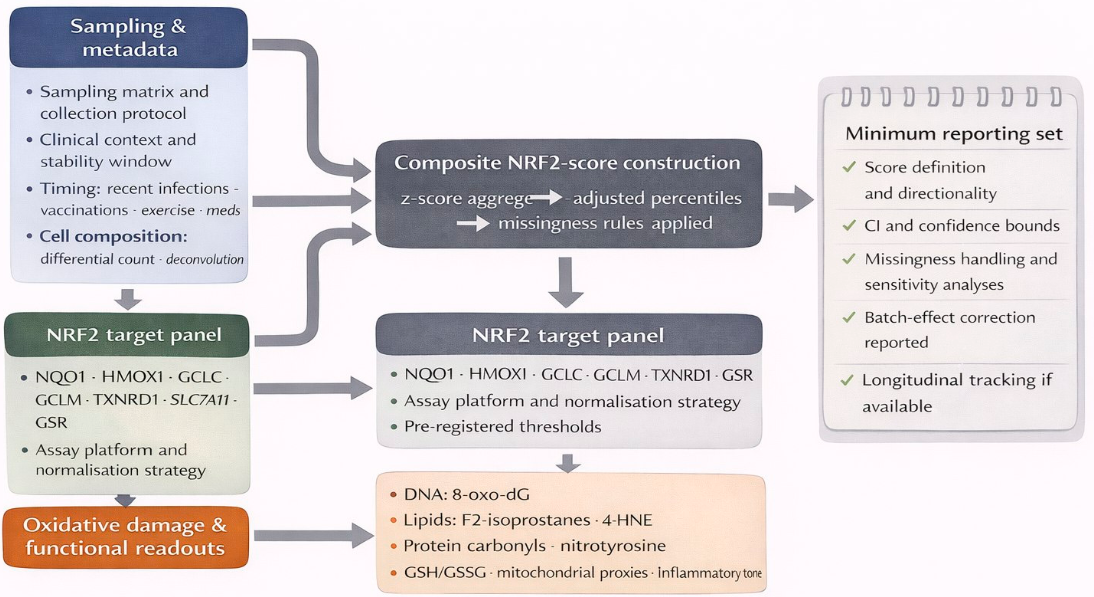
NRF2 insufficiency describes a state in which cells fail to mount an adequate ARE program when confronted with oxidative or electrophilic stress, resulting in weaker detoxification, lower glutathione support, and reduced stress tolerance across diverse organ systems. Therapeutic strategies for NRF2 insufficiency should be framed as restoration of the adaptive range, rather than indiscriminate activation.
We defined low NRF2 activity as a functional deficit in inducible protection, rather than as a single static marker measured at rest. Lifestyle and exposome interventions can remove suppressors and introduce hormetic inputs, while nutritional, pharmacologic, and targeted delivery approaches may provide more direct engagement when disease burden is high.”
https://www.techscience.com/biocell/online/detail/27486 “NRF2 Insufficiency in Chronic Disease”
One problem with reviewers in general is that they only see what’s in their paradigm. Three related omissions in this review are: 1) Narrowing Nrf2 hormesis discussion to just exercise; 2) Adopting the widespread p < .05 numerical definition of significant measurements, which ignores the importance of preconditioning; and 3) Not understanding that factors in human Nrf2 responses are very much influenced by our circadian biology.
1. Comparing the above biomarker panel with the panel used in Combining exercise with sulforaphane showed NQ01 and GR hormetic responses to exercise. HO-1 had a non-hormetic linear/curvilinear response to different sulforaphane doses. GCLC didn’t respond to exercise, but it hormetically responded to different sulforaphane doses.
If researchers use Nrf2 biomarker panels, they need to appropriately analyze hormetic and non-hormetic responses.
2. The second study of Coffee compound effects pointed out:
“Hormetic effects typically show a 30 to 60% stimulation above control. This is far below the 2 to 3-fold greater than control detection limit for statistical significance based on human variability/bioplasticity and are often reported as false negatives.
A weight-of-evidence approach was proposed based on multiple in vivo and in vitro test results to derive a study design strategy to increase detection of hormetic effects within the clinical trial framework.”
But Nrf2 studies don’t do this, again because such responses are deemed numerically insignificant. Looking through the above curated preconditioning papers shows a better understanding of biological significance.
3. The second paper of Broccoli sprouts activate the AMPK pathway, Part 4 pointed out:
“Nrf2 is one of the most cycling genes under control of the circadian clock. Feeding behavior, metabolism and hence AMPK activity follow and substantiate the biological clock, indicating an entangled circadian regulation of metabolic and redox homeostasis.”
There was no recommendation in this review for taking Nrf2 measurements at the same time of day to be comparable in and among subjects and controls. There is a related discussion of epigenetic age clocks in The third phase of reversing aging and immunosenescent trends:
“If you measure your age at 4:00 a.m. versus 11:00 a.m. you’re going to get a different result. It’s dynamic and there’s a trend and over time you change in a certain direction, but over any short period of time you can bounce around a little bit.”