A 2026 review by the researchers of Combining exercise with sulforaphane provided background for that study:
“This review summarizes redox homeostasis and Nrf2 signaling during exercise and training, how these processes are impacted during aging, and the current evidence for and against combining phytochemicals known to activate Nrf2 signaling (i.e., astaxanthin, curcumin, and sulforaphane) with exercise in older populations. We also highlight mechanistic differences between exercise- and phytochemical-induced Nrf2 activation and consider whether combining these two interventions could enhance redox resilience more than either alone.”
https://www.sciencedirect.com/science/article/abs/pii/S0891584926010427 “Exercise and phytochemicals as modulators of redox homeostasis in aging” (not freely available) Thanks to Dr. Ethan Ostrom for providing a copy.
I was put off that three relevant subjects weren’t discussed. First, Nrf2 activation from exercise under fluorescent lights indoors isn’t equivalent to Nrf2 activation from the same exercise conducted outdoors.
Second, nowhere in this review was Nrf2 activation from sulforaphane described as an exercise mimetic although their study found sulforaphane to be a more effective Nrf2 activator than exercise, even hitting a ceiling effect for the dose used. Sulforaphane was also more comprehensive, activating all four target genes of their chosen Nrf2 panel, whereas exercise missed one.
Third, hormetic effects weren’t discussed, and were misdirected into homeostasis arguments. The result is not interpreting data within an appropriate paradigm, such as this graphic promoting redox homeostasis:
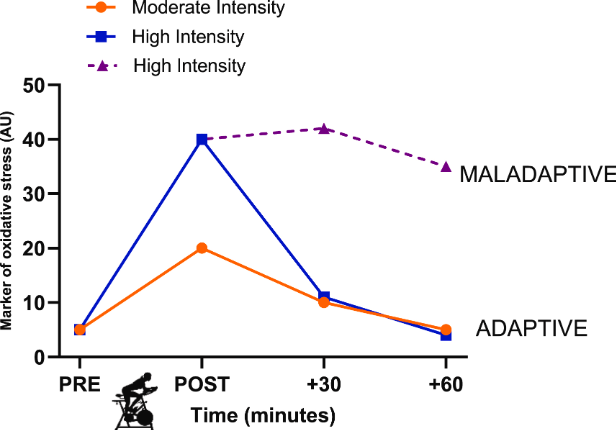
Promoting an inappropriate redox homeostasis paradigm led to misunderstanding and measuring the wrong things, and measuring the correct things inappropriately. For example, these reviewers fashioned a redox homeostasis Goldilocks argument to misinterpret both the hormesis findings of Sulforaphane in the Goldilocks zone and the disconfirming basal Nrf2 levels of other studies. Nevermind that Nrf2 activation lasts for only 15-20 minutes before cells return to baseline Nrf2 conditions.
I suppose that even misguided human sulforaphane research could advance science, though not optimally. For example, mitochondria research has advanced although studies seldom control for light exposure.
I don’t cover this review’s curcumin and astaxanthin research due to the reviewers’ misguided slant. I’d like to see this paper’s peer review comments.
I’m in my seventh year of eating broccoli sprouts every day, and am patiently waiting for research efforts to catch up. I’m not optimistic that people will voluntarily chew something that will never taste good. I expect that people will default to a less effective pill.

