A 2026 ex vivo human study investigated gut microbiota and oat avenacoside interactions:
“Oat steroidal saponins act as microbiota-dependent precursors, whose health benefits are largely mediated by microbial conversion to bioactive metabolites. Which bacterial taxa drive key deglycosylation steps, what enzymatic repertoires enable this activity, and why metabolic capacity differs so substantially among individuals are questions that have not been resolved. Addressing them is essential for linking microbiota composition and functional potential to saponin-derived metabolic phenotypes, and for explaining why individuals may respond so differently to oat consumption.
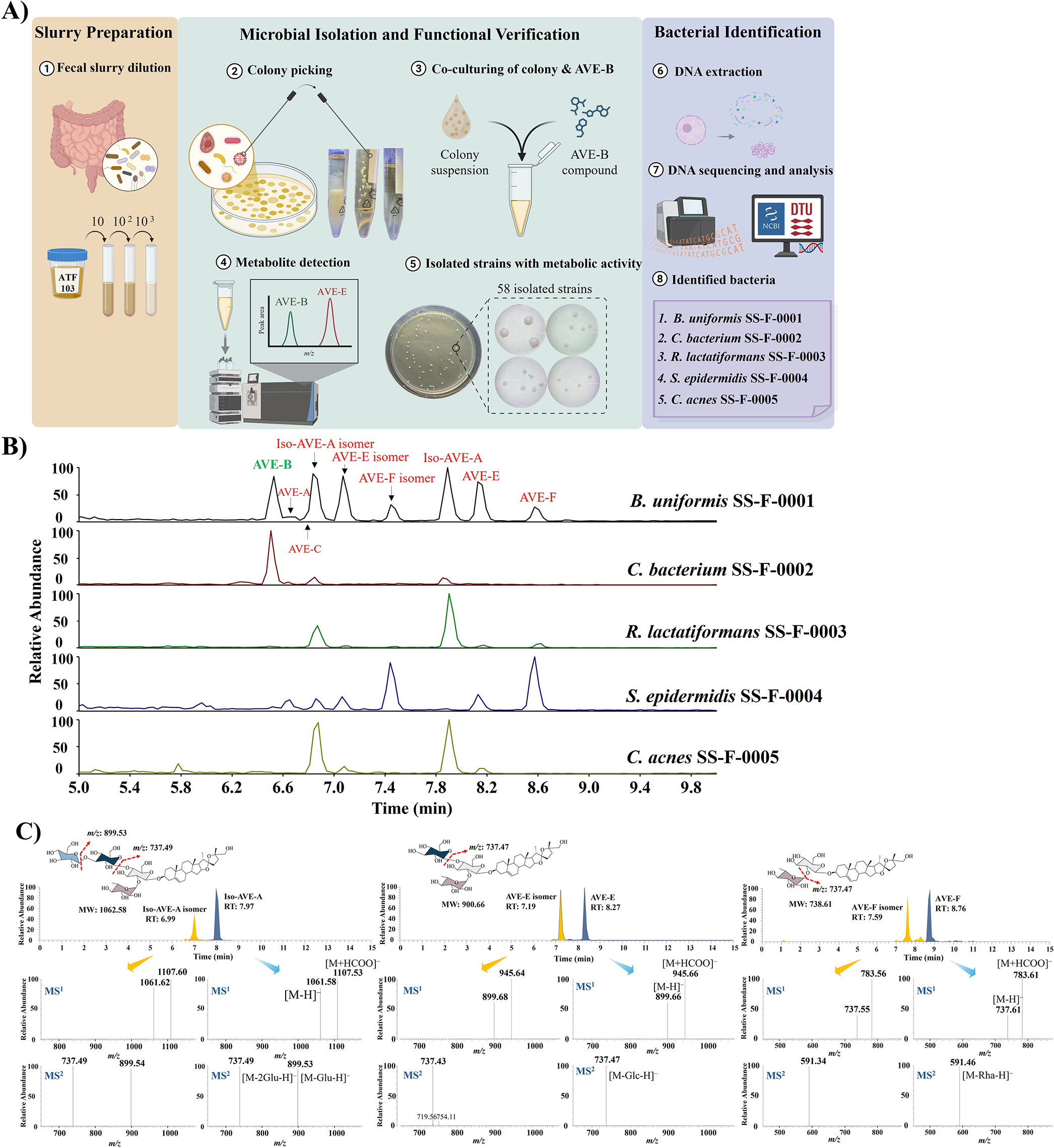
Incubation of avenacoside B (AVE-B), a major oat steroidal saponin, with fecal microbiota from six human donors revealed marked interindividual variation in avenacoside E (AVE-E) production. Five bacterial species capable of AVE-B metabolism were isolated, with Bacteroides uniformis SS-F-0001 exhibiting the broadest metabolic profile. Quantitative PCR and carbohydrate-active enzyme (CAZyme) profiling suggested that abundance alone did not explain conversion capacity.
Several limitations should be acknowledged.
- Only six individual fecal samples were included in this study, which may be insufficient to fully capture interindividual variation in microbial saponin metabolism. Studies with larger sample sizes are, therefore, needed to further validate and extend these observations.
- RCM broth may have favored the growth or activity of certain microbial members, and the bacterial isolates obtained under this culture condition do not represent all AVE-B-metabolizing bacteria.
- Although in vitro fecal community and monoculture incubations allow controlled assessment of microbial metabolic potential, they cannot fully recapitulate the spatial structure, substrate competition, host factors, and microbial interactions present in vivo.
- Genome annotation and CAZyme profiling provide functional clues, but assigning specific reactions will require enzyme-level biochemical validation, including substrate specificity and kinetic analyses.
Bacterial abundance alone did not explain donor-dependent AVE-E production, while comparative CAZyme profiling identified differences in predicted glycoside-hydrolyzing capacity. Together, these findings suggest that microbial functional capacity and community context contribute to variation in oat saponin metabolism.”
https://pubs.acs.org/jafcau/article/doi/10.1021/acs.jafc.6c14250/5467490/Discovery-of-Human-Gut-Bacteria-Responsible-for “Discovery of Human Gut Bacteria Responsible for Biotransformation and Structural Diversification of Oat Steroidal Saponins”
This study provided a good example of the teamwork needed to advance science. These researchers took the best responder’s results, then worked hard to make their findings range as far as they could. I don’t really care for others that stop short of advancing science when they know ahead of time that people respond differently to a treatment, then bail out with the individual differences meme as some kind of substitute for effort.
I read but don’t curate papers that get repeated in reviews as indisputable facts, such as X% of people can’t metabolize compounds to urolithin A because they lack gut microbiota XYZ. Especially when not much has been adequately demonstrated about gut microbiota other than a fecal sample is a poor representation of a person’s entire gastrointestinal microbiota spectrum.

