Any move will worsen your position.

Fedcoin (registration required)
My 700th curation is a 2021 rodent study that investigated time-restricted prebiotic intake combined with an unrestricted bad diet:
“Restricted prebiotic feeding during active phase induced weight-independent alleviation of liver steatosis and reduced serum cholesterol in high-fat diet (HFD) fed mice more significantly than unrestricted feeding.
The prebiotic was a mixture of resistant starch [86%], fructo-oligosaccharide [5%], inulin [7.5%], and xylooligosaccharide [1.5%]. It was administered via drinking water at 10% (w/v) for 11 weeks followed by 20% (w/v) for 4 weeks.

Data suggests that improvement in HFD-induced hepatic steatosis by prebiotics could be associated with increased production of SCFAs [short-chain fatty acids]. Findings suggest that SCFA production can also be modified by timed feeding of prebiotics. This implies that distinct alterations in gut microbiota introduced by a difference in prebiotic feeding regime might be an outcome of gut microbiota undergoing diurnal oscillation.
These results suggest that the impact of prebiotics on weight-independent alleviation of liver steatosis and cholesterol-lowering effect can be optimized by restricting prebiotic intake to active phase, and is associated with a distinct change of gut microbiota with increased SCFA production.”
https://www.ncbi.nlm.nih.gov/pmc/articles/PMC7806547/ “Active phase prebiotic feeding alters gut microbiota, induces weight-independent alleviation of hepatic steatosis and serum cholesterol in high-fat diet-fed mice”
This study provided further evidence for Rhythmicity in that:
“Active phase restricted feeding of prebiotics showed more significant effects on modulating gut microbiota, SCFA production, and metabolic response, independent of weight loss. Alterations in gut microbiota introduced by a difference in prebiotic feeding regime might be an outcome of gut microbiota undergoing diurnal oscillation.”
Subjects’ human-equivalent ages were ~15 years to start and ~30 years at the end. As findings may be applicable to humans, this study was similar to Eat oats to prevent diabetes in that it passed on the issue of causes for detrimental effects continuing.
Eat whatever and whenever you want even though you know it will adversely affect your health? Sure, just add this prebiotic, or even better, time-restrict the prebiotic, and everything’s going to be alright?
This 2021 review subject was circadian signaling in the digestive system:
“The circadian system controls diurnal rhythms in gastrointestinal digestion, absorption, motility, hormones, barrier function, and gut microbiota. The master clock, located in the suprachiasmatic nucleus (SCN) region of the hypothalamus, is synchronized or entrained by the light–dark cycle and, in turn, synchronizes clocks present in peripheral tissues and organs.
Rhythmic clock gene expression can be observed in almost every cell outside the SCN. These rhythms persist in culture, indicating that these cells also contain an endogenous circadian clock system.
Processes in the gastrointestinal tract and its accessory digestive organs display 24-hour rhythmicity:

Clock disruption has been associated with disturbances in gut motility. In an 8-day randomized crossover study, in which 14 healthy young adults were subjected to simulated day-shift or night-shift sleeping schedules, circadian misalignment increased postprandial hunger hormone ghrelin levels by 10.4%.
Leptin, a satiety hormone produced by white adipose tissue, peaks at night in human plasma. A volunteer ate and slept at all phases of the circadian cycle by scheduling seven recurring 28-hour ‘days’ in dim light and eating four isocaloric meals every ‘day’. Plasma leptin levels followed the forced 28-hour behavioural cycle, while their endogenous 24-hour rhythm was lost. However, since meal timing can entrain the circadian system, this forced desynchrony study could not exclude a potential role of the circadian system.
Another constant routine protocol study with 20 healthy participants showed that rhythms in plasma lipids differed substantially between individuals, suggesting the existence of different circadian metabolic phenotypes.
Composition, function, and absolute abundance of gut microbiota oscillate diurnally. For example, microbial pathways involved in cell growth, DNA repair and energy metabolism peaked during the dark phase, while detoxification, environmental sensing and motility peaked during the day.
It is unclear how phase information is communicated to gut microbiota. However, human commensal bacterium Enterobacter aerogenes showed an endogenous, temperature-compensated 24-hour pattern of swarming and motility in response to melatonin, suggesting that the host circadian system might regulate microbiota by entraining bacterial clocks.
With increasing popularity of time-restricted eating as a dietary intervention, which entrains peripheral clocks of the gastrointestinal tract, studies investigating circadian clocks in the human digestive system are highly needed. Additionally, further research is needed to comprehend shifts in temporal relationships between different gut hormones during chronodisruption.”
https://www.nature.com/articles/s41575-020-00401-5 “Circadian clocks in the digestive system” (not freely available). Thanks to Dr. Inge Depoortere for providing a copy.
This review included many more human examples. I mainly quoted gut interactions.
A long time ago I was successively stationed on four submarines. An 18-hour schedule while underwater for weeks and months wiped out my circadian rhythms.
The U.S. Navy got around to studying 18-hour schedule effects this century. In 2014, submarine Commanding Officers were reportedly authorized to switch their crews to a 24-hour schedule.
This 2020 rodent study investigated Type 2 diabetics eating oats along with a bad diet:
“Type 2 diabetes (T2D) is a metabolic disease which is characterized by a state of chronic low-grade inflammation with abnormal expression and production of multiple inflammatory mediators. Insulin resistance (IR), a condition where higher-than-normal concentration of insulin is needed to maintain a normal glycemia and adequate glucose utilization in insulin target tissues, has been clinically recognized as the best indicator for diagnosis of T2D.
Increased proportion of whole grain foods in daily diet are associated with reduced prevalence of IR, which is mainly attributed to abundant non-digestible carbohydrates.”
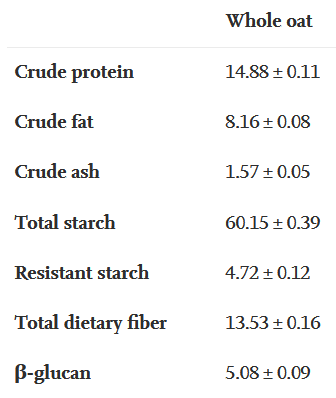
Oat species was Avena nuda, analyzed as:
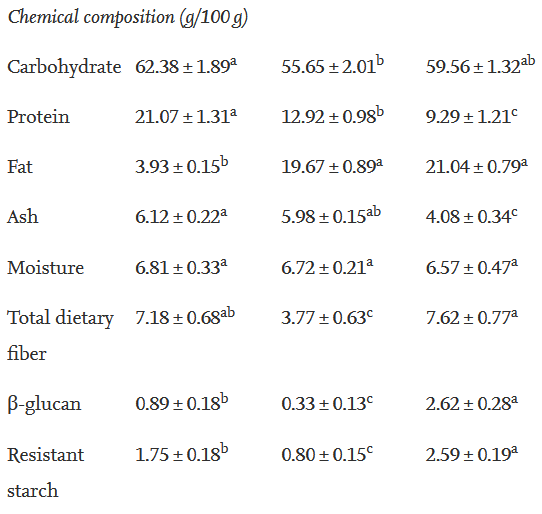
Left to right, diet compositions for basic chow diet, high-fat diet (HFD), and 49% HFD with 51% whole oat flour:
“An inflammation state characterized by high plasma TNF-α, IL-6, and IL-1β level was induced by HFD in T2D rats. Whole oats had anti-inflammatory effects by inhibiting production of proinflammatory cytokines. Our data supports a positive relationship between increased adipose proinflammatory cytokines and increased insulin resistance.
A drop in water and food intake indicated an improvement in typical clinical symptoms of T2D. Results of this study provide information about differences between individual oat products in improving T2D-related symptoms, and the role of gut microbiota.”
https://www.sciencedirect.com/science/article/pii/S1756464620301638 “Effects of oat β-glucan, oat resistant starch, and the whole oat flour on insulin resistance, inflammation, and gut microbiota in high-fat-diet-induced type 2 diabetic rats”
This study’s design wasn’t influenced by It’s the fiber, not the fat evidence. A more thorough analysis of each diet’s fiber contents may have better explained this study’s results.
100% insoluble fiber (cellulose) in “It’s the fiber” didn’t help subjects’ health. Removing 2-5% soluble fiber from subjects’ diets in that study had negative effects.
Although β-glucan isn’t the sole soluble fiber in Avena nuda oats, let’s use this study’s 51% whole-oat flour diet β-glucan of 2.62% as a proxy for soluble fiber:
These researchers could have analyzed all this for soluble and insoluble fiber. They could have isolated resistant starch effects since its content was equivalent to β-glucan in the 51% whole-oat flour diet.
I’ve replaced Avena sativa steel-cut oats for breakfast with the Avena nuda cultivar used in Sprouting hulless oats. They’re chewier when prepared the same way – 1/2 cup soaked overnight in 2 cups water, then microwaved 20 minutes in a 1000W microwave at 80% power.
This Avena nuda cultivar is healthier because of oat bran’s contributions. Per Oat species comparisons of the good stuff, up to 25% of Avena sativa oat seeds are removed by dehulling before the steel-cut process.

I prefer 3-day-old oat sprouts of the hulled Avena sativa cultivar used in Sprouting hulled oats because of their 97% germination rate and taste. The Avena nuda cultivar didn’t sprout as well or taste as good.
 Surface! Surface! Surface!
 Surface Your Real Self