By request, research on astaxanthin bioavailability. I used a “astaxanthin” “bioavailability” “quinone reductase” 2021 search term, and read citing papers.
“The bioaccessibility, bioavailability, and antioxidative activities of three astaxanthin geometric isomers were investigated using an in vitro digestion model.
- 13Z-Astaxanthin showed higher bioaccessibility than 9Z- and all-E-astaxanthins during in vitro digestion, and
- 9Z-astaxanthin exhibited higher transport efficiency than all-E- and 13Z-astaxanthins.
These might explain why 13Z- and 9Z-astaxanthins are found at higher concentrations in human plasma than all-E-astaxanthin.
9Z- and 13Z- astaxanthins exhibited a higher protective effect than all-E-astaxanthin against oxidative stress.”
https://pubs.acs.org/doi/10.1021/acs.jafc.7b04254 “Bioaccessibility, Cellular Uptake, and Transport of Astaxanthin Isomers and their Antioxidative Effects in Human Intestinal Epithelial Caco-2 Cells” (2017, not freely available)
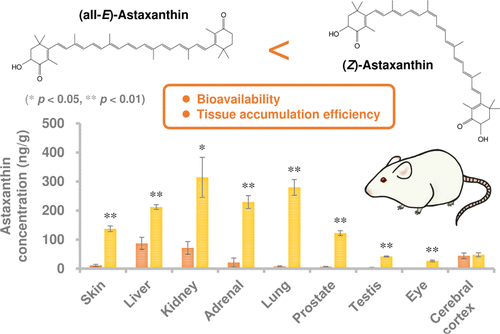
“Astaxanthin with a high proportion of Z-isomer (especially rich in 9Z- and 13Z-isomers) was prepared from (all-E)-astaxanthin by thermal treatment and solid–liquid separation. Z-isomer-rich astaxanthin diet resulted in higher levels of astaxanthin in blood and many tissues (in particular, skin, lung, prostate, and eye) compared to all-E-isomer-rich diet.
Z-isomer-rich diet enhanced the level of 13Z-isomer in blood and tissues rather than that of 9Z-isomer. (13Z)-astaxanthin would have higher bioavailability and tissue accumulation than other isomers.”
https://pubs.acs.org/doi/10.1021/acs.jafc.1c00087 “Z-Isomers of Astaxanthin Exhibit Greater Bioavailability and Tissue Accumulation Efficiency than the All-E-Isomer” (2021, not freely available)
“Astaxanthin is highly susceptible to light, oxygen, and heat stress degradation. In addition, poor water solubility and bioavailability limit its efficacy in vivo. Investigating novel astaxanthin delivery systems is necessary in order to solve these drawbacks.”
https://www.mdpi.com/1420-3049/24/14/2640/htm “The Neuroprotective Effects of Astaxanthin: Therapeutic Targets and Clinical Perspective” (2019)
“Astaxanthin Z-isomers potentially have greater bioavailability and biological activity than (all-E)-astaxanthin. However, stability of Z-isomers is lower than all-E-isomer, which is a serious problem affecting its practical use.
In this study, we investigated impacts of different suspension media (oils and fats) and additives on astaxanthin isomer stability.
- Z-isomers of astaxanthin isomerized to all-E-isomer during storage.
- When soybean and sunflower oils were used as the suspension medium, astaxanthin isomers were hardly degraded. However the total Z-isomer ratio decreased from ~80% to ~50% during 6-week storage at 30 °C.
- (9Z)-astaxanthin showed higher stability than 13Z- and 15Z-isomers.”
https://www.sciencedirect.com/science/article/abs/pii/S0308814621003770 “Evaluation and improvement of storage stability of astaxanthin isomers in oils and fats” (2021, not freely available)
I looked for but didn’t find a graph similar to this one that comparatively plotted astaxanthin:

I also didn’t find recent human studies.
It seems that a special delivery system is required for taking astaxanthin as a supplement. It would require investigating manufacturers’ claims about isomer content and stability.
Eating colorful seafood is another way to get astaxanthin. Don’t know about eating raw or dried algae.
 Surface Your Real Self
Seems to be tons of papers now extolling the virtues of Astaxanthin as a supplement and claims it is safe for long term use. However cannot find solid recommendations on dose to take…
Can you address this?? Thx.
Hi Vince! Thanks for commenting.
This 2012 trial used 12 mg:
“Effects of astaxanthin-rich Haematococcus pluvialis extract on cognitive function: A randomised, double-blind, placebo-controlled study”
A 2022 analysis “Astaxanthin Influence on Health Outcomes of Adults at Risk of Metabolic Syndrome: A Systematic Review and Meta-Analysis” found:
Subjects’ SBP decreased when dosed with AST for more than 8 weeks. AST induced attenuating effects on TC for using AST at the dosages of ≤6 mg/day for less than 8 weeks. Consuming AST at the dosages of ≤6 mg/day showed statistically significant effects on LDL-C for more than 8 weeks but not less than 8 weeks. In addition, AST was effective in the reduction of TG when subjects consumed dosage between 7 and 12 mg/day for more than 8 weeks.
A 2022 nursing home study “Impacts of Astaxanthin Supplementation on Walking Capacity by Reducing Oxidative Stress in Nursing Home Residents” used 24 mg.