Two 2023 human studies of cruciferous vegetables’ consumer acceptance, starting with five species’ 7-day-old sprouts and 17-day-old microgreens:
“Sensory chemistry of Brassicaceae species is complex, reaching gustatory, olfactory, and pain nerves and receptors. Among organosulfur compounds, glucosinolates, their hydrolysis compounds, and sulfur-volatile compounds are responsible for their taste, aroma, and trigeminal characteristics (mainly, bitter taste, sulfurous aroma, and pungency/spicy sensations, respectively).
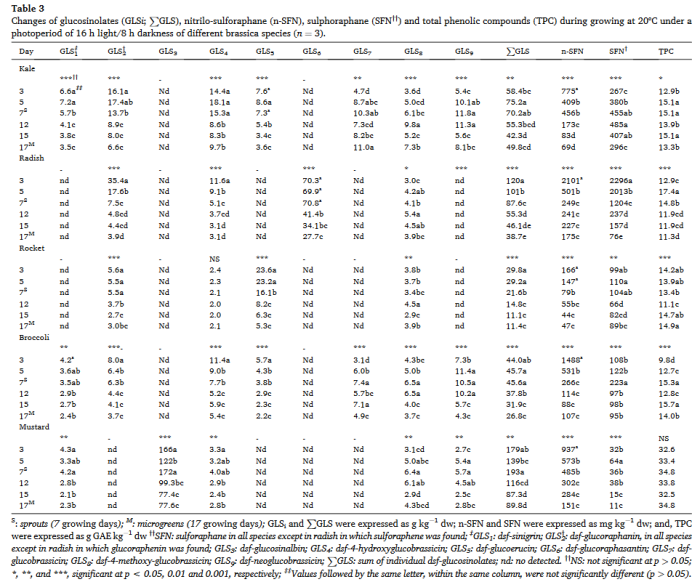
This work compared the sensory profiles and consumer acceptance between (S)prouts vs (M)icrogreens of the same species (kale, radish, rocket, broccoli, and mustard) under the same growing conditions, correlating them with phytochemical composition. On each sampling day (3, 5, 7, 12, 15, and 17 days), S&M were harvested, frozen, and freeze-dried for further analysis.
Previous studies reported the decrease of glucosinolates and sulforaphane from day 4 of germination. Previous studies also indicated that designing crop improvement strategies for sensory traits based on ∑GLS content would be flawed, as it does not consider relative differences in sensory characteristics of different GLSs and isothiocyanates, nor contributions from other GLS hydrolysis products.
Consumers tested 5 brassica species’ 7-day-old sprouts and 17-day-old microgreens. Each consumer was served ∼ 10 g of each sample coded with 3-digit numbers and the questionnaire. Water and unsalted crackers were provided between samples for palate cleaning.
Consumers were asked to taste each sample, express their overall liking and ‘attribute’ liking using a 9-point hedonic scale (1 = dislike extremely, 5 = neither like nor dislike, and 9 = like extremely). The question ‘How much do you like the ‘attribute’ of this sample?’ was used for global satisfaction/overall, and different attributes (appearance, leaves color, hypocotyl color, size, bitterness, spicy, astringency, herbal-vegetal and ID flavor).
- Differences among samples depended more on brassica species than growing stage (S&M).
- In rocket S&M, no attributes were found in the critical corner. RocketS and RocketM were also characterized by the lowest values of ∑GLS. RocketS presented the highest GLS5 glucoerucin content, which does not have bitter taste.
- Although no differences were found in global, bitterness, and spicy consumer satisfaction degree between S&M of radish and mustard species, penalty analysis indicated a need to improve excess intensity of bitterness and spicy in RadishS and MustardS.
4 out of 5 sprout samples needed improvements, while only 2 out of 5 microgreens samples needed improvements. Sprouts are richer in organosulfur compounds than microgreens, although it depends on the species.
An interesting research line would be to study odor-active compounds of these products and link them with consumer preferences. Other vegetable crops could be included, such as cereals and legumes.”
https://www.sciencedirect.com/science/article/pii/S0925521423001722 “How does the phytochemical composition of sprouts and microgreens from Brassica vegetables affect the sensory profile and consumer acceptability?”
This study treated all conditions to 16 hours light/8 hours darkness throughout. If I wanted naturally developed sprouts at Day 7, I’d follow other studies’ methods and keep germinating seeds in darkness through Day 3 to simulate their natural below-ground conditions, then provide white or blue light after Day 3. So I consider this study’s 7-day-old and 17-day-old sprouts to be both microgreens because they got their leaves at Day 3.
Hadn’t thought of a pain aspect to eating sprouts before reading this study. I’d guess a consumer’s hedonic rating of “dislike extremely” would correspond.
I switched to equal starting weights of broccoli, red cabbage, and mustard seeds 2+ years ago during Week 56 to produce 3-day-old sprouts. That combination takes the edge off individually unpleasant attributes while preserving their beneficial effects.
Couldn’t do that with radish sprouts earlier this year. I might try again if my right thumb doesn’t stop hurting, after I find a tactic that tones down their intensity.
An association analysis of 2129 adults aged 40–80 years found:
“The proportion of participants who ate cruciferous vegetables over two days was 29.5% among bitter tasters, significantly lower than that (35.7%) among non-tasters (P = 0.04) after adjustment of age, gender, race/ethnicity, dietary energy intake, physical activity, education, smoking, and income levels.

Bitter taste sensitivity was associated with less consumption of cruciferous vegetables and a high likelihood of obesity, which may mediate its association with diabetes.”
https://pubs.rsc.org/en/content/articlelanding/2023/FO/D3FO02175K “Bitter taste sensitivity, cruciferous vegetable intake, obesity, and diabetes in American adults: a cross-sectional study of NHANES 2013–2014” (not freely available)

 Surface Your Real Self
This comment does not relate to the article, however I was wondering if you had come across long pepper and its possible mechanism as a senolytic agent that selectively eliminates senescent cells.
Love your work.
Tim
Hi Timothy! This is the first I’ve heard of it. Thanks for bringing that up.
No problem,
It would be interesting to see what you find out.
Tim
Hi Timothy! I’m not seeing any senolytic studies using a piperlongumine search.
But I’m biased in disregarding studies before 2023, cancer studies, studies that I can’t get the full copy of, and reviews.
Ok. Thanks! I will probably use it in combination with black pepper as there’s probably no harm
I am probably cheating, but on my cup and a half of broccoli sprouts I have every morning, I put some dressing I make which is about 1 part apple cider vinegar, 4 parts quality olive oil, some garlic powder, and about 1/5 part raw honey (that I MW enough to make it a liquid). No bite to the broccoli at all.
Thanks for all your posts!
You’re only cheating yourself by killing the bioavailability, you can do better.
https://www.ncbi.nlm.nih.gov/pmc/articles/PMC6174964/