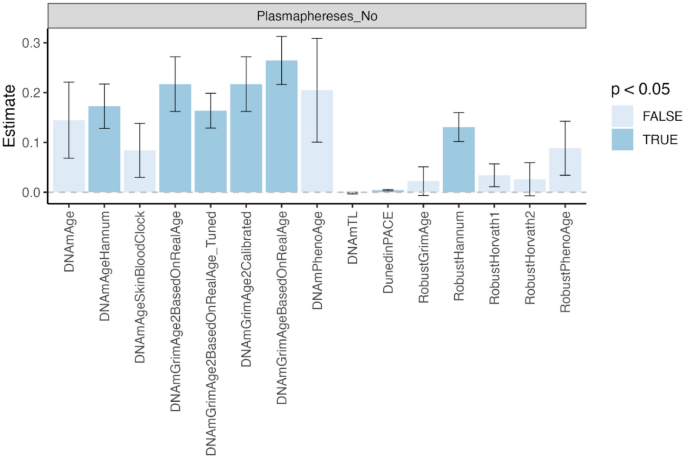
A 2025 clinical trial investigated effects of plasmapheresis as measured with epigenetic clocks:
“This study aimed to assess whether plasmapheresis without volume replacement with young plasma or albumin affects epigenetic age and other biomarkers in healthy adults. No significant epigenetic rejuvenation was observed based on epigenetic clock measurements. Instead, plasmapheresis was associated with increases in DNAmGrimAge, the Hannum clock, and the Dunedin Pace of Aging.
- The relatively small sample size of 34 finishing participants comprising of first-time plasma donors limits the statistical power and generalizability of our findings.
- Our cohort was restricted to individuals aged 40 to 60 years in accordance with Czech regulatory guidelines, which, although intentional to focus on an older population where rejuvenating effects might be most apparent, constrains evaluation of age-related differences across a broader demographic.
- The 18-week duration of the study, while sufficient to detect rapid alterations in key biomarkers under an intensive plasmapheresis protocol, may not fully capture the long-term implications of these changes.
- Due to our trial taking place during spring and summer months, we cannot fully separate the effects of increased sunlight exposure, outdoor physical activity, and dietary changes from the observed rises in Vitamin D and concurrent shifts in DNAm-based aging metrics. We did not collect objective measures of activity or diet, so these factors remain potential confounders.
The protocol of donating plasma every two weeks, although deemed safe by many countries around the world, is not yet well researched and cannot therefore be marked as benefiting to the donor right now. Further refinement to balance clearance of pro-aging factors with maintenance of systemic homeostasis is needed.”
https://www.nature.com/articles/s41598-025-05396-0 “Human clinical trial of plasmapheresis effects on biomarkers of aging (efficacy and safety trial)”

 Surface Your Real Self
if i’m not mistaken, this is not the protocol used in TPE (Therapeutic Plasma Exchange) of Conboy et al study. here, they did a plasma donation–like protocol, and so no replacement with albumine were done at all (contratry to TPE). so patients were left slightly hypoproteinemic and must compensate naturally in this study…
Correct, this was plasma donation levels not TPE.
TPE removes more plasma at one time. Conboy says you need to remove at least 50% of plasma in one session (they arent cumulative) before rejuvenation happens.
Because the rejuvenation that is triggered is from lowering TGF-b by 50% and this triggers the three germ layer rejuvenation. The tgf-b will rebound between sessions so it is not cumulative.
Ordinary plasma donation seems to be a good way do get rid of forever chemicals.
In this study , firemen who donated plasma reduced their PFAS levels by 2.9 ng/mL. Had they been given sulforaphane before hand, it may have been higher. There’s this anecdote where Jon Brudvig PhD, raised the levels of microplastics in his blood by taking a high dose of sulforaphane.