A 2025 rodent study investigated sulforaphane effects on natural skin aging:
“Aging is a multifactorial process that progressively impairs skin integrity by diminishing dermal fibroblast function, which is macroscopically manifested by wrinkling, laxity, and pigmentary abnormalities. The potential mechanism by which sulforaphane (SFN) delays intrinsic skin aging was explored through skin proteomic sequencing and immune cell infiltration analysis. Associations between SFN administration and phenotypic changes in skin aging, immune cell populations, and key signaling pathway targets were further examined.
WBC count results indicated that mice from the Aged group were significantly immunosuppressed. T cells occupied the main lymphocyte lineages.
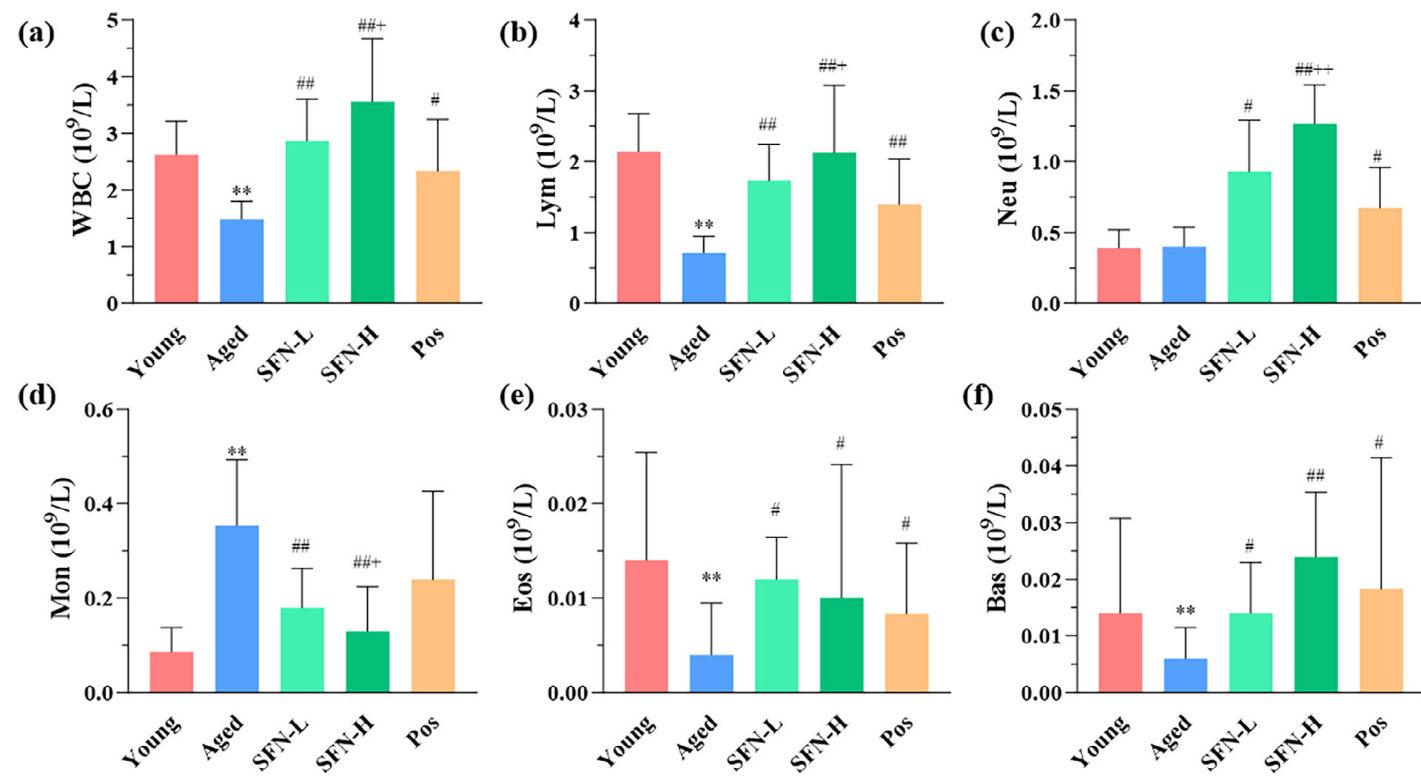
The present study illuminated the skin protective mechanism of SFN by network pharmacology and proteomics analyses in a natural aging mouse model. SFN therapy showed significant alterations in skin structure, redox balance, and composition of immune cell populations after an intervention duration of 2 months.”
https://onlinelibrary.wiley.com/doi/10.1002/mnfr.70281 “Integrative Network Pharmacology and Proteomics Decipher the Immunomodulatory Mechanism of Sulforaphane Against Intrinsic Skin Aging” (not freely available)
I rated this study Wasted resources for using sulforaphane doses not relevant to humans. I usually don’t curate such studies. Its lowest sulforaphane 50 mg/day dose is a ((50 mg * .081) * 70 kg) = 284 mg human equivalent.
I decided to curate it for its informative young controls vs. aged controls results in the above graphic. WBC counts are available on almost every standard human blood test.
This study’s young and aged groups per Grok: “A 2-month-old mouse aging for two more months (reaching 4 months) is approximately equivalent to a human aging from about 12–15 years to 17–21 years old. An 18-month-old mouse (human equivalent: ~45–50 years) aging for two months would be roughly equivalent to a human aging from ~45–50 years to ~51–58 years.”

 Surface Your Real Self